Christian tattoos range from a quarter-inch mustard seed to a full back of Moses kneeling before flame, and the deciding factor is not devotion but visibility: whether you want the symbol recognized across a room or only when you choose to show it.
A hand-placed cross still carries the Crusaders’ practical logic, requesting Christian burial, though the social cost of that placement has climbed sharply since the twelfth century.
1. Cross
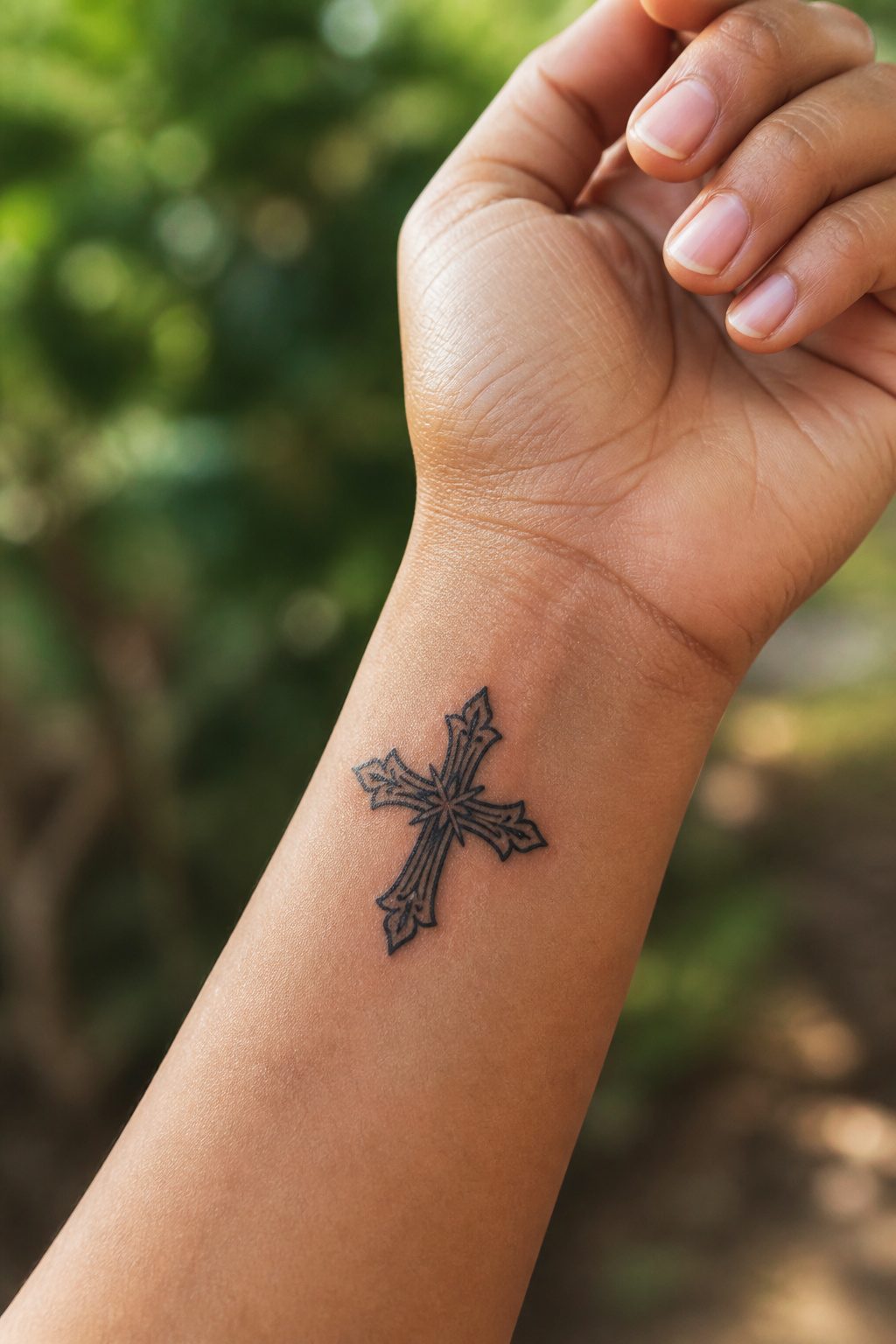
The cross is the most common Christian tattoo design, and it carries the weight of nearly two thousand years of practice.
Early Coptic Christians in Egypt marked their faith with cross tattoos on the wrist or forearm, a tradition that still survives as a religious rite.
Those same diamond-pointed or three-pronged Coptic crosses show up in modern work, often chosen by people who want to honor that lineage.
Size dictates placement in ways that matter for daily life. A small cross sits well on the inner wrist, visible enough to serve as a reminder but easy to cover.
Larger pieces with woven knots or carved detail need the forearm or back to breathe. The Crusaders put theirs on or near the hand for a practical reason: if they fell in battle, the mark requested a Christian burial.
That placement still appeals to traditionalists, though the social cost of a hand tattoo is higher now than it was in the twelfth century.
What the cross means varies almost as much as how it looks. Some wear it as a straightforward sign of Christ’s sacrifice and resurrection.
Others treat it as a commitment device, a way to keep faith present during ordinary mornings. The simpler the design, the less it competes with whatever else you might add later.
2. Ichthys
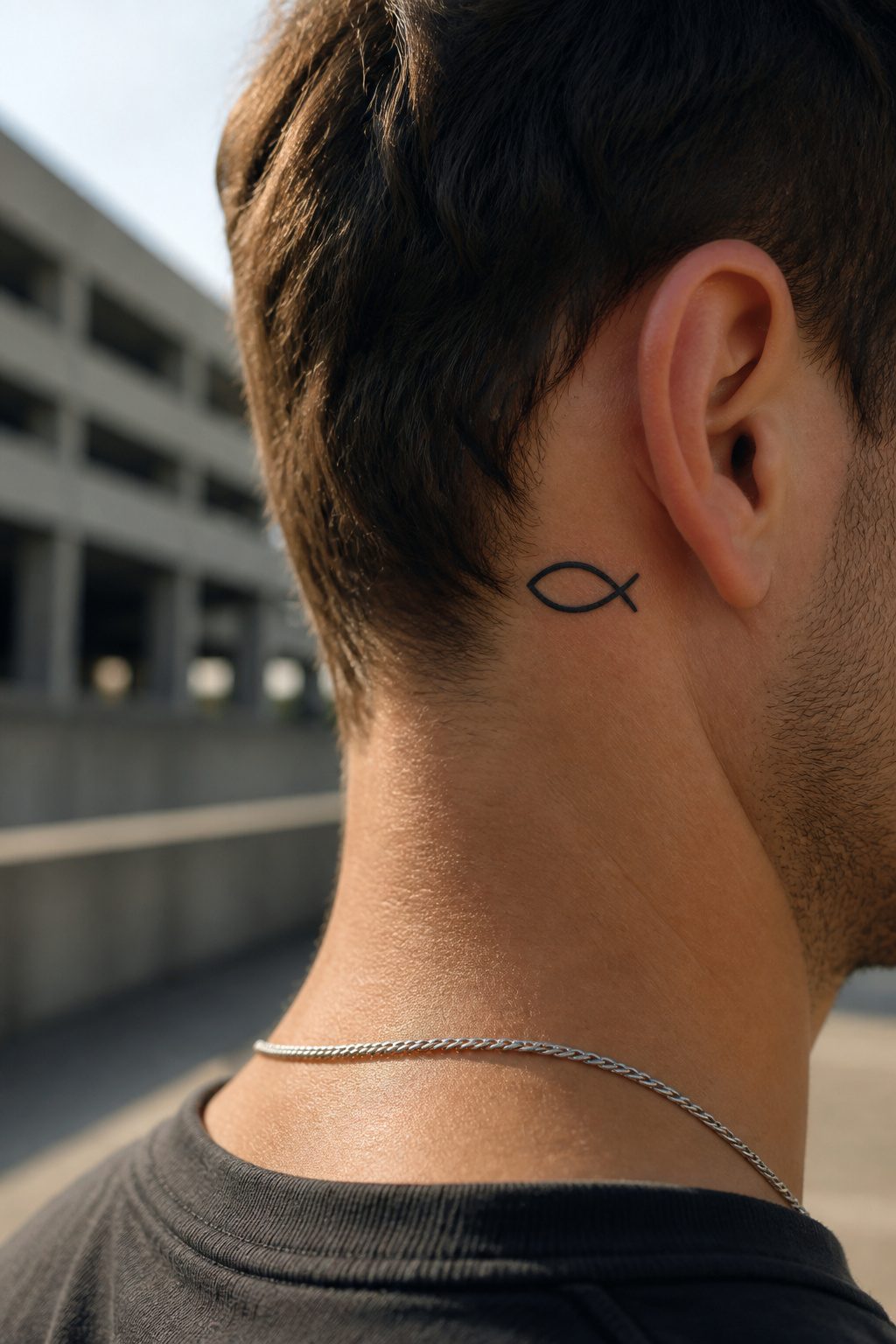
The ichthys, or Jesus fish, carries a quiet history that still draws people today. Greek for "fish," the word also works as an acronym: Iesous Christos, Theou Yios, Soter, or "Jesus Christ, Son of God, Savior."
Early Christians used it to mark meeting places and identify one another in places where open faith carried risk.
A stranger might draw one arc in the dirt; a believer completed the fish, and trust was sealed without a word spoken.
Someone choosing this over a cross often wants the meaning kept personal. The fish reads as simple geometry to most viewers, a small nod that fellow Christians recognize while coworkers or strangers pass it by.
It sits well on a wrist, behind an ear, or along a collarbone, places where a cross might feel too loud for the wearer’s daily life.
The symbol also ages cleanly; its clean lines blur less over time than detailed work, which matters when you plan to carry it for decades.
3. Bible Verse
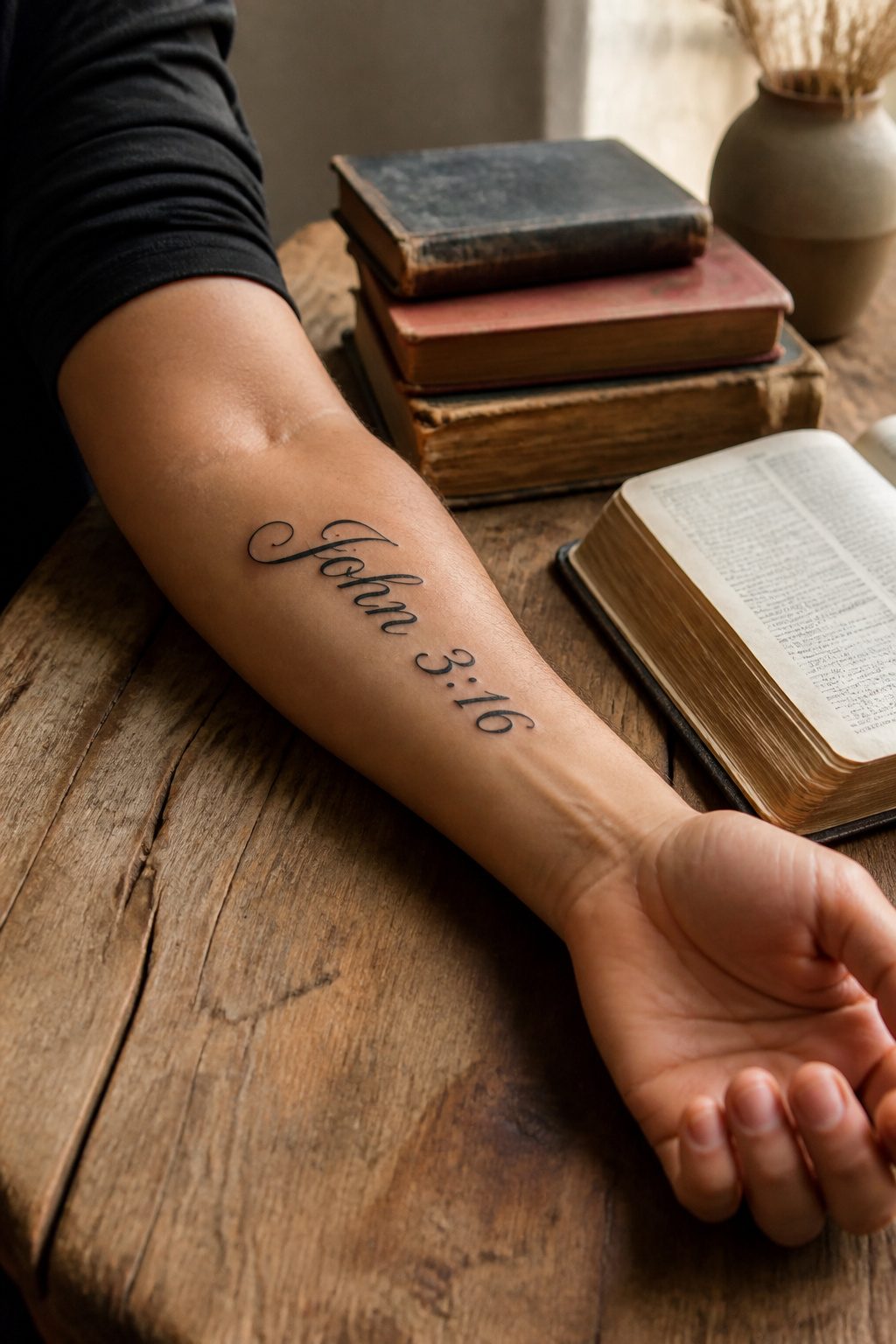
Bible verses are the most requested starting point for christian tattoos, and the same five passages show up across nearly every collection of designs.
John 3:16 lands first for its plain statement of belief: "For God so loved the world that he gave his one and only Son, that whoever believes in him shall not perish but have eternal life."
Jeremiah 29:11 follows close behind, the full text running long enough that some people tattoo only "29:11" on the inside of a finger and let memory fill in the rest.
Romans 8:28, Philippians 4:13, and Proverbs 3:5 round out the set, each carrying a different emphasis from promise to perseverance to trust.
The full wording needs room. A forearm, the ribs, or the back gives a line of scripture space to breathe and the artist space to work with lettering that stays legible over time.
Smaller spots like the wrist or behind the ear suit a verse number alone, but the longer text wants a larger canvas.
4. Angel
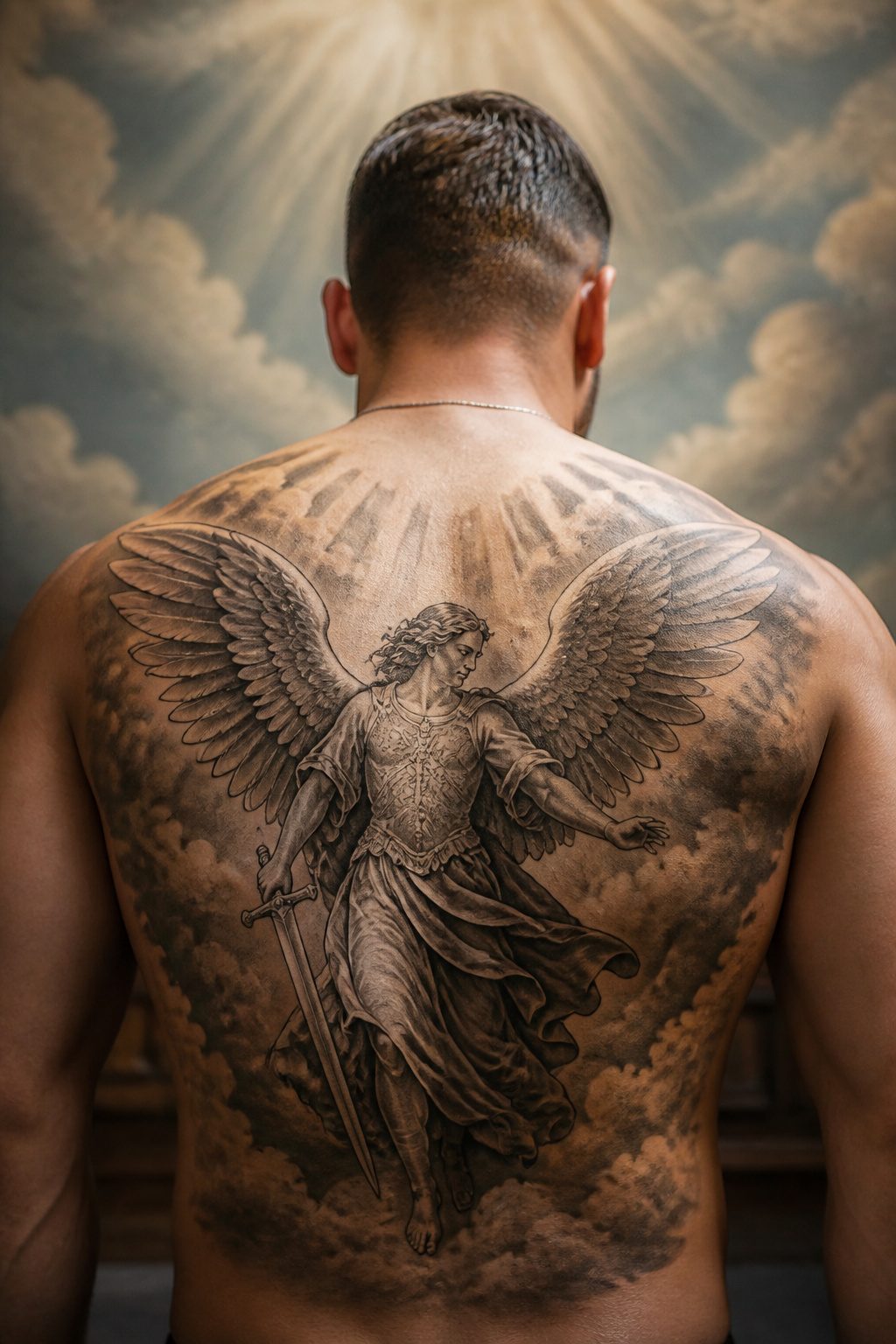
Angel imagery in Christian tattoo work tends toward two distinct paths, each carrying its own weight of meaning and its own demands on placement.
Guardian angel designs work best at a scale that lets the figure breathe, whether that means spreading across the back or settling onto the chest where the heart sits.
The back and chest give the piece the room it needs; a shoulder can hold a smaller version without crowding the wings or the protective stance.
Michael as warrior protector draws from his role as defender of the Christian faith, the general of heavenly armies rather than a gentle presence.
That martial energy changes how the design reads. A smaller Michael on the shoulder risks losing the sword, the armor, the posture that marks him as fighter rather than messenger.
The sources note women often prefer more delicate angel wings, but Michael’s iconography resists delicacy by nature. The choice becomes whether to soften the figure or let the scale carry his severity.
Wings alone offer an alternative, a way to signal divine protection without naming the angel.
They start at the shoulder blades and run down the arms if you commit to the size, or stay compact and personal if you do not.
The visibility question matters here; the wrist or ankle works for a cross, but wings need the back, the chest, or the full span of the arms to achieve their effect.
5. Dove
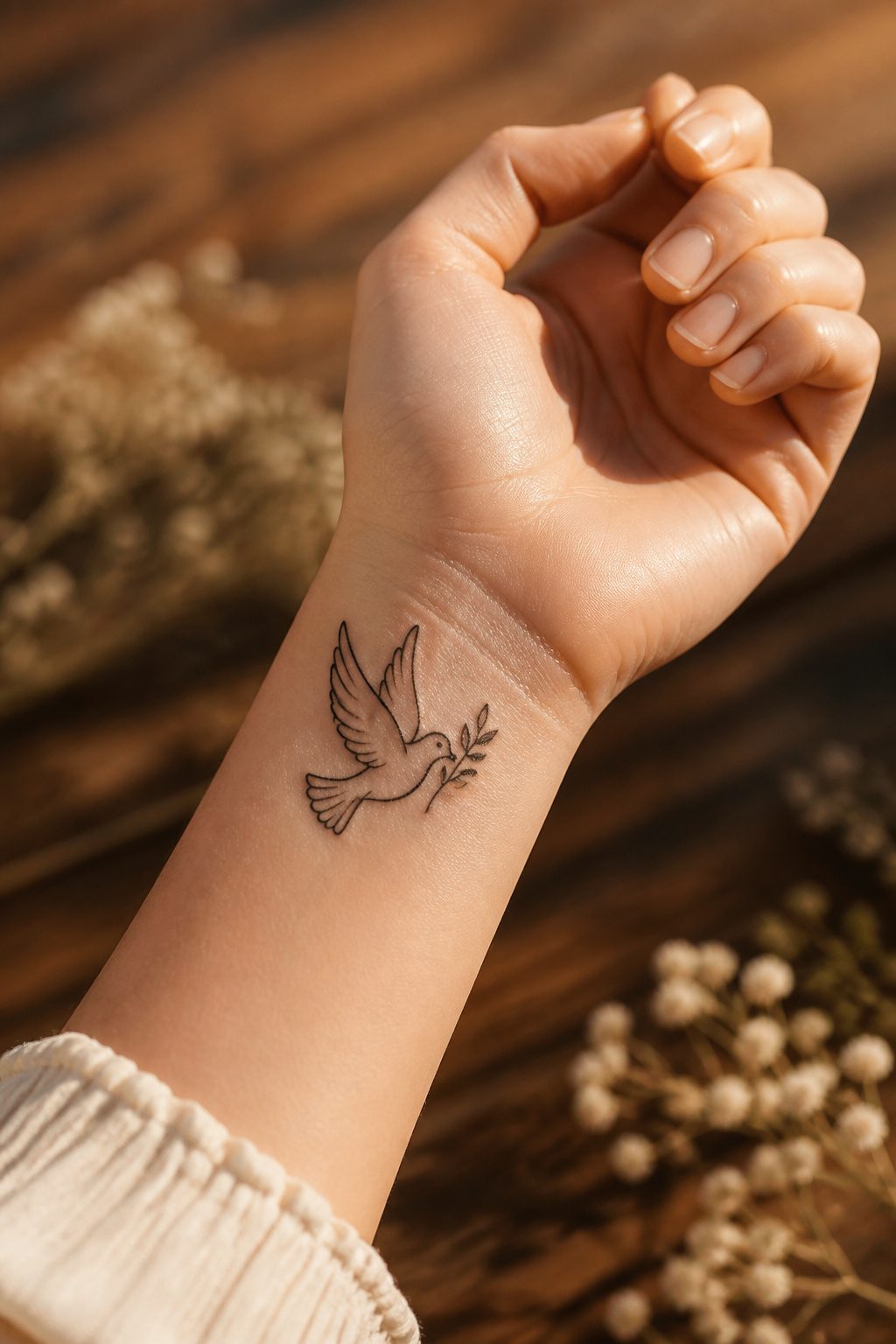
The dove carries the Holy Spirit’s presence, peace, and the moment of Christ’s baptism in a single, quiet image.
It works as a standalone piece or paired with an olive branch, the pairing that comes from Noah’s story and signals peace to anyone who recognizes it.
What draws me to this symbol is its flexibility: small enough to tuck behind the ear or along the wrist, where it reads almost as a simple bird to the casual eye, or opened up larger with rays of light behind the wings for something that fills a forearm or shoulder.
Women tend toward the more delicate renderings, often adding floral touches like roses or lilies that soften the lines without losing the meaning.
The dove also mates for life, which has made it a marker of family commitment and faith together.
If you want a Christian tattoo that does not announce itself immediately, this is the one that lets you carry the meaning privately while the world sees only a bird.
6. Crown of Thorns
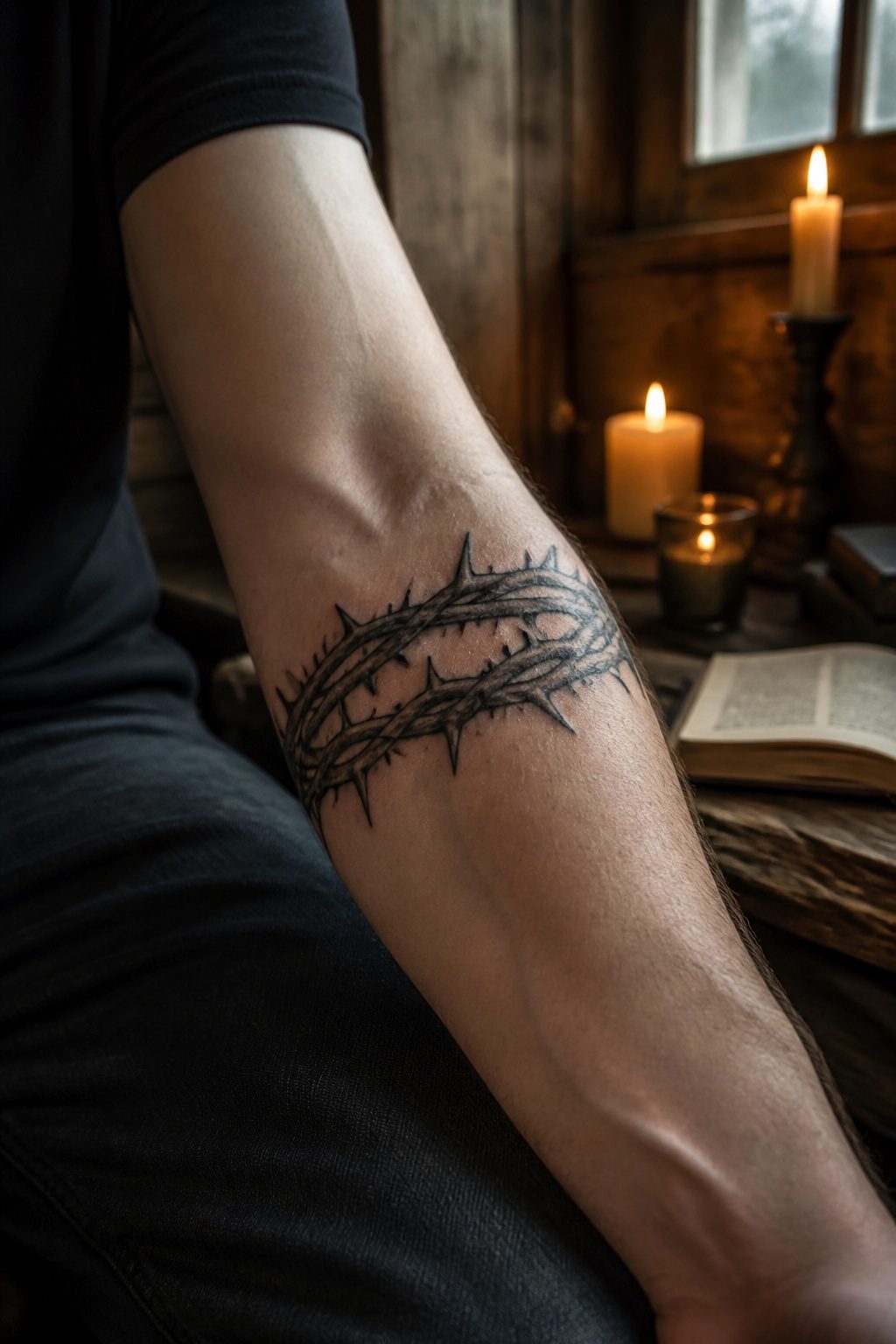
A crown of thorns worn as a wrist band or wrapped around the arm carries a weight a plain cross rarely reaches.
The thorns press into the skin the way the original pressed into Christ’s brow, so the symbol holds both the suffering of crucifixion and the resurrection that followed.
Someone who already carries other ink often finds this easier to weave into a sleeve than a standalone cross, since the thorns can thread through existing work without demanding their own centered space.
The meaning runs darker, too. Where a cross announces faith from across the room, the crown of thorns asks a closer look and a longer conversation about sacrifice and redemption.
For anyone judging symbols on what they actually resolve rather than what they merely claim, this one delivers its theology in the detail: pain first, then hope rising from it.
7. Lamb
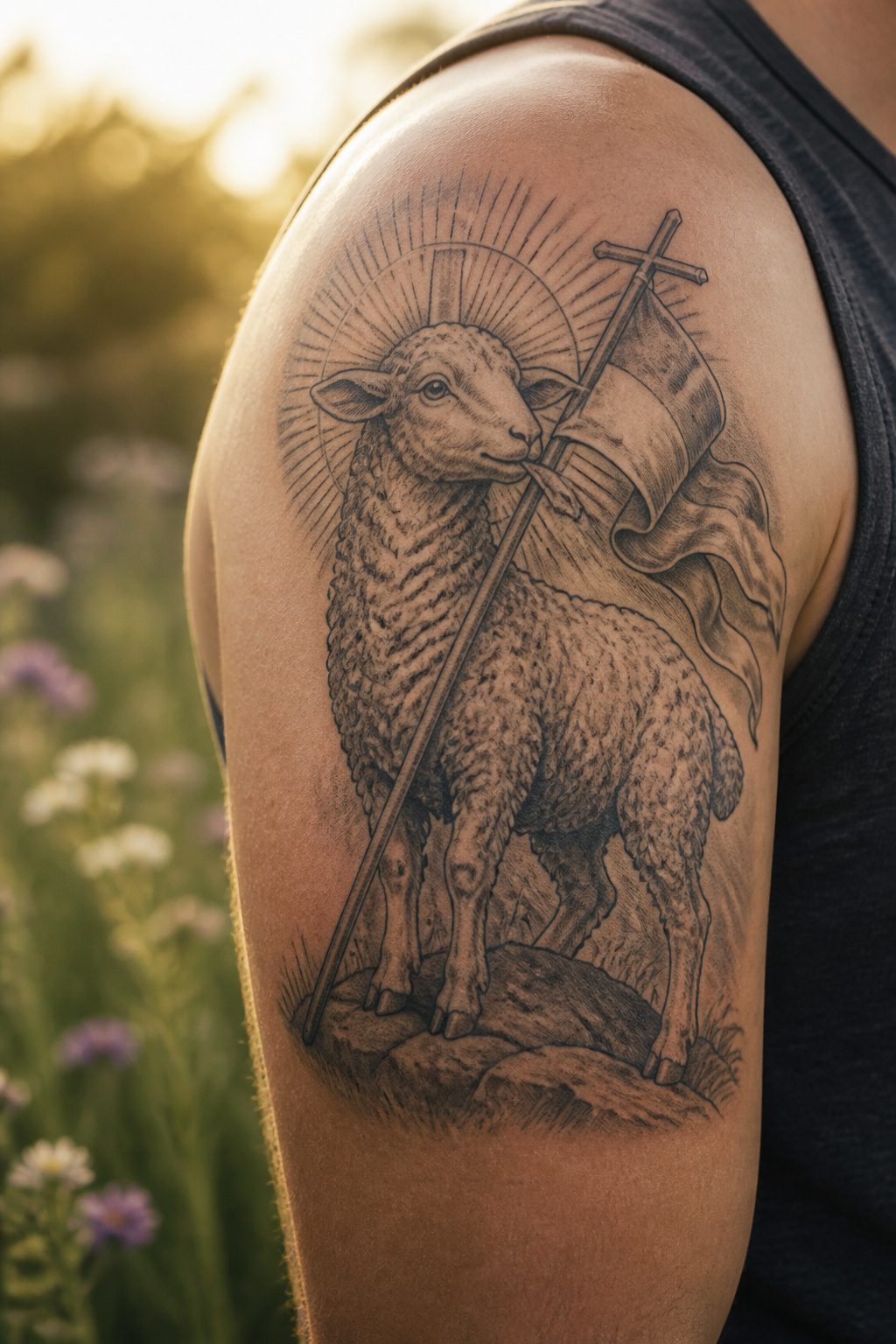
The Agnus Dei, or Lamb of God, carries one of the oldest visual traditions in Christian art. Early believers adopted it from John’s Gospel, where John the Baptist identifies Jesus as the lamb who takes away sin.
By the third century, this image appeared in catacombs and on sarcophagi, usually with the lamb standing between apostles or bearing a cross-topped banner.
That banner, sometimes called the vexillum, signals resurrection rather than sacrifice alone.
A wounded lamb still upright and holding victory’s flag became shorthand for Christ’s death and triumph together. Crosses instead of banners appear too, though the combination of living animal and military standard is what gives the image its particular force.
Tattoo artists today draw this less often than they did two decades ago. The style reads as deliberately traditional now, which suits someone who wants historical weight over current trend.
A small Agnus Dei behind the ear or on the wrist keeps the detail readable; larger pieces across the shoulder or ribs allow the banner’s folds and the lamb’s wool to hold more nuance.
Black and grey work tends to suit the subject better than bright color, since the early sources that established the image were stone and ink, not paint.
Placement matters for meaning as much as visibility. The lamb faces forward in most early examples, direct and watchful, not turned away in profile.
8. Praying Hands
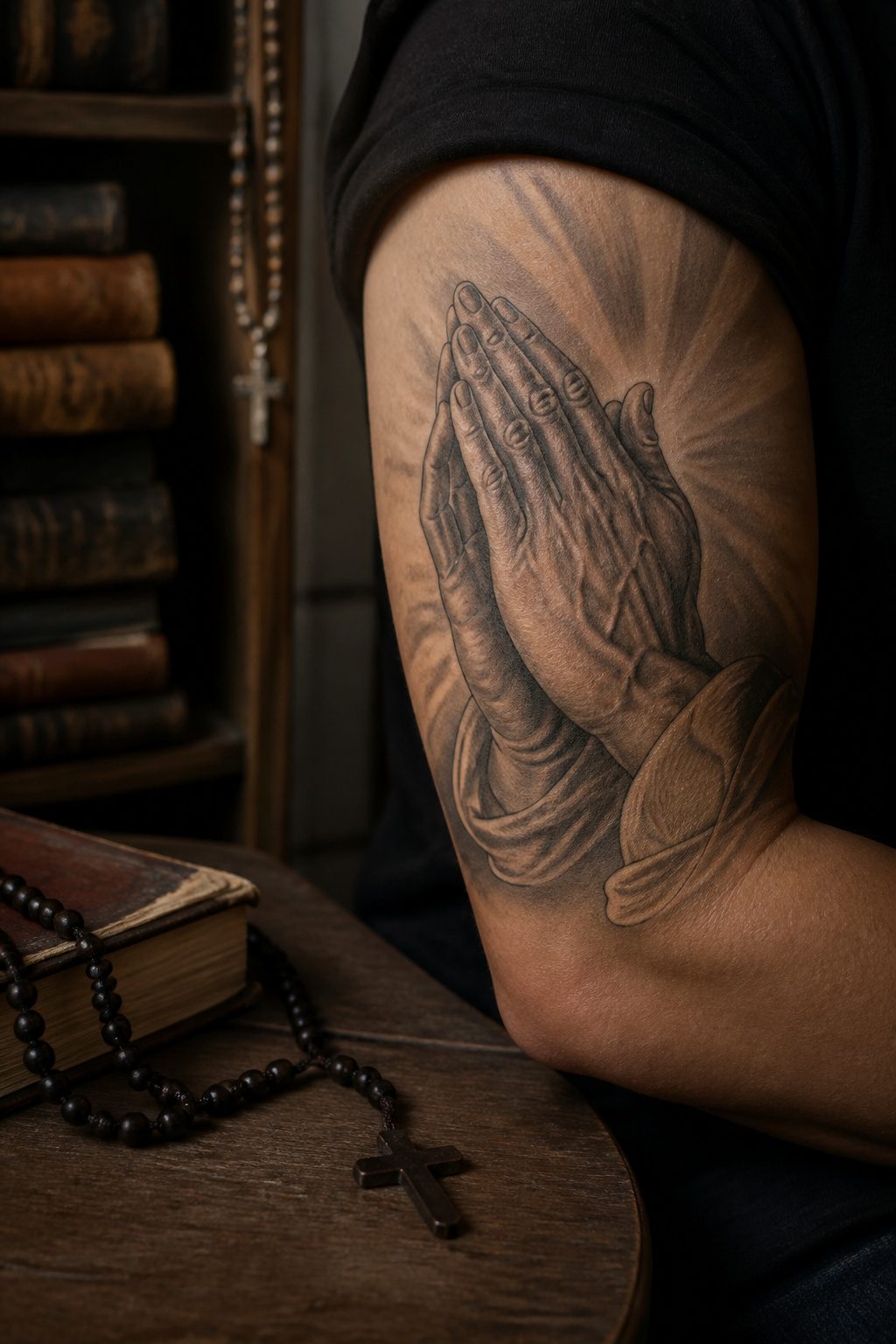
The praying hands design most people recognize comes straight from Albrecht Dürer’s 1508 sketch, not from a modern flash sheet. That lineage matters if you want the piece to read as heritage rather than clip art.
The forearm or bicep carries it best; the image needs length for the fingers to register clearly, and a bicep wrap gives the clasped knuckles real dimension.
Most people who choose this are marking something: a death, a sobriety date, a period where waiting was the only work.
The hands can run photorealistic, every crease and tendon rendered in gray wash, or you can pull back to a clean black outline that reads more like stained glass.
Both work. Catholic wearers often thread rosary beads through the fingers, since that posture is literally how the rosary is prayed; without them, the image stays open to any Christian tradition.
Gray shading holds the detail, but black linework ages cleaner if your artist’s line weight is steady. The piece is small enough to finish in one sitting, which matters when the meaning behind it already has enough weight.
9. Saint Portrait
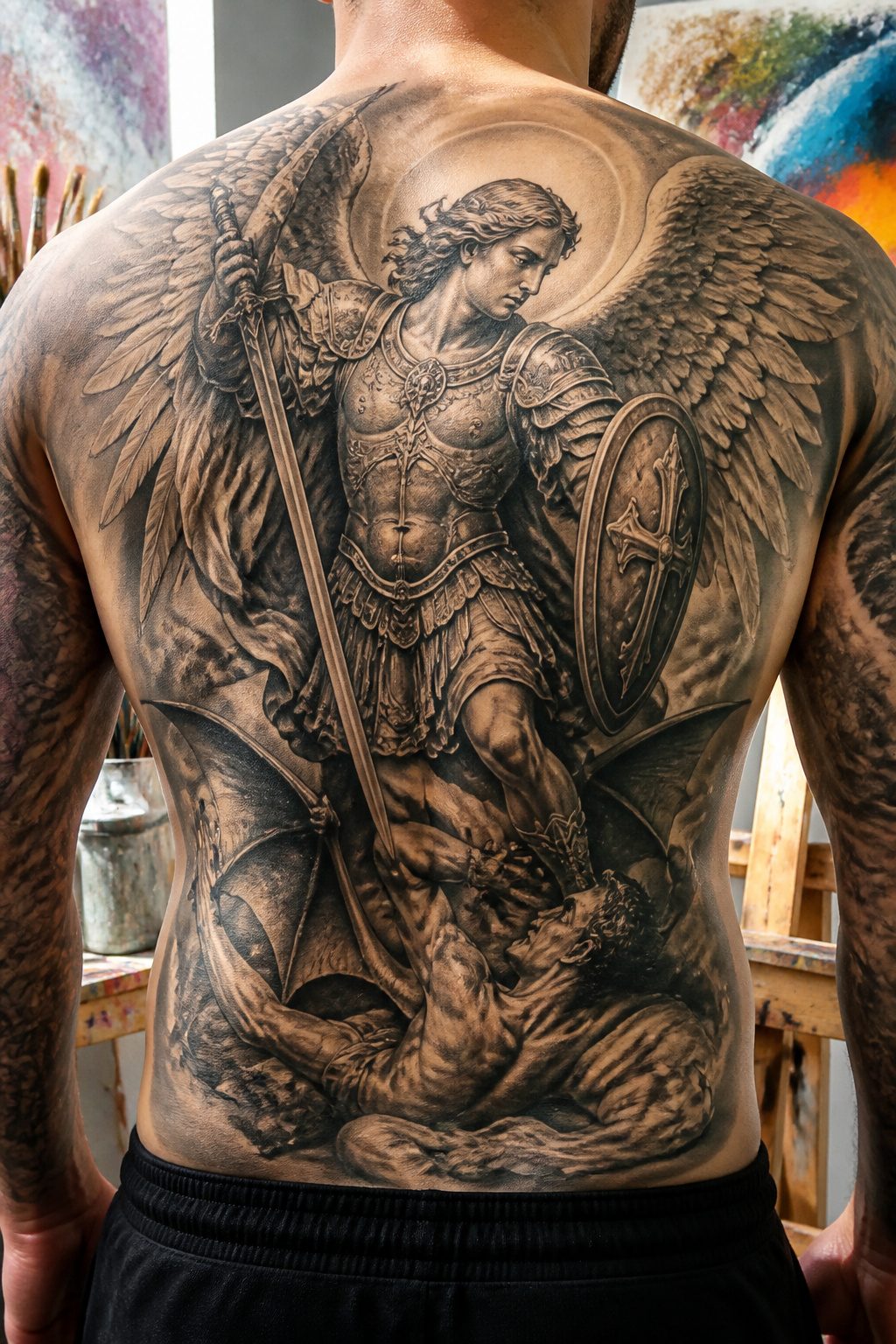
A saint portrait demands an artist who can deliver a recognizable likeness, because a generic face defeats the whole point.
The Virgin Mary, the Archangel Michael, or a personal patron saint are the usual choices, and the scale tends to run large: back, chest, or thigh give the detail room to breathe.
Smaller placements exist, but the face collapses into blur faster than most subjects.
The medal or dog-tag route is the compromise when skin real estate is tight.
A round or oval linework piece carries the same meaning without needing half a sleeve. A patron saint tied to your actual work or story, not just your birthday, carries more weight over time.
St. Jude for impossible causes, St. Christopher for travel, St. Catherine of Siena for nurses: the connection should be specific enough that you can explain it without reaching.
Women’s work in this style often weaves in roses, lilies, or peonies around the figure, softening the traditional iconography without diluting it.
The Virgin Mary with a rosary or the Christ Child stays the most common request, and the halo is usually rendered as negative space or fine line rather than solid gold.
10. Armor of God
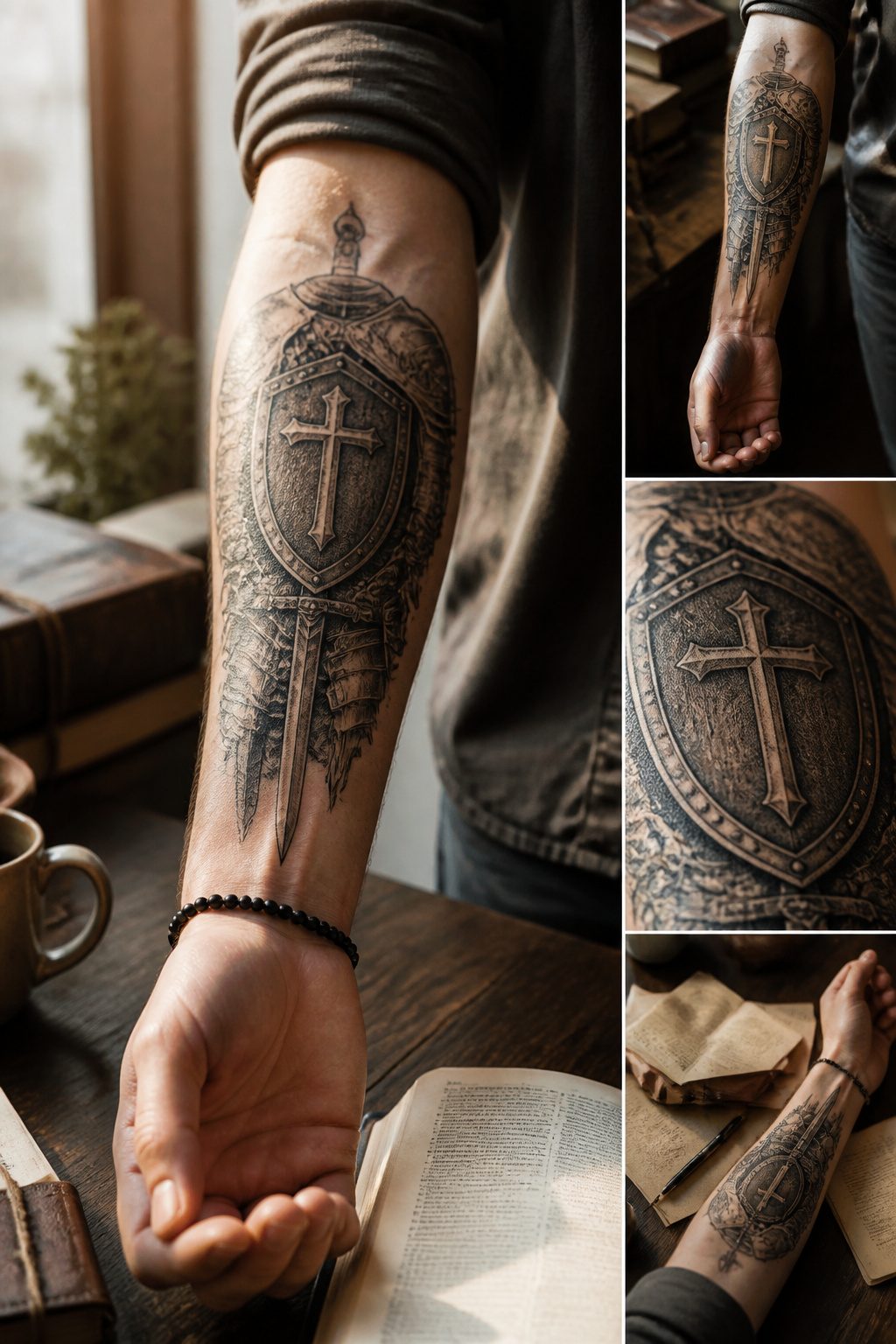
Ephesians 6:10-18 lays out the full kit: belt of truth, breastplate of righteousness, shield of faith, helmet of salvation, sword of the Spirit.
A sleeve that runs shoulder to wrist can fit every piece in sequence, the sword usually finishing at the forearm so the blade points toward the hand.
Smaller placements work too. A shield across the chest or a single sword down the calf carries the same meaning without the chair-time.
The shield and sword pairing draws a lot of veterans and law enforcement, maybe because the language of standing watch and carrying protection already lives in their daily vocabulary.
Biblical inscriptions etched across the blade or into the shield’s face, often the verse reference itself, keep the design from reading as generic medieval armor.
One risk to watch: a breastplate rendered too literally can look like sports equipment rather than scripture. A good artist softens the edges, lets light catch the metal the way old paintings do, not the way a catalog photo does.
11. Lion of Judah
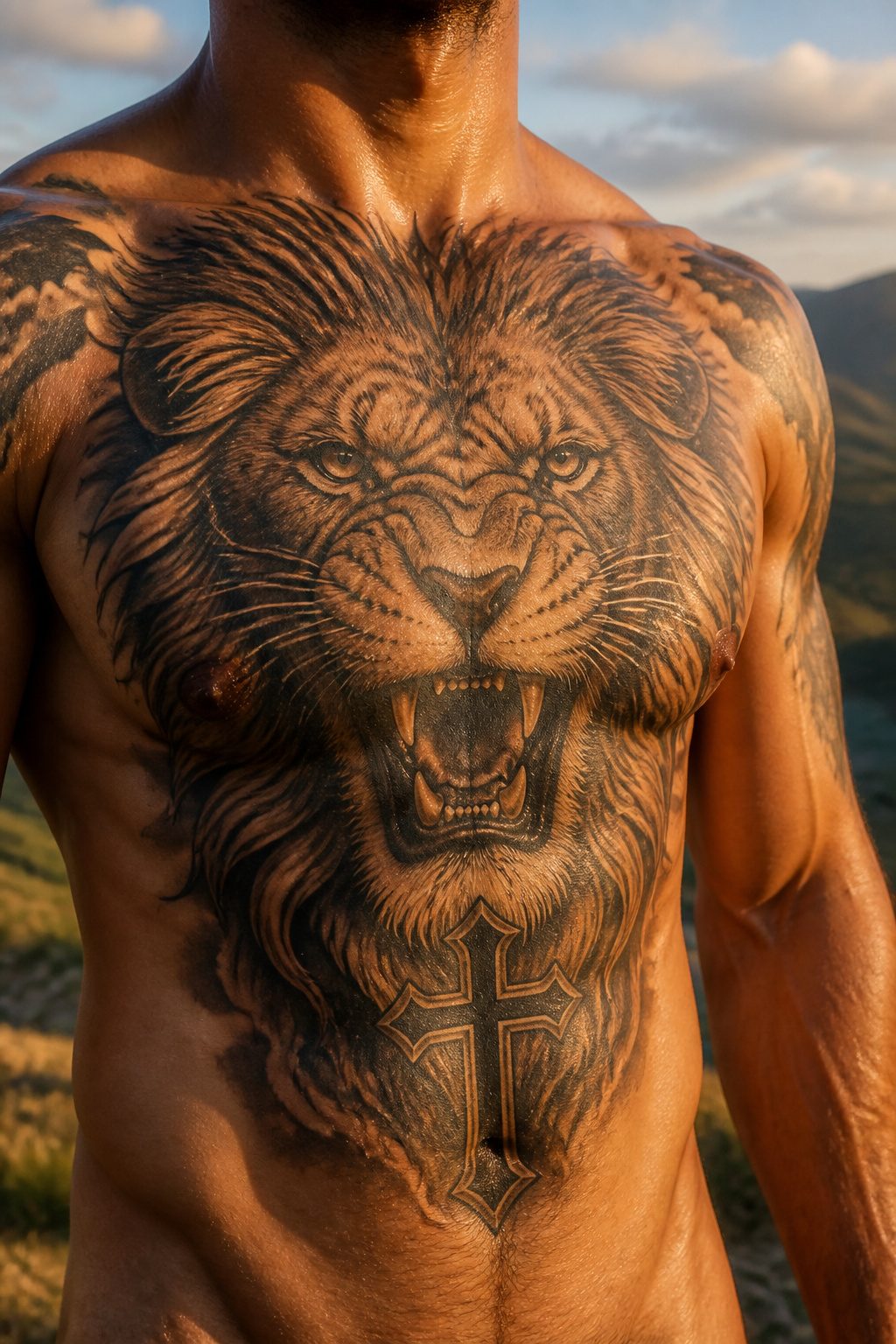
A lion tattoo can read as generic power symbolism until you anchor it to Revelation 5:5, where the Lion of Judah names Christ directly. That verse changes the design from strength in general to kingship and unshakable faith in particular.
Most people who choose this motif add a crown or cross to make the biblical link visible; without that, the meaning stays private, which some prefer and others find too subtle.
The chest or thigh gives the lion enough room for the mane detail that carries the visual weight.
Pairing it with the Lamb of God tells the fuller story, resurrection alongside sacrifice, though either image stands alone if you want a single focus.
What distinguishes this from any lion ink is the specific symbolism: kingship through Christ, not merely courage.
12. Mustard Seed
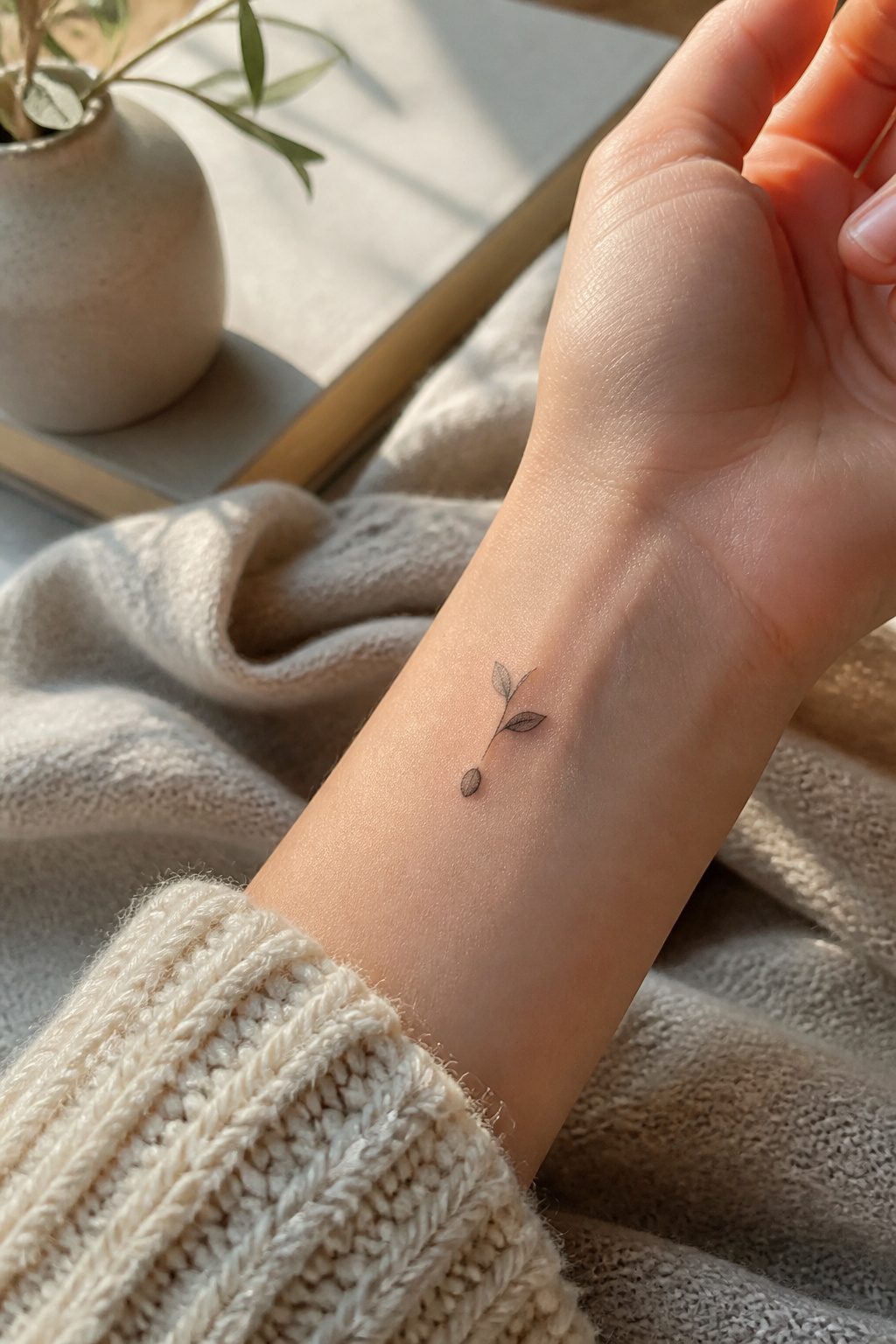
A mustard seed design lives or dies by its actual size. Matthew 17:20 ties the image to faith that moves mountains, and the parable itself turns on something almost invisible growing into something undeniable.
That built-in contrast is why the tattoo works best when it stays genuinely small: wrist, ankle, behind the ear, places where a quarter-inch detail still reads as intentional.
The usual approach is either the seed itself, often with a thin stem just beginning to split the surface, or the moment right after germination, when the first two leaves are still smaller than a fingernail.
Either way, the scale carries the meaning more than the specific drawing does. A mustard seed blown up to two inches becomes a botanical illustration; kept under half an inch, it stays the thing Jesus described.
Color is worth thinking through.
The seed is a dull brown-gold in nature, but the sprout introduces green. Some people keep it monochrome so the size stays readable longer; others add the yellow-green specifically because the parable names the plant’s full growth.
Both choices hold up, though the single-color versions tend to age cleaner on areas that see sun.
Small tattoos heal faster, cost less, and hide under a watch band or sock when needed.
The tradeoff is detail: too fine a line around something this tiny, and it blurs inside a few years. A slightly heavier outline than your instinct suggests usually solves that.
13. Burning Bush

The burning bush carries more narrative weight than most Christian tattoo subjects, which is exactly why it stays underused.
Exodus 3 gives the full scene: Moses approaching, the bush alight yet unconsumed, the voice from within calling him by name. That sequence of action gives an artist something to build, not just a symbol to trace.
A calf or upper back placement works best here because the shape follows the body. The bush itself sits low, flames rising upward, the figure of Moses drawn at a scale that lets him kneel or stand with his staff.
The flame detail is where this piece lives or dies. Color demands an artist who can layer yellow into orange without turning it cartoonish; black and gray needs the same discipline, using contrast to suggest heat rather than outline it.
I have seen versions where the fire reads as flat decal, and the problem is almost always that the artist treated the flames as background instead of subject.
The voice, if you want to include it, works as negative space or as script tucked into the smoke, but the image should hold meaning without the text.
This design asks for more sessions than a simple cross, and more trust in the artist’s planning. The payoff is a tattoo that tells a story across the skin rather than stating one.
14. Anchor
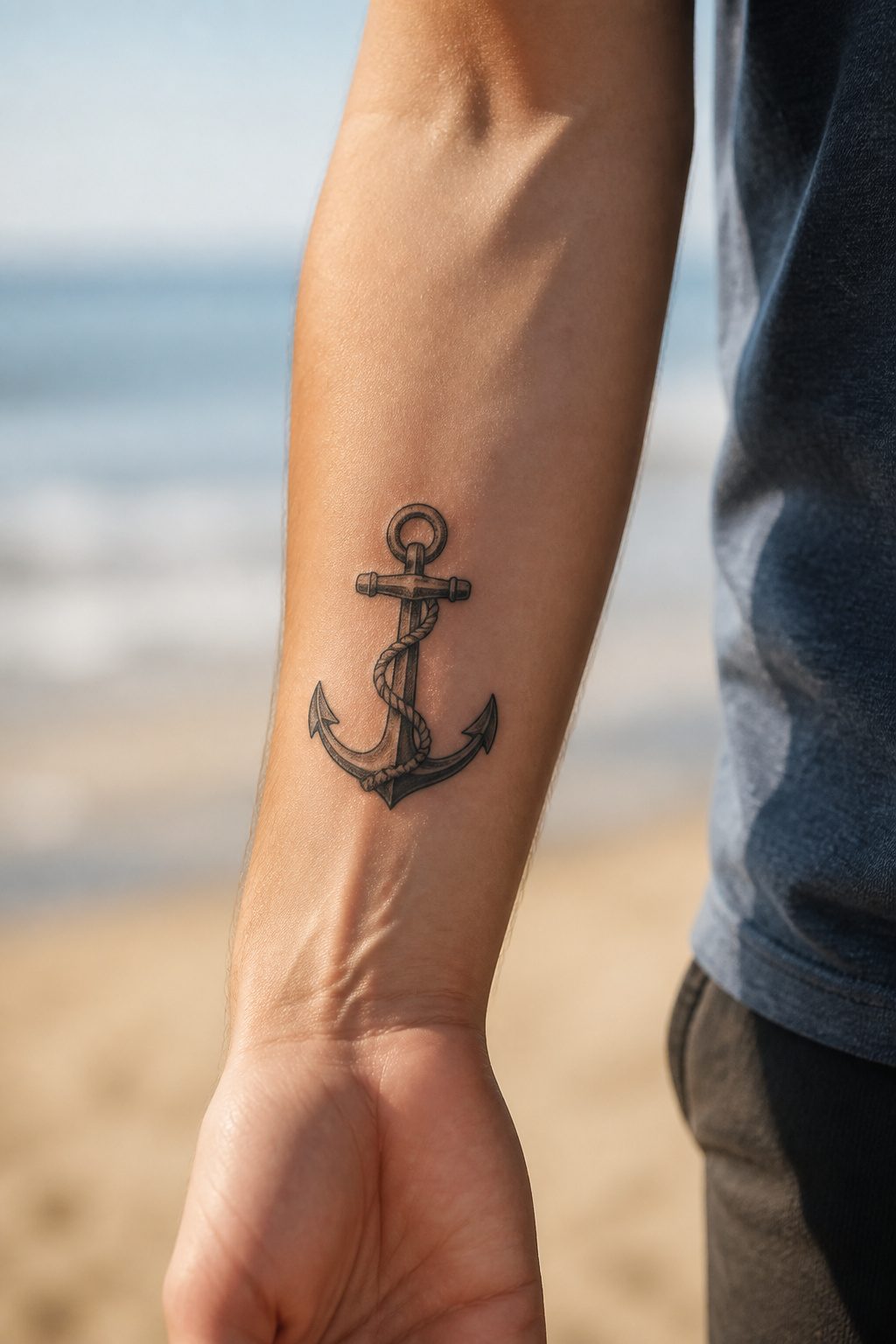
The anchor predates the cross as a Christian emblem in some early uses, carved into catacombs before Constantine made the crucifix visible everywhere.
Sailors adopted it first, and the church borrowed the logic: an anchor holds fast through a storm you cannot stop.
Hebrews 6:19 calls hope "an anchor of the soul, both sure and steadfast," which is why the symbol still reads clearly to anyone who grew up in a church with a navy-blue hymnal.
That same verse makes the anchor a natural choice for someone who wants scripture built into the image itself. The design works small, tucked behind an ear or along a wrist bone where a cross might crowd.
Most artists add rope coiled around the shank, or fit a small crossbar through the ring so the anchor doubles as a disguised crucifix. Either detail keeps it from looking like generic maritime flash.
What I like about the anchor is its restraint. It does not announce belief the way a full sleeve of Revelation imagery might.
Someone who knows the reference sees it; someone who does not still sees a clean, balanced shape. For a first tattoo or a quiet reminder, that balance matters more than most symbols offer.
15. Minimalist Numbers
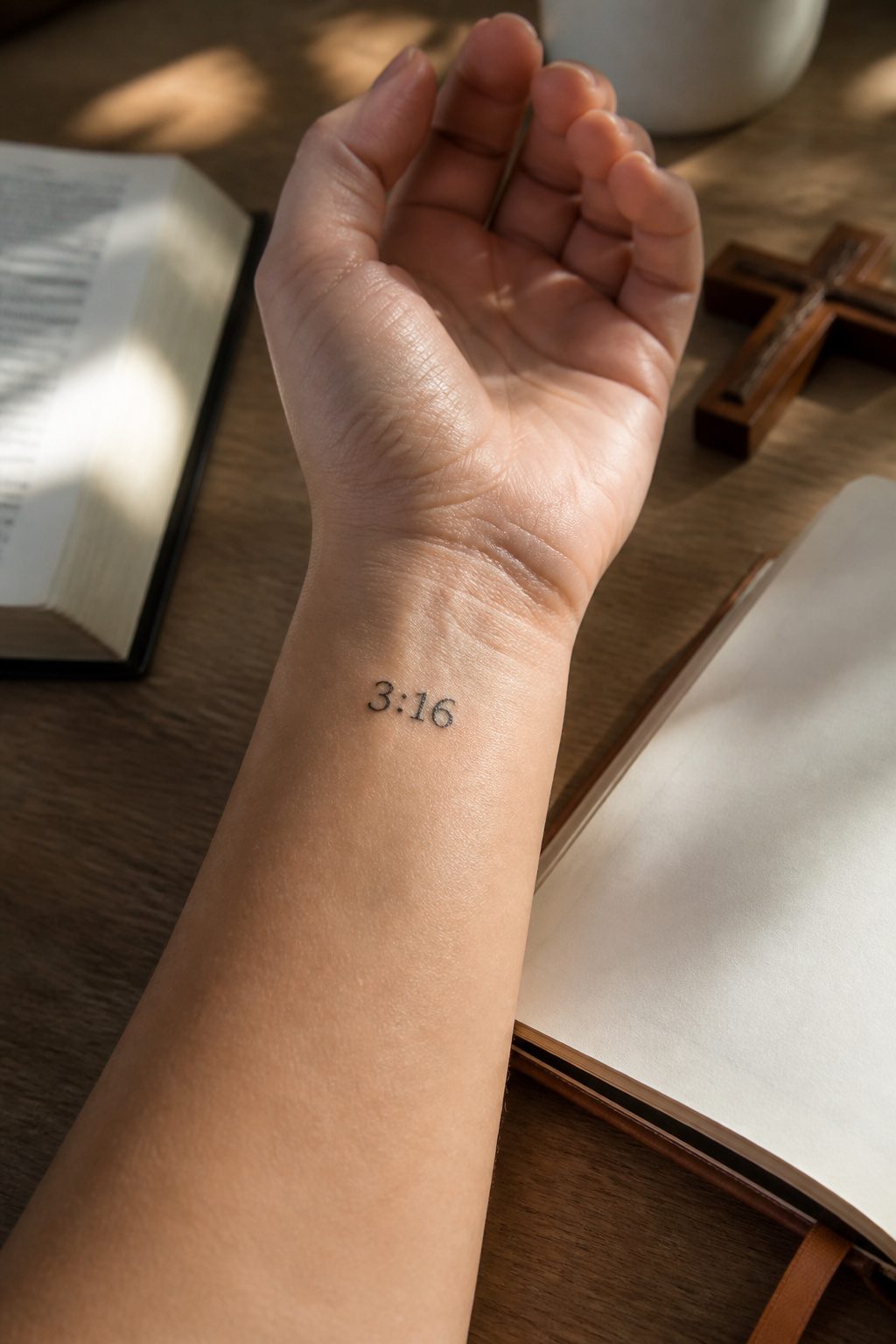
A 3:16 tucked along the inner wrist or a 6:19 riding the curve of a rib reads like a private bookmark rather than a billboard.
The numbers mean nothing without the viewer knowing the book, which is exactly the point. Collarbone placement works the same way: a glance in a mirror catches it, but a stranger at the grocery store probably won’t.
I like that these demand a second step. Someone sees the ink, asks or doesn’t, and either way the wearer chose the threshold.
A wrist version peeks past a watch band in summer. A rib version stays under fabric unless swimming or intimacy changes the context.
The risk is over-explaining it. Adding a cross beside the numerals, or spelling out John, turns the puzzle into a label.
The discipline is letting the reference stay lean enough that only another reader recognizes it. That restraint costs nothing extra at the shop but saves the piece from reading like a bumper sticker.
Placement on bone, close to the surface, tends to blur faster than padded spots.
A collarbone piece in particular will need touch-up in a few years if the lines stay hair-thin. Plan for that, or accept the fade as part of the quietness.
16. Scales of Justice
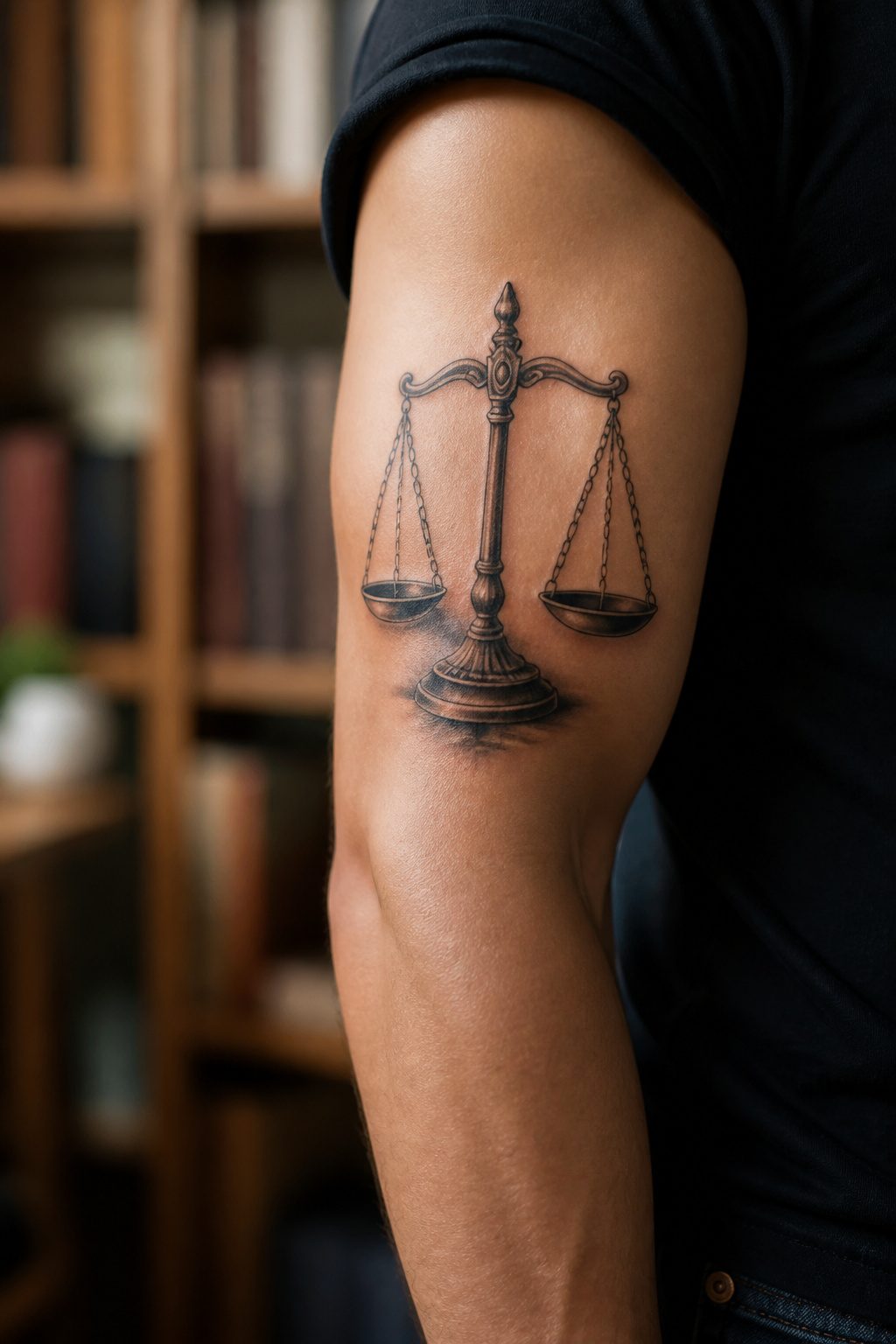
The scales of justice carry weight in scripture that a lot of imagery simply doesn’t.
Psalm 89:14 says righteousness and justice are the foundation of God’s throne, and the balance beam captures that tension between mercy and truth in a way a single symbol rarely manages.
The scale itself sits flat, neither pan touching ground, which reads as fairness rather than vengeance.
Lawyers and judges sometimes gravitate toward this piece, though the pairing matters as much as the scales.
A sword tucked behind the beam shifts the meaning toward final judgment; an open book beneath it, usually scripture, pulls the tone back toward measured mercy.
I’ve seen the forearm work well for the compact version, the beam running crosswise so both pans stay visible from the front.
The broader back piece between the shoulders gives room for the full setup: scales, book, sometimes a draped cloth that suggests the veil between human and divine law.
The risk is making it look like a law-firm logo.
The fix is in the details: the chains should show slight wear, the pans a little tarnish, something that says these scales have actually been used. That lived-in quality keeps the symbol from reading as corporate rather than spiritual.
17. Mountain
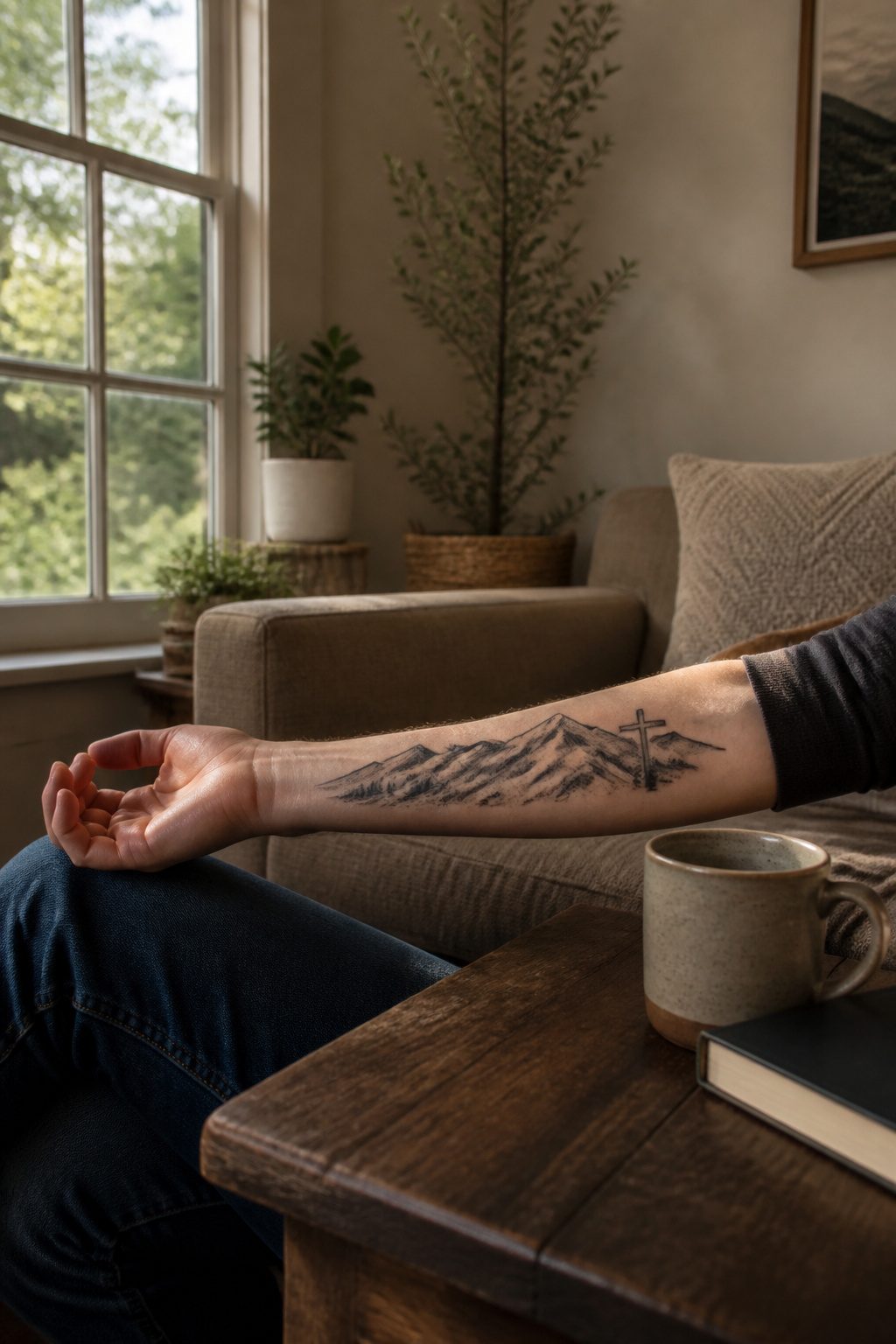
A mountain tattoo carries the promise that faith moves what seems immovable, or the memory that prophets met God on high ground. Psalm 121:1 opens with the eyes lifting to the hills, and that upward gaze translates naturally to skin.
The design works best as a landscape with light breaking through the peaks, the kind of horizontal band that wraps a forearm or runs along the calf.
I have seen these go wrong when the mountain range turns too busy, too many crags competing for attention; three peaks with a single source of light behind them gives the eye a place to rest.
The horizontal format suits the body better than vertical stacking, which fights the natural line of either placement.
A lighter hand on the shading keeps the dawn or dusk readable from a distance, where heavy black ink turns the whole scene into a dark smudge.
18. Whale
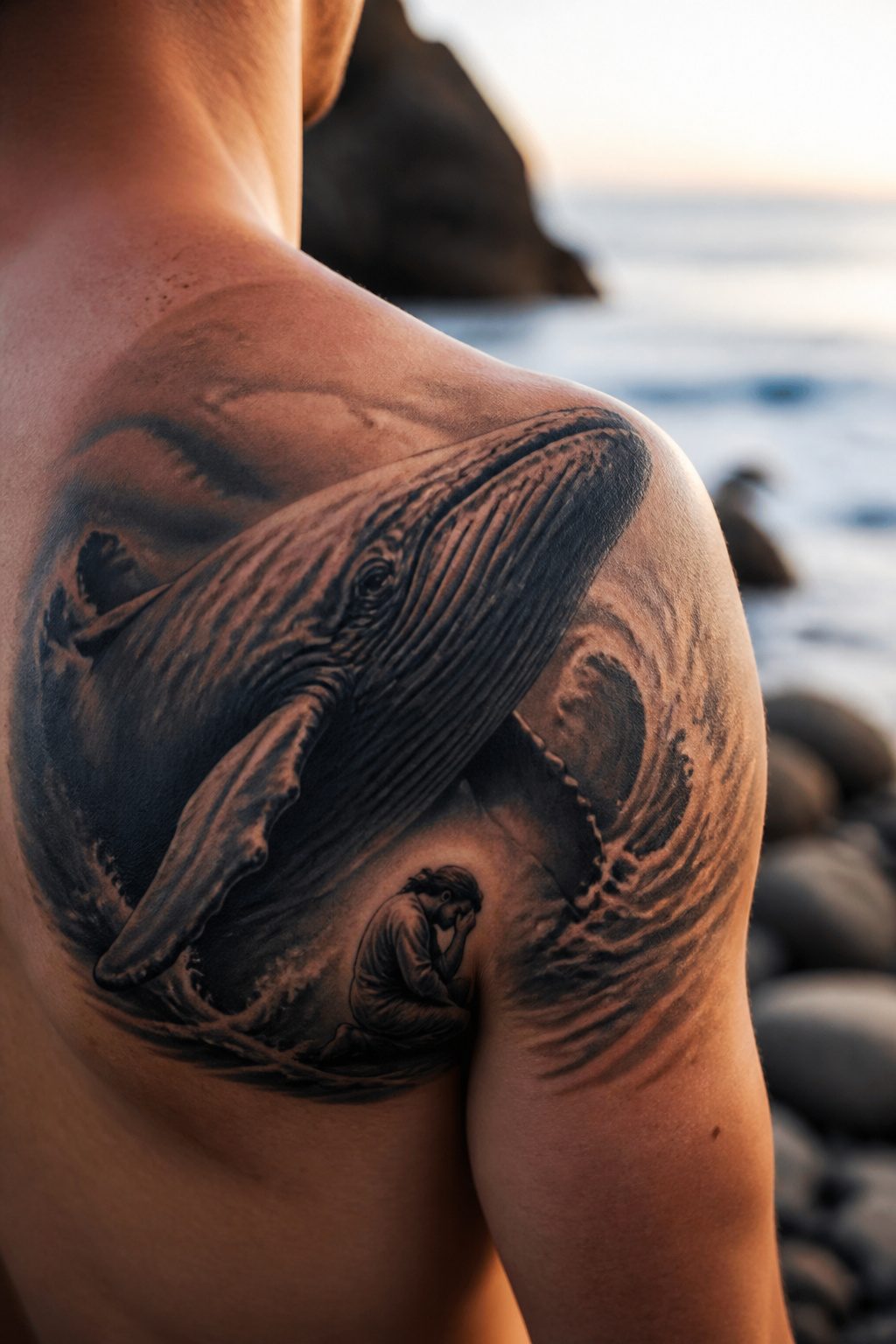
A whale design carries the same resurrection parallel as the cross, but with a story fewer people wear. Jonah spent three days inside the belly before being delivered, and that timeline maps directly onto the three days in the tomb.
The image works best when Jonah himself is visible, either inside the open mouth or kneeling beside the creature, because without that human figure the design reads as generic sea life rather than Scripture.
The passages give the creature as whale or sea monster interchangeably, so the artist has some room on the exact anatomy.
Either way, this option demands more space than a simple fish or cross; the narrative needs enough canvas to show both the danger and the salvation.
On a forearm or shoulder, the whale can curve with the body and leave room for Jonah at the center.
What Leviticus Actually Says
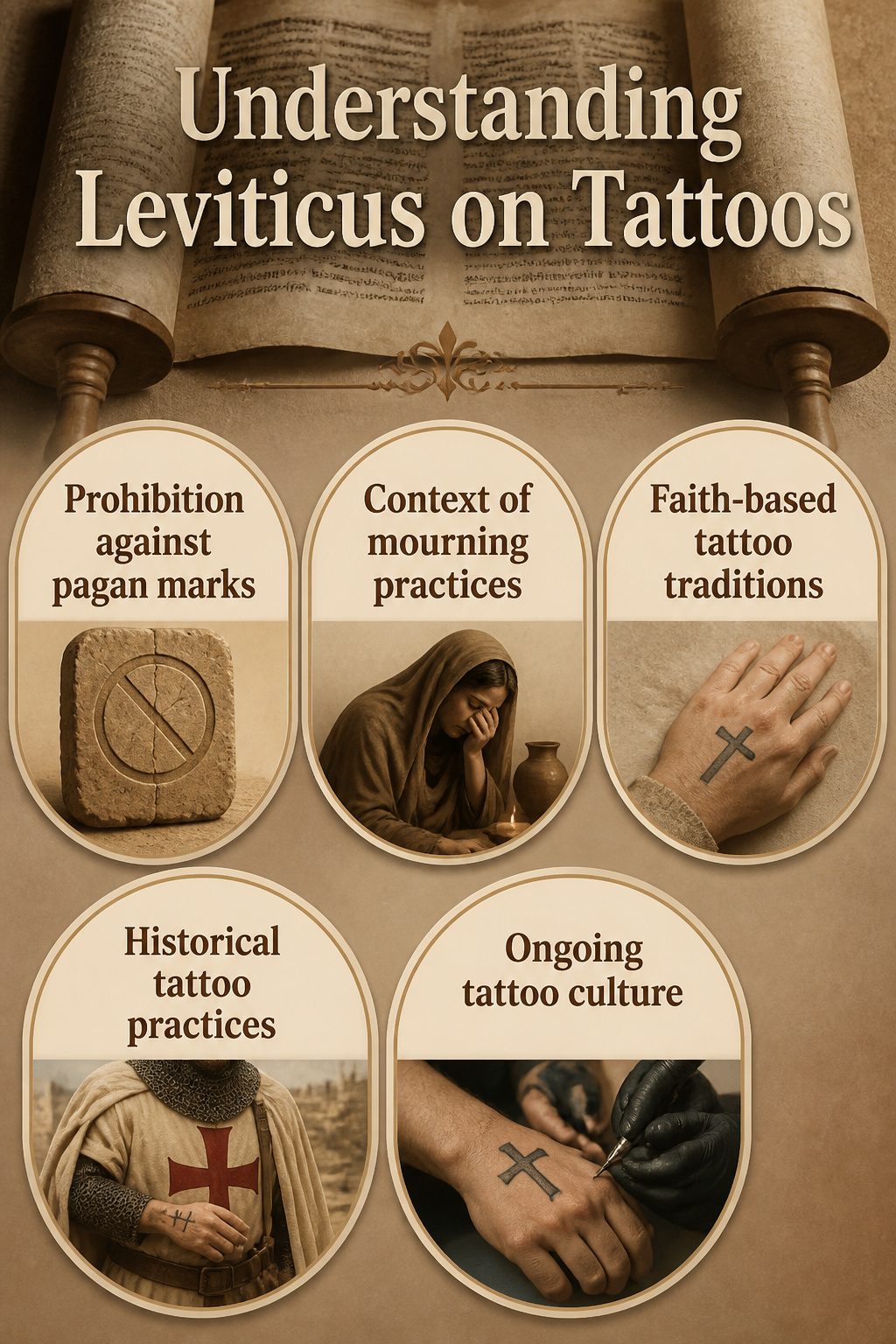
Leviticus 19:28 commands, "Do not cut your bodies for the dead or put tattoo marks on yourselves."
The wording matters: the prohibition pairs marking with mourning for the dead, a practice tied to pagan ritual, not a declaration that all skin marking is forbidden. The context is marking for the dead, not marking for faith.
Isaiah 44:5 offers a different picture entirely: "Some will say, ‘I belong to the Lord’; others will call themselves by the name of Jacob; still others will write on their hand, ‘The Lord’s,’ and will take the name Israel."
That image of writing the Lord’s name on the hand reads almost as permission, especially given what came later.
The Copts of Egypt were already tattooing crosses as marks of faith and identity, a religious rite rather than rebellion.
Crusaders in 1095 tattooed crosses on or near their hands so that if they fell in battle, they would receive Christian burial.
Jerusalem pilgrims did the same to commemorate their journey. The practice has never fully disappeared; traditional artists still offer these tattoos to modern pilgrims.
Two ways to read this: either the Leviticus ban covers all tattoos, period, or it targets a specific pagan funeral rite that no longer exists.
The historical record leans toward the second reading, since the church itself participated in faith marking for centuries.
Where to Put It
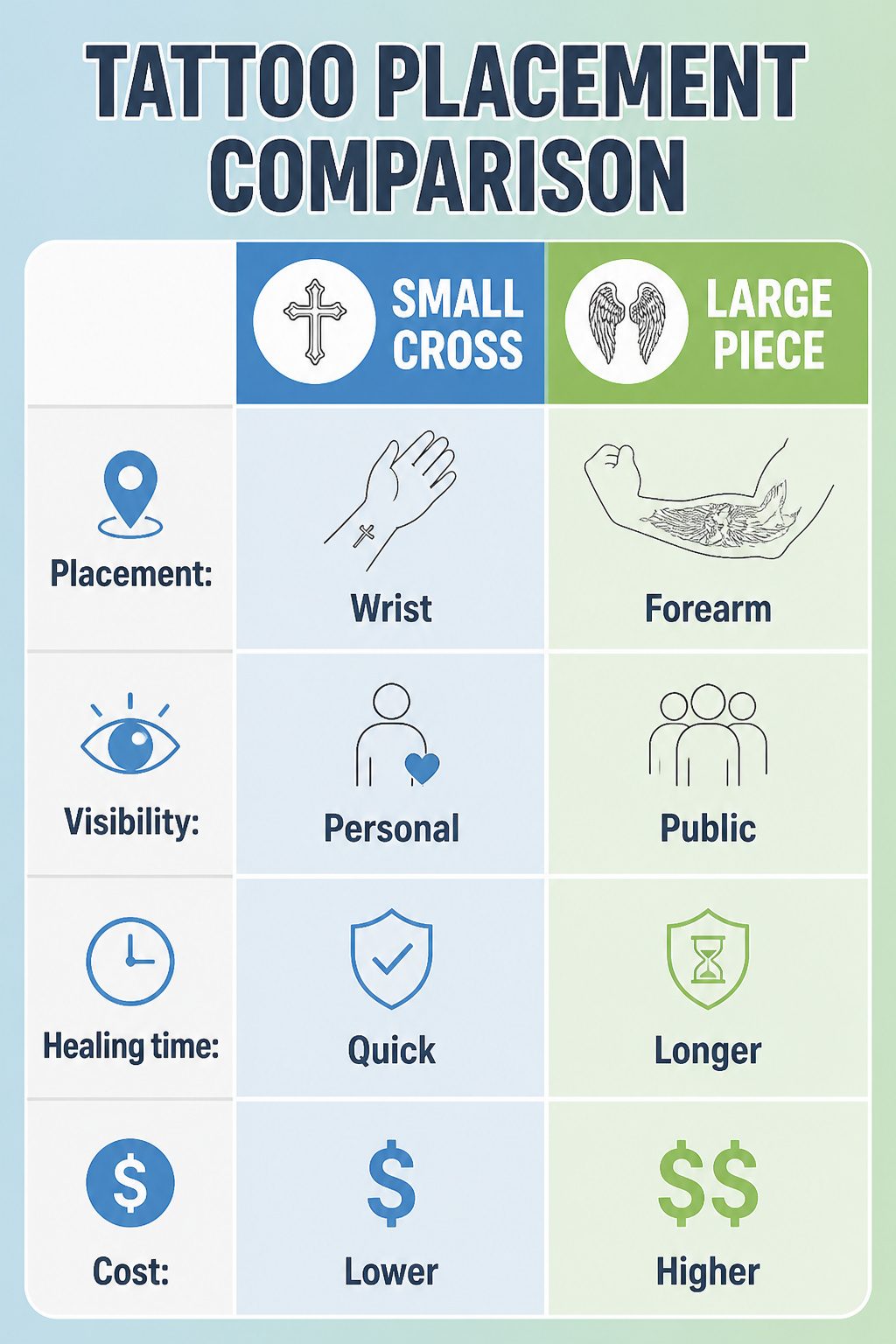
A small cross lands naturally on the wrist, ankle, or behind the ear, spots that keep it personal and easy to conceal for work. Those same compact placements cost less, heal faster, and need less daily attention than larger work.
For something bigger, the forearm, upper arm, back, or chest carry the space and the weight. Angel wings starting at the shoulder blades and running down the arms read as protection you carry openly, not decoration you explain.
The real choice is visibility versus witness. A forearm piece starts conversations with strangers; an ankle cross stays between you and whoever you choose to show.
Professional settings still reward discretion in plenty of fields, so placement doubles as a decision about when your faith speaks and when it listens.
Healing and Long-Term Care
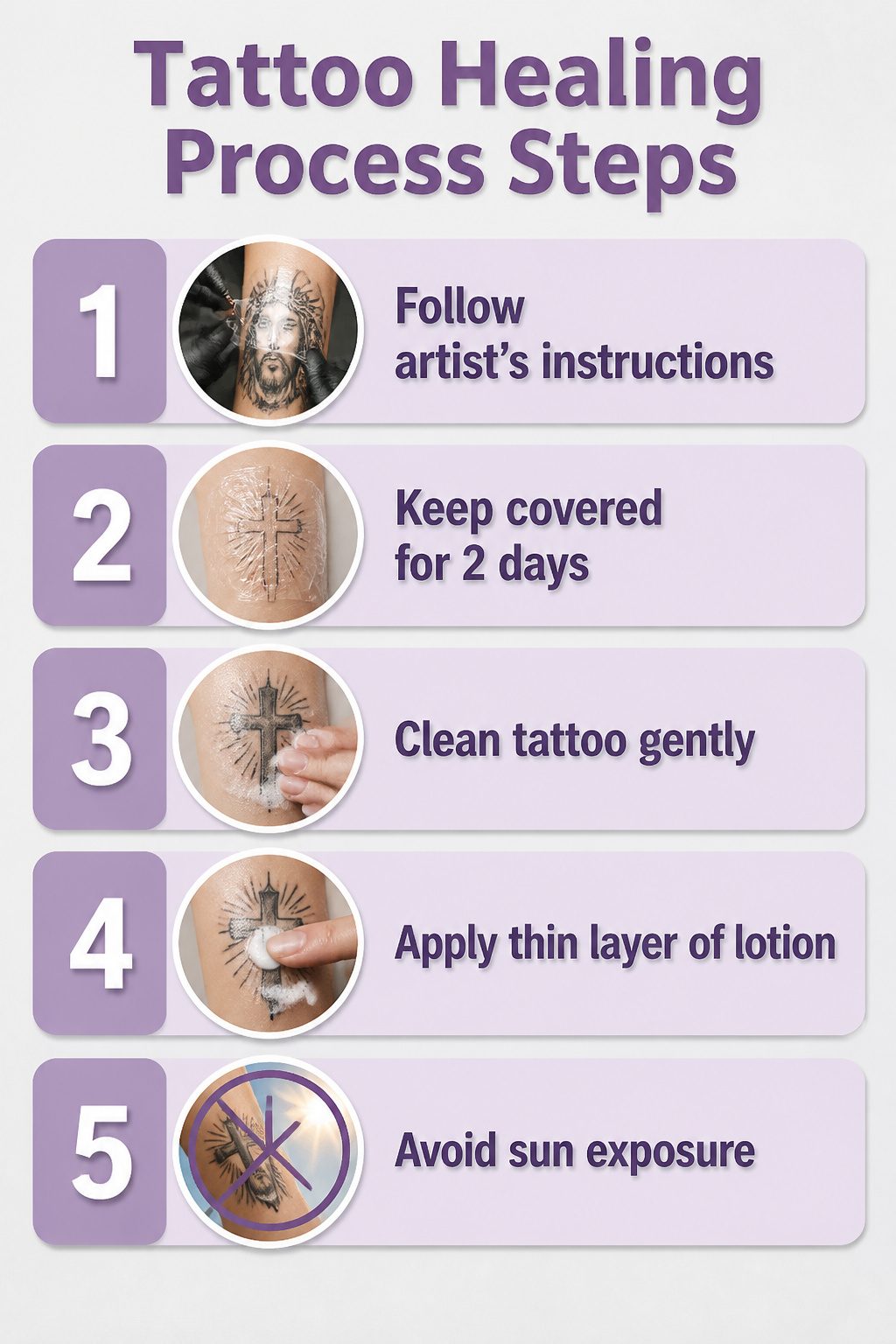
Healing a Christian tattoo follows the same rules as any other piece, but the meaning behind the image tends to make people more cautious about the result.
Follow your artist’s instructions exactly, whether that means keeping a protective clear sheet on for the first day or two, cleaning gently once it comes off, and re-covering as directed.
Those steps protect both the ink and the open wound underneath it.
A light, fragrance-free lotion keeps the skin hydrated without smothering the work.
HUSH tattoo balm works for this, and the same thin layer used during healing can continue long after to keep the ink from dulling. A little goes a long way, so resist the urge to pile it on.
Sun exposure is the enemy of crisp lines, and that matters more when the design carries a face, a verse, or fine detail you chose for its significance.
Religious imagery often sits where you see it daily, which means you notice fading faster and are more likely to schedule touch-ups early. The care routine does not change, but the attention you pay to it might.
How Different Churches See It
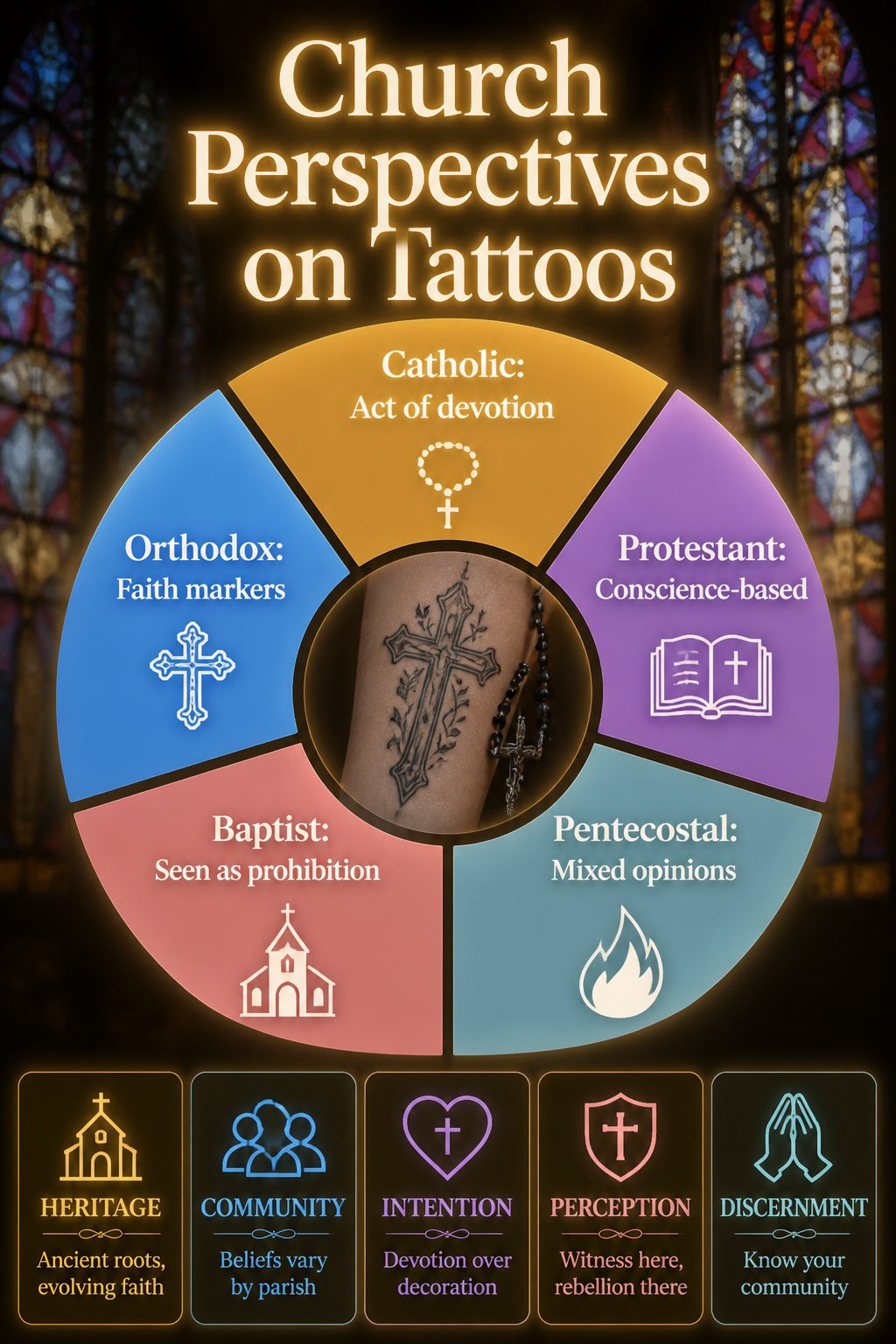
Catholic teaching has softened considerably since the 1980s, and many parishes now see a rosary or saint image as an act of devotion rather than defiance.
Orthodox Christianity carries something older: Coptic and Ethiopian communities have kept continuous tattoo traditions for centuries, with pilgrims still receiving crosses on wrists or forearms as markers of faith and, at times, protection.
That living history sits in the same church family as Greek or Russian Orthodoxy, where opinions vary parish by parish.
Protestant ground is more scattered.
Mainline denominations, Lutheran to Methodist, mostly leave it to conscience. The sharper resistance tends to concentrate in Baptist and Pentecostal circles, where body-as-temple language gets read as prohibition rather than stewardship.
I have watched the same verse quoted to justify both positions, which tells you how much the surrounding culture shapes the reading.
For anyone weighing a design, the practical question is which community you actually sit in, not which denomination looks right on paper.
A tattoo that reads as witness in one congregation can read as rebellion in another, and the distance between those two rooms might be five miles or five blocks.
Frequently Asked Questions
Is it okay to get tattoos if they are of a Christian nature?
Christian tattoos are permissible but should be approached thoughtfully. The question is less whether a cross or Bible verse is a sin and more whether it is beneficial and constructive for your faith.
Some believers find that a Christian tattoo opens doors for conversation that a suit and tie never would.
What are some popular Christian tattoo ideas?
Crosses, the Ichthys fish, Bible verses, saints, and angels rank as the most requested designs.
The article also covers crown of thorns, lamb, anchor, armor of God, Lion of Judah, mustard seed, dove, praying hands, and narrative pieces like the burning bush or Jonah and the whale.
How do I care for my Christian tattoo?
Follow your artist’s specific aftercare instructions exactly; they are written to protect both the tattoo and the open wound beneath it.
Keep the area clean, moisturize lightly, and shield it from sun exposure while it heals. Reach out to your artist if anything looks off, rather than guessing.