A Jesus tattoo is a permanent piece of religious body art depicting Christ, the cross, or related Christian imagery, placed anywhere from a discreet wrist to a full back panel.
The commitment runs deeper than most ink because the subject carries living meaning for the wearer; a generic stencil ages poorly where a portrait with your grandmother’s handwritten verse beneath it becomes a record you carry.
The real cost is not money but precision: a crucifixion scene needs scale to hold its power, while a face compressed onto a hand blurs into gray smudges within a year.
Jesus Arm Tattoo
The arm gives you room to work with without committing to a full sleeve, and the pain stays low to moderate thanks to thick skin, muscle, and fat padding the bone.
That matters more than most people expect when they are sitting for a piece that carries real weight for them.
Forearm placement sits in that useful middle space: visible enough that you catch it yourself throughout the day, easy enough to cover with a long sleeve when the situation calls for discretion.
Upper arm hides more naturally under short sleeves, so the choice between them shapes how often the design meets your own eye versus other people’s.
A meaningful Jesus design benefits from that daily visibility. You are not performing belief for anyone; you are simply keeping the reminder where your own glance lands it.
The arm’s size also means you are not squeezing a complex image into cramped quarters or stretching a simple one across too much empty skin.
Jesus Cross Tattoo
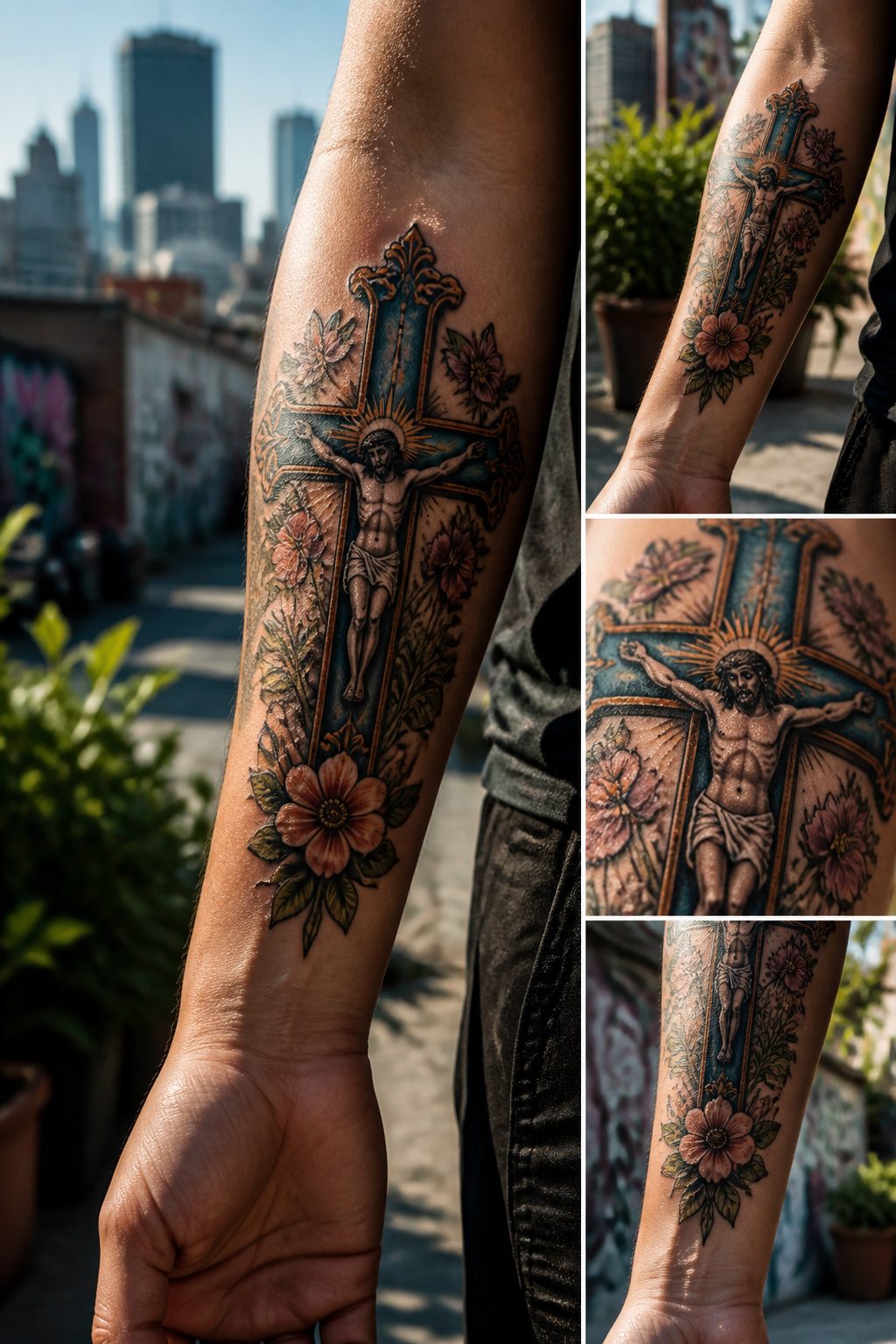
A cross on its own speaks to sacrifice, but pair it with Jesus’ image and the design gains a second layer: the man who chose to die and the death he accepted.
One source frames this as faith, love, and hope made visible, and that pairing is where the meaning thickens. The cross becomes the event; Jesus becomes the person who walked into it.
Together they shift the tattoo from symbol to story.
Placement shapes how that story reads. A small cross beside a portrait on a forearm keeps both elements in conversation, each visible at a glance.
A full back piece can set the cross behind the figure, almost as backdrop and almost as weight he carries. The choice is whether to emphasize the moment of death or the life that made that death matter.
Color changes the tone too. A blood-red cross against a muted figure turns the eye to pain; a weathered wooden cross with a calm Jesus shifts the focus to acceptance.
Neither is wrong, but they are different tattoos with different daily reminders. What holds is that the two symbols do not simply add together.
They complicate each other in ways that reward a design where both are given real space.
Jesus Forearm Tattoo
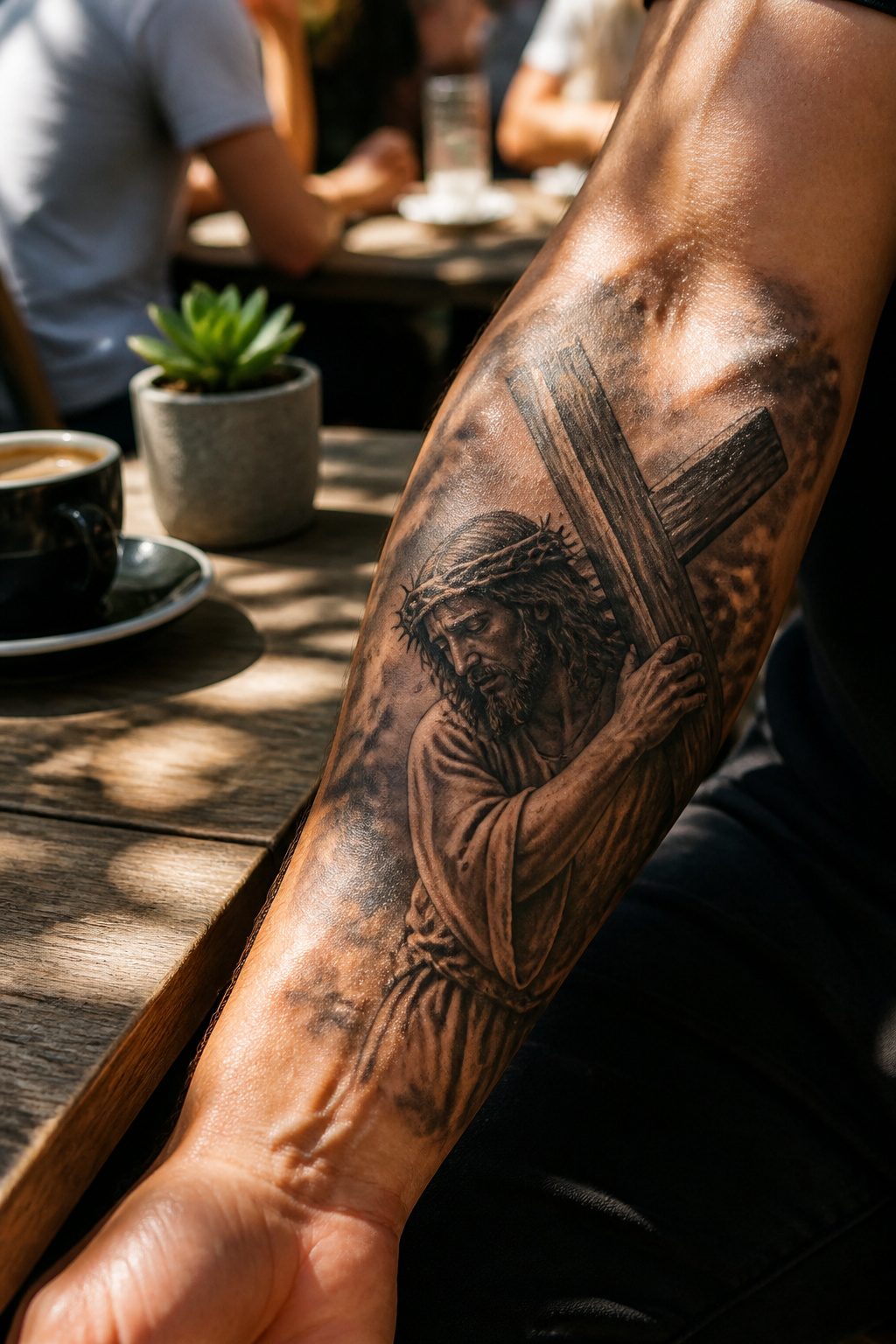
The forearm sits lower than the upper arm, which means daily visibility is built in without rolling a sleeve or choosing a tank top.
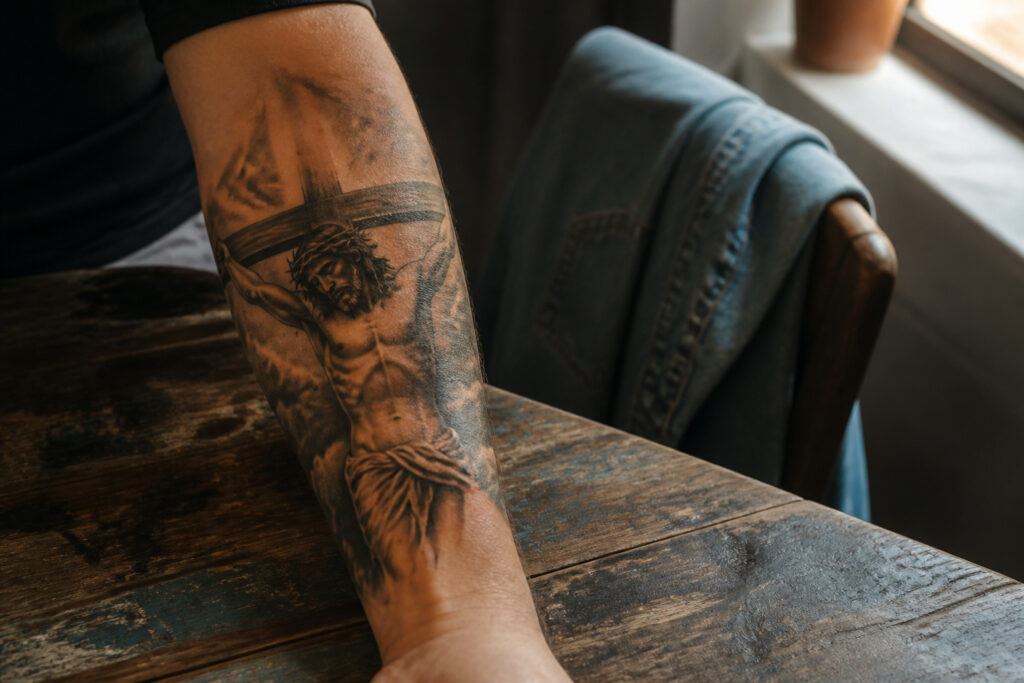
Most long sleeves cover it completely, so the piece hides for work or family gatherings without the commitment of a full arm. A Jesus carrying the cross fits here, or a verse that runs lengthwise with the bone.
Pain ranks lower on the forearm than on most of the torso, and the flat surface gives the artist room without forcing the design small. The catch is deciding whether this is enough.
A full sleeve ties the image into a larger story, shoulder to wrist, but takes longer to finish and costs more at every session.
The half sleeve, elbow to wrist, keeps some of that narrative while still tucking under a buttoned cuff. For someone who wants the image seen in a short sleeve but gone in a jacket, the forearm alone wins.
Jesus Hand Tattoo
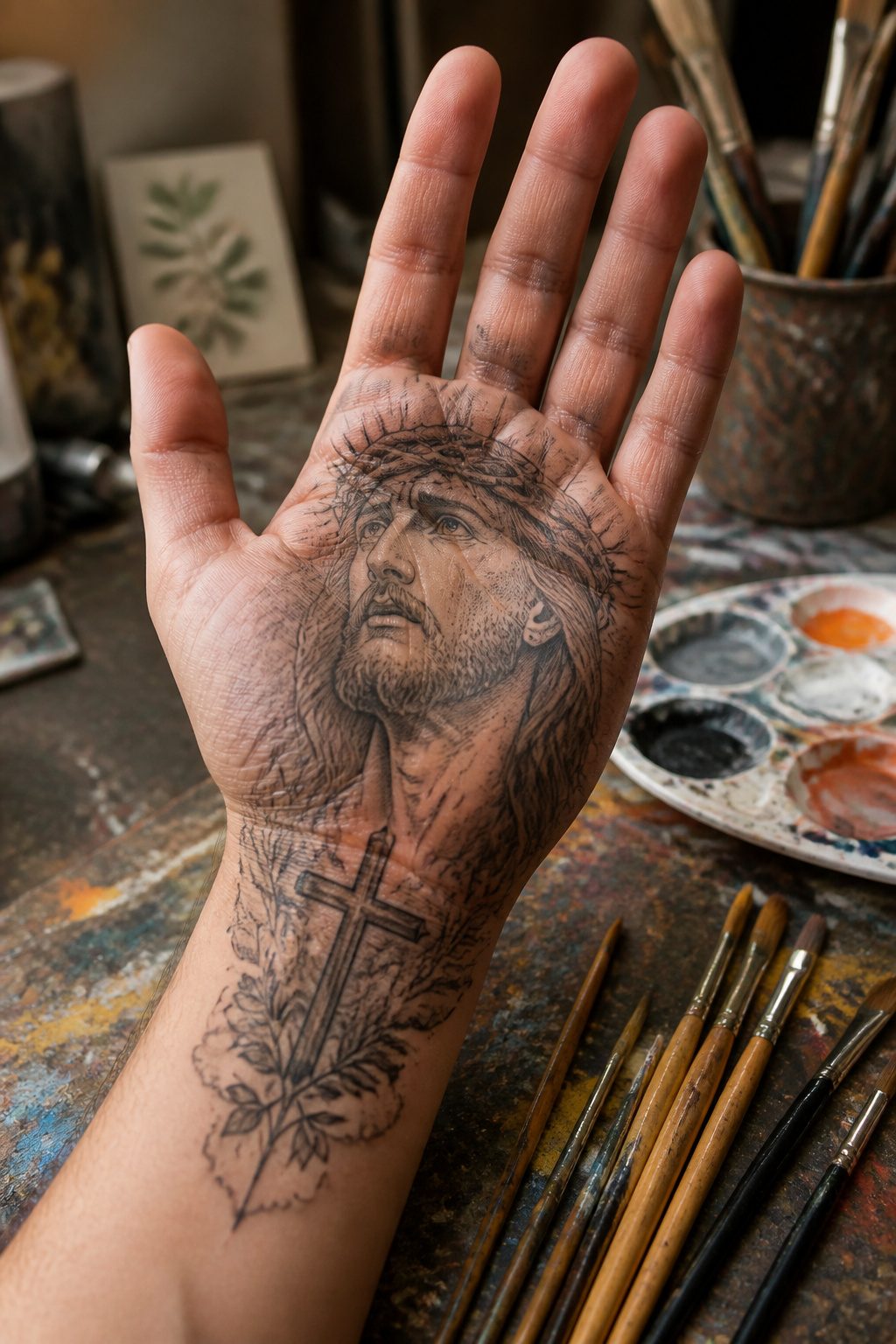
Hand placement puts the image in front of you every waking hour, which is exactly the point for a devotional piece, but that visibility cuts both ways.
Thin skin, almost no muscle padding, and bone sitting right underneath make the needle work more painful than most locations, and the high concentration of nerve endings in the fingers and knuckles does not help.
The hand also works harder than almost any other canvas: constant washing, sun exposure, and friction from daily tasks mean the ink fades faster here and needs touch-ups sooner.
A Jesus hand tattoo cannot be hidden under a sleeve for a job interview or a formal occasion, so the commitment is permanent in a way that even a neck or forearm piece is not.
That openness suits someone who wants the reminder always in sight, but the tradeoff is real: more pain going in, more maintenance over time, and no option to step back from the statement it makes.
Jesus Crucified Tattoo
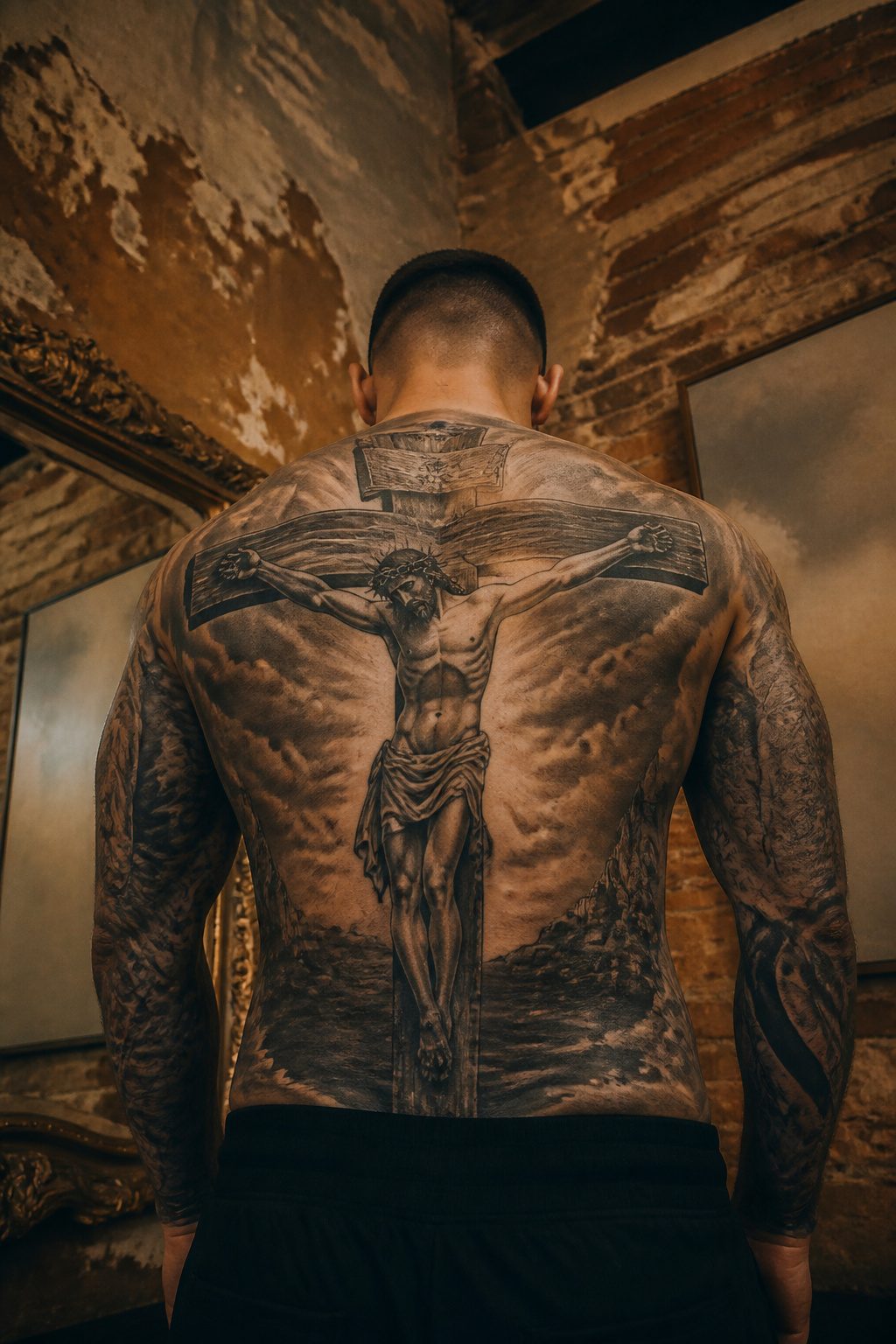
A crucifixion scene carries the heaviest emotional weight of any Jesus tattoo design.
The image of Christ nailed to the cross speaks directly to sacrifice and unconditional love, which is why it so often becomes the anchor piece in larger work rather than a standalone image.
The symbolism runs in two directions at once. For the faithful, it marks the moment of salvation and the depth of divine love.
Others read the same image as a meditation on pain, death, and the cost of conviction. Either way, the design refuses to stay neutral.
What makes this piece work as a centerpiece is the room it demands.
A crucifixion scene needs scale to hold the detail that gives it power: the tension in the arms, the tilt of the head, the texture of the wood.
On a back panel or a full sleeve, it can gather surrounding elements, verses, or rays of light without losing focus.
On smaller placements, the same image often collapses into a symbol rather than a scene, which is a different tattoo entirely.
Many who choose this design add a Bible verse that names the specific meaning they want carried. The verse becomes the bridge between the visual and the personal, turning a historical image into a private statement.
Without that addition, the crucifixion can read as generic religious art; with it, the tattoo becomes unmistakably yours.
Jesus Heart Tattoo
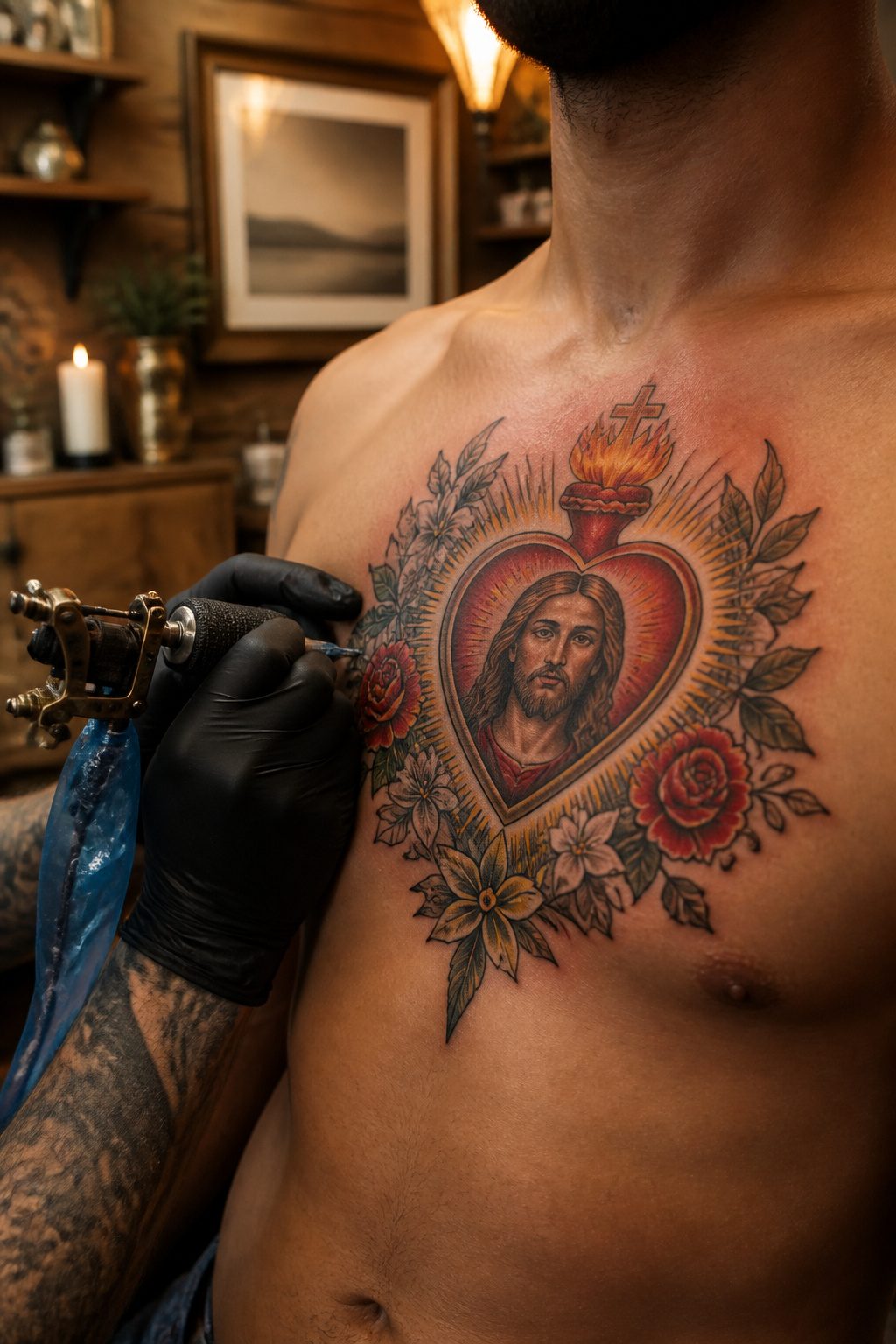
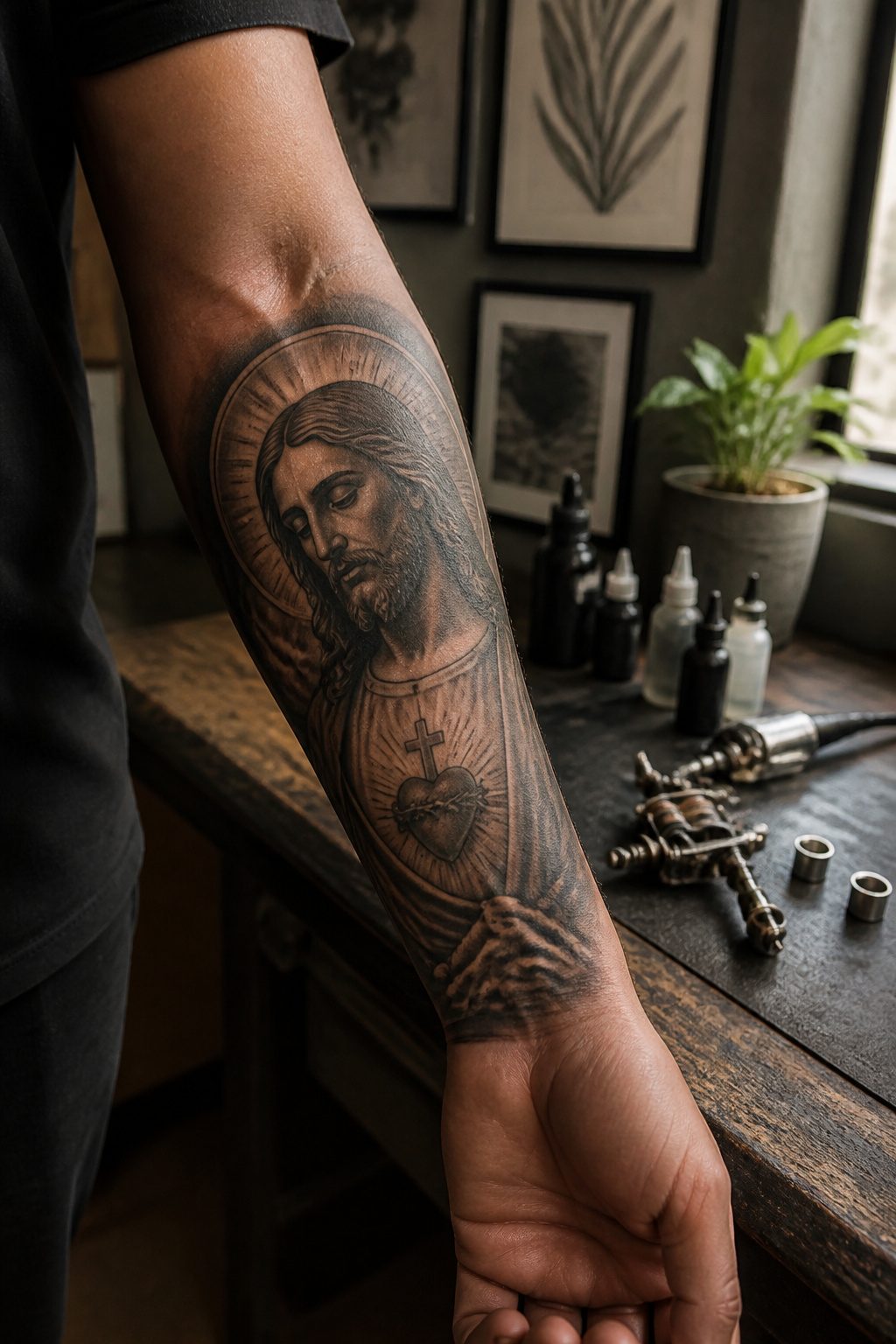
A Jesus heart tattoo pairs the sacred heart image with Christ’s likeness, or it sets a realistic heart against his figure, showing how sacrifice and love reshape a life.
The heart itself carries devotion and faithfulness, not just the generic romance the symbol usually signals.
Most people who choose this design add a name, a date, or a verse from scripture to mark a specific turning point: a conversion, a loss, a recovery. The placement tends to follow the weight of that moment.
Over the actual chest, the tattoo stays private, felt before it is seen. On the wrist or forearm, it becomes a daily reminder the wearer checks without thinking.
Either way, the image works only when the personal detail is settled first; without it, the heart stays generic, and the faith journey reads as borrowed rather than lived.
Jesus Face Tattoo
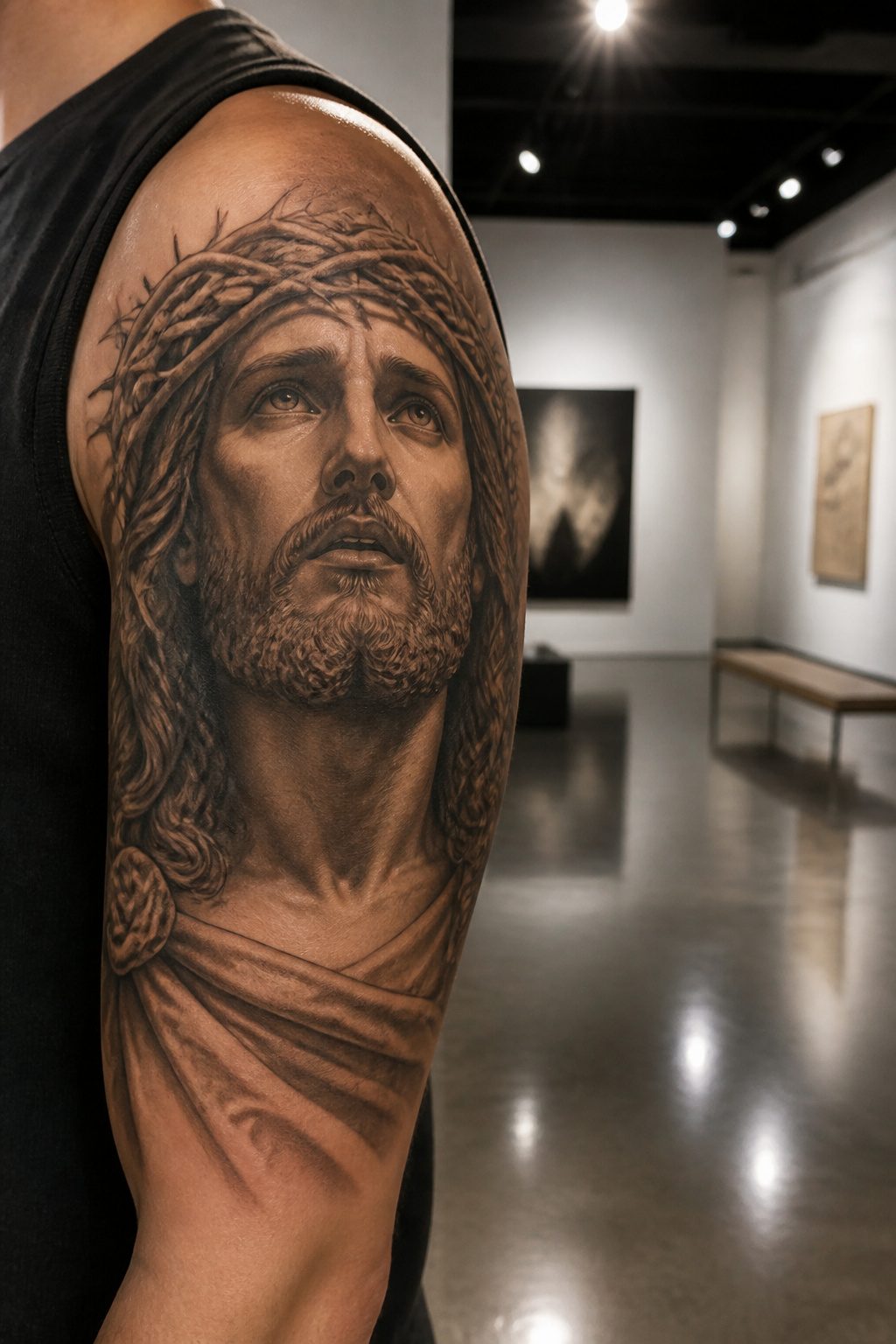
A portrait of Jesus on skin demands an artist who specializes in realism, not just someone who can handle a religious stencil.
The face carries expression and a quality believers experience as sacred, and translating that into ink is among the more technically difficult work in tattooing.
Subtle shifts in shadow around the eyes or mouth read as serene on canvas but can flatten into something generic or unsettling if the artist misses them.
The piece also needs room. An arm, thigh, or back gives the space the detailing requires; squeezing it onto a forearm or hand loses the gradations that separate a likeness from a label.
What convinced me, looking through portfolios, was comparing two Jesus portraits done at similar scale: one on a shoulder blade where the artist had space to build depth in the beard and forehead, another forced onto a wrist where the same features merged into gray smudges within a year.
The larger work aged like a photograph; the smaller one aged like a blurred copy.
If this is the design you want, book the consultation with a portrait specialist first and let the body placement follow from what the artist says they need.
Jesus Fish Tattoo

The ichthys, or Jesus fish, carries about as much history as any symbol you could put under skin. Early Christians drew it in secret to mark safe meeting places, a simple curved line that meant belonging without announcing it.
That same quietness makes it a practical choice now for a first tattoo. The shape sits clean at an inch or two behind the ear, along the ankle bone, or inside the wrist, places a long sleeve still covers.
Some keep it bare, two arcs and nothing else. Others nest the name Jesus inside or let the fish swim toward a small cross.
The design needs almost no detail to read, which keeps the session short and the healing straightforward. For someone testing whether faith and ink mix, that low commitment matters.
Jesus Shoulder Tattoo

The shoulder sits at that natural hinge between the body and the arm, which makes it one of the more flattering places to carry a detailed piece.
Skin there stretches less over time than on the stomach or thighs, so a Jesus portrait or crucifixion scene keeps its lines cleaner as the years pass.
Pain stays low to moderate on most of the shoulder, though the closer the needle moves toward the blade, the sharper it gets; bone sits right under the surface there.
Space is generous without demanding the commitment of a full sleeve. A design can wrap over the cap, sit across the top, or drop slightly onto the upper arm while still reading as a shoulder piece.
For anyone already thinking ahead, this placement leaves the chest and back open.
A portrait that starts at the cap can extend inward across the pec or sweep onto the shoulder blade later, and the flow feels natural rather than patched together.
The area also covers easily under a shirt sleeve or tank strap, and shows when you want it to. That flexibility makes the shoulder a practical starting point for a Jesus tattoo that might grow into larger work.
Jesus Lion Tattoo
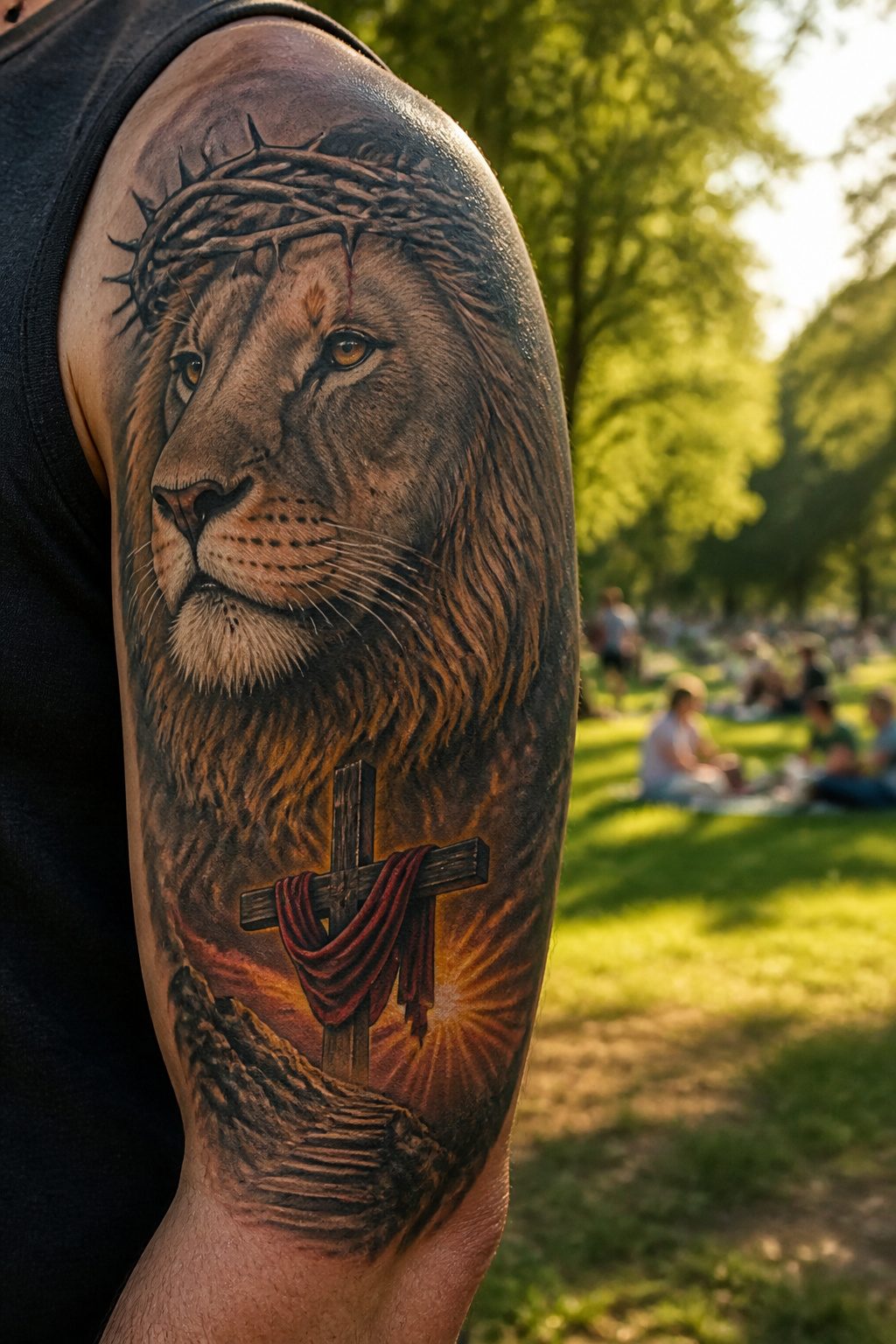
The lion paired with Christ carries the weight of Revelation’s description: Jesus as the Lion of Judah, a symbol of both kingship and sacrifice. This duality is what gives the design its force.
The lion’s mane can frame a calm face of Christ, or the beast can stand alone as his proxy, roaring where the human figure would speak quietly.
Bravery and power read immediately in the lion’s posture. A seated lion with a haloed Christ behind it reads as protection; a lion mid-roar with eyes lifted toward light suggests resurrection rather than conquest.
The visual impact depends on which quality you want forward. The lion’s body carries the motion, but the face of Christ, when included, arrests the eye and slows the reading of the piece.
Color shifts the tone fast. A lion in full gold and brown realism against a washed, almost graphite Christ creates tension between earth and spirit.
Reverse that, a pale lion behind a vividly inked Christ, and the lion becomes the background hum of divine authority rather than the foreground claim.
Either works; the choice is whether you want the symbol or the person to dominate first glance.
Jesus Carrying Cross Tattoo
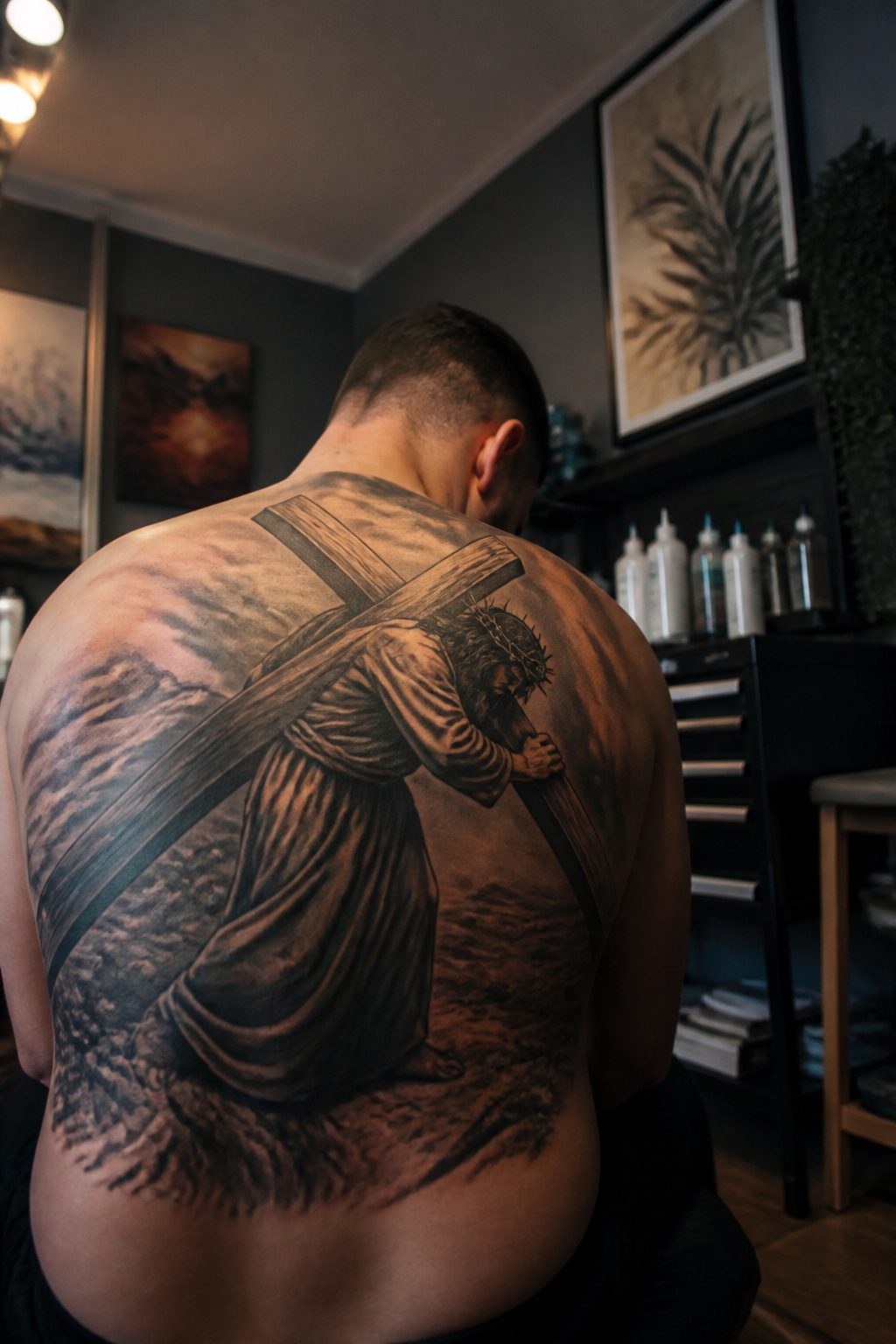
A Jesus carrying cross tattoo centers on the moment before crucifixion, when Christ shoulders the weight of the wood through Jerusalem. That image carries its own meaning separate from the crucifixion itself: the burden accepted rather than the sacrifice completed.
The design speaks to trust in God during struggle, not just devotion after victory.
Artists usually build this as a narrative piece, stretching the story across skin.
The fallen Christ, the crown of thorns, the crowd pressing in, the crossbeam splitting his shoulder, these details let a sleeve or a full back piece read like a sequence of panels.
The composition moves upward, from the ground to the hill, so the eye travels the same path the body did.
What draws people to this specific image over the crucifixion is the forward motion. Christ is still walking.
The tattoo becomes a reminder that strength means continuing under weight, not the absence of it. That message lands hardest for people mid-struggle, when the finish is not yet visible.
Jesus Back Tattoo
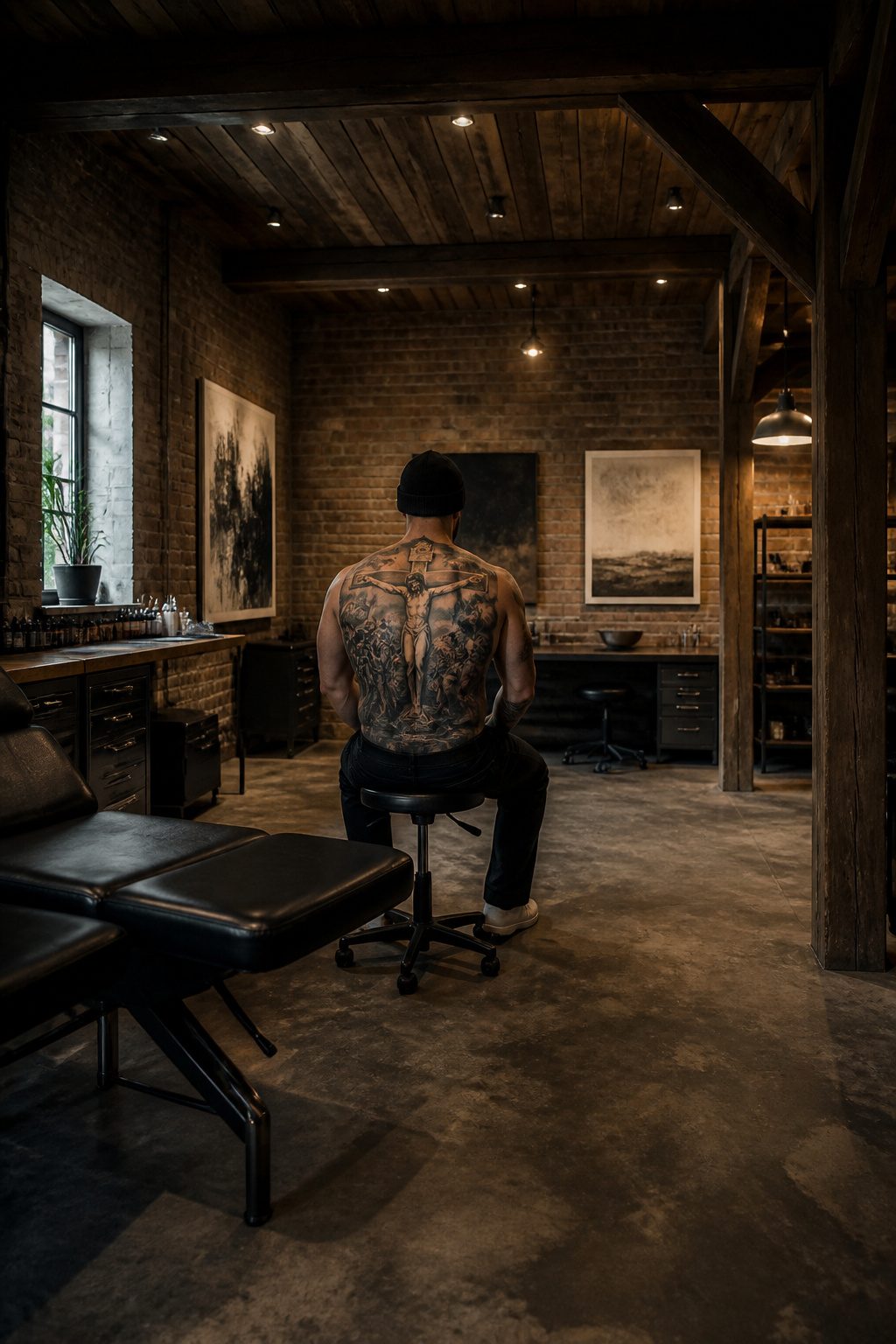
The back offers the widest uninterrupted canvas on the body, which matters when a Jesus design carries multiple figures, a full crucifixion scene, or lettering you want readable from ten feet away.
Thick muscle and fat across most of the area cushion the needle, so the work sits moderate on the pain scale, though the spine and hip bone themselves sting sharply enough that most artists build in breaks.
What drew me to researching this placement is the control it gives over who sees the piece and when.
A back tattoo stays under a shirt at work, at family dinner, during any interaction where you would rather not field questions about faith or art.
Revealing it becomes deliberate, which makes the first showing feel more intimate than a forearm piece that announces itself to every cashier and colleague.
That privacy comes with a cost in time. A full-back Jesus composition rarely finishes in one session.
The detail possible at this scale, the skin real estate for a crown of thorns rendered at actual size or a draped robe with real shadow depth, typically spreads across multiple extended appointments.
Plan for that upfront: the design deserves the hours, and rushing a large back piece shows in the healed work for decades.
Jesus Tattoo Sleeve
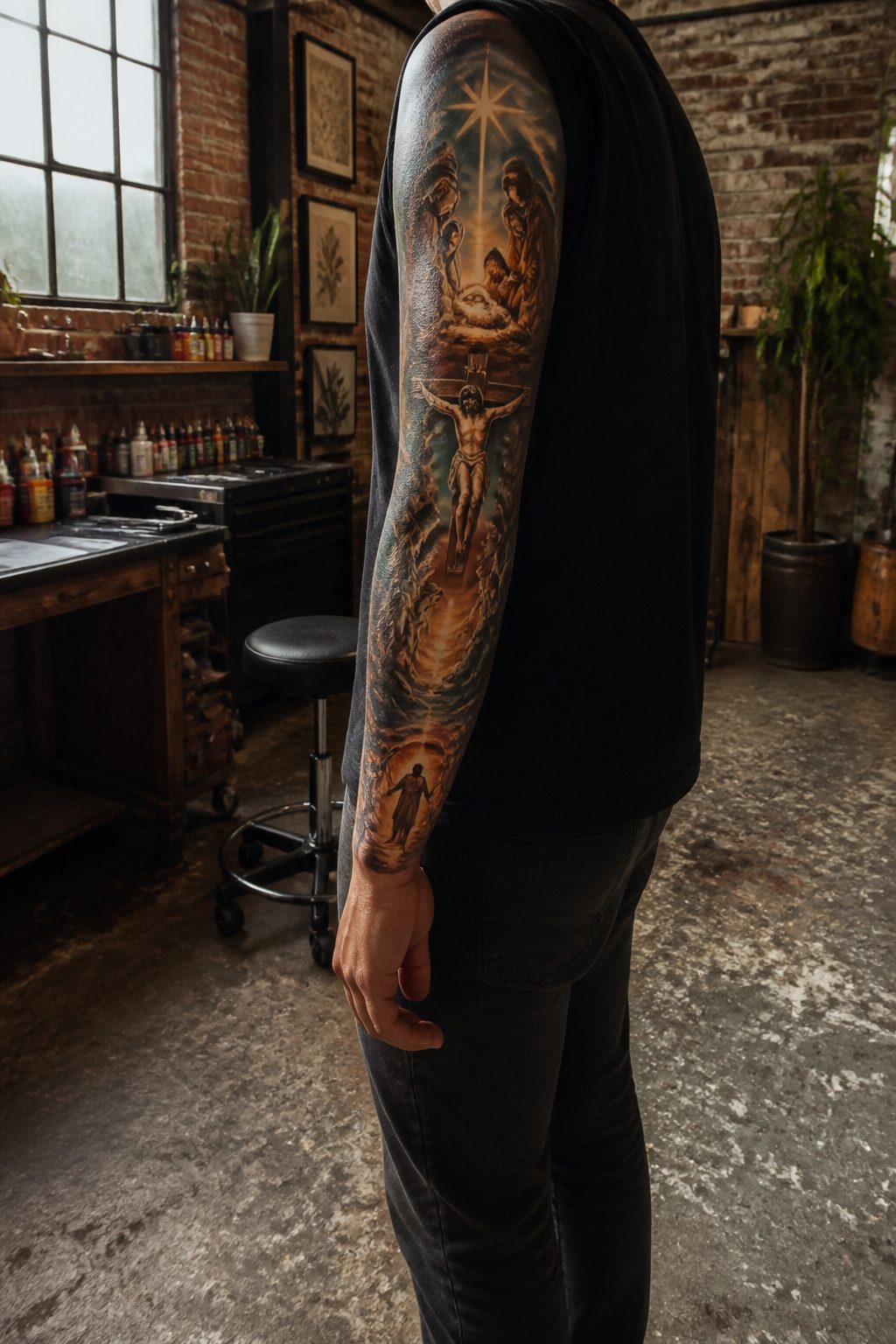
A Jesus tattoo sleeve turns the entire arm into one continuous narrative, running from shoulder to wrist with Christ at the center and supporting imagery radiating outward.
Crosses, scripture verses, and scenes from the Passion fill the gaps between larger figures, each piece placed so the eye travels naturally up or down the limb.
These sleeves demand the most time and money of any religious tattoo option. Multiple sessions stretch across months, sometimes more than a year for dense black-and-gray or full color work.
The expense reflects that commitment, with hourly rates stacking up across twenty, thirty, forty hours or more depending on detail level and the artist’s tier.
What separates a sleeve from smaller Jesus tattoos is the room for storytelling.
A forearm piece might show the face of Christ; a sleeve can move from nativity to ministry to crucifixion to resurrection, the arm becoming a timeline the wearer carries.
The canvas lets an artist build atmosphere around each scene, clouds and light and architecture holding the images together so the whole reads as one vision rather than a collection of separate tattoos.
The tradeoff is permanence in a very visible form. A sleeve does not hide under a short sleeve, and the religious content makes the statement explicit.
For someone already certain in their faith and their design, that visibility is the point.
Jesus Half Sleeve Tattoo
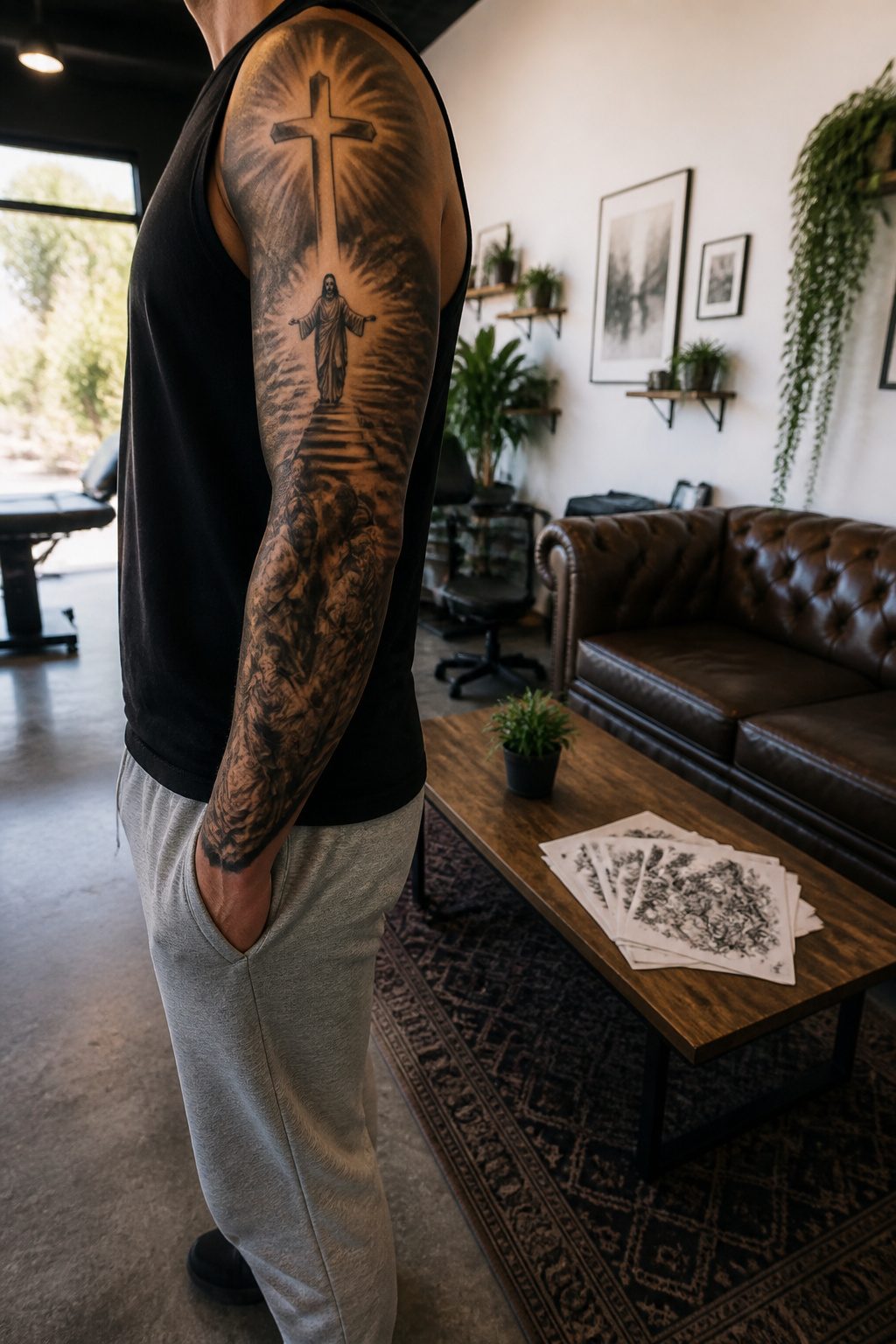
A half sleeve runs either shoulder to elbow or elbow to wrist, and that choice alone decides how public the work becomes.
The upper placement keeps the ink under a short sleeve without much thought; the lower half puts the image forward whenever you reach across a counter.
I spent a long afternoon in a shop once, watching an artist map a crucifixion scene from shoulder to mid-arm while the client next door sat through hour twelve of a full sleeve.
The difference in time and money was obvious even then. A half sleeve demands fewer sessions and less cash out, but it still reads as a complete piece rather than a fragment waiting to finish.
The versatility matters more than people expect at first. A full sleeve locks the whole arm into one narrative; the half sleeve lets you keep the other half blank, or save it for something separate years later.
For anyone weighing scope against commitment, this is the middle ground that actually works.
Jesus Chest Tattoo
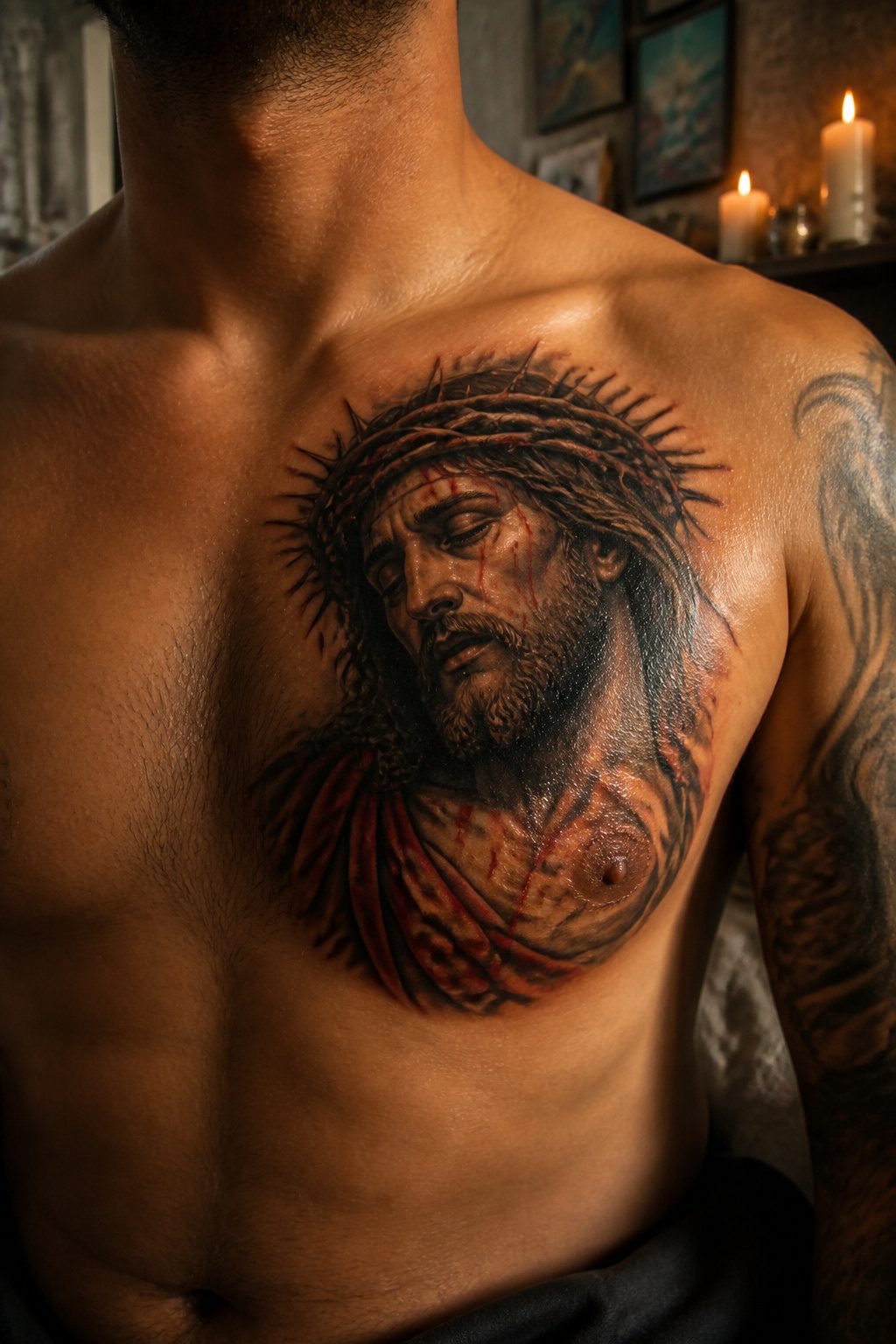
The chest carries a weight no other placement matches, sitting the work directly over the heart and keeping it close in a way that feels deliberately private.
Most artists who specialize in religious portraiture treat this area as reserved for the pieces that mean the most, not the designs meant to catch a stranger’s eye across a room.
That privacy comes with a cost: the skin here is thin, the bone sits close beneath it, and the sensitivity runs high enough that sessions often split into multiple sittings.
The pain factor ranks among the highest on the body, with the sternum and collarbone edges hitting hardest.
A Jesus chest tattoo therefore reads as a declaration made first to yourself, visible only when you choose, which is exactly why the format works for a deeply held faith rather than a passing interest.
What These Tattoos Mean
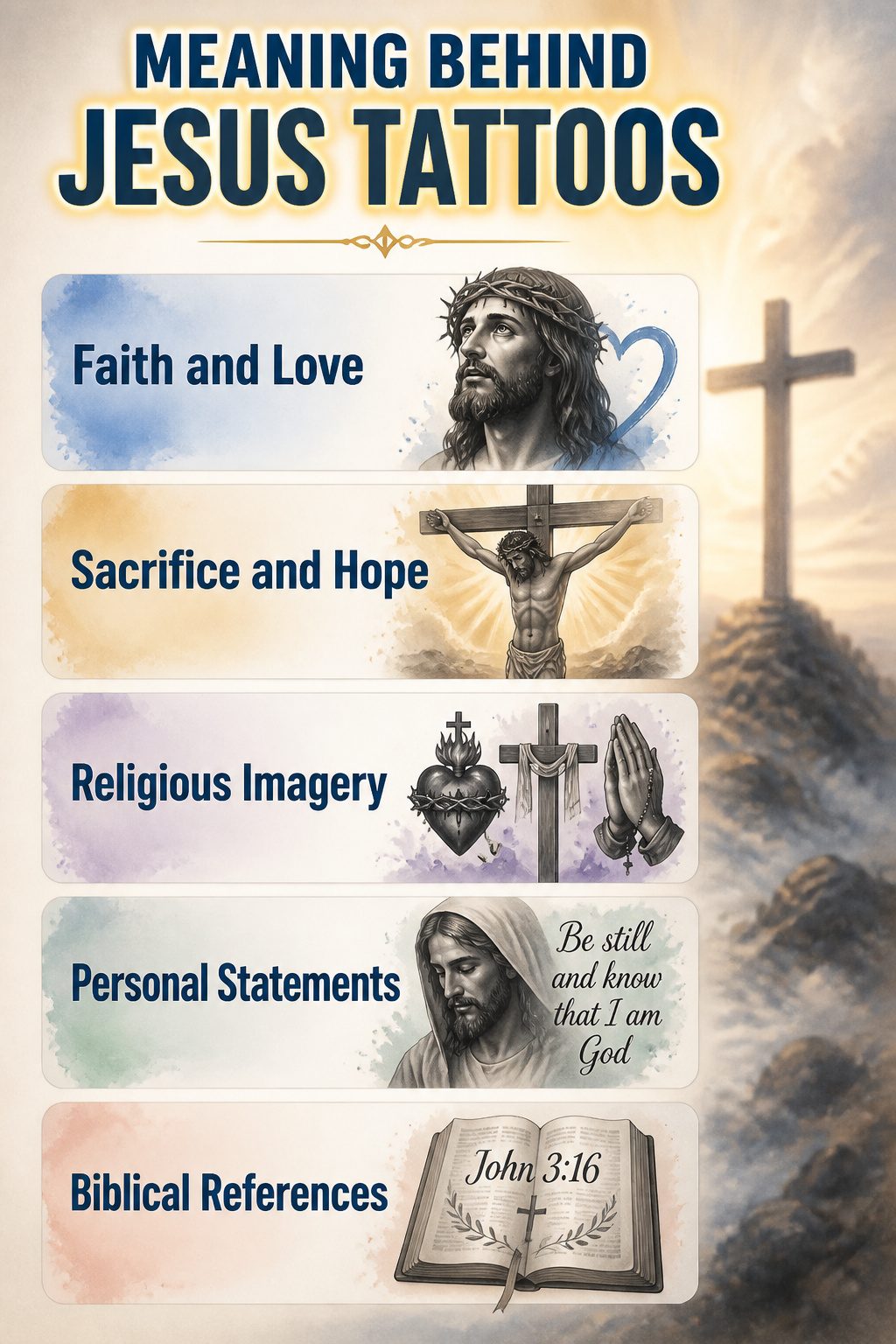
A tattoo of Jesus Christ carries weight that goes beyond the image itself.
For most people who choose this subject, the design represents faith, unconditional love, sacrifice, and hope, rooted in the belief that Jesus died on the cross to atone for the sins of humanity.
That core meaning draws in people devoted to the Bible and its teachings.
The image alone is only the starting point. Adding other religious imagery, a cross, a sacred heart, or praying hands, shifts what the tattoo communicates.
A quote or Bible verse pinned somewhere in the composition turns a standard piece into something that speaks to a specific moment or struggle in the wearer’s life.
Without those additions, the design risks reading as generic; with them, it becomes a personal statement of what that sacrifice and that hope actually look like for the person wearing it.
Where to Place the Work
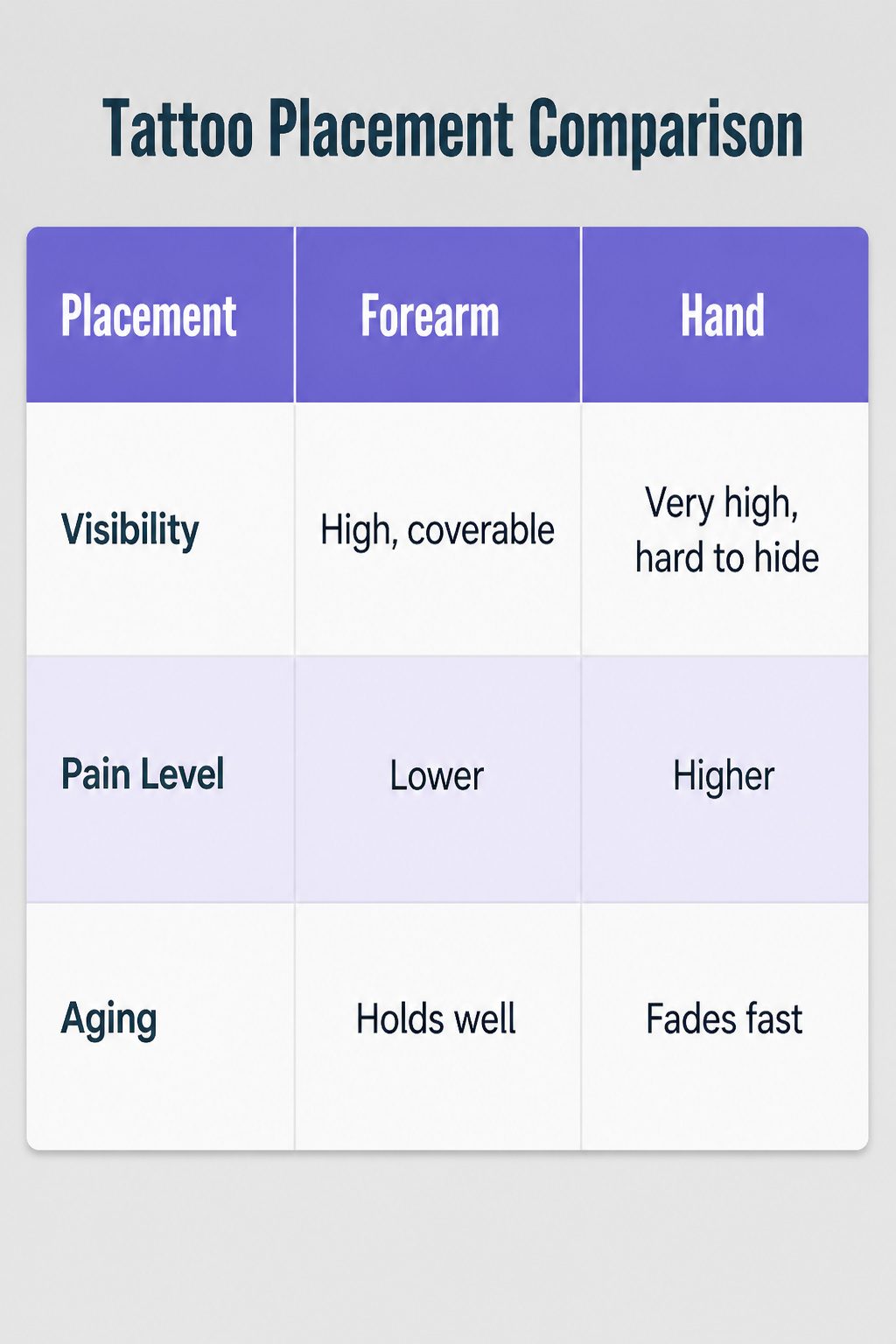
Placement shapes how often you see the piece, how much it hurts, and how long the lines stay crisp.
The forearm sits in a practical middle ground: visible enough to catch your own eye daily, easy to cover when work or family occasions call for it, and low enough on the pain scale that most people sit through a session without a break.
Skin there holds ink well, and the flat surface gives an artist room for detail on a Jesus portrait or a full scene of the crucifixion.
The hand tells a different story.
Nerve endings cluster close to thin skin and bone, so the needle hits harder, and the constant motion of washing, gripping, and sun exposure means hand tattoos fade faster than work on the arm or back.
What reads bold at six months can look washed by year two. That visibility is the tradeoff: the world sees your conviction, but the upkeep never really ends.
| Placement | Visibility | Pain Level | Aging |
|---|---|---|---|
| Forearm | High, coverable | Lower | Holds well |
| Hand | Very high, hard to hide | Higher | Fades fast |
| Upper arm | Moderate, easily covered | Lower | Holds well |
| Back/Chest | Low unless shirtless | Moderate | Holds well |
Back and chest give the most canvas for a full narrative scene, and the skin there ages slowly with less sun strain. For a piece meant to last decades with minimal touch-up, those larger areas win.
Making the Design Yours
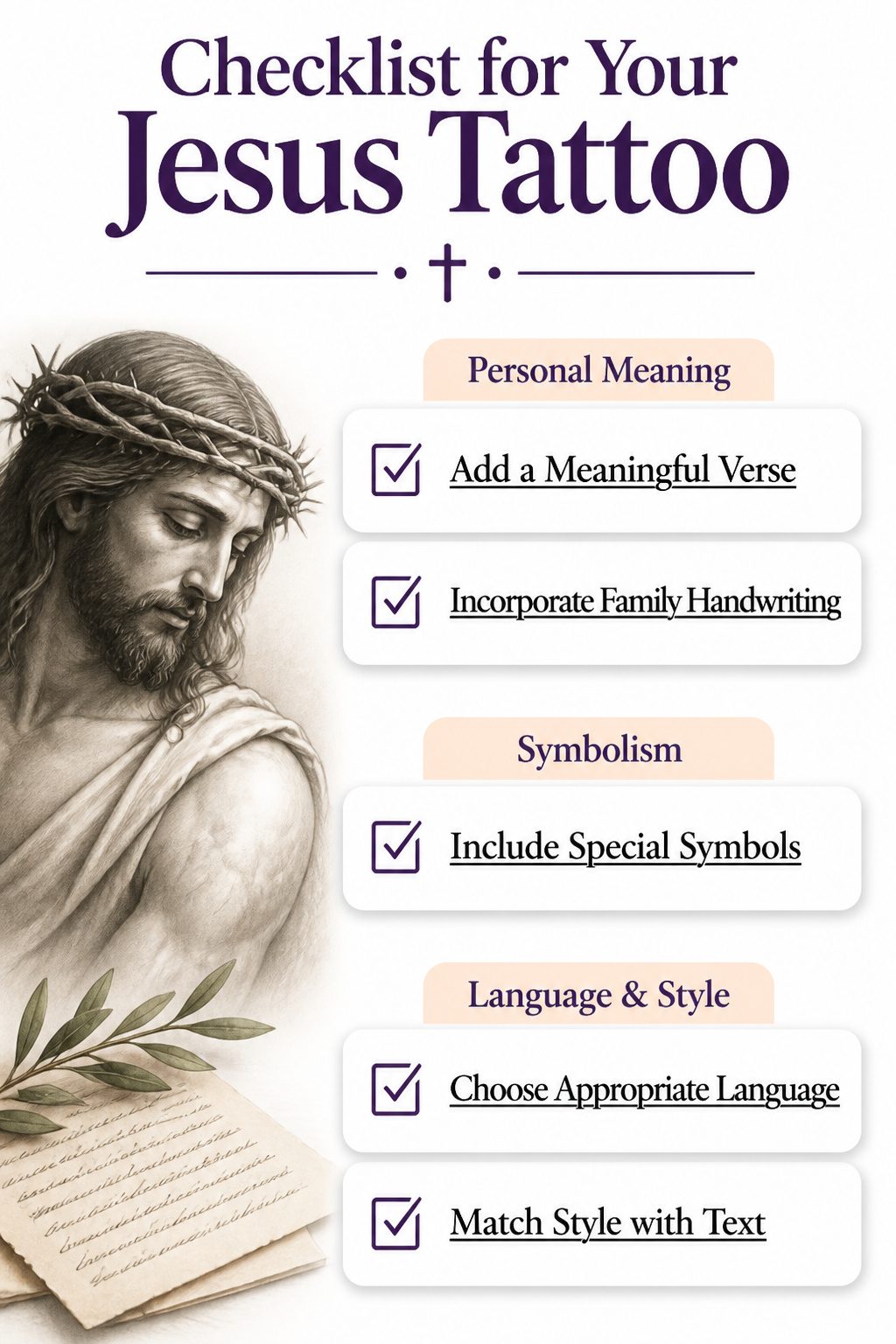
A standard Jesus portrait becomes something you carry when you add the verse that got you through a specific year, or the name of someone you prayed with.
One woman I heard from placed "Peace I leave with you" in her grandmother’s handwriting beneath a shoulder piece, turning a common image into a family record.
Scripture references work best small, tucked along the inner arm or collarbone edge where the eye finds them second.
Another collector paired a crucifixion scene with a single olive branch, not for decoration but because the garden of Gethsemane sat in his mind during a particular loss.
The design still reads as traditional; the private meaning lives in the detail you have to be close enough to ask about. That proximity requirement is part of the point.
Quotes in Latin or Greek age better than English, though the translation should sit somewhere in your own notes, not necessarily on the skin.
I have seen "I am the way" rendered in Aramaic script lose its impact because the lettering looked decorative rather than intentional.
Match the language to the style of the figure: a Renaissance-influenced Christ carries Latin naturally; a rough woodcut style wants plain English or none at all.
Frequently Asked Questions
Did Jesus have a tattoo?
Jesus Christ did not have a tattoo. The confusion comes from Revelation 19:16, which describes a name written on his vesture and thigh, but this is generally understood as symbolic rather than a literal tattoo.
What does a tattoo of Jesus mean?
A Jesus tattoo represents faith, unconditional love, sacrifice, and hope, rooted in the belief that Christ died to atone for humanity’s sins.
Adding crosses, sacred hearts, praying hands, or Bible verses shifts the meaning and makes the piece personal rather than generic.