Spartan tattoos range from a helmet tucked behind the ear to a full sleeve of black-and-grey temple ruins that takes multiple sessions to finish.
What decides which one belongs on your skin is how much space you can give it and whether you want the warrior as a person or as a symbol.
1. Realistic Spartan Tattoo
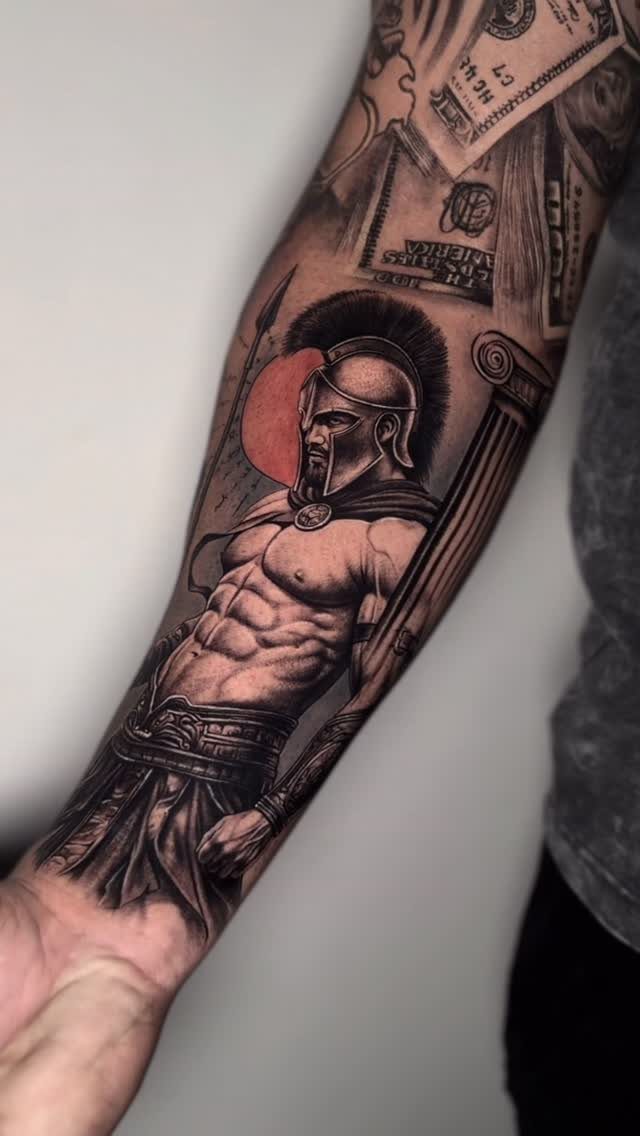
A black-and-grey Spartan in full Corinthian helmet and armor reads as portrait work rather than symbol.
White ink on the cheek guards and the crest’s edge gives the helmet its weight, the same way a painter uses titanium white to pull bronze forward from shadow. The column beside him sets the era without cluttering the arm.
This suits someone who wants the warrior as a person, not an icon. The style demands a larger flat area: forearm, thigh, or calf.
A sleeve or chest piece competes with too many other elements and breaks the stillness that makes realism work.
Budget for multiple sessions. Solid black and grey with selective white is less forgiving than bold traditional work; the artist needs time to build temperature in the metal and fabric.
2. Wolf and Spartan Tattoo
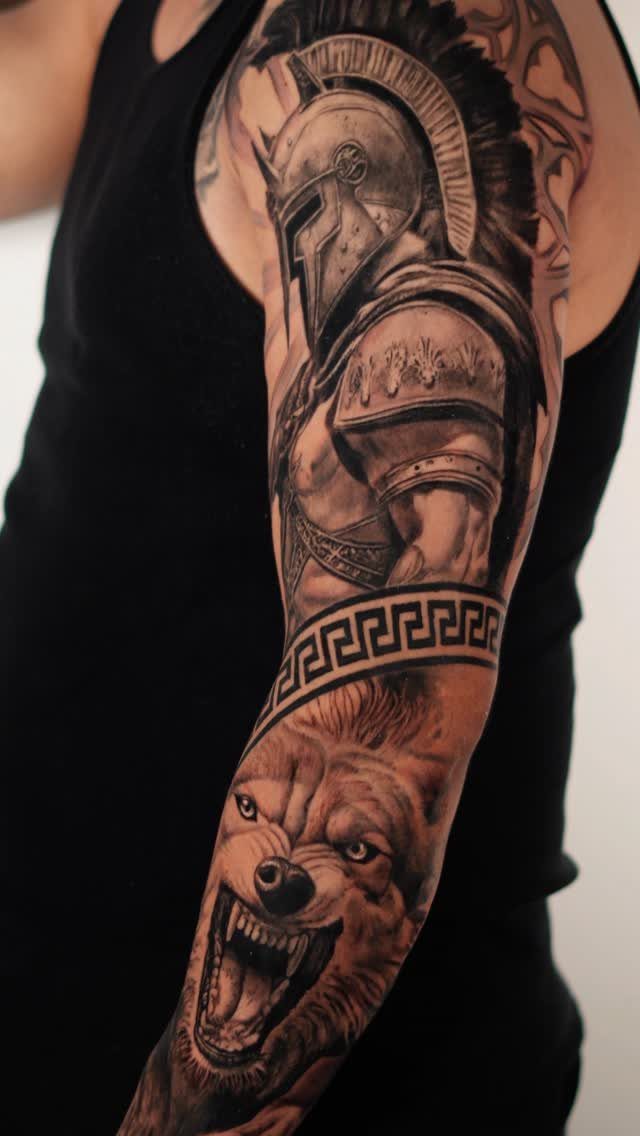
The pairing works because the two animals share a job description. Wolves run on pack logic and Spartan phalanx fighting does the same; both protect the group at cost to the individual.
A Greek key band between the wolf and the warrior keeps the arm from reading as two separate tattoos that happened to land nearby.
I would keep the wolf on the forearm and the Spartan higher, where the bicep rounds the helmet into three dimensions.
Reverse it and the wolf’s muzzle points toward your hand every time you gesture, which reads as aggression you did not choose.
The leaf or geometric base matters more than most people plan for. Without it, the wolf floats.
Ask your artist to draft that connective tissue first; it is easier to adjust a border than a face.
3. Lion Spartan Tattoo
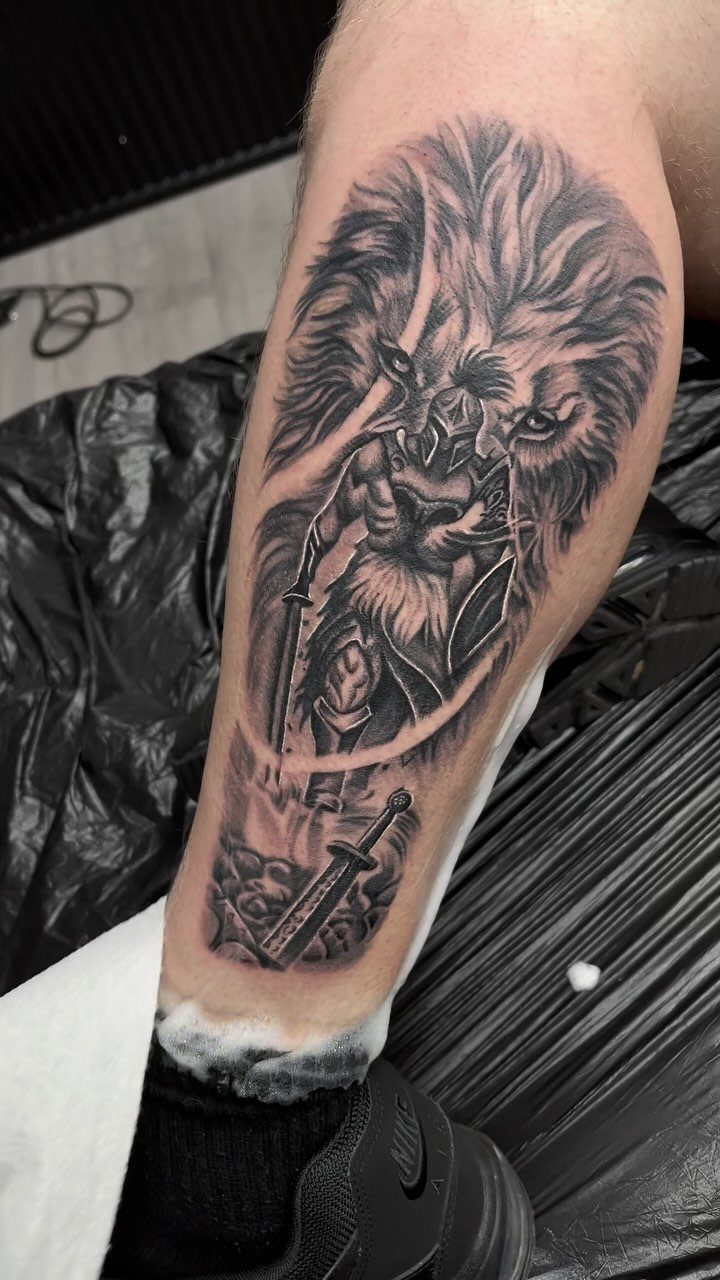
Superimposing the lion behind the soldier solves a composition problem. Two figures of equal weight fight each other for space; layering them lets the lion carry the background while the Spartan holds the foreground action.
The lower leg uses the calf’s natural curve to shape the lion’s mane around the warrior’s stance.
Black and grey keeps both readable. A color lion and grey soldier, or the reverse, splits the eye and the tattoo reads as two ideas colliding rather than one fused symbol.
If you want color, limit it to the Spartan’s cloak or the lion’s eyes, one accent each.
This needs a substantial canvas. The lion’s face requires enough scale for the mane to read as texture, not mud.
Calf or outer thigh; the ribs will compress the mane into stripes.
4. 300 Spartan Tattoo
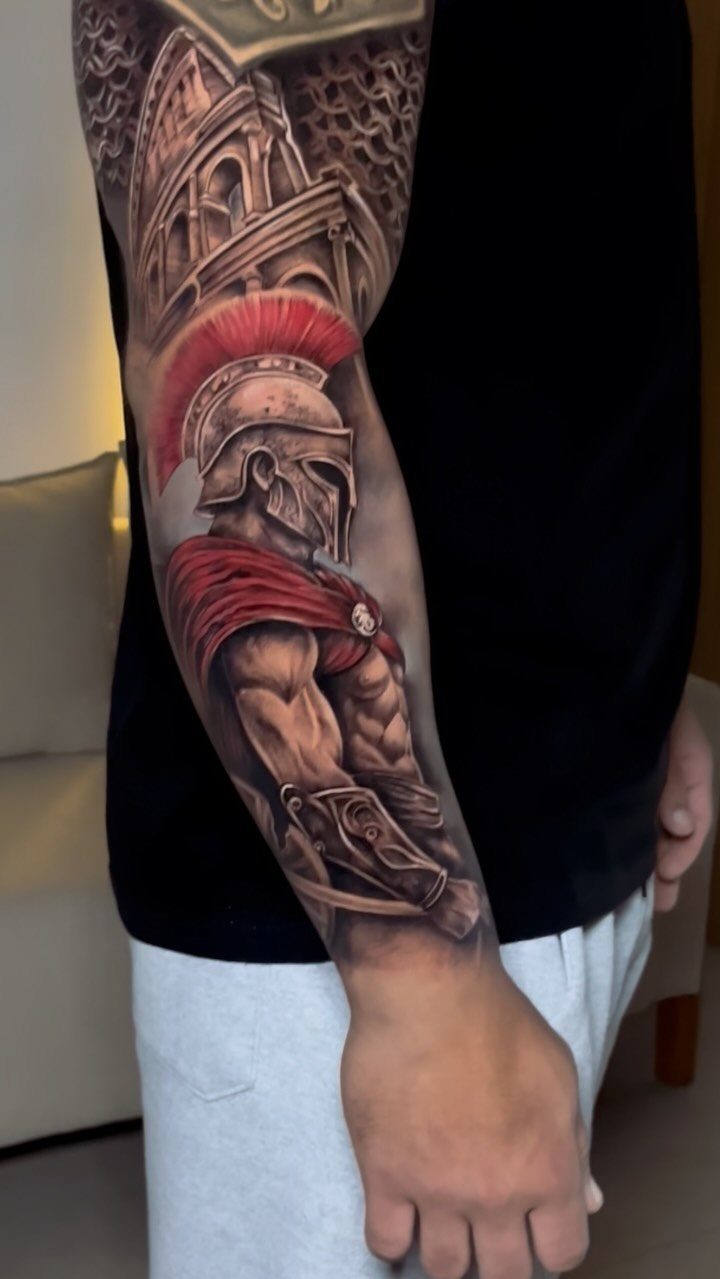
The 2006 film’s look is specific: desaturated bronze, blood as a near-brown rather than bright red, and that particular helmet crest falling forward.
This works best if the movie meant something to you at a specific time. The visual shorthand is strong enough that viewers will read the reference, so you should want them to.
A sleeve placement lets you add the ruins or the Colosseum as environment, though historically the battle was Thermopylae, not Rome; the architecture sets mood, not exam answers.
The red must stay muted. Bright vermilion tips the cape into carnival territory and loses the film’s dried-blood palette entirely.
5. Greek Spartan Tattoo
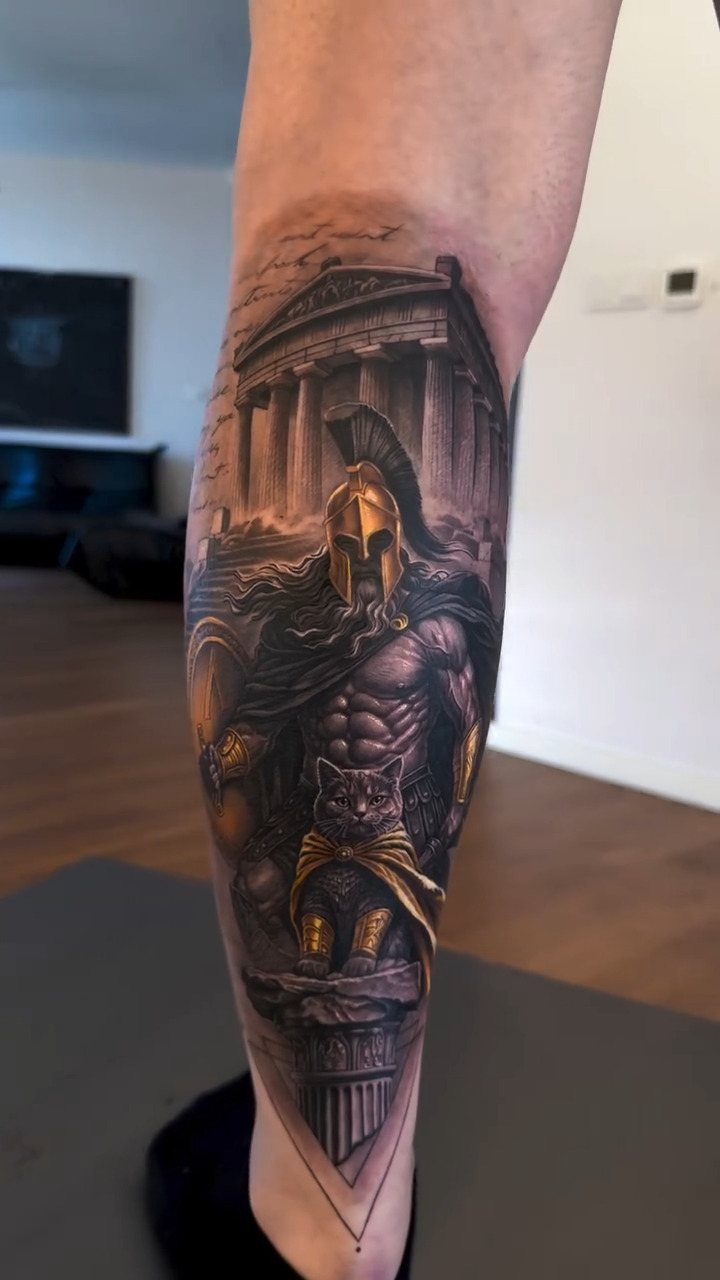
A Spartan helmet alone can read as gym logo. Adding Greek key, columns, or olive branches anchors it in history rather than fitness culture.
The temple and broken column give the warrior somewhere to stand, which sounds obvious but changes how the eye travels: the helmet becomes a detail in a world, not a sticker.
I would pick two Greek elements maximum. Alphabets, gods’ symbols, architectural fragments, and olive branches all fit under this heading.
Three or more compete; two let the helmet stay central.
My choice would be key pattern plus one column, or a single god’s symbol that means something specific: Athena’s owl for strategy, Poseidon’s trident if your family has seafaring history, Zeus’s thunderbolt for sudden force.
The cat in armor is a joke that only works because the rest of the piece is serious. Do not attempt this unless your artist has done humor before; deadpan technical skill carries it.
6. Molon Labe Spartan Tattoo
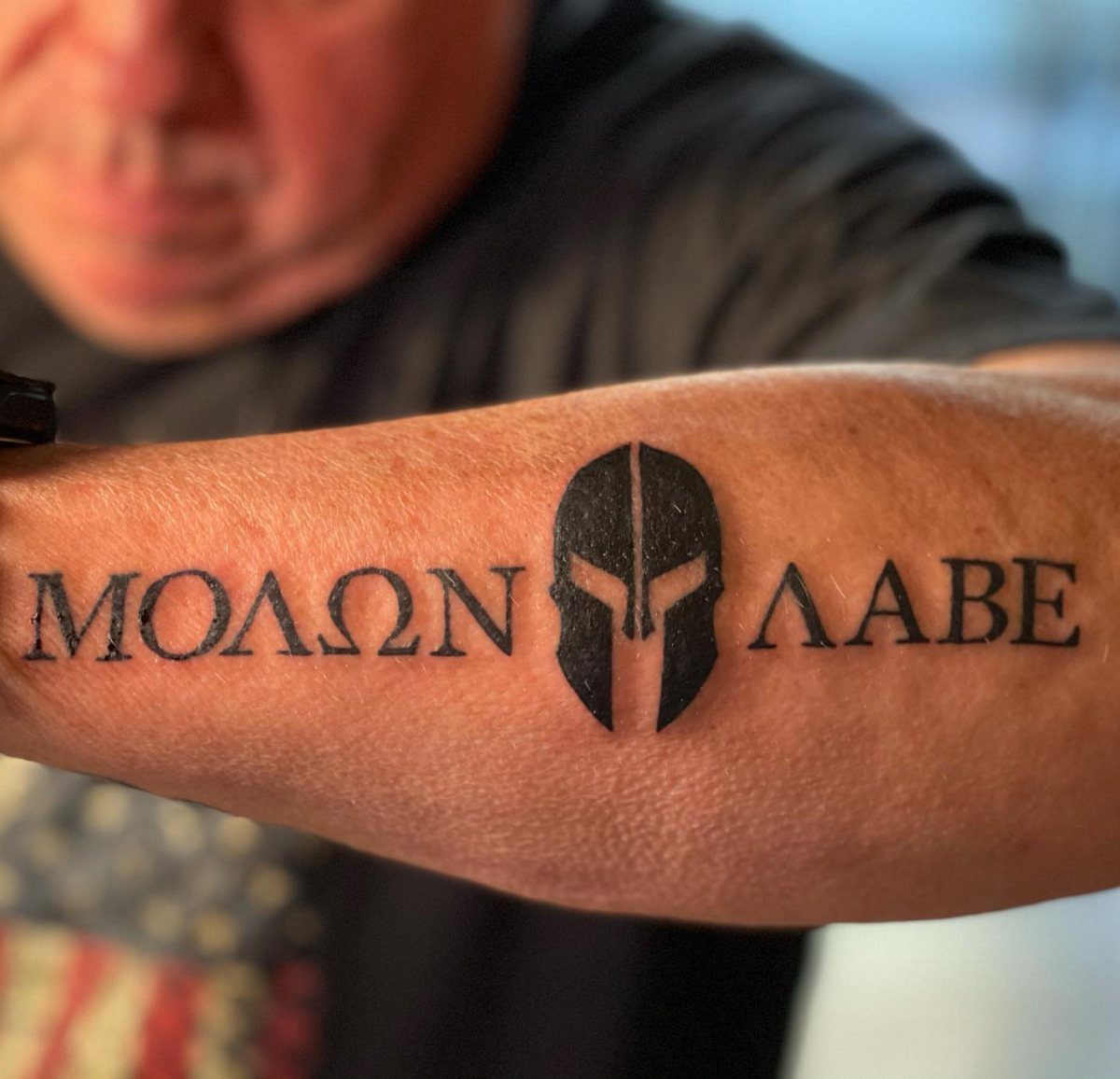
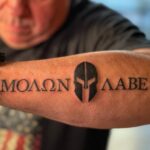
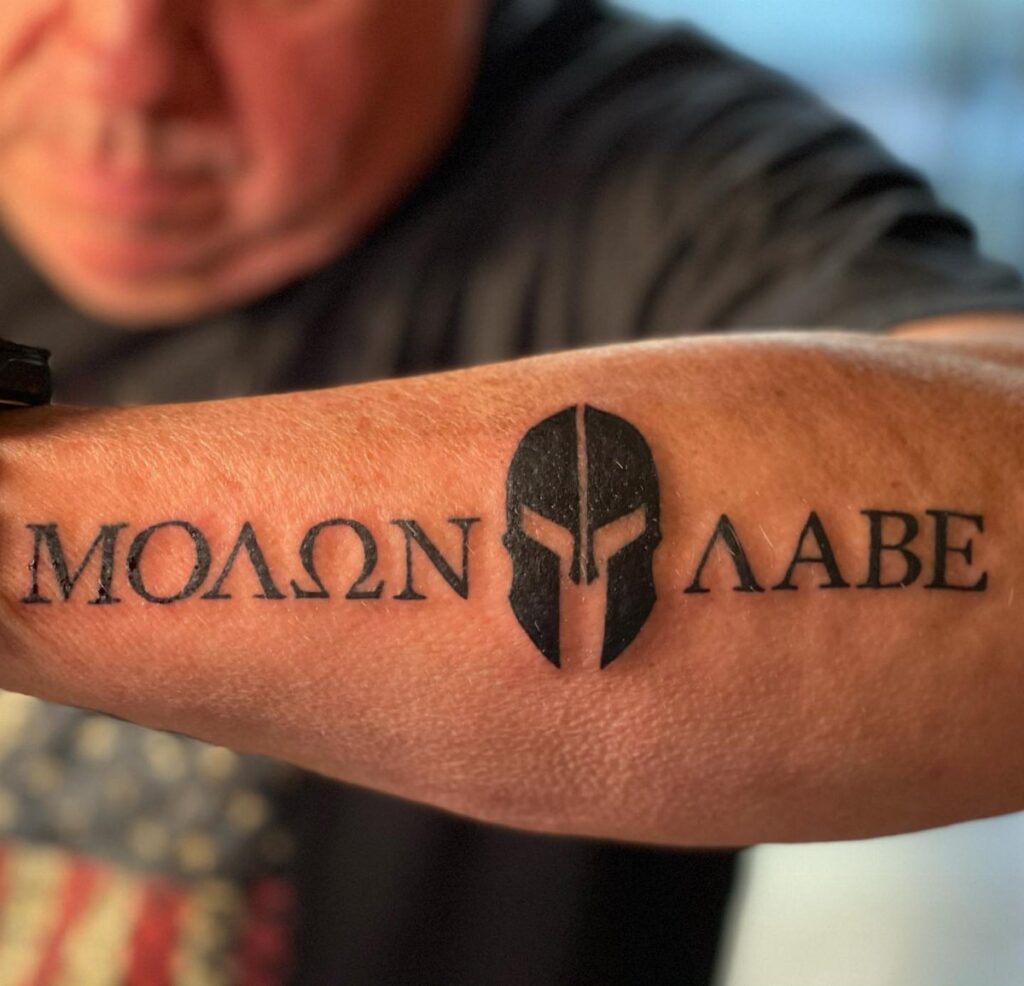
"Come take them," Leonidas’s reply to Xerxes demanding the Spartan weapons, works as text because the helmet icon does the visual work.
The forearm placement keeps the Greek words readable at arm’s length, which matters: "ΜΟΛΩΝ ΛΑΒΕ" in authentic script looks like a fraternity formal to anyone who cannot read it, and the wearer should know what they are carrying.
The Romanized "MOLON LABE" is easier to verify but loses the Greek element entirely. I would go with the Greek and accept that most viewers will ask what it says.
A phrase tattoo either starts conversation or stays private, and forearm is public.
Black ink only. Color on text this spare looks like a sports jersey.
The helmet silhouette between the words needs weight; too light and the phrase separates into two floating tattoos.
7. Small Spartan Tattoo
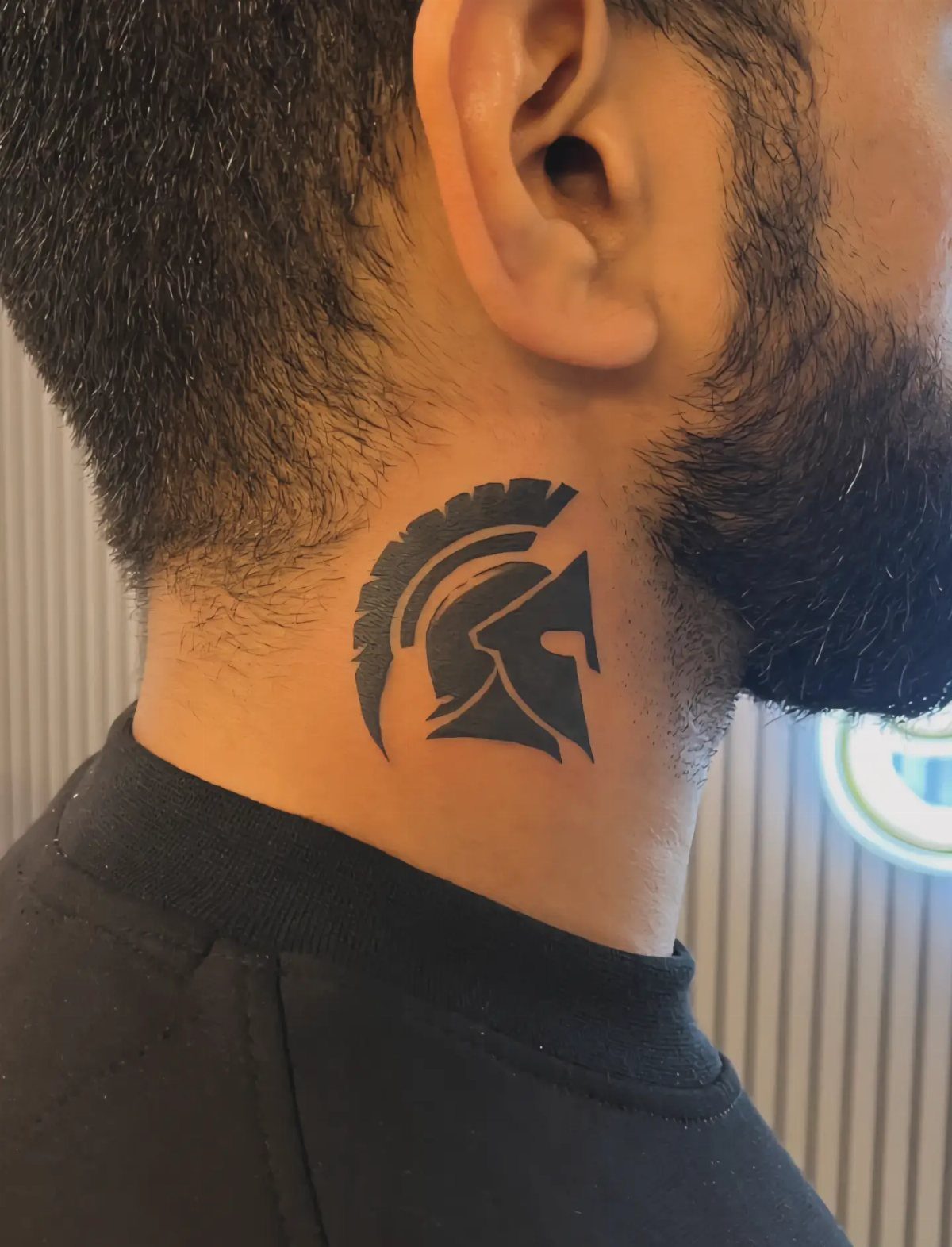
A minimalist Spartan helmet keeps the symbol without the sleeve commitment. The black and gray palette with bold lines and vignette shading gives that worn, antique-metal texture even at an inch or two.
Placement below the ear works for someone who wants it found but not announced; the inner forearm or ankle bone are other spots where a small piece reads cleanly.
Detail is what you give up: the face, the muscle, the story. What you keep is immediate recognition.
For a first tattoo or a Greek heritage nod that does not dominate, this is the one to book.
8. Cool Spartan Tattoo
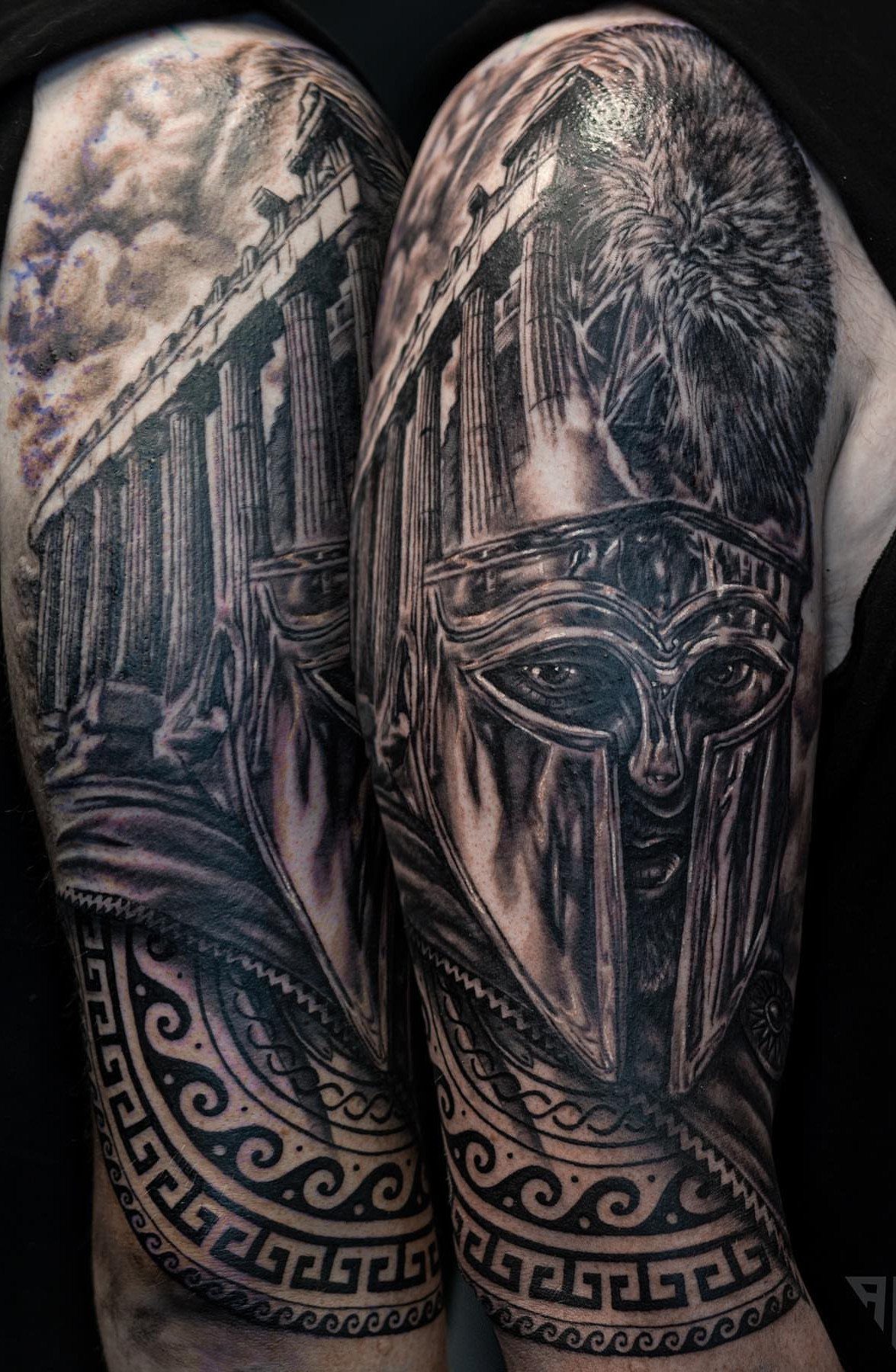
A full sleeve lets you build a scene: helmeted warrior, temple columns, meander border tying it together. The black and grey realism here uses advanced shading and filigree to separate the elements without crowding them.
This demands time, money, and a chair you can sit in for multiple sessions. The piece reads as leadership and physical discipline, the qualities Spartans trained for years to earn.
If you want the warrior spirit but not the full sleeve, a single sword or shield in the same style carries the symbol without the commitment.
9. Spartan Army Tattoo
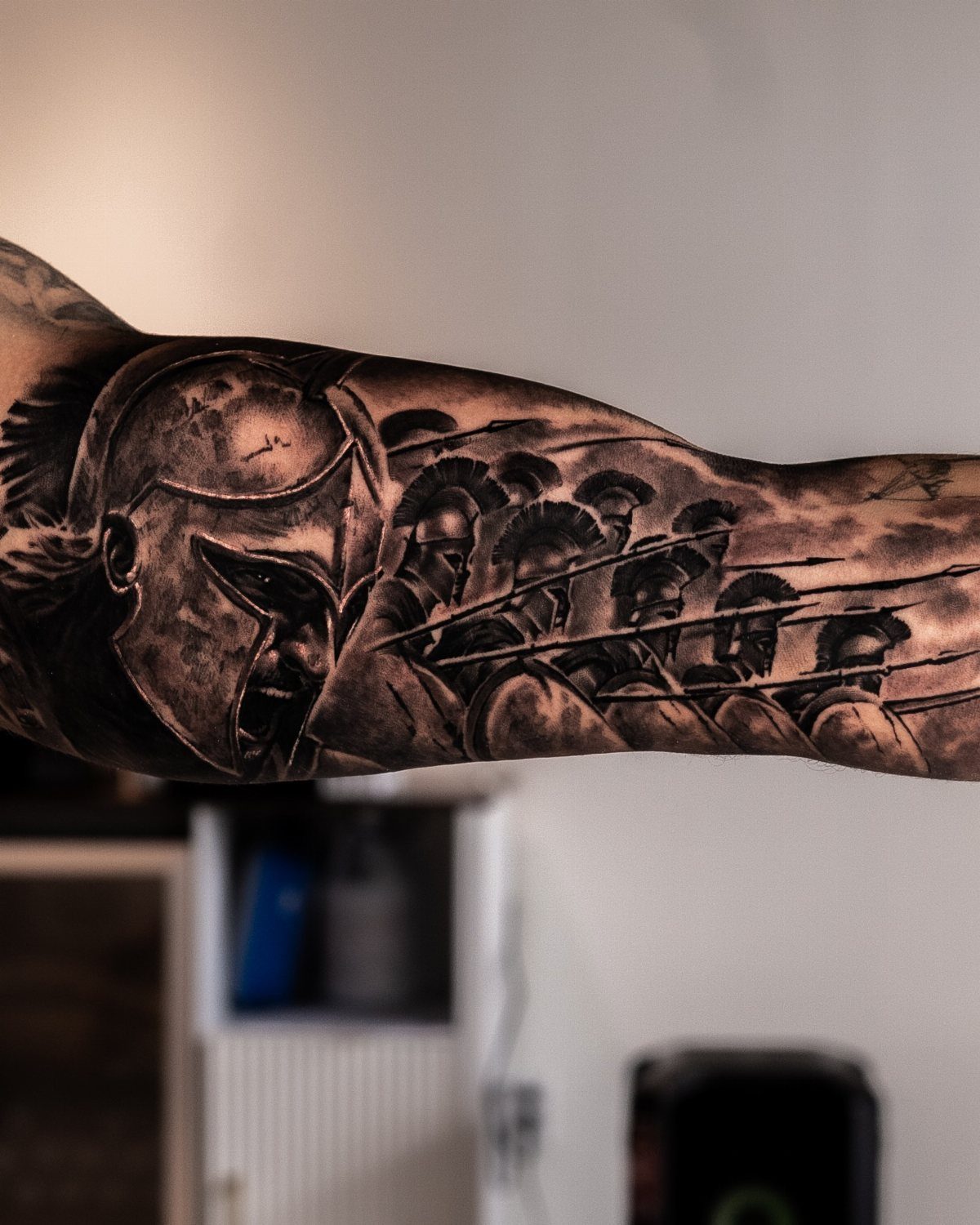
A single Spartan warrior carries weight, but a phalanx changes the story entirely.
The forearm placement here keeps the formation readable at a glance: the lead figure in sharp detail, the line behind him fading slightly to suggest depth without crowding the canvas.
Color would split attention across too many points; the eye needs to travel from the shouting face to the advancing spears in one motion. Ask your artist how many soldiers the space can hold while keeping each shield distinct.
On a narrower arm, three figures behind the lead reads as a column. A broader canvas lets you add background soldiers with less detail on each.
This piece rewards patience. Sessions run longer than a solo helmet, and the line work must stay consistent across sittings.
I’d schedule this only after seeing a portfolio with similar multi-figure compositions healed, not fresh.
10. Spartan Warrior with Motivational Words
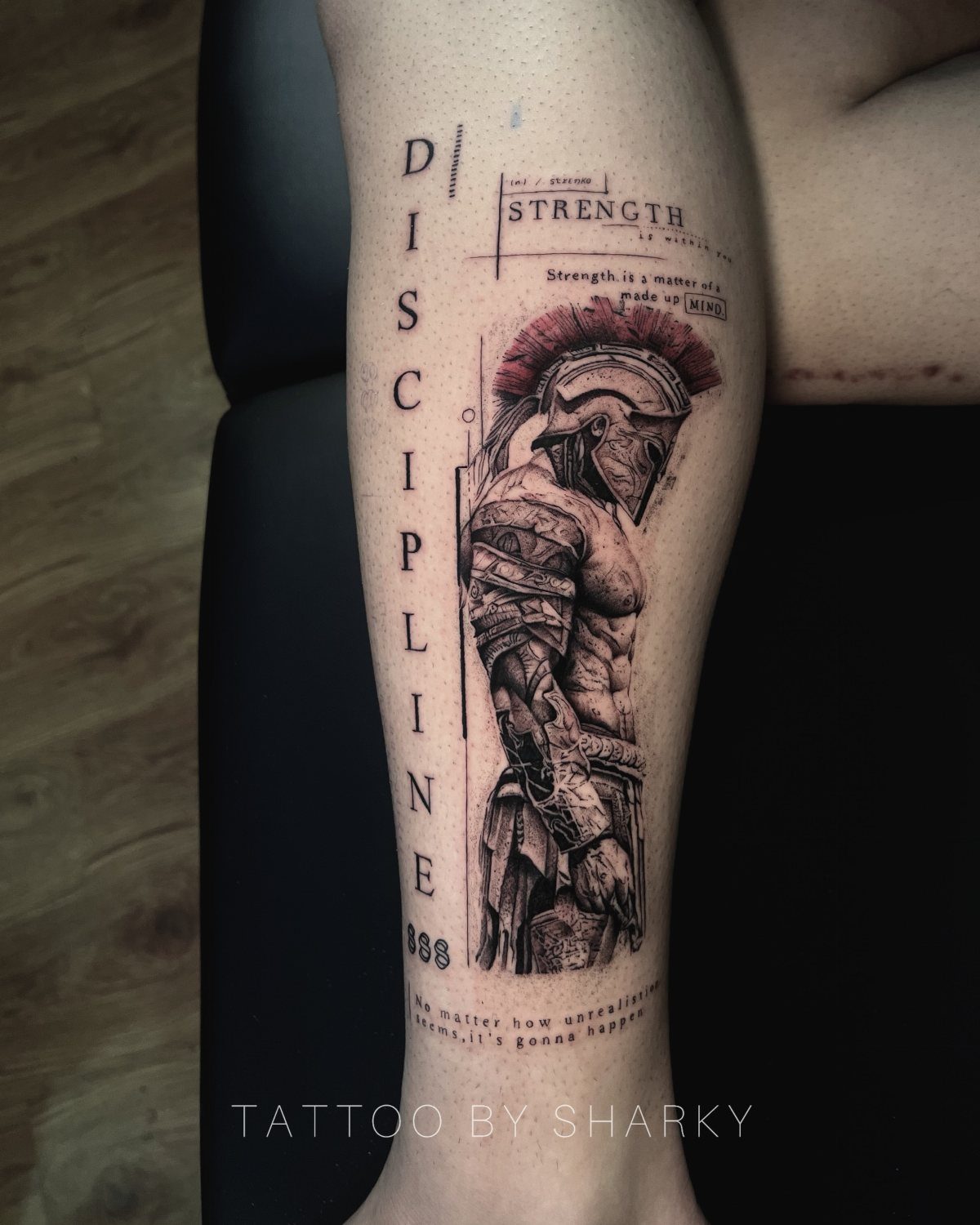
Typography turns a warrior portrait into a personal manifesto. The vertical "DISCIPLINE" running alongside the figure here does what a caption cannot: it becomes architecture, framing the helmet and armor rather than floating beneath them.
Placement on the lower leg gives the words room to breathe at scale large enough for clean lettering. Smaller fonts blur over time; this size holds.
Single-concept words like DISCIPLINE, STRENGTH, MIND share a rhythm: no articles, no softening. That consistency matters more than the specific choices.
Pick words you have actually thought about during hard moments, not ones that sound impressive.
Black-and-grey for the figure keeps the focus on form; the text can match or carry a slight weight difference.
I prefer the words in the same tone as the armor, letting the composition read as one piece rather than illustration plus caption.
11. Spartan Helmet Back Piece
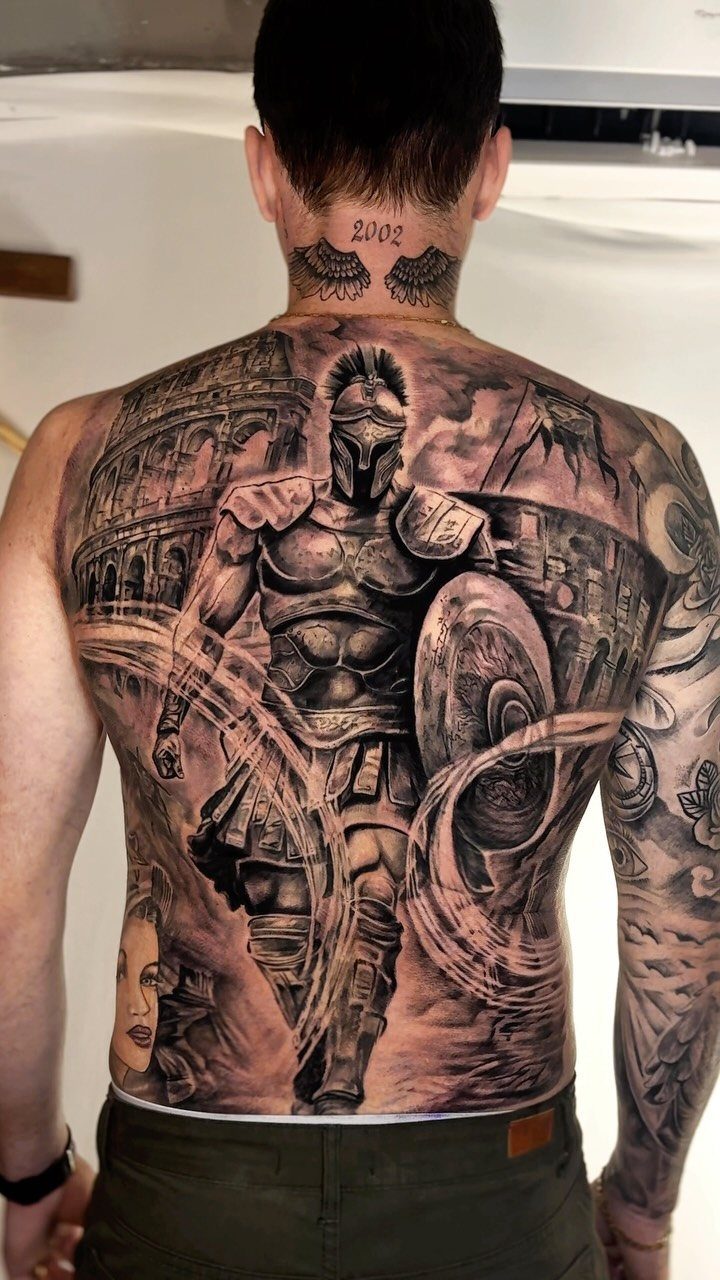
The back is the only canvas that lets a Spartan stand at full scale against architecture and sky. Here the warrior faces forward, spear ready, with ruins behind him and clouds above.
The vertical space from neck to waist becomes the scene itself.
This demands a specialist in large-scale realism, not a generalist who sometimes takes big pieces. The architectural elements, columns and stonework, require perspective skill that portrait work alone does not prove.
Ask to see healed back pieces specifically; fresh ink hides uneven saturation that shows up months later.
A date on the neck suggests personal significance without explaining itself. Adding a year or a short phrase in a separate location, rather than crowding the main scene, keeps the narrative layer distinct from the visual one.
A piece this size rushed in marathon sittings heals poorly and settles unevenly.
12. Spartan Helmet with Red Crest
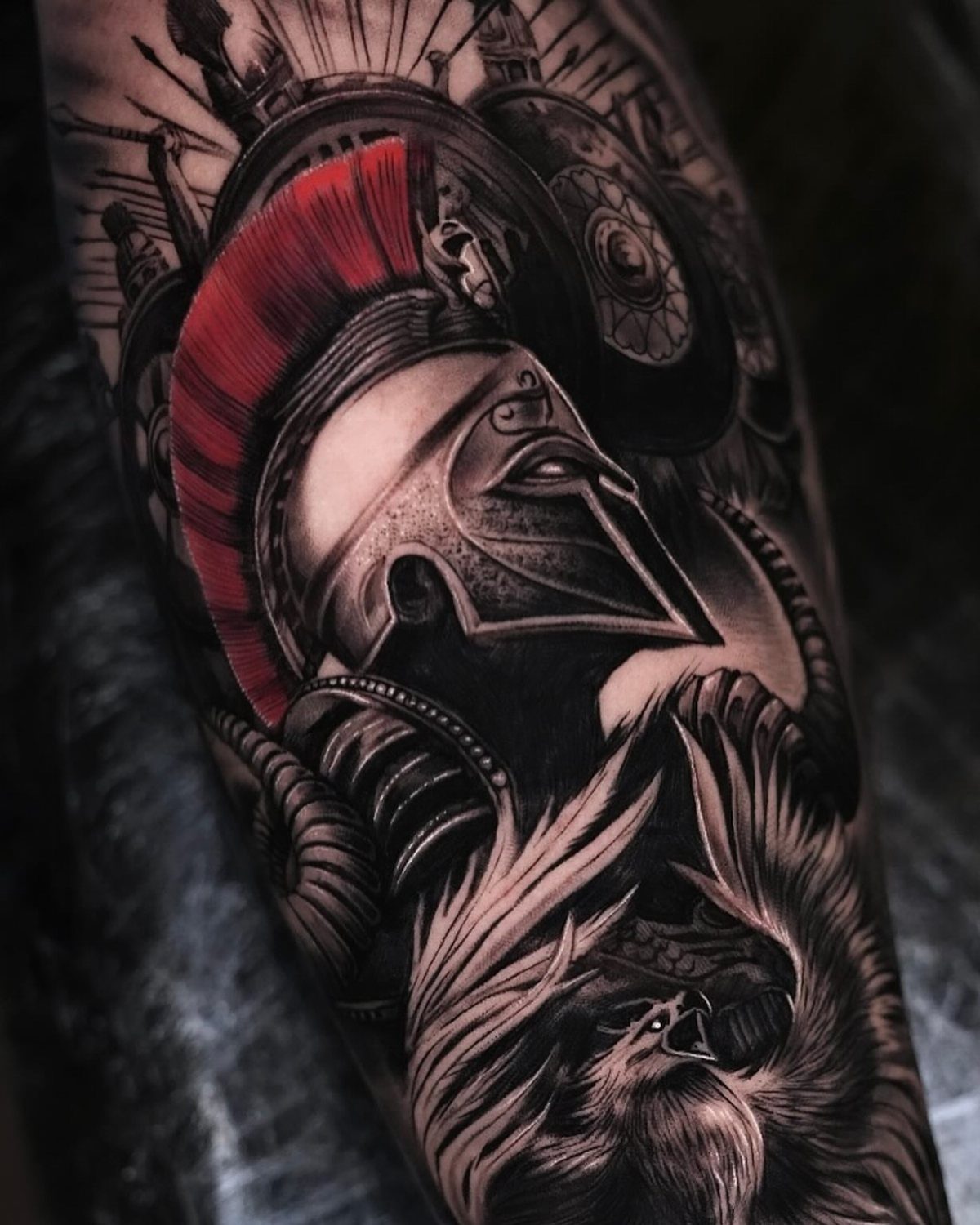
One color, precisely placed, turns a monochrome helmet into something alive. The red crest here draws the eye first, then lets it travel down into the greyscale detail of the Corinthian curves and cheek guards.
Red ink behaves differently than black. It fades faster, it can spread slightly at edges, and it demands a touch-up plan before the first needle touches skin.
The artist needs experience with saturated color in black-and-grey contexts, not just color work on its own. Ask how the red will read once it has aged against the black.
The surrounding warriors and eagle visible in this piece add narrative density, but the crest works alone on a simpler composition too.
For a first large piece, I’d consider the helmet and plume by themselves, letting the red carry the impact without competing elements.
13. Spartan Helmet Tattoo
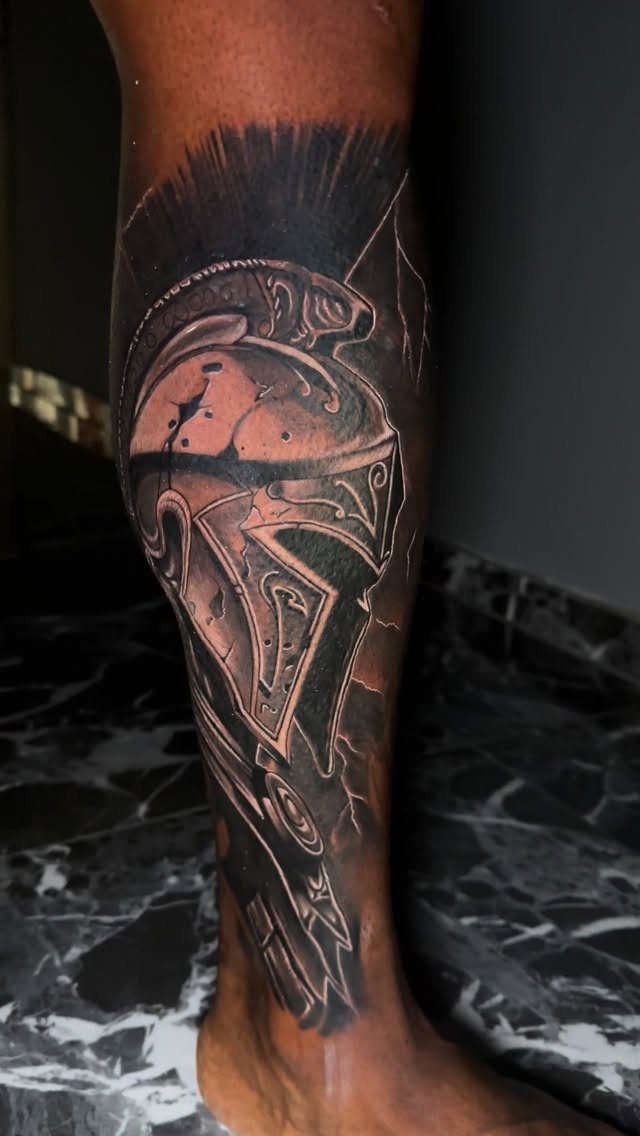
The lower leg offers a natural cylinder for a helmet portrait, and the calf muscle provides subtle contour that flat planes cannot.
Here the helmet sits with lightning accents carved into the negative space around it, the dark background making the metal read as emerging from shadow.
Lightning is a specific choice, not a default. It adds motion and a slight modern edge to classical subject matter.
Without it, the piece reads as historical reconstruction; with it, the Spartan becomes symbol rather than reenactment. Either works, but the decision shapes what else belongs nearby.
The intricate shading on the cheek guards and nasal piece requires an artist comfortable with smooth gradations in a small area.
Leg skin, especially over the calf, holds detail well but can swell during sessions, making long sits harder than on the upper arm. Plan shorter appointments.
This placement shows in shorts and hides in formal settings, a practical balance for professional environments where visible ink still carries weight.
Meaning of Spartan Tattoos
A Spartan tattoo carries weight beyond the gym poster version of the warrior.
A helmet or shield in a Spartan tattoo usually reads as discipline, the sort that carries someone through training, recovery, or a long shift after motivation has run out.
The Greek heritage angle matters to some wearers and not at all to others. Either choice is valid, but the tattoo reads differently depending on which one you bring.
A connection to Sparta’s actual history grounds the piece in duty and sacrifice for something larger than yourself. A purely personal reading keeps the focus on individual resilience.
The artwork succeeds either way if the meaning is settled before the needle starts.
Cultural Significance
Sparta’s military culture ran from roughly the 6th to the 4th century BCE, a period long enough that the city-state became shorthand for an entire approach to training and social order.
Male citizens entered the agoge at age seven and stayed in some form of state-directed life through adulthood. That system produced soldiers who held formation at Thermopylae against numbers that should have broken them.
The helmet in your tattoo descends from that specific era and its choices about what a citizen was for. The austerity, the group loyalty over family, the contempt for comfort: these were not side effects but curriculum.
A tattoo that references this history honestly does not need to celebrate all of it. Borrowing the imagery means knowing what you are borrowing.
Design Styles
Black and grey realism suits the subject because Spartan equipment was bronze and iron, not bright banners. The metal reads as temperature, not color: warm where light hits, cold in shadow.
Bold color can work but fights the source material. The ancient world was not monochrome; it was dusty.
Ochre, faded crimson, the green that bronze turns after centuries underground. A color piece that goes accurate rather than vivid will look correct longer than one that reaches for saturation.
Ask to see healed photos of any color the artist proposes. Fresh ink lies about how it will settle.
Placement of Tattoos
The arm, chest, and back serve the design because they offer flat or gently curved skin at scale.
A helmet with Corinthian detail needs room for the nose guard to read as protective rather than decorative, and a phalanx scene needs width to show the shield overlap that made the formation work.
The forearm splits the difference between display and cover. It shows when you gesture and hides under a long sleeve without the compression that distorts a back piece under a tailored jacket.
The calf is less common for Spartan work but underrated: the muscle gives a standing warrior a ground plane, and the curve shapes a column or a meander border without forcing the design flat.
Small placements demand simplification. Below the ear or at the ankle bone, the helmet becomes outline and suggestion.
That is not a lesser choice; it is a different contract with the viewer, one that asks them to complete the symbol from a few lines.
Frequently Asked Questions
What does a Spartan tattoo stand for?
A Spartan tattoo stands for bravery, strength, and resilience, the qualities that defined the warrior culture of ancient Sparta.
The helmet or figure stands for keeping your discipline when the pressure is on, and for giving something up when the cause matters more than you do.
Most people who choose this symbol want the warrior spirit rather than a history lesson, though adding Greek key, columns, or a god’s symbol can anchor it in heritage rather than gym culture.
What is the 1/3 rule tattoo?
The 1/3 rule in tattoo composition means dividing the available skin into thirds and placing the main subject in one of those divisions rather than dead center.
Centering every element flattens the image; offsetting the Spartan helmet or figure creates movement and lets the eye travel through the scene.
A wolf on the forearm and a Spartan higher on the bicep follows the arm’s natural thirds, rather than crowding both subjects into the middle.