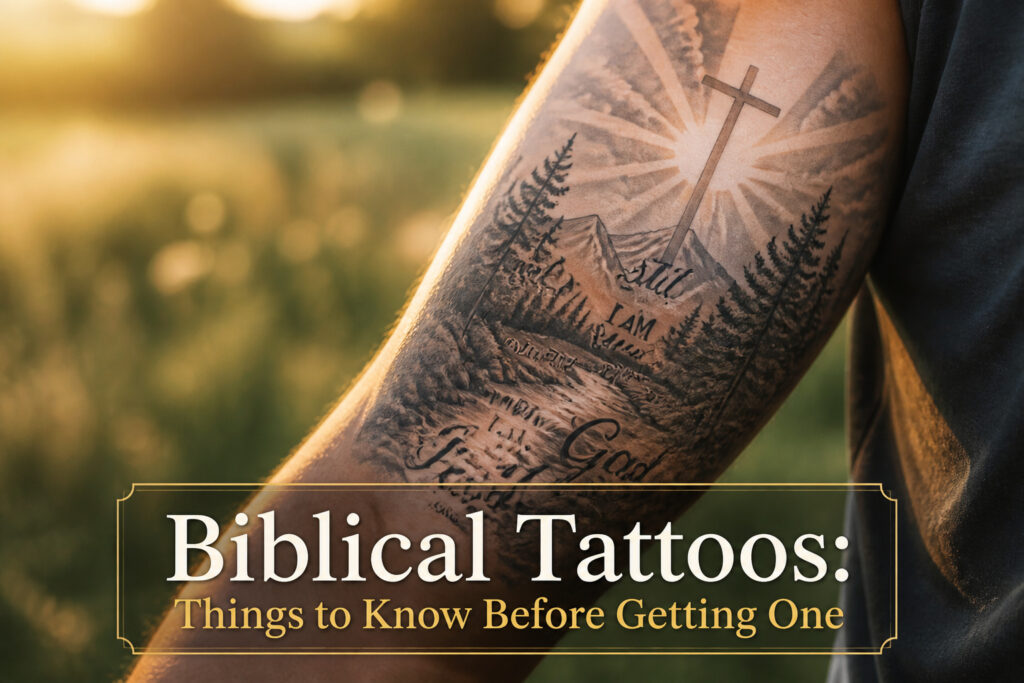
The New Testament never mentions tattoos, which means the decision rests on your own conscience rather than a clear rule.
The catch is that Leviticus 19:28, the verse most people quote to forbid them, sits in a chapter that also bans trimmed beards and cotton-poly blends, rules most Christians quietly ignore. A biblical tattoo is rarely the sin; the motive is.
1. Biblical Verses Against Tattoos

Leviticus 19:28 sits at the center of almost every conversation about whether Christians should get tattoos: "You shall not make any cuts on your body for the dead or tattoo yourselves: I am the Lord."
The wording is direct, and five separate biblical discussions treat it as the single explicit prohibition on the practice. What complicates the reading is context.
The same passage bans trimming the edges of your beard and cutting the hair at the sides of your head, rules most modern Christians do not observe.
The tattooing described was tied to pagan mourning rituals, not to the decorative or devotional ink people seek today. Scholars read the command as part of a larger project: setting Israel apart from neighboring nations by rejecting their religious customs.
The principle of holy distinction still matters for many believers, even if the specific ritual no longer applies. That leaves the verse doing real work in the debate, but rarely settling it.
2. Contextual Interpretation of Tattoos
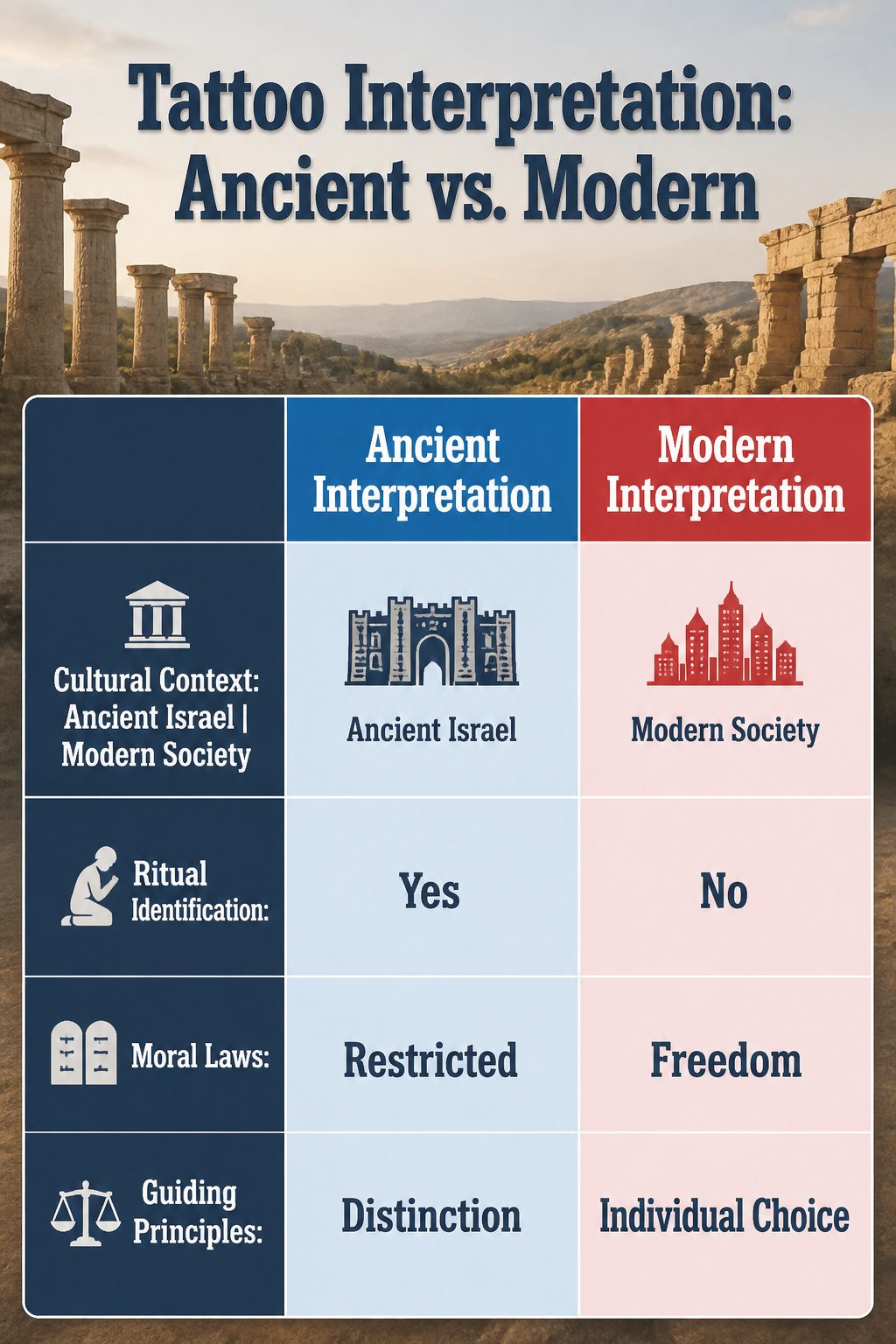
Leviticus 19:28 sits in a chapter packed with commands that separated ancient Israel from neighboring peoples.
The same verse that bans tattooing also forbids cutting the hair at the sides of your head and trimming the edges of your beard, practices tied to Canaanite mourning rituals.
Most Christians today trim their beards without a second thought, which tells us something about how these laws functioned in their original setting.
The cultural context of ancient Israel matters here. The tattoo prohibition appears alongside cutting the body for the dead, a specific pagan mourning practice.
The law targeted ritual identification with foreign gods, not decorative body art.
Four separate interpretive traditions make this case: the command belongs to a covenant code meant to distinguish Israel’s worship practices from surrounding nations, not to establish a permanent aesthetic rule for all time.
When Jesus speaks of fulfilling the Law rather than abolishing it, and Paul describes Christ as the culmination of the Old Testament commandments, the question becomes which principles carry forward and which stayed bound to their ancient purpose.
The New Testament letters never revisit tattooing as a live issue for Gentile believers, which itself signals how the early church read these passages.
3. New Testament Perspective

The New Testament never directly mentions tattoos, and that silence is exactly what makes this a genuine question rather than a settled rule.
Four separate discussions of the topic all point to the same gap: no verse in the Gospels or Epistles says yes or no to ink. What the New Testament does offer is a framework for gray-area decisions.
Romans 14:22–23 tells believers to be fully convinced in their own minds and to stop passing judgment on one another over disputable matters. The tattoo itself is not the sin; the motive and the image are.
Paul’s teaching on adornment in 1 Timothy 2:9 and 1 Peter 3:3–4 pushes toward inward character over outward display, which some read as a quiet caution and others read as irrelevant to a faith-based tattoo.
The result is two workable positions: one person sees a biblical tattoo as an act of devotion, another sees any permanent marking as conflicting with a gentle and quiet spirit. Both are drawing from the same text.
The New Testament leaves the space open, so the decision lands on conscience, context, and what the specific design actually says.
4. Motivation Behind Tattoos

The intention behind a biblical tattoo matters more than the ink itself. Three different frameworks for evaluating this motivation show up in Christian discussions, and they overlap more than they conflict.
One line of thinking, drawn from 1 Peter 3:3–4, warns against outward adornment that eclipses inner transformation.
A tattoo meant to draw attention to the body rather than the spirit falls into the same category as any vanity: the decoration becomes the point, and the person becomes the display.
Another framework, built on 1 Corinthians 6:19–20, treats the body as a temple of the Holy Spirit and asks how much modification is appropriate before self-expression crosses into something closer to mutilation.
That threshold is left to individual prayer and reflection, not fixed by rule.
A third approach, grounded in 2 Corinthians 5:20, shifts the question outward: what message does this tattoo send to someone who does not share the faith?
The same design, a cross or a verse reference, reads differently depending on whether the wearer got it to glorify God or to conform to a trend.
Romans 14:6 and 1 Corinthians 10:31 frame the standard explicitly: gray-area decisions must be made "to the Lord," for His glory, and from faith rather than rebellion.
For minors, the calculus changes entirely; Ephesians 6:1–2 puts parental authority ahead of personal preference on disputable matters, and getting inked against a parent’s wishes is itself judged as rebellion rather than a separate moral question.
The common thread across all three frameworks is that the tattoo is rarely the sin. The motive is.
5. Common Tattoo Ideas from the Bible

Three verses show up again and again in studios doing biblical tattoos, and each one carries a different weight.
- John 3:16 sits on forearms and collarbones as a straight declaration of belief, the kind of line someone wants visible in a tank top or at the gym. It reads like a mission statement in ink.
- Philippians 4:13 draws people who need the reminder on their own skin, not just in a verse they memorized as a kid. Athletes tend to ask for it, or anyone coming through something that tested what they thought they could handle.
- Psalm 23:4 works quieter, usually smaller and placed where the wearer sees it more than anyone else. The valley-of-the-shadow language lands hard for people who have actually walked through one.
The resonance is personal, not decorative. A verse chosen because it got someone through a year reads differently than one picked from a list of "top Christian tattoos."
6. Cultural Shifts in Tattoo Acceptance

Tattoos in America have moved well past their old reputation. Teachers, doctors, and pastors now wear ink openly, and the link to gangs or prison life that once defined public perception has faded.
For Christians specifically, the question has shifted from whether tattoos are acceptable to what message the tattoo carries. The New Testament never directly addresses the practice, which leaves believers weighing their own conscience rather than following a clear rule.
Some still point to Leviticus 19:28, the verse most commonly referenced in this debate, yet even that passage is often chosen as tattoo text itself, a kind of reclaiming that shows how far attitudes have shifted.
What matters now is the subject and the motive: a Bible verse marking marriage or loss reads differently than ink chosen to follow a trend.
The social stigma has not vanished everywhere, but in most communities the visible tattoo no longer automatically signals rebellion or spiritual compromise.
7. Personal Testimonies and Experiences

The personal stories behind biblical tattoos rarely show up in the research, which makes them easy to overlook when you’re deciding whether to get one. Most of what you’ll find covers verses, interpretation debates, and design trends.
But the people who actually choose these tattoos usually mark something specific: a marriage, a child’s birth, a death, or recovery from something that nearly broke them.
One tattoo collector described a Matthew 25:21 piece on their outer forearm as a scriptural tribute to a late service dog, the verse about a faithful servant translated into skin.
Another common pattern, though less documented, ties these tattoos to conversion moments or the hard-won clarity that follows loss. The sources thin out quickly here.
Only two of the major pages ranking for biblical tattoos include any personal dimension at all, which means this is the weakest-backed part of the whole conversation. That matters if you’re looking for guidance.
The absence tells you that most advice on biblical tattoos treats the decision as theological or aesthetic, not lived.
If your reason is personal, you’re largely on your own to judge whether the ink will hold its meaning or become a mark you second-guess.
Biblical Interpretation
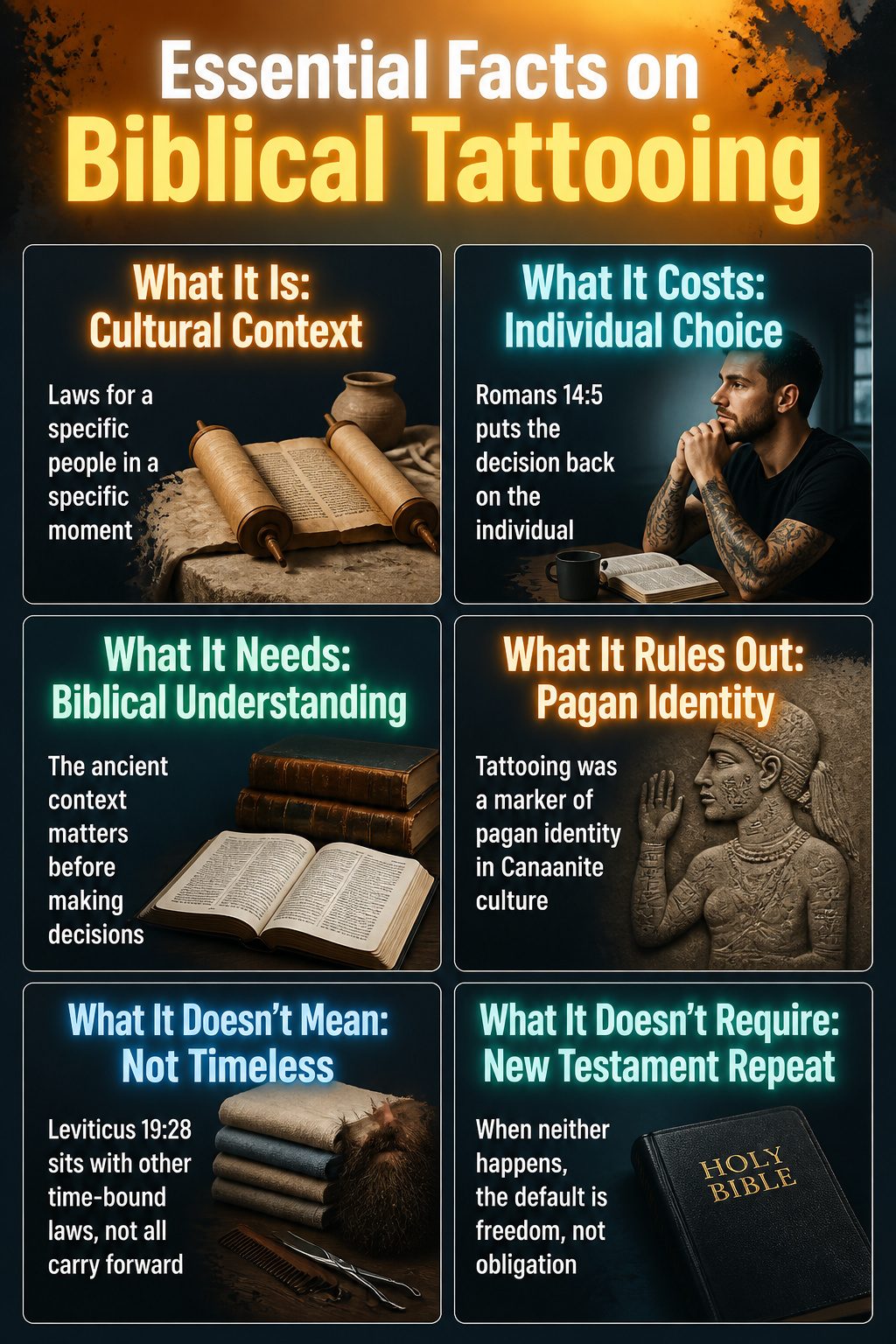
Leviticus 19:28 sits in a chapter that also bans cotton-poly blends and trimming your beard, so treating it as a timeless moral command while ignoring the rest takes some explaining.
Most pastors and scholars who walk people through this start with the same move: the ancient context matters, because the laws were written for a specific people in a specific moment.
The tattoo ban in Leviticus appears alongside prohibitions against cutting your body for the dead, practices tied to Canaanite mourning rituals. Israel was meant to look different from neighboring nations, not just morally but visibly.
That separation principle still holds for Christians today, but the specific mechanism, tattooing as a marker of pagan identity, does not map cleanly onto a 2026 tattoo parlor in Ohio or Oregon.
Two tests tend to sort which Old Testament laws carry forward. First, does the New Testament repeat it?
Second, did Jesus affirm it? When neither happens, the default is freedom, not obligation.
Romans 14:5 puts the decision back on the individual to be "fully convinced in their own mind," which is exactly where most believers land after doing this homework.
Personal Reflection

Prayer before ink is not a formality; it is the work that makes the decision either solid or hollow.
The sources frame this clearly: anything not arising from faith is sin (Romans 14:23), which means the question is not whether a tattoo is cool or even meaningful, but whether it emerged from an actual conversation with God.
That distinction matters because a design can look spiritual without being prayed over.
The practical discipline looks like this. Set aside the image boards and sit with the text first.
A verse pulled from context to justify a decision already made is a mirror, not a guide.
The passages suggest asking specifically how the tattoo affects witness (2 Corinthians 5:20): does it open conversation about Christ, or does it draw attention to the art rather than the gospel?
For minors, the discipline includes honoring parents’ stance (Ephesians 6:1–2), which means waiting even when the conviction feels certain.
The line between permissible art and vanity sits at motivation, not design. Peter’s warning about outward adornment (1 Peter 3:3–4) does not ban decoration; it ranks it.
A tattoo chosen after years of praying over a specific scripture, woven into daily life, carries a different weight than one chosen for aesthetic alignment with a faith identity.
The body is a temple (1 Corinthians 6:19–20), which raises honest questions about modification: where does expression end and mutilation begin? Those answers vary by person, and the sources refuse to draw a universal line.
The discipline, then, is submission of the entire decision, not just the design. James 1:5 promises wisdom to those who ask without hedging.
The tattoo itself is rarely the biggest question; the readiness to submit the whole life to God’s will is.
Christian Freedom

The freedom Christians live under now is not the freedom to ignore conscience but the freedom to serve without a rulebook.
Romans 7:4 puts it plainly: believers have died to the law through Christ’s body so that belonging to him produces fruit for God. That reframes every choice, including whether to get biblical tattoos, around relationship rather than regulation.
The old written code is replaced by what Paul calls "the new way of the Spirit."
This matters because Leviticus 19:28 still gets quoted as a flat prohibition. The response from Protestant theology is twofold.
First, the Mosaic law’s purpose was to mark Israel as distinct from nations whose practices compromised allegiance to Yahweh. The concern was cultural signaling, not skin as somehow inviolable.
Second, Romans 7:6 releases Christians from that system entirely. The question becomes whether a tattoo grows out of joyful allegiance to Christ, not whether a list somewhere forbids it.
Galatians 5:1 calls this liberty explicitly: "It is for freedom that Christ has set us free." 1 Corinthians 10:23 adds the boundary, that while all things are permissible, not all are beneficial.
The freedom is real, but it operates within faith. Romans 14:23 tightens this further: anything not from faith is sin.
A biblical tattoo chosen through prayer and for godly reasons fits within this framework. One chosen because a design looks cool, without that settled confidence, does not.
The decision turns on motivation, not on finding a rule that permits or forbids the ink itself.
Frequently Asked Questions
What does the Bible say about tattoos?
The only explicit mention is Leviticus 19:28, which commands Israel not to tattoo themselves. That prohibition sat alongside other rules separating ancient Israel from pagan neighbors, including bans on trimming beards and cutting hair at the sides of the head.
Most scholars read it as targeting ritual identification with foreign gods, not decorative body art.
Is it a sin to get a tattoo?
Getting a tattoo is not inherently sinful. The New Testament never directly addresses tattoos, and Romans 14 treats this as a disputable matter for individual conscience.
What can make it sinful is the motive: ink chosen to conform to trends or draw attention to the body rather than to glorify God crosses a line that the tattoo itself does not.
Can Christians get tattoos?
Yes, many Christians believe they can if the motivation is right. The New Testament framework in Romans 14 and 1 Corinthians 10:31 leaves this decision to prayer and conscience.
A biblical tattoo chosen after genuine reflection, meant to honor God or mark a meaningful spiritual moment, fits within Christian freedom. One chosen for rebellion or vanity does not.