Angel tattoos run from a single haloed circle behind the ear to a full sleeve that takes months and multiple sessions to complete, and the ideas ahead cover every stop along that range: cherubs, wings, guardians, fallen angels, archangels, and every variation of placement and style I could fit on the list.
The deciding factor is not how much you believe in the subject but how much skin and time you are willing to give it: a wrist cherub finishes in one sitting, while a back-piece guardian angel with light rays and grey wash drapery demands the flat ground and budget of a larger canvas, and the list ahead maps each idea to the commitment it asks for.
The 444 on a forearm, rendered in minimalist linework down the bone, carries the same private meaning with none of the commitment.
1. Cherub Tattoo
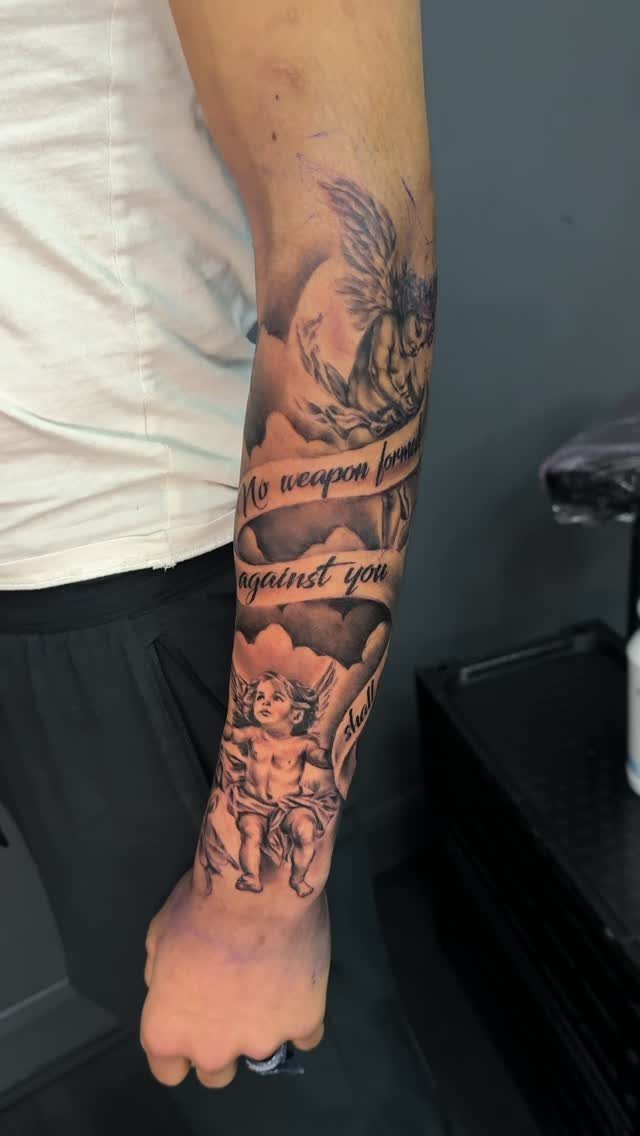
A cherub tattoo works best when you want something small that still carries weight. A chubby, childlike cherub works well among clouds and scrollwork, rendered in black and grey with the soft shading you’d see in older religious art.
That realism style takes time, maybe multiple sessions, but it ages better than line-only work.
I’d point this toward parents, whether celebrating a birth or marking a loss. The scale fits the wrist, ankle, or behind the ear if you want it hidden.
A banner with text adds space and cost; going without keeps the focus on the face. The small size and familiar subject make a cherub an easier first sit in the chair.
2. Devil and Angel
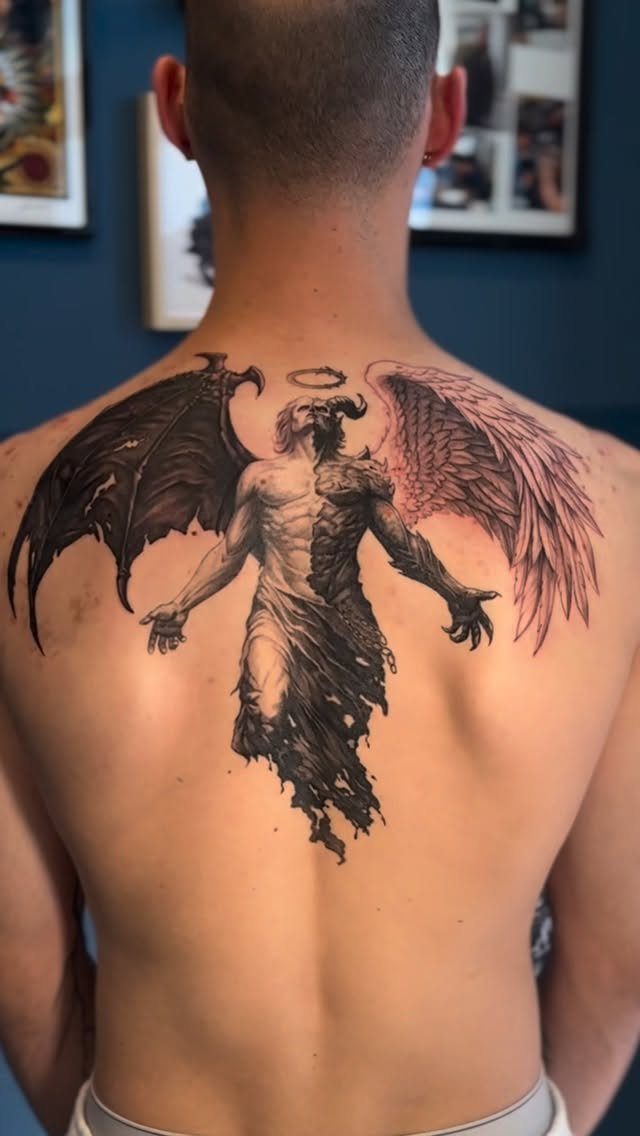
Splitting one body down the middle, half halo and half horns, turns your back into a stage for the old argument about what lives inside us. A single figure, whole rather than split, reads more like balance than war.
You can push either side harder. More shadow on the devil half, more gold tone on the angel, and the meaning tilts.
Matching tattoos work too, one person wearing the horns, the other the halo, though that reads cutesy on ankles and serious on ribs or thighs.
The back gives the artist room for the full wingspan and the split down the spine. Forearms force a tighter composition, which some artists handle better than others.
3. Angel Wings Tattoo
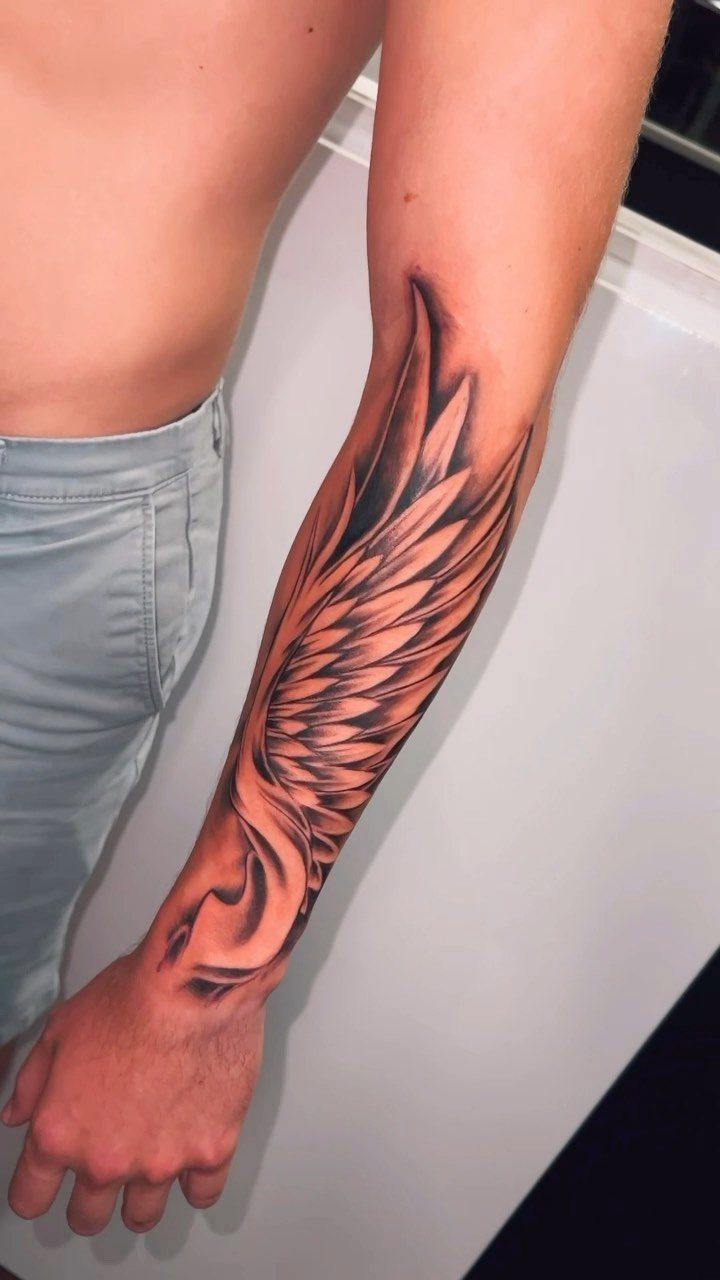
Wings alone let you skip the face, the story, the specific saint or scene. A forearm piece can run from wrist to elbow, feathers layered dark to light so the wing seems to fold with the arm’s movement.
That placement means the tattoo lives in motion; it looks different raised than at rest.
One wing alone suits the forearm or bicep without crowding. Paired wings across the back read as memorial more often than not, something for a lost person rather than a personal symbol.
Size changes the time and the toll: the wrist version might finish in an hour, while a full back piece spreads across multiple sessions and needs a budget to match.
I’d ask the artist to show healed photos of feather work; grey wash can muddy if the saturation is off.
4. Guardian Angel Tattoo
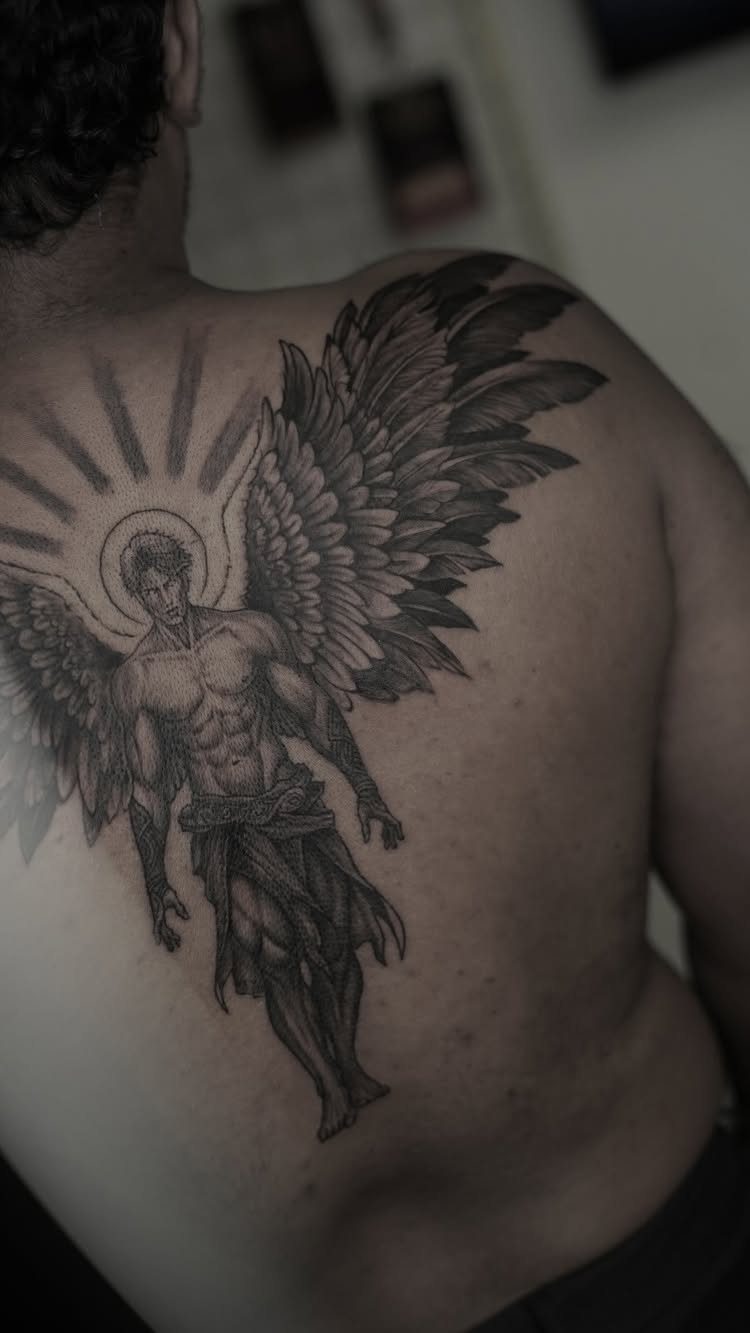
A guardian angel with wings spread wide enough to cover the upper back gains presence from light rays behind the head and a halo in grey wash.
That scale lets the artist build muscle definition and drapery that would blur at half the size.
People often come to this design after something hard: illness, an accident, a period when they felt watched over. The tattoo then marks the watching, not the trouble.
You can go detailed, like the photo, or strip it down to a robed figure with only the wings and halo for identifiers.
The back carries the wings best; arms or legs force the wings to fold, which changes the posture from protective to waiting.
A minimalist version, just the outline and a few lines of light, works on the ribs or collarbone for someone who wants the meaning without the hours.
Guardian angel tattoos are some of the most popular choices for men; their symbolism and endless design choices make them ideal for any person. The angel tattoo is no longer only for religious men; the tattoo now often stands for protection, devotion, hope, and trust.
5. Fallen Angel Tattoo
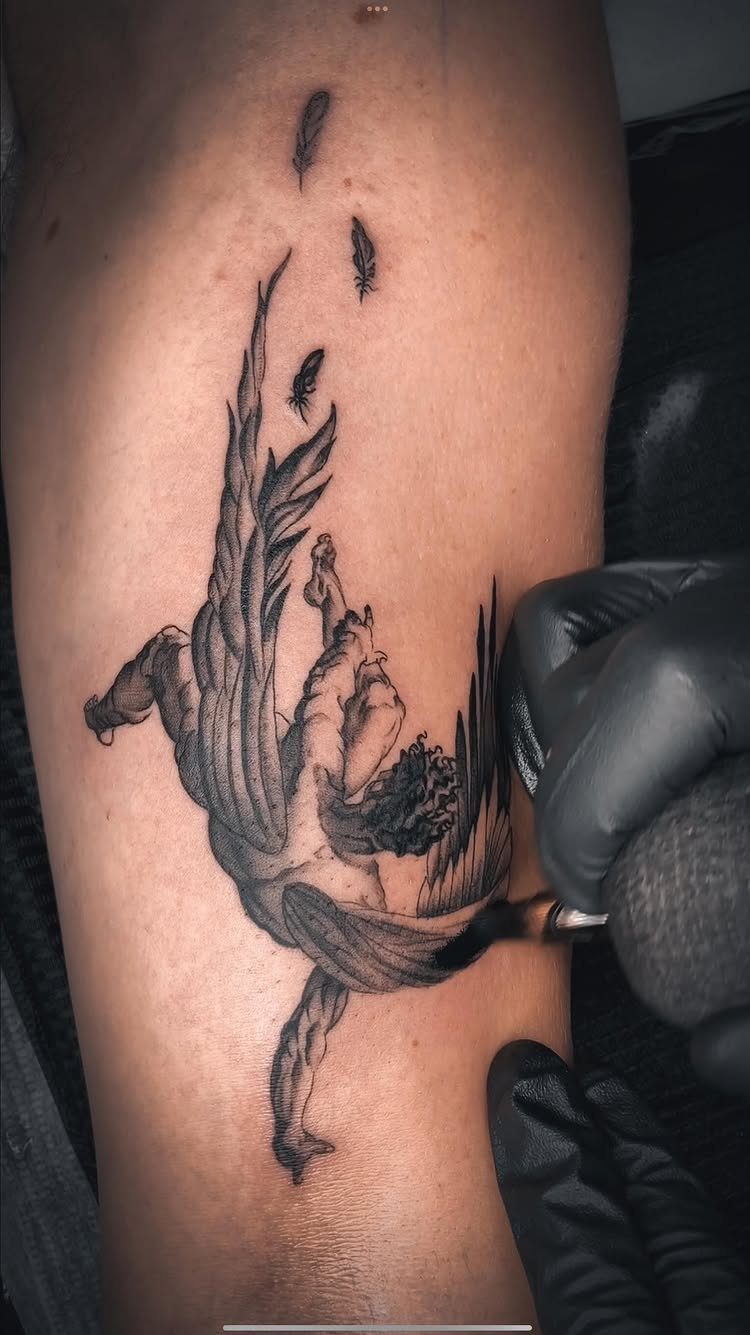
A fallen angel tilts the head down, wings still spread but losing feathers, the body angled like someone pushed or let go.
A leg piece can show the figure dropping through open space, feathers drifting above, which reads as motion rather than defeat. That matters; you want the fall to look active, not ended.
Cabanel’s 1847 painting of Lucifer still shapes how artists draw this: young, beautiful, refusing to kneel. Your version can borrow that pride or go darker, face buried, wings broken.
The upper arm or forearm suits the single figure; calves work if you want the fall to read vertically, head toward the ankle.
I’d caution against adding too many extras, a sword, a chain, a torn banner; the figure carries enough alone.
6. Angel of Death Tattoo
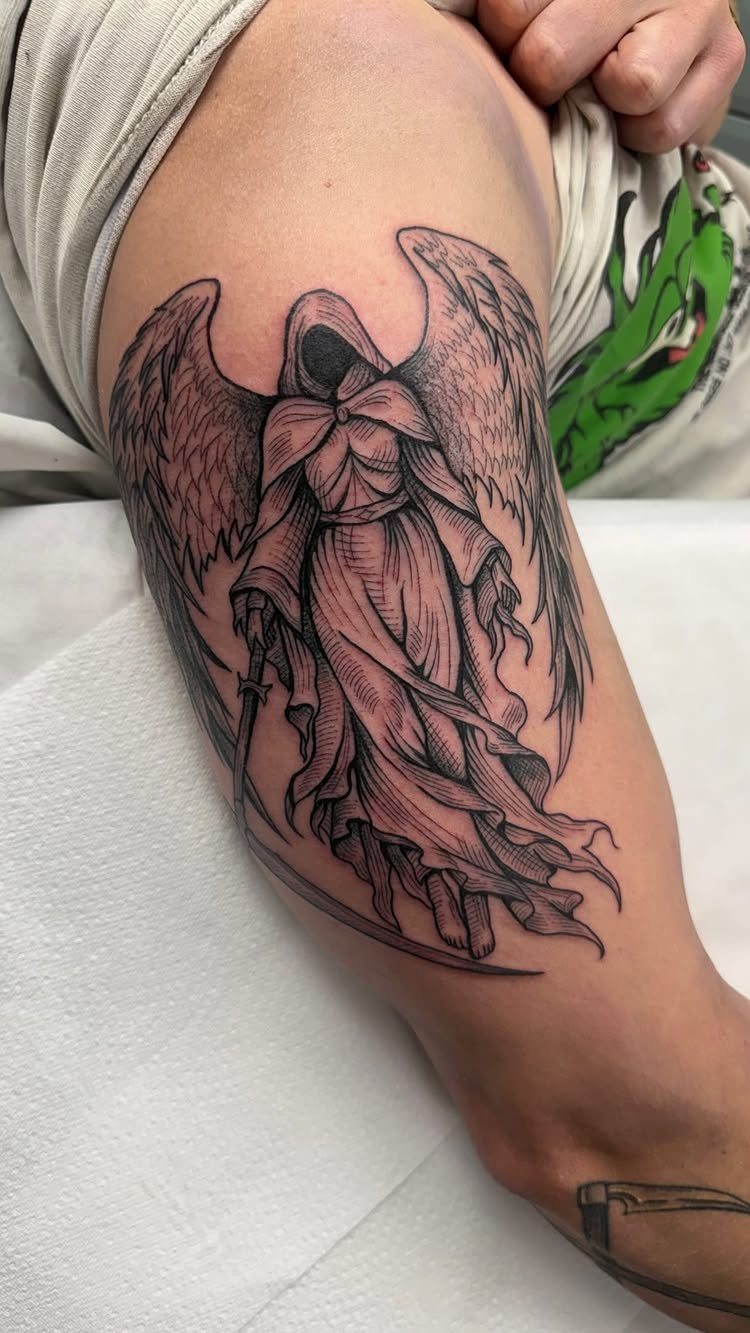
The hooded figure with the scythe is not the Grim Reaper, though people mix them. Wings mark this as angelic, a collector of souls rather than death itself, and the wings in the piece are full and dark, not skeletal.
That distinction matters if you’re bringing reference photos to a consultation.
Thigh or chest gives the artist the flat ground needed for the robe’s folds and the scythe’s straight line.
The forearm or sleeve can work, but the vertical scythe competes with the arm’s length, and some compositions solve that better than others. Black and grey suits the subject; color would fight the mood.
For someone who wants the memento mori reminder without the skull and clock cliché, this trades one tradition for another, older one.
7. Archangel Tattoo
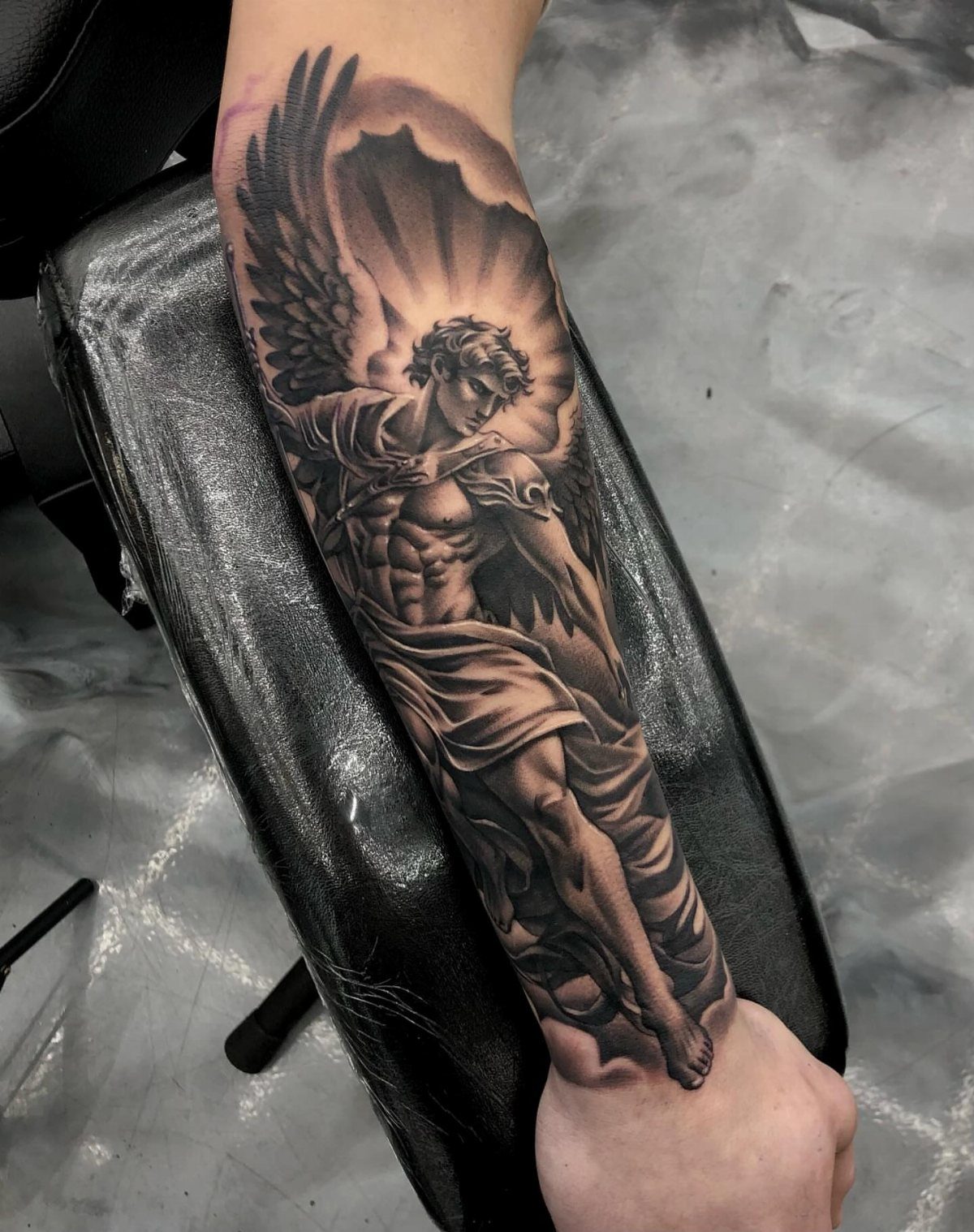
An archangel tattoo brings the weight of a warrior saint to the skin. Michael dominates these pieces, sword in hand, wings spread against darkness or light.
The armor and musculature demand space; a forearm or calf carries him better than a shoulder cap.
Black and grey realism keeps the armor, the wings and the sword readable without color bleeding into itself. Color reads decorative on a figure built for confrontation.
The sword can angle toward a dragon, a demon, or nothing at all; each choice shifts the tone from triumph to vigilance.
This one suits someone who wants protection visible, not whispered. The detail level sets the price and the sitting count.
A smaller archangel loses the face; at that scale, consider a wing or a sword alone instead.
8. Angel Number Tattoo
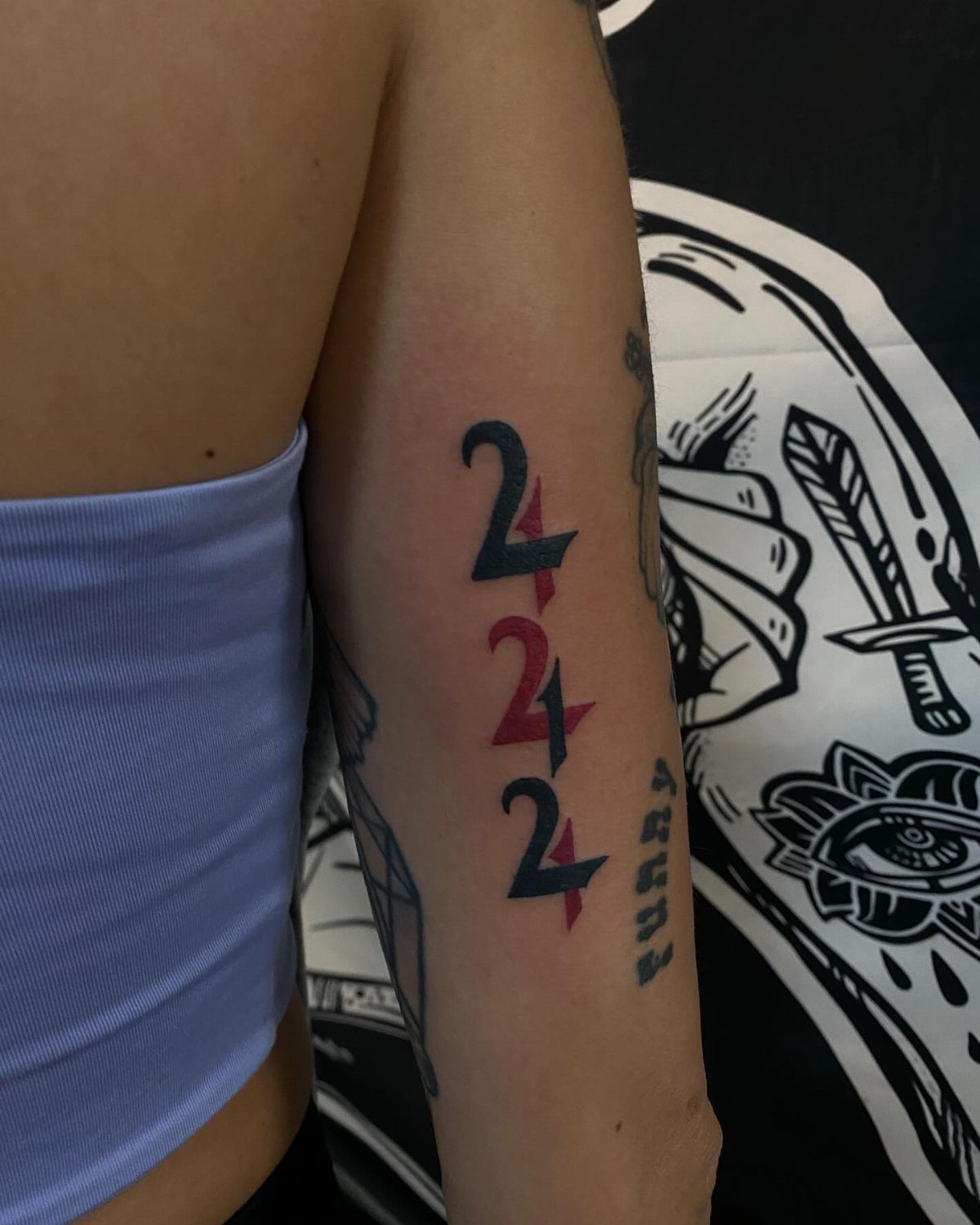
Three identical digits in a row carry their own language now. 111 signals a start; 444, a coming change; 888, the money number, abundance pushing through.
The tattoo lives or dies by the font: too plain and it reads as a date, too ornate and the repetition gets lost.
Minimalist linework wins here. A vertical run down the back of an arm follows the bone and catches in mirrors.
Red accents can lift the black, but one color is enough; two risks clutter on something this small.
Size matters less than placement. These numbers need to sit where the eye finds them often: wrist, forearm, behind the ear.
The meaning is private; the visibility keeps it present.
9. Baby Angel Tattoo
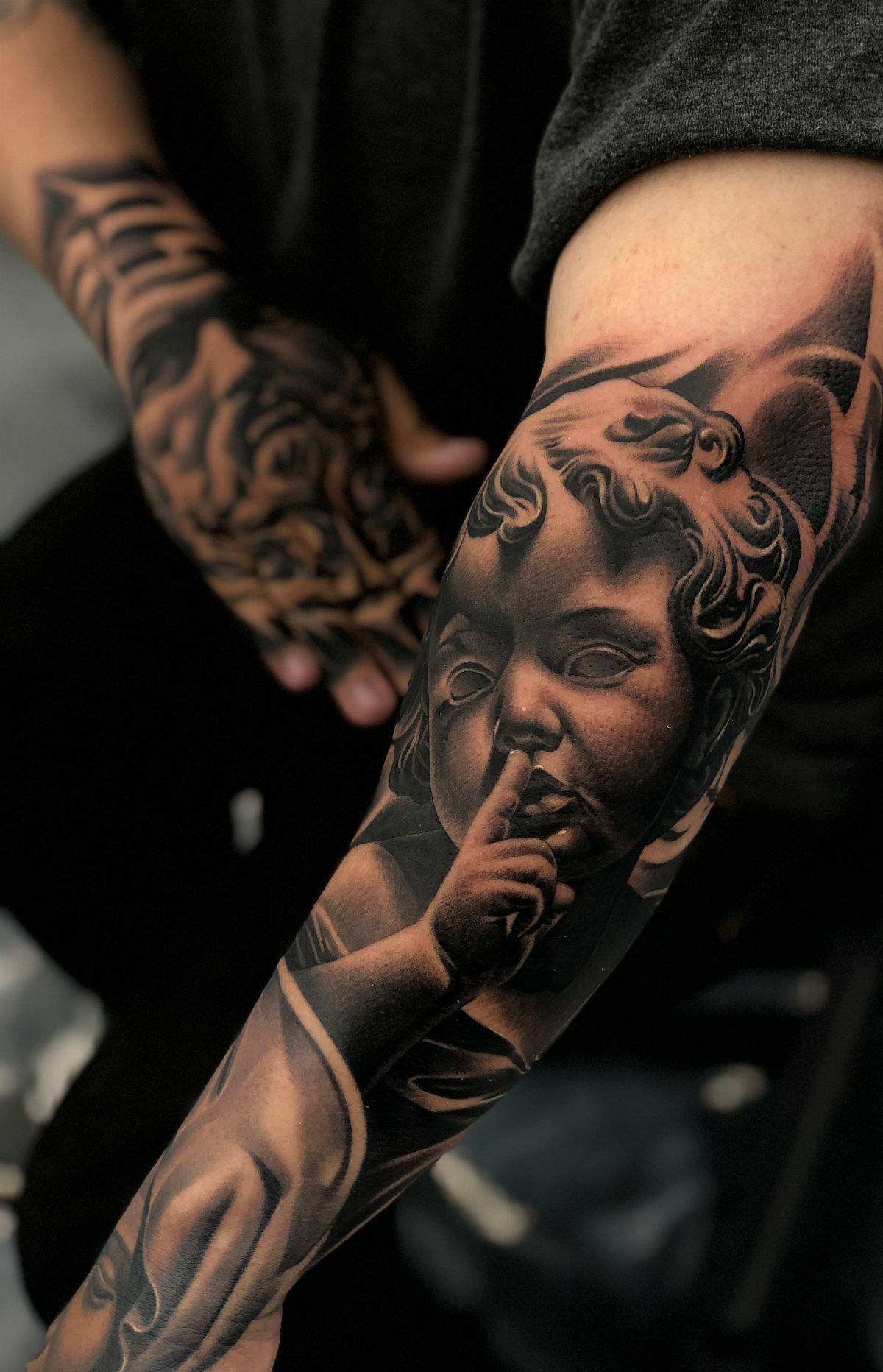
A baby angel holds two stories at once. The same image, finger to lips, speaks silence, grief, a life that ended too early.
The shushing gesture changes everything. Without it, the piece drifts toward nursery decor.
With it, the tattoo gains a purpose: a memorial, a secret kept, a peace requested. Curly hair and soft cheeks need a steady hand; the innocence is in the roundness, and roundness blurs fast if the shading rushes.
Forearm or back of the arm gives the viewer control over when it shows. For a lost child, some add a footprint or a date; for the aesthetic alone, the figure stands complete.
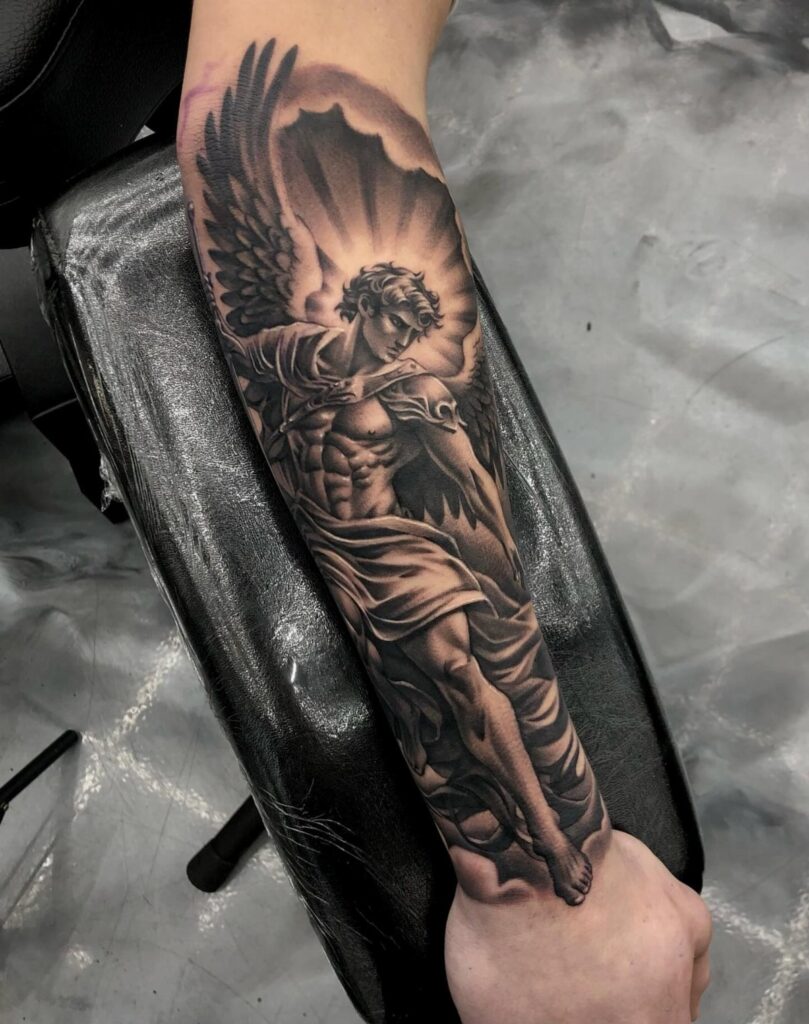
10. Angel Forearm Tattoo
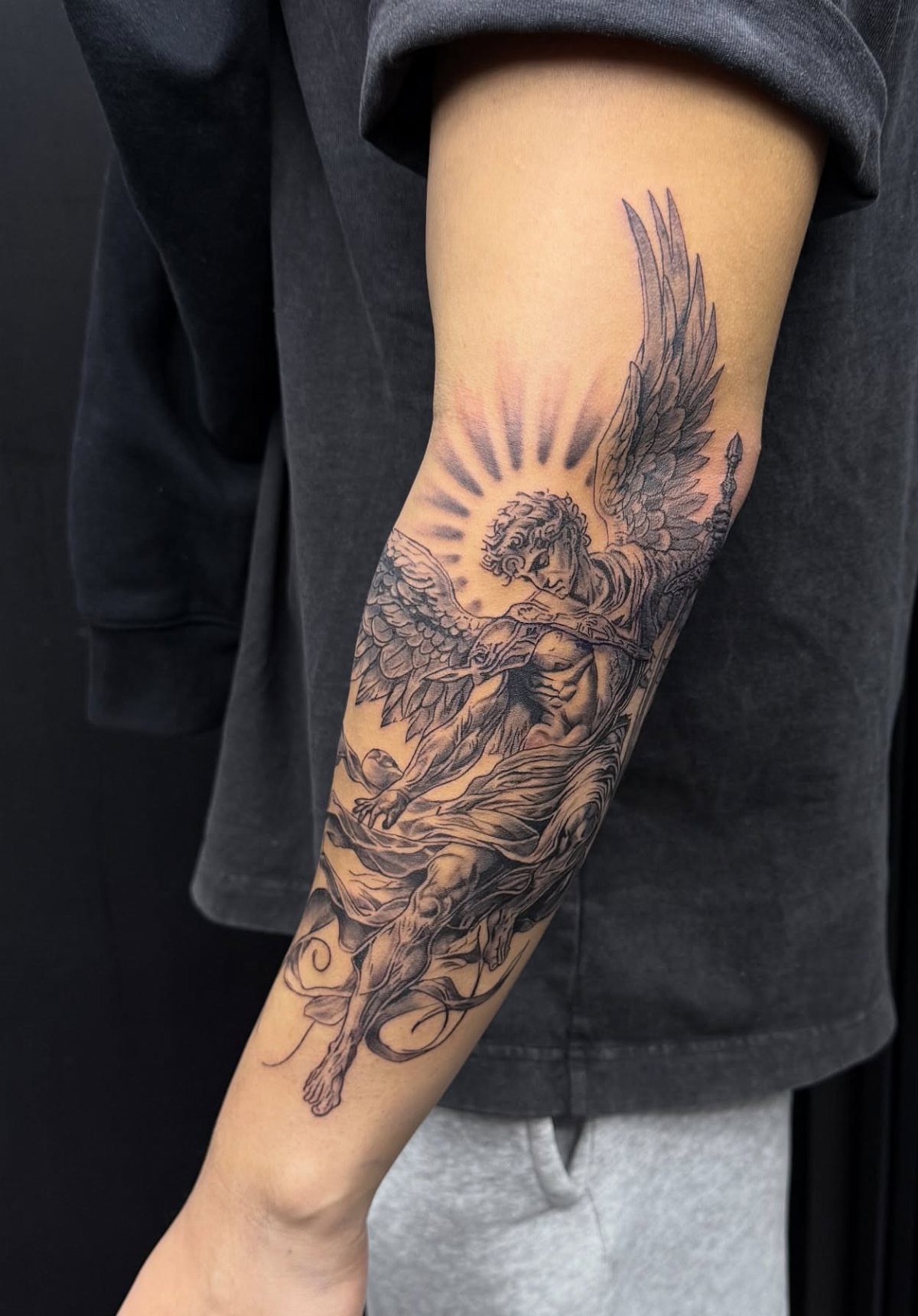
The forearm offers what the angel needs: length for wings, width for a body, enough plane to build atmosphere behind the figure. A standing angel fits vertically; a descending one needs the horizontal sweep from elbow to wrist.
Sleeves hide it. Short sleeves do not.
That rhythm works for most daily routines, but check your own: hands-on work, uniform requirements, the usual summer coverage.
The skin here takes ink well and ages it slowly, so the piece stays readable longer than a rib or a thigh.
Detail costs time. A radiant halo, drapery folds, the turn of a face: each adds sessions and cost, so plan the budget before planning the detail.
For a single sitting, simplify to wings and suggestion, or scale down and place higher, nearer the elbow where the canvas narrows.
11. Angel Heart Tattoo
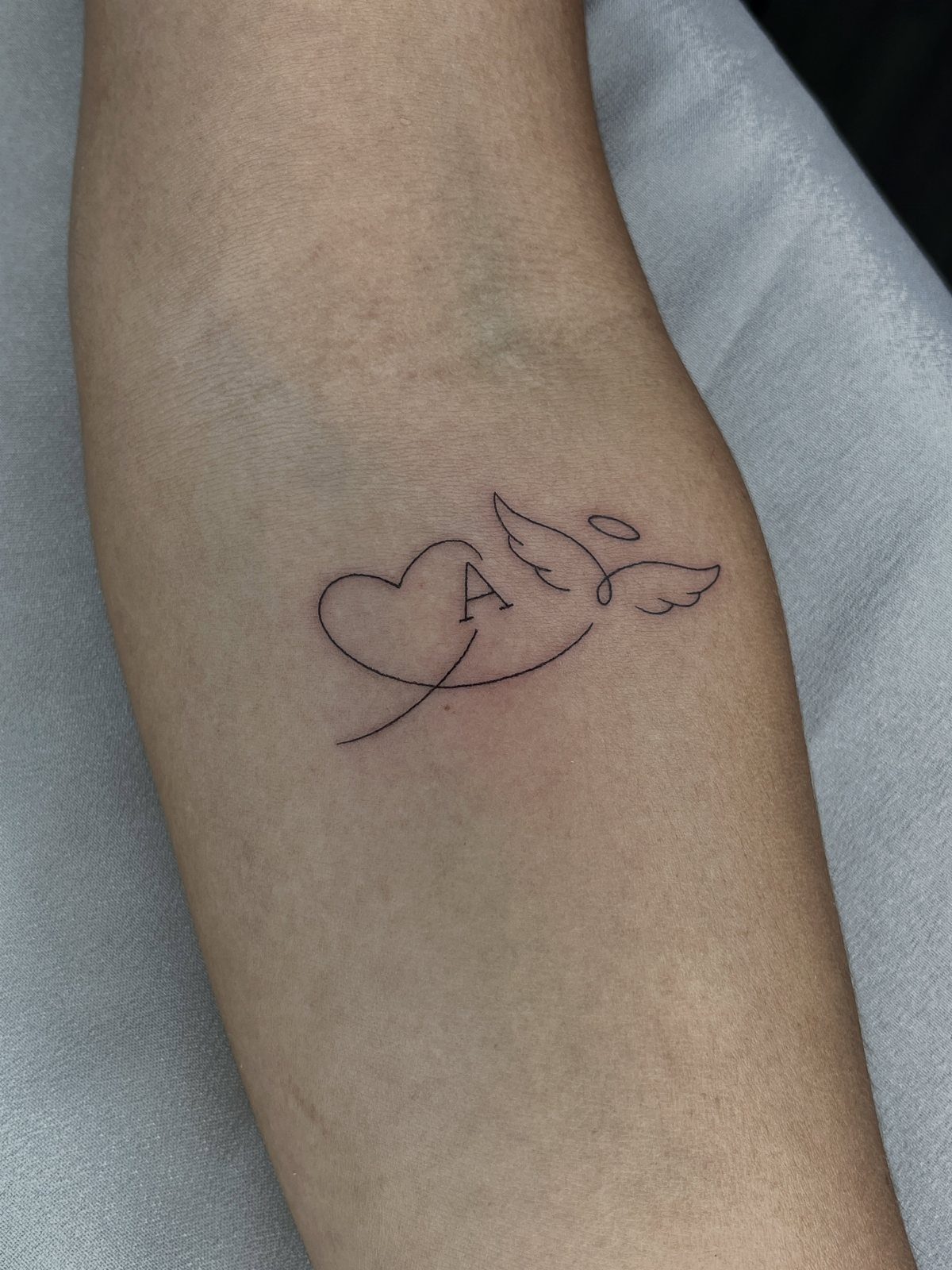
Wings and a heart share a geometry that artists have exploited forever. Two wings, tips meeting, outline the heart shape directly.
Or the heart sits central, wings spreading from it, a halo floating above. The letter A, for angel or for a name, tucks in where the lines allow.
Red in the heart, black everywhere else: that single color choice makes the piece readable from across a room. Without the red, it softens; with more color, it drifts toward cartoon.
The chest carries it as a declaration, the inner arm as a private reminder.
This one works for bonds, not losses. The heart insists on connection, living or wished-for.
For grief, the weeping angel or the memorial piece speaks plainer.
12. Angel Statue Tattoo
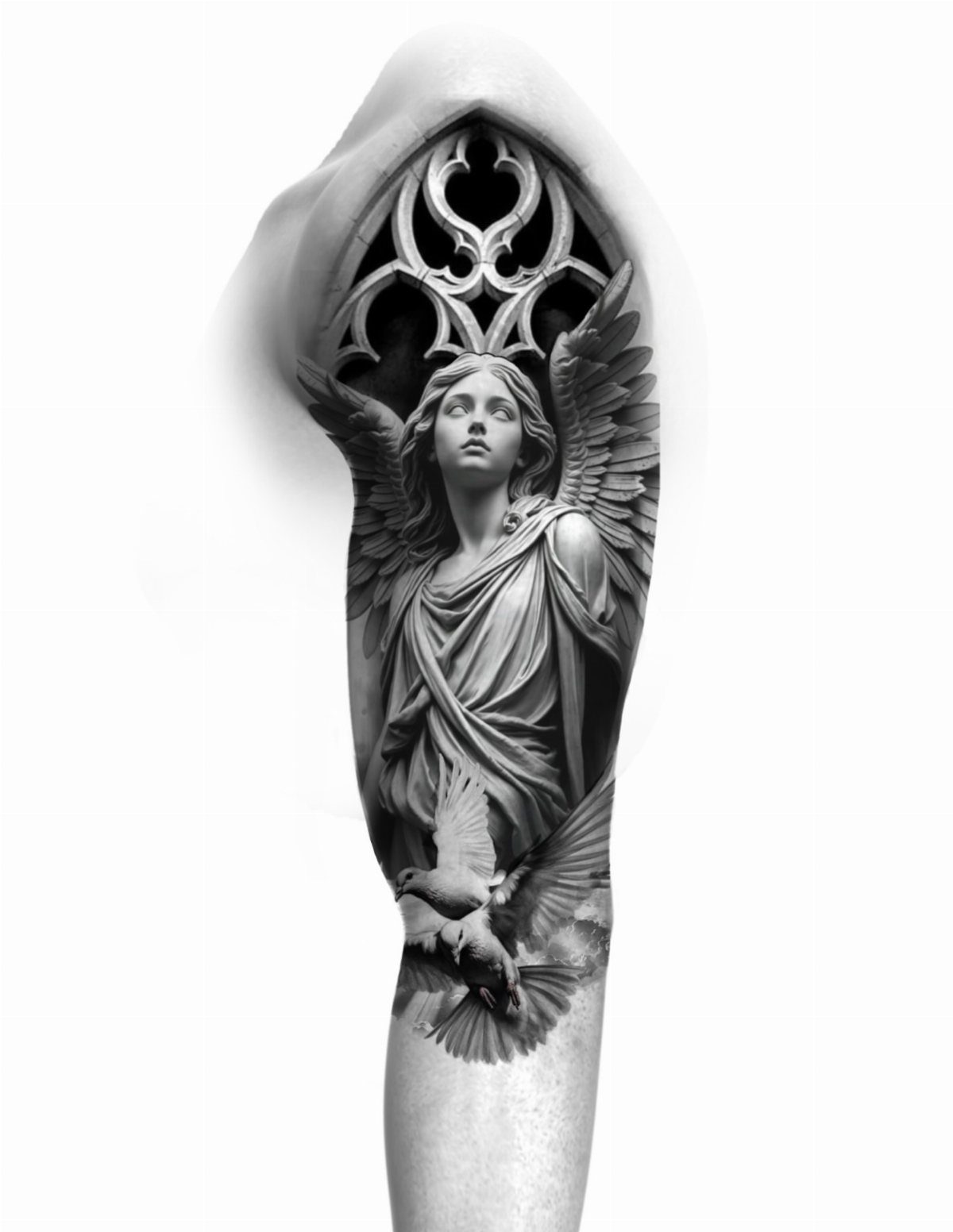
Stone translated to skin asks for stippling, for grey wash that builds shadow without hard lines. A Gothic frame, an arch overhead, a dove below: the arm becomes a cathedral wall.
That architecture is optional; the seated figure alone carries the weight.
Classical robes need time. The folds must read as marble, as gravity working on fabric frozen mid-motion.
A seated angel suggests permanence, a guardian at post, where a flying figure suggests intervention, arrival. The mood shifts with the posture.
This style suits collectors who already have pieces and want one that anchors them. It reads as finished, deliberate, the opposite of spontaneous.
The sitting count runs high; the result, on the right arm, becomes the tattoo that other tattoos orbit around.
13. Angel Neck Tattoo
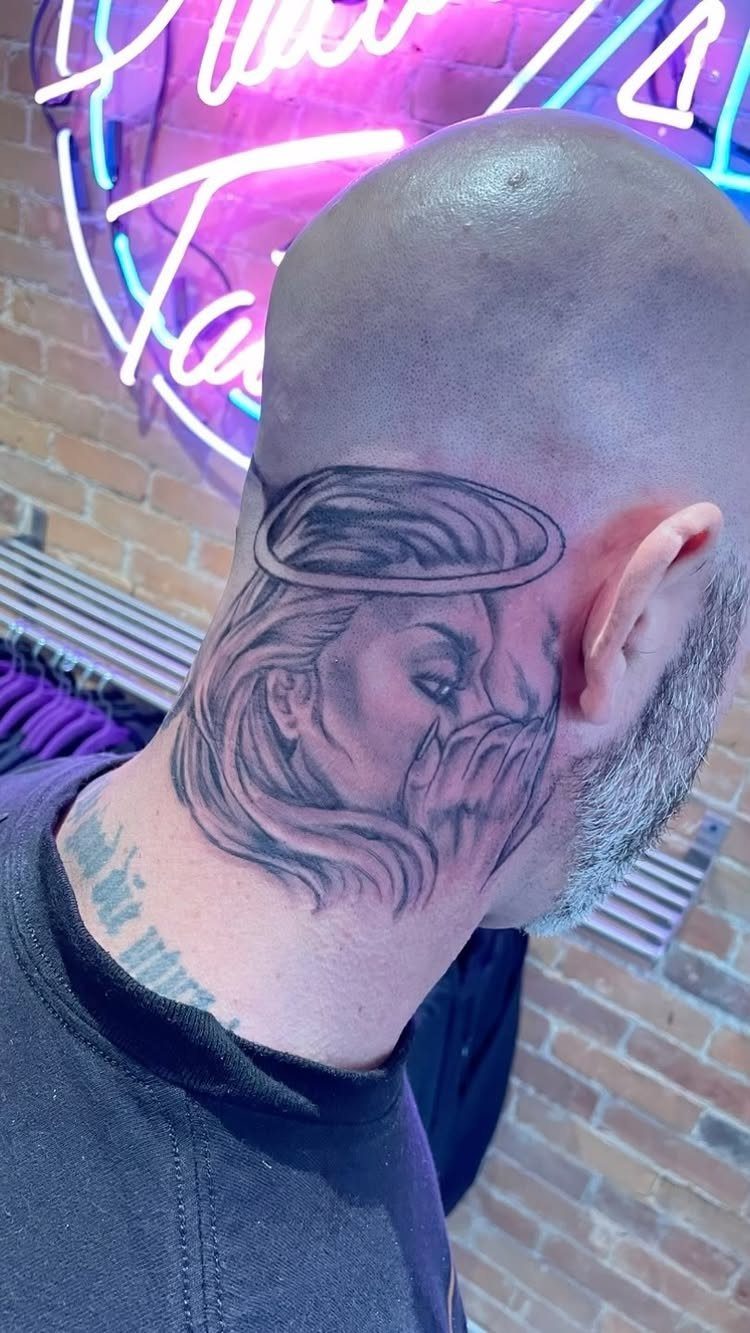
Neck placement turns an angel tattoo into a statement you cannot dial back.
The skin there moves constantly and sits in full view, so the design needs to read clean from across a room and hold up as hair grows or gets cut.
A small haloed figure at the nape stays hidden under a collar when work demands it. Wraparound wings demand more sessions and a higher pain threshold; the skin over bone and tendon complains louder than fleshier spots.
Black and grey realism ages better here than fine line, which can blur into a soft smudge within a few years.
I’d reserve this for someone already heavily tattooed who knows how strangers read a neck piece. First-timers usually regret the lack of control over when they show it.
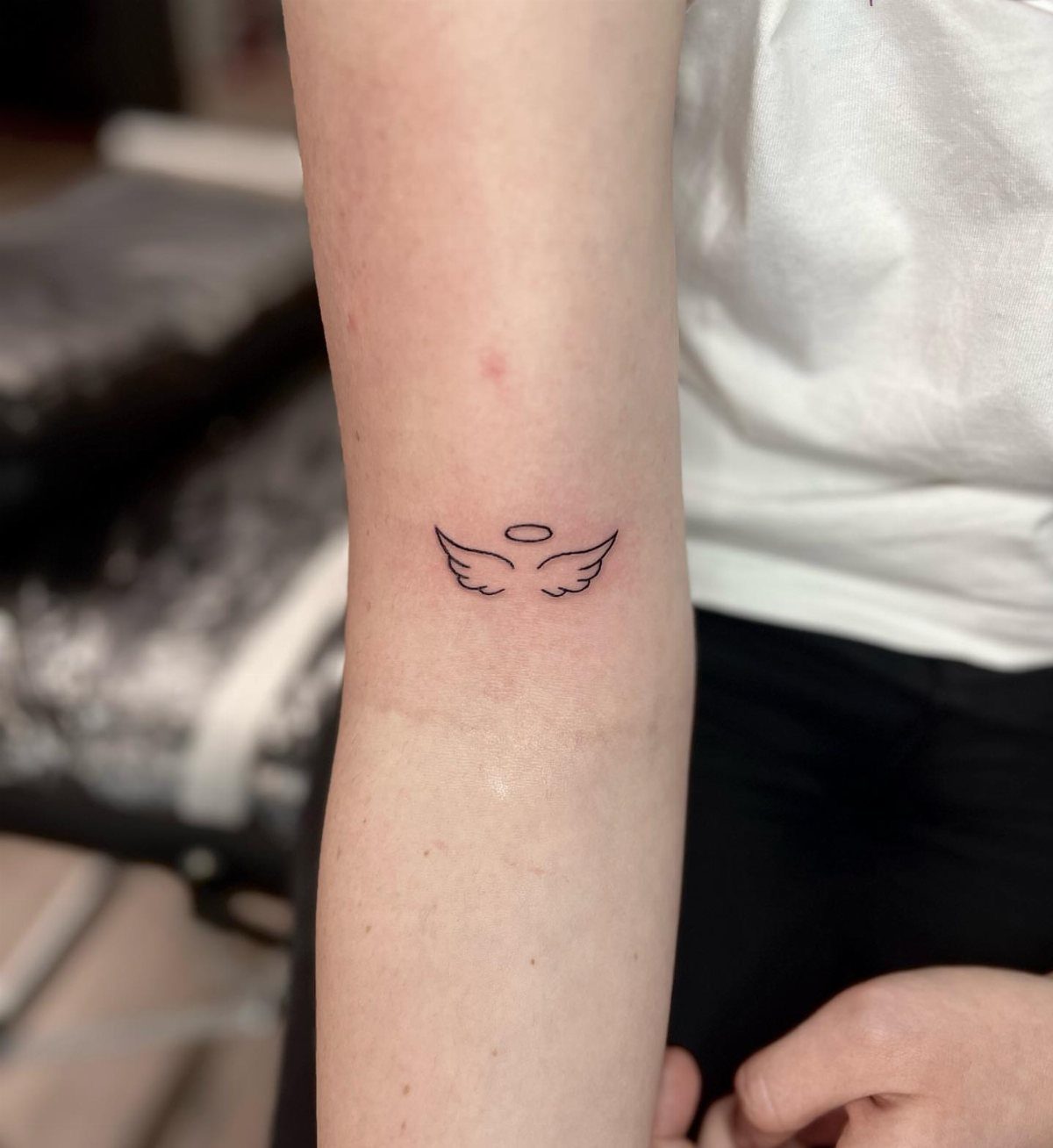
14. Angel Halo Tattoo
The halo arrived in art centuries after the biblical texts, which describe angels as wheels of fire or four-faced creatures rather than winged people with golden rings.
That gap between scripture and painting gives you room to choose: literal or symbolic.
A standalone halo with two small wings reads as jewelry on the skin, light enough for a wrist or ankle. The circle itself carries the meaning; everything else is decoration you can scale up or strip away.
Fine line suits this best, since the design lives or dies on the precision of that single curve.
Color rarely improves it. The classic form is black ink, spare and immediate, the kind of tattoo that looks like it has always been there.
15. Angel Fighting Demons Tattoo
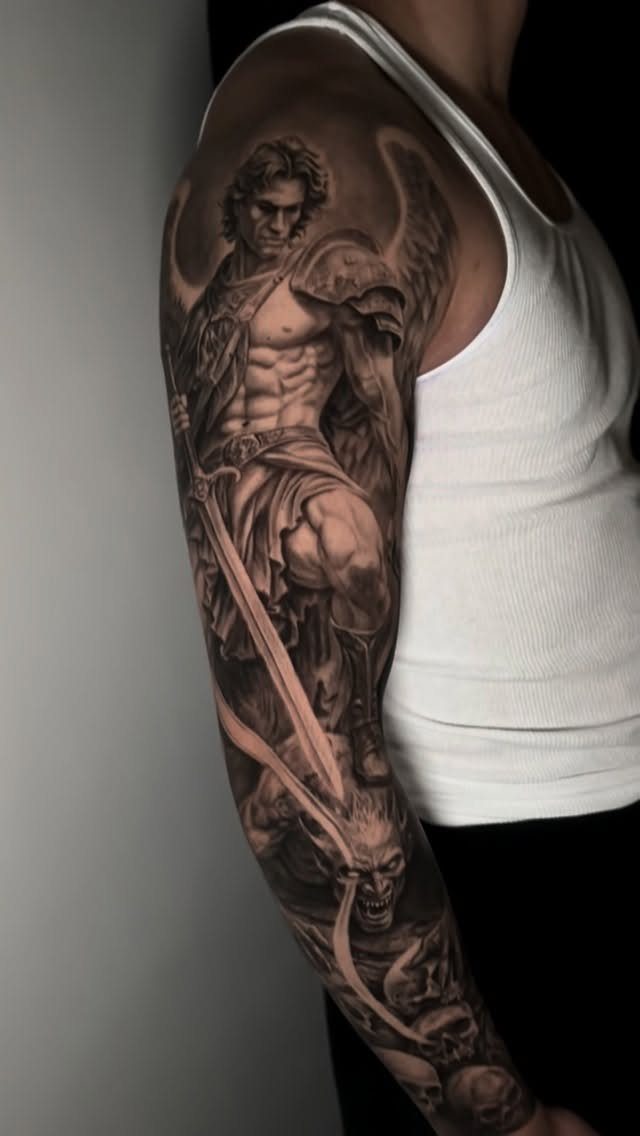
An angel with a sword standing over a demon compresses a whole story into one image: the fight you are in, or the protection you believe sits just outside your sight. The composition matters more than the theology.
A balanced piece lets both figures breathe; too often the demon gets shrunk to a prop and the drama flattens.
Armor and weapons add detail that rewards a large canvas. A forearm or upper arm gives the angel weight and the demon enough presence to matter.
Red ink for the demonic side, used sparingly, can split the figure into two natures without cluttering the design.
This asks for an artist comfortable with human anatomy in motion. Static poses kill the tension.
I’d look for someone whose portfolio shows figures that twist and reach, not just stand at attention.
16. Cross with Angel Wings
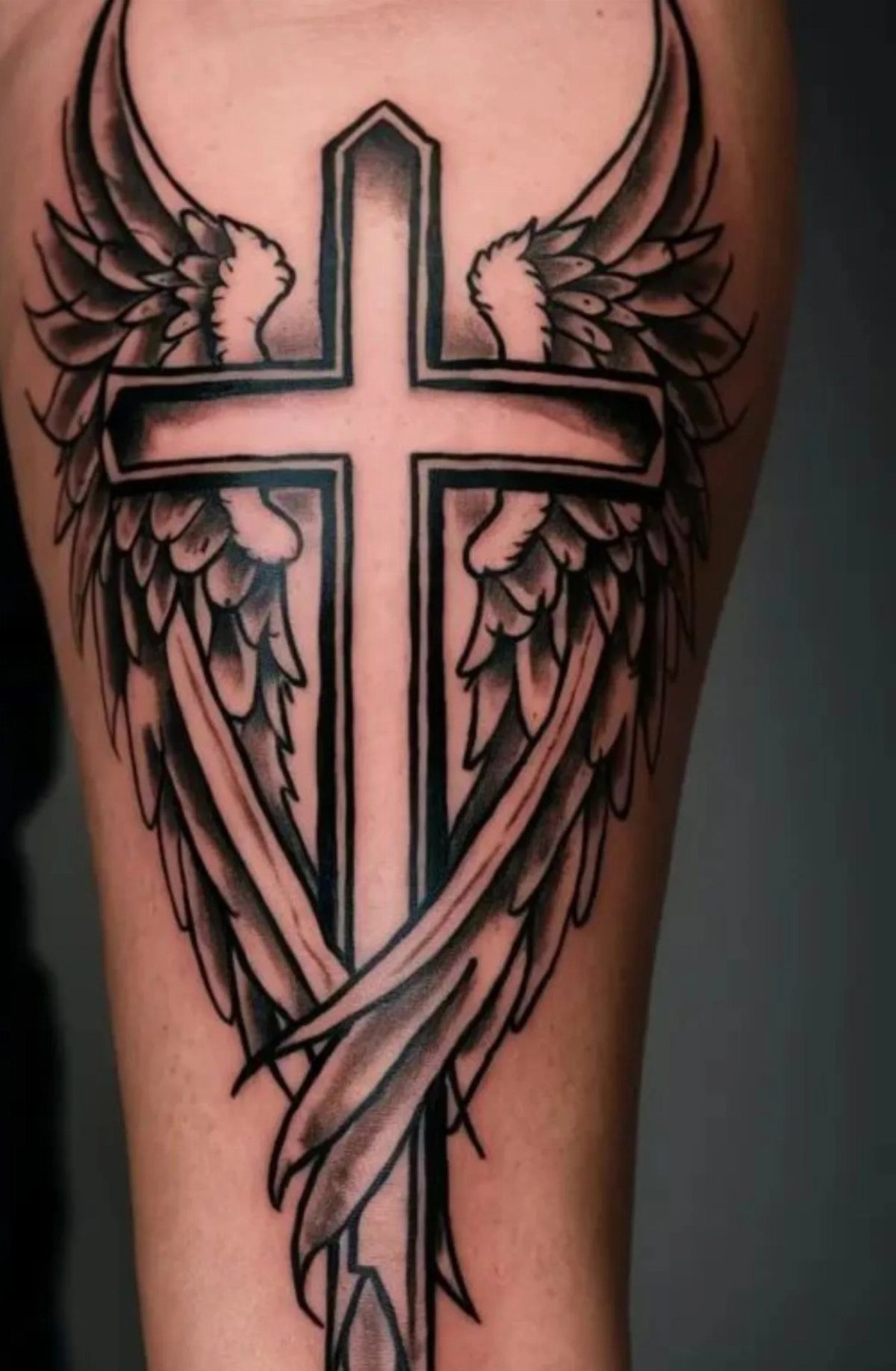
A cross flanked by wings merges two symbols that travel separately through most of religious art.
Together they speak to someone specific: the person who wants to mark faith and loss in the same gesture, or who sees freedom as something granted rather than seized.
The wings can rise behind the cross or spread from its horizontal bar; the first reads as ascent, the second as embrace. Shading determines whether the piece feels carved from stone or feathered and alive.
Memorial versions add a name or date at the base, though the image itself already carries enough meaning that text sometimes overworks it.
This design has been common for decades, so the artist’s hand makes the difference between generic and particular. I’d study how they handle the negative space between wing and cross; that gap is where the piece finds its air.
17. Full Angel Sleeve
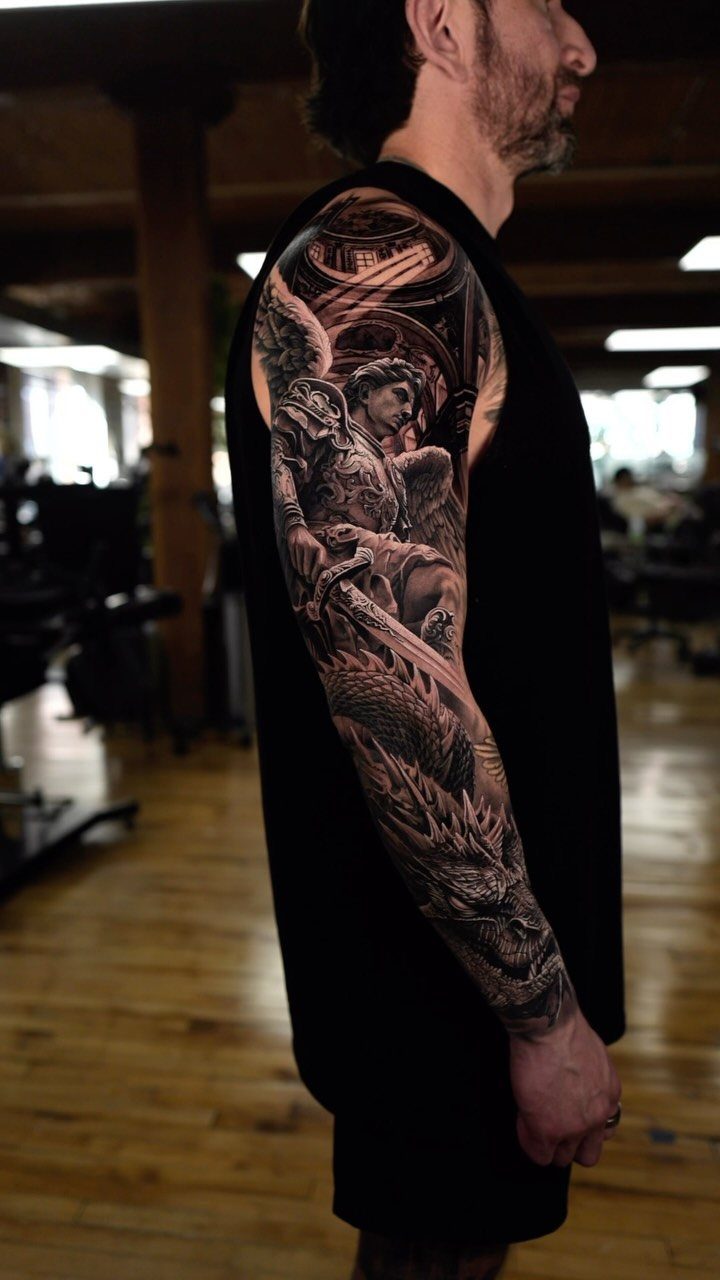
A full sleeve leaves no room for hesitation. The angel must relate to everything else on the arm: the dragon, the sword, the mandala on the hand, each element locked into a single flowing composition.
Planning takes longer than the tattooing itself, and the tattooing takes months.
Multiple sittings mean healing between sessions, so the artist works from shoulder toward wrist in stages you cannot rush. The cost runs high, the pain runs higher, and the commitment is visible every day in every sleeveless moment.
What you gain is a narrative armature no single-session piece can match.
I’d only start this with an artist whose healed sleeves I have seen in person, not just in photos.
The planning conversation should take hours, not minutes, and you should leave it certain they understand how your particular arm moves and hangs.
18. Memorial Angel Tattoo
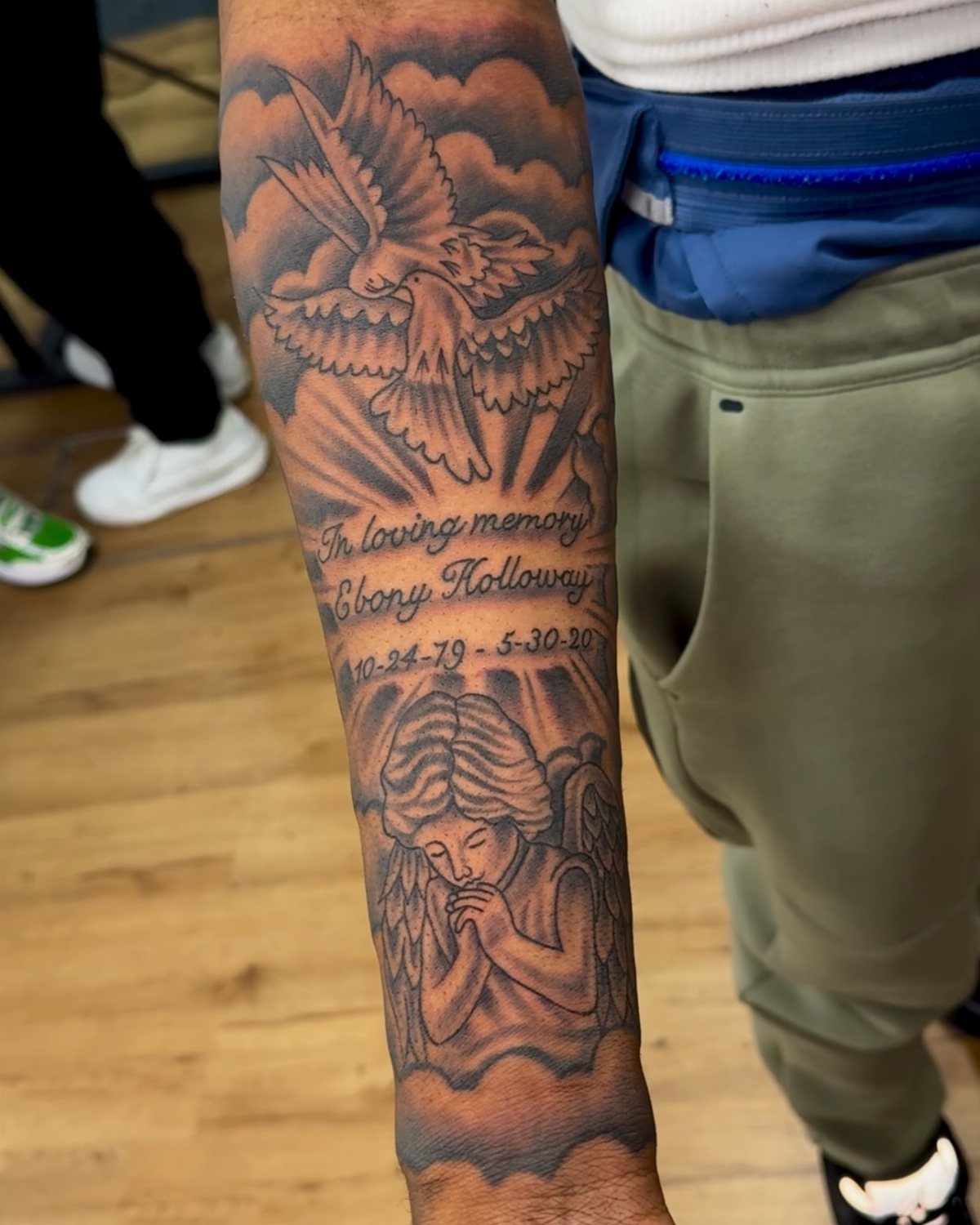
A memorial angel carries names and dates the way a headstone does, but on skin that warms and ages with you.
The cherub, the dove, the clouds and light rays form a visual language of consolation that needs no explanation to anyone who has stood at a funeral.
The text demands particular care. A date format that reads clearly at size matters more than ornamental flourishes around it.
10-24-79 to 5-30-20 sits legible; script that curls through the numbers can bury them. Placement on the forearm lets you read it yourself, which matters more than most people admit in the first year.
I’d tell anyone considering this to wait until the first raw grief has settled. The tattoo should commemorate a life, not chase a feeling that will shift shape.
The best memorials come from people who know what they want to say after they have already survived saying it.
19. Weeping Angel Tattoo
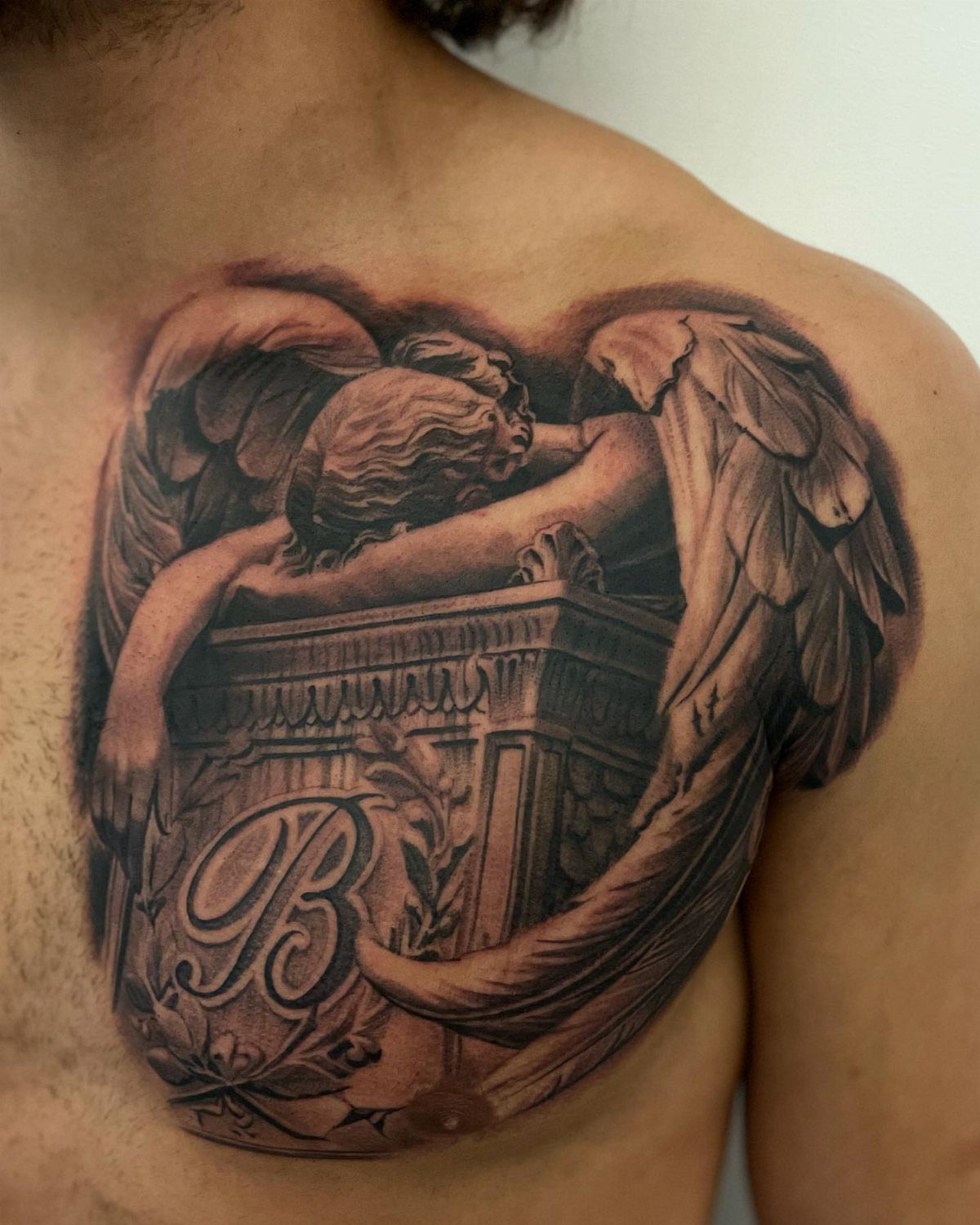
A weeping angel carries grief without needing to name it. The bowed head and covered face let the wearer keep the story private; viewers see sorrow, not the cause.
This design shrinks better than most angel work. A wrist or behind the ear takes a small version fine; a chest piece leaves room for dates or initials on the stone below.
The "Doctor Who" fans have claimed their own version, but the traditional mourning figure still reads as personal loss to most who see it. Either meaning works; the tattoo does not ask you to explain which one you meant.
Best for someone who wants the feeling without the explicit memorial setup.
20. Dark Angel Tattoo
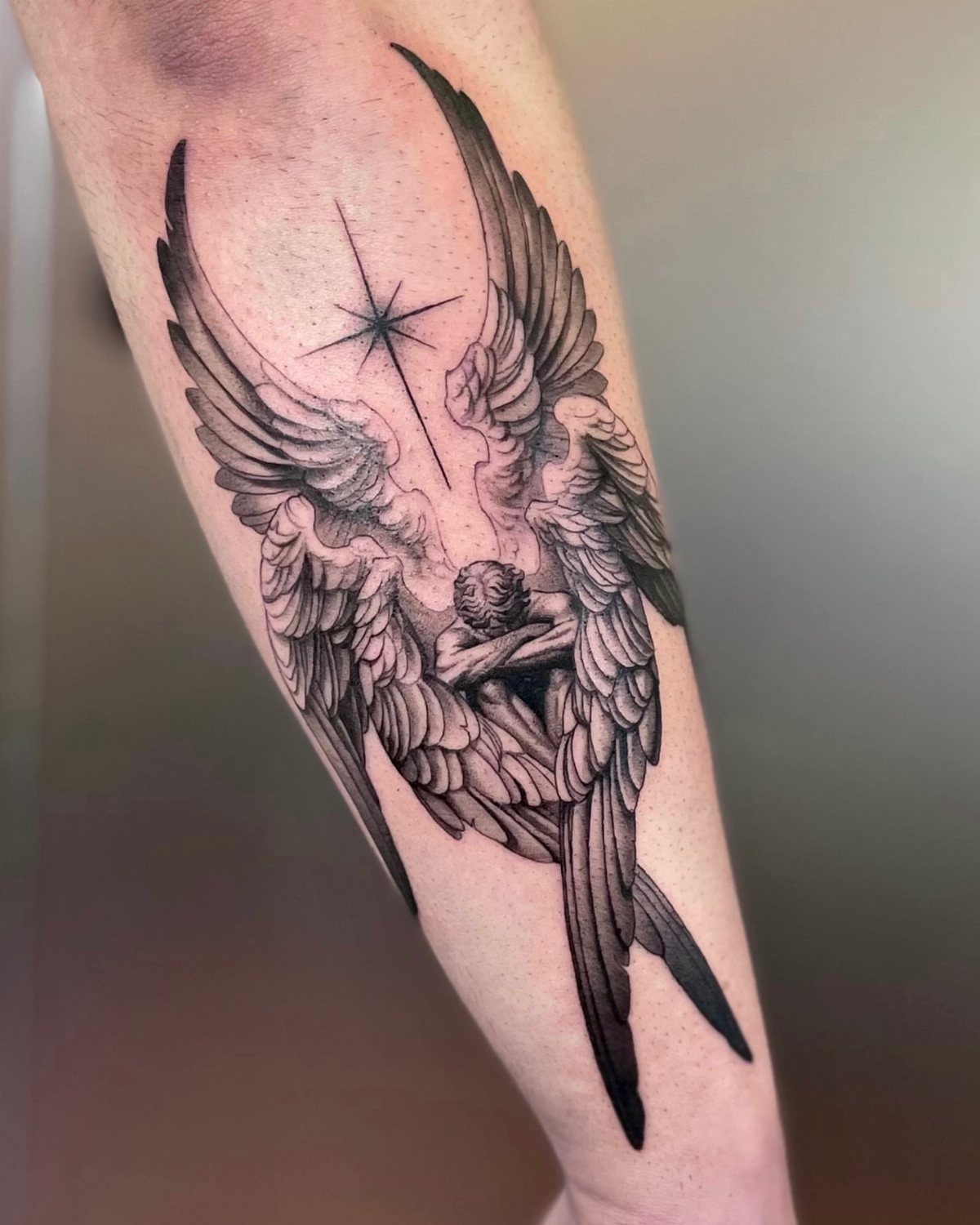
Dark angel tattoos turn the usual comfort on its head. The figure may kneel, wing-damaged, or carry a blade instead of a blessing; the mood is struggle, not protection.
This suits a forearm or calf placement, especially if the design includes a sword that runs with the limb’s line.
The darkness is in the theme, not necessarily the ink: some healers prefer heavy blackwork, others let the shadows sit in the expression and posture alone.
A single bright star above the hunched figure gives a small hope against the gloom. That contrast keeps the design from reading as pure despair.
Not a tattoo to get on impulse. The meaning deepens with time if the struggle is real; it hollows out if it was only a phase.
21. Angel and Name Tattoo
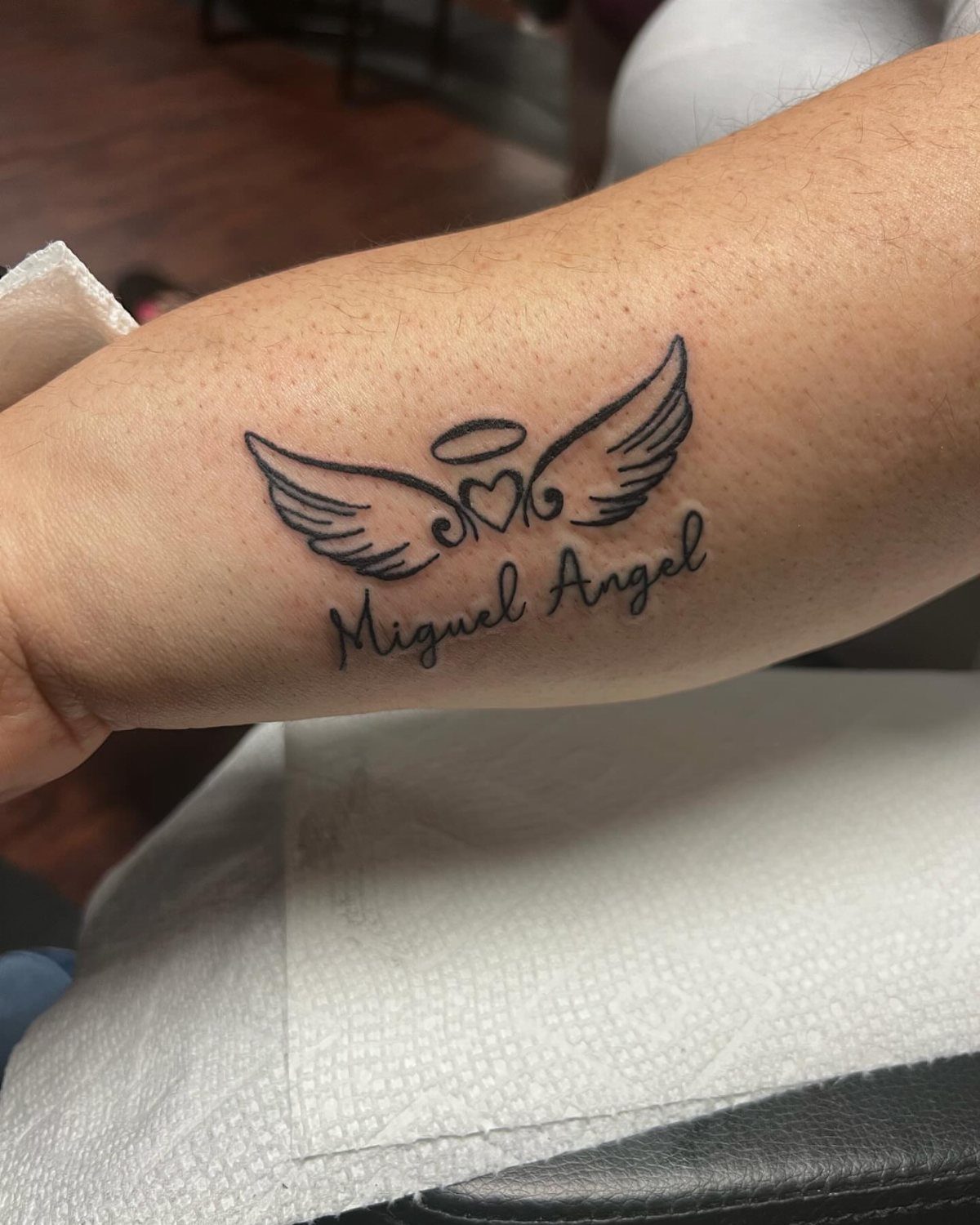
Putting a name between wings turns generic angel imagery into a specific person. The wings frame rather than carry; the name becomes the whole point.
Script choice matters more here than in most text tattoos. Flowing cursive softens the memorial tone; block letters turn it toward military or street style.
A halo above and heart between add layers without cluttering; three symbols is about the maximum before the design splits apart.
Chest or outer forearm gives the name the space it needs. Wrapping the wings around a short name works; forcing them around a long one stretches the feathers thin.
A living person’s name risks the relationship; a passed one’s name keeps. The angel imagery does not change that math.
22. Gangster Angel Tattoo
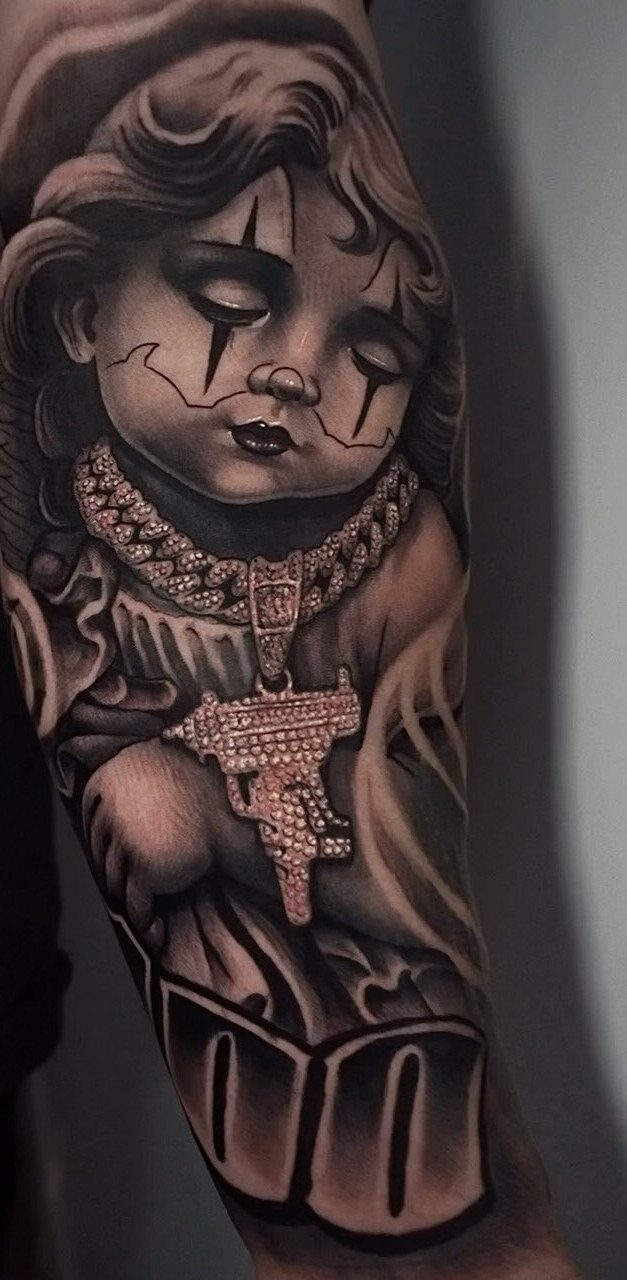
A baby face with clown paint and a gun pendant should not work together, yet the tension is exactly the point. The cherub form holds innocence; the accessories strip it away.
This style draws from Chicano tattoo tradition, where religious figures often carry street signifiers. The chain and pendant are not afterthoughts; they are half the message.
The clown makeup, specifically the teardrop and exaggerated smile, references a specific West Coast visual language that viewers will read correctly or miss entirely.
Placement on the arm lets the details show: the jeweling on the chain, the gun’s small mechanics. A calf would hide too much.
The morality is deliberately muddy. If you need your tattoos to resolve cleanly, pick a different angel.
23. 3D Angel Tattoo
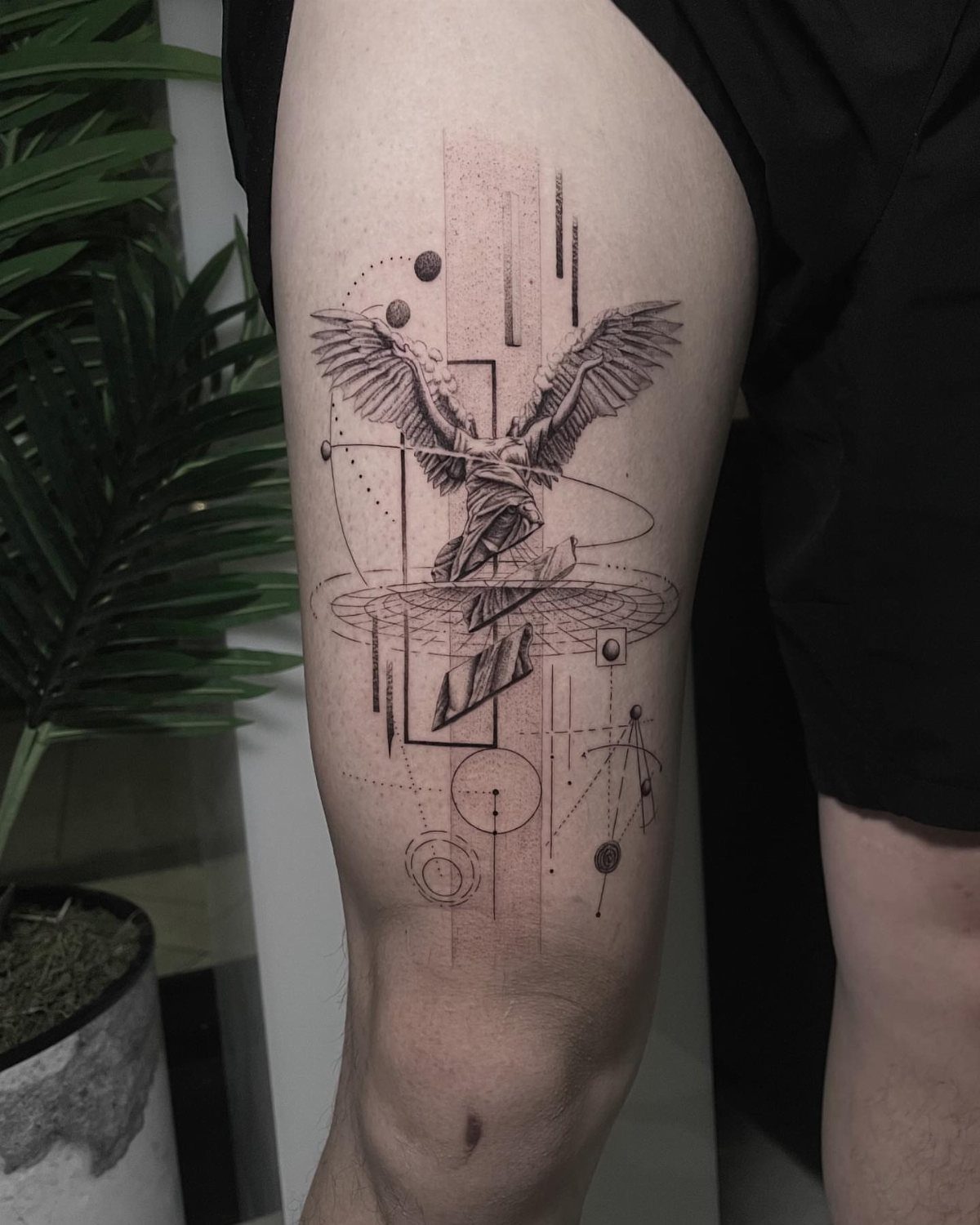
Three-dimensional angel tattoos depend on the artist’s shading discipline, not on any special ink or equipment. The geometry around the figure, circles and perspective grids, tricks the eye into reading depth where the skin is flat.
This style demands space. The thigh uses the muscle’s natural curve to help the illusion; a flat plane like the inner arm fights the effect.
The geometric framing also solves a practical problem: it gives the eye a place to rest, so the detailed figure does not overwhelm.
Not every shop that claims 3D work delivers it. Ask to see healed photos, not fresh ones; swelling flatters the shading.
The grid lines must stay crisp after recovery or the whole piece collapses into grey mush.
Budget for multiple sessions. Single-sitting 3D usually means rushed 3D.
24. Angel Leg Tattoo
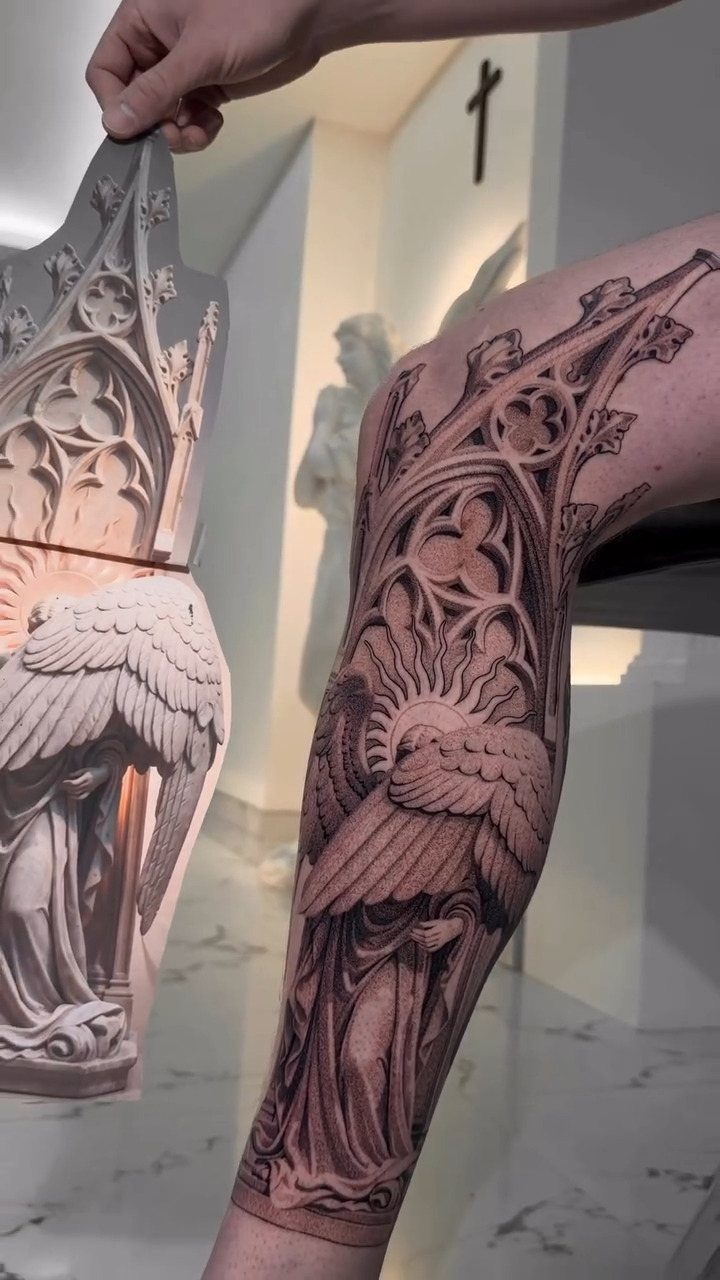
The leg offers the largest uninterrupted canvas below the neck, and angel scenes need that room. Gothic architecture, full wing spread, background figures: all fit where a back piece would be the only other option.
Calf or quad, not shin. The shin bone sits close to the skin, so the needle hits hard and the swelling distorts fine lines.
The calf wraps slightly, letting the design turn the corner with the body.
Working from a 3D-printed reference model shows in the stone tracery’s accuracy. Most clients bring flat photos; the dimensional model let him check shadows from angles the photo could not give.
That preparation shows in the finished arches.
A leg piece takes longer to heal than arm work, and pants rubbing do not help. Plan the timing for shorts weather or accept the extra care.
Symbolism of Angel Tattoos
An angel tattoo rarely means one thing. Protection sits at the center, the old idea of a guardian watching the path ahead.
That meaning shifts when the ink follows a loss; the same wings and halo become proof that someone still travels with you, just out of sight.
A fallen angel carries the opposite: the moment after a mistake, not the mistake itself. The archangel and the angel fighting demons push further into struggle, the daily effort rather than the victory.
Divine connection works as a broad label, but most people arrive at it through something specific: a prayer that seemed answered, a period when survival felt unlikely, a number pattern that kept appearing.
The tattoo then locks that signal in place. The meaning lands where the image interrupts your attention.
Best Placements for Angel Tattoos
The back remains the natural home for wings. A full back piece reads as memorial because the scale demands commitment.
The forearm suits the daily visible reminder. A guardian angel there stays in sight during work, during conversation, during the routines that make up a life.
The length works for vertical figures; the width forces simpler compositions than the back allows.
The chest carries weight. A heart with wings, a cross flanked by feathers: these sit over the sternum where the meaning feels organ-deep.
The ribs work for narrow, vertical figures but hurt more and age faster.
The wrist and ankle stay available for halos, small cherubs, single numbers. The constraint is the size; the gain is control over who sees and when.
Legs offer the calf for medium archangels and the thigh for the angel of death’s vertical scythe. The sleeve builds whole scenes, multiple figures in relation, though that canvas takes planning and a budget spread across months.
Combining Angel Tattoos with Other Symbols
A cross changes an angel tattoo from general to specific. The combination has decades of use behind it, so the artist’s hand matters more than the concept.
The meaning tilts toward living connection, bonds rather than grief, and a single red accent in the heart keeps the piece readable at distance.
Doves, sun rays, praying hands: each adds a second language to the first. The dove brings peace, the rays bring revelation, the hands bring petition.
Pairing an angel with a cross or heart works when the symbols share weight and the eye reads a single story rather than a list.
Choosing the Right Style
Realism asks for time and for an artist whose portfolio shows healed skin, not just fresh work.
The grey wash in a guardian angel’s wings or a cherub’s cheeks can muddy after healing if the saturation was pushed too light or too dark. I’d request to see photos taken a year out, not just the day of.
Minimalist linework suits halos and angel numbers where a single curve carries the design. The risk is different: a wobble in a circle reads immediately, and fine line on the wrist or behind the ear blurs faster than bolder work.
The trade is delicacy against longevity.
Serious subjects call for black and grey: the angel of death, the fallen angel, the stone statue translated to skin.
Color reads decorative on an archangel in armor; the same red in a heart with wings becomes necessary, the single note that makes the symbol work.
Abstract and biblical forms step away from the Renaissance figure entirely. Wheels of fire, four faces, the strange forms the texts actually describe: these need an artist comfortable with source material that most reference images skip.
The result is less immediately readable and more conversation, which suits some wearers and not others.
Frequently Asked Questions
What does having an angel tattoo mean?
An angel tattoo usually signals protection, guidance, or a spiritual connection that the wearer wants kept visible.
The meaning shifts with the design: a guardian angel marks being watched over, wings alone can memorialize someone lost, and a fallen angel speaks to pride or struggle rather than peace.
What the tattoo means to the person wearing it matters more than any fixed dictionary of symbols.
What tattoos go well with angels?
Crosses pair naturally with angel wings, either rising behind the cross or spreading from its horizontal bar. Hearts, doves, light rays, and praying hands also share the same visual language and sit comfortably in the same composition.
A full sleeve needs everything to lock into one flowing design, so planning how the angel relates to nearby pieces matters more than the specific symbol you pair it with.
What is the best spiritual tattoo?
Angel tattoos rank high for spiritual work because the imagery carries across traditions without requiring a single denomination.
A guardian angel with spread wings and light rays behind the head builds presence on the upper back, while a minimalist halo with small wings reads as jewelry-like and light enough for a wrist.
The choice depends on whether you want the symbol seen by others or kept private.