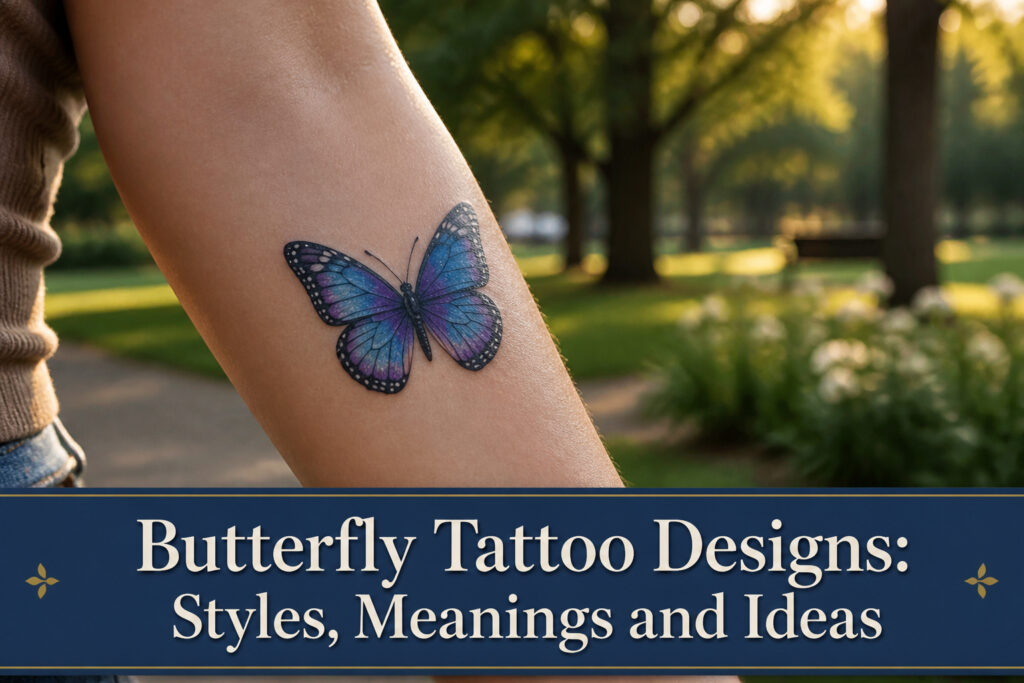
A butterfly tattoo design is a permanent image of an insect chosen for its symbolic weight and visual adaptability, but the style you select determines whether it holds detail or dissolves into a blur within a few years.
Micro-realistic work demands 4–6 cm just to keep individual wing scales legible, and anything smaller collapses the precision you paid for.
The same size floor applies to minimalist designs, where a single wobbled line at 2 cm turns elegance into a mistake you notice every morning.
Micro-Realistic
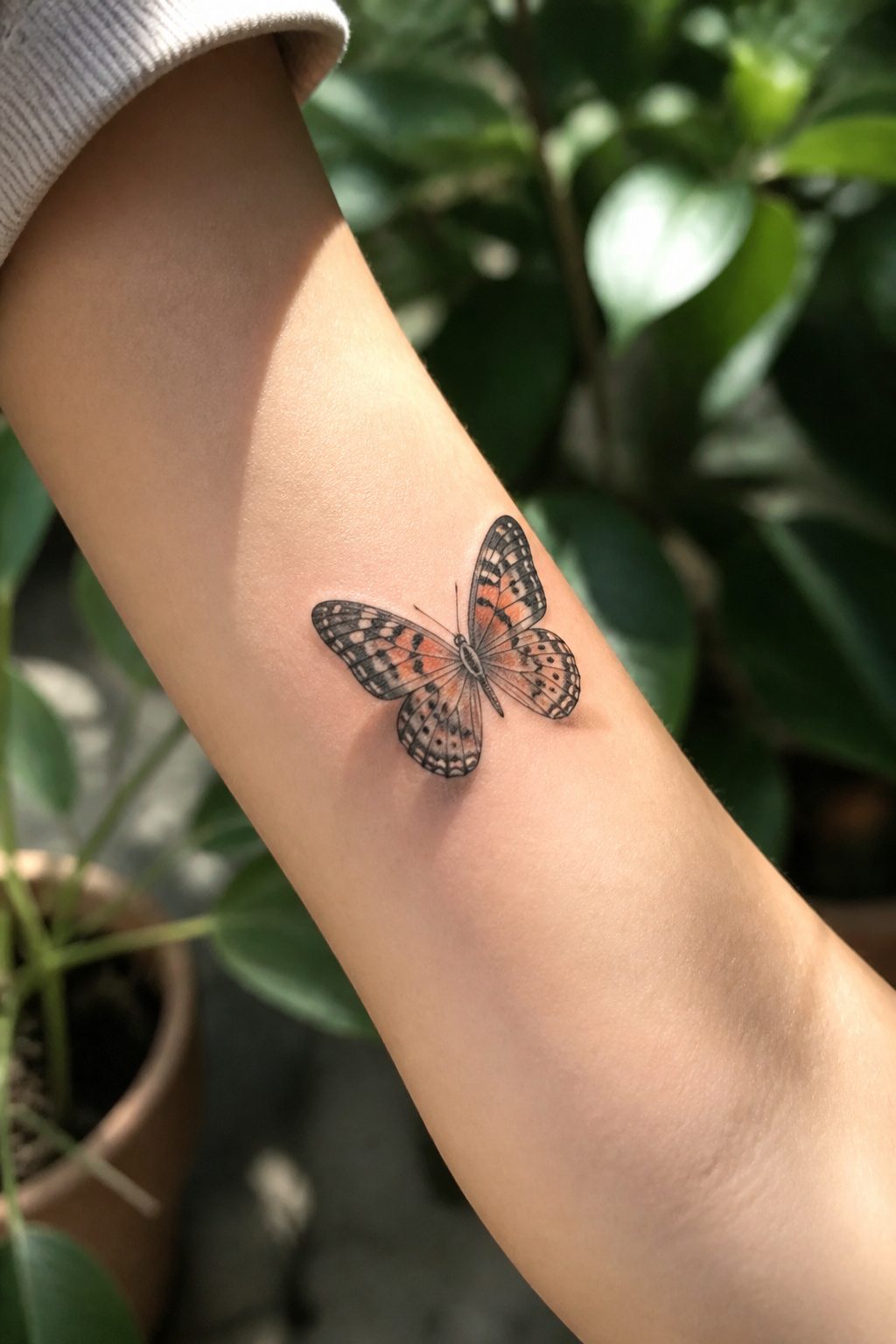
A micro-realistic butterfly sits at about 4–6 cm, the size where the wings still hold individual scales and the body keeps its segmented texture.
Anything smaller collapses the detail into a blur; anything larger and the piece drifts into a different category entirely.
The technique asks serious precision from the artist. Soft shading gives the impression the insect has actually perched on the skin, but that effect dies fast if the linework wobbles or the symmetry slips.
Butterflies are unforgiving: both wings have to match, and the eye goes straight to any imbalance. Checking a portfolio for clean, balanced work on paper first is worth the extra step, because skin is less forgiving than a sketchpad.
The meaning here tends toward a finished transformation rather than an ongoing one. Someone who has already moved through a change, career shift, recovery, a earned milestone, often chooses this style for its clarity.
The butterfly looks like a real thing that happened, not a symbol of something still becoming.
The catch is aging. Fine detail in that 4–6 cm window spreads and softens over five to ten years.
What reads as lifelike now may settle into a gentler suggestion later. That is not necessarily a loss, but it is a limit to plan around.
An artist who keeps the shading light and lets the design breathe, rather than packing every millimeter with ink, slows that process. The goal is the image of something alive, not a specimen pinned under glass.
Fine Line
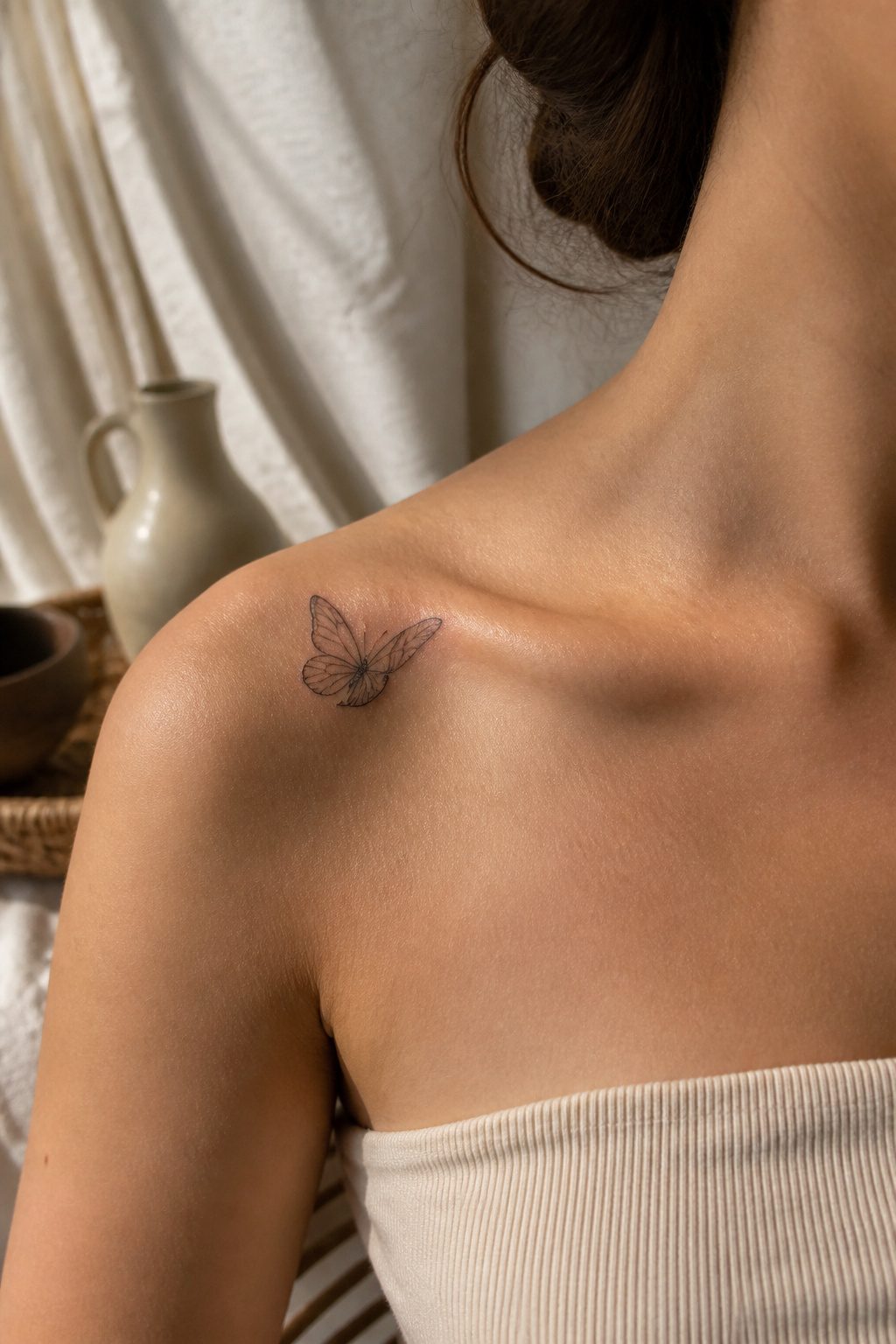
A fine line butterfly sits on the skin like a whisper, no dense fills to shout for attention.
The size that keeps this working is 2–6 cm, small enough that the lines stay crisp and the shape reads as elegance rather than a sketch that wandered too large.
Placement follows bone, not muscle: the collarbone or the ribs, tracing natural curves so the tattoo moves with the body instead of fighting it.
What ages well here is not the design at all. It is the artist’s hand.
A butterfly in this style needs precision built in from the first pass; lines too thin or too close will blur together inside a few years. Before booking, ask to see healed work, not fresh photos.
An artist who specializes in fine line should explain exactly how they space strokes for longevity, and if they dodge that question, the tattoo will not hold the delicacy you paid for.
The meaning, silent resilience, only works if the ink itself stays legible enough to carry it.
Minimalist
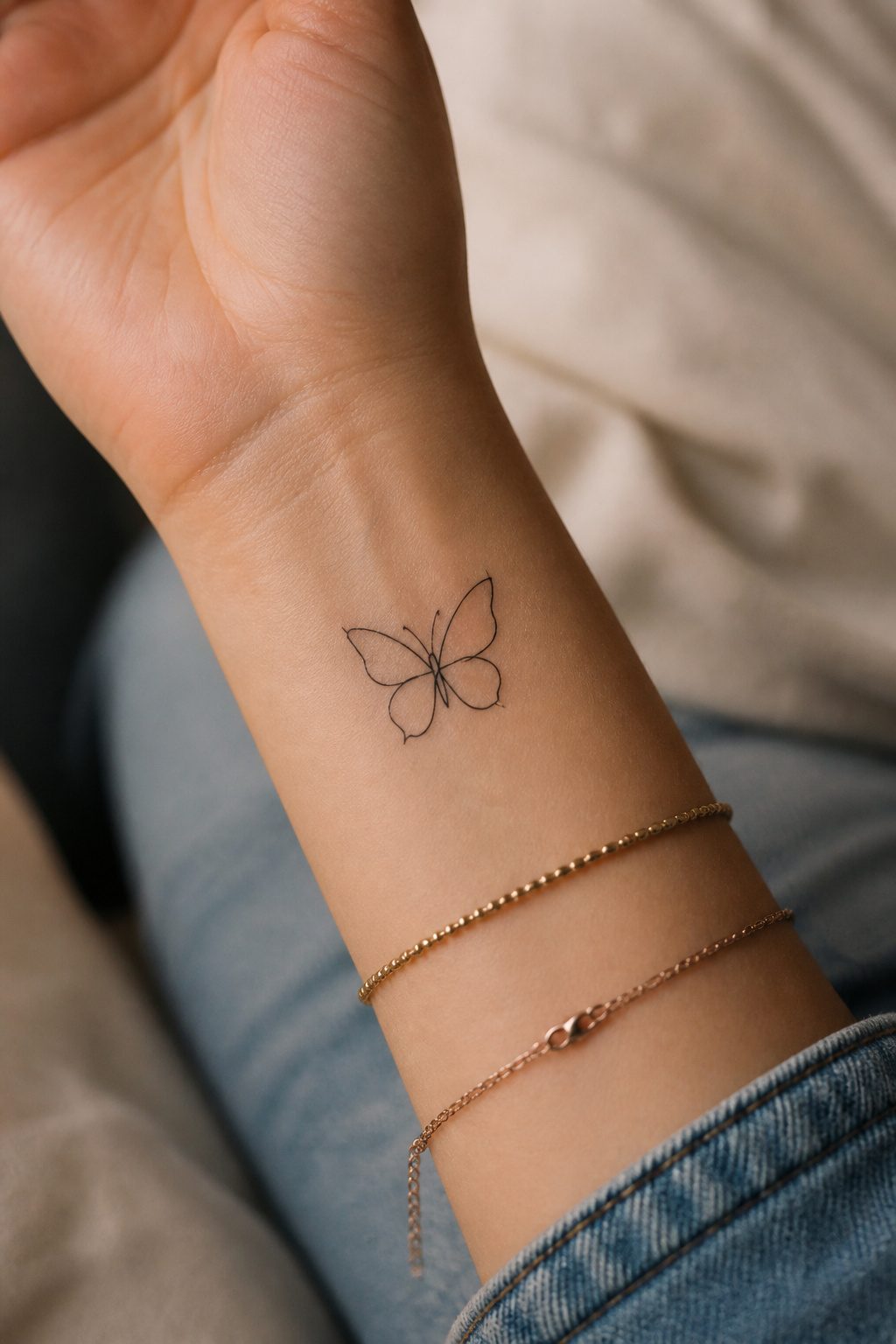
A 2–4 cm butterfly sounds like the easiest request an artist can field, but skin is not paper and a needle is not a pen. The smaller the design, the less room there is to hide a wobble.
A single continuous line, no shading, no fill, looks effortless only when the spacing between the wings and the curve of the antennae are mathematically precise.
One uneven edge and the whole insect collapses into something a child drew in a margin.
The best placements for this scale are the inner wrist, ankle, collarbone, or ribs, spots where the tattoo reads as a private signal rather than a broadcast.
What the design means also shifts with the restraint: mental clarity, the decision to strip away what does not matter, or silent resilience, change that happens without announcement.
Either reading depends on the line being clean enough to disappear into the skin at a glance and reward the closer look. That balance is what separates a professional from someone who simply owns a machine.
Mini
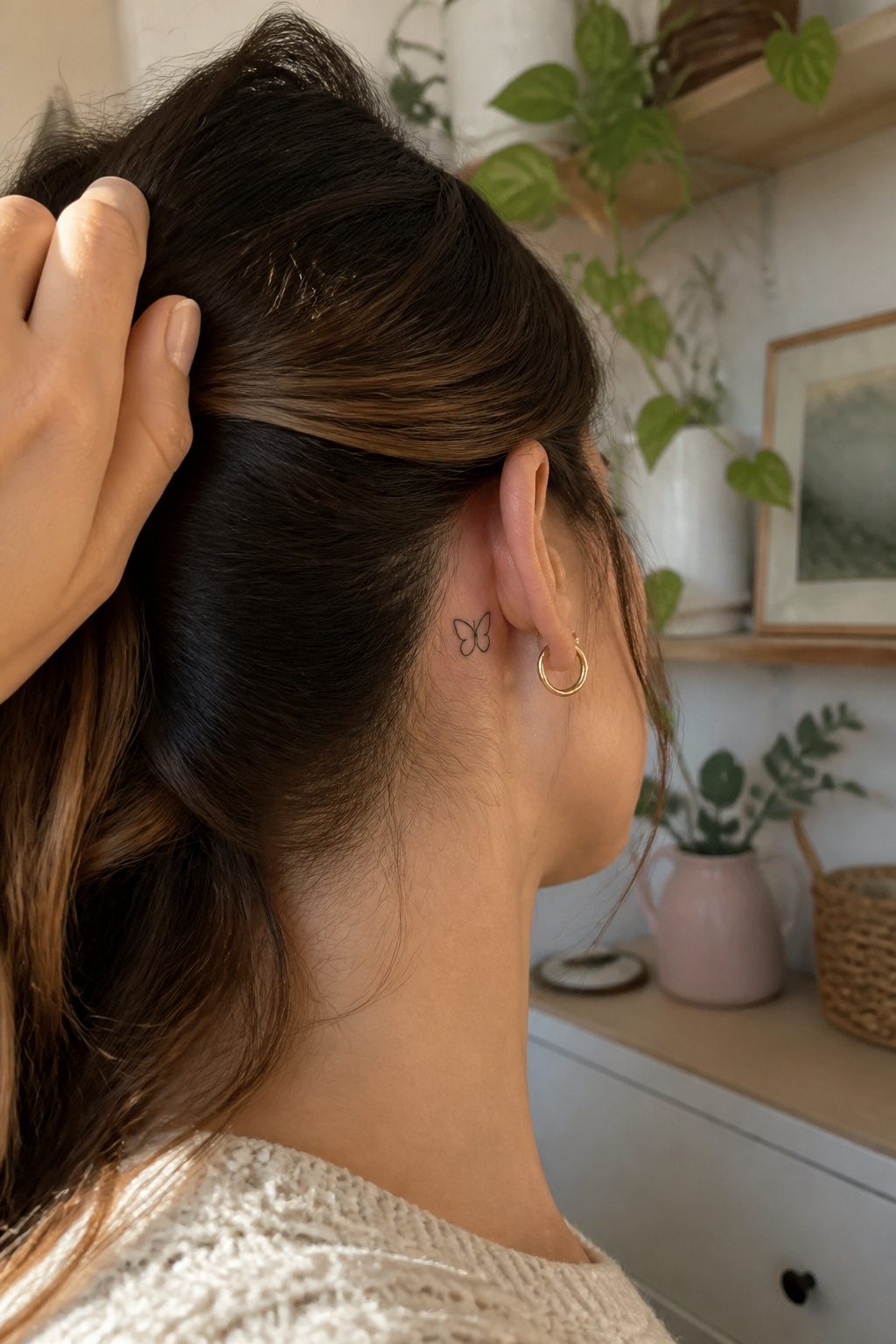
A mini butterfly tattoo at 1 cm or less lives in spots you choose to reveal, not ones the world sees first: the inner wrist, the ankle bone, the back of the neck beneath a collar, the hip just inside a waistband.
At 0.9 cm, some sit so small they read as a private mark, a shape you glance at rather than display.
The practical ceiling is unforgiving. Shading, fine-line antennae, or any interior pattern will bleed together within a year or two; the skin moves, the ink spreads, and detail becomes a gray smear.
What holds is a clean silhouette, one unbroken outline with maybe a single dot for an eye. Anything more and you are asking the needle to draw what the body will not keep legible.
Placement matters more here than with larger work. A 1 cm mark on a finger or the side of a foot faces constant friction and sun, so the line dulls faster.
The inner arm or behind the ear protects it, lets the simple shape stay sharp longer.
The tradeoff is visibility versus longevity, and at this scale, longevity wins if you want the tattoo to stay a butterfly rather than a faint blur you have to explain.
Set and Group
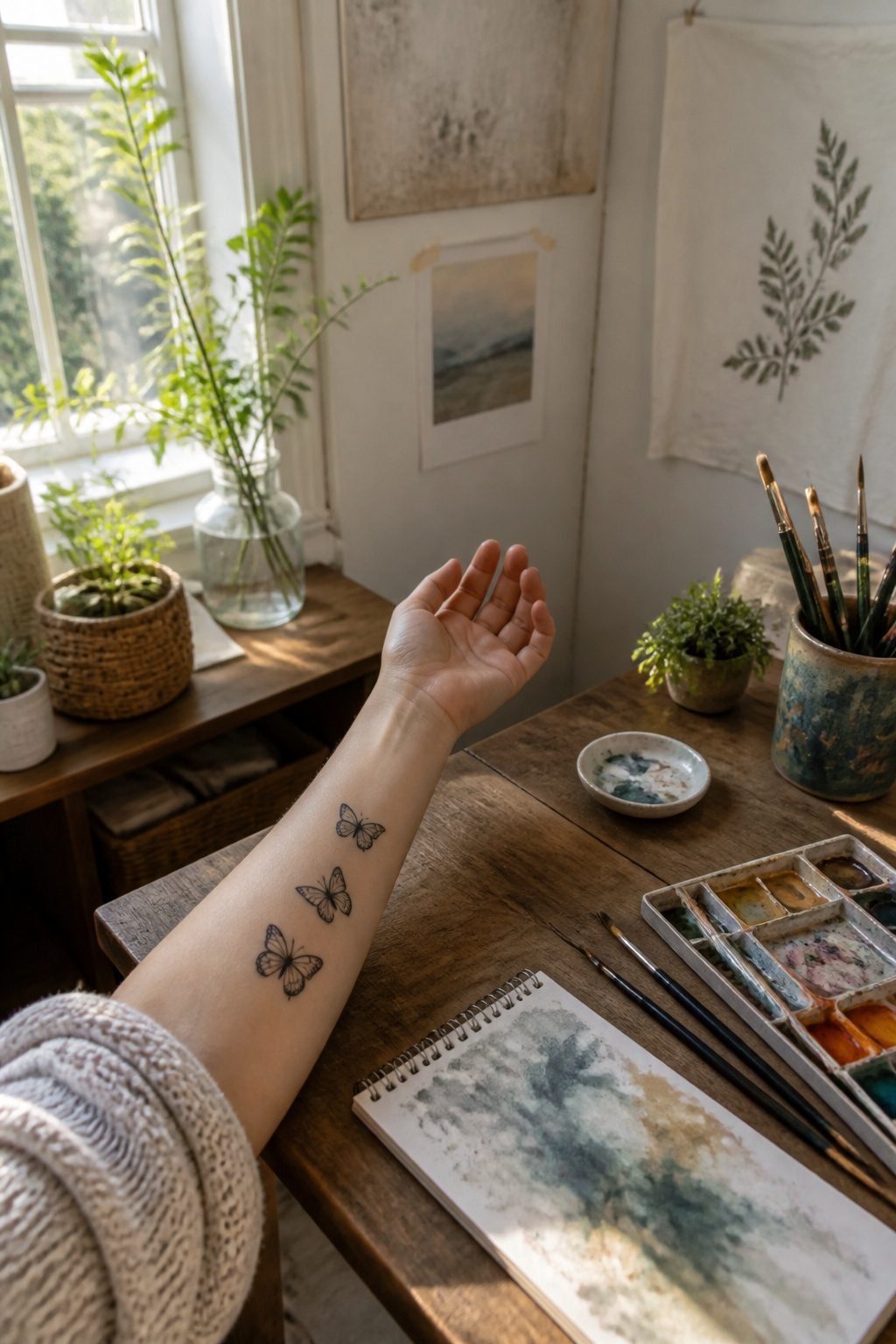
A set of two or three butterflies, each around 2–3 cm, reads as a single 6–7 cm piece that carries a different weight than one insect alone.
The spacing between them is what turns the design from a cluster into a line of flight. Tighter grouping suggests family bonds, the figures staying close like parents and children or a tight inner circle.
Wider spacing, with the butterflies trailing up a shoulder or forearm, creates movement through space and marks a transitional phase, one change leading into the next. The arm elongates best when the line climbs rather than sits flat.
This middle-ground size works well if you want an arm composition with several tattoos but are not ready to commit to a single large piece.
Three butterflies also give the artist more freedom to adjust placement to your body proportions, applying each one separately rather than locking into a fixed stencil.
Skull
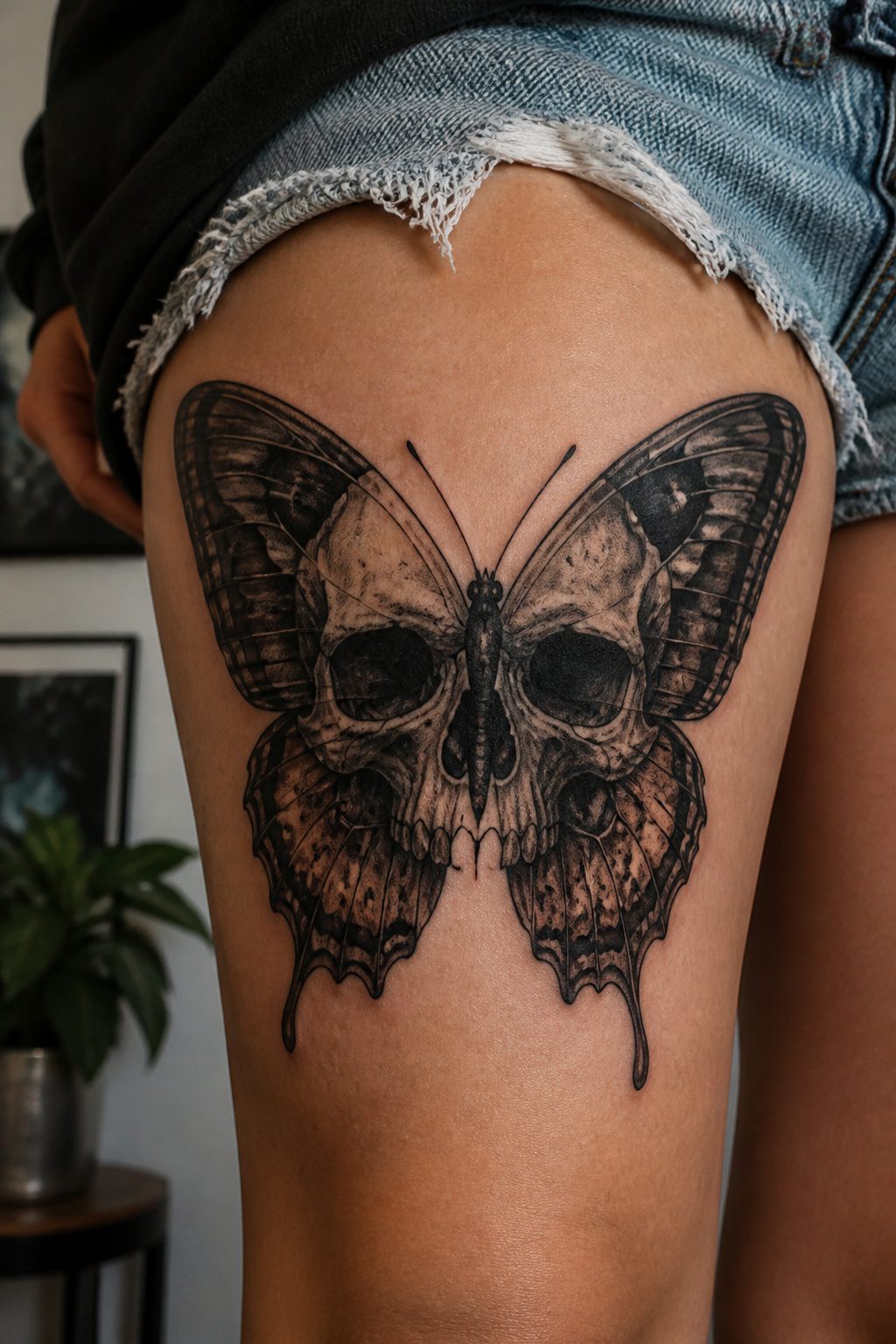
A skull butterfly needs 7 cm or larger to read as anything more than a smudge. The skull hides inside the wing shading, so the detail work demands space.
Thigh, shin, or calf carry it best; the curve of those areas gives the skull room to sit naturally without distorting.
The pairing flips the usual meaning hard. Alone, a butterfly reads as light, change, maybe rebirth.
Set a skull into those same wings and the message becomes duality itself: fragility against strength, life against death, the fact that one requires the other. It is not a gentle tattoo.
The black fills and heavy shading push the mood toward toughness, and that is the point. If you want the butterfly shape but cannot stand how delicate it usually looks, this is the route.
The wing structure does the familiar work; the skull does the rest.
Large

Large butterfly tattoo designs start at 8 cm or larger and demand real estate where the body stays relatively flat. The center of the back, between the shoulder blades, or the sternum gives the detail room to breathe without warping.
Curved spots like ribs or shoulders fight the design; the wings distort when skin stretches and compresses with movement, and intricate shading blurs into a mess within a few years.
Detail dictates scale. A butterfly heavy with linework or gradient shading needs that size minimum to read as anything more than a dark smudge from arm’s length.
The back piece I keep returning to in my research sits dead center, symmetrical, unhurried. It takes up space deliberately, the way a person who has actually finished a transformation might stand in a room.
Placement on the forearm works if you have length to spare, but the curve still intrudes near the wrist and elbow ditch.
The shoulder blade offers bone beneath and less give, though the wing tips ride up toward the collarbone in ways that look accidental unless the artist planned for it.
3D
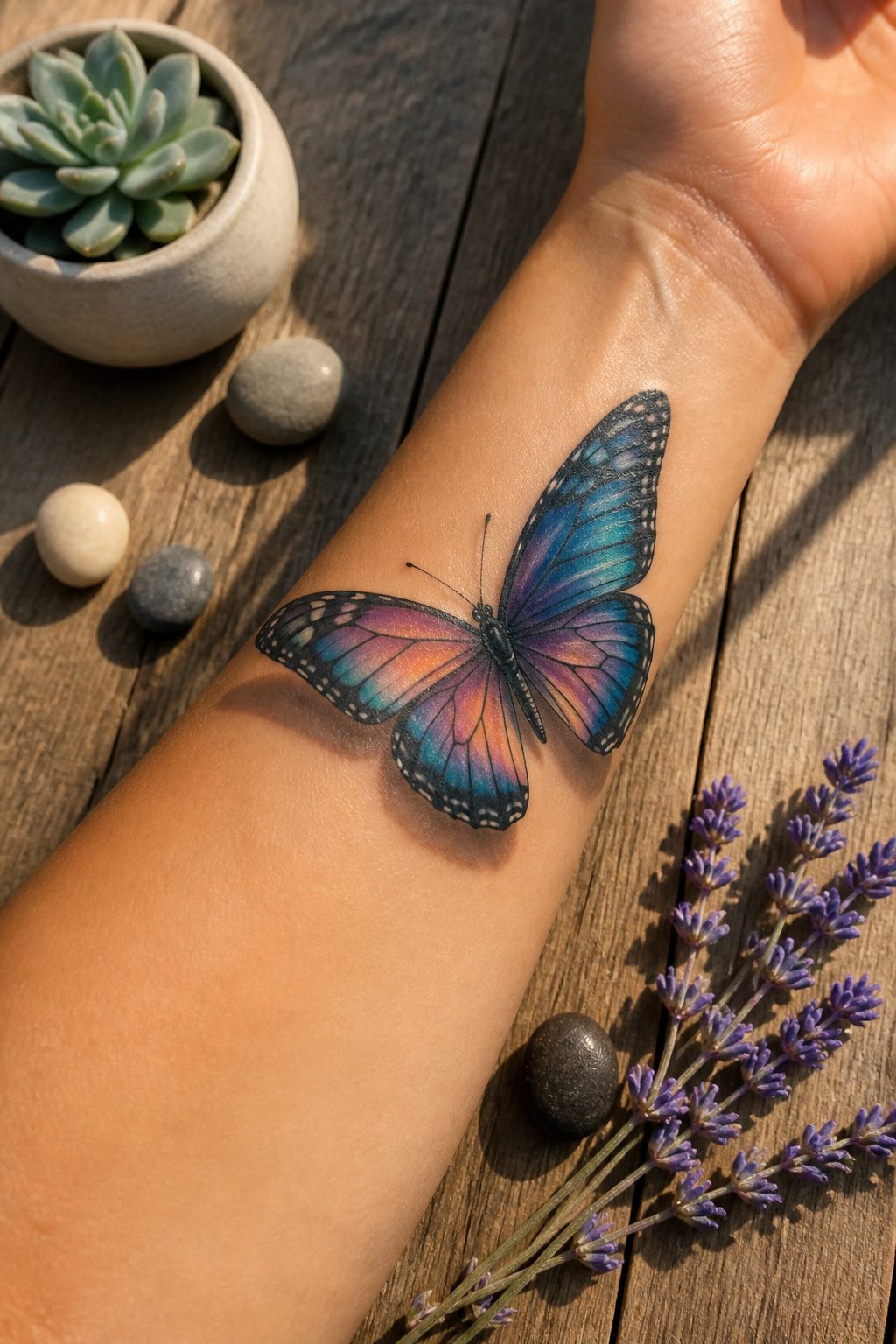
A 3D butterfly tattoo lives or dies by how well the artist manipulates shadow and highlight.
The technique builds depth through layered shading: darker tones recede, lighter ones advance, and the eye reads the result as a physical object resting on the skin rather than ink sitting inside it.
Done well, the butterfly appears to flutter when the person moves, the wings catching imaginary light from any angle.
The catch is the artist’s skill ceiling. Overly dark shading flattens the illusion into a muddy smudge; lifeless color drains the sense of something alive.
A bad 3D piece ages especially poorly because the contrast that creates depth is the first thing to blur as lines spread and blacks soften over time. The effect demands an artist who understands optical illusion, not just tattooing.
Without that, the butterfly looks like it lost a fight rather than landed for a rest.
Geometric
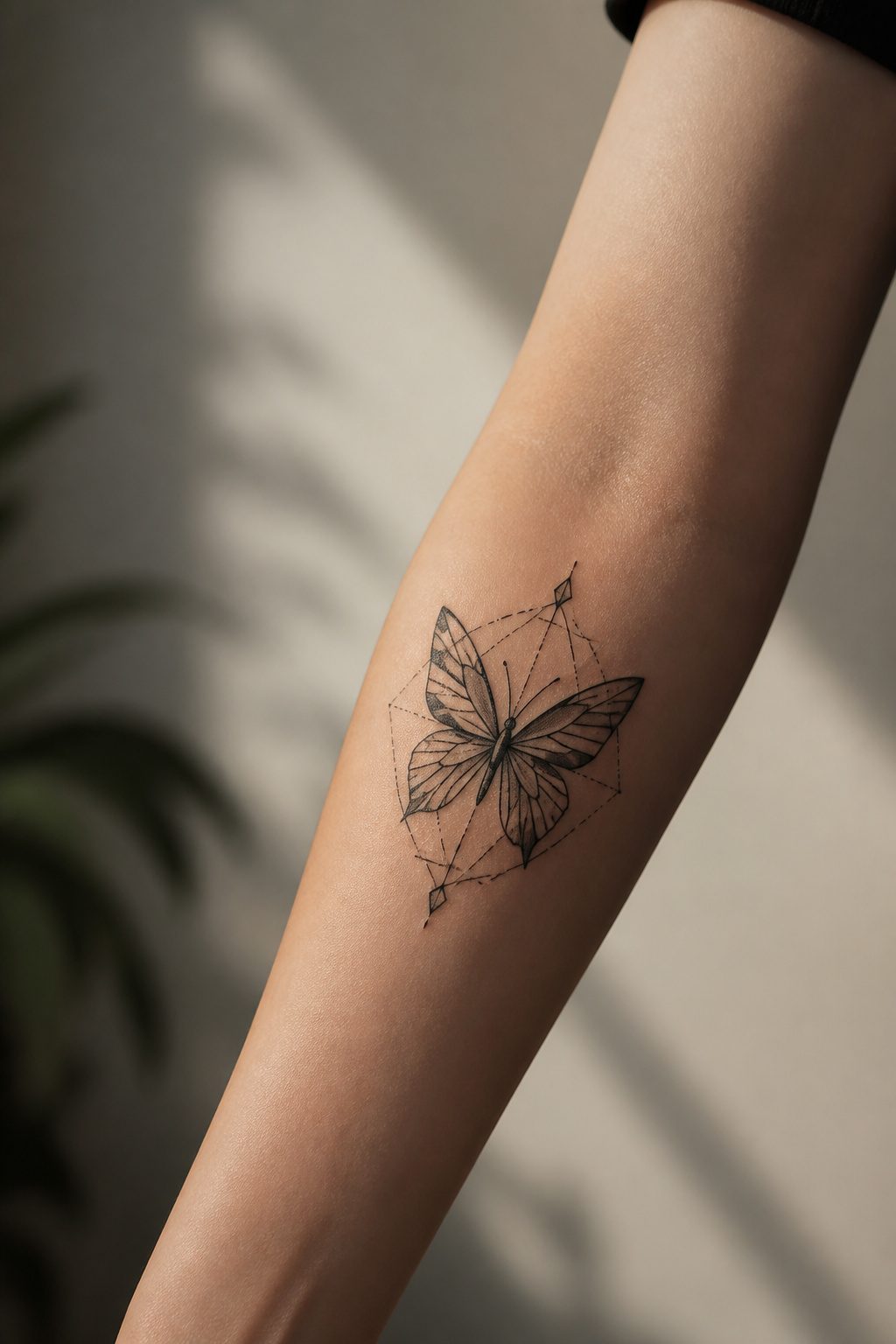
Geometric frames give a butterfly tattoo its structure without killing the movement.
The way I see it played out most often: a hexagon or thin triangle sits behind the wings like a shadow box, or a single wing gets broken into polygons that still read as a wing from across the room.
The risk is going too fine. Lines under about 2 mm wide tend to blur inside a year on high-movement spots, and a geometric butterfly already asks the eye to do more work than a naturalistic one.
Keep the shapes bold enough to hold, or scale the whole piece to at least 8 cm so the negative space survives.
That size lands it between the collarbone whisper and the full back statement, a mid-size choice that works on a thigh or a forearm without dominating either.
What I look for in a design that will last: the geometry should intersect the body, not just sit on top of it.
A mandala center where the thorax would be, or a straight line that follows the spine while the wings break it, gives the piece a reason to be a tattoo rather than a sticker.
Watercolor
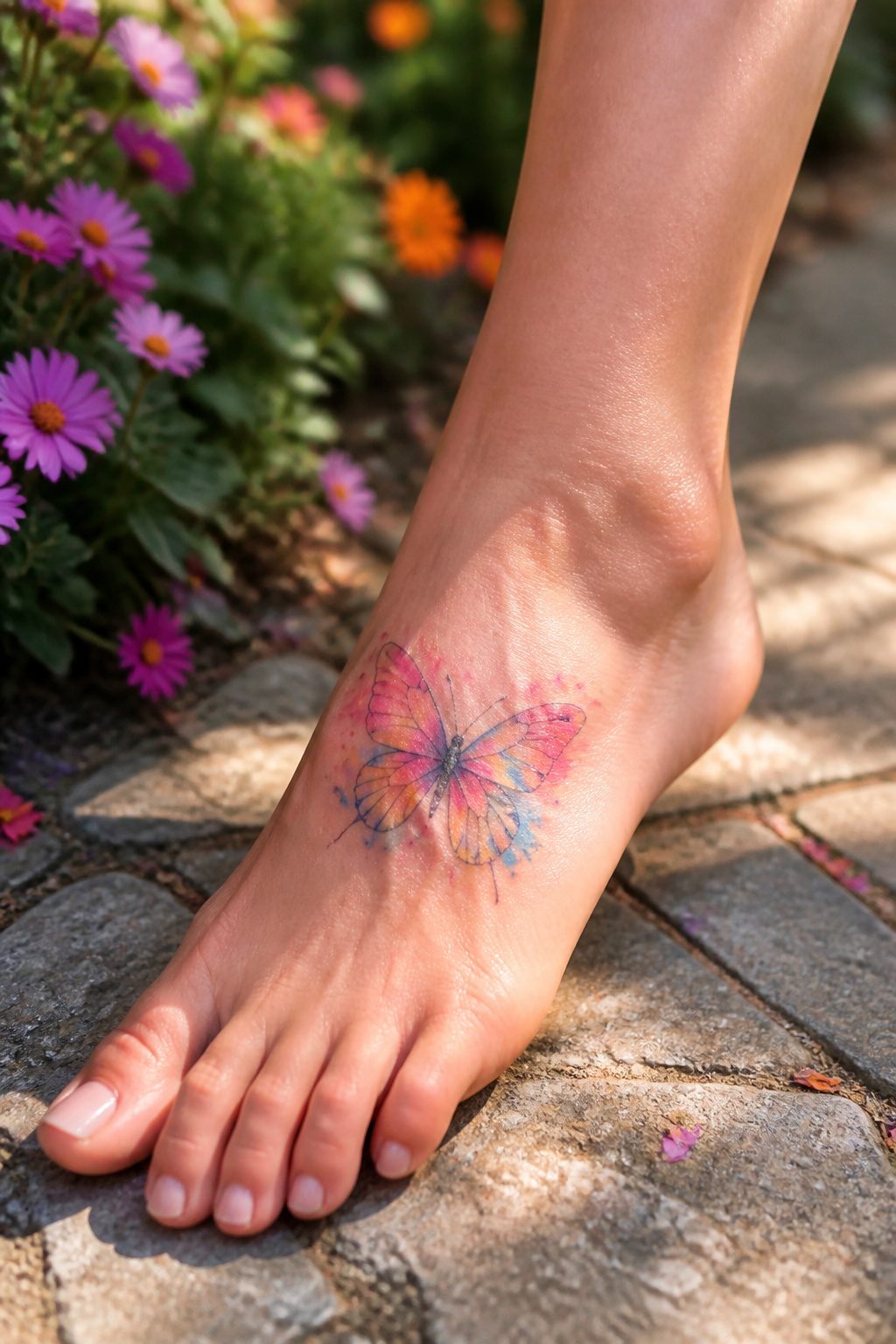
Watercolor butterfly tattoos carry pigment the way paint sits on paper: soft edges, visible flow, and color that seems to bleed outward rather than hold a hard border.
The ink is applied in translucent washes, so the skin beneath still shows through in places, giving the piece its airy, half-finished quality. That same translucency is what makes aftercare stricter than with traditional work.
A watercolor piece needs consistent, gentle moisture for the first two weeks; the lighter saturation means scabbing pulls more pigment away, and the faded spots that result are harder to touch up without breaking the wash effect.
Traditional saturation packs ink densely enough that a little dryness during healing still leaves solid color behind. Watercolor does not forgive that.
The style also ages differently. Where bold traditional lines blur slowly and evenly, watercolor’s soft edges can muddy faster, and the lighter tones sometimes disappear into the skin tone itself within a few years.
A touch-up plan matters from the start, not as an afterthought.
Traditional
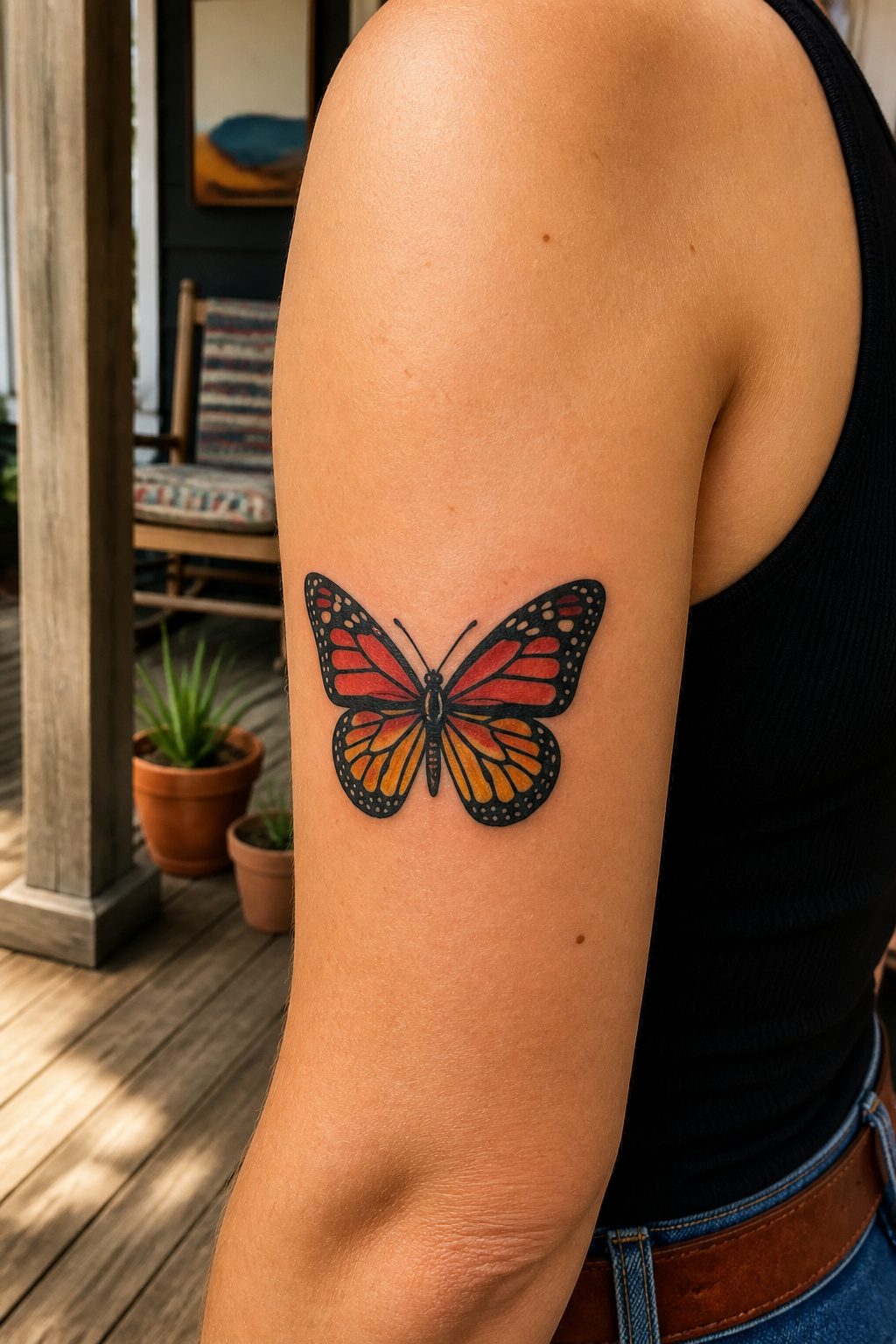
Traditional butterfly tattoo designs lean on bold outlines and a tight palette of bright, saturated color, usually red, yellow, green, and black.
The monarch pattern comes up often in this style, its wing markings simplified into clean shapes that read clearly from across a room. That simplicity is the point.
The style grew out of American tattooing from the early-to-mid 1900s, when equipment and ink limited what artists could do, and those limits became the look that collectors still ask for a century later.
Color in these pieces carries weight: blue shades point toward freedom, red toward passion, yellow toward positivity. The trade is upkeep.
Bright pigments fade faster than black and grey, and skin tone changes how those colors pop.
A traditional butterfly avoids that problem partly by using fewer colors, each one placed deliberately, so the design holds its contrast even as the years pass.
The strong outline does the rest, keeping the shape legible long after softer, trend-driven work has blurred into something unrecognizable.
Neo-Traditional
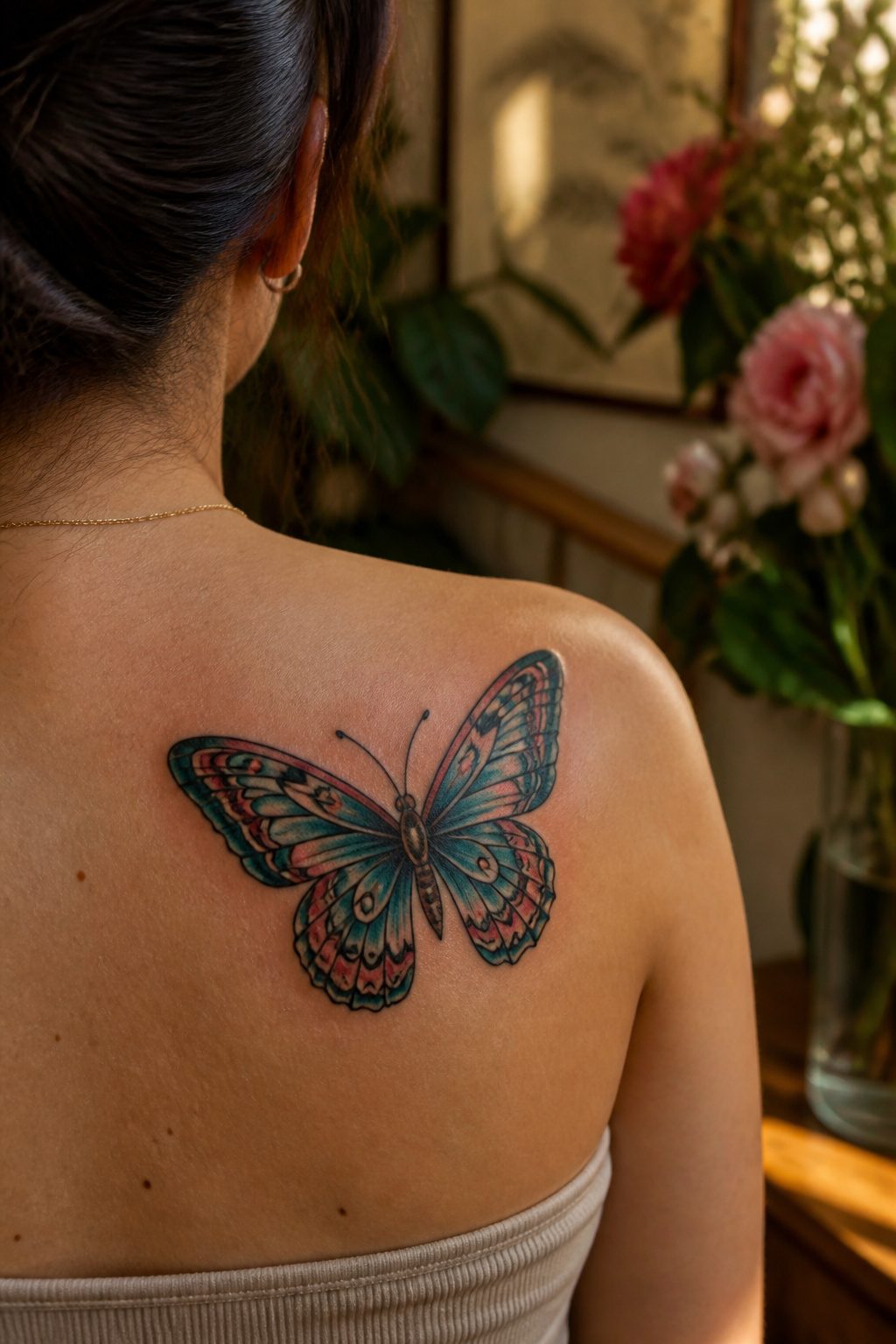
Neo-traditional butterfly tattoo designs keep the bold black outlines and saturated color blocks that define old-school American traditional work, then layer in softer shading, a wider palette, and more intricate compositions.
The result sits between two poles: it is not as flat or limited in color as pure traditional, but it stops short of the photographic precision that realism demands.
A traditional butterfly might read as a symbol first and an insect second. Neo-traditional reverses that priority slightly.
The wings carry more dimension through graduated shading, and the body often shows finer detail in the antennae and leg joints.
Where traditional work would stop at red, yellow, green, and black, this style works in teals, dusty roses, and muted golds without losing the graphic punch.
The compositions grow more complex too. A neo-traditional piece might frame the butterfly with ornamental scrollwork, integrate it into a bouquet, or let the wings overlap a dagger or hourglass.
That layered storytelling is the real departure. Traditional butterfly designs tend to stand alone; neo-traditional uses the insect as one actor in a larger scene.
The tradeoff is size. These pieces need more room than a classic small-format tattoo to let the shading breathe and keep the lines from muddying together.
Dotwork
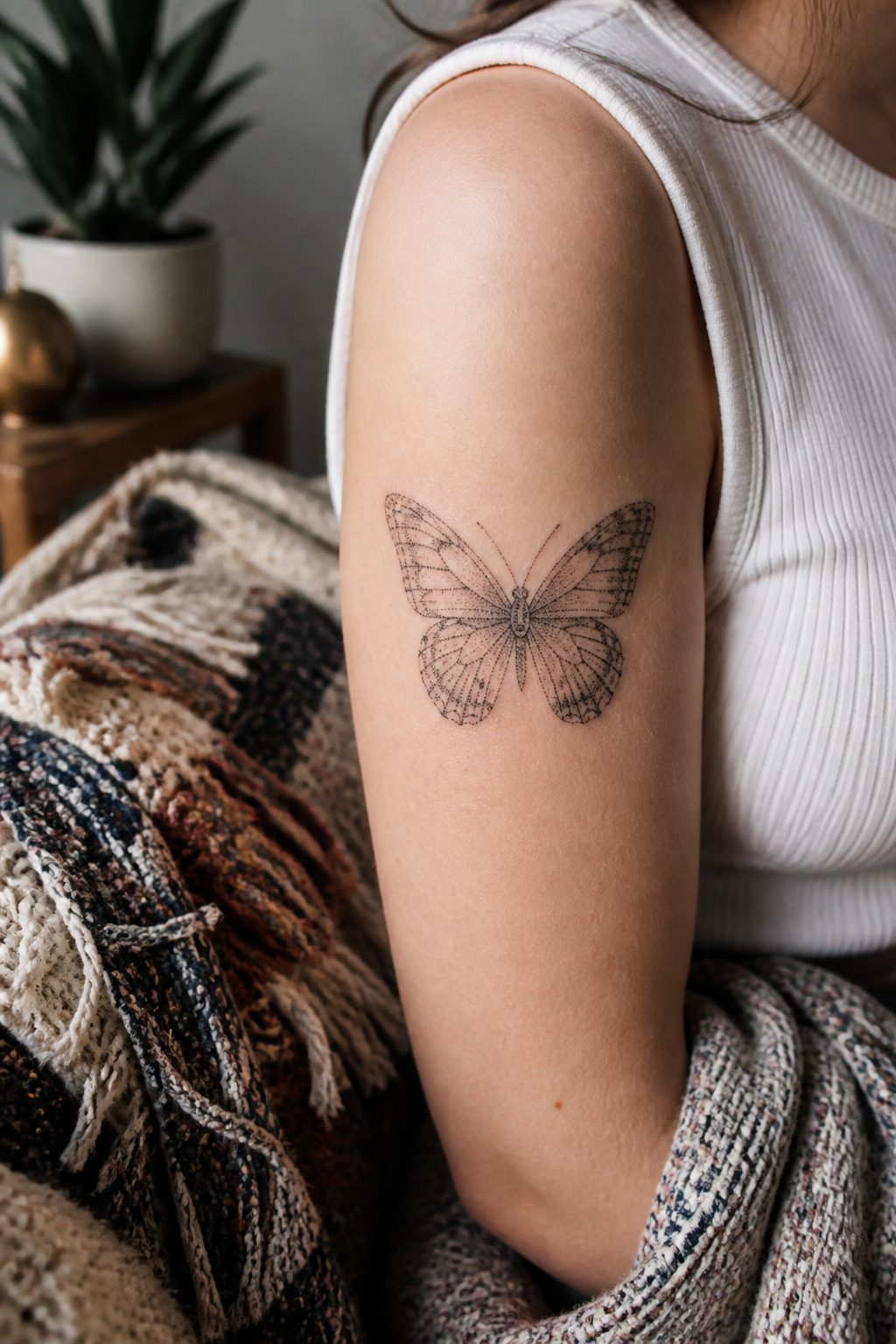
Dotwork builds a butterfly from nothing but stippled points, thousands of them, clustered tight for shadow and spaced wide for light.
The technique creates a soft, almost dusty texture that solid fill cannot replicate, and on a wing shape that texture reads as natural iridescence rather than flat color.
What convinced me, looking through portfolios of healed work, is how the gradient holds up: because the ink sits in discrete dots rather than a solid wash, the eye still reads the intended tone even after some points blur or fade.
The tradeoff is session length. A palm-sized piece that would take ninety minutes in solid black can stretch past three hours when every mark is laid individually, and the artist’s hand must stay steady throughout.
Budget for two sessions, not one, especially if the design crosses the shoulder blade or ribs where the skin fights the needle. The aging pattern differs too.
Where solid black can blow out into a soft edge, dotwork tends to lighten evenly across the whole piece, keeping the relative values intact even as the overall contrast drops.
A ten-year-old dotwork butterfly still reads as a butterfly; it just looks like it was photographed with a softer lens.
Linework
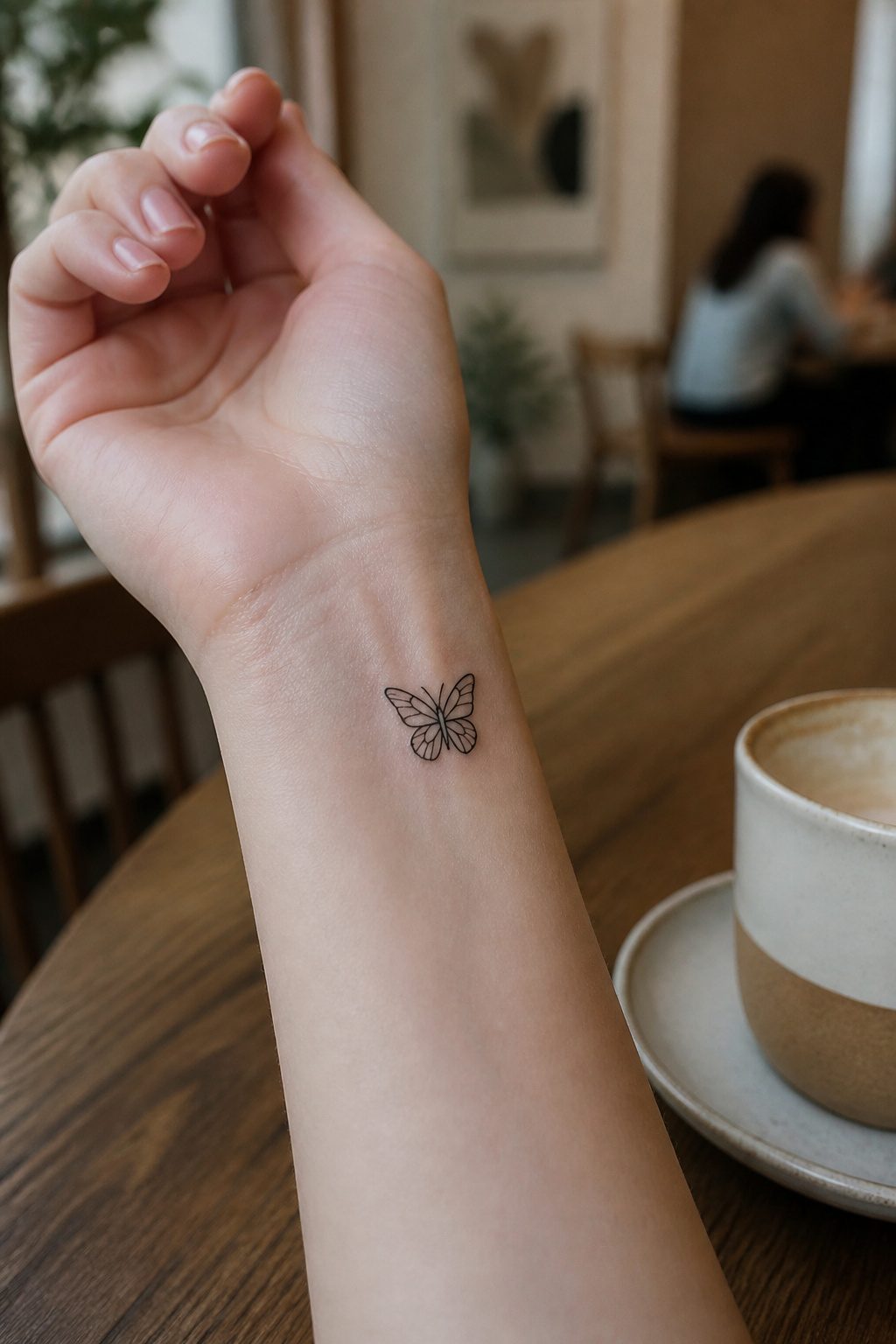
Clean single-weight lines with minimal or no shading give butterfly tattoo designs their sleekest graphic quality. The style strips away fills and gradients until only the silhouette remains, usually sized around 2–4 cm for the clearest read.
What looks simple on paper demands near-perfect execution on skin. A single wavering edge or uneven wing curve reads immediately, because there is no surrounding detail to hide behind.
The eye goes straight to the flaw.
This is the style that separates confident linework from rushed work.
An artist who can balance negative space against the drawn line will keep the butterfly light; one who overworks the needle leaves a heavier mark than the design was built for.
The precision matters most in small placements, the inner wrist or ankle, where the shape sits close to the viewer and every millimeter of line weight shows.
A shaky line here does not look artistic; it looks like a mistake you will notice every morning.
What the Butterfly Means
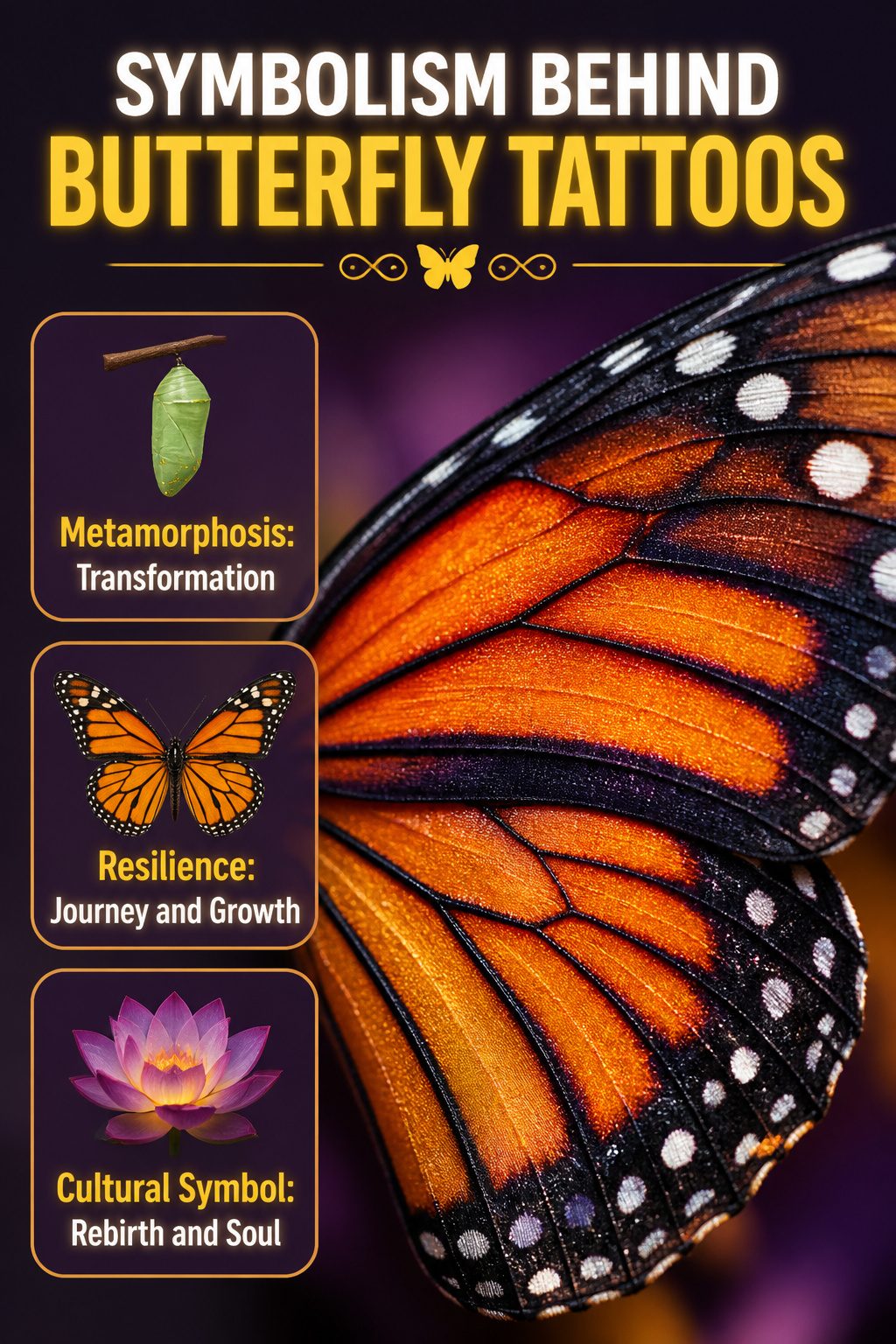
A butterfly tattoo carries metamorphosis as its core meaning, the literal dissolve-and-rebuild that turns a caterpillar into something unrecognizable.
That biological process, breaking down into soup inside a chrysalis with no guarantee of survival, is what the image actually references: radical change rather than gentle growth.
The monarch butterfly adds a second layer through its migratory journey. The species travels thousands of miles across generations, each individual pressing forward on a route it has never flown before.
That orange-and-black pattern becomes a marker of determination and resilience, of continuing without a map.
Cultural threads run alongside the biological ones. Across traditions, the butterfly has stood for the soul, for rebirth, for spiritual passage between states of being.
These meanings layer onto the personal ones: a mark of overcoming, of reinvention, of a chapter that left no trace of who came before it.
The image works because the viewer sees only the finished wing, not the history. A wearer chooses what weight to place on which thread, and the tattoo holds all of them at once.
Where to Place It
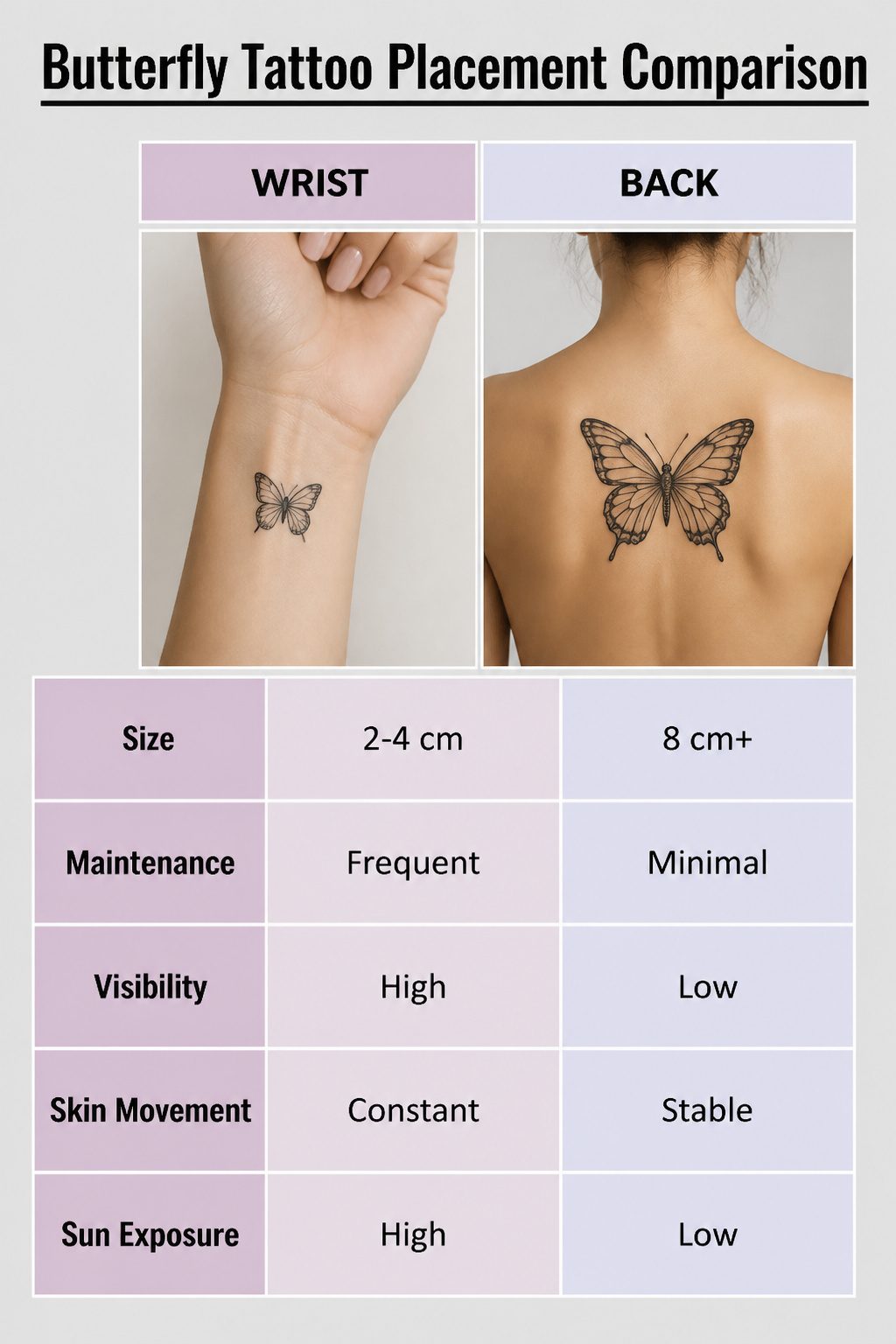
The wrist works for a minimalist butterfly tattoo design in the 2–4 cm range, but that placement comes with a maintenance cost I didn’t fully appreciate at first.
Skin there moves constantly and sees more sun than most spots, so lines soften faster and colors fade sooner. Touch-ups every few years aren’t optional; they’re part of the deal.
If that rhythm doesn’t fit your calendar, the ankle holds a similar small-scale look with less daily flex.
For anything above 8 cm, the back is the practical choice. It stays flat, ages evenly, and gives the artist room for detail you simply can’t fit on a wrist.
The trade is visibility: you need a mirror to see it, which some people love and others regret by month three.
The shoulder sits between those two worlds. A 4–6 cm micro-realistic piece there stays concealable under work clothes but shows when you want it to.
The skin is stable enough for fine detail without the back’s total remove from your own sightline.
Collarbone and rib placements follow the body’s curves well for fine line work in that 2–6 cm band.
What sways the choice is your own daily routine: a collarbone piece meets seatbelts and necklace chains, while ribs stay hidden but flex with every breath.
Size by Style
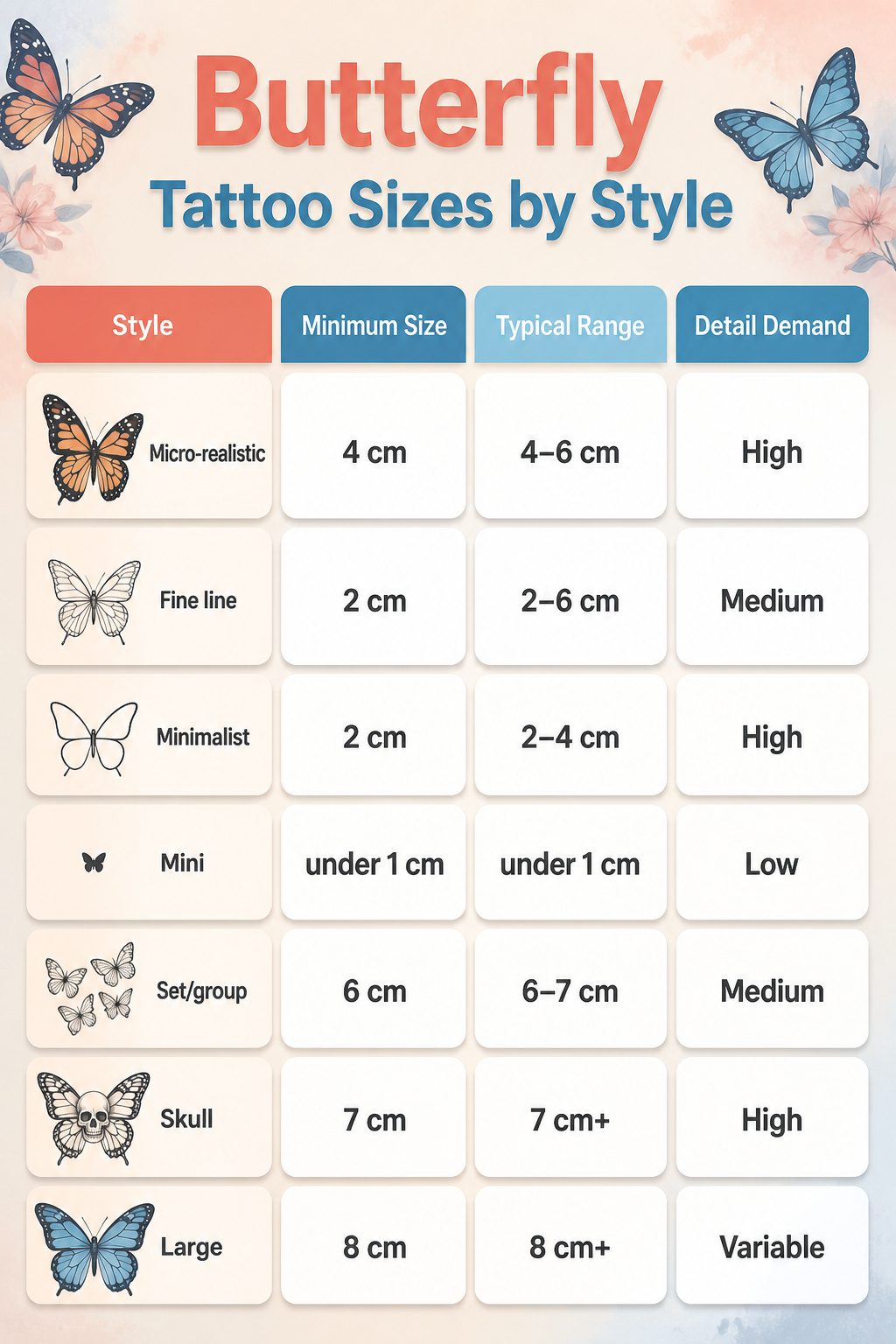
Detail level sets the floor for butterfly tattoo designs more than most people expect. A micro-realistic piece needs 4–6 cm minimum just to hold the fine linework and shading that make it read as real.
Drop below that and the antennae blur into antenna, the wing scales become mud.
| Style | Minimum Size | Typical Range | Detail Demand |
|---|---|---|---|
| Micro-realistic | 4 cm | 4–6 cm | High: shading, symmetry, fine linework |
| Fine line | 2 cm | 2–6 cm | Medium: clean lines, strategic negative space |
| Minimalist | 2 cm | 2–4 cm | Deceptively high: one shaky line ruins it |
| Mini | under 1 cm | under 1 cm | Low: silhouette, no interior work |
| Set/group | 6 cm | 6–7 cm | Medium: spacing between forms matters |
| Skull | 7 cm | 7 cm+ | High: bone texture competes with wings |
| Large | 8 cm | 8 cm+ | Variable: often combines techniques |
The 2 cm gap between fine line and minimalist minimums surprised me when I mapped this out. Both look simple on paper, but minimalism punishes imperfection harder.
An unsteady hand turns a clean outline into something that reads as a child’s drawing, not a choice. That precision costs space the same way realism does, just differently.
Species and Their Meanings
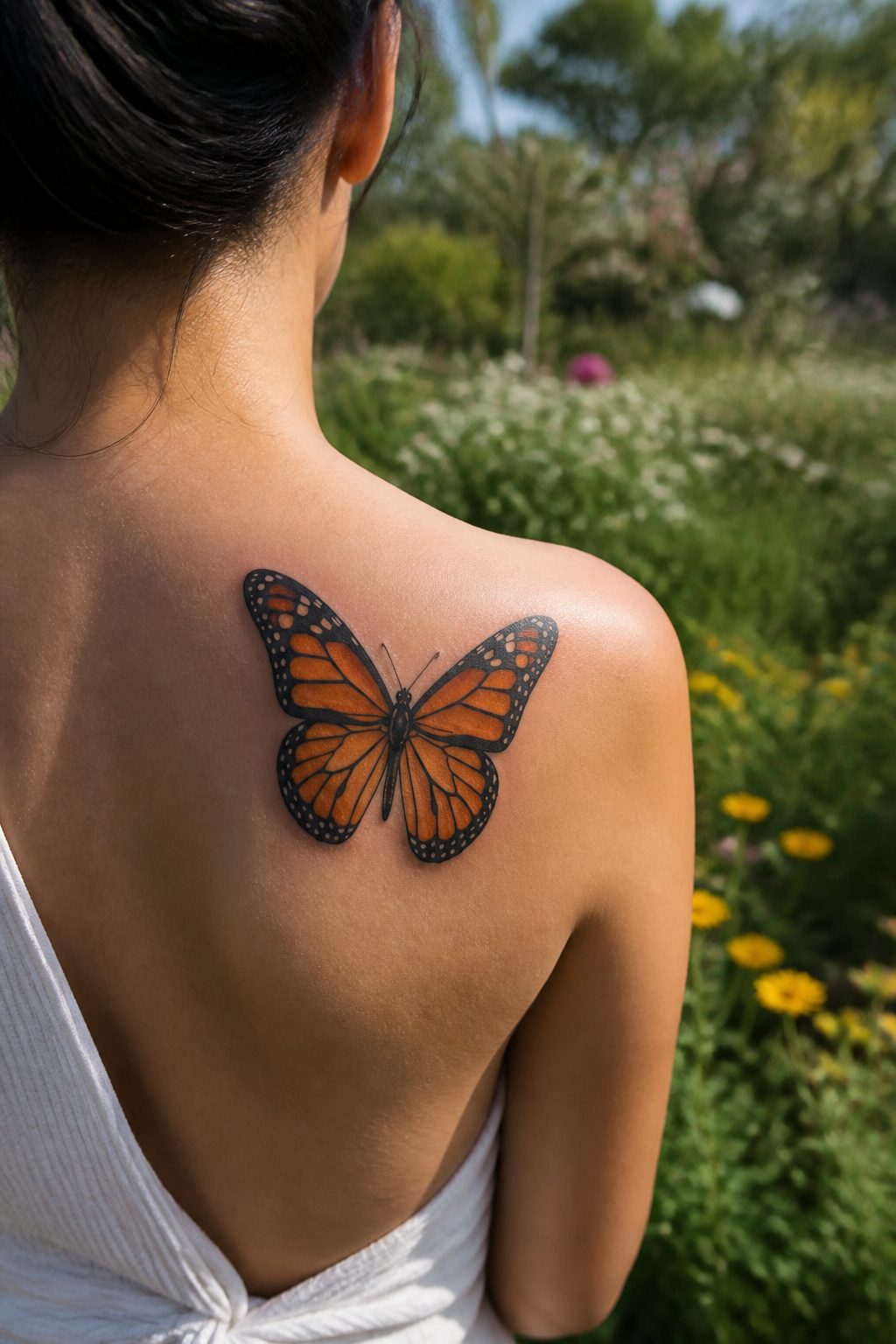
A monarch butterfly tattoo carries the weight of a real migration: three thousand miles of flight against wind and weather, which is why the species has become shorthand for resilience and determination.
The orange-and-black pattern is recognizable enough that someone across a room knows what you chose without asking.
The swallowtail moves in a different register. Its long tail streamers and broad wings read as grace rather than endurance, a lighter symbolism that suits a different story.
Choosing an actual species over a generic butterfly shape matters more than most people expect. A generic form signals "transformation" in the broadest sense, which is fine if that is what you want.
A named species ties the image to something specific: a migration you admire, a garden you remember, a quality you are trying to keep.
The monarch and swallowtail are only two options among dozens of native and exotic species, each with its own field marks and its own associations.
The difference shows in the tattoo’s authority. Someone who knows butterflies recognizes the accurate wing venation or the correct placement of eyespots, and that recognition gives the design a groundedness that a fantasy outline rarely achieves.
The work of choosing is part of the meaning.
Frequently Asked Questions
What does the butterfly tattoo symbolize?
A butterfly tattoo symbolizes metamorphosis, the radical dissolve-and-rebuild process that turns a caterpillar into something unrecognizable. The monarch butterfly adds a layer of resilience and determination through its migratory journey of thousands of miles.
Cultural threads layer on as well: the soul, rebirth, and spiritual passage between states of being. The wearer chooses which weight to place on which thread, and the tattoo holds all of them at once.
What tattoo goes well with a butterfly?
A butterfly tattoo pairs well with flowers, names, geometric patterns, and celestial elements like stars and moons. Flowers enhance the theme of nature and renewal, while script adds sentimental value.
Geometric designs create a modern, structured contrast to the organic form. Skulls or clocks integrate for a balance between beauty and impermanence, emphasizing the fleeting yet powerful nature of change.
What is the best size for a butterfly tattoo?
The ideal size depends on detail level and style. Micro-realistic designs need 4–6 cm to hold fine linework and shading.
Fine line and minimalist styles work at 2–4 cm, though minimalism punishes imperfection harder than it looks. Mini silhouettes can sit below 1 cm but must stay simple to avoid blurring.
Large or complex pieces, including skull butterflies or neo-traditional work, start at 7–8 cm to let detail breathe without muddying.