The right skull tattoo depends on how much weight you want the symbol to carry. A bare anatomical rendering keeps the conversation personal, but add a crown and the piece turns into political warning; add wings and mortality becomes ascent instead of ending. The best artists know the ratio by instinct, though asking for a specific lean during consult is worth doing.
1. Sugar Skull Tattoo
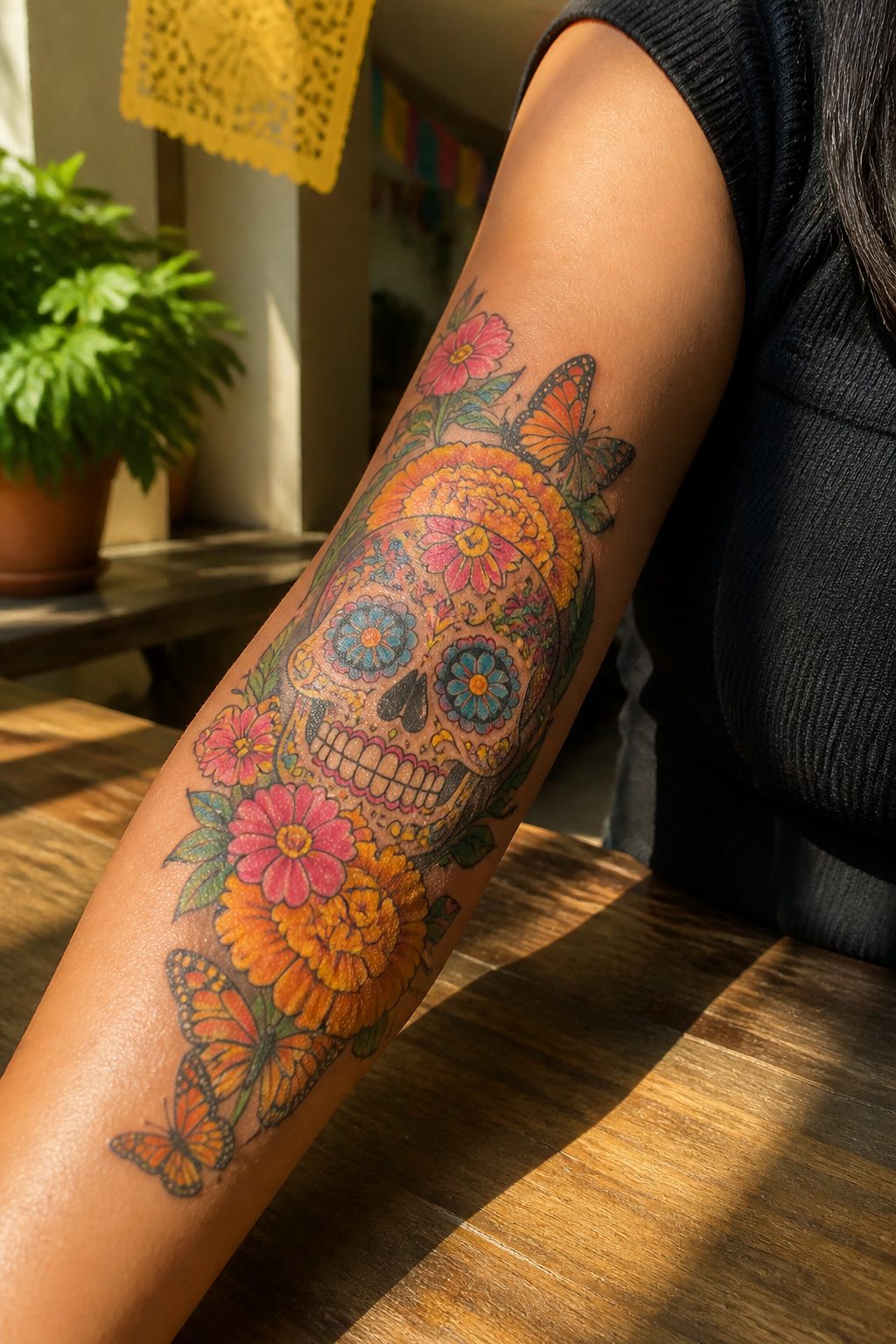
The sugar skull tattoo draws from Mexican Día de los Muertos traditions, where families craft candy skulls to honor relatives who have passed. That practice translates into body art built from bright color work and floral imagery, a sharp departure from the somber skull designs most people picture first.
Women tend to gravitate toward this style for exactly that reason: the palette reads feminine, and the built-in symbolism offers room to personalize. Each flower choice, each butterfly placement, and each hue can carry specific meaning about the person being remembered. The design commemorates death without mourning it; the tone is celebration, not grief.
But the cultural roots matter. Wearing a sugar skull without understanding its Day of the Dead context turns a ritual object into mere decoration. The best pieces I’ve seen were ones where the wearer could name whose memory the tattoo held, and why the marigolds or monarch wings in the design connected to that story. Source that meaning properly, and the result carries weight that generic skull work rarely achieves.
2. Day of the Dead Skull
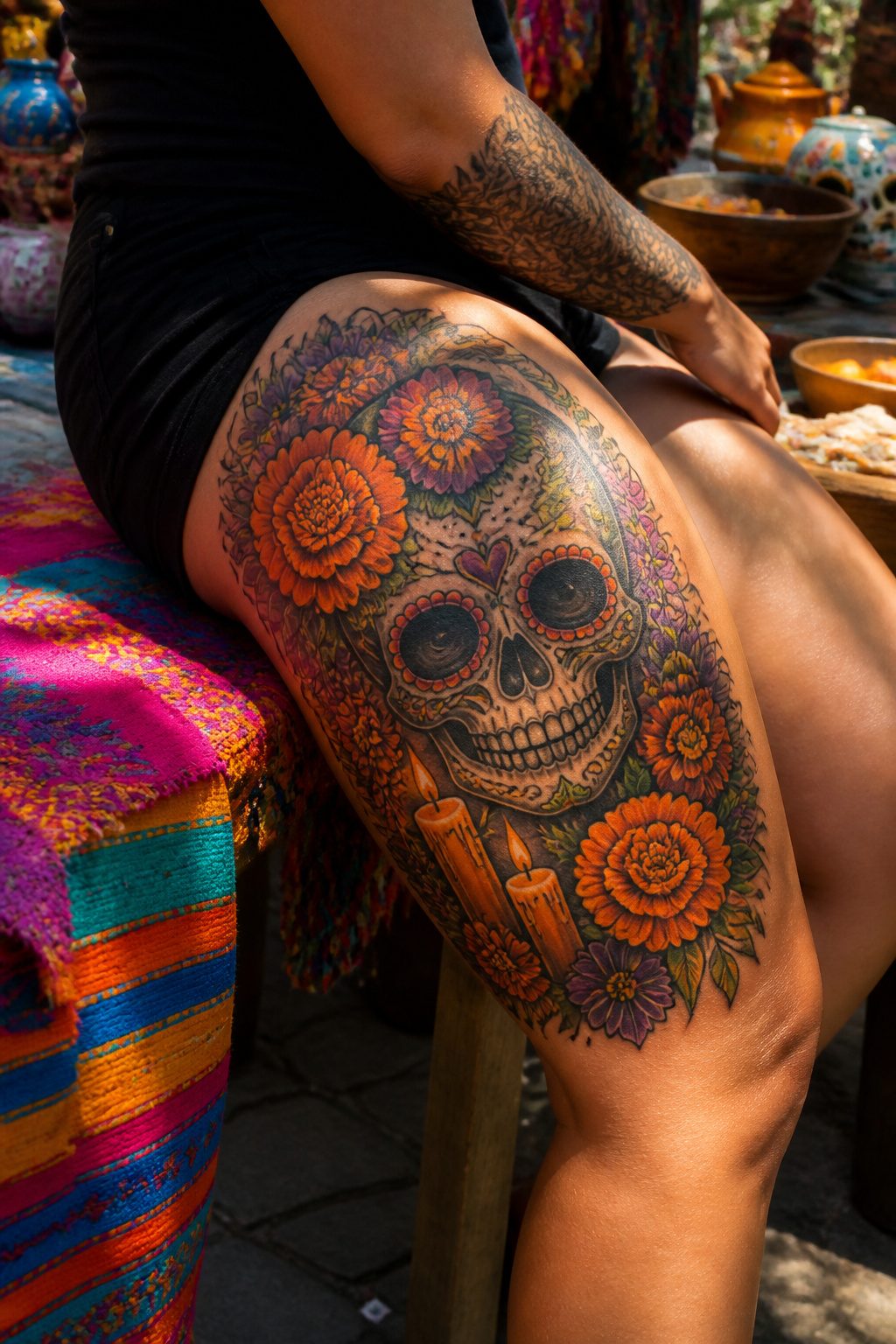
A Day of the Dead skull tattoo carries more range than the sugar skull designs that often get mixed in with it. Sugar skulls stay close to the candy mold look: symmetrical, decorative, usually flanked by flowers and butterflies in bright color. The broader Día de los Muertos category pulls from the whole celebration, and that leaves room for scenes of the living and dead together, marigold paths, candles, the annual ofrenda.
The style stays vivid, which is why the tattoo often reads as more feminine, though the imagery itself is gender-neutral. What changes is the storytelling. A sugar skull honors one person through ornament. A Day of the Dead skull can place that same face in a narrative: walking, eating, playing music. The skull becomes a participant in the holiday rather than a memorial object.
Color matters here more than in most skull tattoos. Black and grey would miss the point. The Mexican tradition uses bright pigment to celebrate return rather than mourn loss, and a tattoo that goes this route needs to commit to that palette. A muted version reads as borrowed imagery rather than understood meaning.
Placement tends toward larger work. The detail in traditional dress, papel picado, or pan de muerto needs space to register. A small calf piece can work if it isolates one element, say a single decorated face. For a full scene, the thigh, back, or upper arm gives the composition room to breathe.
3. Skull and Rose Tattoo
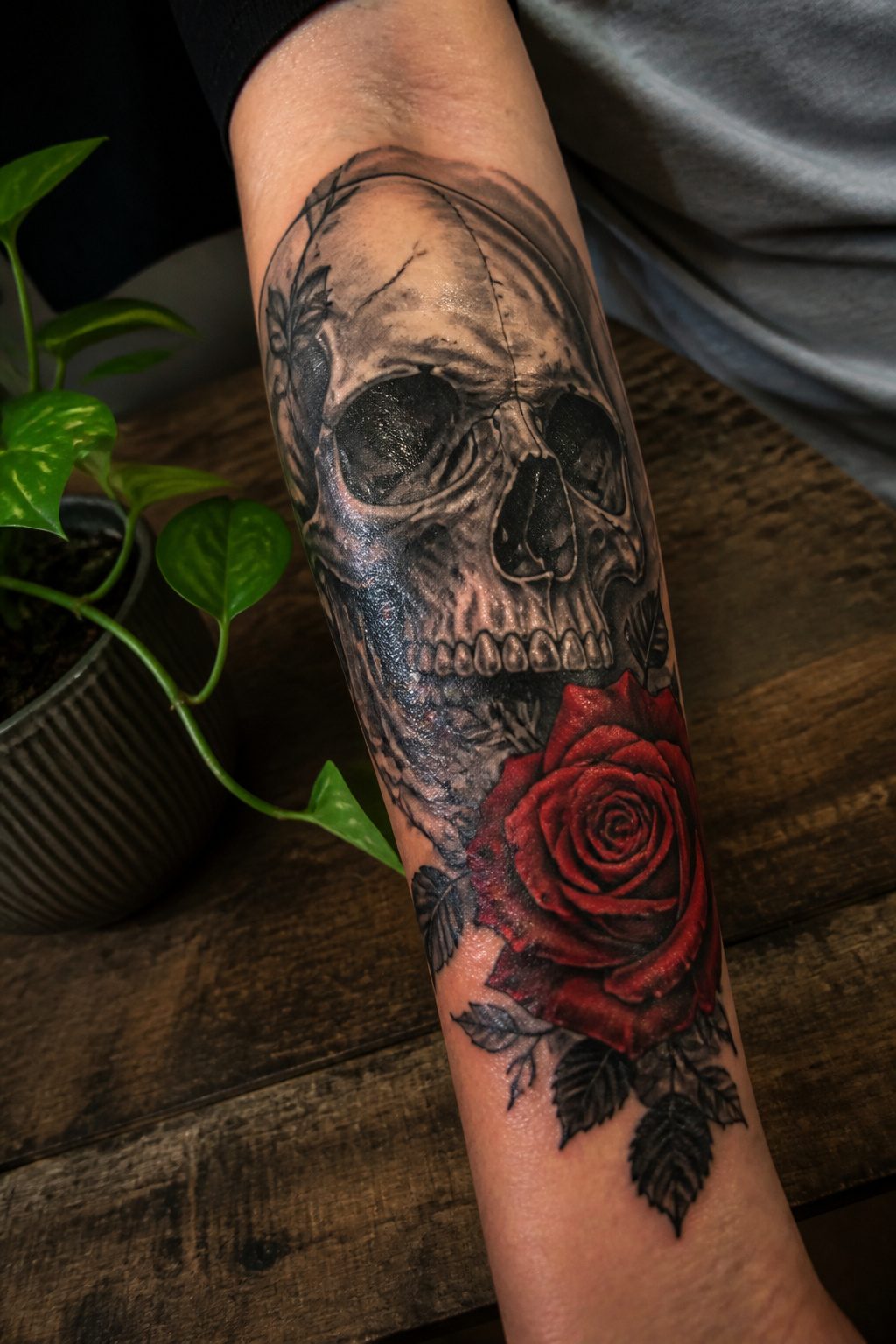
A skull and rose tattoo sets two opposites against each other on the same plane of skin. The skull carries life and death; the rose carries beauty and love. The tension between them is the point, not a problem to solve. One element does not soften the other. The skull keeps the rose from turning sentimental, and the rose keeps the skull from turning purely dark.
What reads as contradiction on first glance usually resolves into something more honest the longer you look. The design says that beauty and ugliness share the same moment, the same body, the same life. The pairing works visually because the curves of the rose echo the hollows of the skull, so the eye travels rather than fixes on one symbol or the other. Color choice changes the weight: a vivid red rose against gray bone pushes the contrast harder than a muted palette would. Either approach is valid, but the decision shapes what the piece says about how someone holds life’s contradictions.
4. Grim Reaper Tattoo
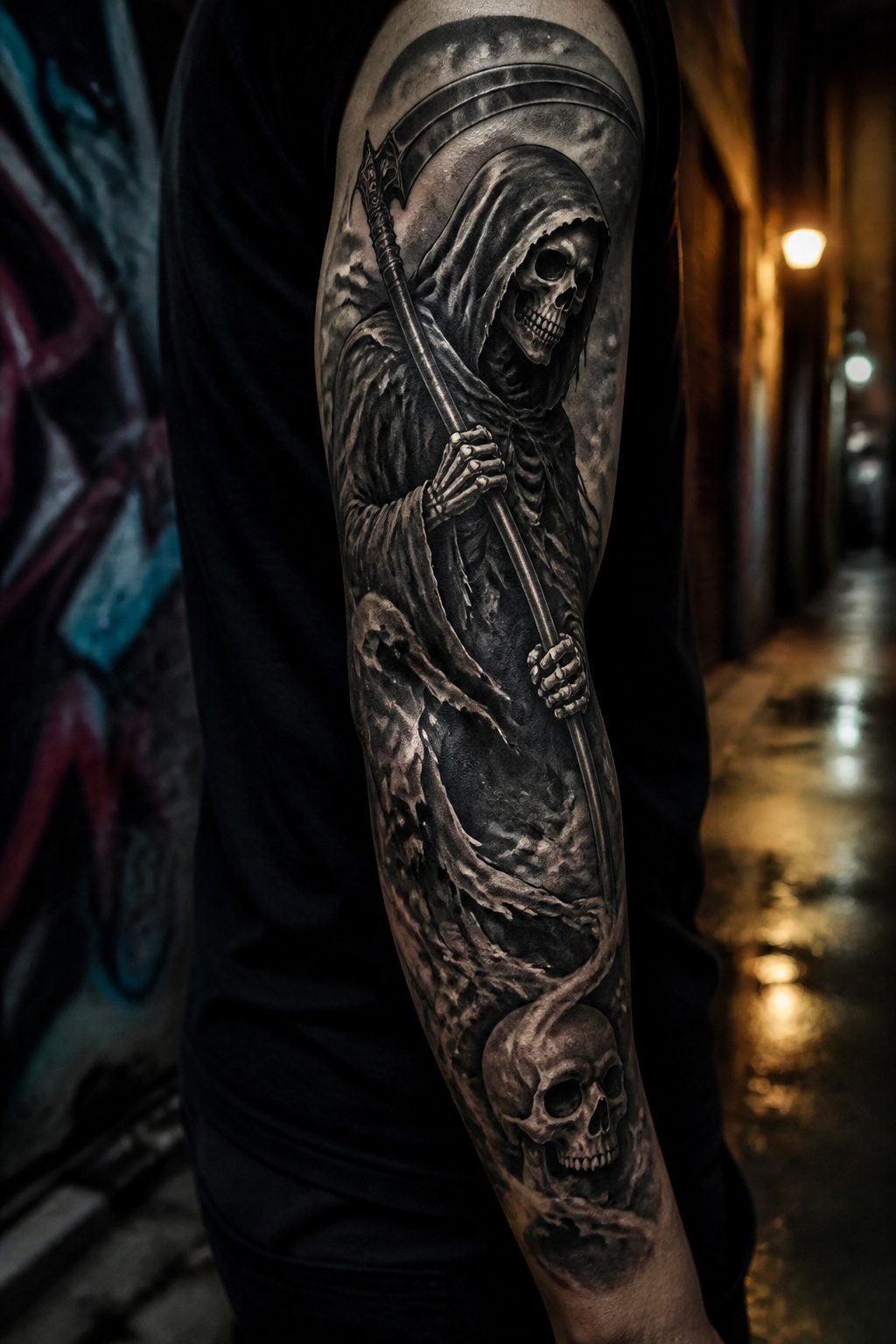
The Grim Reaper carries a heavier symbolic load than its spooky reputation suggests. Beyond the obvious death imagery, the design stands for the circle of life, the full rotation rather than the endpoint. Some wearers also read it as courage, even good fortune, a kind of defiant luck in the face of what waits for everyone.
The traditional version shows a hooded figure gripping a scythe, the blade angled like a question mark. That silhouette has lasted because it reads instantly from a distance and leaves room for variation: a tattered cloak, empty sockets, sometimes a clock or hourglass tucked into the folds. People choose it for the stark visual impact, but also for the personal meaning they layer underneath. Phrases like "fear the reaper" or "death comes for us all" sometimes ride alongside the image, turning the design into a statement about how the wearer meets the inevitable. The hooded figure works best when the artist pushes contrast, deep blacks against skin tone, so the void of the face pulls the eye first and the scythe second.
5. Human Skull Tattoo
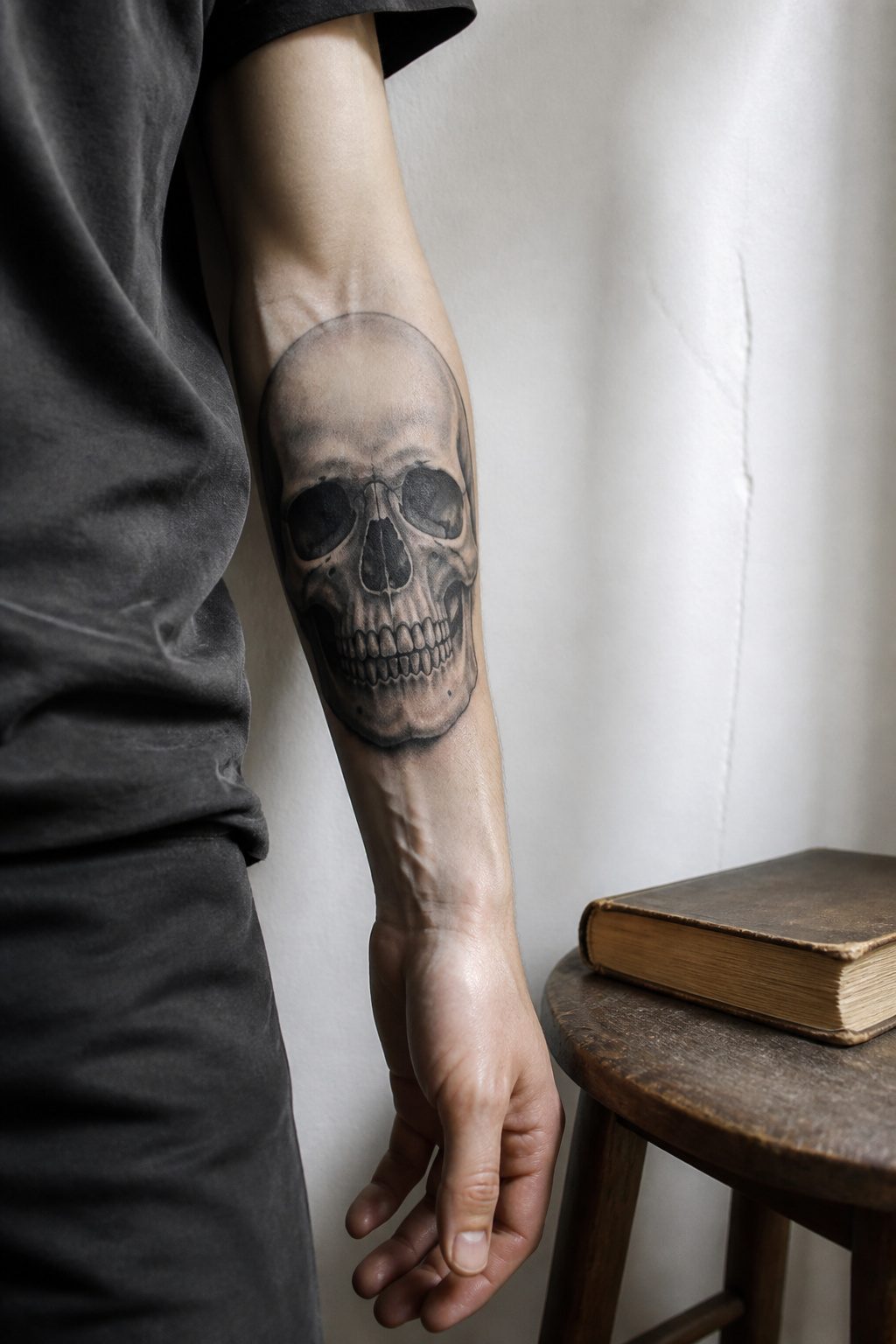
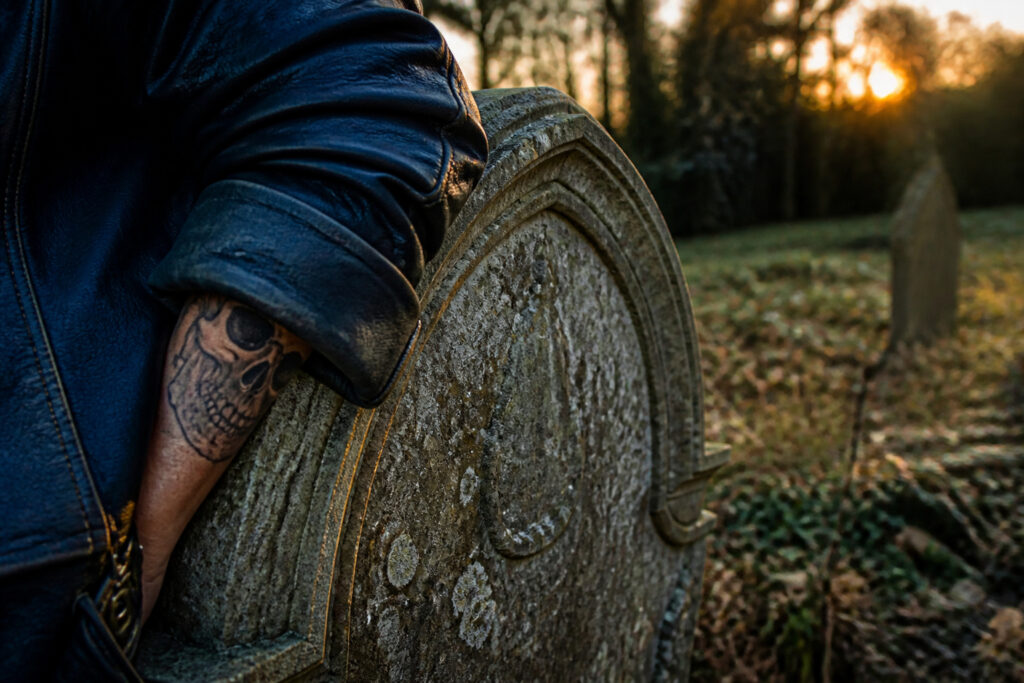
A human skull tattoo stripped to bone alone carries weight precisely because nothing distracts from the message. No roses, no flames, no cultural ornament; just the architecture of mortality itself. The wearer is someone who looked at death directly and decided not to flinch.
The meaning lands in two places. First, it signals that death does not govern your choices, that fear of the end is not what shapes how you live. Second, it works as daily reminder: the skull is inevitable, so the hours before it demand fullness. Quality of life, not length, becomes the point.
This is the design for someone who wants the philosophy without the theater. A clean anatomical rendering keeps the conversation personal rather than performative. Placement matters more here than with busier pieces; the jawline, the inner forearm, or running up the ribs all turn the body itself into the reminder.
Style choices narrow quickly. Photoreal black-and-gray demands skin that holds detail and an artist who understands how light falls across bone. A looser etching style, almost medical-illustration, reads more timeless and ages more forgivingly. Either way, the restraint is the point. Add one element, a single decorative frame, and the tattoo shifts into a different category entirely.
6. Celtic Skull Tattoo
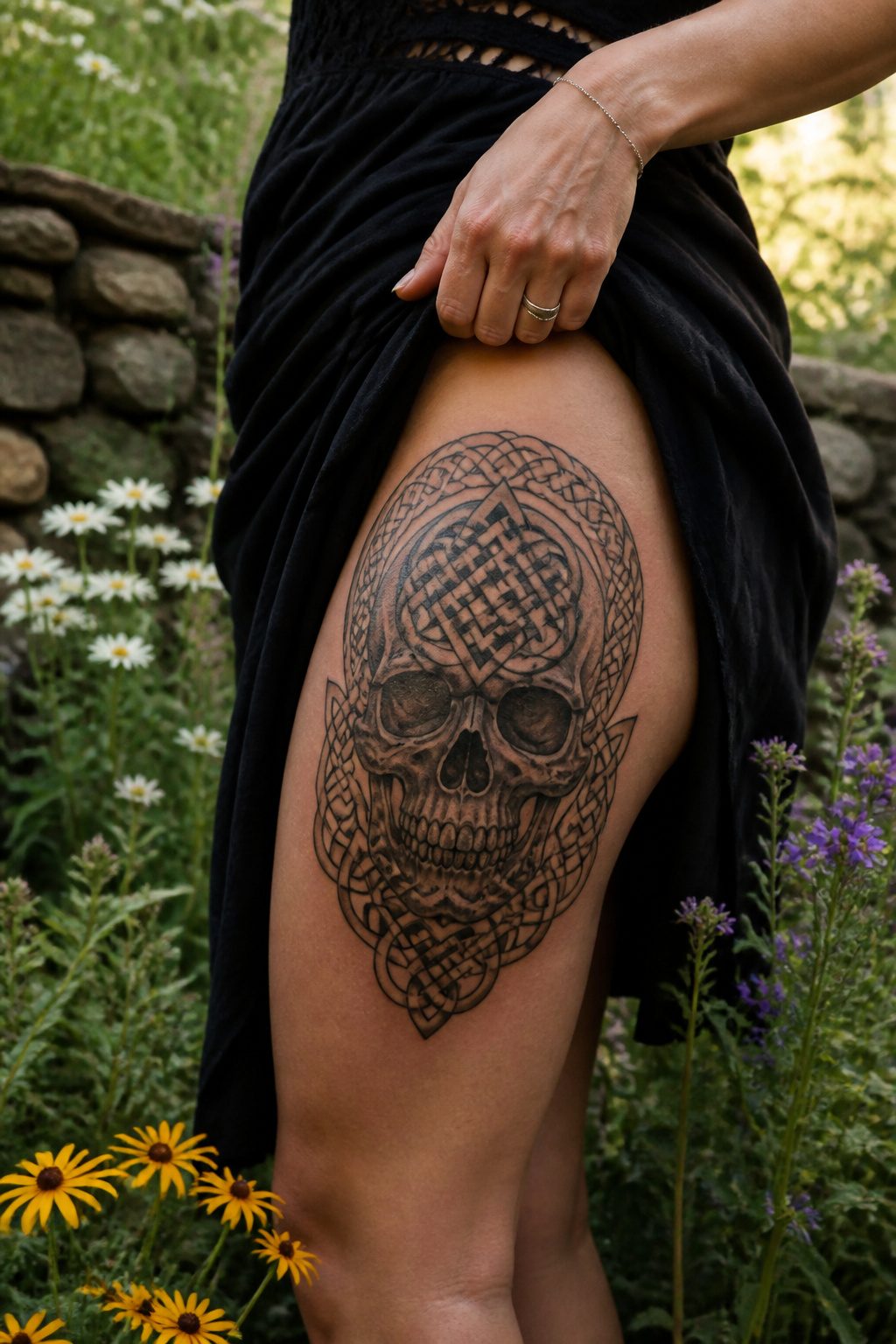
Celtic tradition treats the skull as the seat of the soul, a portal rather than an ending. That distinction changes everything about how the design reads on skin. Where generic skull tattoos lean on danger or decay, the Celtic version channels passage toward higher knowledge and understanding.
The knotwork is what makes this visually unmistakable. Interlaced lines weave through and around the cranium without breaking, a continuous path that mirrors the soul’s journey the culture describes. The knots themselves are not decoration added to a skull; they are the structure holding the meaning together.
Generic skull designs often isolate the bone against empty skin. Celtic work fills the negative space with pattern, so the eye keeps moving. The density demands a larger placement to read clearly, and the linework requires an artist steady enough that a single waver unravels the interlace. I have seen pieces where the knotwork was treated as background filler, and the whole thing flattened into busy wallpaper. The ones that hold up treat every strand as architecture, not ornament.
7. Skull Outline and Flowers Tattoo
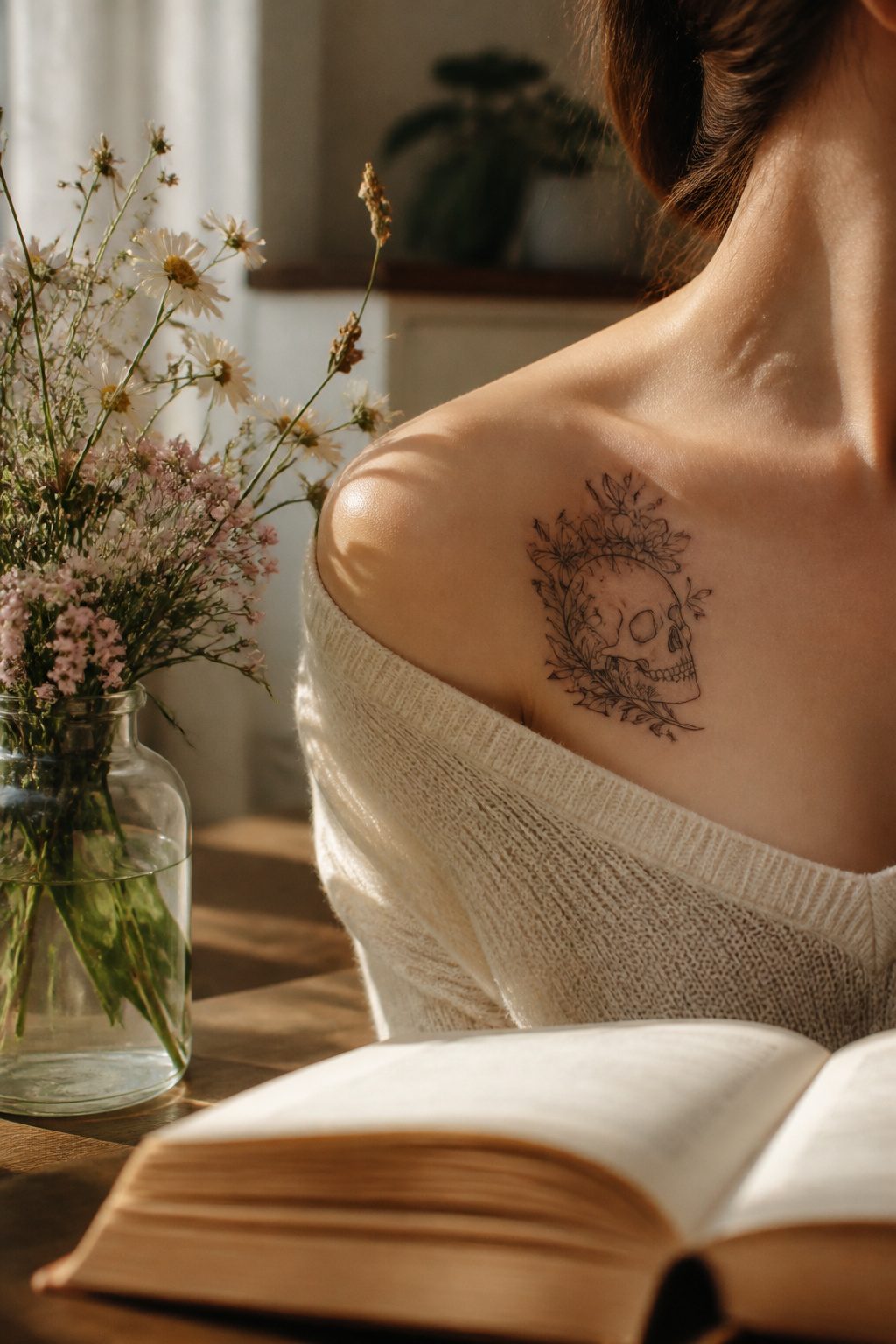
A skull outline with flowers trades the weight of solid black for thin, continuous line-work that lets skin breathe through the design. The skull reads as a sketch rather than a shadow, and the flowers woven between the jaw or circling the temple soften the edge without diluting the symbol. I have seen this pairing described as a conversation between two forces: the skull holding life and death, the bloom standing for beauty and love, and the combination marking the tension between them rather than declaring a winner. Japanese Irezumi tradition reaches for something similar when it sets skulls beside cherry blossoms to speak of impermanence; the minimalist version strips that same thought down to essentials. Line-work ages faster than saturated black, so placement matters. Inner forearm or collarbone, where the skin sees less sun and the lines stay crisp, carries the design longer than a spot that tans daily.
8. Smokey Skull Tattoo
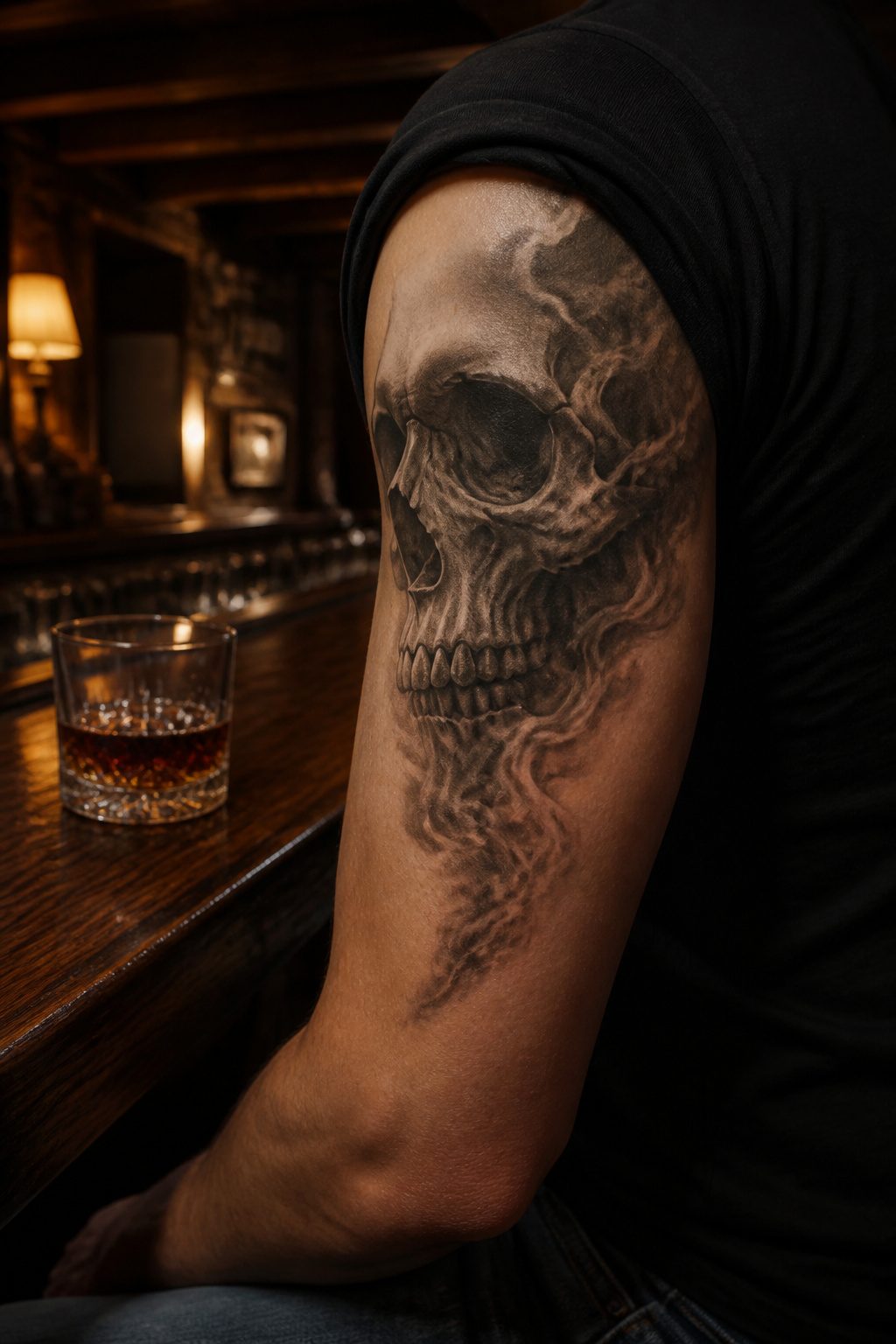
Smoke curling from a skull’s eye sockets or jawline turns a hard symbol into something that dissolves before your eyes. The mist eats the bone’s edges so the image feels caught mid-fade, neither fully present nor gone. That half-there quality is what draws people in. A solid skull states mortality; a smokey one lets mortality drift.
The technique asks more from the artist than the viewer might guess. Smoke has no fixed shape, so the tattooist builds the effect from contrast alone: dense black where the skull still holds, gray wash where it breaks apart, skin tone where it disappears entirely. Get the gradation wrong and the smoke reads as mud; get it right and the bone looks like it was always meant to become vapor.
Placement matters for the illusion. A smokey skull needs room for the fade to work, so the upper arm or thigh gives the mist space to thin out. Cram it onto a wrist and the effect collapses into a smudge.
What the smoke actually means shifts with the wearer. For some, the dissolving skull speaks to loss they are still processing. For others, it is a quieter claim: nothing stays, not even the body. The image does not preach either reading. It simply holds the moment where form becomes absence, and lets the eye decide what that costs.
9. Tribal Skull Tattoo
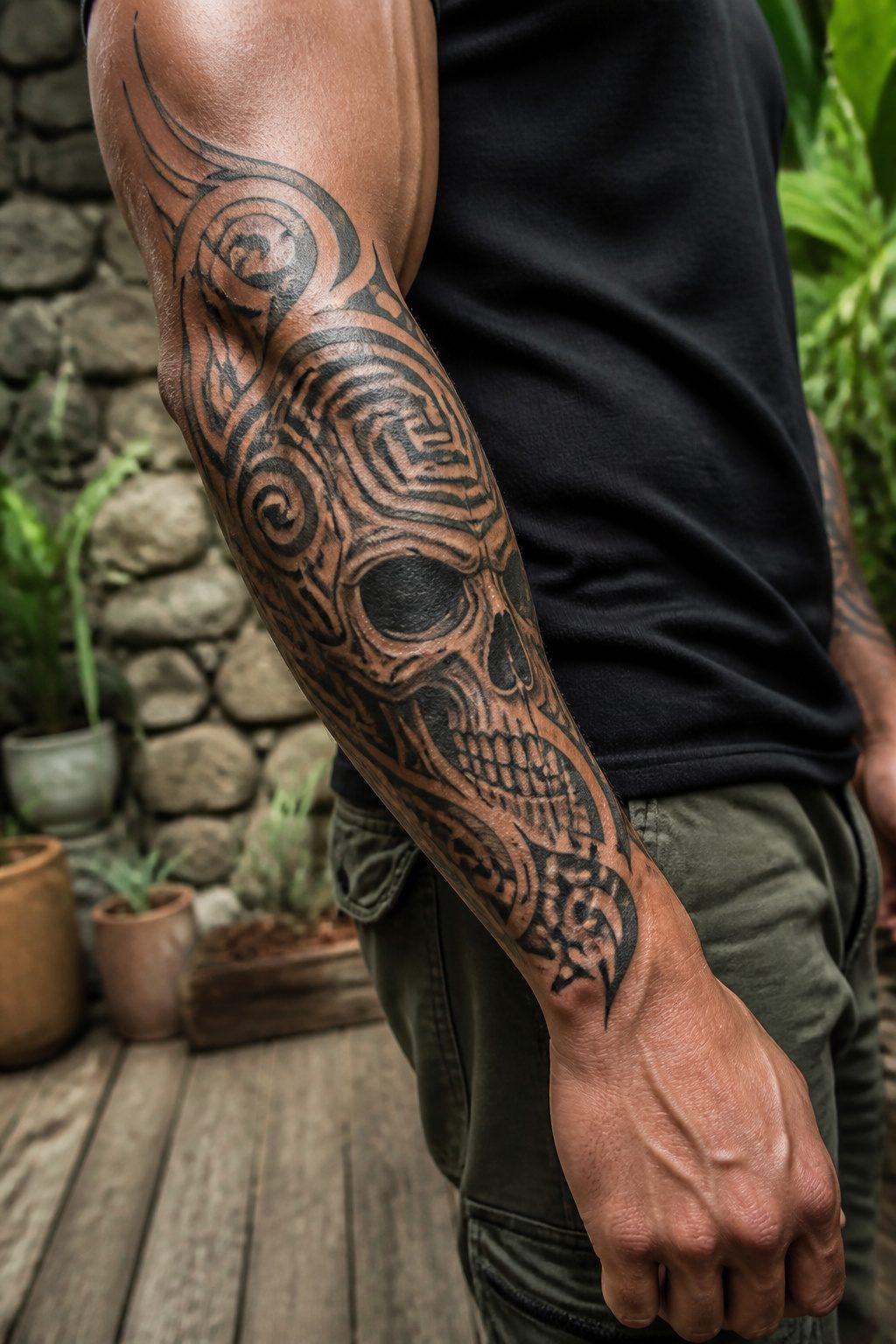
Bold black patterns drawn from Polynesian and other indigenous traditions wrap around or through the skull shape, turning negative space into part of the design. The heavy linework frames the skull so the bone reads as negative space inside the pattern, or the pattern itself builds the jawline and cheek hollows from repeating shapes. Either way, the eye reads skull first, pattern second, which keeps the image from going busy.
The protective association runs deep in these traditions. Warriors wore these patterns as amulets; transferring that idea to a skull, itself a memento mori, creates a layered meaning. You carry both the warning and the shield.
Placement matters for readability. The bold blacks need room to breathe, so a shoulder cap, outer forearm, or thigh works better than a spot where the pattern would wrap and distort around a joint. Black ink only, no color, and the lines must stay crisp or the whole piece softens into a blur. Find an artist who has actually studied the specific tradition they are borrowing from, not one who mixes random "tribal" shapes from a flash sheet. The difference shows in the flow of the pattern and the respect behind it.
10. Skull with Wings Tattoo
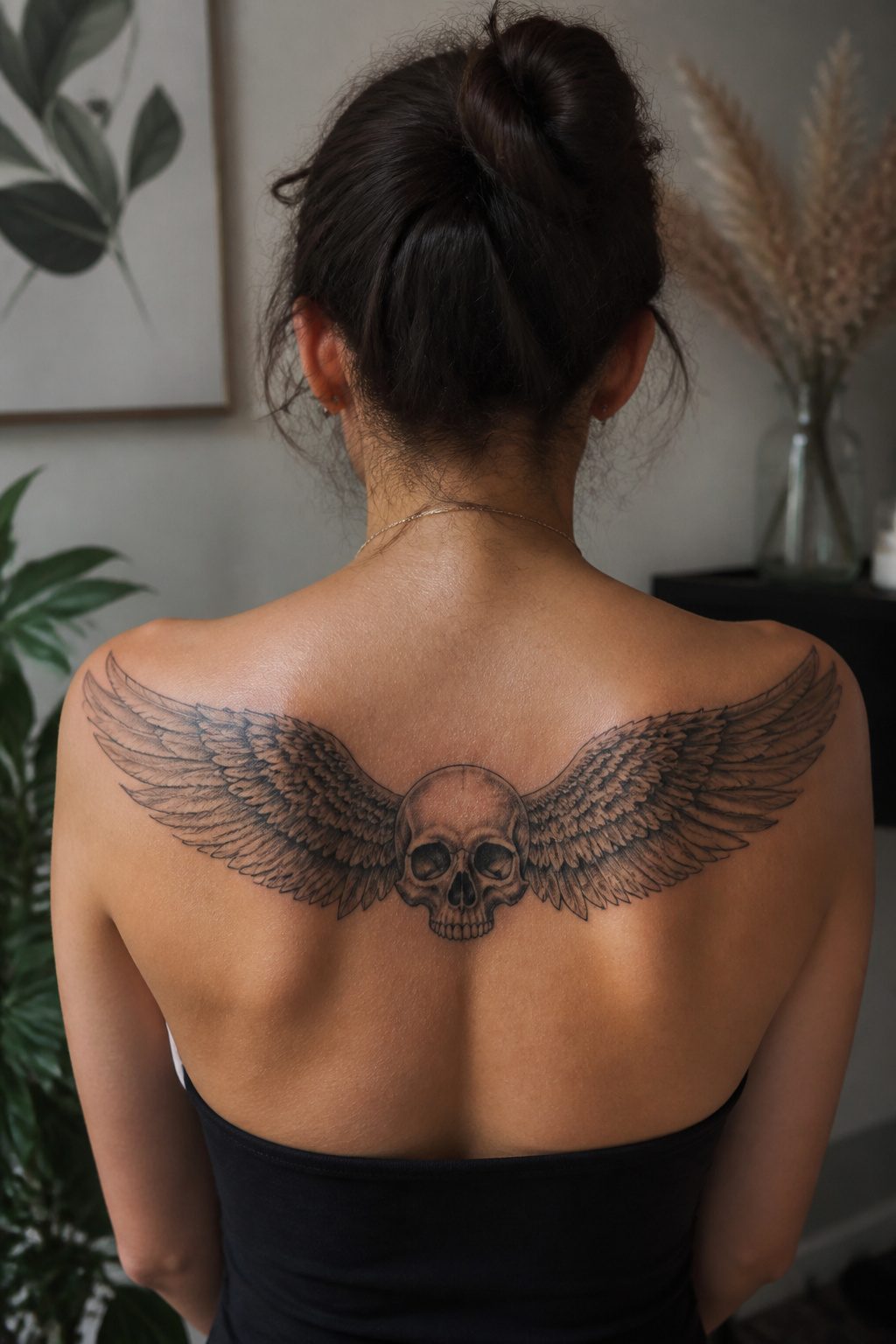
A skull on its own lands hard on mortality, but wings soften the landing entirely. The bone becomes a traveler rather than an ending, and the whole piece starts reading as ascent instead of arrest.
I have seen this shift happen in the chair. A client came in set on a memorial piece for her brother, adamant about the skull, but the bare design kept pulling toward grief she did not want to wear daily. We added kestrel wings, angled upward, and the meaning turned: not death remembered, but the dead gone flying. She still gets asked about it, and she still says it changed the conversation from "sorry for your loss" to "where is he headed?"
The style of wing matters as much as the skull style. Spread eagle wings carry a military or biker weight, all pride and defiance. Thin, almost transparent wings, the kind you see in old engravings of souls leaving bodies, push the piece toward spiritual travel, something more like liberation than conquest. A moth’s wings, tattered at the edges, hit a middle ground: still earthly, still fragile, but in motion.
Placement changes the read too. Across the upper back, the wings can actually span, and the skull hangs between them like a carried thing. On a forearm, the wings usually fold or half-furl, more ready than airborne, and the tone stays quieter. I would not put this on a hand or neck unless the wings are small and the skull is dominant; the symbolism collapses into generic biker flash if the proportions fight.
Color is a judgment call. All black keeps the edge, but a warm brown or muted gold in the wings separates bone from feather enough that the eye reads two materials, two worlds, touching. That contrast is where the meaning lives.
11. Skull and Raven Tattoo
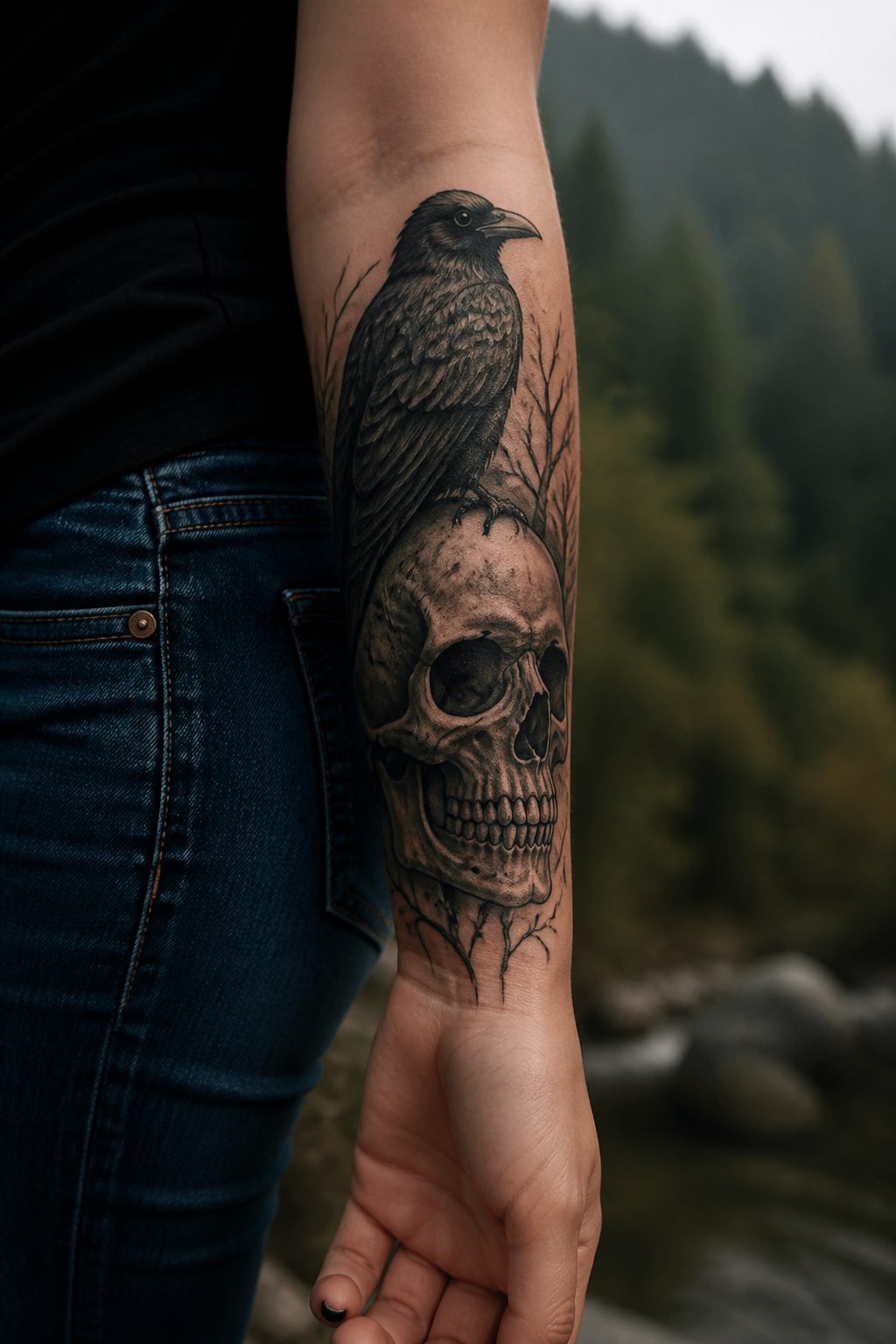
Ravens carry the weight of messenger and omen across several traditions, most recognizably Norse, where Odin’s pair, Huginn and Muninn, flew out each dawn to gather news of the world. That habit of circling what remains, of speaking with the dead, pairs naturally with the skull. Visually, the bird tends to land at an angle, beak open or head tilted, so the eye travels from feather to bone and back again. The skull anchors the composition; the raven adds motion and something like voice. Together they signal death plus intellect, not mourning but the mind still working after the body has finished. The pairing reads as warning or as watchfulness, depending on how the artist weights the two. A raven with bright, fixed eyes against a weathered skull tips toward vigilance. One with wings half-furled, beak lowered, leans into grief or foreboding. Placement matters too. On a shoulder or outer arm, the raven can appear to depart or arrive; on the chest, it settles, keeping its counsel close.
12. Skull Leaves Tattoo
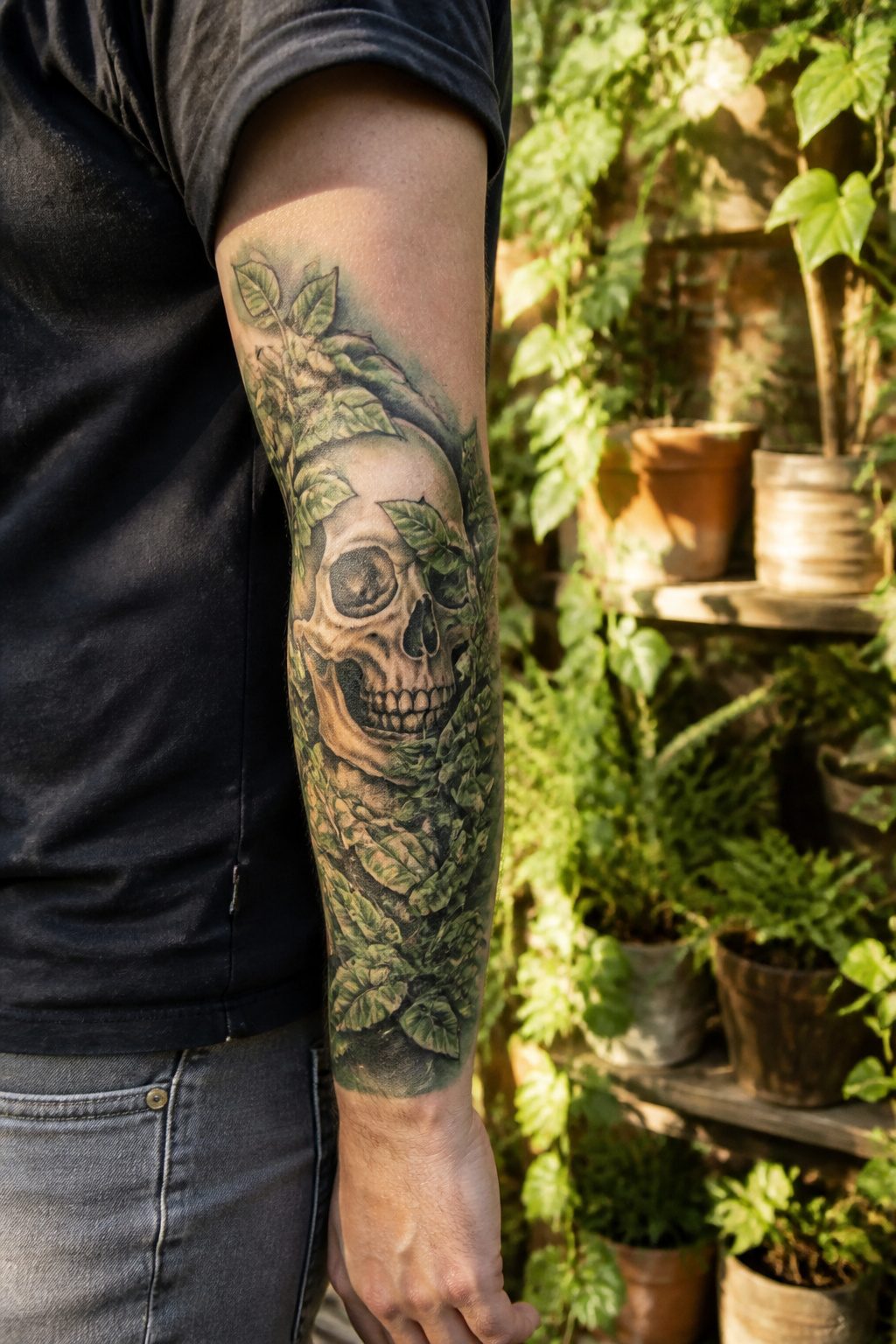
A skull wrapped in leaves reads differently than one standing alone. The foliage doesn’t just decorate; it reframes the whole symbol. Where a bare skull announces mortality outright, leaves introduce the other half of the cycle: decay feeding what comes next.
Spring growth pushing through a skull’s eye sockets carries a specific charge, the same imagery fall colors would soften into something more elegiac. Summer leaves, thick and full, suggest the skull is being overtaken, reclaimed. Winter’s stripped branches leave it exposed again, but changed by the memory of cover.
The pairing works because foliage redirects the skull’s meaning without denying it. The death symbol stays intact; the leaves don’t argue against it. They add the regrowth phase that a skull alone leaves implicit. Someone choosing this design gets to keep the edge of mortality while signaling they understand it as part of a loop, not a full stop.
Placement matters for how the balance reads. A leaf-heavy composition with the skull half-hidden reads gentler, closer to garden imagery. Reverse the ratio, skull dominant with a few leaves trailing, and the tone stays darker, the regrowth reading more like aftermath than renewal. Most artists who work in this style know the ratio by instinct, but asking for a specific lean during consult is worth doing.
13. Longhorn Skull Tattoo
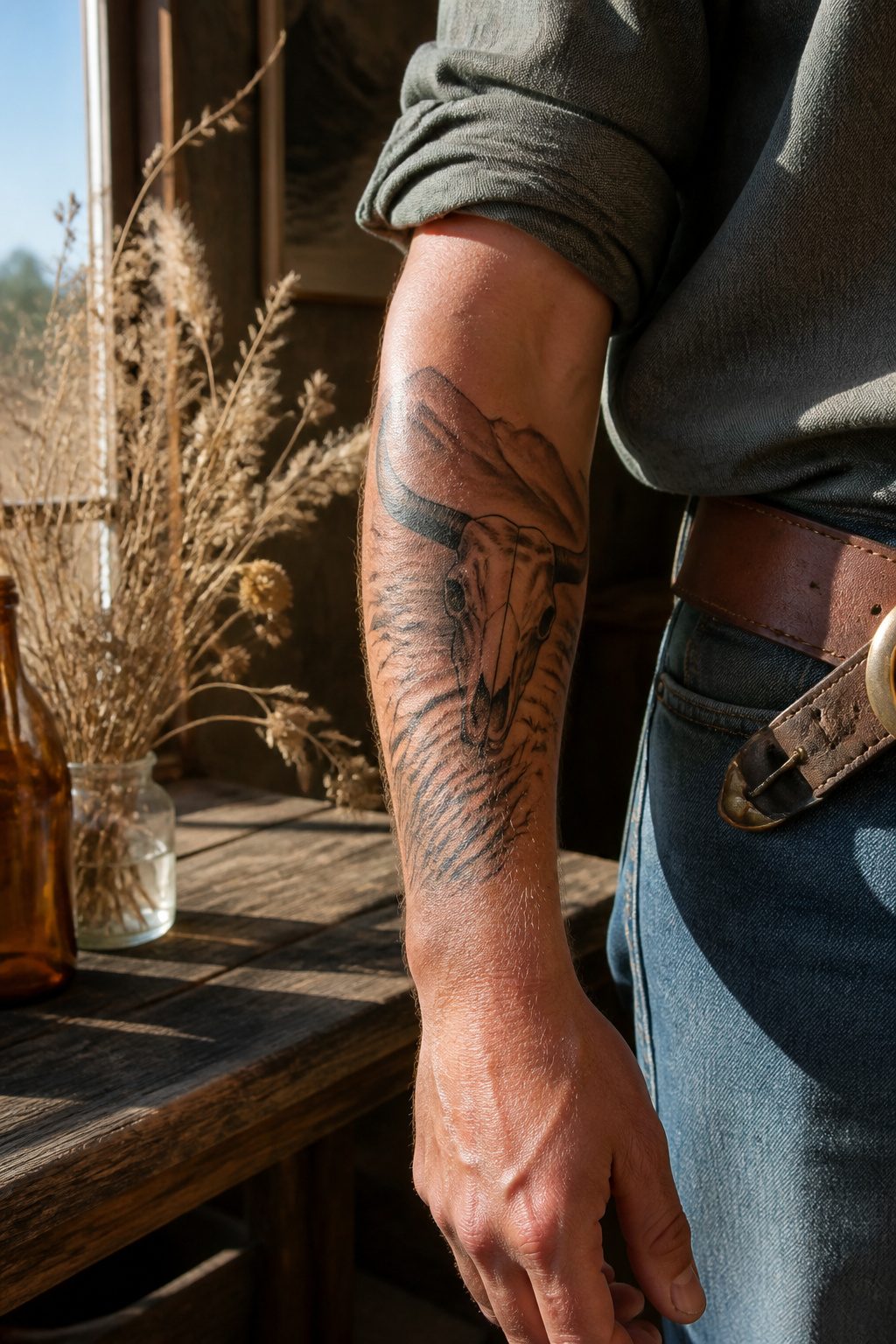
A longhorn skull tattoo carries the weight of open range and sun-baked earth. The hollow eye sockets and sweeping horns echo cattle skulls weathered white against desert scrub, a image tied to ranch life and the Southwestern landscape where self-reliance stops being romantic and starts being necessary.
Some see the design as a nod to Native American tradition, a symbol of protection rooted in the natural world and the courage to face what threatens it. That reading pairs naturally with the cowboy mythology the image also carries: long drives, hard winters, the kind of independence that does not announce itself.
The style choices matter. A clean, bleached-bone rendering keeps the focus on endurance and the passage of time. Add desert blooms, a rattlesnake, or worn leather and the piece shifts toward the specific geography of the American West. Either way, the longhorn skull reads less as menace and more as the mark of someone who does not need the comfort of fences.
14. Pirate Skull Tattoo
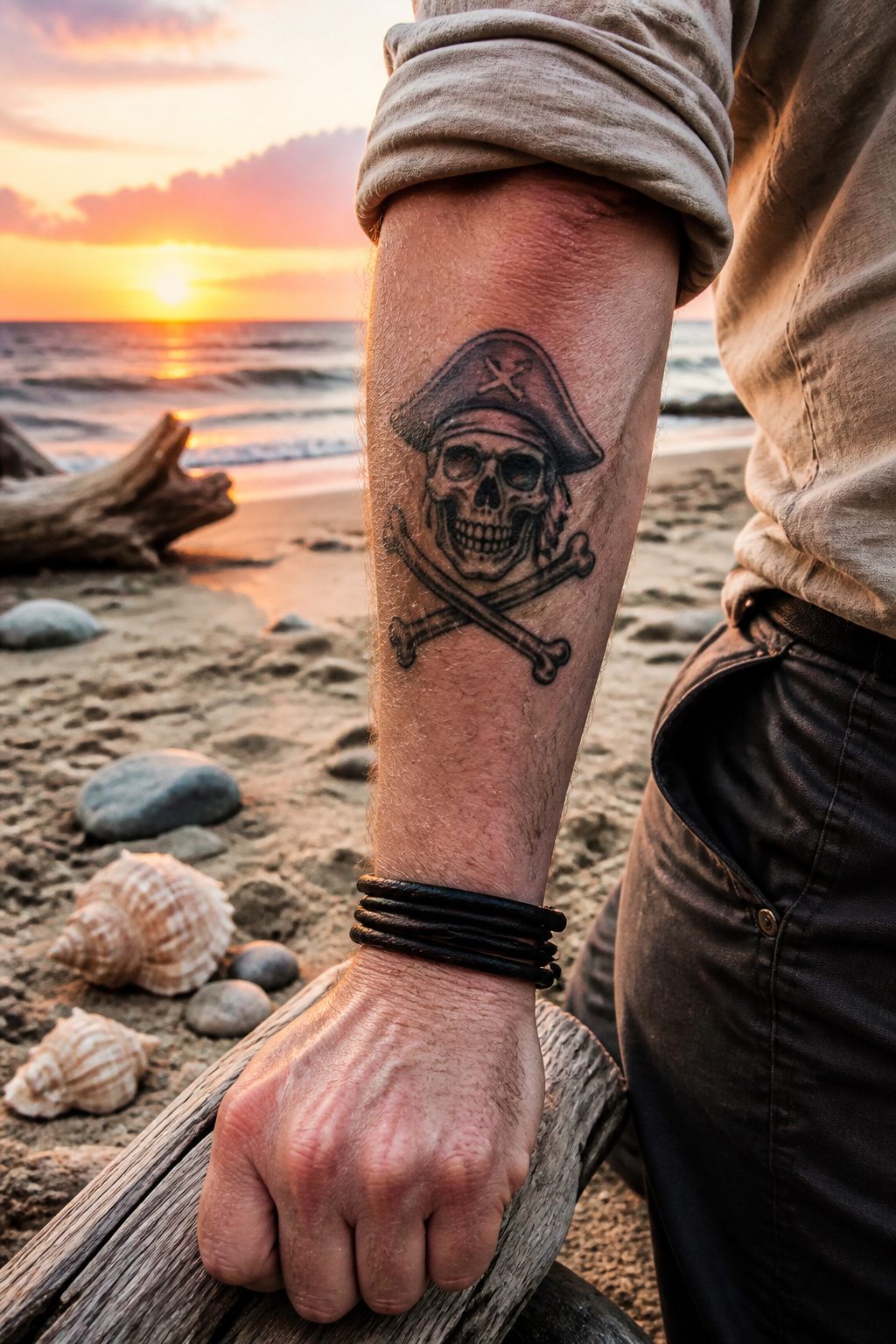
The Jolly Roger lineage runs straight through every pirate skull tattoo, and that history is what keeps the design from looking like generic Halloween clip-art. Skulls in this style trace back to the Age of Exploration, when they flew on black flags to signal lawlessness and a refusal to bow to any crown. The meaning stuck because it pairs mortality with deliberate choice: the wearer is not afraid of death, and not asking permission either.
Crossed bones beneath the skull are the classic finish, though swords sometimes replace them for a sharper silhouette. Either way, the arrangement borrows from those same flags, where the crossed objects underneath served as a warning you could read from a ship’s deck. That visual punch is why the pirate skull still resurfaces in films, album art, and streetwear; the design does not need explaining, which makes it a reliable pop-culture staple.
For a tattoo that reads as authentic rather than costume, the line work matters more than the subject. A skilled artist keeps the bone structure tight and the crossed elements symmetrical, because sloppiness here turns rebellion into caricature faster than any other skull style I have seen.
15. Skeleton with Crown Tattoo
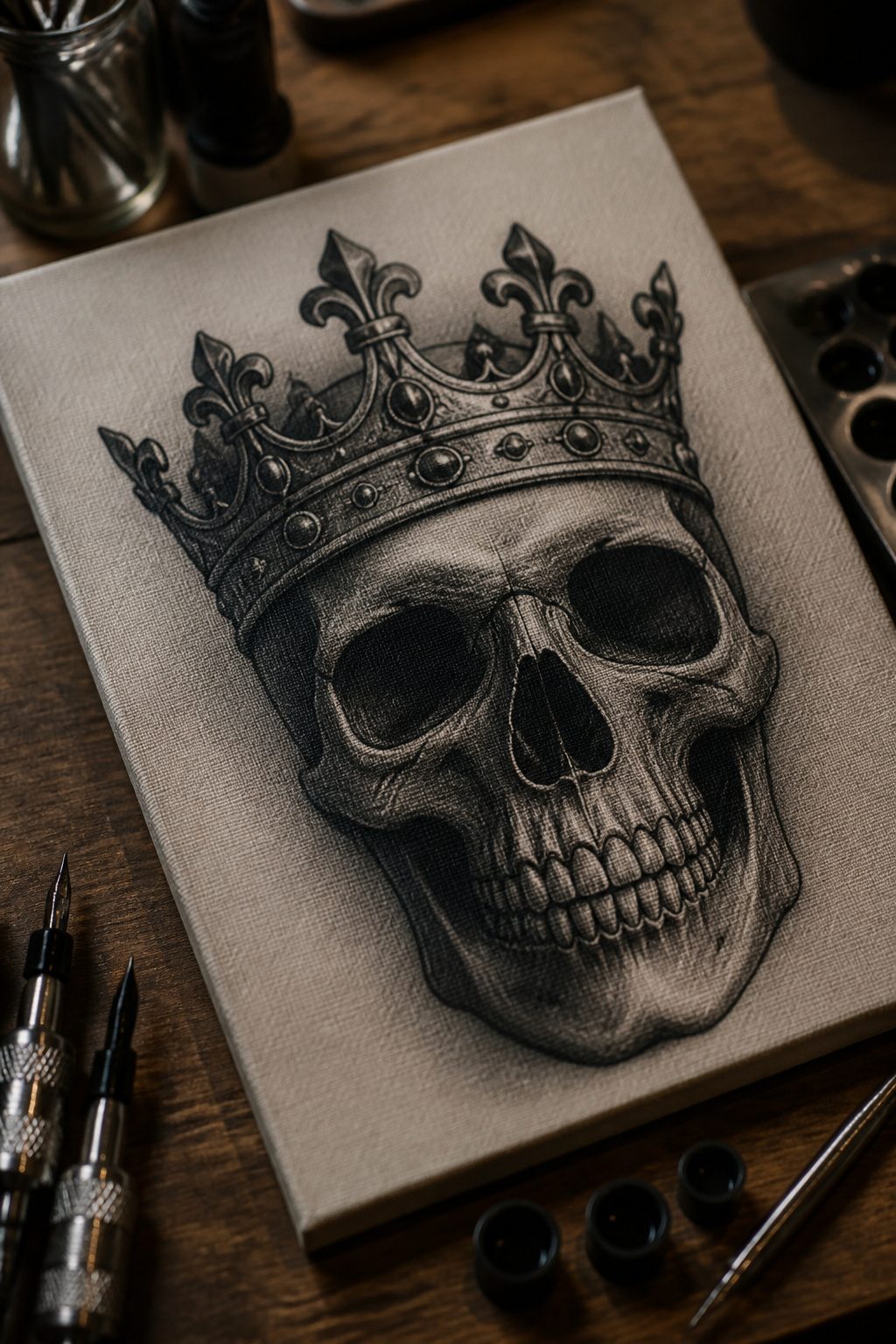
A skull wearing a crown reads differently than a plain skull because the crown names who died. The memento mori tradition, that Latin warning to remember your own end, was never meant only for common graves. Medieval painters put crowns on skeletons to remind kings that their power stopped at the coffin lid. That same image still works for anyone who needs the reminder that status is temporary, or for someone who watched a tyrant fall and wants the death of ego marked on their skin.
The crown itself changes the skull’s meaning more than most added symbols do. A simple band reads as humility, the lesson that even crowned heads end as bone. A heavy, jeweled crown tilts toward mockery, the death of a particular ruler rather than the abstract idea of mortality. Some artists stack the crown slightly askew, which lands closer to the Jolly Roger spirit, that pirate refusal to bow to authority. Placement matters too: a small crown high on the forehead keeps the face human, while a crown so large it dwarfs the skull turns the whole thing into political cartoon.
Size and style shift the tone quickly. A realistic skull with a tarnished, dented crown carries the weight of actual history, something you might see in a Dutch vanitas painting. Clean lines and a bright gold crown move the same image toward graphic design, more logo than warning. The crown’s condition matters as much as its presence: polished metal suggests the power still lingers, while rusted or cracked gold says it already ended.
What Skull Tattoos Mean
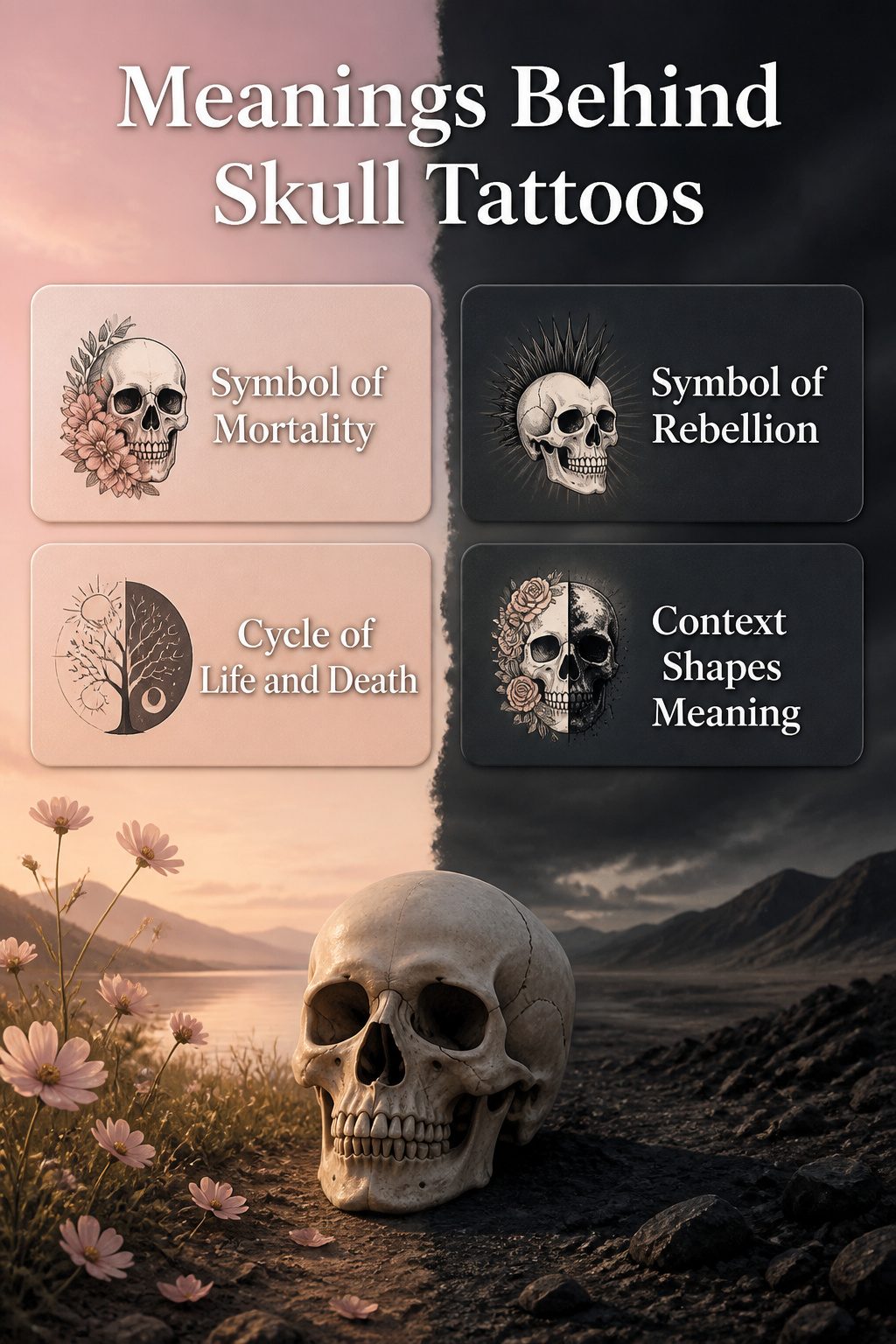
A skull carries two conversations at once. The same design can whisper about peace or shout defiance, depending on what sits beside it and how the lines fall.
Mortality is the starting point most people expect. The skull is the last bone to decay, so it has long stood for consciousness surviving after the body fails. That reading turns death from an ending into a transition, a reminder that physical life is temporary but something essential continues.
The life-death cycle sits right next to it. In that frame, the skull becomes less about loss and more about the full loop, birth through decay and whatever follows. Personal transformation works the same way: the old self ends, a new one begins. Several traditions treat the skull as the seat of intelligence and rebirth rather than mere rot.
Courage enters when the wearer chooses to look at what others avoid. Rebellion and individuality push further, turning the symbol into a refusal of polite convention. The skull says the wearer will not pretend death is hidden, will not follow the path laid out for them.
Context shifts the weight every time. A skull with soft lines and flowers leans toward acceptance and renewal. The same skull rendered in hard blackwork with aggressive posture reads as warning or defiance. The wearer decides which conversation belongs on their skin.
Cultural Roots Across History
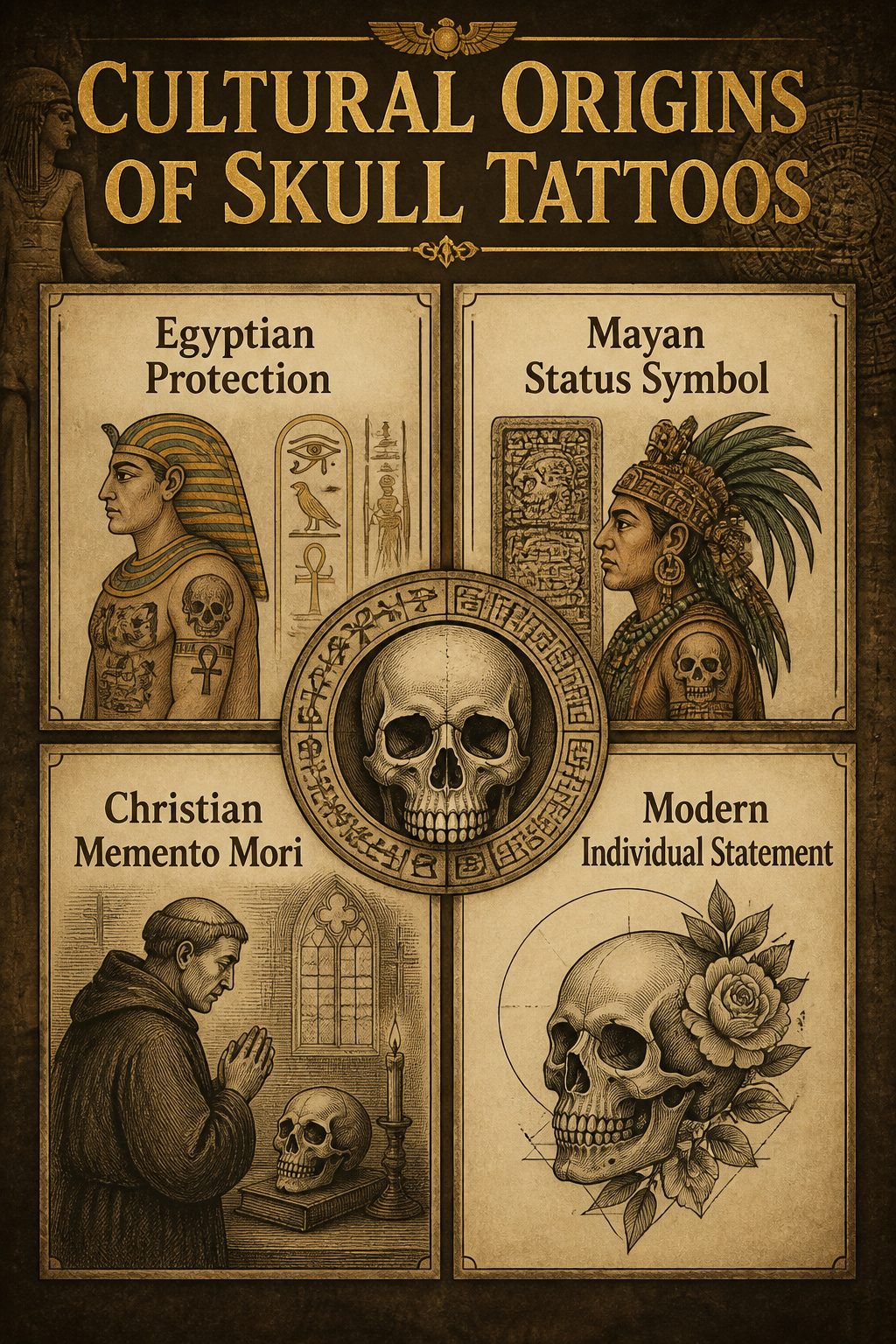
Ancient Egyptians and Mayans both pressed skull imagery into skin long before electric needles existed, though for different reasons. Egyptian priests and warriors wore skull marks as protection against death itself, a spiritual barrier rather than a decoration. Mayan nobility used them to broadcast status, the bone symbol marking who carried ritual authority and who did not.
The meaning shifted hard once Christianity dominated European thought. By the Middle Ages, the skull had become Memento Mori, a deliberate memento of mortality meant to push the viewer toward righteous living. Sailors and pirates later stripped away that moral weight entirely. The Jolly Roger turned the skull into a flag of rebellion and lawless freedom, a long jump from temple ritual.
What strikes me reading through the history is how each era kept the same shape but swapped the purpose underneath. The modern skull tattoo carries almost none of the ancient spiritual armor or the medieval guilt. It is now almost entirely personal: rebirth, individuality, the wearer’s own statement on existence rather than society’s. Traditional American flash, Japanese Irezumi, minimalist linework, all pull from that same historical reservoir but filter it through private meaning. The skull endures because it empties easily and refills with whatever the living need it to hold.
Design Styles That Change the Look
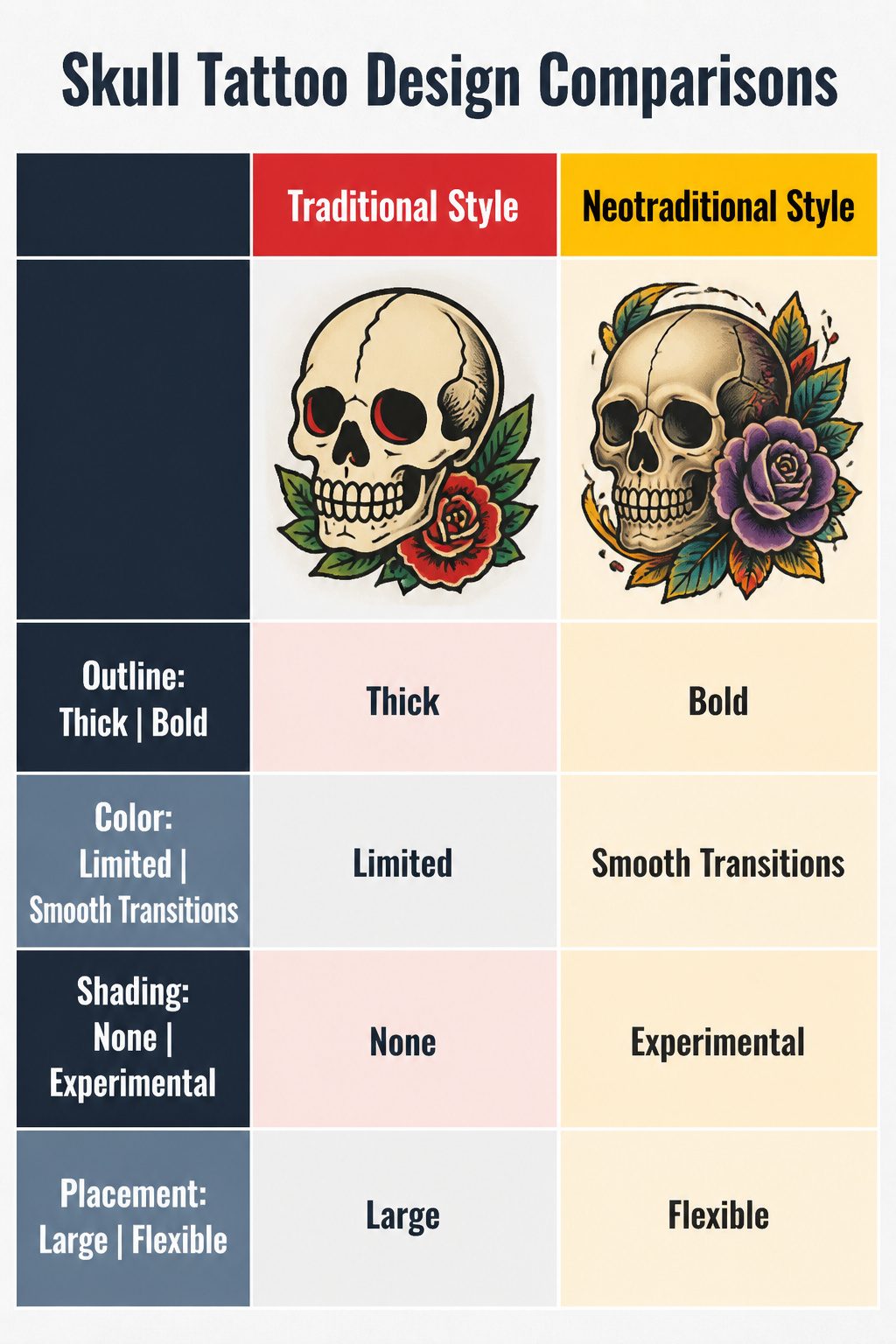
A skull drawn in traditional style carries thick black outlines, limited but saturated color, and almost no shading gradation. The same skull rendered neotraditional keeps that bold structure but opens the door to smoother color transitions and more experimental palette choices, often reading as louder and more contemporary without losing the graphic punch. Watercolor skull tattoos abandon line weight almost entirely, letting pigment bleed and pool so the bone reads as dissolving or half-formed, an effect that works only when the artist understands negative space well enough to keep the skull recognizable. Blackwork takes the opposite path, building the skull from dense, deliberate patterns or solid black planes that rely on geometry rather than color temperature for contrast. What convinced me, looking through portfolios for months, was how dramatically placement changes these outcomes: a watercolor piece needs enough flat skin to let the wash breathe, while blackwork can shrink to a few inches and still hold its weight.
Frequently Asked Questions
What do skull tattoos symbolize?
Skull tattoos carry multiple meanings at once. The core symbolism starts with mortality, but the same design can signal peace, defiance, courage, or the full life-death cycle depending on what accompanies it. A bare skull tends toward direct acknowledgment of death, while added elements like flowers, wings, or crowns shift the reading toward transformation, ascent, or the fall of ego.
What are the different types of skull tattoos?
The main types include sugar skulls and Day of the Dead designs from Mexican tradition, grim reaper tattoos, skull-and-rose pairings, human skulls stripped to bone, Celtic skulls with knotwork, tribal skulls, longhorn skulls tied to the American West, pirate or Jolly Roger skulls, and crowned skulls drawn from memento mori tradition. Each carries distinct cultural roots and visual rules.
How do I care for my new skull tattoo?
Proper aftercare keeps the ink crisp, which matters especially for skull tattoos that rely on fine detail or heavy blackwork. Keep the area clean, moisturized with fragrance-free lotion, and out of direct sun during healing. For line-heavy designs like skull outlines or Celtic knotwork, sun protection stays important long-term since those styles fade faster than saturated black.