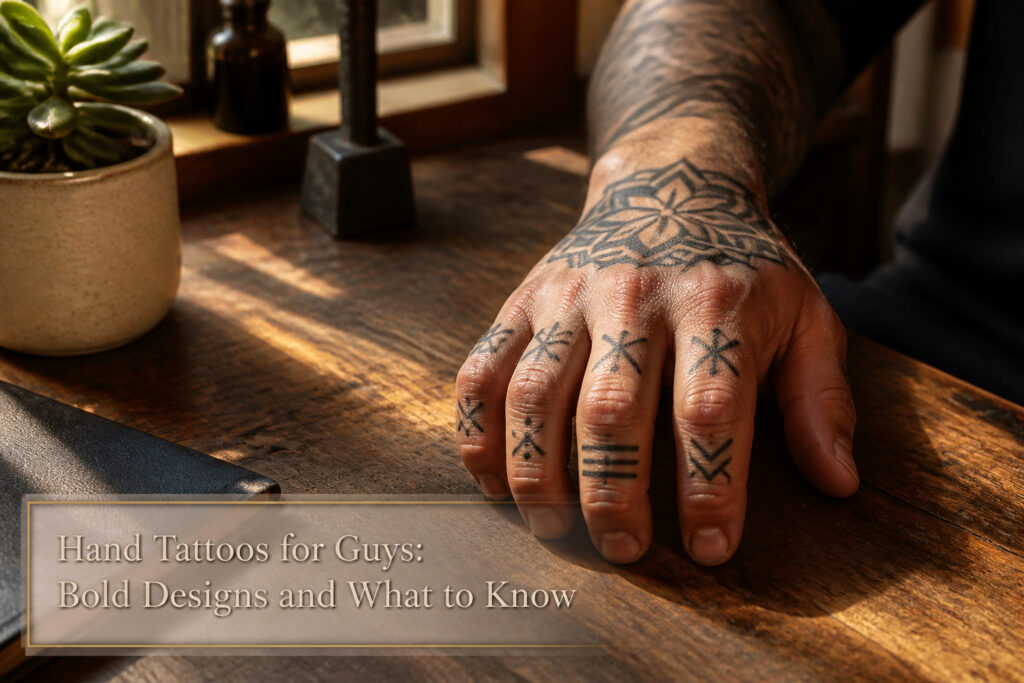
A hand tattoo is ink placed on the fingers, knuckles, or back of the hand where no sleeve can hide it.
The catch is permanence without retreat: every handshake and job interview carries the design forward, and the thin skin there blurs fine detail faster than almost anywhere else on the body.
Bold outlines and simple geometry age better here than intricate portraits or light colors, which is why a single black cross the size of a quarter or a stripped-down tiger silhouette tends to outlast work that looked sharp at twenty but softens to a smudge by thirty.
Symbols and Icons
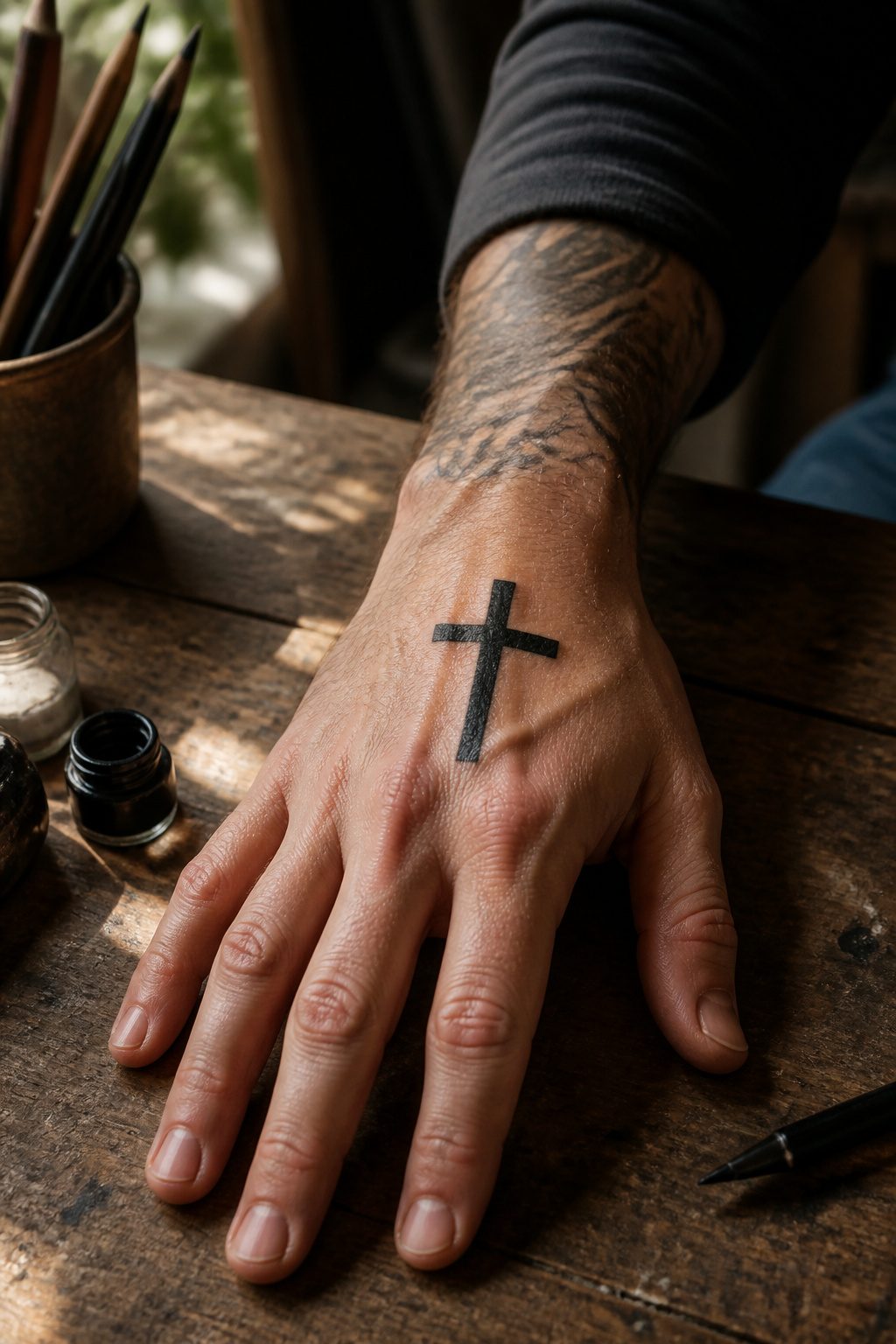
Crosses, anchors, and arrows rank among the most requested hand tattoos for guys, and the appeal is straightforward: they read instantly from a distance and carry weight without needing explanation.
A small anchor riding the thumb web, a single arrow following the index finger’s line, or a cross centered on the back of the hand all stay legible because the shape itself does the work.
Zodiac signs, Norse runes, and Greek letters follow the same logic. These symbols compress meaning into a few strokes, which matters more on hands than almost anywhere else.
Skin here sees constant motion, sun, and washing; fine detail blurs, light colors drop out, and what looked intricate at twenty can turn unreadable by thirty.
Bold outlines and simple geometry age better here than anywhere on the body, which is why a rune with clean verticals or a single Greek letter in solid black tends to outlast a crowded composition.
The restraint also serves visibility. A hand tattoo announces itself in every handshake, every gesture at a counter, every time you reach for your keys.
A symbol that takes a half-second to register lands harder than one that demands study. For men who want meaning without noise, the spare approach wins.
Animals and Predators
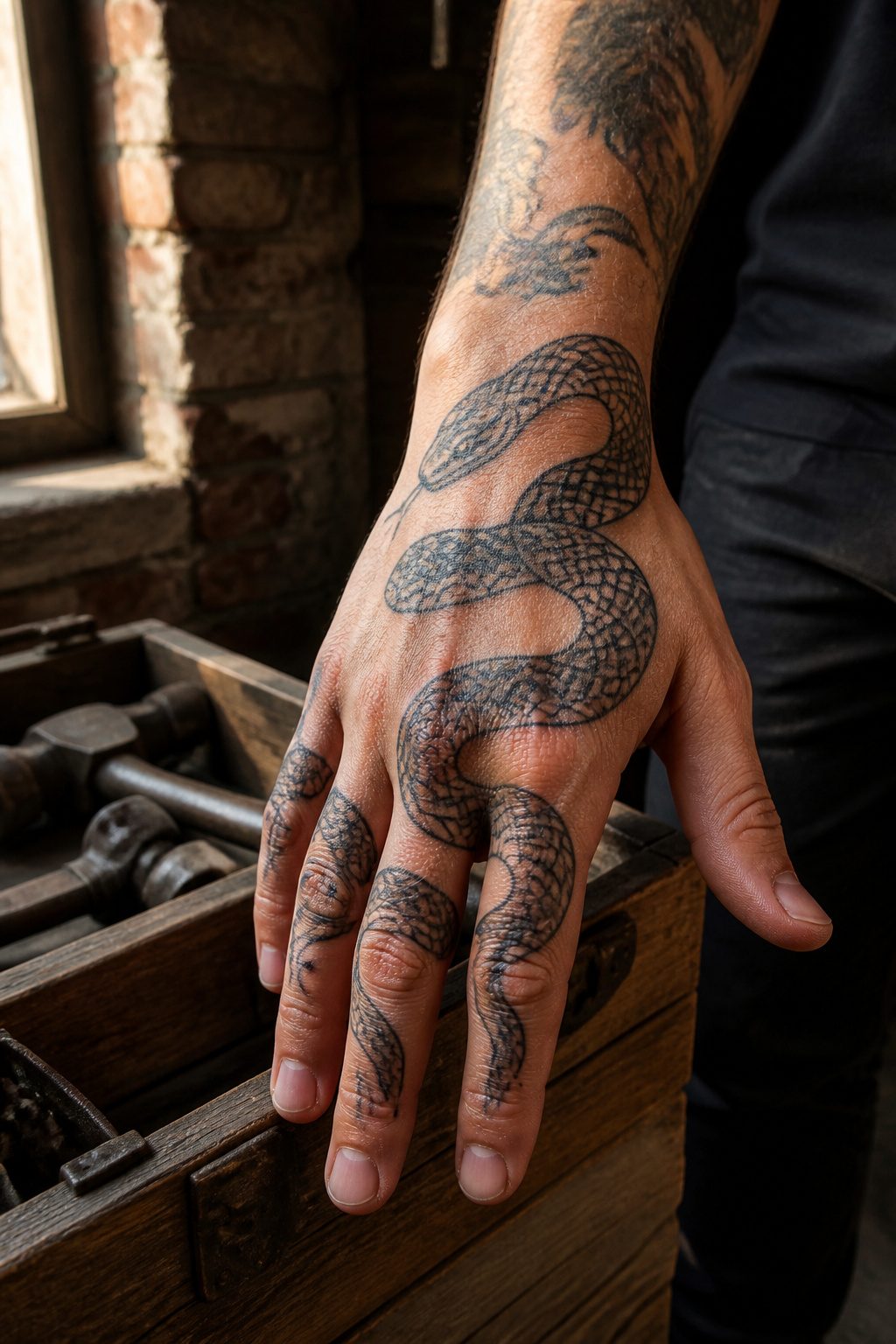
Lions, wolves, tigers, snakes coiled around fingers, and eagles in flight have become staples in hand tattoos for guys who want the design to do the talking before they do.
The hand leaves nowhere to hide, which is exactly why these predators work: the placement itself reads as confrontation, and a lion or wolf there signals strength without needing explanation.
Historically, warriors and tribes marked their hands this way, turning the body part you lead with into a permanent claim on identity and bravery.
The catch is detail. Hands move constantly, and skin there regenerates fast.
Bold, simple designs with clear outlines age far better than intricate fur texture or fine feathering that blurs within a few years.
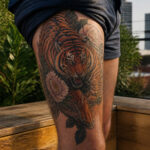
A tiger stripped to its essential stripes will still read as tiger at fifty; one packed with photorealistic shading may soften into a smudge you have to explain.
My own bias, after looking at hundreds of healed photos, runs toward the traditional and geometric: give the snake a strong silhouette, let the eagle’s wings stay graphic rather than feathery.
The masculine energy these animals carry does not depend on complexity. It depends on the hand being visible, immovable, and impossible to miss.
Skulls and Skeletons
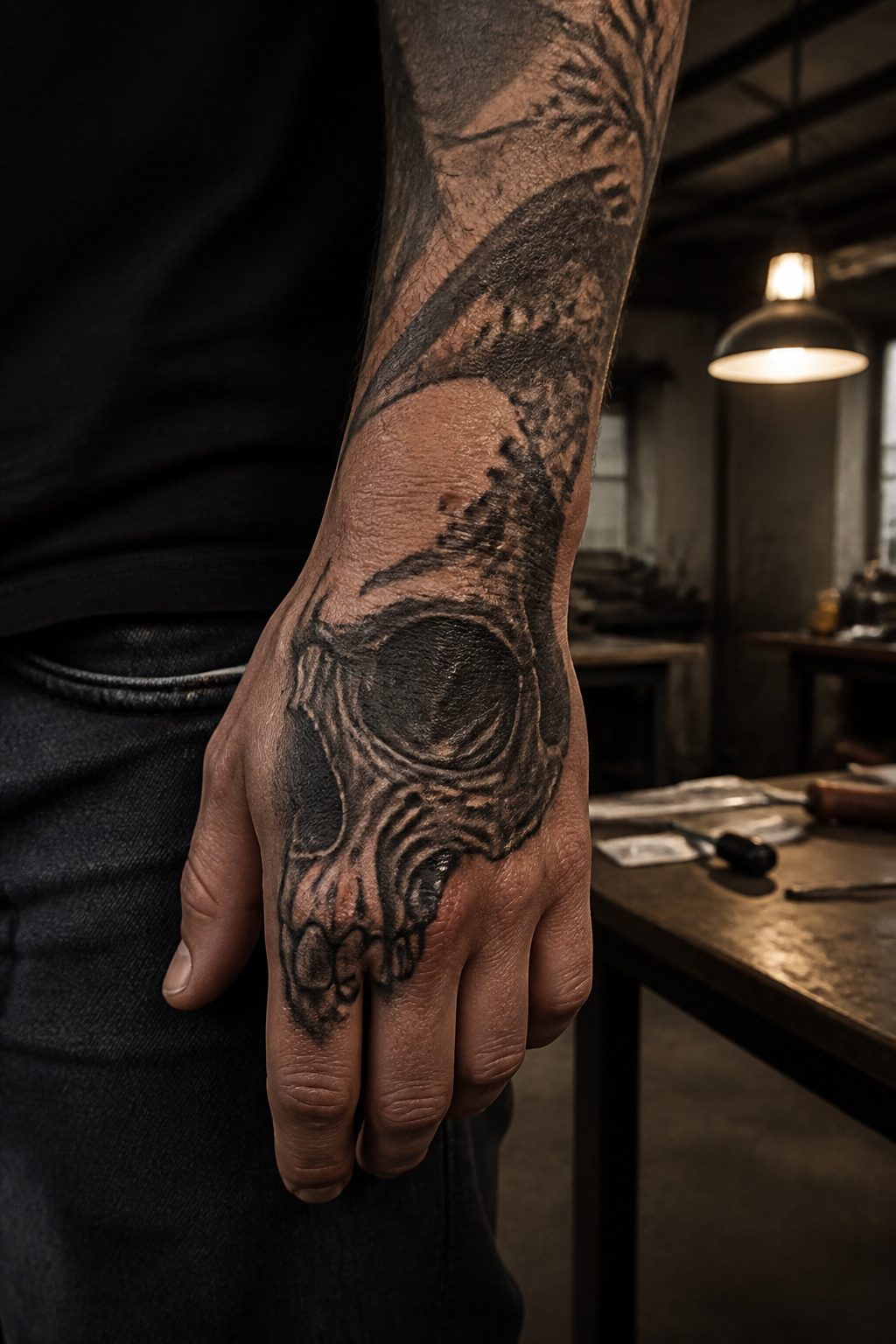
Realistic skulls, half-face skeletons, and sugar skulls each land differently on a hand.
A full realistic skull across the back of the hand reads as raw acknowledgment of mortality, the kind sailors and warriors historically carried to signal they’d already made peace with the worst outcome.
The half-face skeleton, split across two fingers or one side of the hand, keeps the same weight but leaves room for movement; the design shifts when you close your fist, which turns the symbol into something alive rather than static.
Sugar skulls carry the cultural marker of Día de los Muertos, and on a hand they function as celebration rather than warning, the color and filigree offsetting the bone beneath.
The historical thread runs through all three.
Warriors marked themselves with skull imagery before battle to show they did not fear death; sailors later adopted the motif as a record of survival, a visible claim that they had faced the void and returned.
That lineage still matters because hand placement removes the option to hide the statement. The skull becomes defiance made permanent, a refusal to soften the message for a job interview or a family dinner.
Mortality as theme works precisely because the hand never stops moving; the reminder is constant, unmissable, and deliberately confrontational in a way a shoulder or back piece rarely achieves.
Floral Designs
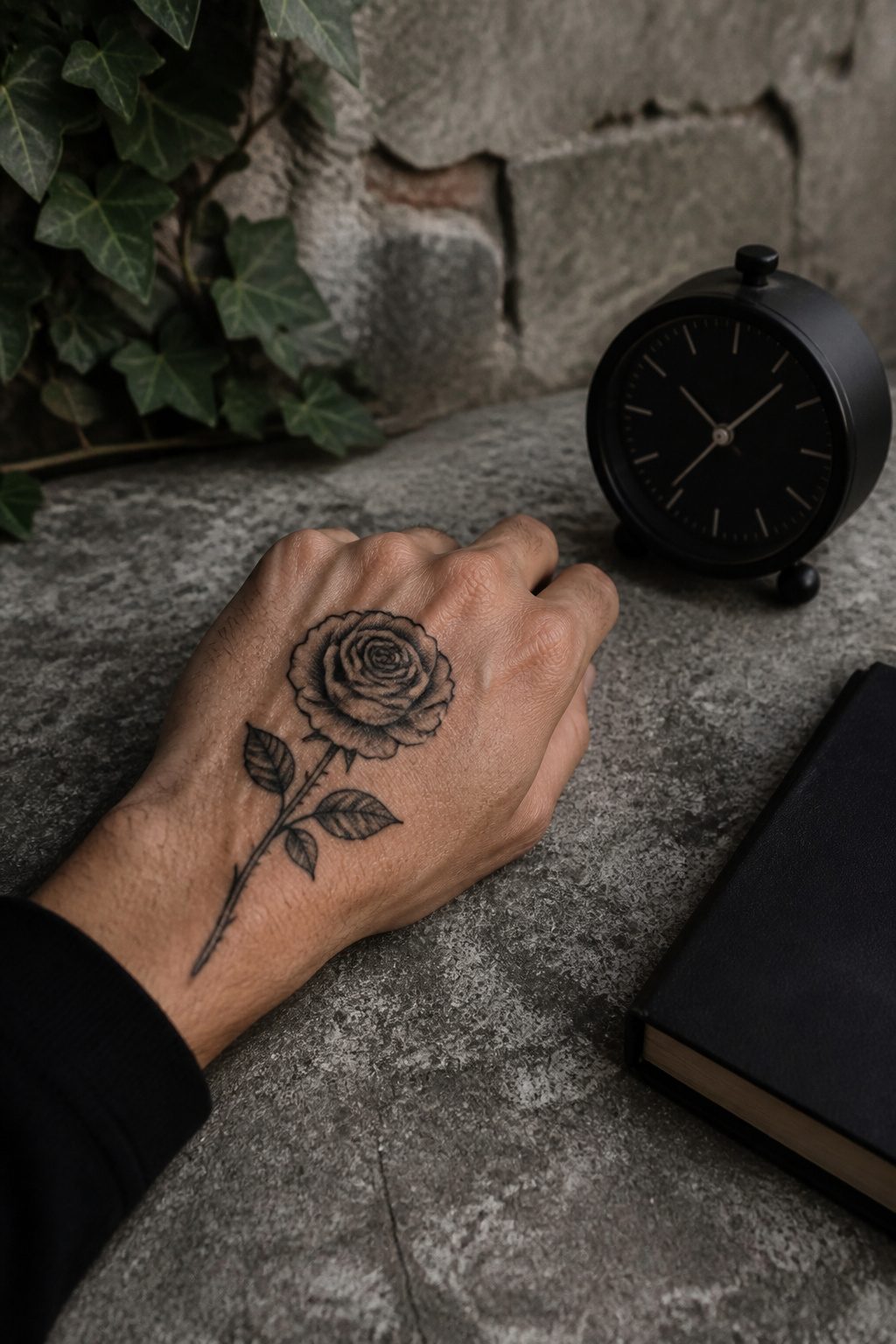
Roses on a man’s hand used to draw double-takes, but that reaction has cooled noticeably over the last decade. The old rule tied roses strictly to romance or memorial pieces, which kept a lot of guys away.
What changed was placement and pairing: a single rose on the back of the hand, stem running toward the wrist, reads as graphic and structural rather than sentimental.
A rose paired with a clock, a dagger, or negative-space thorns shifts the meaning from love to time, risk, or resilience, which is the repositioning that made floral work palatable to masculine hands in the first place.
Lotus and cherry blossoms followed the same path, though more slowly. The lotus carries its own weight in Eastern traditions, and on hands that meaning holds because the flower closes at night and opens at dawn, a daily visible cycle.
Cherry blossoms stay brief by nature, a reminder of impermanence that suits the hand’s constant motion and exposure. Both designs demand clean line work at small scale, and the hand’s thin skin means any petal blur shows early.
A friend of mine watched his cherry blossom outline soften inside eight months where the knuckles bent, a reminder that floral detail on hands needs a lighter touch than the same design on a shoulder or calf.
Lettering and Phrases
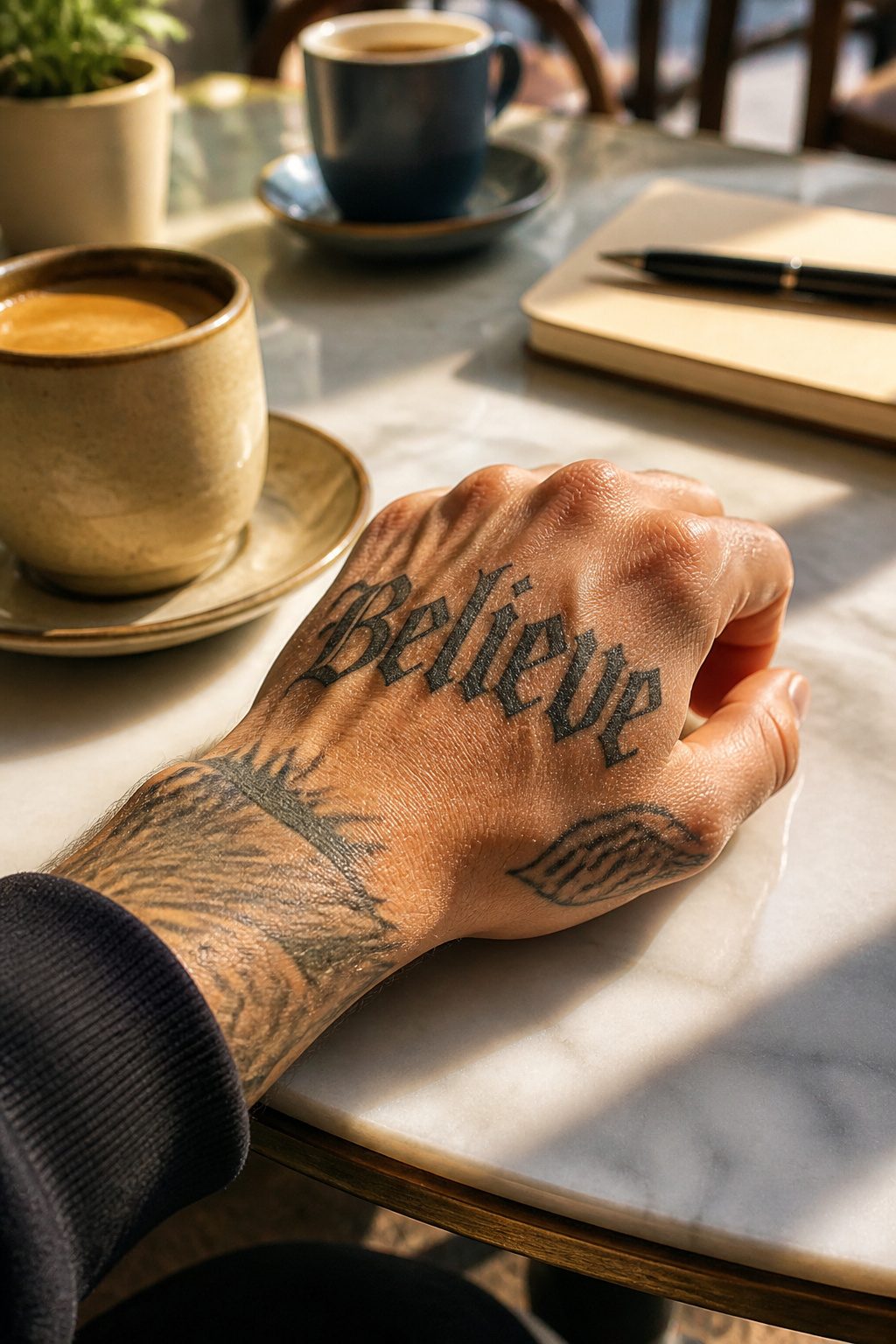
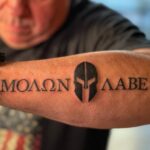
Words like "Loyalty," "Faith," and "Stay True" sit well on a man’s hand because they read fast from across a room and carry weight without needing an image.
Initials, single letters, or Roman numerals across the knuckles work the same way: the message is immediate, and the spacing uses the hand’s bone structure as its own frame.
The problem is the hand itself. Skin here is thin, moves constantly, and takes sun without much cover, so fine lines blur and small letters blob together faster than they would on a shoulder or a forearm.
Clean, strong fonts with clear outlines age better here, which is why bold traditional lettering tends to outlast scripts with hairline details.
A word that looks sharp at twenty can look like a bruise at forty if the font was too delicate to begin with.
Placement matters for work, too. A phrase across the back of the hand is harder to miss than one tucked along the thumb edge or between the fingers.
In industries where handshakes still matter, that visibility can shift a first impression before you speak.
The tattoo doesn’t have to hide completely, but knowing which parts of the hand catch light during a meeting is worth mapping before the needle starts.
Geometric Patterns
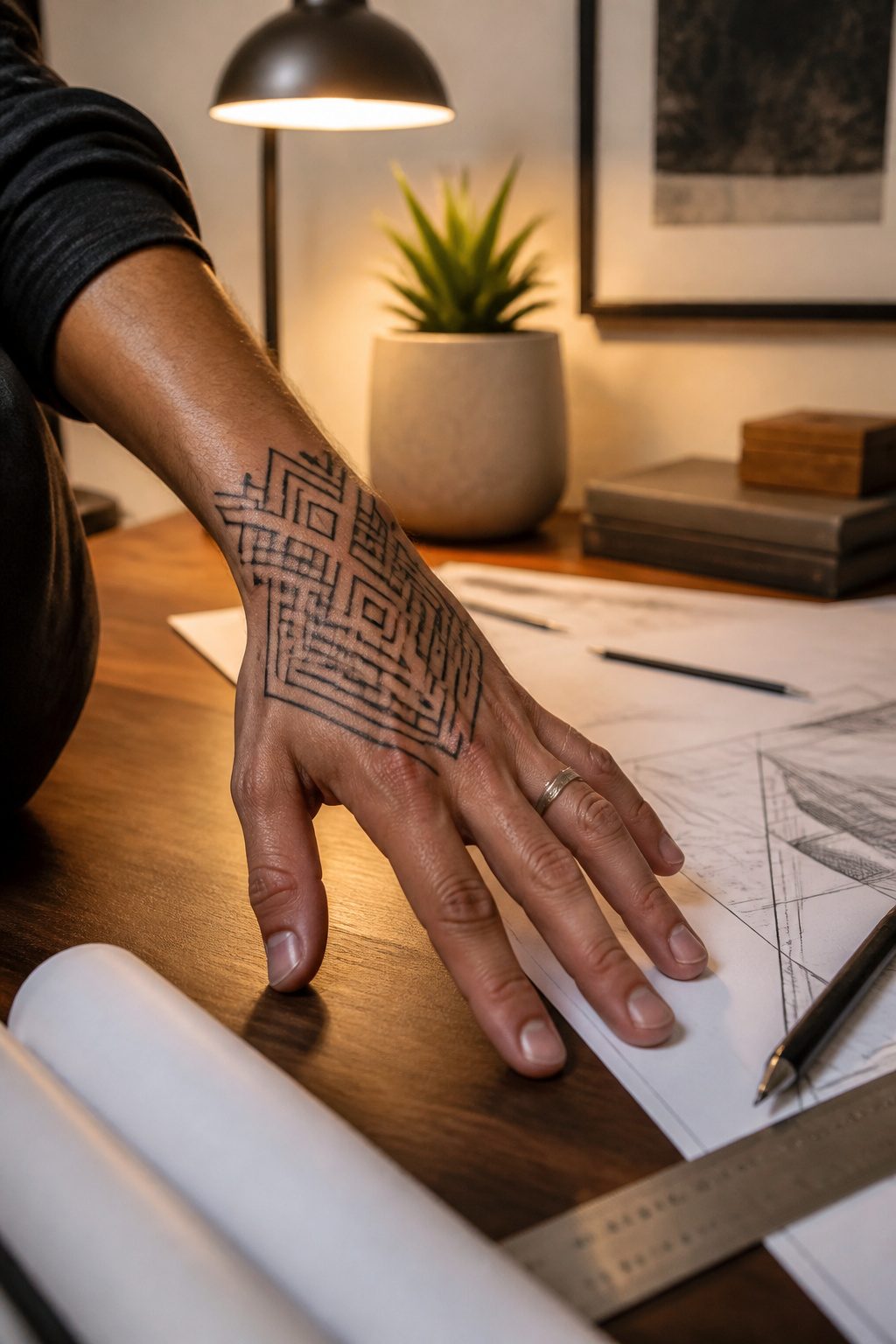
Geometric patterns on the hand read as armor built from math rather than myth, and that distinction matters for men who want coverage without borrowing someone else’s symbolism.
The shapes interlock across knuckles and tendons, following the hand’s own geometry so the design flexes when the hand flexes rather than fighting it.
Abstract linework can also bury older tattoos that no longer fit. A dense field of triangles or extended polygons weaves over existing ink, using the old piece as negative space rather than demanding removal.
The effect is deliberate and structural, not decorative in the usual sense.
This style carries the same historical weight as figurative hand tattoos, the marks of status and passage that Polynesian and sailor traditions established, but strips away the narrative content.
What remains is the declaration itself: visibility, precision, and the choice to make the hand a surface for pure pattern rather than story.
Minimalist Designs
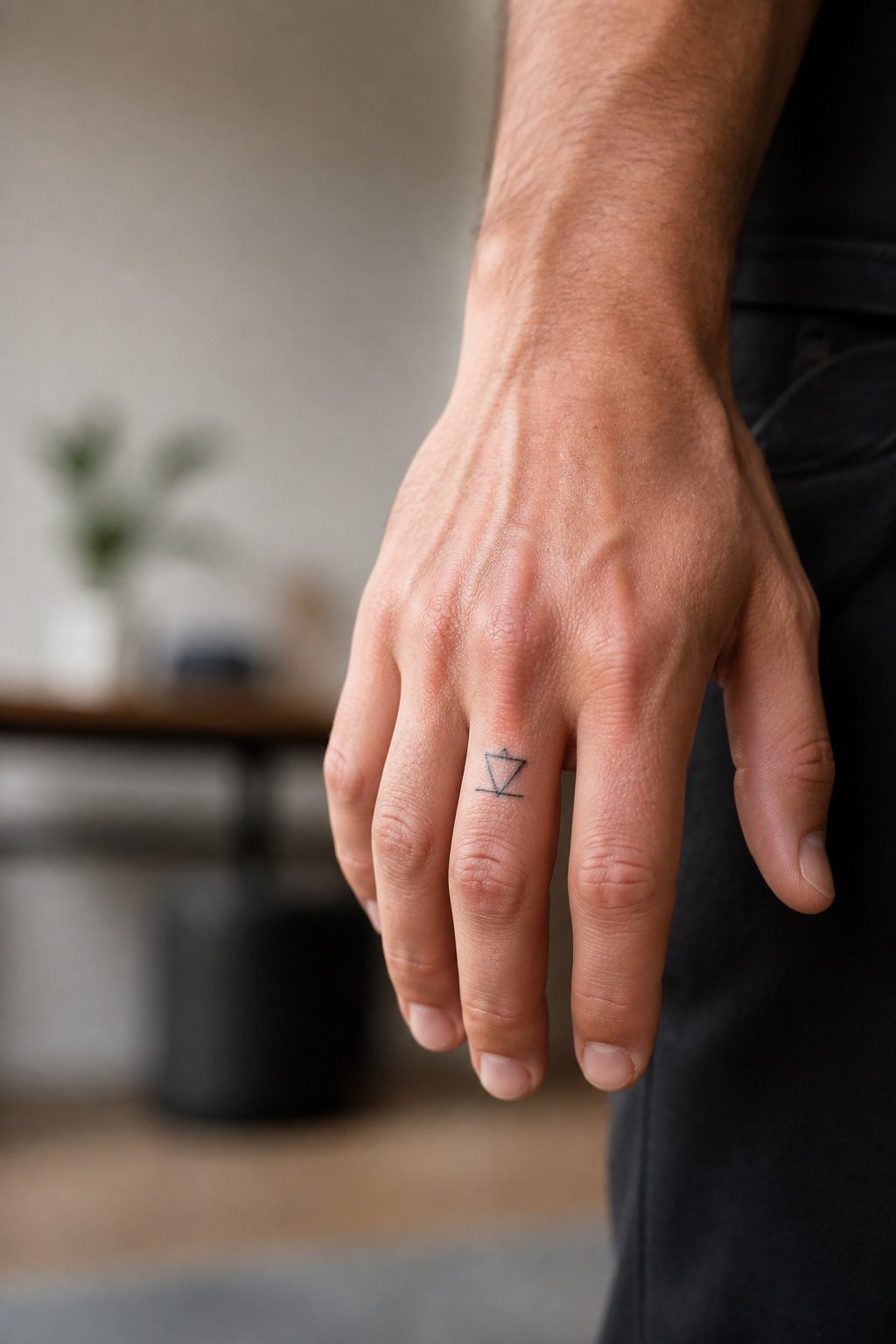
Fine lines, single dots, and abstract shapes sit on the back of the hand without shouting for attention.
A tiny compass near the wrist or a black triangle at the base of a finger reads as deliberate, not accidental, which matters when the placement itself is impossible to hide.
The hand’s constant motion and sun exposure mean even the cleanest linework blurs faster than ink on a shoulder or thigh, so understatement here is partly practical: less detail leaves less to distort.
Some men choose this restraint precisely because the hand is always visible.
A geometric outline or dotwork band signals taste without committing the full volume of a traditional piece, and that balance keeps doors open in offices that still flinch at knuckle tattoos.
The style ages better in the sense that it draws less attention to its own aging; a faded single-line design looks intentional where a once-bold predator might look merely worn.
Portraits
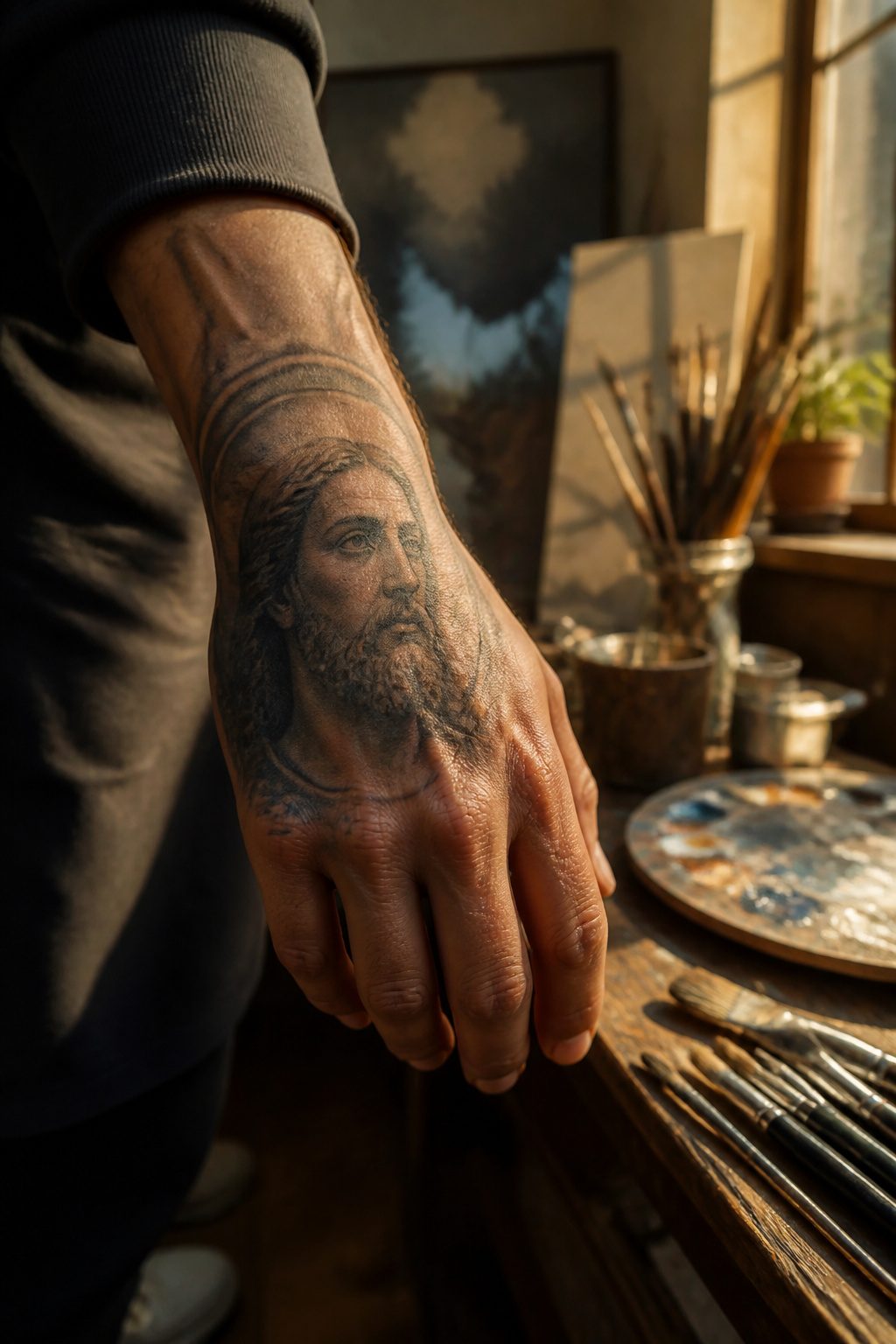
Traditional portraits of faces rank among the weakest choices for hand work, and most artists will warn you away from them outright.
Skin on the back of the hands shifts constantly, thins early, and carries almost no fat cushion, so the fine lines that give a portrait its likeness blur faster here than anywhere else on the body.
What reads as a recognizable face at month three can soften into generic shading by year two, especially across the knuckles where movement never stops.
I have seen this failure pattern described enough times to treat it as settled: the technical difficulty is extreme, the fading is accelerated, and the touch-up schedule becomes relentless.
A few studios still list portraits in their hand portfolios, usually as proof of skill rather than recommendation.
For a guy set on a face, the inner forearm or outer bicep holds the detail far longer with half the maintenance cost.
Mandalas
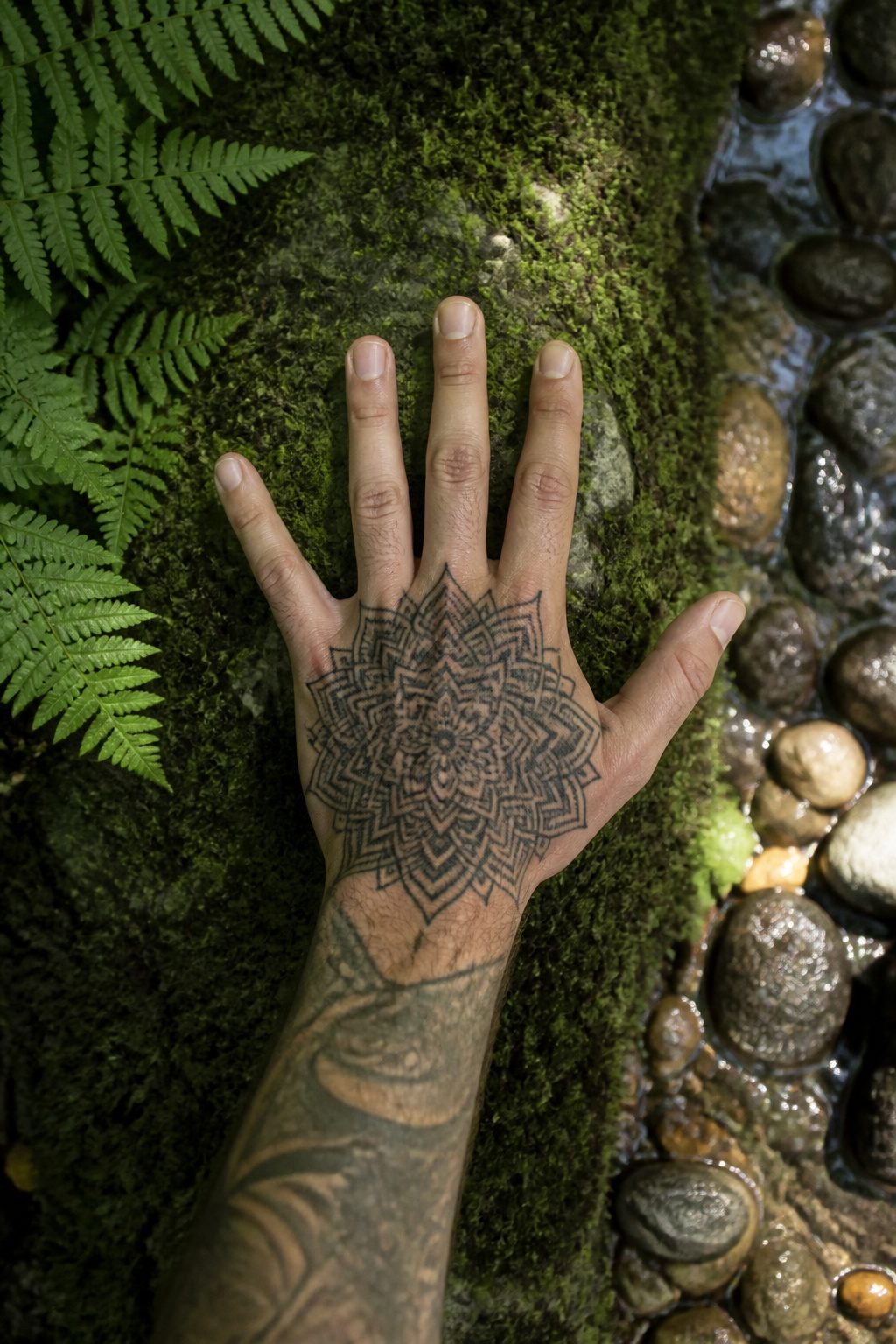
A mandala sits flat against the back of the hand in a way few other designs manage, its symmetry matching the geometry of the fingers rather than fighting it.
The pattern draws the eye inward to a center point, then outward through interwoven lines that seem to expand with every glance.
In Hindu and Buddhist iconography, this shape represents the universe itself, a tool for meditation and a symbol of harmony that predates its use in tattooing by centuries.
That spiritual weight carries onto the skin as a personal emblem, a quiet claim about searching for inner peace rather than broadcasting toughness. Some guys hesitate here.
The fine linework and balanced form read as decorative in a culture that still codes masculinity through armor and aggression.
A geometric pattern built from the same shapes but framed as protective, as a barrier against adversity, lands differently with the same crowd.
What convinced me, looking through portfolios, is that the hesitation itself is the point. The man who chooses a mandala on his hand is choosing visibility without hostility, intricacy without fragility.
The design demands precision from the artist and patience from the wearer, and the flat planes of the hand reward that investment with a display that moves naturally with the body.
Mythical Creatures
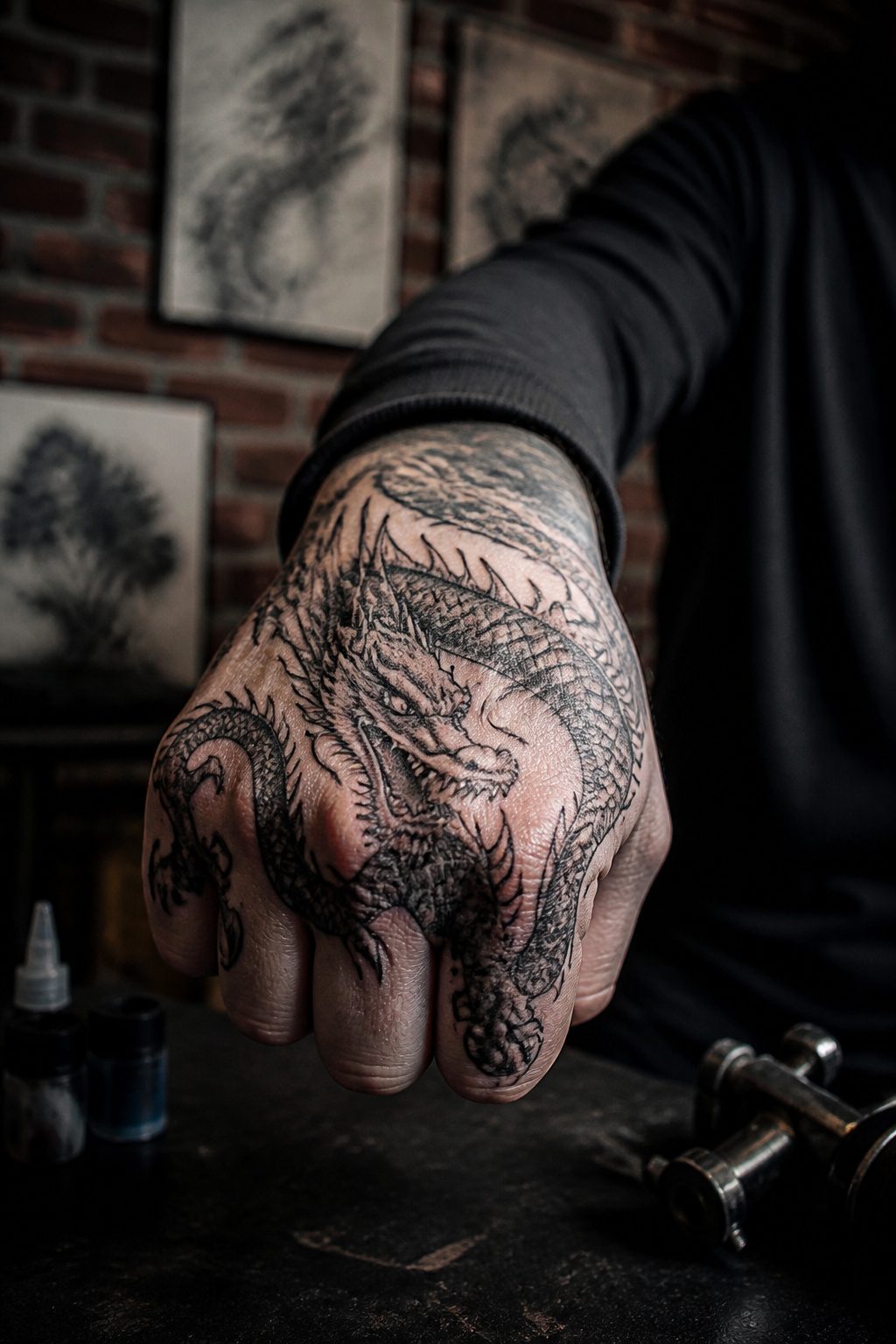
A serpentine dragon coiled across the knuckles carries the same weight it has in older traditions: power, protection, and the kind of ferocity that doesn’t back down from being seen.
The hand leaves nowhere to hide, which is exactly the point for someone choosing this placement.
The phoenix rises on a different register, and the transformation symbolism matters more here than with most designs. Rebirth through fire reads as personal mythology rather than borrowed fantasy when it’s burned into skin you shake hands with daily.
A phoenix on the hand commits to the narrative publicly, not tucked under a sleeve for selective disclosure.
Scale brutalizes both creatures. What reads as intricate on a shoulder blade collapses into muddy scales or flame feathers across the narrow terrain between knuckles and wrist.
The artists who pull this off work with single-needle precision and charge accordingly; the ones who don’t still take your deposit.
Dragon whiskers and phoenix tail plumage are the first details to blur as the hand moves, heals, and moves again.
Eye Designs
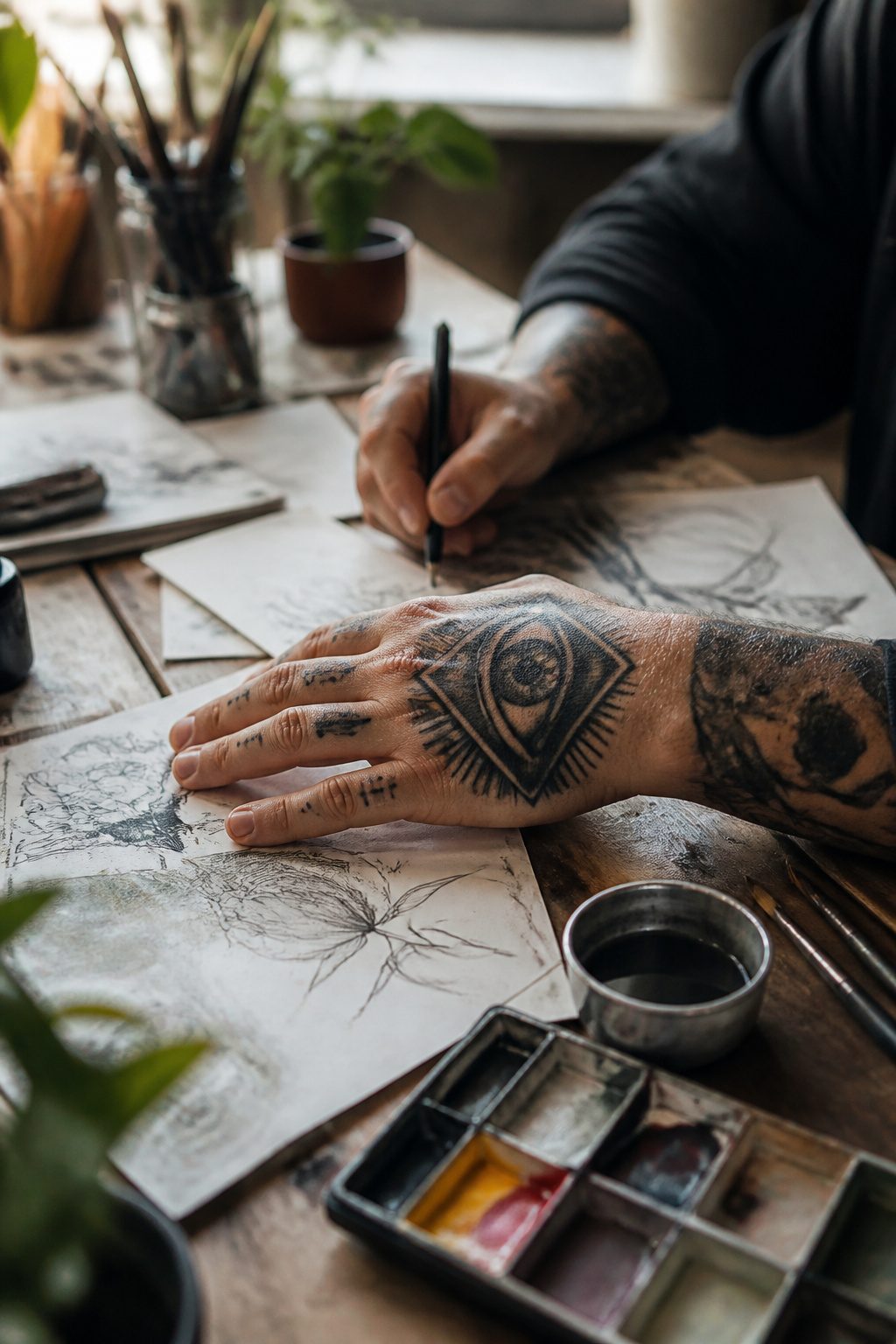
An all-seeing eye centered on the back of the hand carries a direct statement about insight and protection, the kind of symbolism that reads immediately across a room.
The design works with fine linework or heavy black and grey, but the placement itself does the heavy lifting: the eye sits where the wearer and everyone else cannot miss it.
Eyes inked onto the palms create a different effect entirely. The image surfaces when the hands cover the face, turning a gesture of hiding into one of revelation.
That placement speaks to perception beyond ordinary sight, an inner vision the wearer holds literally in their grasp.
The palm carries a cost.
Thin skin stretched over bone makes the session more painful than work on the back of the hand, and the constant friction of daily use wears the lines faster than almost anywhere else on the body.
Scabbing takes longer to settle when the hands never stop moving.
Hands are among the more painful spots due to thin skin and proximity to bone.
— Neebol
For a design built on clarity and perception, fading and distortion hit harder here than symbolism alone can justify. The eye motif demands precision, and precision on the palm is a commitment to repeated touch-ups.
Butterflies
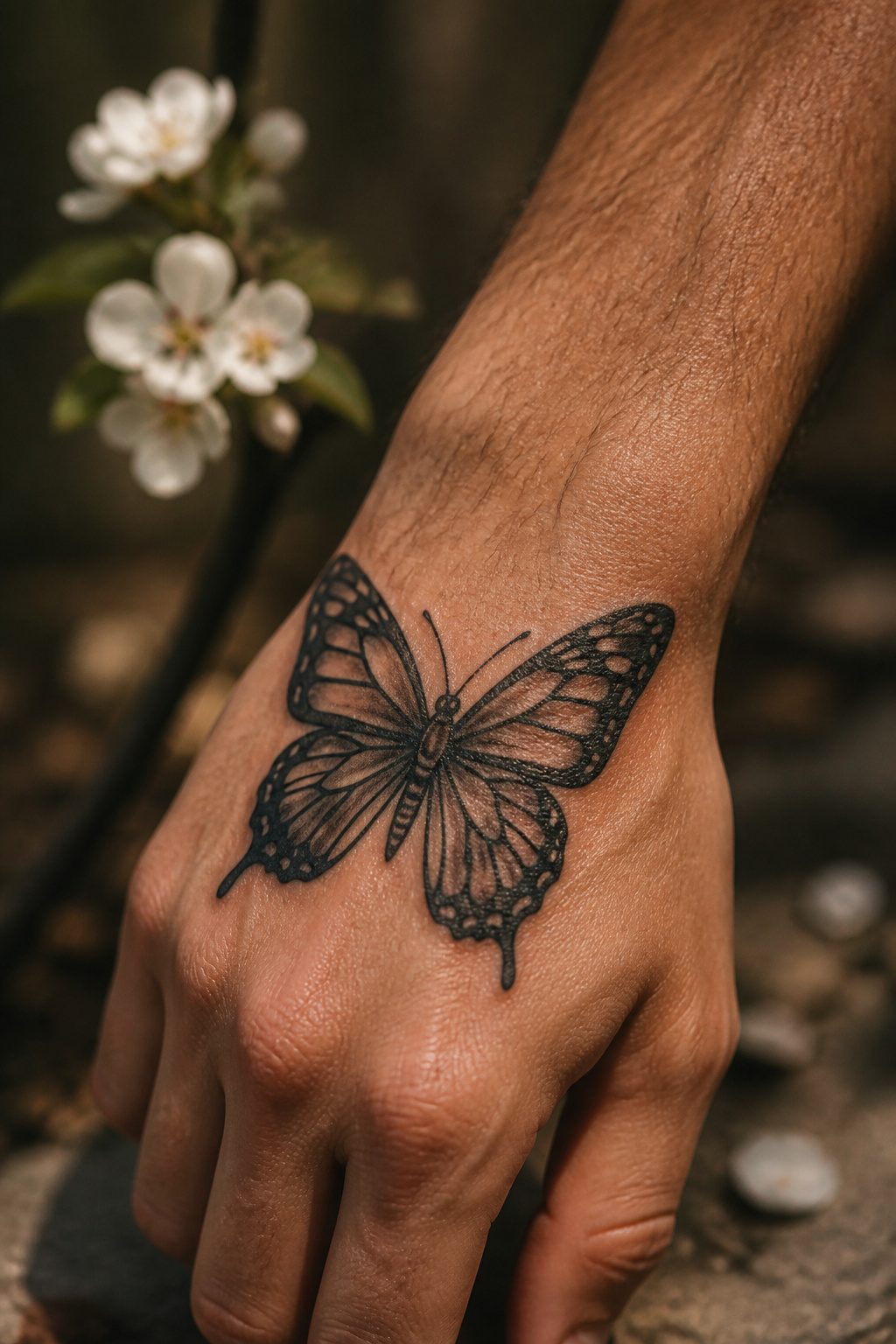
A butterfly on the hand reads as an unexpected choice for men, but the symbol itself carries weight that overlaps with the territory staked out by dragons and phoenixes in other sections.
Transformation is the shared theme: the creature starts in one form, endures a contained collapse, and emerges with color and motion it did not possess before.
That narrative fits the hand precisely, a placement tied to action and interaction, suggesting the wearer means to engage the world with whatever change is now complete.
The detail in the wings matters more than the outline. Dense linework across the knuckles or a single specimen perched at the thumb base both work, though the former risks blurring faster on skin that moves and creases constantly.
A butterfly here signals personal growth openly, not tucked beneath a sleeve where only the wearer sees it. The visibility is the point.
For men considering this route, the design leans less delicate than the garden-variety version and more toward the structural: bold black lines, high contrast, or a moth variant that trades brightness for something more weathered.
Cross Designs
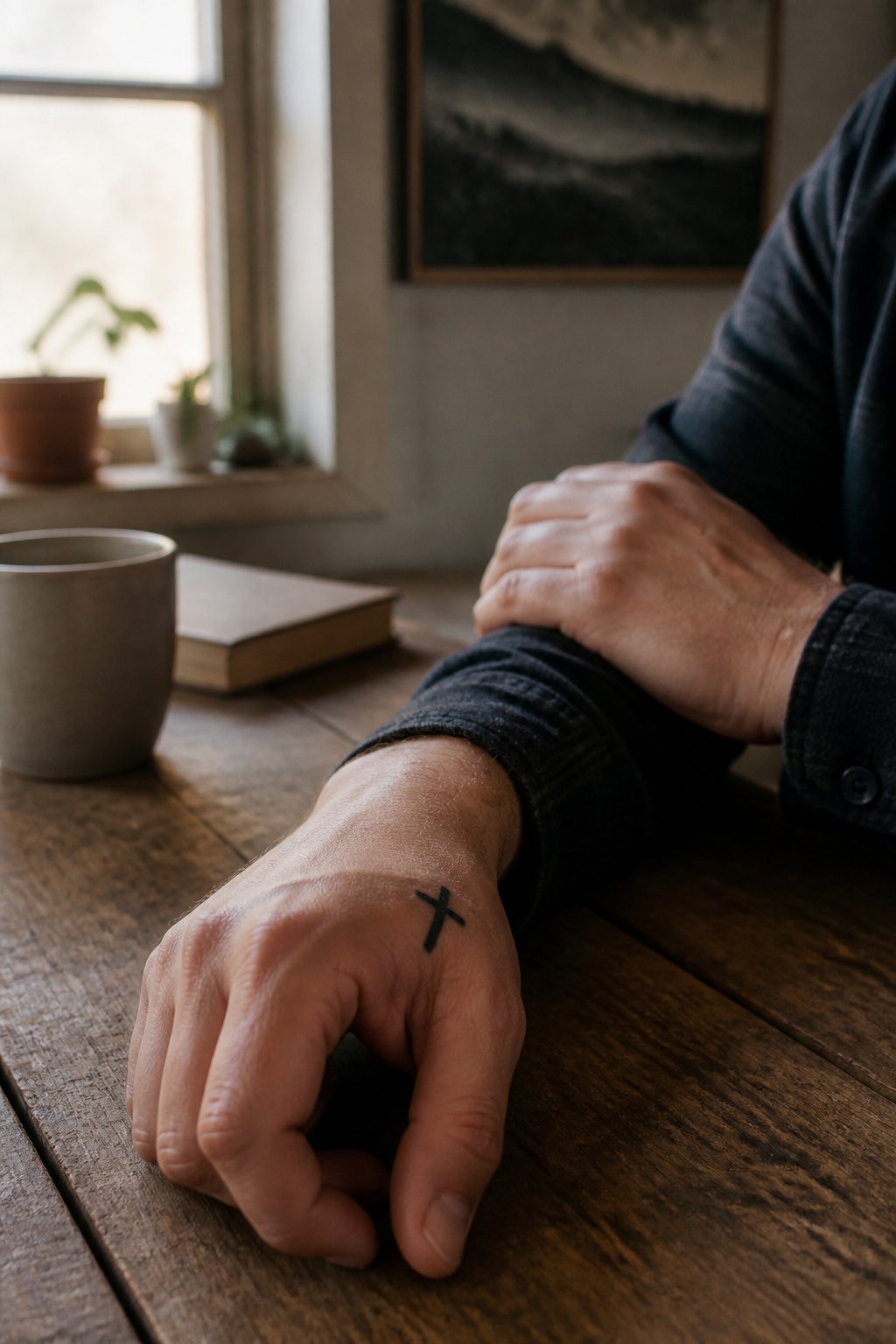
A simple cross on the hand lands differently than a skull or a wolf. The design stays unembellished, two plain lines, and that restraint is the point.
It reads as a grounding in tradition rather than a grab for attention, and for men getting their first hand tattoo, the cross often wins because the meaning is already settled.
No explanation needed at a gas station or a job site.
The hand moves constantly, which is where the plain cross has an edge over ornate or Celtic variants. Bold, clean lines hold up against the stretching and knuckle flexing that blurs finer detail.
A cross with a clear outline ages better than something crowded with interlacing knots.
Small spaces suit it too. The cross sits cleanly on a finger, the side of the hand, or the back without fighting the bone structure.
A single black cross about the size of a quarter keeps the symbolism central without turning the hand into a billboard.
That scale keeps it personal, visible to the wearer first and readable by others second, which is the balance most first-timers actually want.
Bird Silhouettes
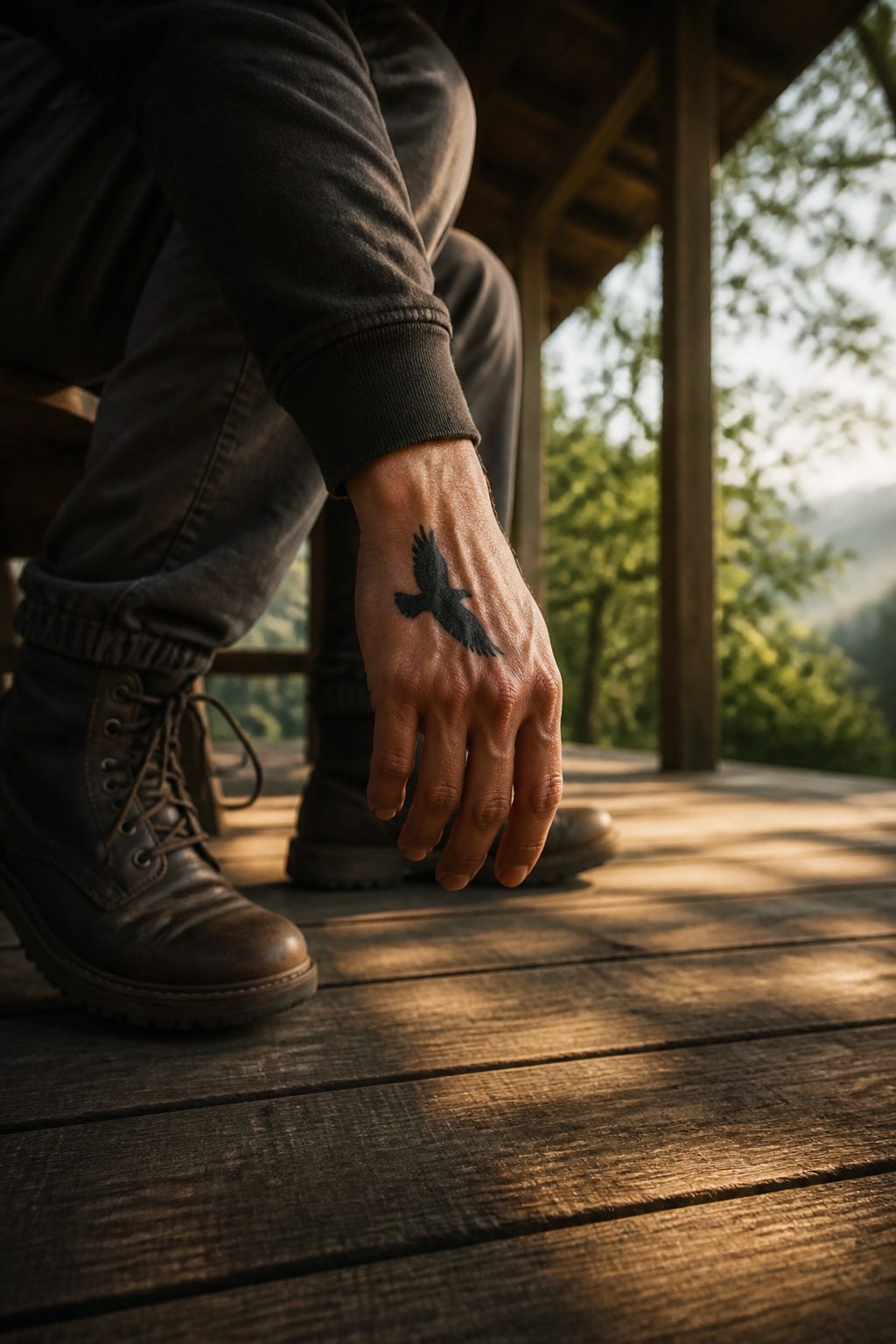
Bird silhouettes strip the idea down to its cleanest form: a single shape against skin, no feather detail needed to read the species or the intent.
That spareness is what keeps the line crisp after years of sun and washing, since every extra hatch mark in a tattoo is another groove for ink to drop out of over time.
The shape alone carries the weight: flight, distance, the choice to leave.
Eagles get the press for masculine hand work, and they belong in that conversation, but the smaller birds, the unmarked profiles, hold the same meaning without borrowing someone else’s symbolism.
A swallow, a crow, a bird you do not name at all, all read as the same statement of freedom once you reduce them to outline.
The hand placement matters here because the silhouette moves when the hand moves, a small motion that keeps the image alive without animation.
What I notice comparing healed work is that the ones that aged best were the ones that started with the least: one weight of line, one direction of travel, no background, no attempt to ground the bird in a scene.
The wearer supplies the context every time they raise their hand.
What Hand Tattoos Symbolize
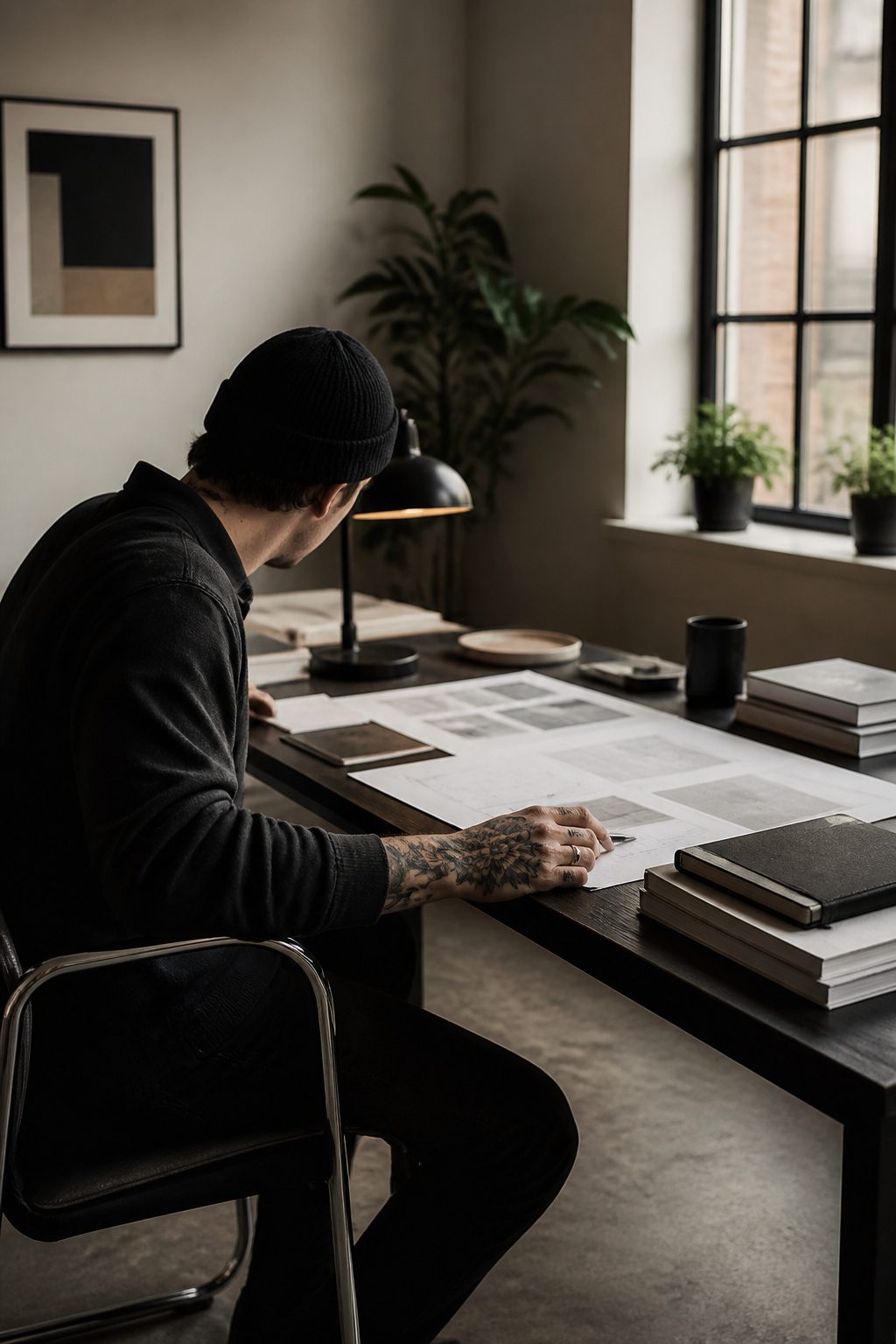
A hand tattoo on a man reads as confidence made visible. The placement refuses concealment; it announces that the wearer accepts being marked for scrutiny in every handshake, job interview, and family gathering.
That willingness carries weight. Historically, warriors and tribes used hand markings as identity and bravery, and that lineage still echoes.
Strength, power, and resilience remain the core associations, though the modern shift is toward personal identity rather than group code. The design itself becomes the statement, whether that is intricate artwork or a single bold symbol.
Some still view the choice as non-conformity, a deliberate friction against professional norms that persist in certain settings. The visibility is the point: the hand does not hide, so the commitment must match.
Pain Level and What to Expect
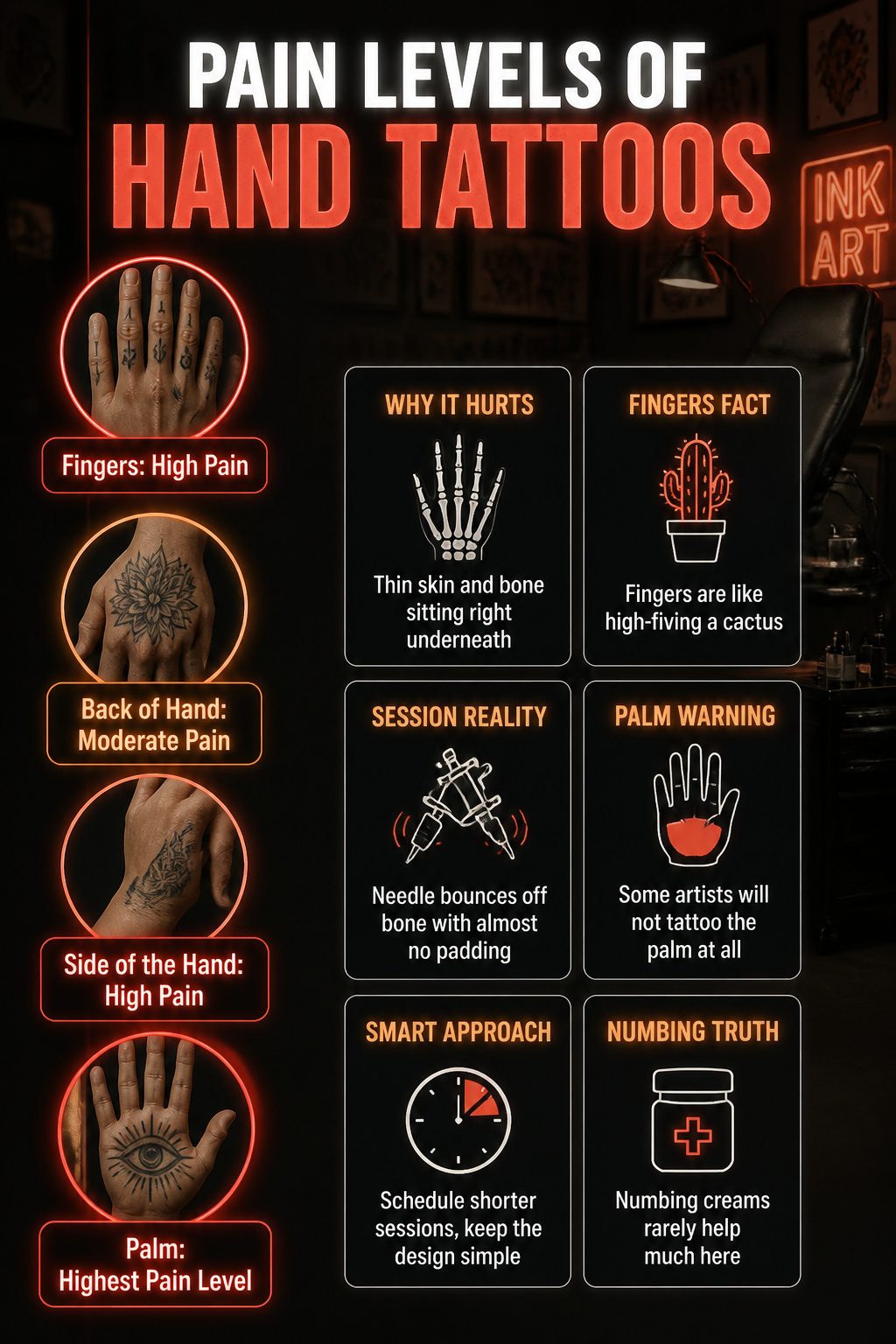
Thin skin and bone sitting right underneath make the hand one of the more demanding spots to sit through.
Fingers are like high-fiving a cactus; the needle bounces off bone with almost no padding, and each pass feels sharper than the last.
The back of the hand eases up only slightly, a moderate game of why am I doing this, with the knuckles and tendons keeping the vibration alive the whole session.
Side of the hand and palm rank higher still, enough that some artists will not tattoo the palm at all. The visibility and impact of hand tattoos for guys come with that trade.
If you are set on the placement, schedule shorter sessions, keep the design simple for a first piece, and accept that numbing creams rarely help much here.
Healing and Aftercare
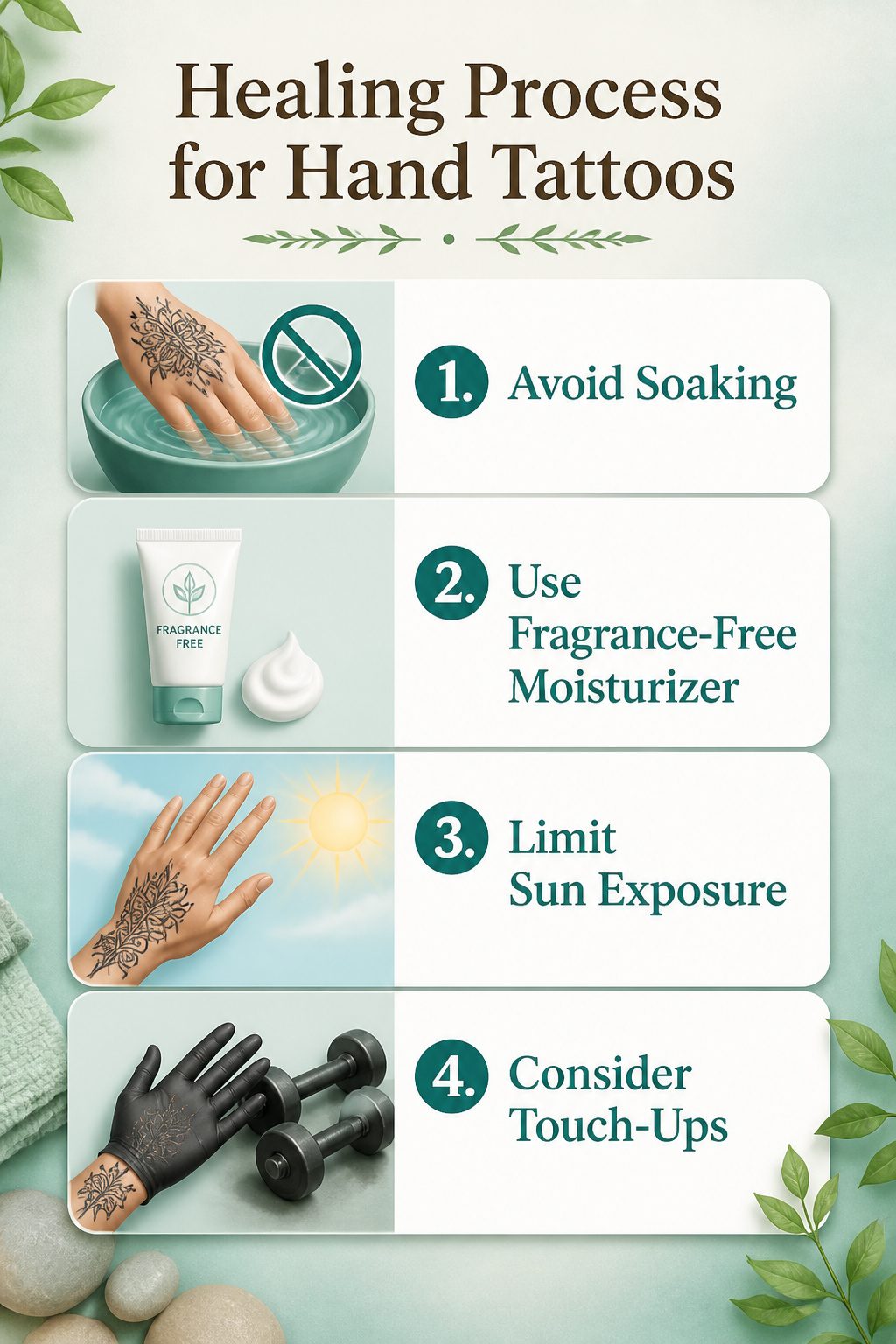
Hands heal slower than almost any other tattoo site because they never stop moving. The constant flexing, gripping, and washing pulls at fresh ink, which means scabbing tends to be heavier and fading starts earlier than you’d expect.
Two weeks of careful handling makes the difference between clean lines and a washed-out result.
Soaking is the first thing to cut. Skip long dish sessions, baths, or swimming for a full fourteen days; quick showers are fine, but pat dry immediately and gently.
Moisturizer matters too, and fragrance-free is the only way to go. Scented creams irritate broken skin and can pull pigment during healing.
I keep a plain, unmarked tube by the sink and reapply every time hands feel tight.
Sun exposure is the long-term enemy. UV breaks down tattoo ink faster on hands than on covered skin, so SPF becomes part of the daily routine once healing closes.
Some artists suggest gloves for dirty work even after the surface heals, and the logic holds: friction from tools, gym equipment, or repeated rubbing wears lines down over time. Touch-ups aren’t failure; on hands, they’re part of the commitment.
Professional Considerations
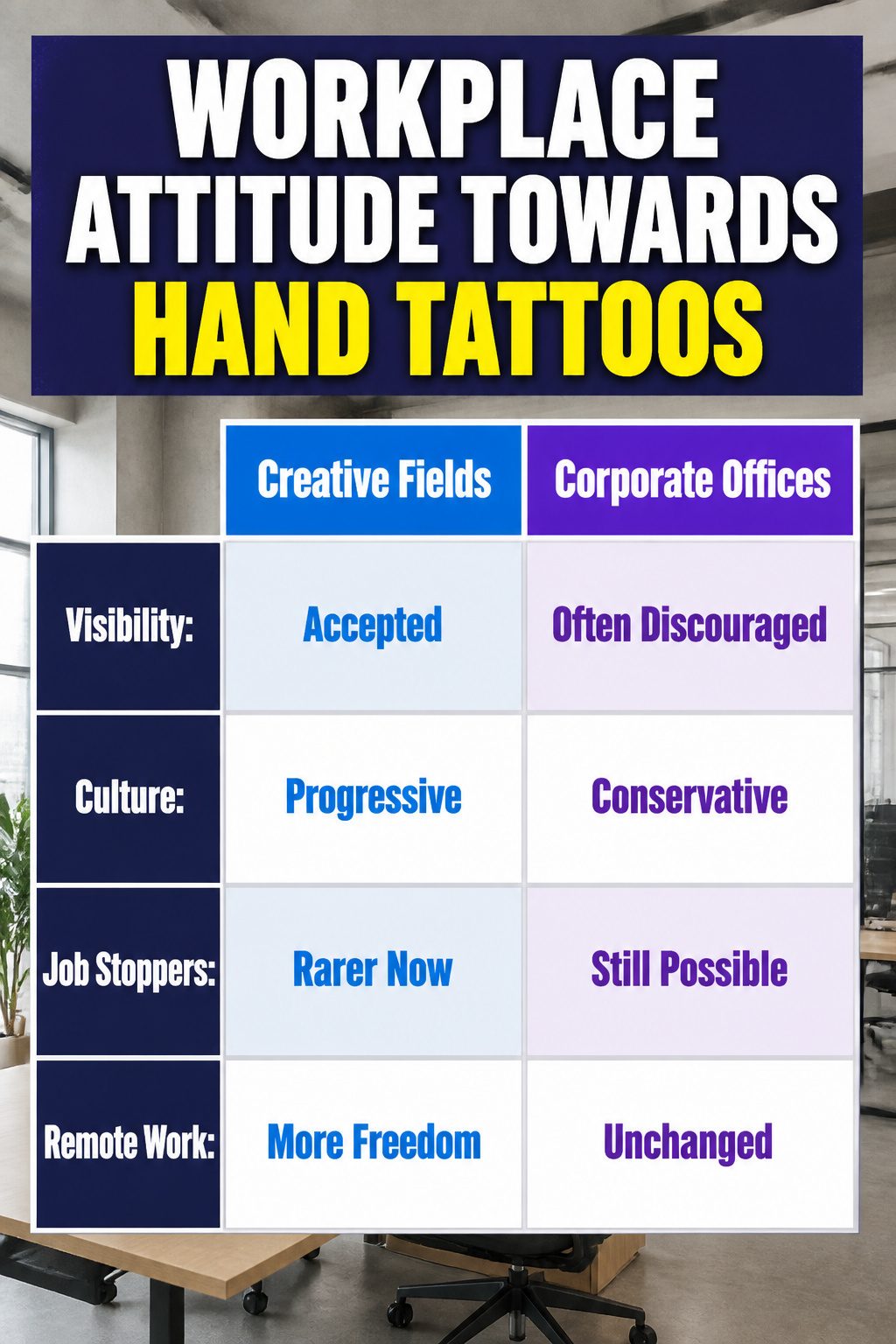
Creative fields have loosened up on visible ink faster than corporate offices ever will. A hand tattoo that reads as bold self-expression in a design studio still scans as careless in a law firm or a client-facing sales role.
The split is real, and industry still decides whether hand tattoos are job stoppers.
That said, the outright ban is rarer now than it was even ten years ago. Remote work blurred the line between personal presentation and professional image for a while, and some employers stopped policing what they rarely saw on Zoom.
In-person roles snapped that back. Corporate culture moves slower than tattoo culture, and the hand remains one of the last places where ink draws automatic scrutiny.
Solid numbers are hard to pin down. No large survey tracks hiring rates by tattoo placement, so most advice rests on observation and anecdote rather than data.
What is clear: the risk is uneven. A graphic designer in Portland faces a different calculation than a financial advisor in Charlotte.
The tattoo itself matters less than who has to look at it and whether they hold the budget you want to reach.
Touch-Ups and Long-Term Maintenance
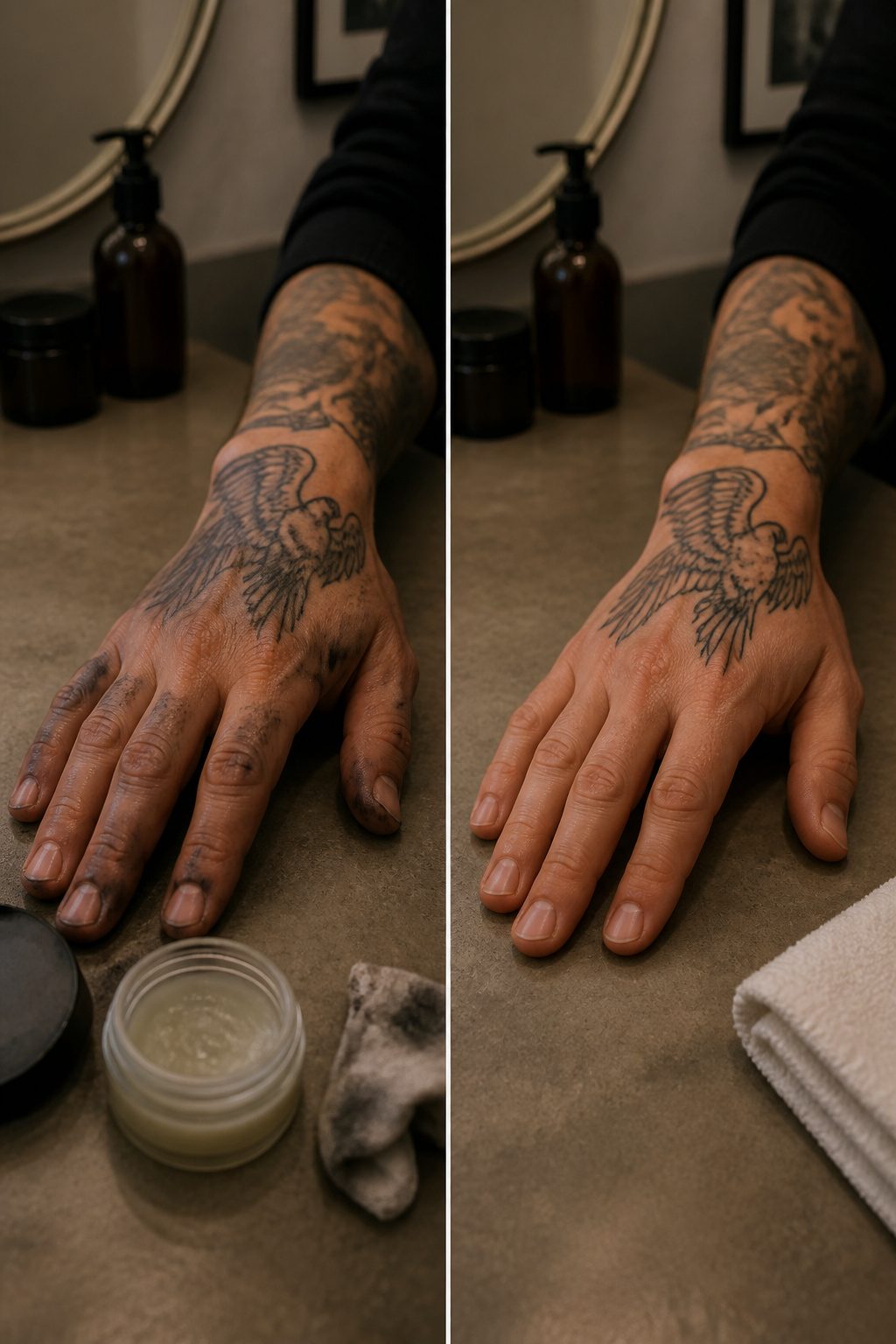
Hand tattoos for guys fade faster than ink on less exposed areas because the skin is in constant motion and takes daily hits from sun, water, and friction.
Touch-ups are part of the commitment, not an optional extra, and planning for them means keeping your artist’s contact close and scheduling sessions more regularly than you might for a back or chest piece.
The long-term cost runs beyond the chair: professional-grade sunscreen replaces whatever you grabbed at the drugstore, and a real hand cream becomes standard gear if you want the work to hold its line.
Some men weigh this against the visibility and decide the tradeoff favors a bolder placement; others realize too late that "permanent" on a hand demands more upkeep than they signed up for.
Either way, the fading starts early, and the choice is whether to stay ahead of it or watch the detail blur.
Frequently Asked Questions
Which tattoo looks good on hand for guys?
Bold, simple designs with clean outlines age best on hands. Symbols like crosses, anchors, and arrows read instantly from a distance, while geometric patterns and animal silhouettes hold their shape as skin moves and fades.
Fine detail and photorealism blur quickly here, so restraint beats complexity.
Do hand tattoos last long?
Not as long as tattoos on less exposed areas. Hands see constant motion, sun, water, and friction, so fading starts earlier and lines soften faster.
Touch-ups are part of the commitment, not a sign of poor work.
Are hand tattoos still considered job stoppers?
Less than in the past, but industry still decides. Creative fields accept visible hand ink readily; corporate and client-facing roles often do not.
Remote work loosened norms briefly, but in-person roles snapped expectations back.
What does the hand tattoo mean for a man?
It signals confidence and a willingness to be permanently visible. Historically tied to warriors and tribal identity, the placement now reads as personal identity, strength, and sometimes deliberate non-conformity.
The hand never hides, so the commitment itself carries weight.