
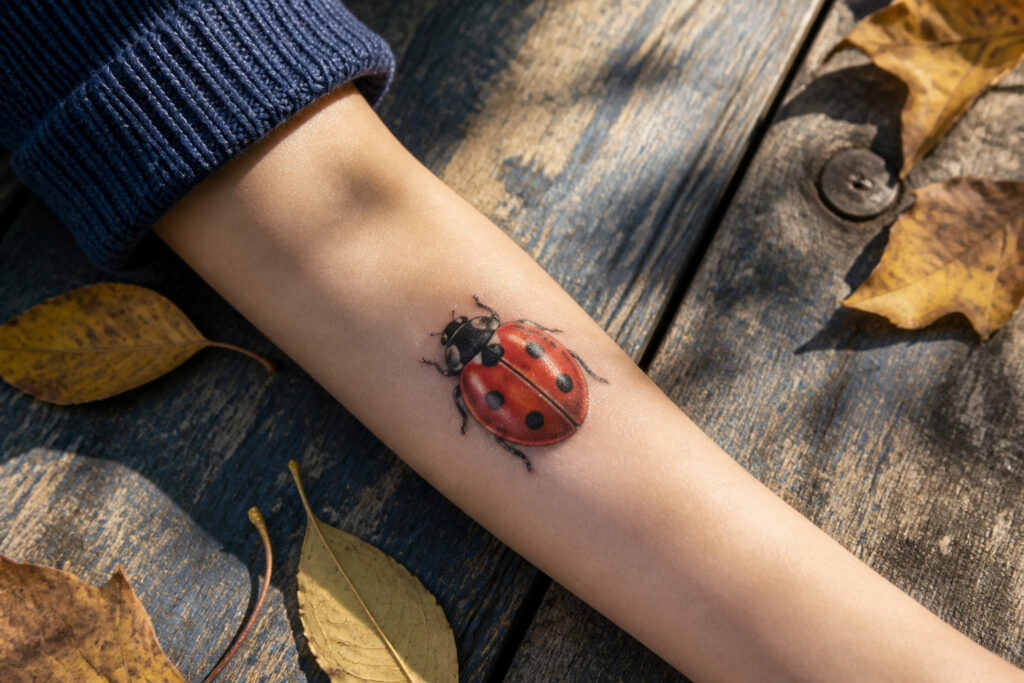
A ladybug tattoo can cost you a touch-up in two years or hold its shape for ten, and the difference is not the beetle but the style you choose.
Red pigment scatters under skin differently than black; the same scarlet shell can stay poppy or dull to rust depending on whether the artist pushed too hard, too shallow, or chose traditional bold lines over watercolor washes.
The 5,000 species in the Coccinellidae family all share that recognizable dome, yet the seven-spotted Coccinella septempunctata still dominates flash sheets because those seven spots carry the folk meanings people actually ask for.
1. Traditional Ladybug Tattoo
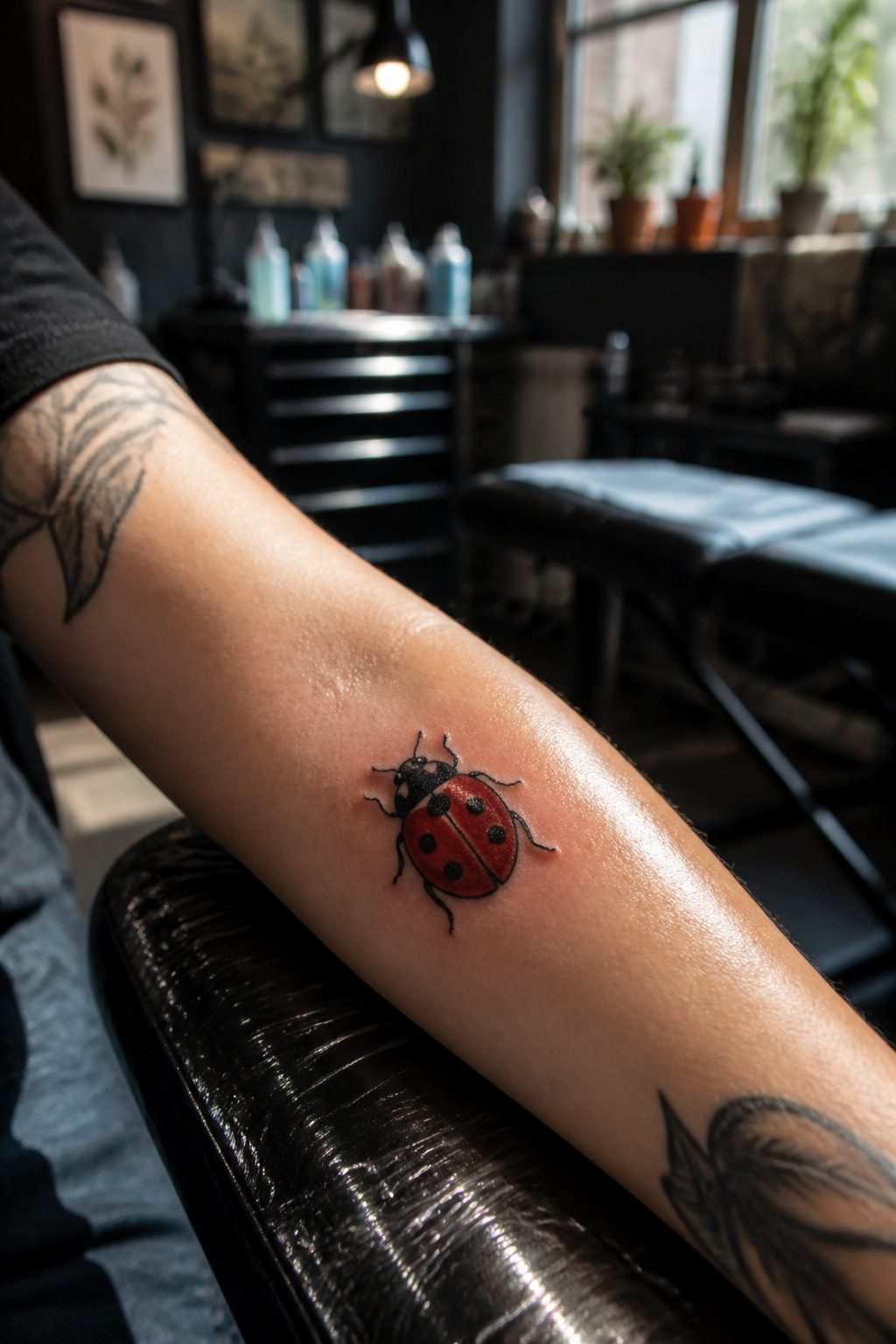
Traditional ladybug tattoos pull from the same visual language as American traditional work: saturated reds and solid blacks locked in by bold outlines.
That palette is not decorative. Red pigment in this style is formulated to stay dense rather than fading to pink, and the heavy black linework gives the shape immediate readability even at a distance or after years of sun.
The design usually keeps the beetle’s dome shape simple, though some artists mix in secondary colors for a slight gradient on the wing casings.
Faces or flowers sometimes appear beneath the wings, but the core appeal is the classic silhouette. This is the style most first-timers ask for when they walk in wanting a ladybug, and the reason is practical.
The bold lines and limited color count mean the tattoo holds its structure even if the wearer is not meticulous about sunscreen.
For someone who wants the image recognizable in ten years without touch-ups, that durability matters more than ornate detail.
2. Abstract Ladybug Tattoo
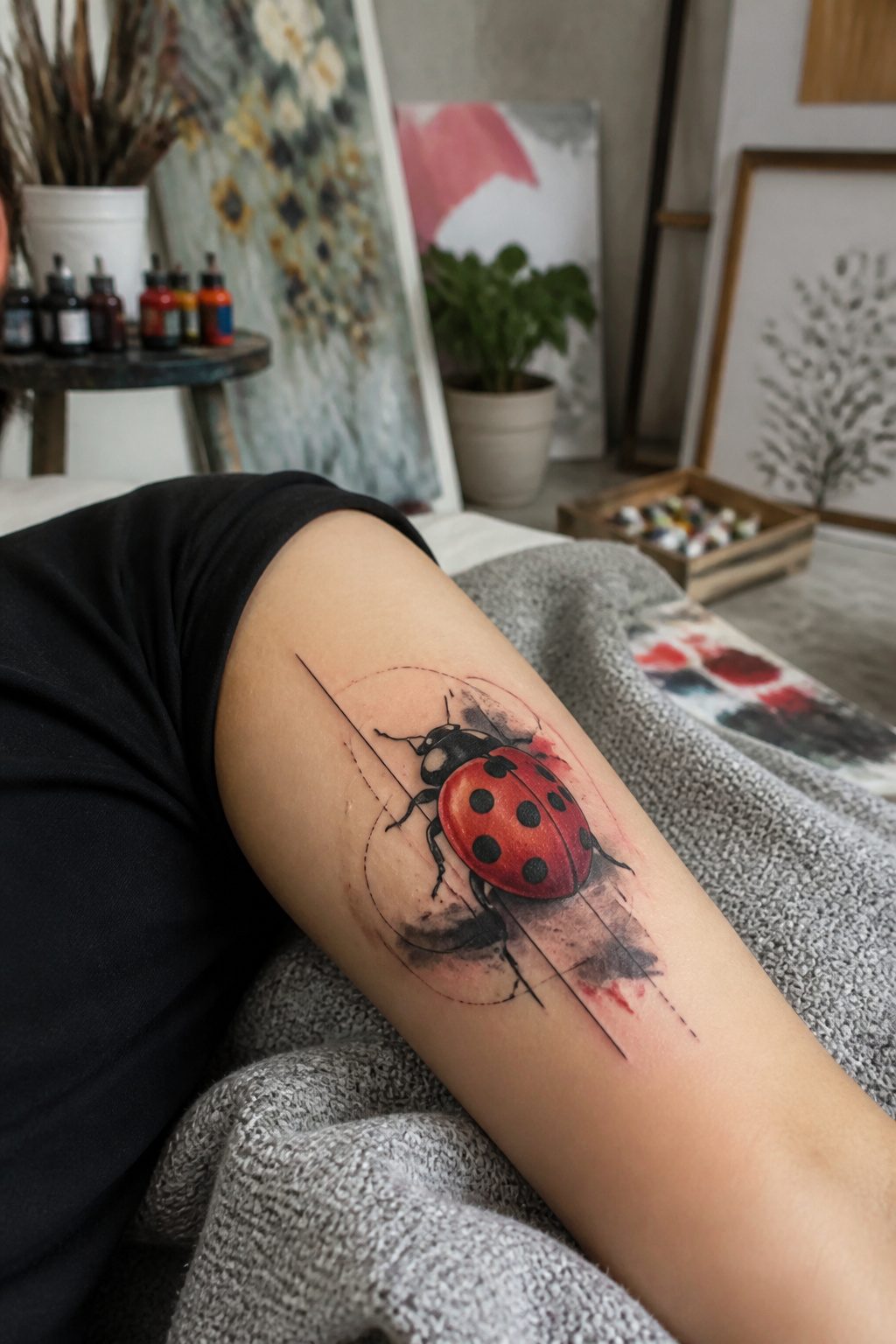
Abstract ladybug tattoos keep the bug’s familiar silhouette and the classic red-and-black palette intact, but the artist treats the surface as a field for interpretation rather than a specimen to copy.
Shadowing gets pushed further than nature allows, sometimes pooling into shapes that read more as ink study than insect anatomy.
Geometric elements might frame the shell or fracture across it; the background can dissolve into color fields that suggest garden or sky without pinning either down.
This style lands in a useful middle space. The symbol stays readable, so the luck and protection associations remain available to anyone who asks.
Yet the wearer isn’t walking around with a literal beetle parked on their shoulder. Shadowing and non-literal backgrounds do the work of personalizing the piece without abandoning the form that makes it a ladybug in the first place.
For someone who wants the meaning but flinches at the idea of a garden-variety bug tattoo, the abstract route offers a way to keep the shape and lose the sticker-book quality.
3. Realistic Ladybug Tattoo
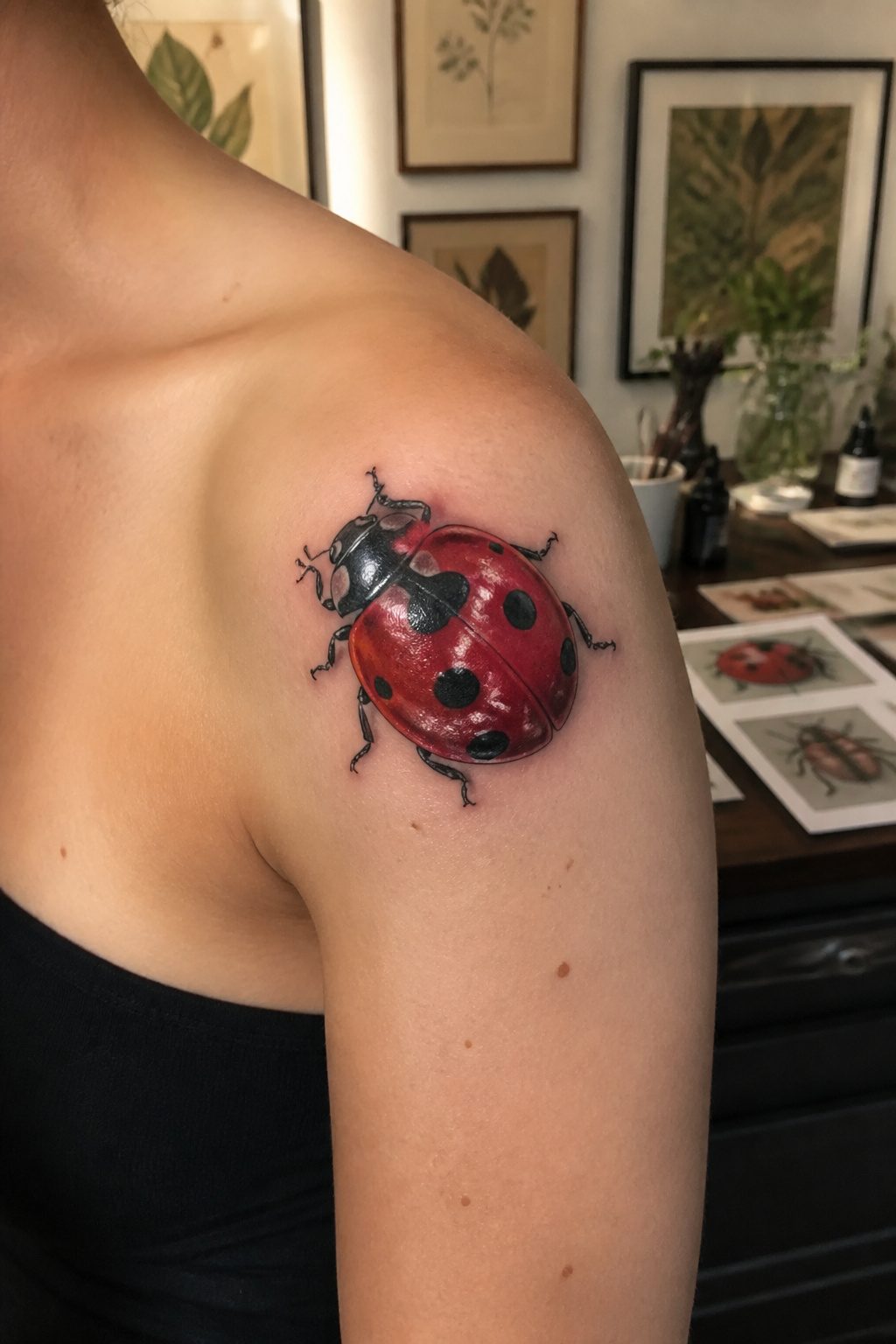
A realistic ladybug tattoo demands an artist who actually works in photorealism, not just one who says they can. The seven-spotted ladybug, Coccinella septempunctata, is the reference most people bring in, and getting those spots right matters.
The colors need fluid dynamic shading, not flat red and black, or the bug looks stickered on rather than settled into the skin.
Every segment of the elytra, the way light catches the dome, the thin margin where the wing covers meet, all of it gets inked with the same precision you’d need for a portrait.
Shadow work is what sells the illusion, and that is where less experienced artists usually flatten out.
The result, done well, can look startlingly like a live insect paused on the body. Done poorly, it reads as a blurry red oval with dots.
4. Watercolor Ladybug Tattoo
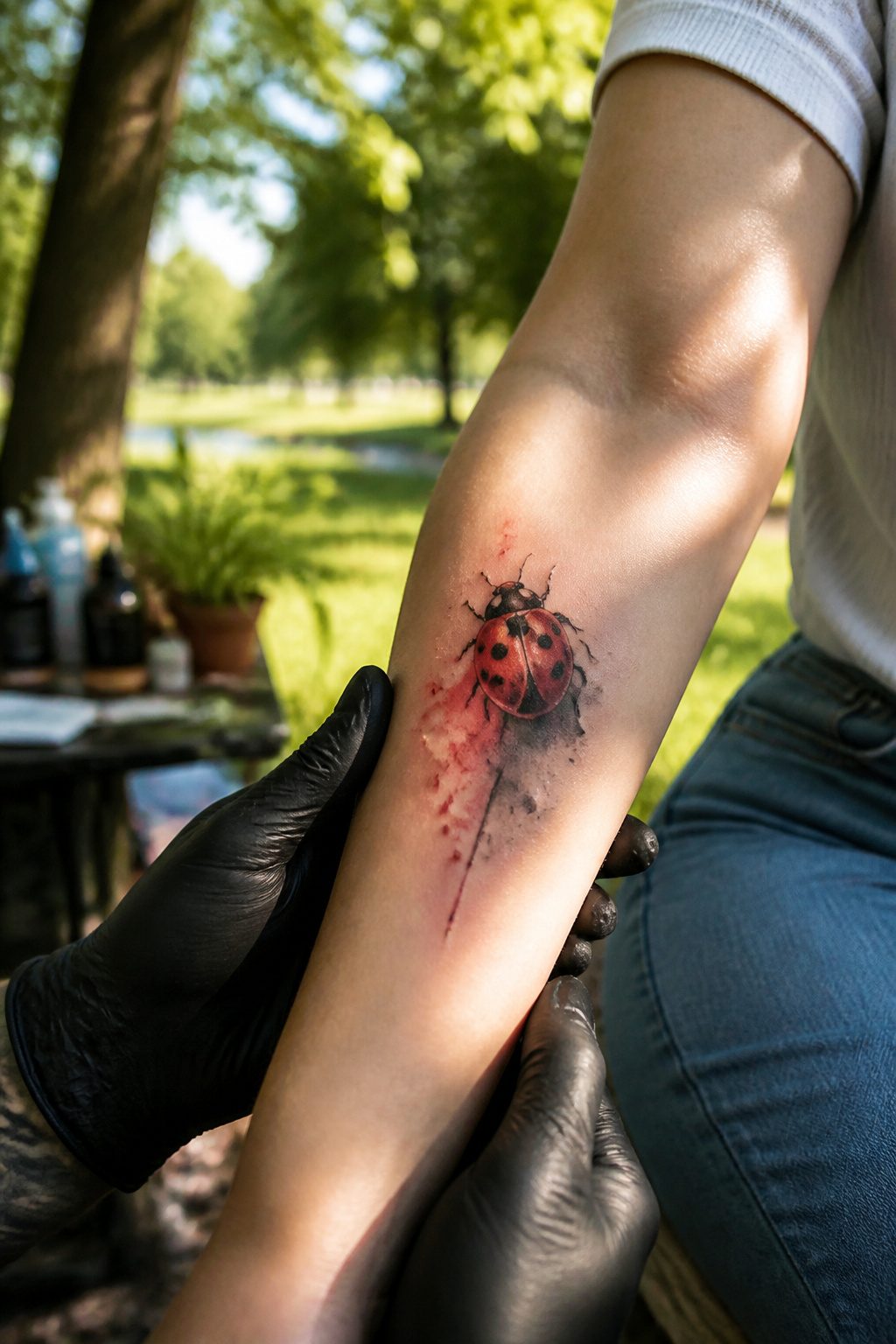
Watercolor technique lets a ladybug’s red shell bleed softly into the surrounding skin, the black spots dissolving like ink dropped into wet paper rather than sitting in crisp borders.
The palette almost carries itself: that particular scarlet and pitch black have enough natural contrast that the eye reads the shape even when the edges wander.
I have watched this style age on friends, and the truth is the color drops faster than traditional linework.
Reds especially seem to sun-fade or blur within a few years, so the piece that looked like a fresh brushstroke in 2023 may read more like a watercolor memory by 2028.
Placement matters for slowing that down. A spot that sees daily SPF and less friction, the inner forearm or a shoulder blade, keeps the saturation longer than a hand or ankle that takes constant abrasion.
The tradeoff is built into the choice: you get that living, painterly quality, but budget for a touch-up session if you want the original intensity to hold.
5. Ladybug on Flower Tattoo
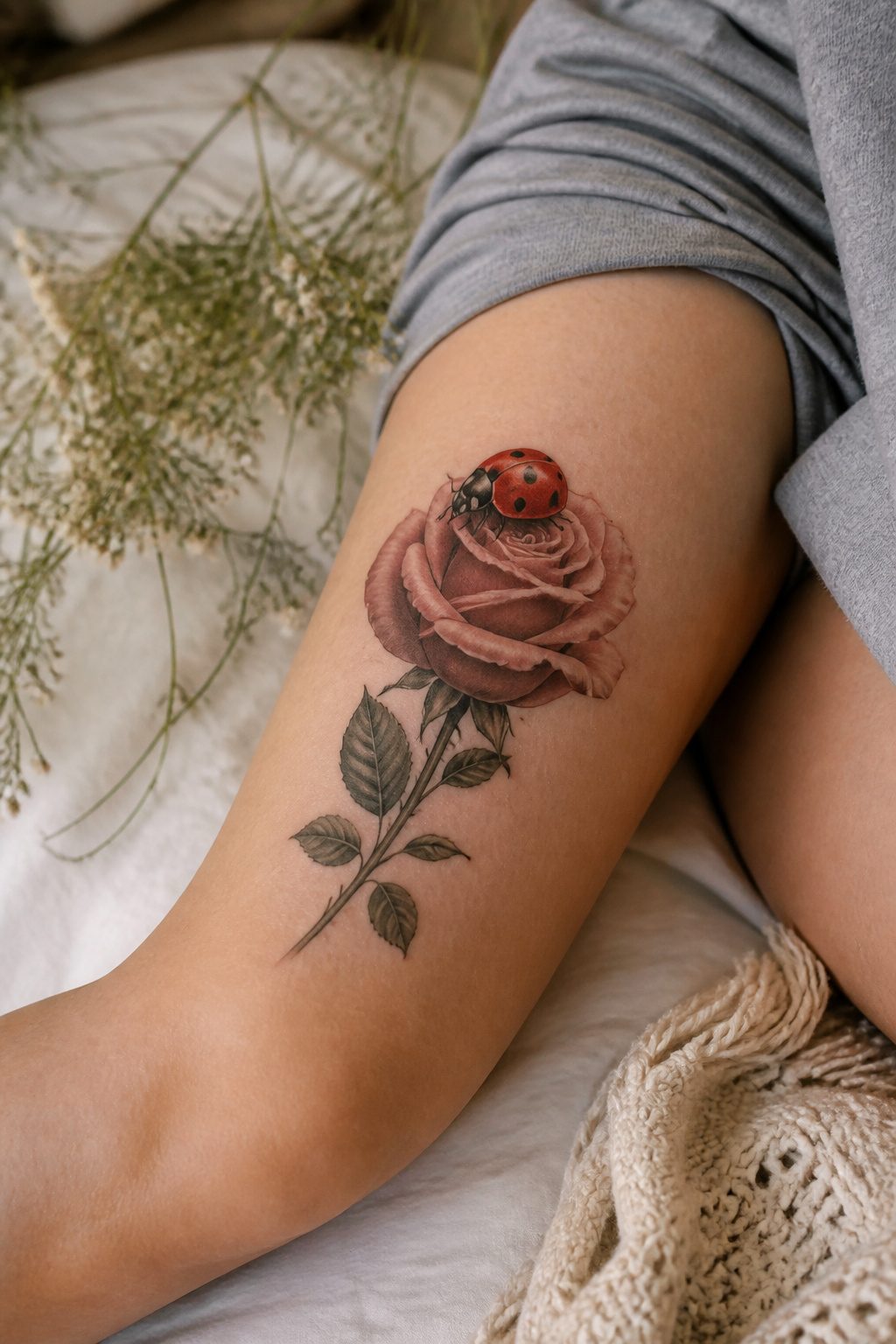
Ladybugs and flowers share a color harmony that makes them natural partners in a larger composition.
The red shell against green stems or soft petals gives the eye an immediate focal point, and the size difference lets an artist build real depth.
A ladybug perched on a rose reads as a small accent against layered petals, while the same insect on a daisy holds more visual weight because the flower itself stays simple and open.
One approach that works particularly well is keeping the flower in black-and-gray or muted tones and letting the ladybug carry the only red in the piece.
The contrast draws attention without the design feeling busy, and it opens up space for detail work on the petals that might otherwise compete.
Wildflower clusters offer another direction: the scattered, uneven spacing of poppies or cornflowers mirrors how ladybugs actually move through a garden, so the composition feels observed rather than arranged.
The scale gap matters for placement too.
A rose-and-ladybug design needs enough room for the bloom to read as a rose, which pushes it toward the shoulder or thigh, while a single daisy with a small ladybug can sit on a wrist or ankle without losing either element.
The ladybug should be the smallest readable detail, not shrunk so far that it becomes a red dot with no shape.
An artist can always add a second ladybug lower in the frame if the first one gets lost, using the pair to guide the eye through the flower’s structure.
6. Fine Line Ladybug Tattoo
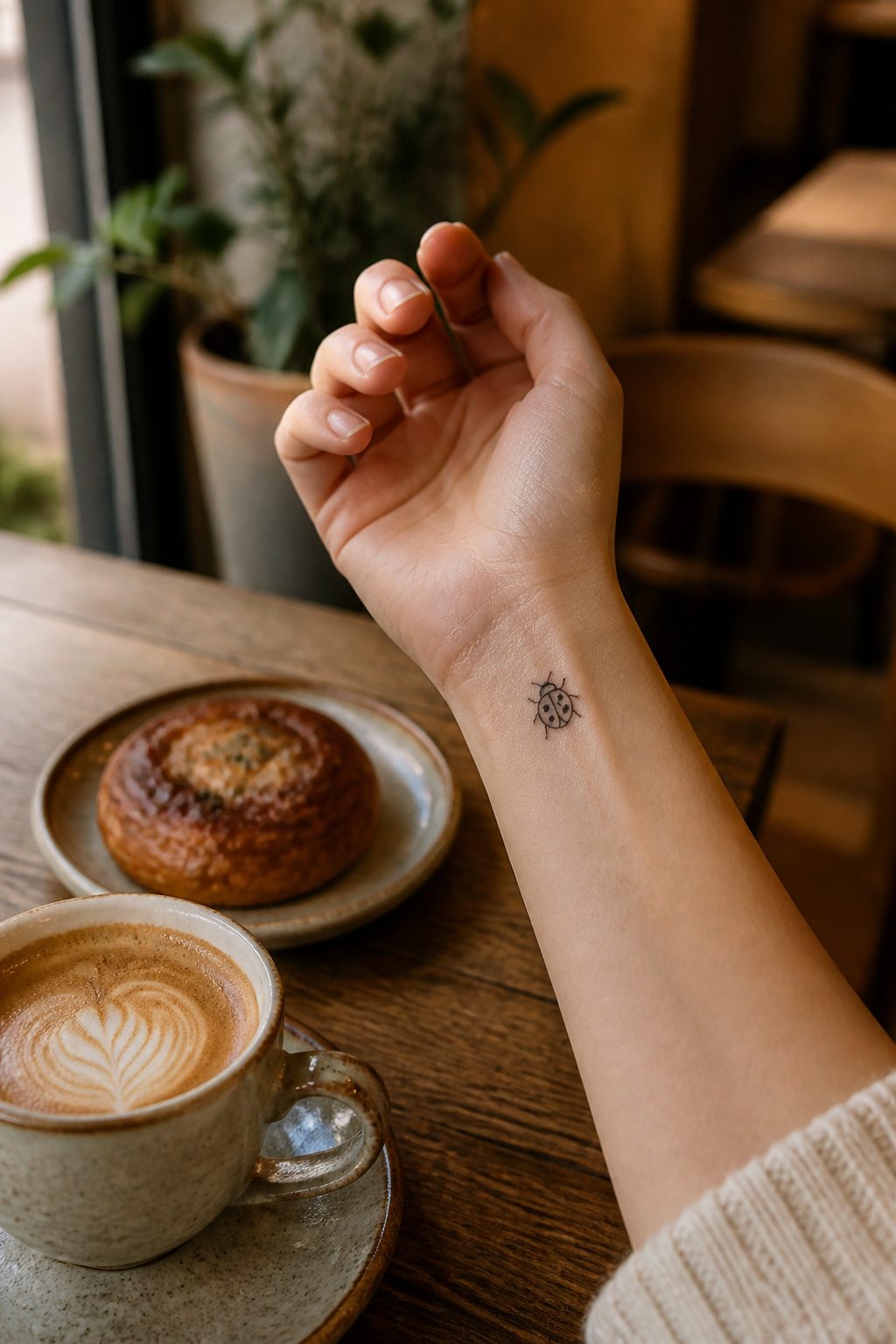
A fine line ladybug tattoo relies on single-needle work so thin it sits just under the skin, letting the outline itself do all the talking.
The black dots that make a ladybug recognizable still read clearly even at minimal scale, and the round shape keeps the creature cute without needing shading to sell it.
What draws people to this approach is how quietly it lives on the body: the line blends into the surrounding skin tone rather than riding on top of it like bolder traditional pieces.
Smaller placements suit this style best. A wrist, ankle, or behind-the-ear spot gives the design room to breathe without demanding detail the needle cannot deliver at that size.
The tradeoff is in aging. Bold outlines hold their ground against sun and time; hair-thin lines soften faster, spreading slightly or fading to a whisper.
Touch-ups matter more here, and the artist’s hand matters more too, since a wobble in a single-needle line shows instantly where a thicker stroke would hide it.
7. Cartoon Ladybug Tattoo
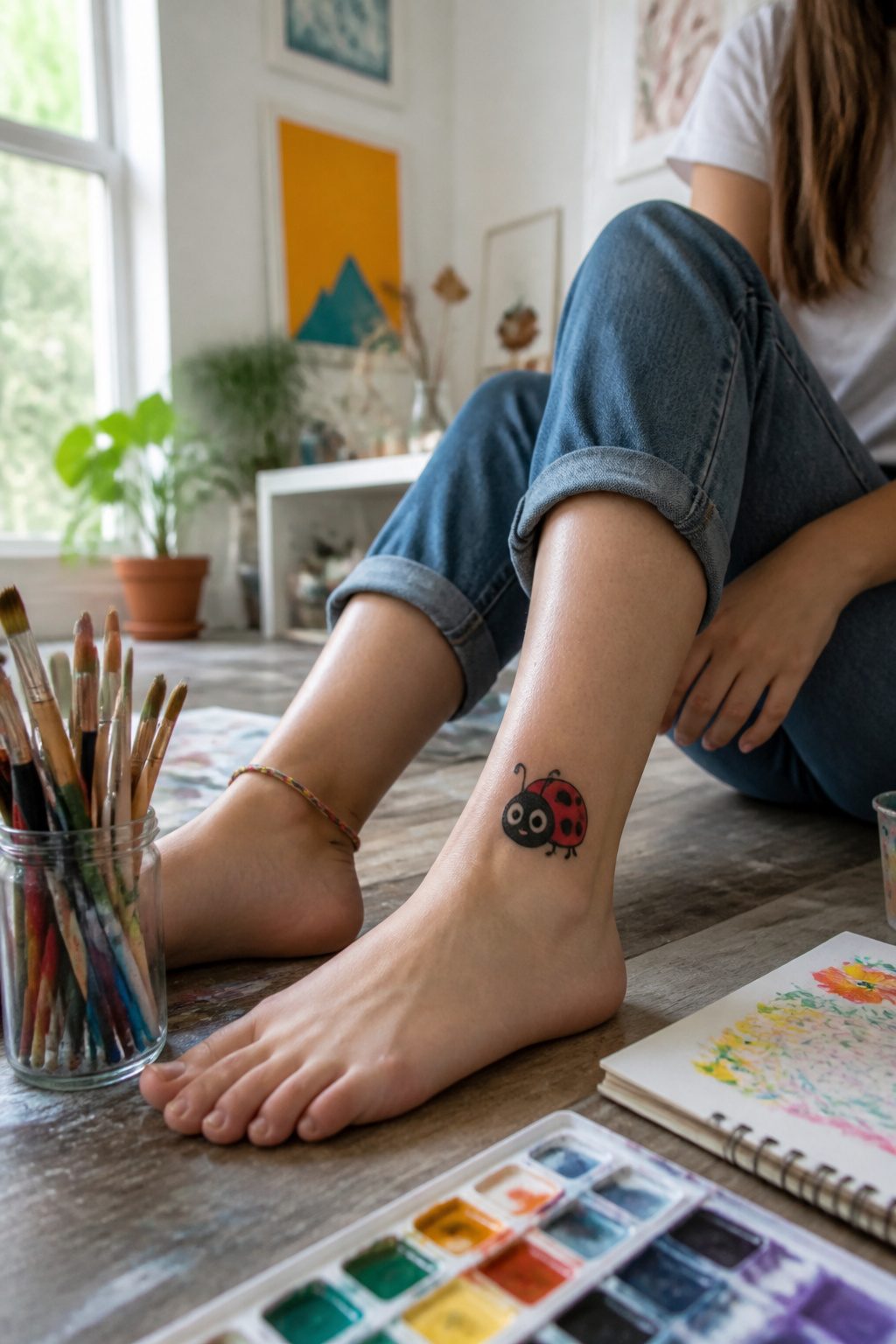
Cartoon ladybug tattoos pull straight from the nursery books and Saturday morning animation that shaped early memories. The style leans into oversized, teary eyes and rounded shells, sometimes dotted with tiny hearts or love symbols instead of the usual spots.
That bubble-shaped cuteness is the whole point; the design works because it does not try to look grown up.
Most people who choose this route are marking something specific from childhood, a character they once carried everywhere on a backpack, or a grandmother who called every ladybug lucky.
The format gives the artist room to push personality hard: grumpy eyebrows, wings mid-flap, a shell patterned like a watermelon slice. A cartoon rendering lets the bug carry human expression without looking strange, which a realistic style cannot manage.
The linework tends to stay bold and the color palette flat and bright, so the tattoo keeps its readability even at smaller sizes. Placement on the wrist, ankle, or just above the elbow crease suits the compact shape.
A good artist in this style should show you a sketchbook full of expressive faces, not just technical precision; you want someone who draws emotion first and anatomy second.
8. Ladybug and Butterfly Tattoo
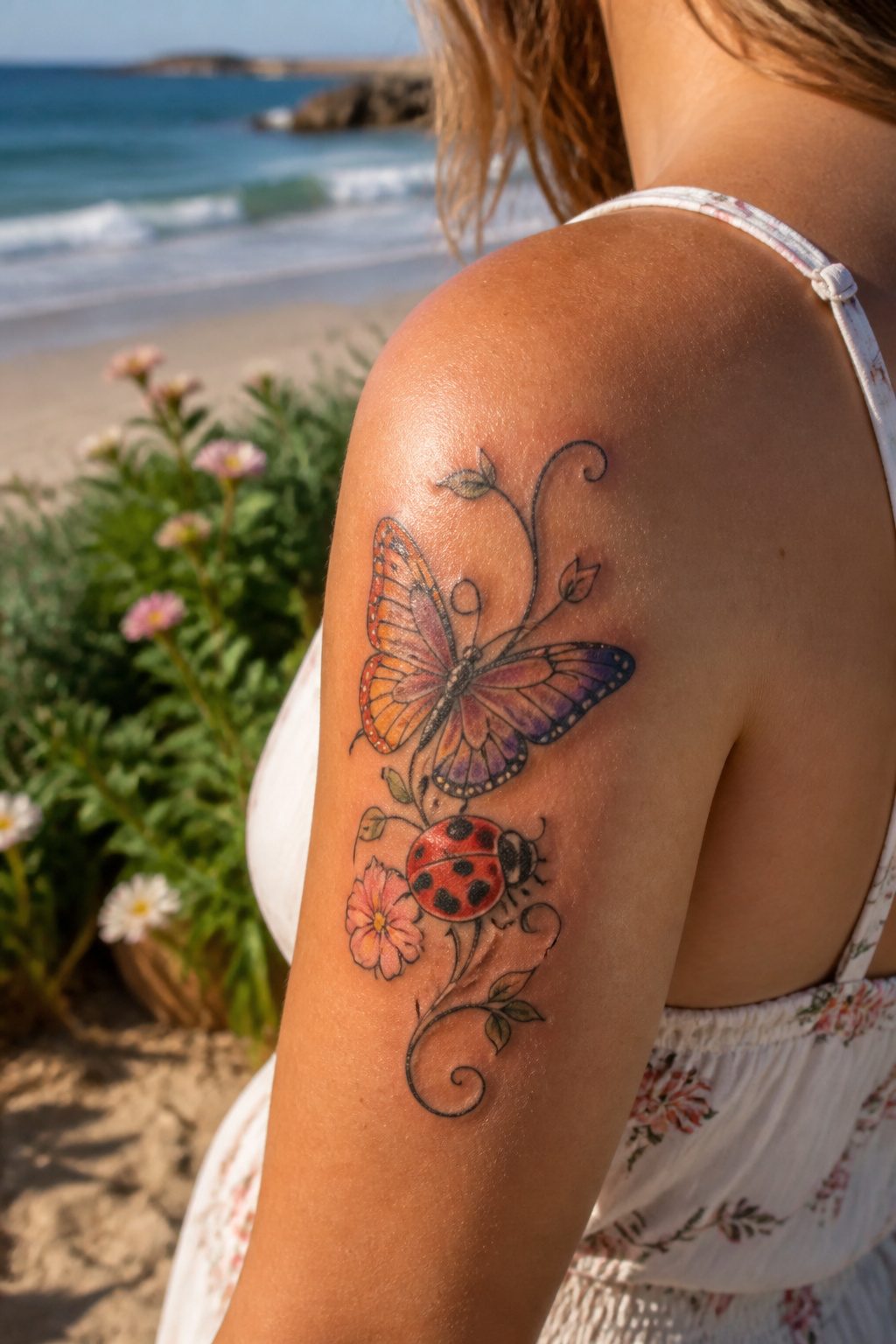
Pairing a ladybug with a butterfly carries weight because both insects undergo complete metamorphosis, that full-body rebuild from larva to winged adult. The symbolism lands harder when the biology is real rather than decorative.
A straight-line layout between the two can mark ambition or a journey through transformation, the visual push from one form to the next mirroring a period of actual change in the wearer’s life.
The ladybug’s obsidian shell dots read almost as natural jewelry against the butterfly’s broader wings, giving the design a feminine balance without tipping into ornament for its own sake.
Someone choosing this combination is usually marking something specific: a career pivot, a recovery, a relocation, a self that got rebuilt.
The tattoo works best when the placement allows that line of travel, shoulder toward hip or wrist toward elbow, so the eye follows the same direction the insects took in nature.
9. Ladybug on Leaf Tattoo
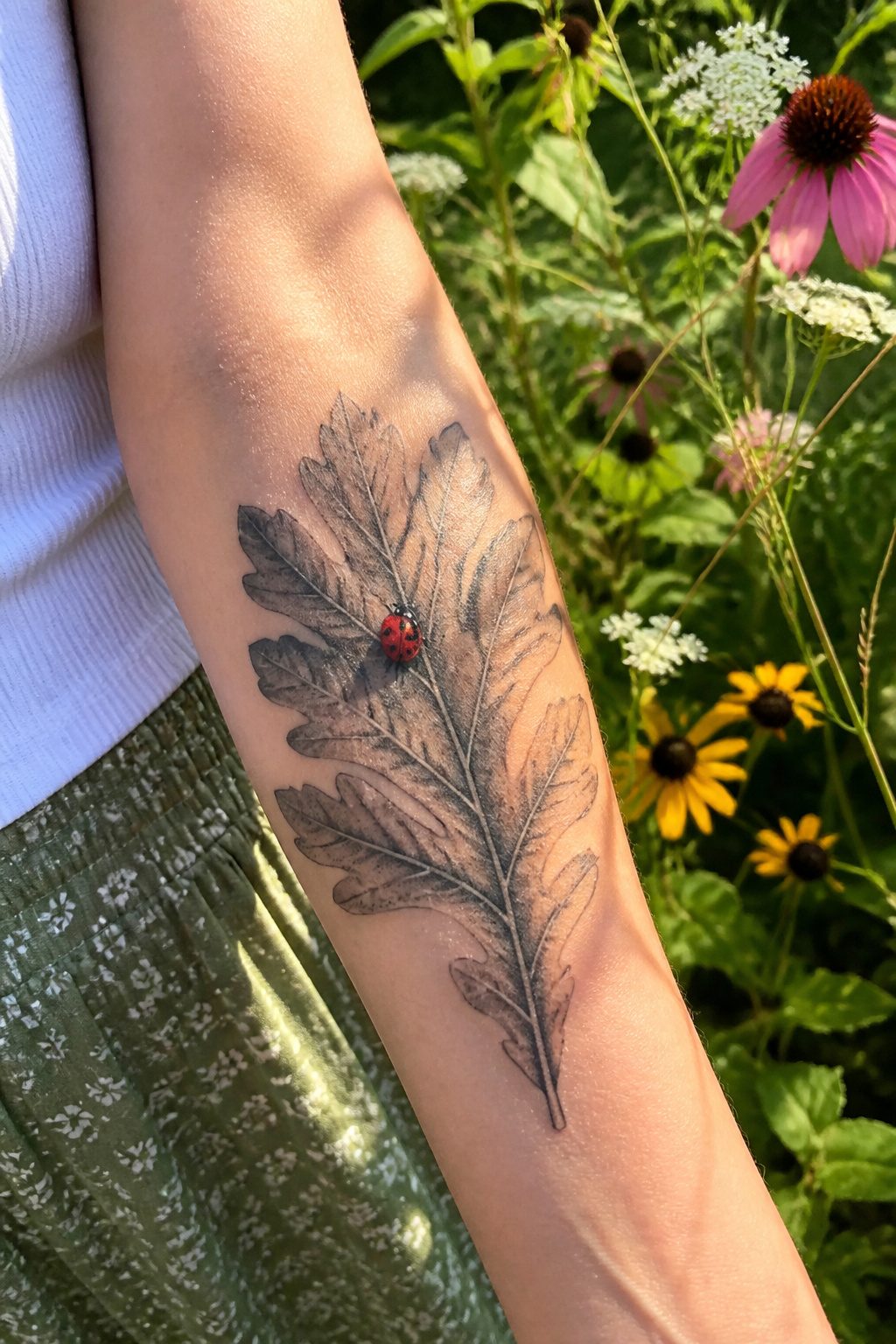
A ladybug resting on a leaf anchors the design in something real rather than symbolic. The pairing emphasizes the insect’s actual work in gardens, where it patrols foliage for aphids and other pests.
That ecological role gives the tattoo a layer of meaning beyond luck or charm; it speaks to natural balance and the small, specific jobs that keep a garden healthy.
Scaling this design from a two-inch wrist piece to a full sleeve depends on how much of the leaf you include.
A single veined leaf with the beetle near the edge reads as delicate and self-contained. Multiple leaves curling around an arm, perhaps with stems trailing toward the shoulder, build into something more immersive without losing the grounded, botanical feel.
The leaf’s veins and natural asymmetry give the artist structure to work with, so the composition holds together at any size.
10. Dainty Ladybug Tattoo
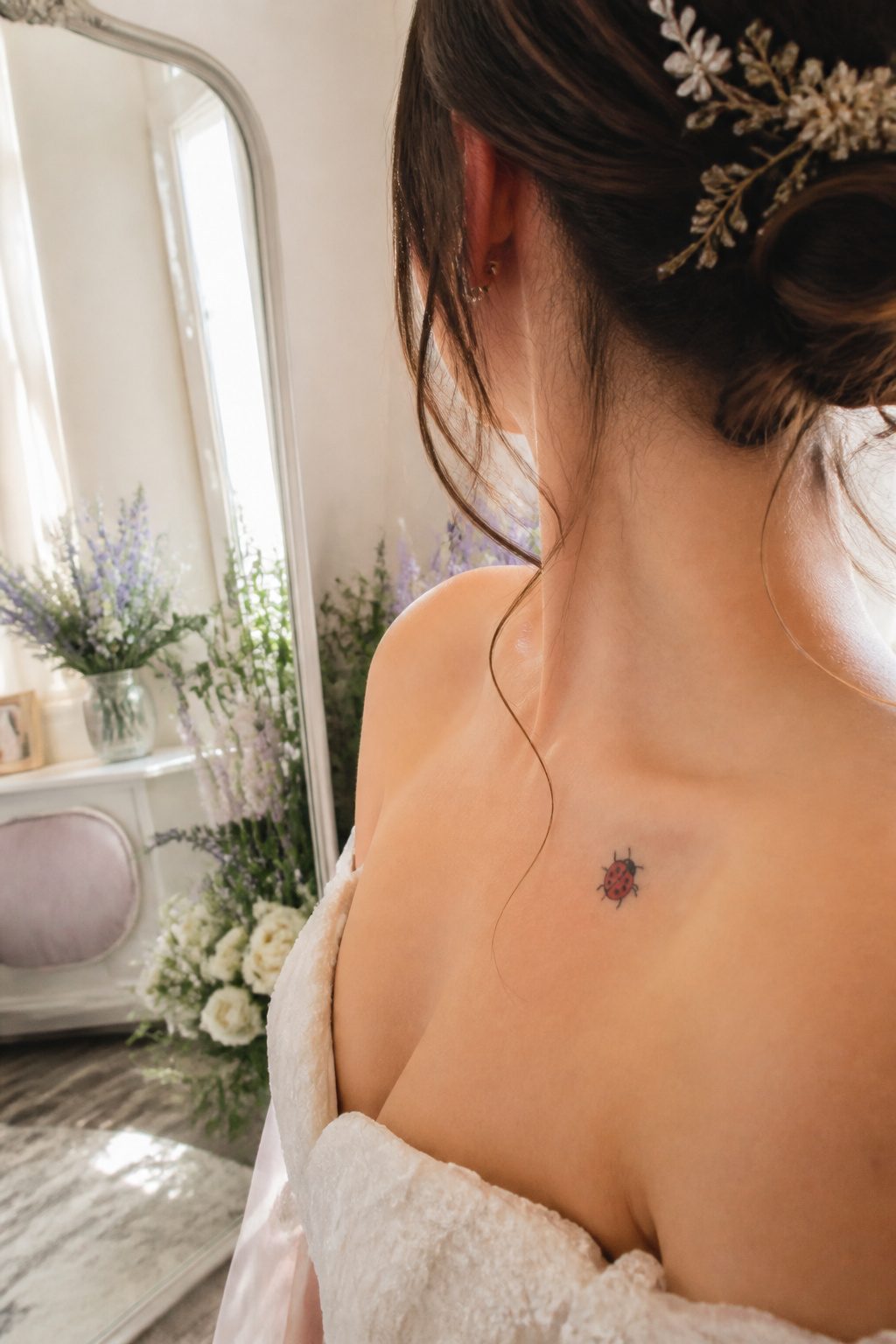
A dainty ladybug tattoo keeps the insect at its actual scale, which makes the design read as delicate rather than shrunken.
Fine lines and minimal dotwork suit fingers, wrists, the collarbone, or behind the ear, places where a larger piece would crowd the bone or distort with movement.
The coloration stays soft, a muted red rather than saturated, so the blush reads like something that just landed there.
These placements draw people who want minimal visibility or are still testing whether tattooing fits their routine. A finger placement almost turns the ladybug into something you carry, the way you might notice a real one paused on your hand.
The tattoo needs a light hand, though. Heavy ink in these spots ages poorly, and the fine brushstrokes that make the dainty style work are the first to blur if the artist pushes too deep.
11. Ladybug Mandala Tattoo
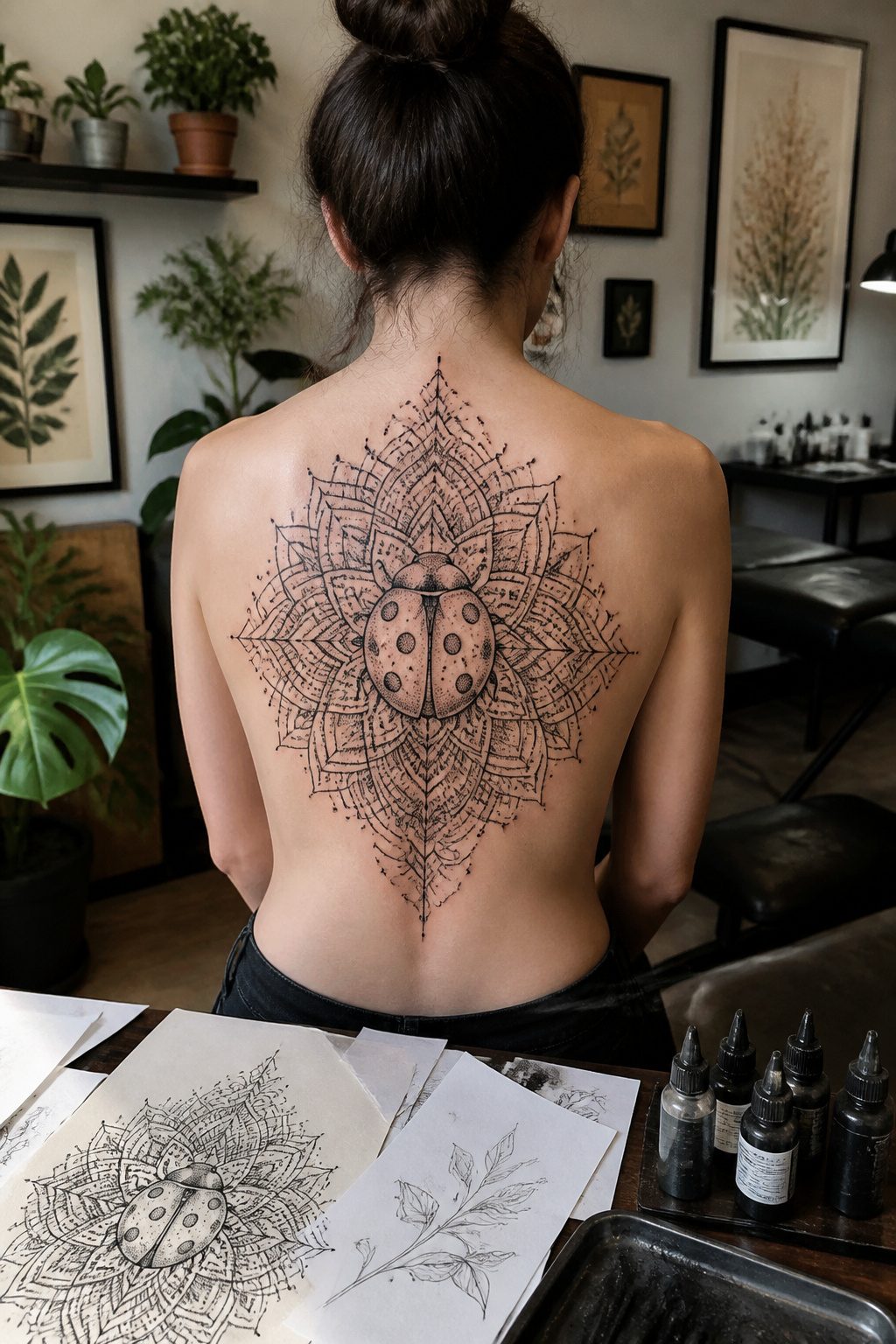
A ladybug’s dome-shaped shell already carries a natural symmetry that lends itself to mandala work. The circular body sits at the center while geometric patterns radiate outward, turning the insect into a living hub of repeating shapes.
This style demands patience from both artist and client. Sessions run long, and the thigh, back, or upper arm give the space needed for clean linework to breathe.
Smaller placements compress the detail into a blur. I have watched designs lose their precision when squeezed onto a wrist or ankle; the petals and dots merge into noise instead of pattern.
Color stays optional. Some of the strongest pieces keep the mandala in black ink and let the ladybug’s red shell provide the single accent.
Others weave the red through the geometry itself. Either way, the result reads as deliberate rather than decorative, a tattoo that feels closer to textile or architecture than to nature illustration.
12. Ladybug Tattoo Behind the Ear

A ladybug tattoo behind the ear works best when you want control over who sees it.
Hair down keeps it hidden for client meetings or conservative offices; a quick tuck behind the ear turns it into something only closer friends notice. That same small, curved space limits what an artist can render cleanly.
Intricate shading or multiple ladybugs crowded together tend to blur within a few years as the skin there moves constantly with jaw motion and heals unevenly from the start.
Simpler designs win here: a single ladybug with clean black outline, minimal red fill, perhaps just the classic dome shape and a few dots. What convinced me, looking through portfolios, was how the best examples all shared that restraint.
The placement has become common enough among people in professional settings that most reputable artists now price it as a standard small piece rather than a tricky custom job, though you will still pay for the precision the spot demands.
What Ladybug Tattoos Mean
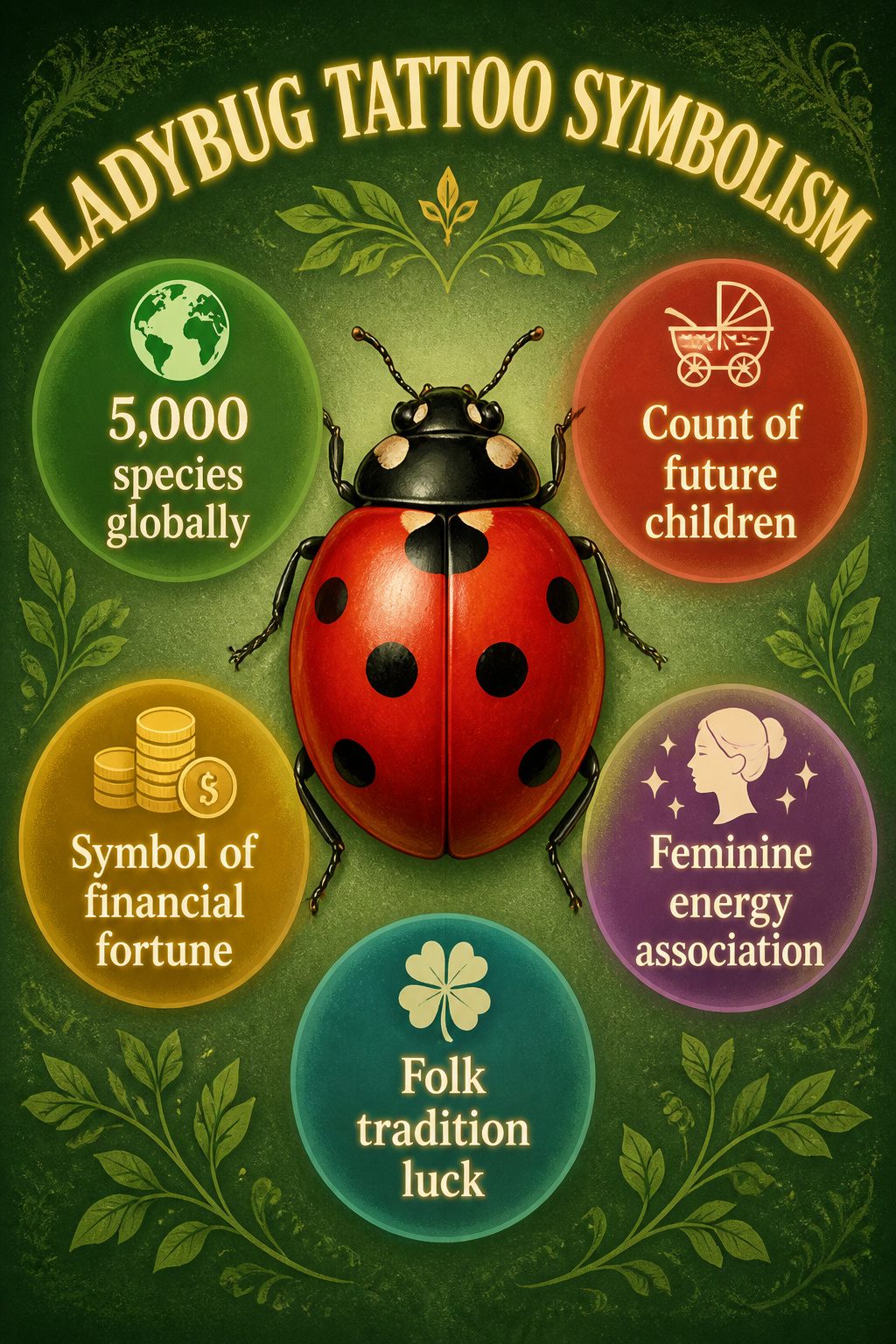
Ladybugs carry more weight than their size suggests. At 0.8 to 18 mm, beetles in the family Coccinellidae number roughly 5,000 species worldwide, yet the seven-spotted ladybug, Coccinellidae septempunctata, dominates both gardens and tattoo flash sheets.
Those seven spots hold specific folk meaning: some read them as a count of future children, others as a marker of financial fortune you might accrue across a lifetime. The interpretation stays personal.
There are a staggering 5,000 different species of ladybugs found worldwide.
That variety matters when you choose a design. The common red shell with black dots reads instantly as luck and protection, a belief that traces back to European folk tradition where a landing ladybug signaled blessings and growth.
Artists also associate the beetle with feminine energy, pointing to its flight pattern and rounded form as quieter symbols of womanhood than louder tattoo motifs.
Less known is the old matchmaker belief: a ladybug crawling on a young woman’s hand supposedly measured the time until a suitor arrived by counting spots.
Whether you buy the folklore or not, the layers give a small tattoo room to mean something specific rather than generic cute.
Where to Place a Ladybug Tattoo
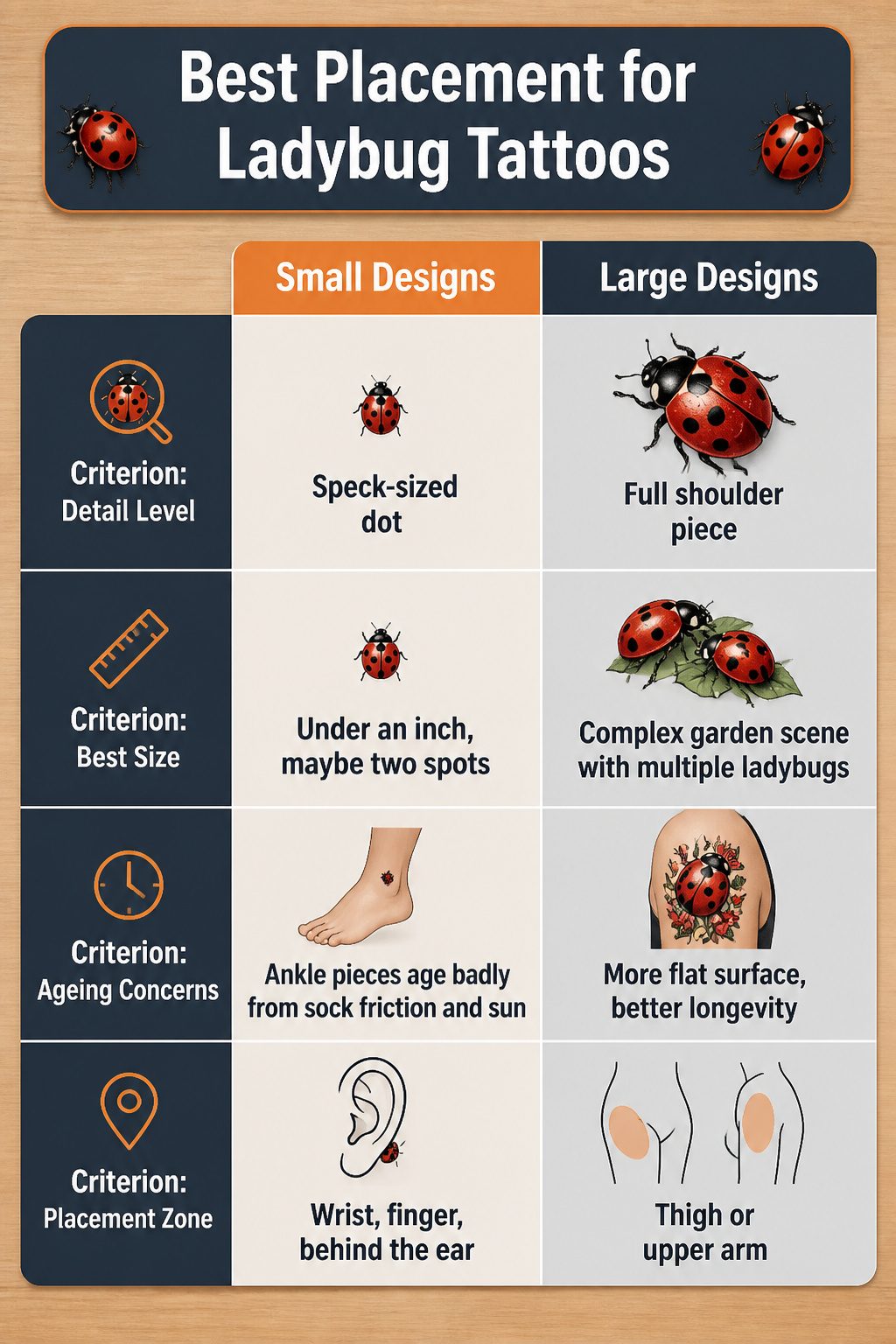
Ladybugs scale better than almost any subject in tattooing.
A speck-sized dot behind the ear still reads instantly as a ladybug because the silhouette is that recognizable, while a full shoulder piece gives an artist room for every wing vein and dewdrop.
The detail level has to match the real estate or the tattoo blurs into a red blob inside six months.
A wrist or finger placement works when the design stays under an inch, maybe two spots and a simple black outline, nothing more.
Behind the ear, the curve of the skull does half the work; the bug looks like it just landed.
Ankle and shoulder offer more flat surface for shading and small surrounding leaves, though I have seen ankle pieces age badly from sock friction and sun.
For a complex garden scene with multiple ladybugs, flowers, and background color, the thigh or upper arm is the only place with enough uninterrupted skin.
The mistake is choosing a tiny spot for a detailed design and watching the artist cram in lines that will bleed together by year two.
Picking an Artist for Your Ladybug Tattoo
A ladybug’s bright red shell looks simple until you try to ink it.
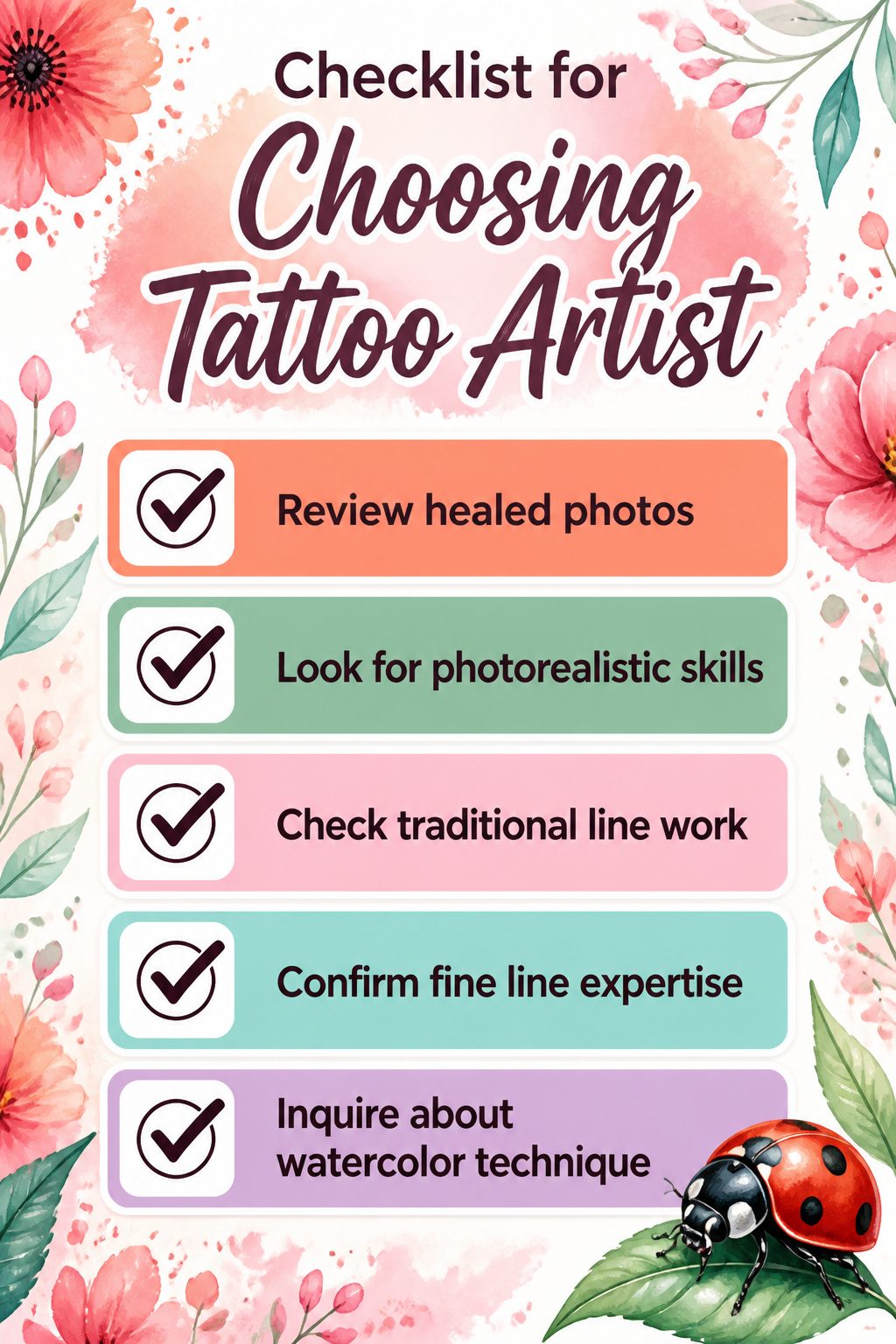
Photorealistic work demands an artist who builds depth through layered saturation, while traditional bold lines need someone who can hold a clean black outline without the red bleeding inward.
Fine line single-needle artists face the opposite problem: keeping those delicate spots from disappearing entirely as the skin heals.
Watercolor technique, meanwhile, lives or dies on how the artist handles pigment density, since red washes fade faster than blue or green.
Healed photos matter more than fresh work for lady bug tattoos. Red pigment scatters under skin differently than black, and that crisp shell can turn muddy within a year if the artist pushed too hard or too shallow.
Ask to see a ladybug or similar small red piece at six months minimum, not the flash photo taken under studio lights.
What convinced me, reading through a dozen portfolios, was the gap between the same artist’s fresh and healed reds: some held that poppy brightness, others dulled to rust.
The ones that lasted came from artists who talked about needle depth and saturation passes like a mechanic talks about torque specs. If they dodge the question, keep looking.
Frequently Asked Questions
Are ladybug tattoos lucky?
Yes. Ladybug tattoos are widely considered symbols of good luck, with roots in European folk tradition where a landing ladybug signaled blessings and growth.
Many people get the tattoo specifically to attract positivity and protection. The belief is old enough that it still shapes why first-timers ask for the design.
What do 7 dots mean in a ladybug tattoo?
The seven spots on a classic ladybug shell carry two main folk interpretations.
Some read them as a count of future children, while others take them as a marker of financial fortune across a lifetime. The meaning stays personal, and the article notes you can layer your own interpretation onto the traditional count.