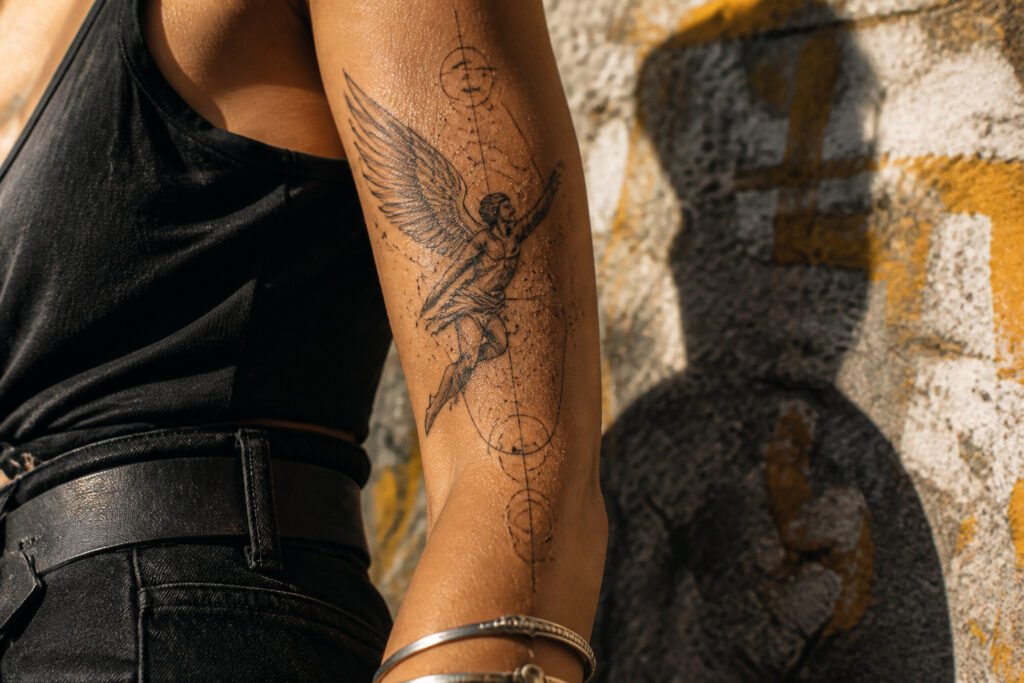
The right icarus tattoos balance the myth’s weight against the style that will carry it on your skin for decades. Blackwork ages cleaner than fine detail under sun, but fine line fire breathes where bold black would collapse into shapeless mass. Geometric frameworks turn a single fall into orbital time; a balance scale, hung above the figure, lets the eye read judgment before it reads story. What changes the choice is how much disorder you want the piece to admit.
1. Blackwork Icarus Sword Fall Tattoo
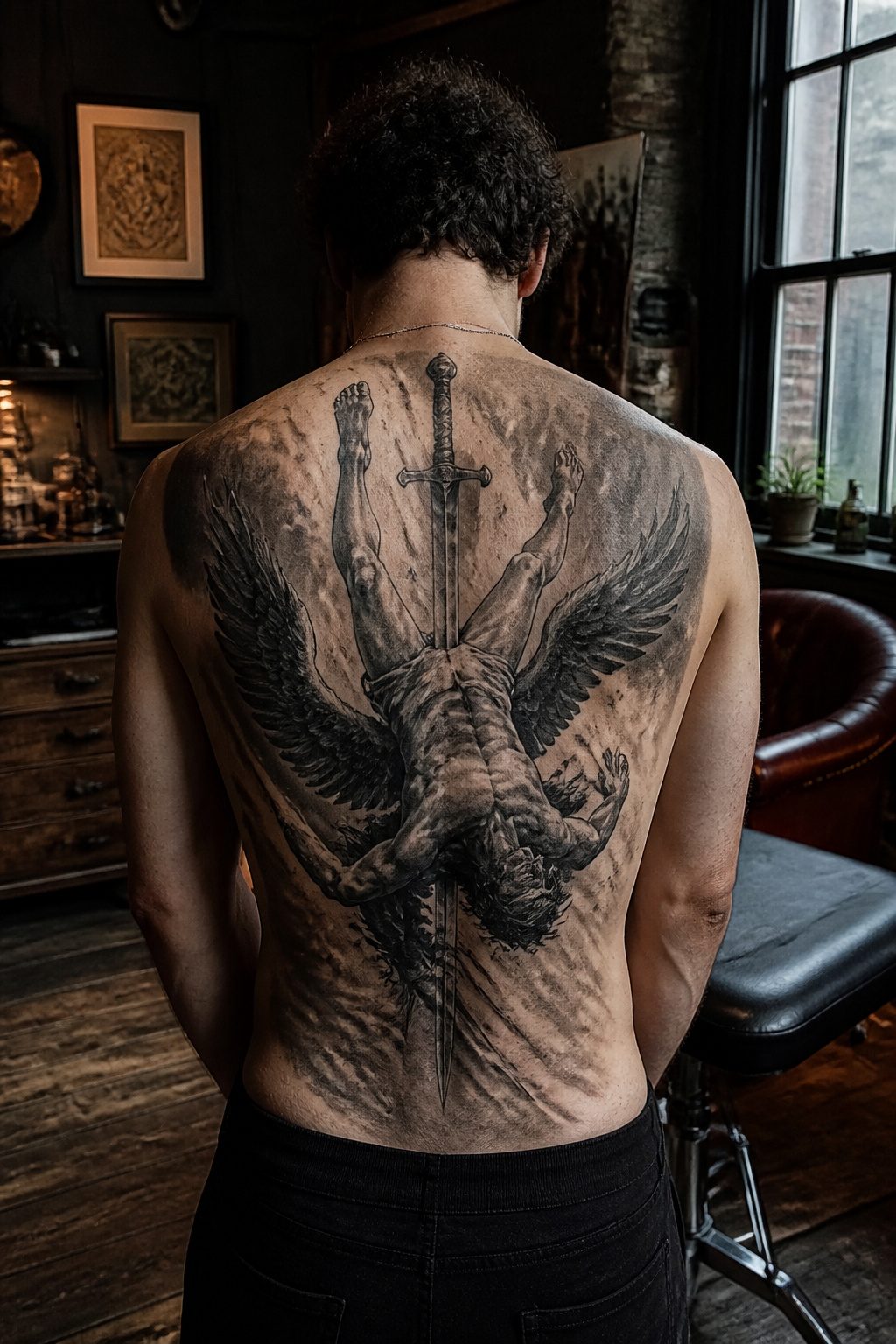
The sword changes everything about this fall. In the classic telling, Icarus drops because the wax melts, a boy undone by physics and impatience. Add a blade running through the composition, and the descent becomes something he walks into, not something that happens to him. The blackwork shading, heavy on black and grey, sculpts the figure into something that reads less like an accident and more like a ritual.
I kept returning to the way the blade recontextualizes the myth. Without it, the image warns against reaching too high. With it, the fall reads as chosen consequence, maybe even sacrifice. The strong shading gives the piece a frozen quality, like a still from a tragedy already concluded rather than a moment caught mid-flutter. That sculptural treatment matters for longevity; solid black and grey ages cleaner than fine detail that blurs after a few years of sun.
The blade turns hubris into fate, and that shift carries weight for anyone who wants the tattoo to say something about deliberate risk rather than youthful mistake. The design works best at a scale where the sword can dominate without crowding the figure, letting the two elements argue with each other across the skin.
2. Geometric Icarus Falling Shin Tattoo
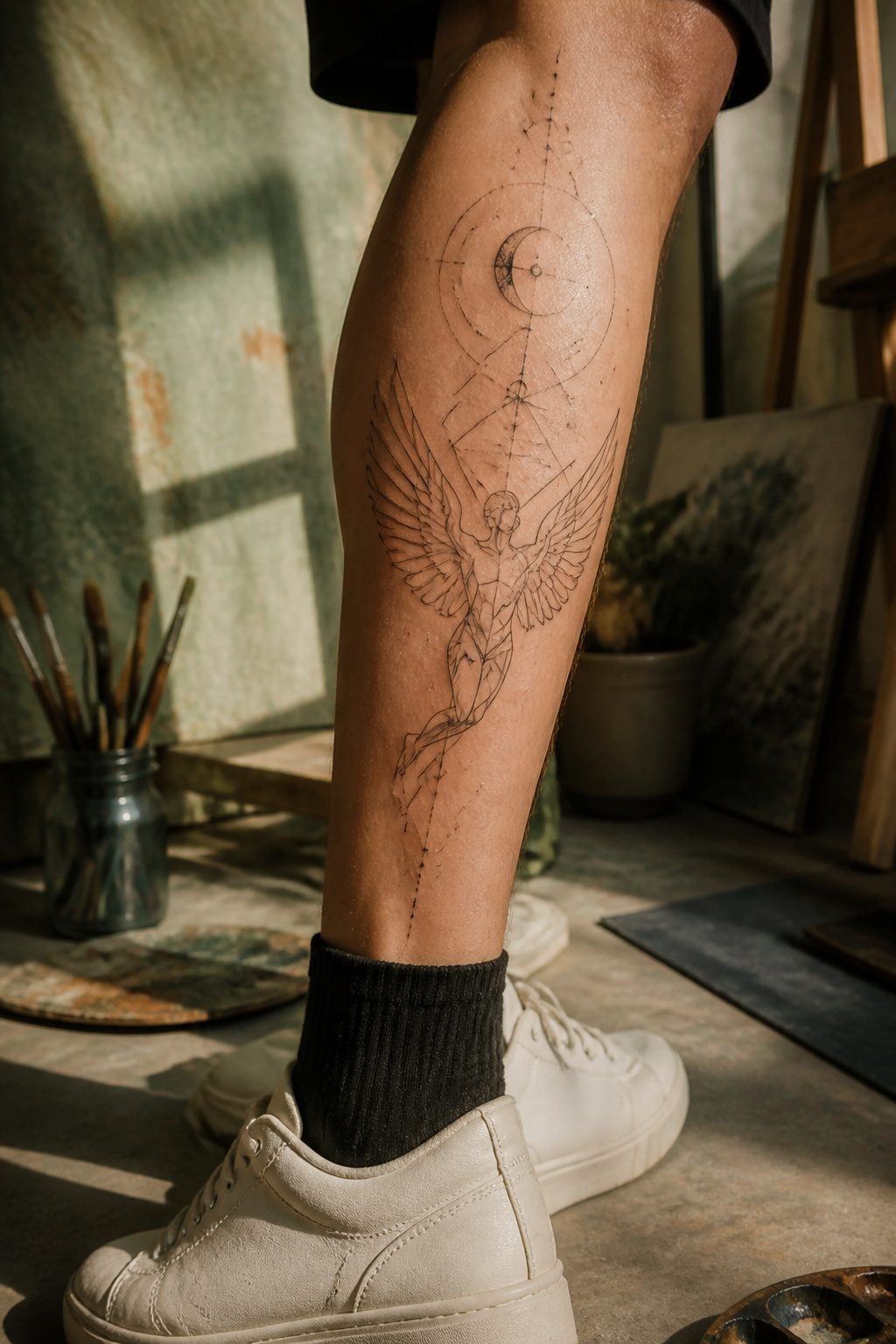
A geometric Icarus falling shin tattoo works because the bone itself becomes part of the story. The tibia’s straight edge gives the vertical fall a natural track, so the descent reads downward the way gravity actually pulls. Above the figure, a framework of lines and lunar phases sets up rigid celestial order against the chaos of the body tumbling through it. That tension is the whole point: the grid suggests fate or cosmic structure, while Icarus twists through it in a spiral no geometry can contain. The shin placement means the design stays visible in shorts or skirts but hides under work trousers, which suits the 35–54 reader who checks ingredient lists and prefers proof over promise. She will notice that the contrast between clean linework and organic motion gives the piece intellectual weight without needing to explain itself. What convinced me, looking through how these are built, is that the lunar phases above the frame do more than decorate; they mark time passing, which turns the fall from a single moment into a slow-motion story.
3. Illustrative Graffiti Icarus Crown Tattoo
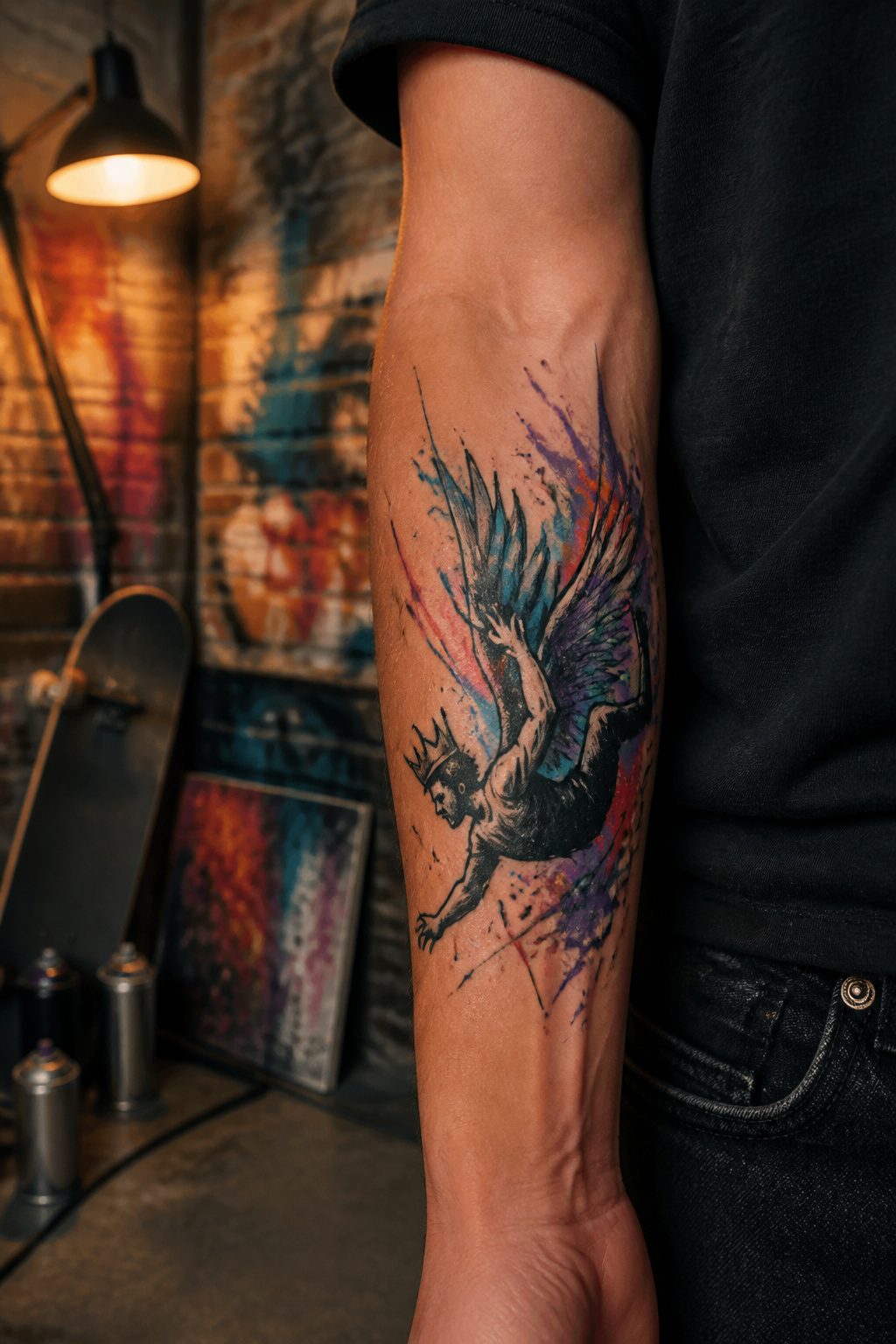
A floating crown hovering above Icarus as he drops changes the entire meaning of the story. Instead of a boy punished for innocent overreach, the image reads as a figure who reached for status itself and lost everything in the attempt. The crown becomes the prize that was never truly his, and the fall lands harder for it.
The graffiti illustration style keeps this from feeling like a museum piece. Simplified wings and sketch-like outlines give the design a raw, contemporary energy; the lines look drawn fast, almost tagged rather than rendered. Negative space does most of the work, so the symbolism carries without clutter. That restraint matters with a concept this loaded. Too much detail would turn the crown into costume jewelry and the fall into melodrama. The minimal treatment lets the pride read as personal, not theatrical.
For placement, the spare composition adapts well to an arm or a calf where the falling motion can stretch naturally. The crown sits high enough to draw the eye upward first, so the downward pull registers as a surprise. That small visual trick reinforces the narrative: ambition looked reasonable until it did not.
4. Fine Line Icarus Feather Fall Tattoo
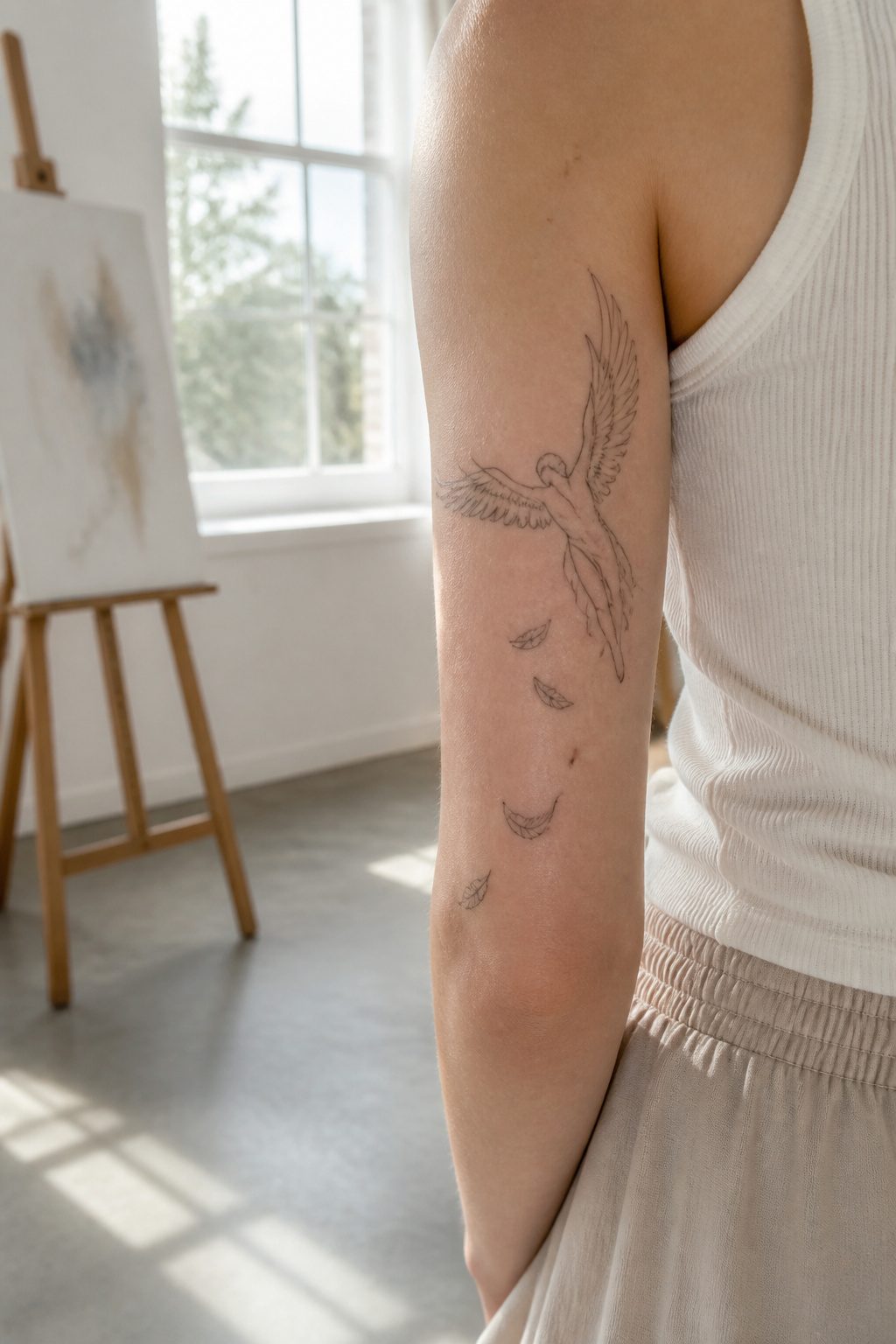
A few drifting feathers carry more weight than full wings when the story is collapse. The composition keeps only what is necessary: soft, flowing shapes that drift away from the body rather than anchor it. Fine line work serves this lightness by refusing to crowd the skin. Each feather gets a single clean stroke, no doubling back for emphasis, so the eye reads air between the marks.
The body itself hangs in helpless position, and that contrast is what makes the fall feel poetic rather than violent. The airy composition lets the viewer feel the moment just before complete collapse, when movement is still graceful. What convinced me, looking through dozens of these, is how much the spareness asks of the artist. One wavering line and the weightlessness breaks into error. The discipline is in what gets left out.
5. Black and Grey Icarus Sun Tattoo
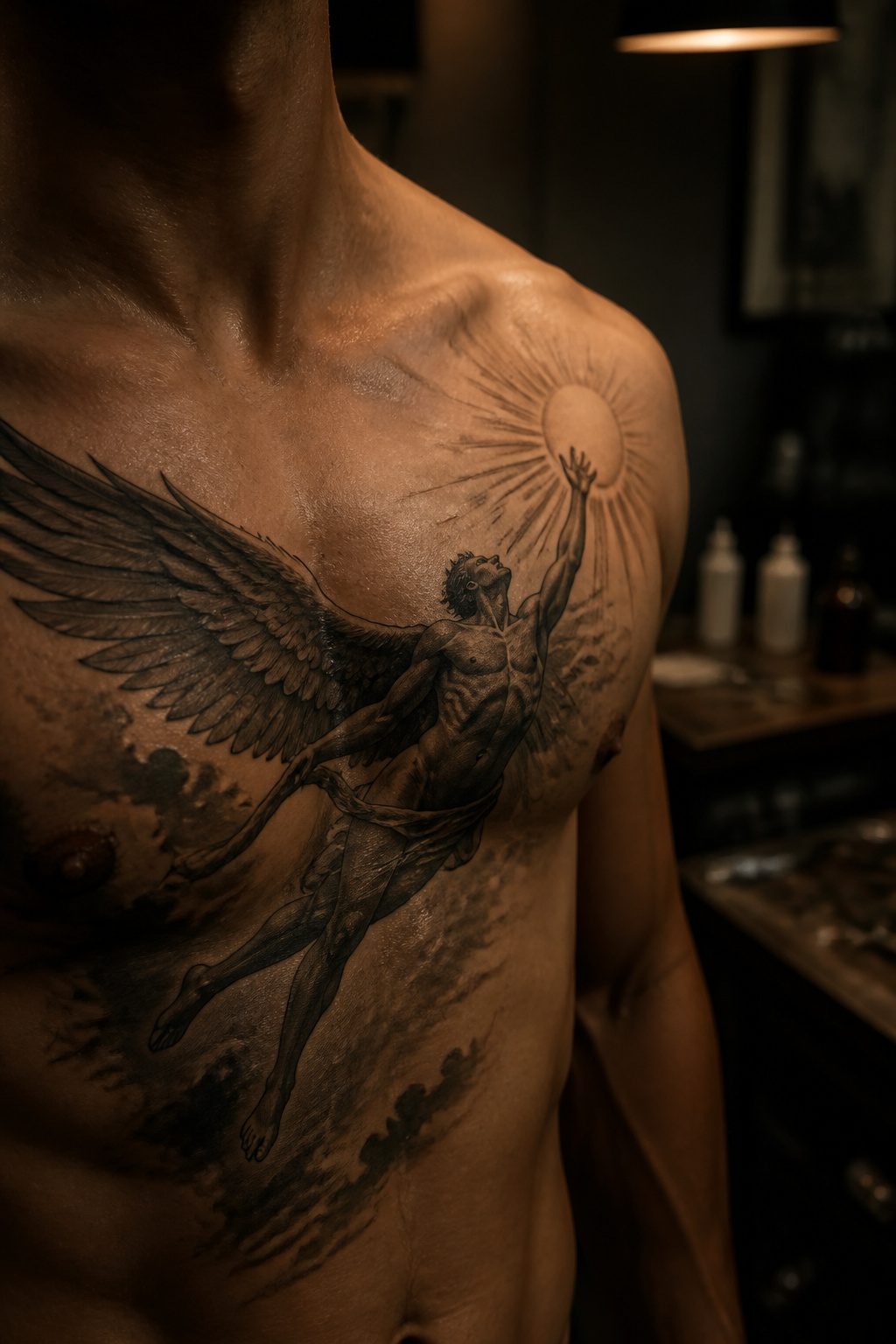
Strong shading on the figure gives black and grey Icarus sun tattoos a statue-like weight that color simply cannot match. The sun sits just outside his reach, making the design feel like a single frozen moment where ambition meets its limit. Radiating sunburst lines add tension and direction, pulling the eye toward that hard stopping point while the wings stretch across the arm to emphasize both freedom and vulnerability. The absence of color strips away distraction and leaves gravity in its place. A piece like this carries the myth’s caution without needing to shout it.
6. Painting Style Icarus Maze Tattoo
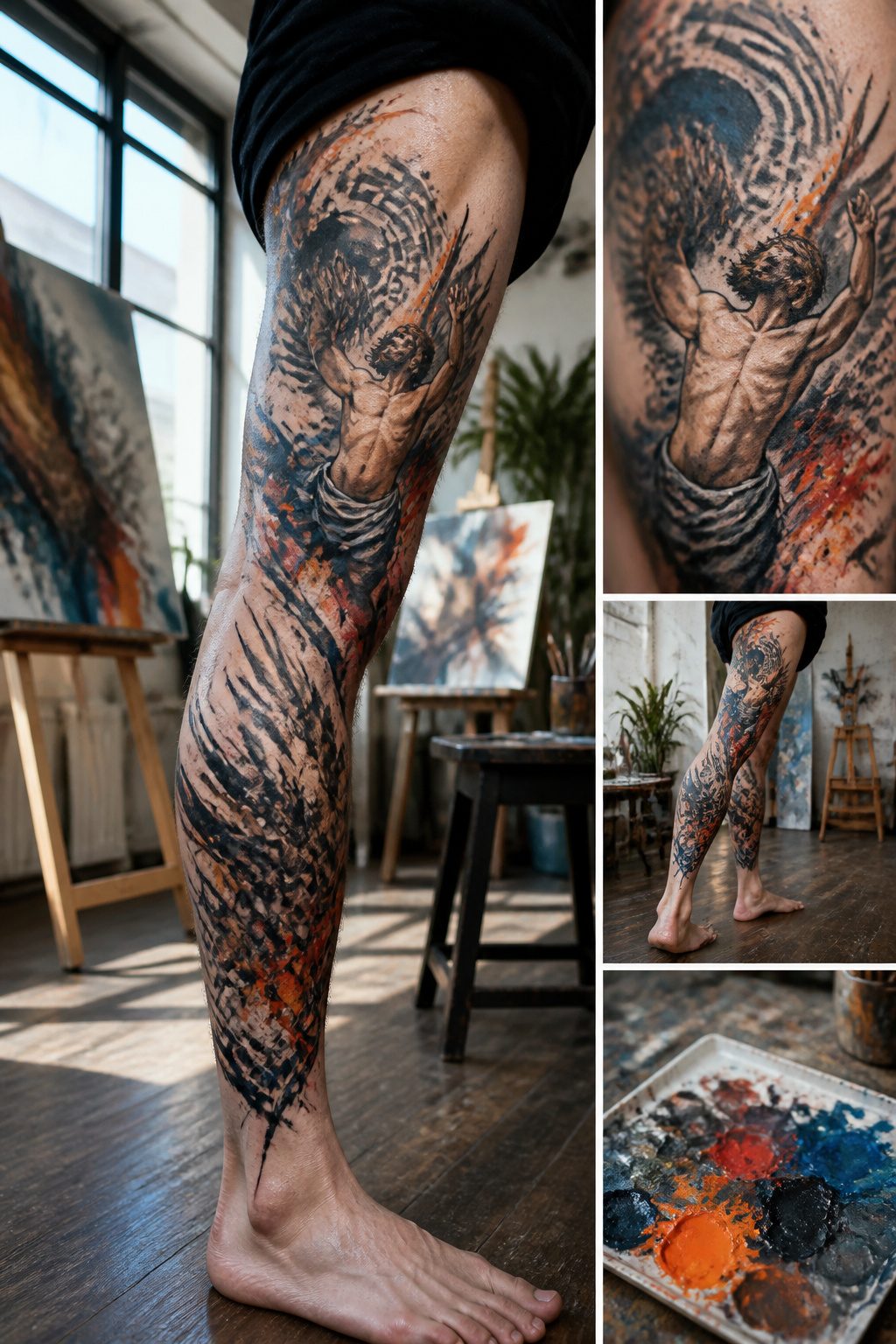
Light rays pouring from above give the maze its reason for existing. In this composition, the geometry does not merely frame Icarus; it traps him, while the fabric of his wings still carries the motion of the fall. The contrast between hard lines and flowing cloth turns a single moment into a complete story of temptation and consequence.
What convinced me, looking at how this piece holds together, is that the maze structure risks feeling static without the light source. The rays establish where the danger comes from, so the eye travels upward even as the body descends. That tension between direction and outcome is what separates a narrative tattoo from a simple figure study.
The dramatic motion of the fall is amplified, not softened, by the architectural grid beneath it. For someone considering this style, the key decision is scale: the maze details need enough room to read as geometry rather than texture, or the whole effect collapses into busy noise.
7. Geometric Icarus Ascension Shoulder Tattoo
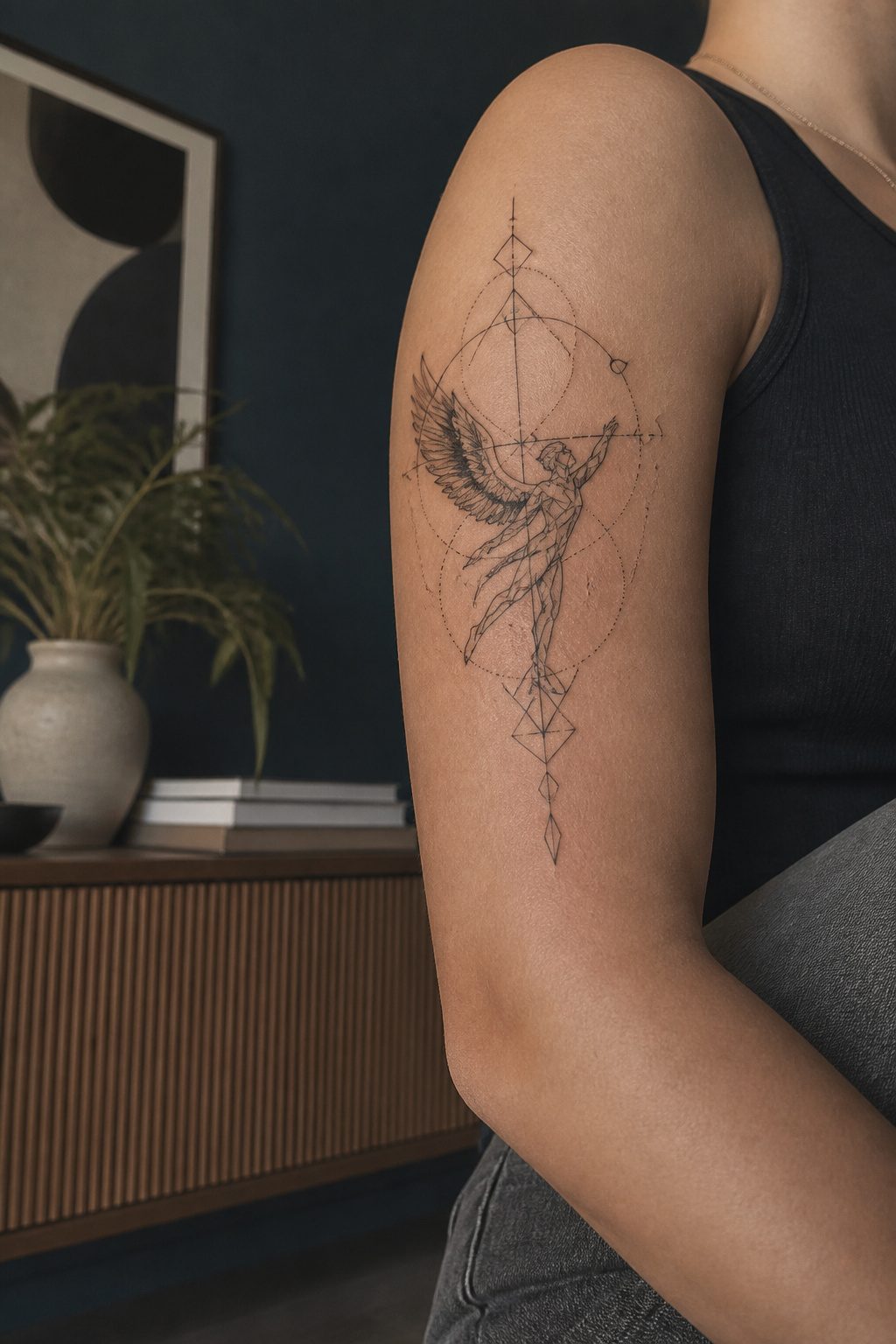
Geometric shapes give upward motion a sense of intention rather than chaos. Clean diamonds and circular forms frame the figure as he reaches, creating visual order against the body’s natural slope rather than fighting it. The shoulder placement follows this logic: the clavicle and deltoid already rise toward the neck, so the ascending lines read as an extension of your own structure, not a design sitting on top of it.
A small bird near the upper edge and a sun-like motif above the figure turn the composition into something closer to spiritual symbolism than pure myth retelling. The contrast between organic anatomy and rigid geometry keeps the eye moving without clutter. Flat surfaces suit this style best; the shoulder’s relatively straight planes let the framing lines hold their edges where curves would distort them.
8. Sketch Style Icarus Flight Tattoo
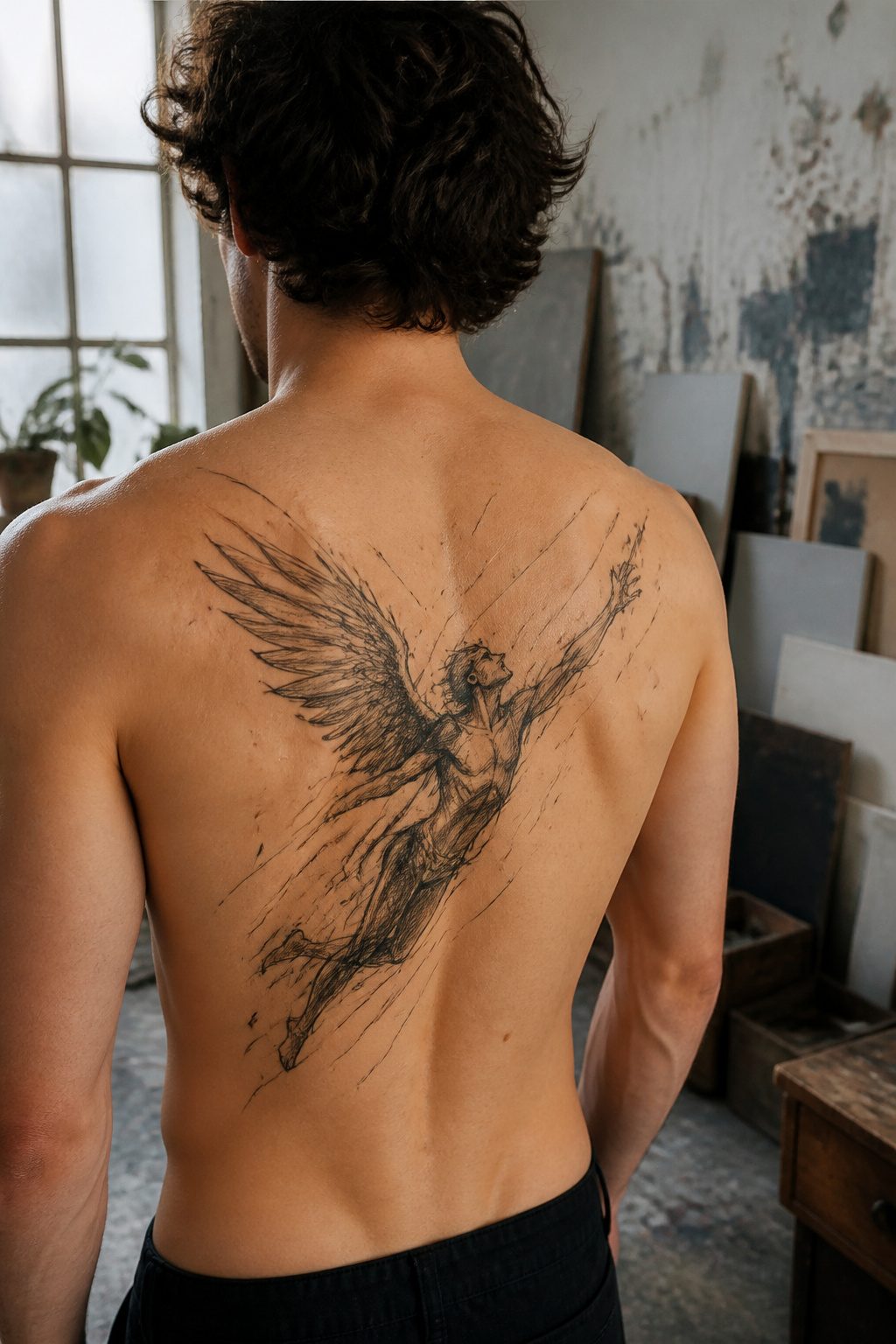
Rough linework does something finished polish cannot: it keeps the moment alive. A sketch-style Icarus in mid-flight, drawn with loose, scattered strokes and fragmented ink marks, makes the wings look like they are still beating. The energy is right there in the lines, not smoothed away.
This aesthetic suits the myth at its most hopeful. Icarus has not fallen yet. The rough strokes catch him straining upward, feathers beginning to break away in tiny fragmented details around the figure, and that raw unfinished quality mirrors the risk itself. The sketch lets the striving show.
The minimalist approach keeps attention on motion and emotion rather than on technical precision. A few rough lines are enough. The viewer reads the effort in the marks, not in any perfected form, which is exactly what the story asks for.
9. Golden Falling Icarus Forearm Tattoo
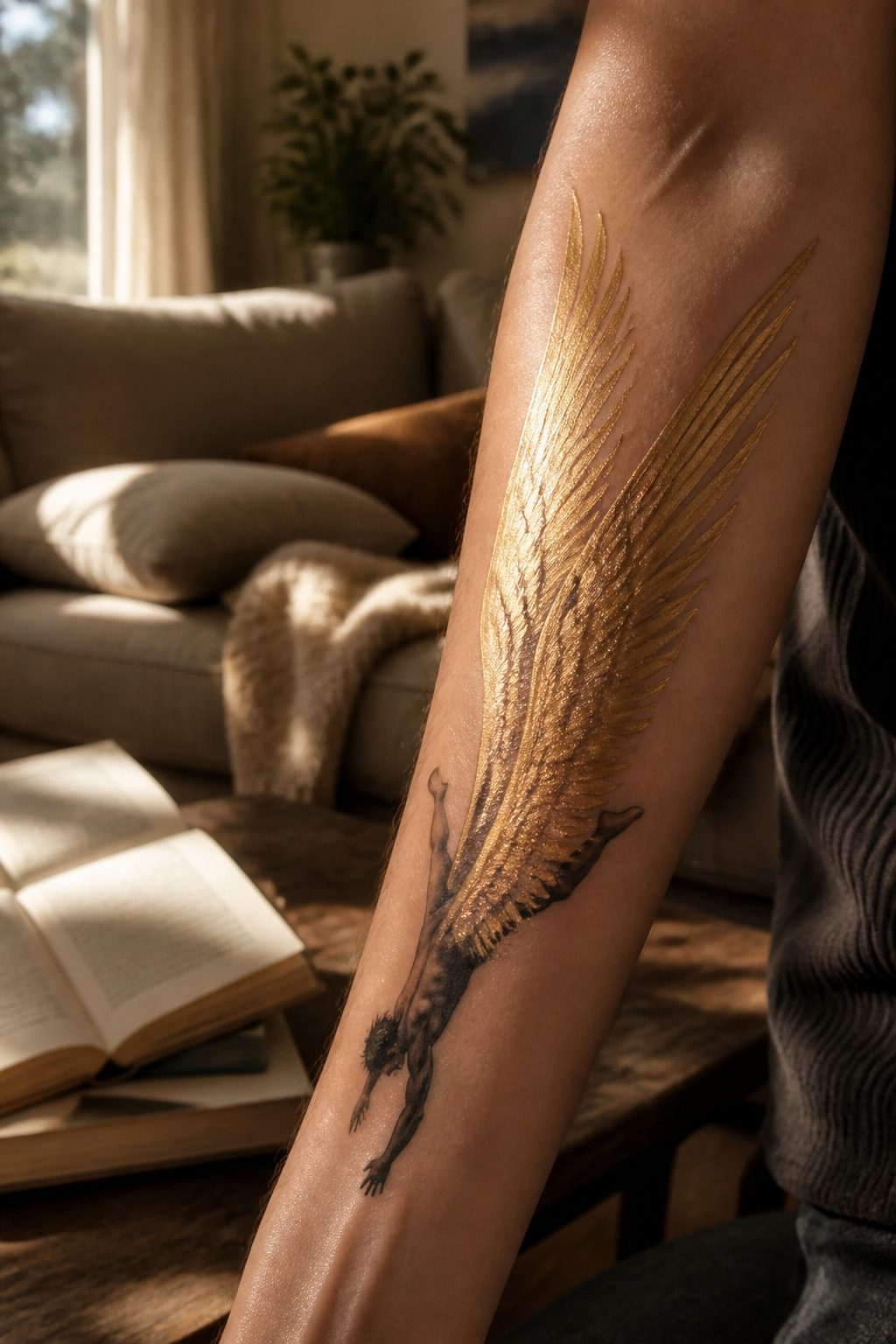
Golden wings against a dark falling figure read as the last light of divinity rather than defeat. On the forearm, that contrast stays in sight through ordinary motion: typing, lifting a coffee cup, reaching across a table. The vertical streaks of gold above the body suggest sunlight or melting wax descending with him, which warms the myth beyond the usual monochrome fall. A forearm placement keeps the image at a scale where those warm tones read as celestial rather than merely decorative, and the daily visibility turns the failure into something you work beside rather than hide. The richness of the palette is the point; traditional Icarus tattoos often default to shadow, but this one lets the power linger even as the figure drops.
10. Fine Line Geometric Icarus Tattoo
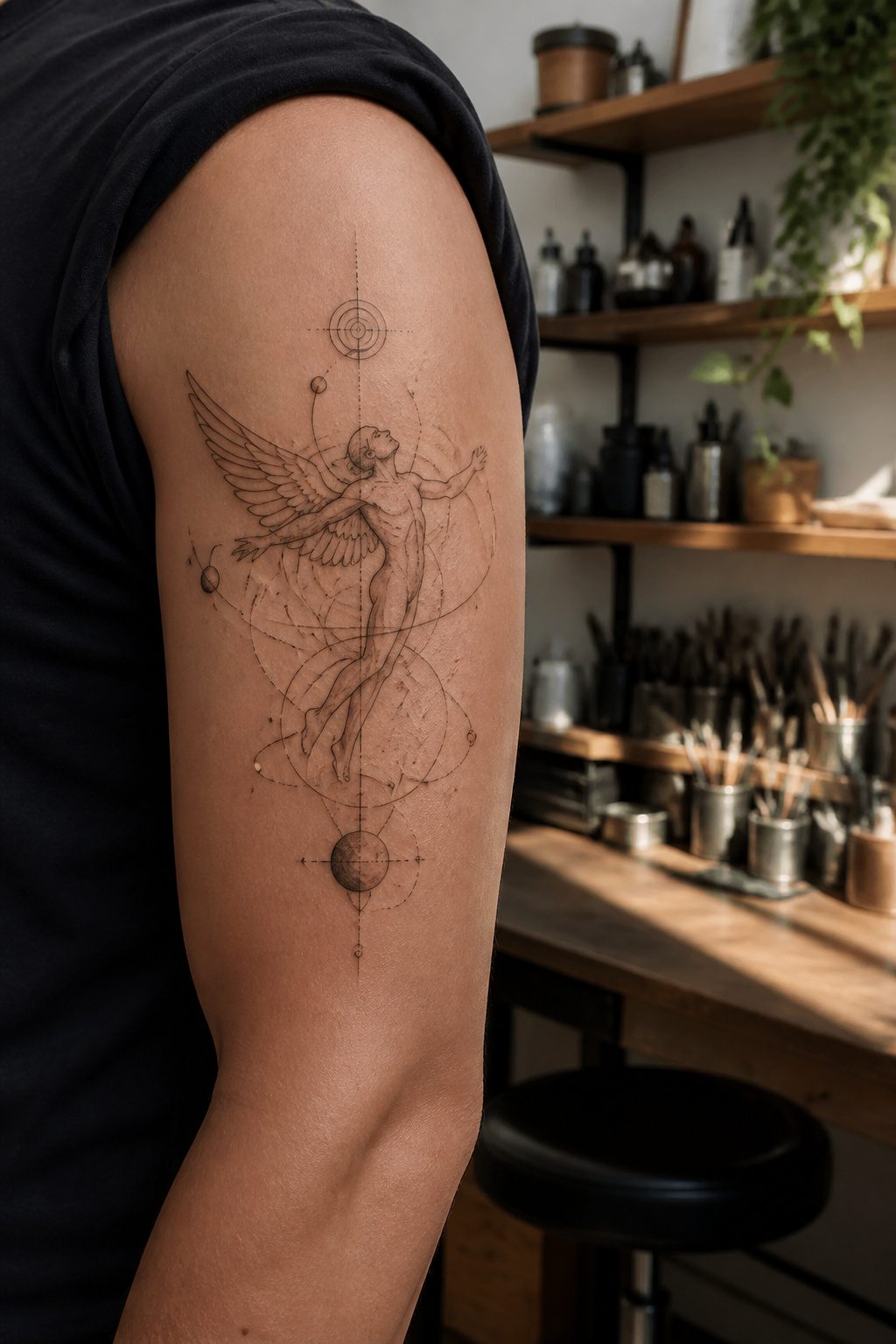
A fine line geometric Icarus tattoo works when the figure and the surrounding symbols agree on weight rather than fighting for attention. The falling body stays central, rendered in thin, continuous strokes, while radiating circles, celestial motifs, and an eye placed inside the sun orbit around him like a mapped solar system. The dotwork keeps both languages delicate enough to layer without either one shouting over the other.
The eye within the sun changes the emotional register of the piece. Without it, Icarus falls alone. With it, the collapse reads as observed, almost judged, by something larger than the myth itself. That single detail shifts the tattoo from narrative illustration toward symbolic statement.
The geometry does not frame the figure so much as set the terms he moves through. Circles repeat at different scales, some complete, some interrupted by the body passing through them, so the composition holds together even where the lines cross. The result reads as one integrated system rather than a figure with decoration applied after.
11. Geometric Icarus Sun and Eye Tattoo
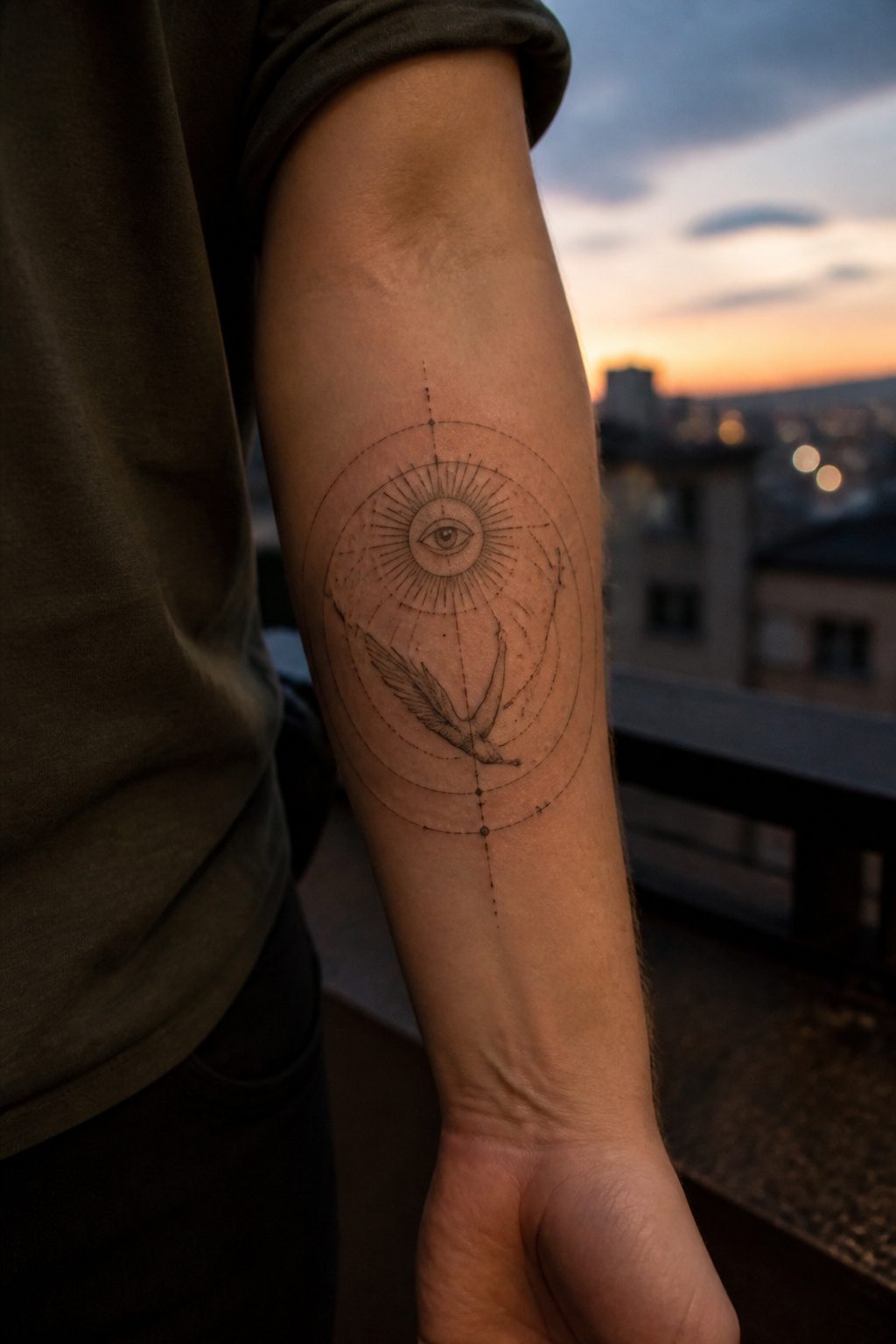
Circular geometry turns the Icarus story into something you read clockwise. The sun sits at the top, its center holding an eye that watches the whole arc. From there, lines sweep down through the falling figure and close again at the bottom, where a small symbol of grief or reflection anchors the loop. The eye matters because it shifts the fall from private accident to witnessed event; someone, or something, saw this happen.
Dotwork keeps the circles from going heavy. The radiating lines around the sun stay fine enough that skin texture still shows through, and the geometric frame gives the body a place to tumble without the composition flying apart. Icarus himself is usually drawn small against the structure, almost a detail inside the larger orbit.
The circular path reads two ways at once: orbital motion and the fixed stare of that eye. Both trace loops. Both return to where they started without ever quite landing. That double reading is what makes the design hold up past the first glance; the geometry earns its space by doing actual narrative work, not just decorating a fall that would read the same without it.
12. Fine Line Celestial Icarus Tattoo
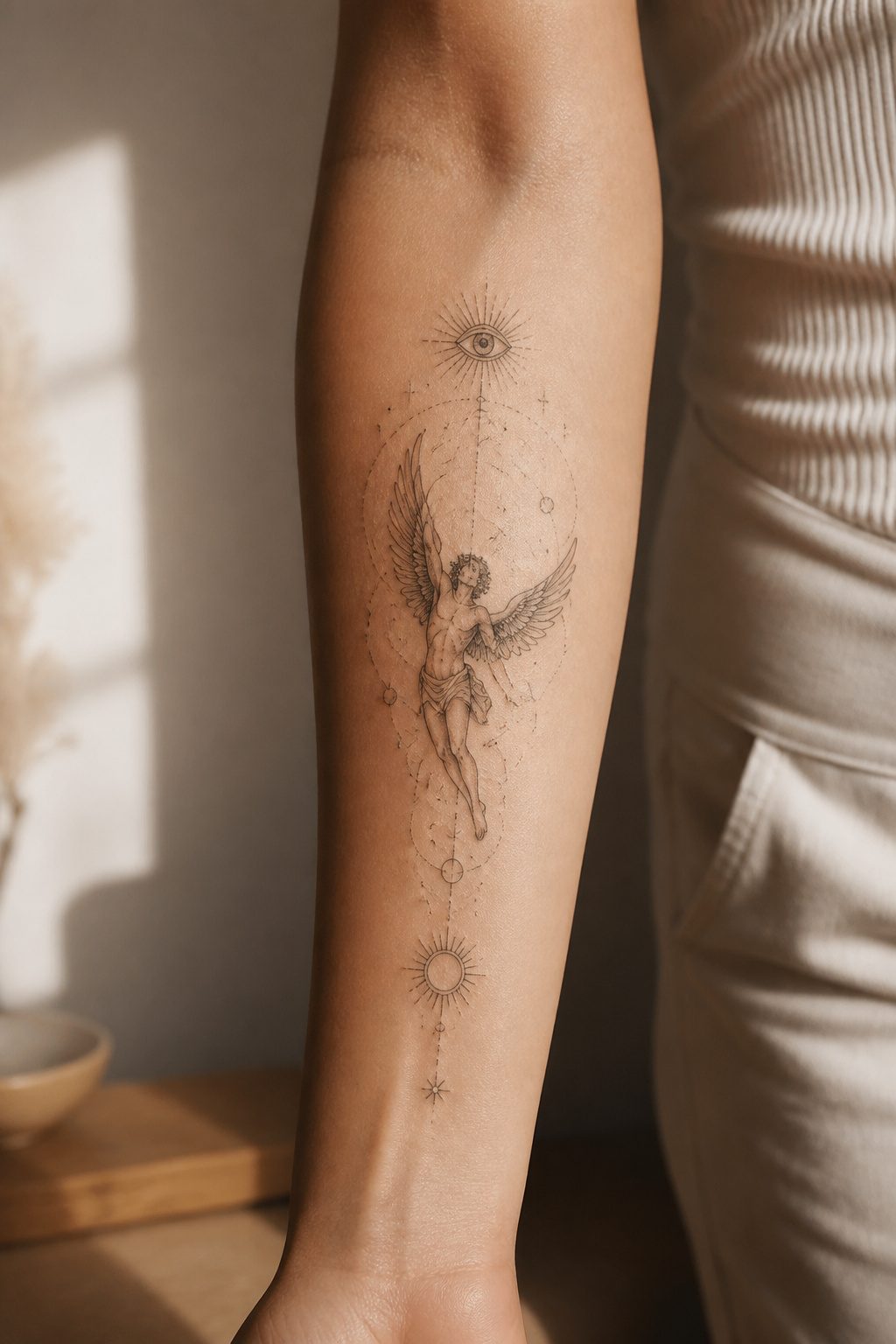
A fine line celestial Icarus tattoo works best when the figure hangs in that exact middle, neither climbing nor tumbling yet. The eye above him reads as a witness, something divine or cosmic watching the choice unfold. Around the body, geometric accents and radiating circles build a subtle frame, a kind of invisible solar system holding him in place. Clean linework and deliberately left negative space keep the whole piece elegant, which matters because the theme itself is already heavy. Dotwork adds texture without weight. What separates this from busier geometric versions is restraint: the celestial elements stay sparse enough that the eye moves first to Icarus, then outward to the symbols. For placement, the upper arm or ribcage gives that suspended composition the vertical room it needs. The negative space does as much work as the ink here, and a crowded design kills the effect entirely.
13. Micro Realism Icarus Time Tattoo
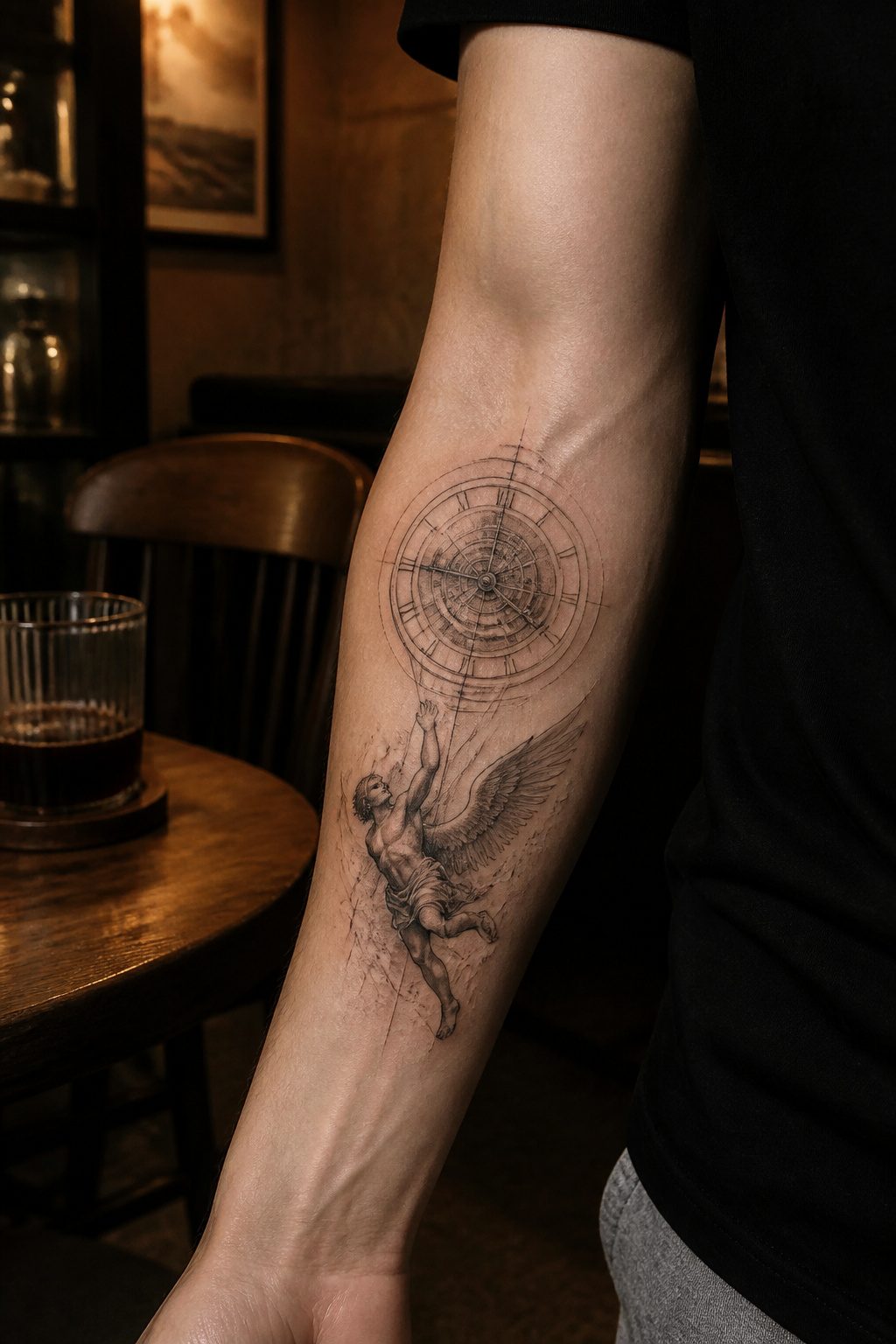
A micro realism Icarus time tattoo reframes the myth by placing an orbital clock above the falling figure, turning the story from simple hubris into a meditation on mortality and the moments that slip past. The clock demands you step in close; at arm’s length it reads as a dark circle, but from six inches the gearwork and face resolve, and the point becomes clear. Thin vertical lines connect that celestial object down to the body in descent, creating alignment that pulls the eye through the full narrative in a single sweep. The minimal layout keeps every element working, nothing decorative without purpose, so the composition never overwhelms the skin it sits on. This is a piece built for intimate viewing, the kind someone notices across a dinner table rather than from across the room, and that closeness suits the subject: mortality, after all, is personal.
14. Illustrative Icarus Classical Column Tattoo
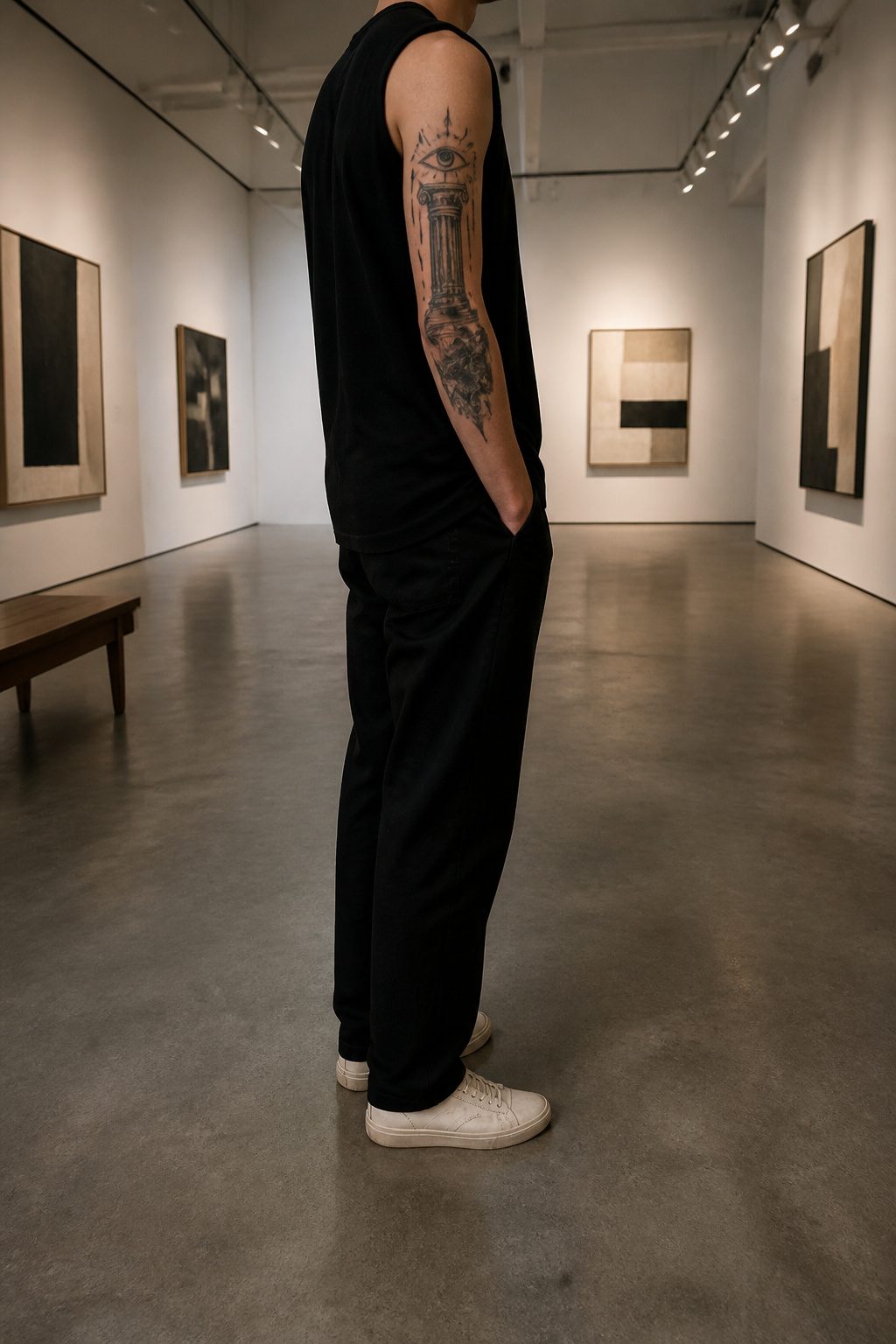
A broken classical column anchors this design with more weight than mere scenery. The fluted shaft, snapped at mid-height, turns the myth into something architectural: the ruin itself becomes the argument about human limits. Above the fracture, a watchful eye keeps vigil while descending arrows track Icarus downward. The composition reads as a meditation on order and its collapse, not just a fall.
The shark silhouette slipping beneath the surface adds a layer I did not expect at first glance. Danger in this reading is not the sun alone but whatever waits below, indifferent to whether the wings failed or the ambition did. The column’s geometry, its measured proportions and deliberate symmetry, frames the chaos of the fall as something almost philosophical. Greek builders designed columns to carry weight across empty space; here the broken shaft carries the idea that even perfect structure has its limit.
What separates this from simpler Icarus pieces is that restraint. The figure is present but subordinate to the system around him: the eye, the arrows, the ruin, the hidden predator. Someone choosing this variant is less interested in the moment of burning and more in the aftermath, the evidence left behind when ambition meets an immovable order.
15. Fine Line Icarus Scale Tattoo
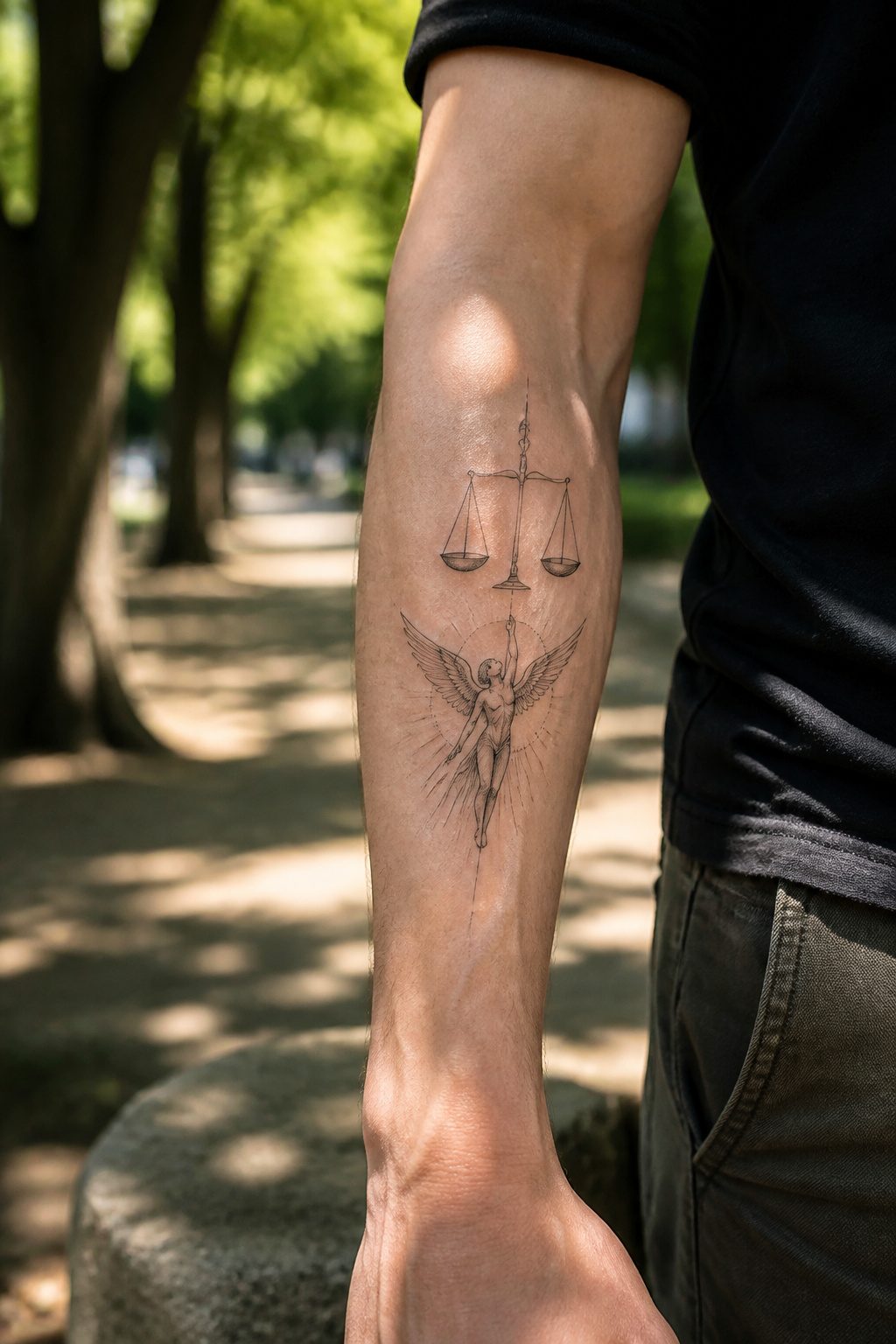
Fine line work keeps a busy design from collapsing under its own weight. The Icarus scale tattoo I keep coming back to, credited to @yangda.ttt, places the figure beneath a suspended balance scale with circular geometric forms tracing a quiet orbit behind him. At first glance it reads as Icarus being weighed, which lands harder than any caption could. The scale itself carries the older meaning, judgment rendered rather than merely risk taken, and the thin single-needle lines let that symbolism sit there without shouting. Geometric backdrops in this style tend to go celestial by instinct; here the circles stay restrained enough that the eye moves to the figure first, the apparatus second. What works is the refusal to choose between narrative and ornament. Most Icarus designs pick ambition or consequence and hammer it. This one holds both in tension, the balance scale literal and the fine line technique doing the same job visually, keeping everything level.
16. Sketch Style Icarus Falling Tattoo
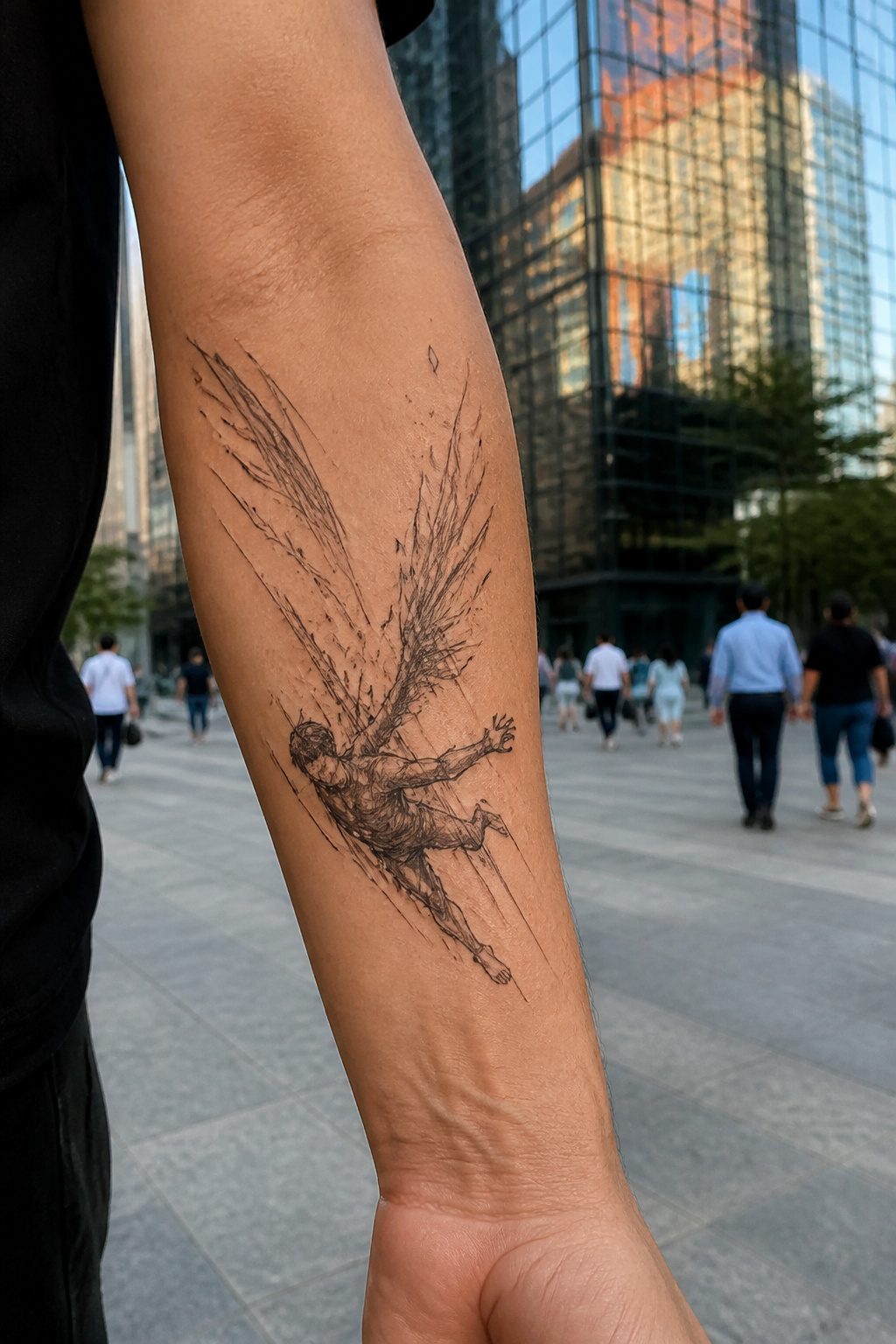
Loose brush-like strokes and fragmented lines give this falling Icarus a raw energy that feels unfinished in the best possible way. Where the sketch flight style keeps vibrating wings in controlled motion, this descent accepts disorder as the whole point: the wings appear to dissolve during the fall rather than merely break. Geometric precision would kill the effect. The chaos makes the moment feel immediate and emotional, the modern artistic edge arriving from what the lines refuse to tidy up. Scattered ink marks around the figure replace clean feather details with something closer to panic. The difference between the two sketch approaches is intent. Flight sketch channels roughness into lift; falling sketch lets that same roughness collapse. Both use minimal means, but this one risks losing the subject entirely to get the feeling right. It is a style for someone who wants the myth’s warning more than its beauty, and trusts the artist to know when a line should stop short of completion.
17. Geometric Moon Phase Icarus Tattoo
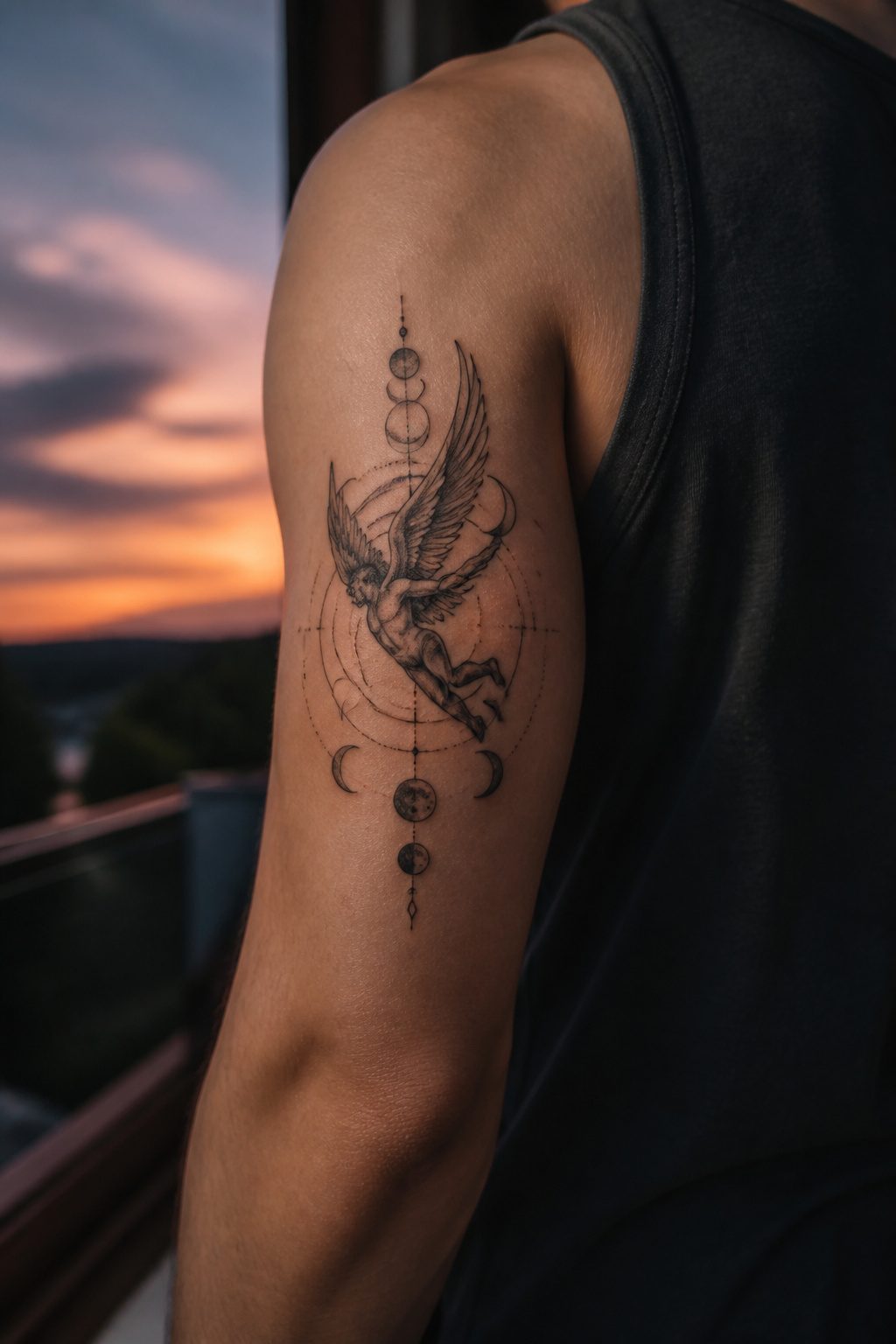
The sun in Icarus’s story burns once and ends everything. A geometric moon phase design replaces that single catastrophe with a cycle that keeps returning, which changes the meaning entirely. Lunar phases orbit the figure in repeating order: new, waxing, full, waning, new again. Where the original myth traps Icarus in one moment of failure, the moon structure lets the fall exist inside something larger that never stops moving.
Geometric frameworks hold this together. Orbital circles, measured angles, and clean line work build a celestial blueprint around the body. Scattered feathers break the symmetry just enough; without them, the design would feel like a diagram rather than a fall. The tension sits between that cosmic order and the chaos of the figure dropping through it.
Sacred geometry and mythology balance differently here than in sun-based pieces. The sun demands a climax. The moon offers return, repetition, a kind of patience. For placement, this reads best where the phases can wrap a limb or follow a shoulder’s curve, letting the cycle complete its loop across the body’s own geometry.
18. Fine Line Flaming Icarus Tattoo
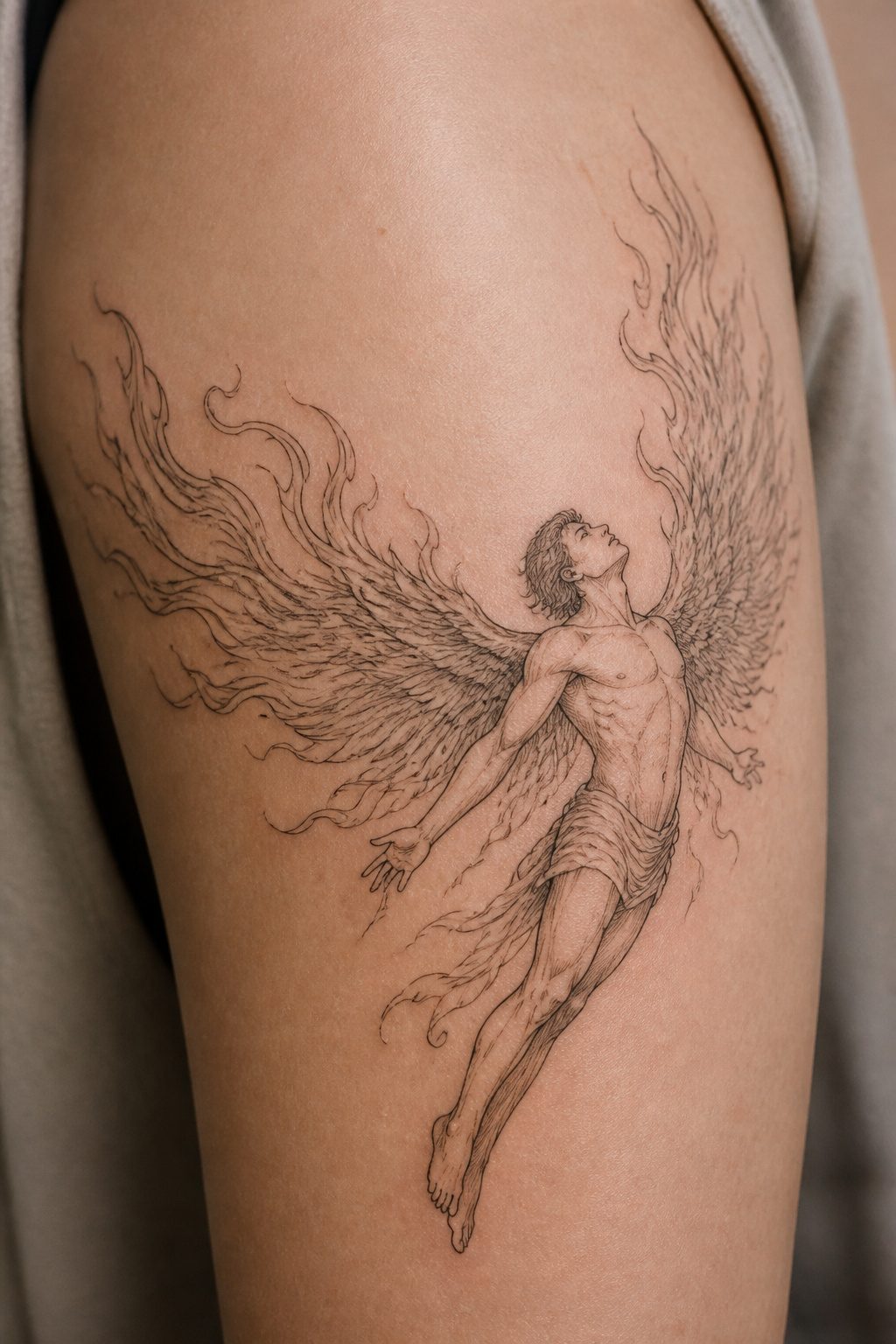
Fine line work carries flame differently than bold trad or neotrad pieces because the needle groupings are tighter and the ink sits closer to the surface. Where a thick bold line would read as a solid shape, a single needle or tight three-round liner lets the fire breathe, each strand of flame standing alone against skin rather than collapsing into a blob. The effect is transformation replacing flight: the wings do not merely melt but become the fire itself, the feathers reimagined as tongues of flame stretching outward like extensions of what the wings were.
The composition pulls the eye upward toward a radiant point, the same sun that inspired the ascent now marking the downfall. Dotwork keeps the heat from looking muddy, and fine lines keep the whole piece elegant even when the concept is complex. I have watched this style age on friends who went fine line over bold for their first pieces, and the fire stays readable longer than I expected because the negative space between each flame strand does the work that heavy black would do in a bolder piece. The tradeoff is touchups; fine line fire needs them sooner than a packed black sun would.
19. Geometric Surreal Icarus Conceptual Tattoo
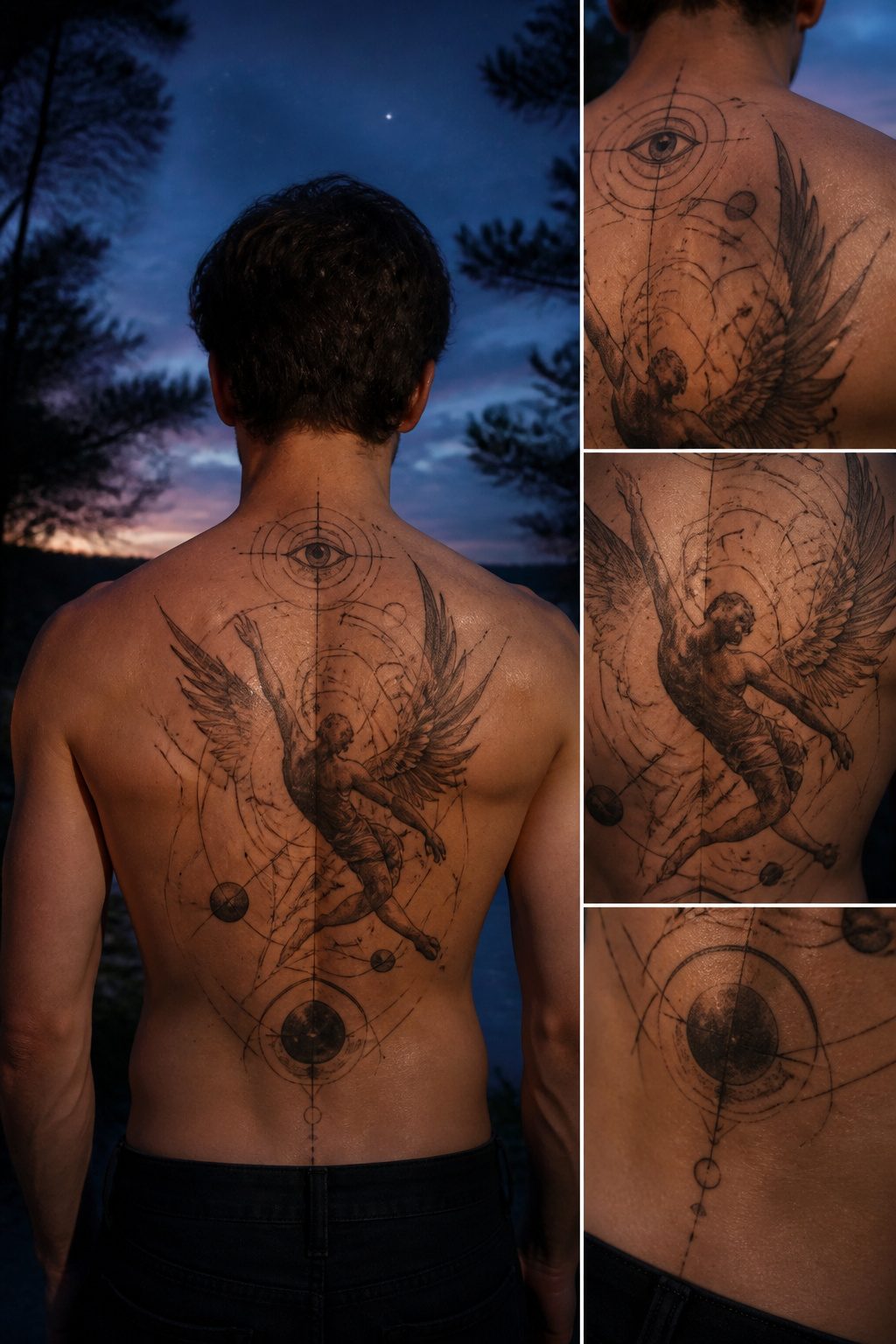
A geometric surreal Icarus conceptual tattoo layers multiple symbols around the falling figure to create density of meaning through surreal juxtaposition. An eye, celestial forms, a soaring bird, a butterfly, and geometric structures all orbit the central figure, each carrying its own weight rather than serving as mere decoration. The vertical arrangement reads as a symbolic journey through space and consciousness, with Icarus tumbling through the center while perfectly arranged geometric symbols and radiating circles surround him like an invisible cosmic system.
The eye within the sun introduces a sense of observation, making the fall feel witnessed or judged by a higher force. Delicate dotwork and fine lines keep the composition elegant despite its complexity, which matters because a design this busy can collapse into visual noise without restraint. Rather than depicting a simple fall, this approach explores transformation, observation, and the connection between different stages of existence. The longer you look, the more the design reveals, rewarding the viewer who stays with it while giving the wearer a piece that shifts meaning depending on what they need to see that day.
20. Black and Grey Melting Wing Icarus Tattoo
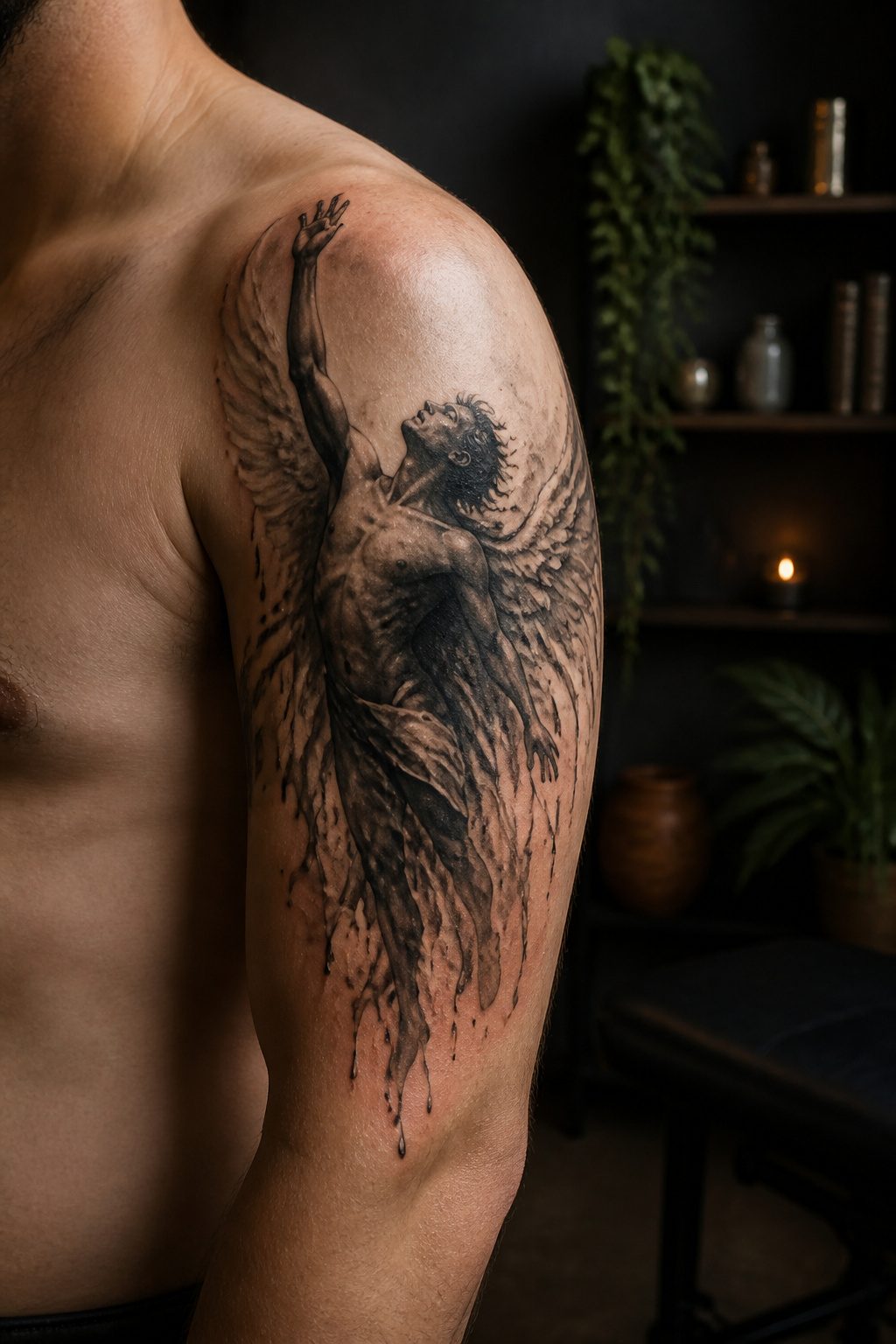
Black and grey ink gives the melting wing Icarus tattoo its real force. The figure reaches upward, still determined, while dark droplets fall from the wings and the damage is already happening. Strong realism keeps the body almost statue-like, solid and fixed, but the melting effect introduces movement and fragility that a color piece would struggle to match. The grey wash serves the dissolution itself, letting the wax-softened feathers blur and run without the distraction of hue. The contrast between aspiration and decay is what makes the composition work; you see the ambition and its undoing in the same glance. For anyone drawn to the Icarus myth as caution rather than celebration, this treatment lands closer to grief than glory, and that is the point.
21. Motivational Collage Icarus Tattoo
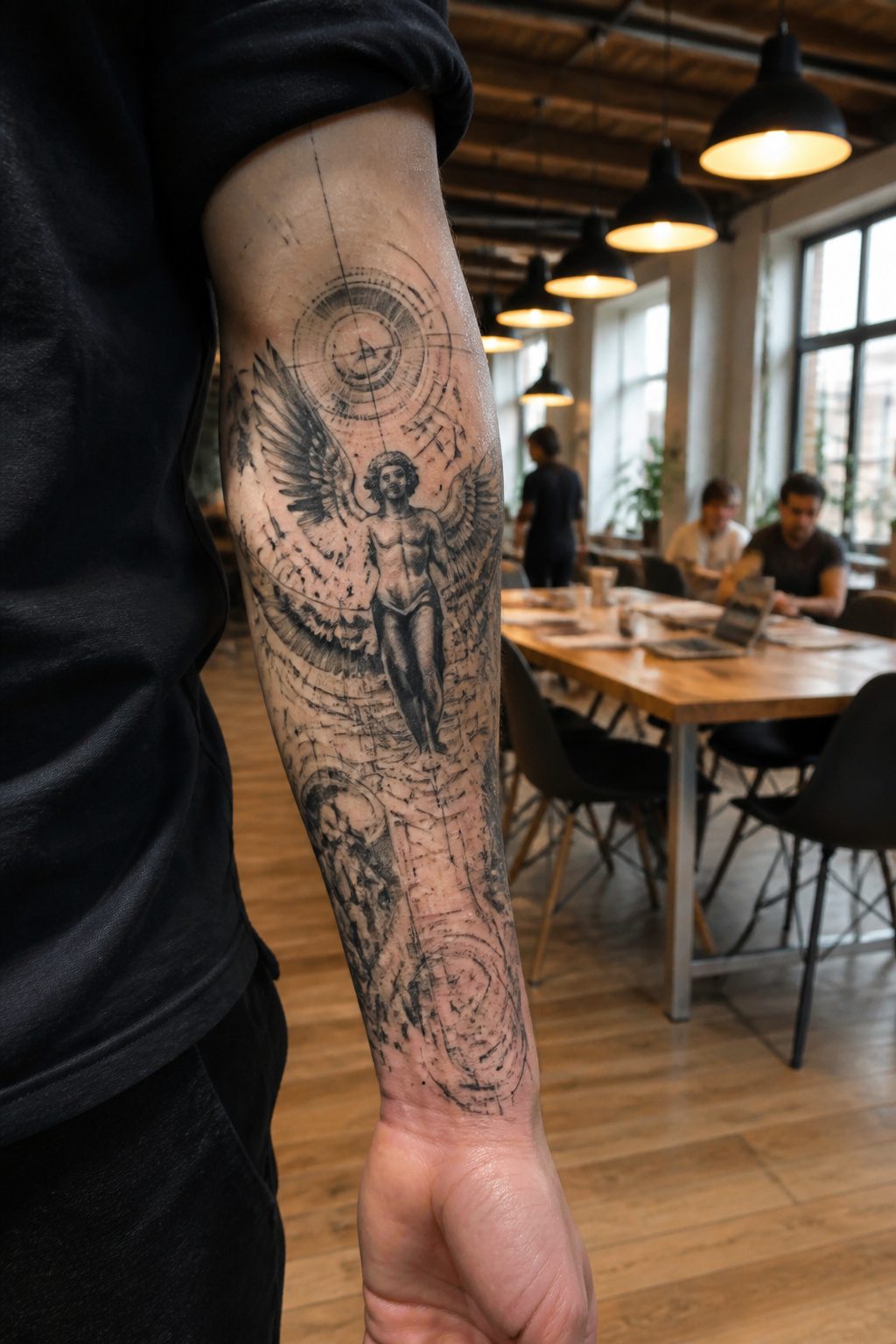
A motivational collage Icarus tattoo works best when the words are not captions but co-conspirators with the image. Ambition, patience, perspective, balance; these terms flank the falling figure and turn a single moment from myth into a running argument about growth and discipline. The eye, the chess pawn, the scales; each fragment brings its own symbol, and the wearer ends up with a visual manifesto rather than a one-line moral.
The real risk is clutter. Geometric lines and intentional spacing are what keep a dozen separate ideas from becoming noise. Without that structure, the eye bounces; with it, the fragments read as deliberate chapters in the same thought.
On the forearm, a similar approach layers the rising sun, watchful eyes, text, and numerical details around Icarus so the myth becomes a frame for personal belief. The result feels less like a story told in order and more like a collection of reminders held together by shared gravity. Either way, the collage lives or dies on whether the geometry earns the viewer’s patience.
22. Color Realism Icarus and Daedalus Tattoo
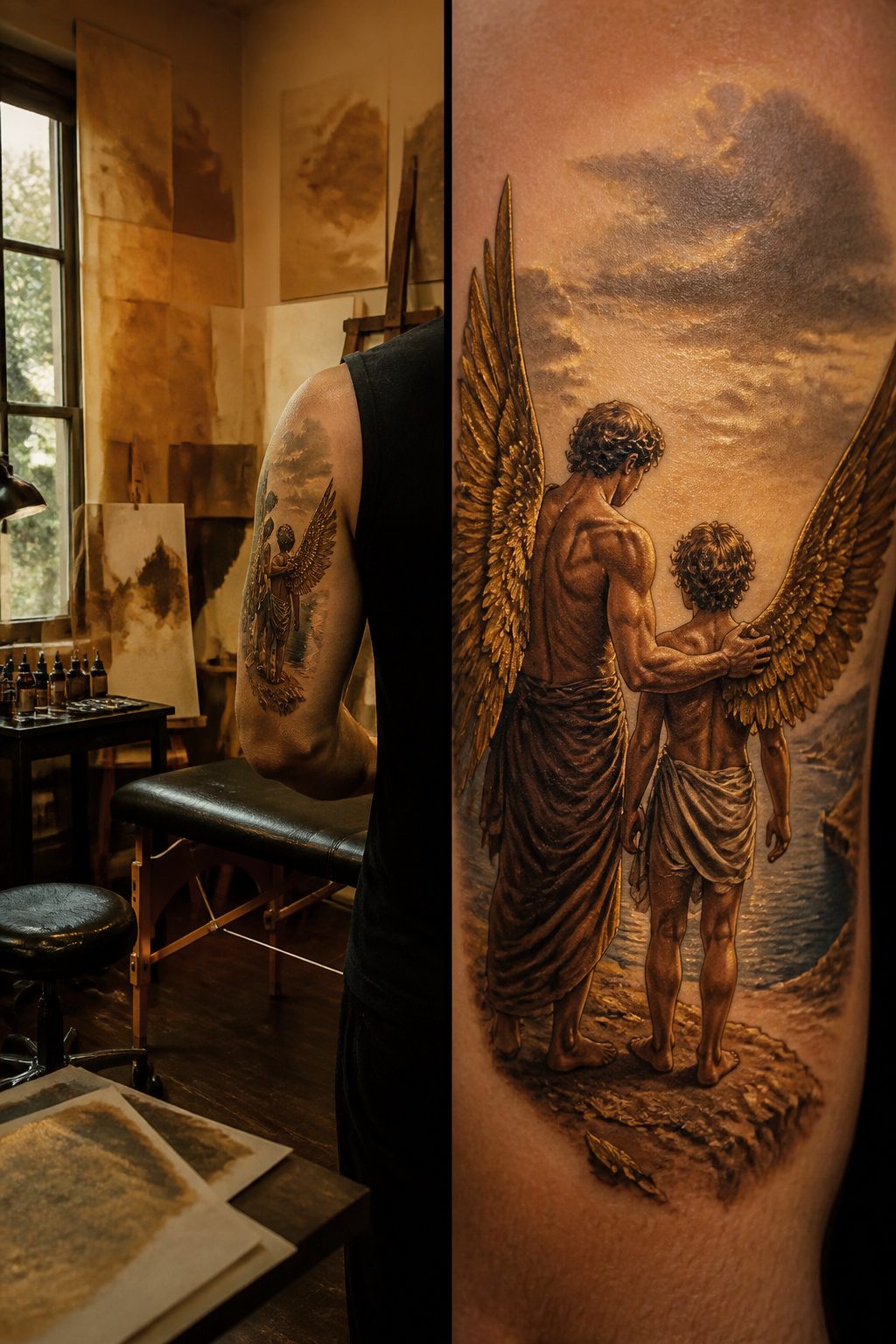
The golden wings still hold their shape in this piece, wax not yet melted, feathers catching light that reads as real metal against real skin. Daedalus stands beside his son, close enough to touch, and that proximity changes everything. The myth usually isolates Icarus in his failure; here the father witnesses the moment before, the warning given and the choice already made. The composition borrows from classical painting, a framed scene that turns the forearm or the back into gallery wall. Color realism demands patience and a budget that matches the hours, but the result carries emotional weight that a solitary falling figure cannot reach. The story becomes about guidance ignored rather than punishment earned, about the specific grief of watching someone you taught choose the very danger you named. For anyone drawn to Icarus tattoos for their cautionary weight, this pairing asks harder questions than the fall alone.
23. Minimalist Geometric Icarus Tattoo
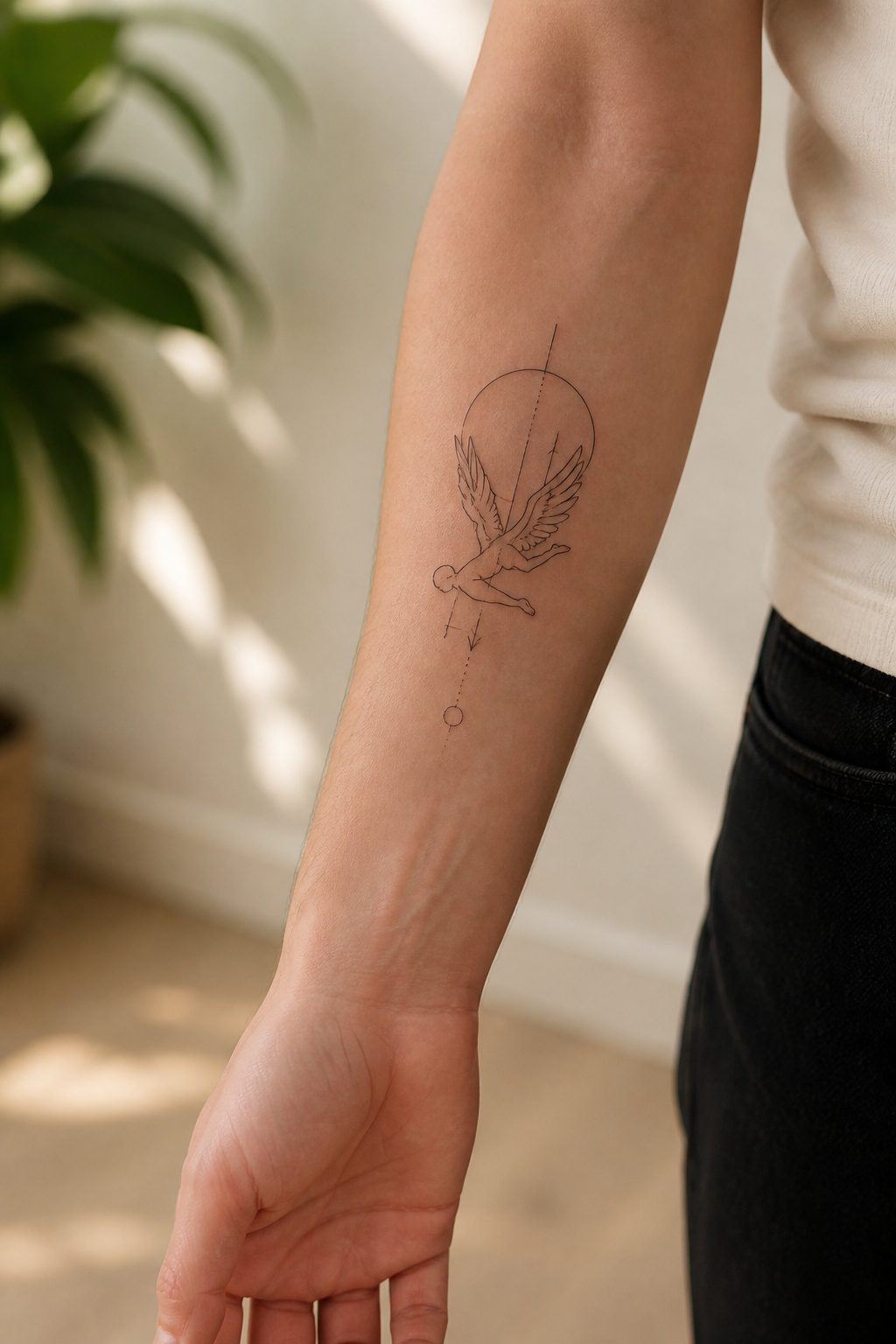
A few thin lines can carry the whole myth if they are placed with intention. The falling figure stays readable because geometric guides intersect the body at calculated angles, giving the descent a sense of structure without cluttering the anatomy. That restraint is what makes the tension land. The viewer sees order and collapse at once, the cosmic blueprint pressing against human chaos.
The sparse composition keeps the eye on the descent itself, not on decorative extras. What surprised me, looking through how these are built, is how expressive minimalism becomes when the subject already carries this much weight. Icarus needs no embellishment; the geometry only has to hold him in place long enough for the fall to register.
For placement, this style rewards spots where the body provides its own straight lines: the forearm, the ribcage edge, the calf. The tattoo stays legible at small scale because the figure is reduced to essential posture and a handful of guiding marks. The restraint is the point: add more, and the myth’s tension dissolves into ornament.
24. Patchwork Icarus Typography Tattoo
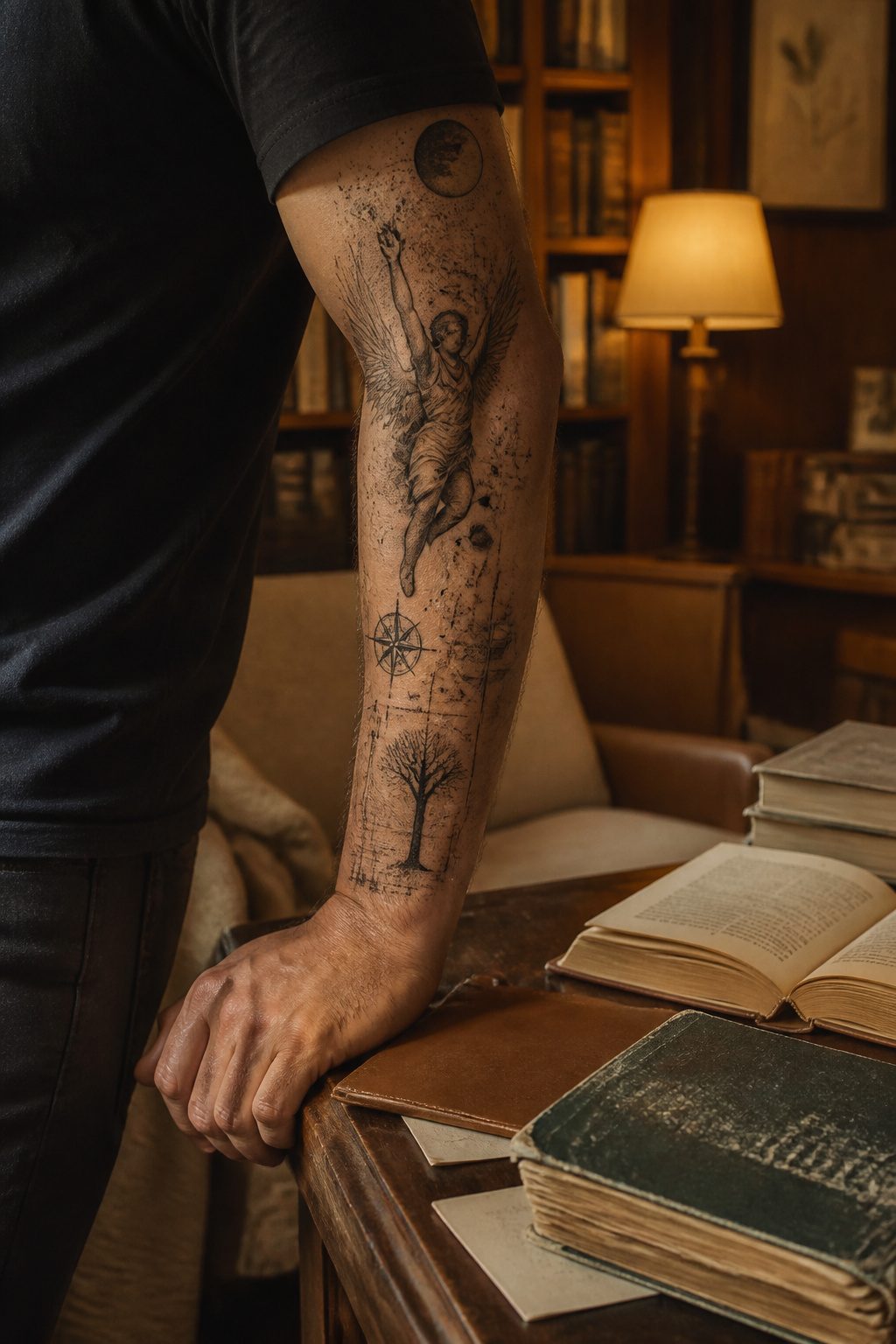
A patchwork Icarus typography tattoo lets the myth speak in several voices at once. The forearm piece by @william.marin_ layers a rising sun, watchful eyes, meaningful text, and numerical details around the central figure, so the composition reads less like a single story and more like a collection of beliefs, memories, and reminders held together by the fall. That scattered quality is the point: patchwork gives you permission to add the quote that mattered in college, the date that changed everything, the eye that watched you fail and start again. Geometric lines and intentional spacing keep it from becoming chaos, which matters when words like ambition, patience, perspective, and balance share skin with a chess pawn or a set of scales. The typography itself becomes imagery, not just caption. For someone who wants Icarus to mean something specific and personal rather than universally tragic, this approach turns the myth into a visual manifesto you revise over years instead of locking in at one sitting.
25. Geometric Ascending Icarus Tattoo
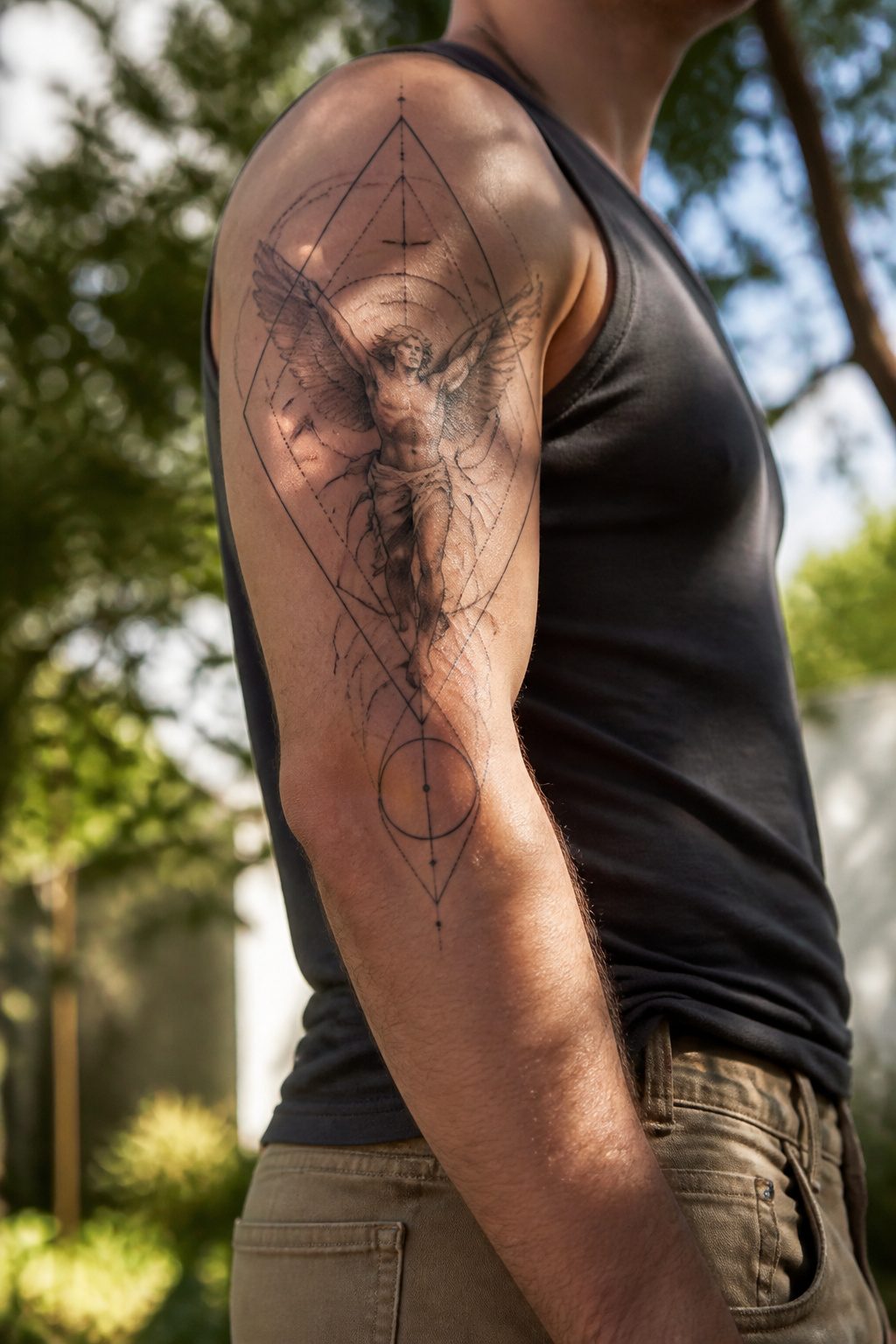
Upward motion in an Icarus piece usually reads as hubris, the moment before the fall. Flip that reading by locking the figure inside geometric diamonds and circular forms that turn ascent into something deliberate, almost engineered. The rigid shapes against organic muscle make the climb look chosen, not reckless. A small bird placed high in the frame keeps the symbolism of freedom without undercutting the structure, while a sun-like motif above gives the eye a fixed destination. The result sits closer to perseverance than to mythic warning, geometry doing the moral work that a falling pose would undo.
26. Black and Grey Eclipse Icarus Tattoo
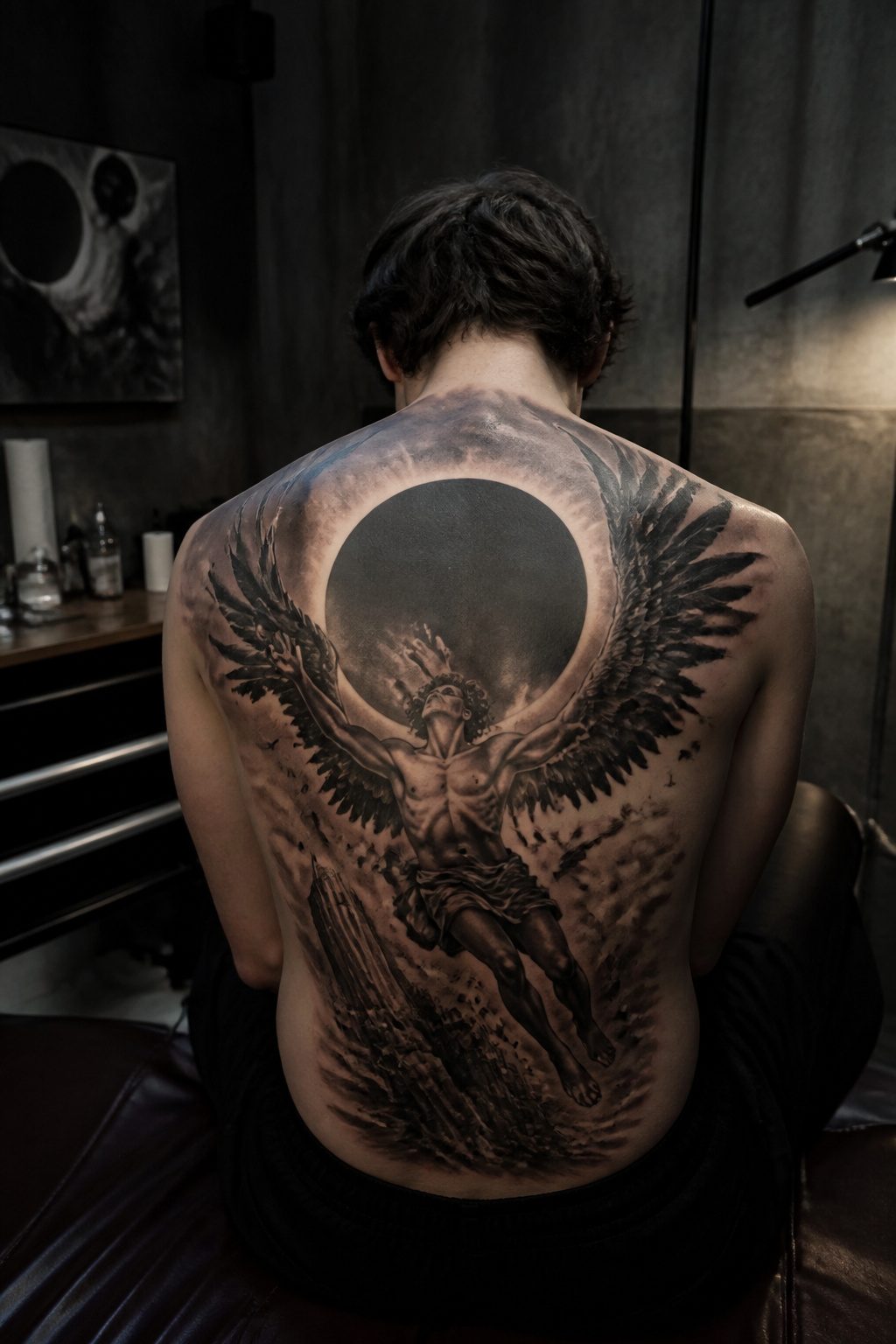
The dark celestial body in this design replaces the sun entirely, so the warning Icarus ignored becomes something colder and more absolute. The eclipse geometry, with its precise ring of corona light, frames the falling figure like a portal closing behind him. Large wings curve around his body, almost cradling him in descent rather than carrying him upward. Soft shading around the eclipse edge creates the atmospheric depth that separates a flat symbol from something that feels vast. What draws me to this version is how it shifts the myth’s center of gravity: fate reads as shadow instead of light, and the cosmic scale makes the failure feel less personal, more like gravity itself. The black and grey palette keeps the drama without tipping into theater, which matters on skin where color ages faster and busier compositions blur together. For anyone weighing this against the brighter sun variants, the eclipse offers a quieter permanence; the story stays the same, but the mood is midnight rather than noon.
27. Neo Classical Eclipse Icarus Tattoo
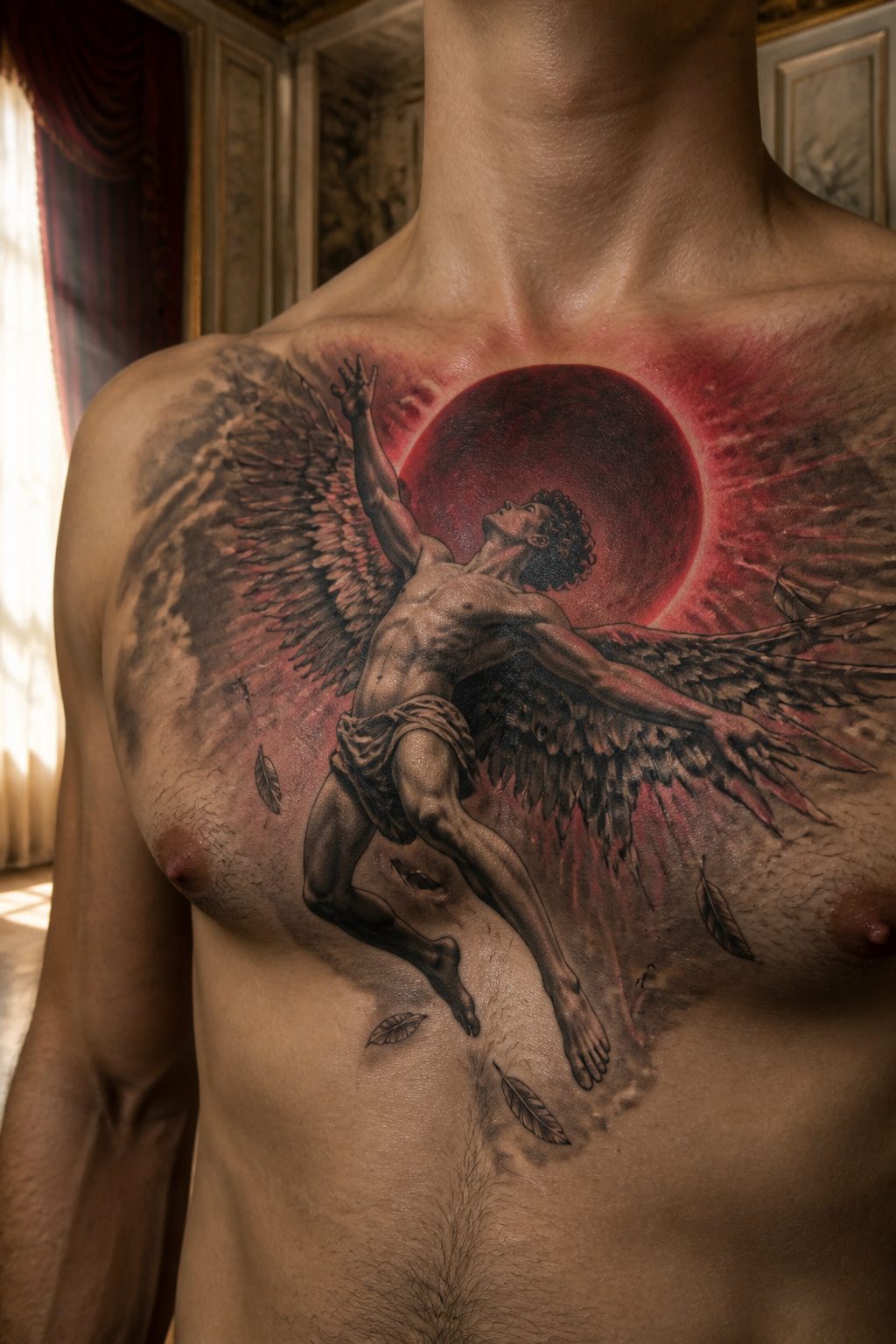
The neo classical eclipse Icarus tattoo takes the familiar falling figure and pushes it toward something almost heroic. A red eclipse burns behind the body like a celestial halo, throwing the dark wings into sharp relief and letting the color do the emotional work. Where softer Icarus pieces lean into tragedy, this posture reads as confidence and defiance; the figure is still descending, but the stance suggests he chose the ascent and accepts the cost.
The real tension sits in that contrast. The warm halo against cold shadow, the classical musculature rendered with contemporary intensity, beauty and danger held in balance rather than resolved. It borrows from sculpture and gives it a pulse.
What convinced me, looking through dozens of these, is how the eclipse reframes the myth. The sun becomes an event, not just a backdrop, and Icarus becomes someone who flew toward something rather than away from everything. That shift matters if you want the story on your skin to read as ambition rather than warning.
28. Radiant Sunfall Icarus Tattoo
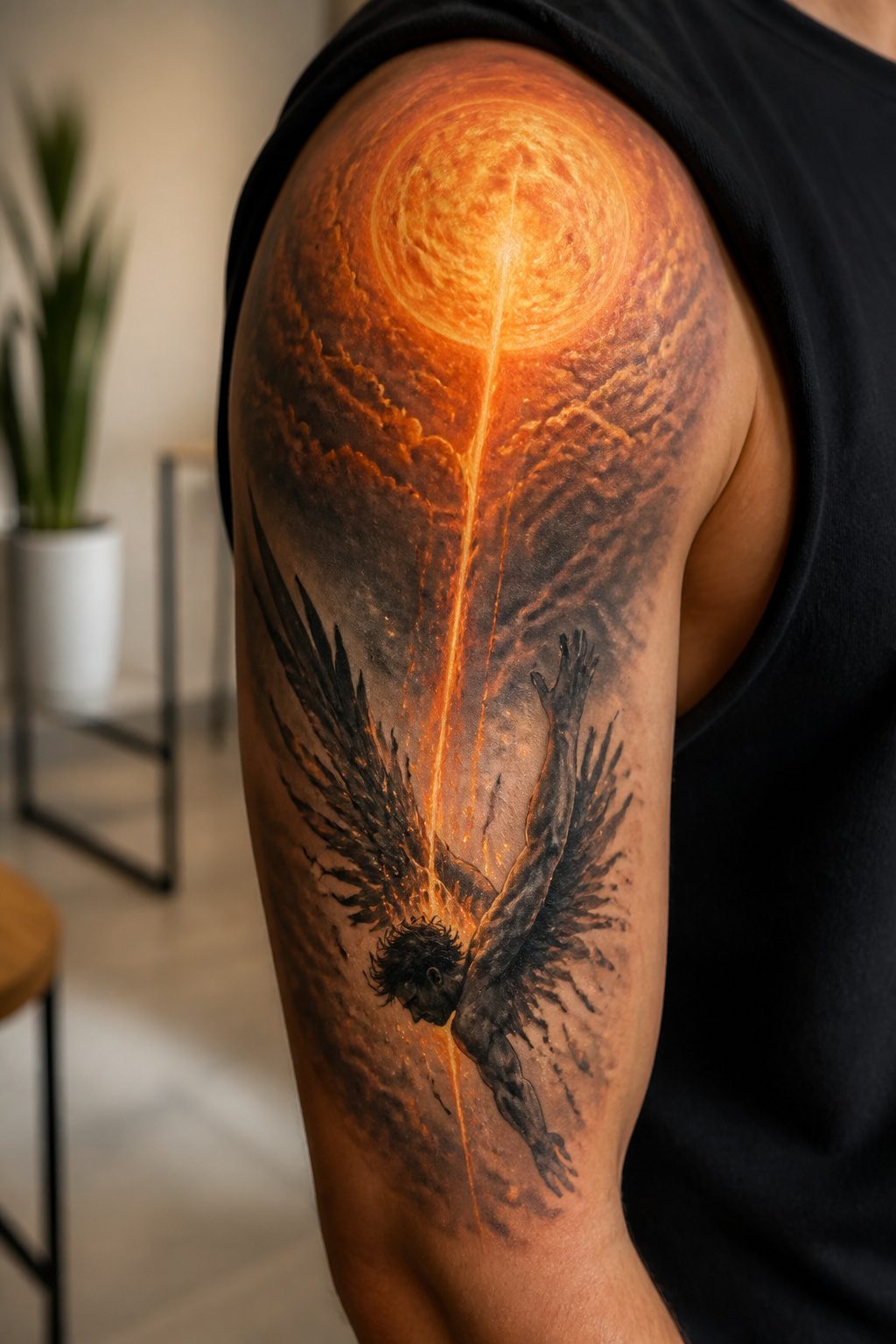
The sun in these pieces does not sit quietly in the background. It pushes forward, the radiance itself becoming the trap, so the eye reads the tattoo from light to dark instead of figure to ground. Icarus falls beneath a sun that fills the shoulder or upper arm, with rays spreading outward and feathers drifting in the space between. The molten streak connecting the figure to that brightness makes the failure visible: ambition drawn as a line you can follow from wax to flame. Bright orange against deep black shading gives the composition its tension, and the size of the sun relative to the body means this design needs real estate. A forearm will not hold it; the shoulder or a full back panel gives the rays room to spread without crowding the fall. The result reads as grandeur and consequence together, not one after the other.
29. Abstract Angel and Demon Wings Icarus Tattoo
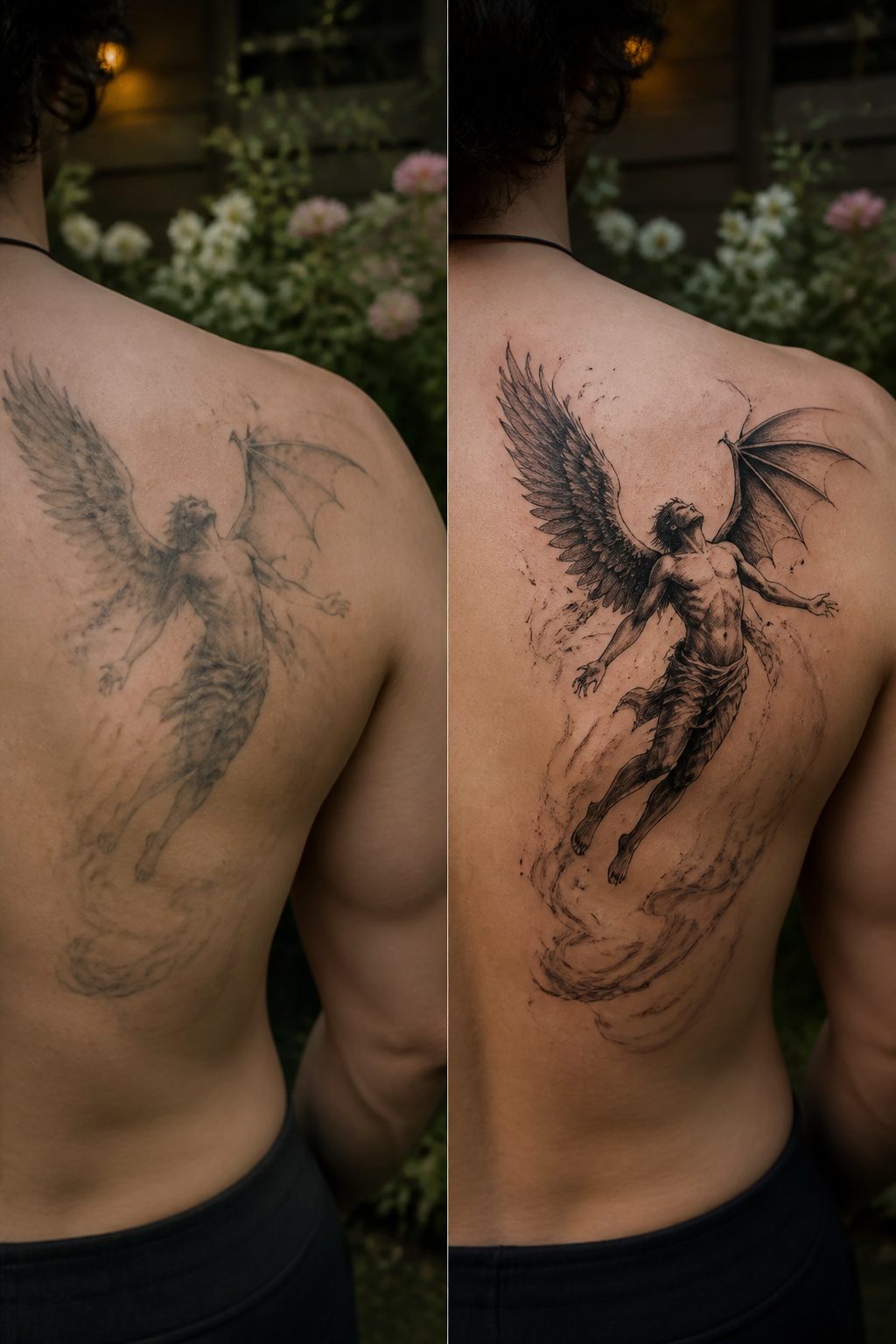
One wing stays feathered and soft while the other turns bat-like and angular, and that split is what makes this design land. The contrast takes an internal conflict, the pull between restraint and reckoning, and puts it right on the skin where anyone can read it. Loose sketch-style shading keeps the whole piece from feeling too literal; the figure drifts somewhere between waking and dream, not quite angel and not quite demon but some third thing that belongs to neither world fully.
The shoulder placement matters here. A span that wide lets the asymmetry breathe, with the dark wing drawing the eye first and the lighter one catching up a half-second later. That delay creates a small narrative in the viewing, which is more than most single-figure tattoos manage. What holds the composition together is the motion implied between the two halves: the body still reads as Icarus mid-fall, not as two separate symbols stitched together. The dreamlike quality comes from the shading, not from softening the contrast; the wings stay sharply different in structure even as the tones around them blur. Someone drawn to this version probably already knows which wing they feel closer to on a given day, and the tattoo’s honesty about that shift is what earns its place.
30. Sacred Geometry Icarus Hand Tattoo
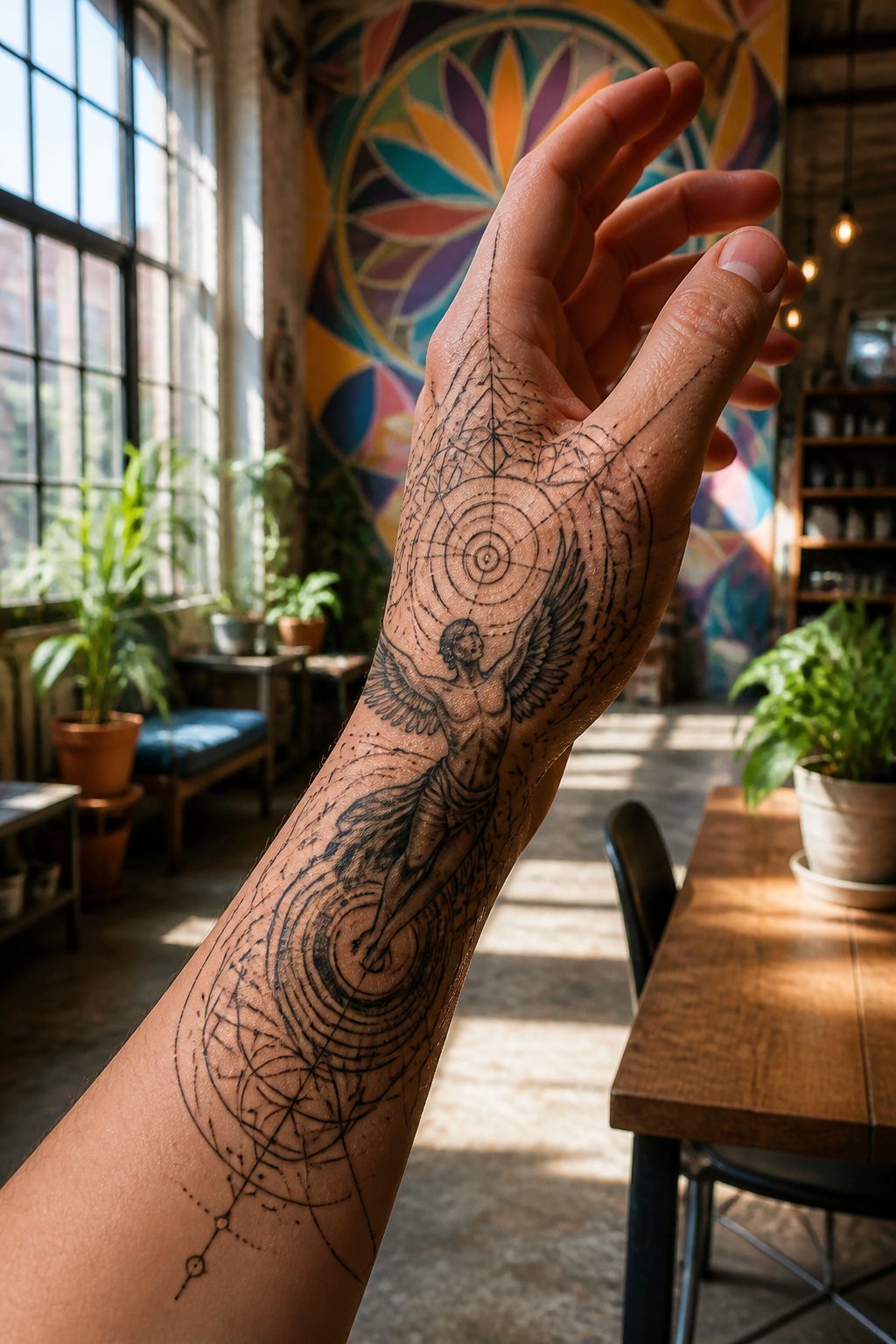
Sacred geometry gives the Icarus myth a frame that feels almost devotional. Grid-like celestial maps and layered mandala forms wrap around the winged figure, turning a story about falling into something closer to cosmic order. The geometry does not decorate; it recontextualizes. Where a standalone Icarus might read as warning, the surrounding shapes suggest pattern, destiny, universal rhythm. The hand placement makes this physically present in gesture, so the design moves with the wearer into every handshake, every reach, every raised palm. Flowing onto the wrist, the composition stays continuous rather than trapped in one static view. Moon phases or orbital circles can extend that celestial language if the wearer wants the astronomical register stronger, though the core geometry already carries enough weight on its own. Scattered feathers breaking the symmetry introduce the necessary vulnerability; without that slight disorder, the piece risks feeling like a diagram instead of a fall. The hand commits fully. There is no hiding it, no rolling a sleeve down. That visibility is the point: the myth becomes part of how the wearer moves through ordinary space, not a private symbol but a performed one.
31. Abstract Geometric Icarus Tattoo
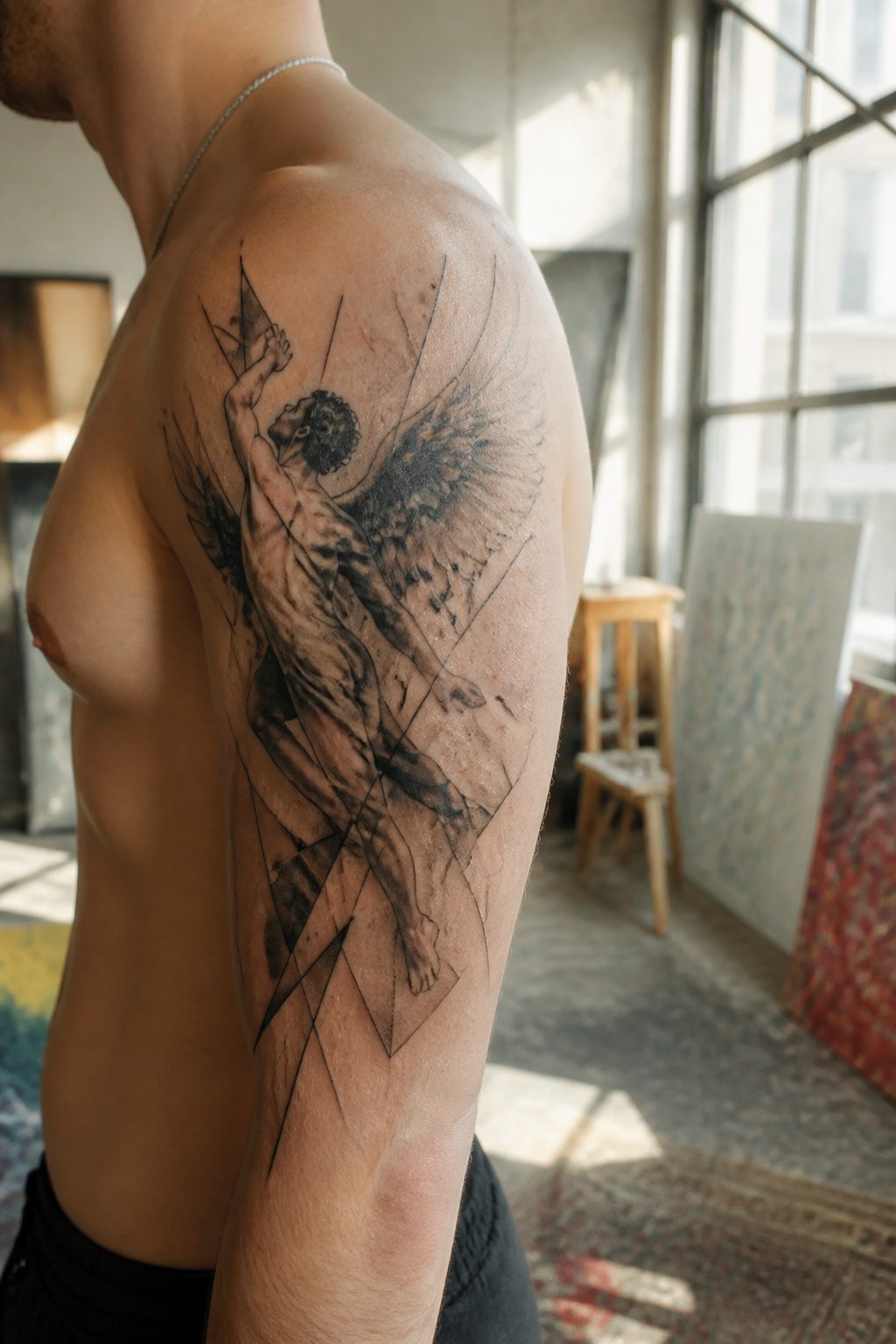
Sharp angles and curved orbital lines wrapped around a realistically rendered Icarus create the real tension here. Two visual systems are deliberately at odds: the figure’s detailed anatomy and feathered wings stay grounded in recognizable form, while floating geometric shapes and negative space around him suggest motion through something larger and more abstract than a simple fall. The shoulder placement gives the composition room to breathe, letting the eye travel from the human detail outward into the mathematical framing. What works is that neither system wins. The geometry does not decorate the realism, and the realism does not anchor the geometry; they collide, which keeps the eye moving the way the design intends. Negative space is what saves the figure from getting lost in that collision, preserving the focal point without softening the contrast. The result reads as mythology filtered through modern art rather than myth illustrated in a modern style, and that distinction matters for anyone considering how long the concept will hold up.
32. Fallen Icarus Memorial Tattoo
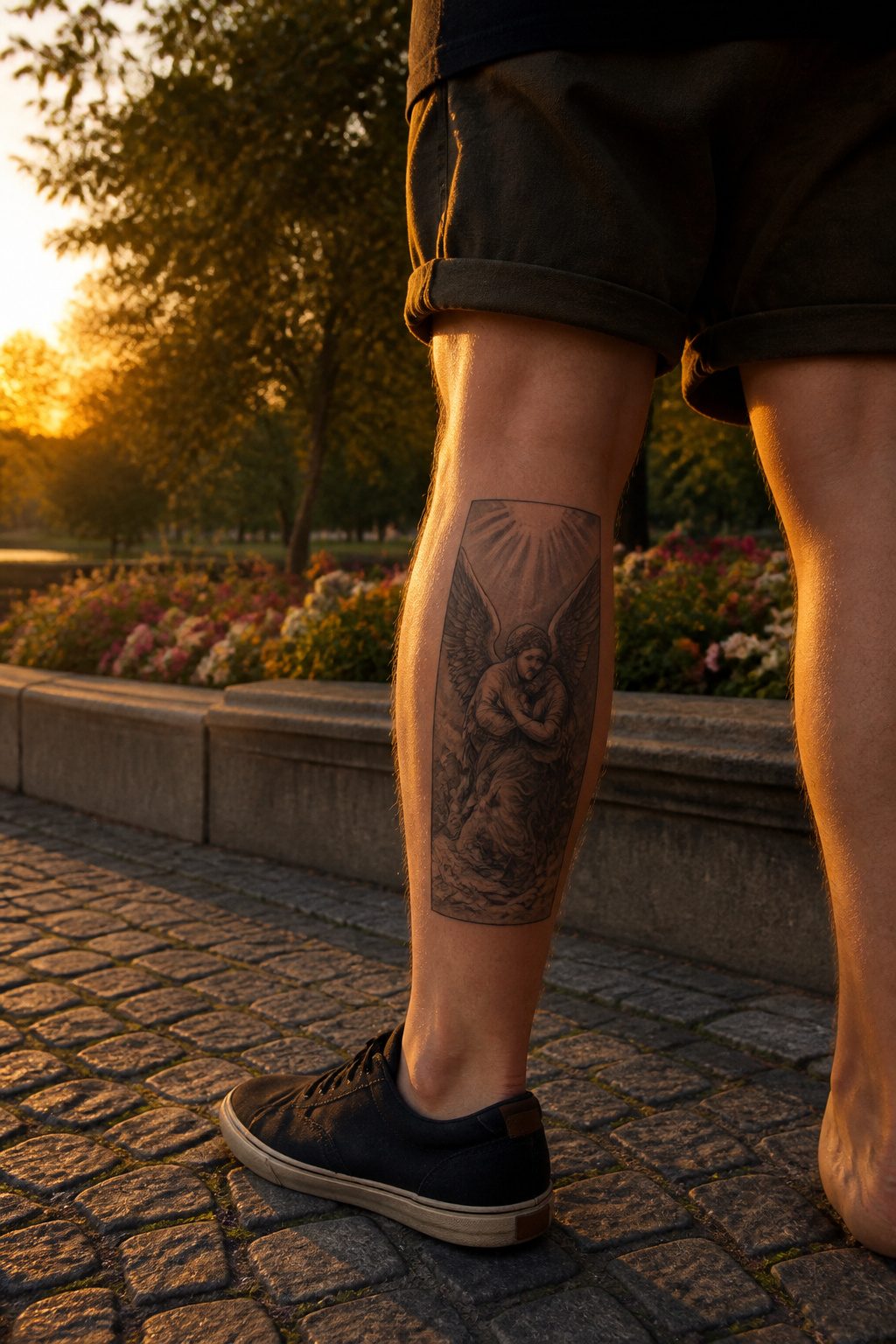
A fallen Icarus memorial tattoo shifts the myth away from the moment of flight and toward what comes after. The figure lies still, cradled by a winged companion whose feathers wrap around him like a protective embrace. A rectangular backdrop frames the scene like a classical painting, giving the composition the weight of something hung in a gallery rather than inked on skin. The tone is not cautionary but compassionate, transforming the story from one about ambition into one about loss and remembrance. Some artists draw heavily from Renaissance-inspired imagery, with large wings stretching outward while graceful figures surround the fallen Icarus. Every feather and fold of fabric contributes to a serene, almost heavenly atmosphere that softens the tragedy rather than exploiting it.
33. Delicate Classical Mourning Icarus Tattoo
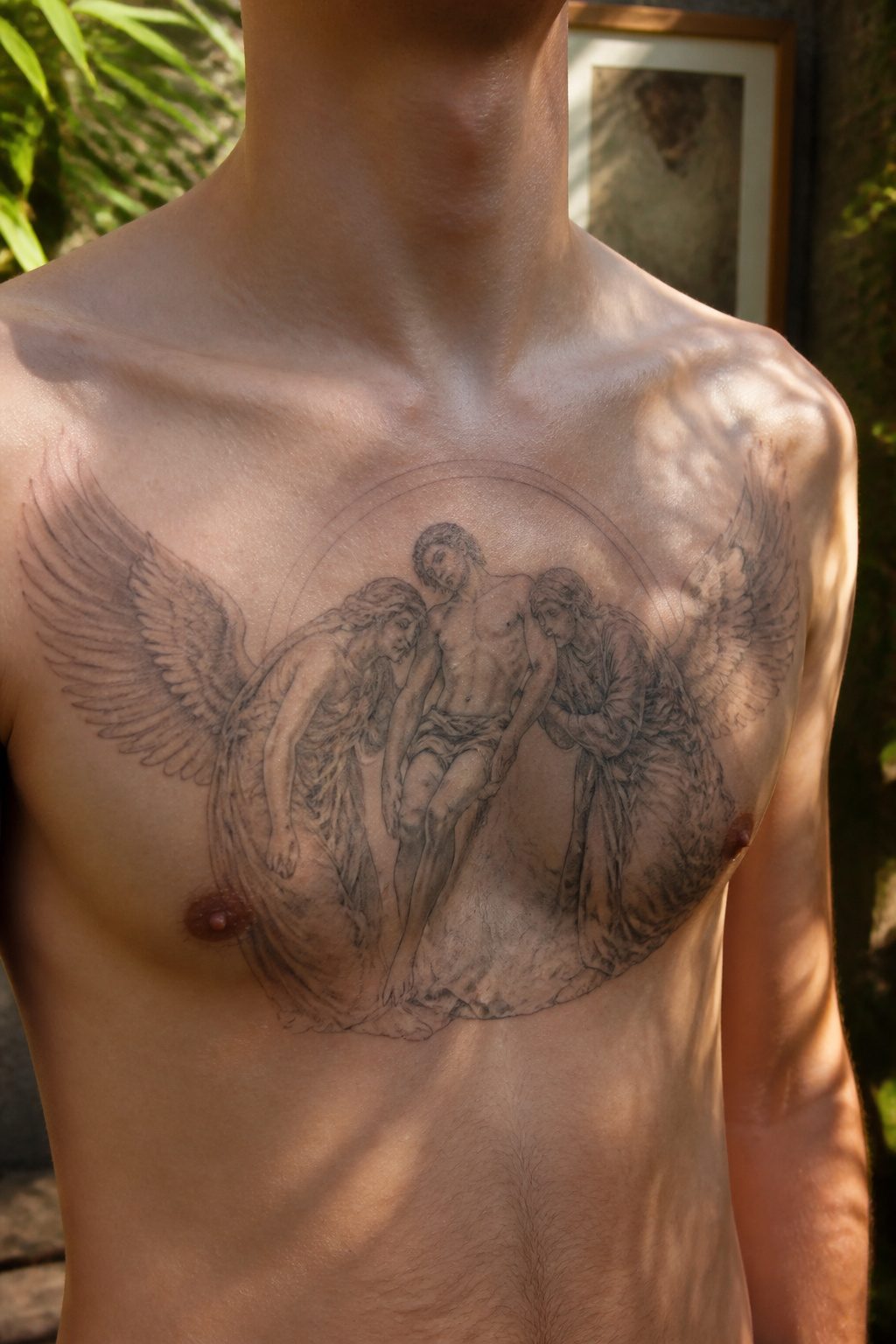
Renaissance softness turns the Icarus myth into something you can carry without flinching. The chest piece that convinced me this approach works shows large wings stretched outward, graceful figures gathered around the fallen body, every feather and fold of fabric arranged so the scene reads as comfort rather than abandonment. Delicacy here serves mourning directly: the gentler the line work, the more room the grief has to breathe. Beauty contains the tragedy instead of shouting over it. The old masters understood this balance, and tattooers who borrow from them are not softening the story to make it pretty. They are admitting that loss feels almost heavenly when someone stays beside you through it. That serene atmosphere is the point.
34. Melting Golden Sun Icarus Tattoo
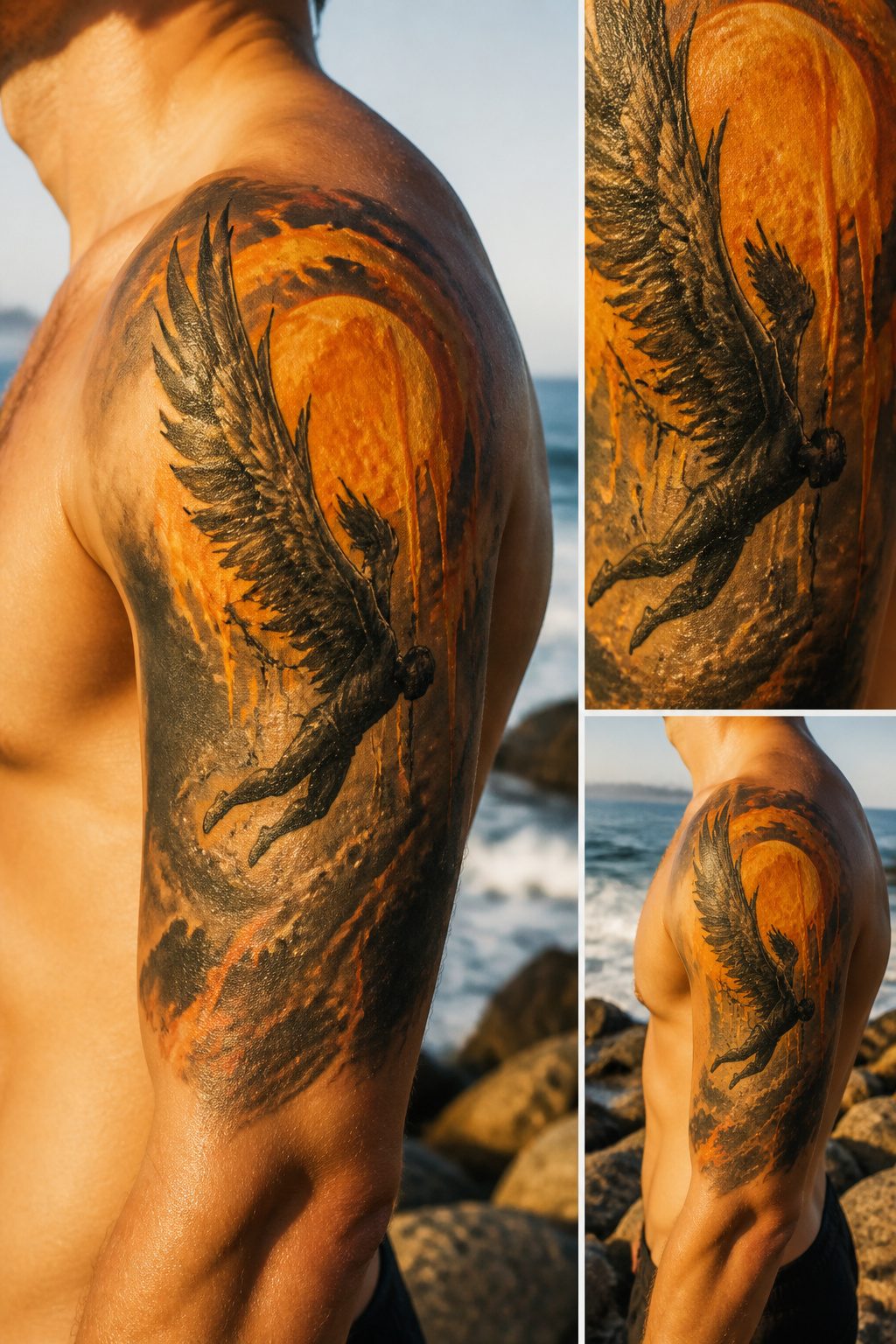
The blazing golden sun dominates this composition, becoming both the destination and the danger. A dark silhouette of Icarus tumbles beneath it while a molten streak visually connects the figure to the celestial body above. The contrast between bright orange tones and deep black shading creates immediate drama without needing extra ornament.
Vertical streaks of gold above the body read as sunlight, heat, or melting wax descending with him. The warm palette adds a richness rarely seen in traditional Icarus tattoos and gives the myth a more celestial appearance than the usual greyscale fall. What works here is the direct line between ambition and consequence: the same gold that lifts Icarus upward becomes the instrument of his undoing. The tattoo focuses on the irresistible pull of ambition and the consequences of getting too close to greatness, letting the visual logic do the moral work instead of spelling it out.
What Icarus Tattoos Mean
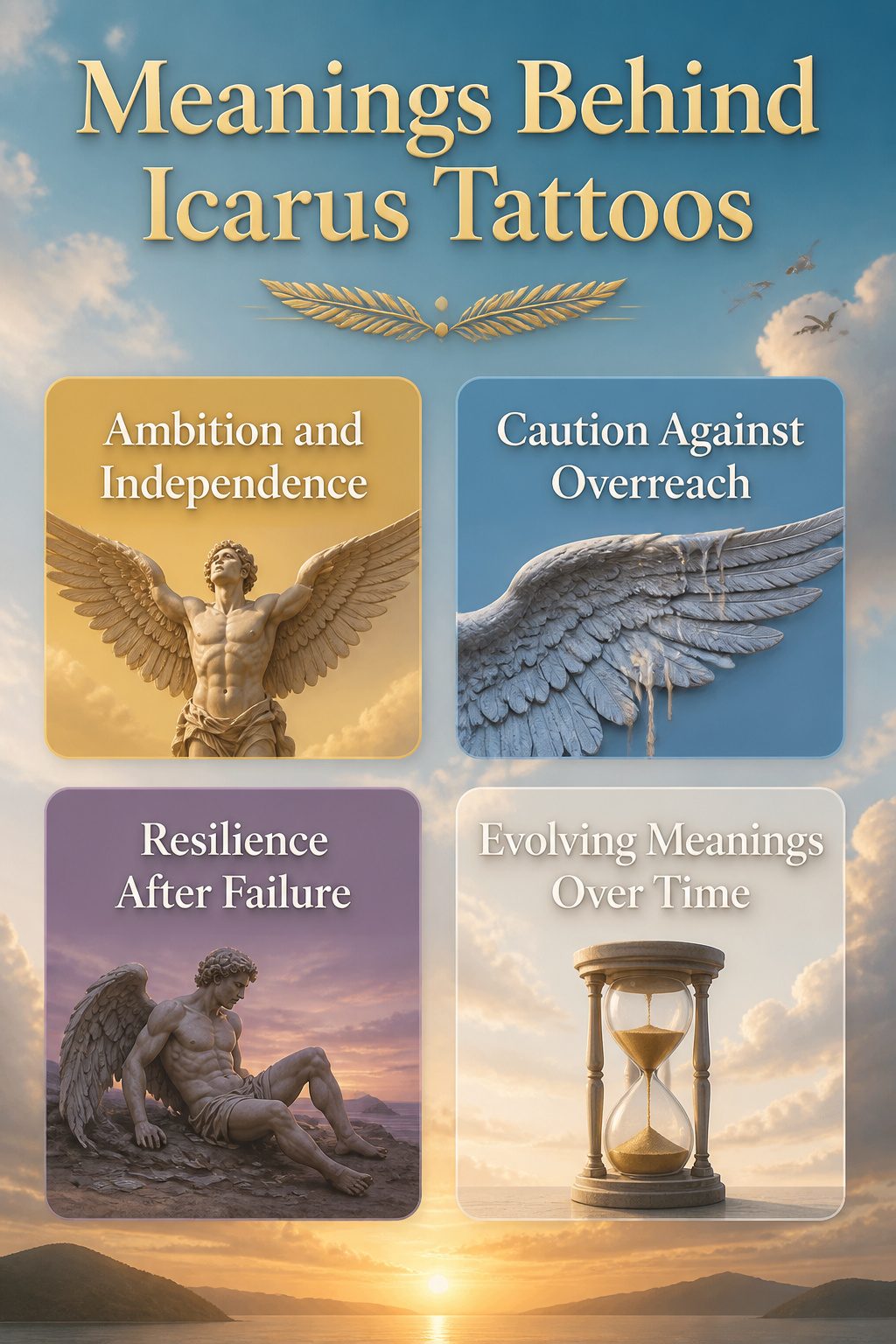
Icarus tattoos carry a tension that keeps them interesting: the ambition to rise and the warning about overreach, held in the same image. The myth itself gives us the line that usually gets quoted, "The higher we soar, the farther we have to fall," and the flight itself stands in for human ambition and the pursuit of the impossible.
What draws someone to the design varies. One person sees the wings as independence, the refusal to stay grounded. Another reads the melted wax as caution, a reminder to check the limits before burning out. A third might focus on the fall itself, on getting back up after the crash. The tattoo works because the myth does not resolve the tension; it just presents it. You choose which side to lean toward.
The popularity comes from that openness. A design with narrative weight needs room for the wearer to shift their reading over time. Icarus gives that. The same ink can mean striving at twenty and resilience at forty without the symbol itself changing.
Placement and Visibility

Where an Icarus tattoo sits changes what it says to you every morning and what others read from it. A chest placement turns the figure into a broad, deliberate statement: the pectoral plane holds a rising or falling form with almost architectural stability, and the wings stretch across bone rather than soft tissue. The daily sight line matters too. You see a wrist piece while typing, washing hands, reaching for keys; it functions as a private checkpoint, a small reminder of limits without the performance of display. The back offers the largest canvas for a falling trajectory, letting the spine’s natural verticality echo the plunge, though you surrender the easy self-view that makes a tattoo part of your own ritual.
Body contours reshape the geometry of the myth itself. Curved surfaces distort straight lines; a geometric grid that reads as celestial order on a flat sketch warps around a bicep or the hollow of a hip. The wrist-to-hand flow, where a design travels from the narrower bone onto the broader back of the hand, creates continuity that flat placement cannot match. Color carries differently as well. Bright orange or yellow holds its energy against most skin tones but can flare into visibility you did not plan; cooler blues and greens settle back, reading as atmosphere rather than alarm. The same palette reads louder on a wrist, where skin shifts and thins, than on a chest buffered by thicker tissue. A tattoo artist can map how pigment sits against your particular undertone, but the location sets the terms before ink ever touches skin.
Design Styles That Hold Up
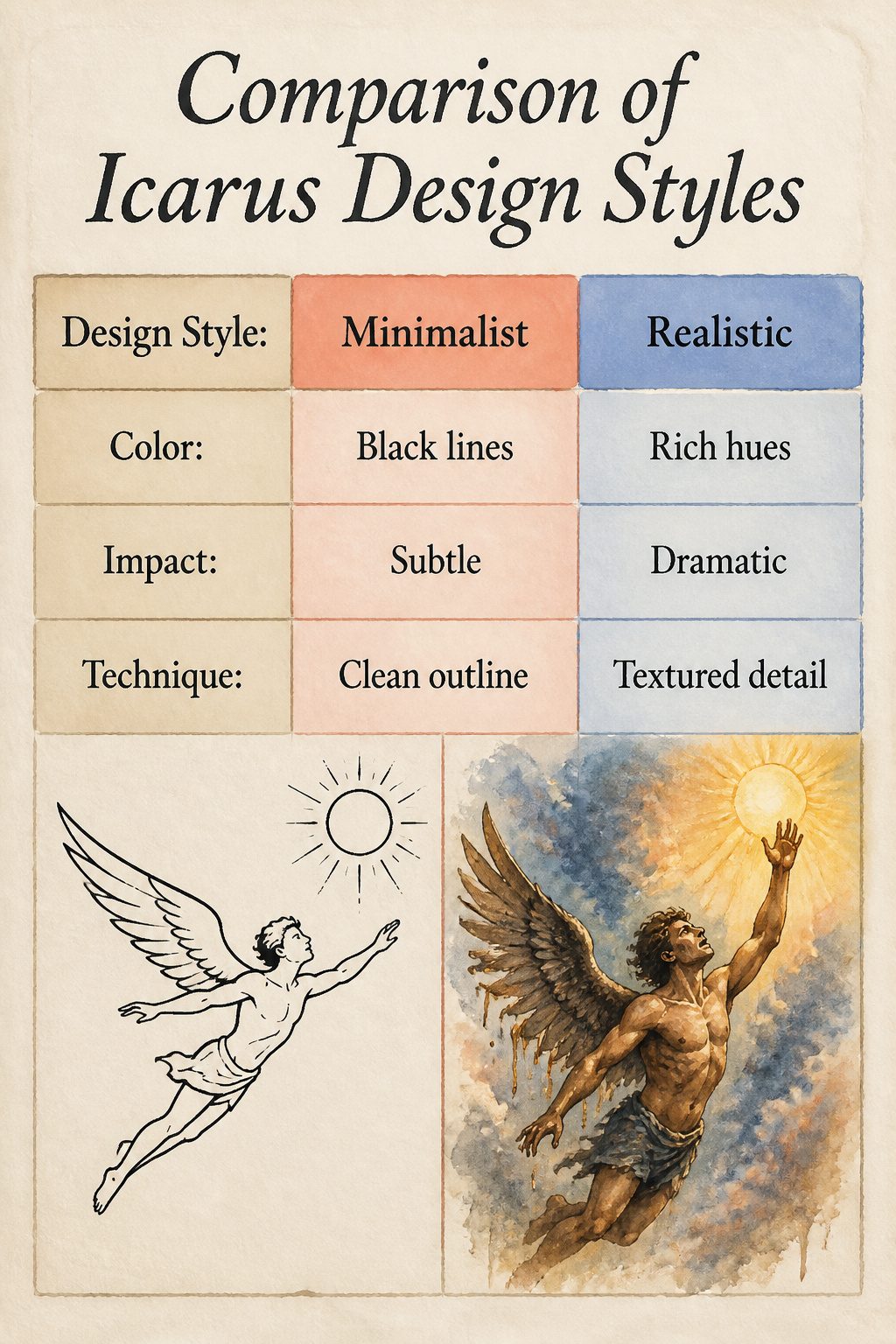
Minimalist silhouettes strip the myth down to clean black lines, often just Icarus in flight against a bare background. The result reads subtle on a wrist or the back of a neck, and the image still carries the whole story because the wings and the sun are already built into what people recognize. A skilled artist can push the opposite direction, layering feather texture and the strain in Icarus’s face until the moment of melting feels physically present. That realism works especially well for the fall itself, the scorching sun just outside his reach, radiating tension across the composition.
Watercolor techniques give the design a dreamlike, painted-onto-skin quality that suits the myth’s cloud-soaring imagery. Hues blur into one another, and the piece can drift into surrounding work without hard borders. For anyone wanting the narrative spelled out, lines from the myth thread through any of these approaches. "The higher we soar, the farther we have to fall" turns the image into a direct statement about hubris and consequence.
Frequently Asked Questions
What does an Icarus tattoo mean?
An Icarus tattoo usually speaks to ambition and the deliberate risk of reaching past your limits. The myth gives the design weight beyond pure decoration; it can warn against hubris, honor the attempt itself, or mark a chosen fall rather than an accidental one. The exact meaning shifts with the details you add: a sword turns the descent into sacrifice, a crown makes the fall about status lost, and golden wings let the power linger even as the figure drops.
What does Icarus fall symbolize?
The fall symbolizes the moment when ambition meets its hard limit, though the tattoo version rarely stops at simple punishment. In the classic telling it is hubris and disobedience, but the designs above reframe it constantly: chosen consequence, witnessed collapse, or even necessary failure inside a larger cycle. The blackwork sword variant makes the fall a ritual the figure walks into; the geometric moon phase version places it inside repeating time rather than a single catastrophe.
What makes the Icarus tattoo design so popular?
The design stays popular because the myth carries enough layers to suit almost any personal reading: freedom, warning, ambition, or the beauty of the attempt itself. Modern styles keep refreshing it. Blackwork gives the figure statue-like weight, fine line keeps the composition airy and intellectual, graffiti styling strips away museum dust, and geometric frameworks let the fall argue with cosmic order. That flexibility means the same story can read as cautionary tale or as celebration of reaching, depending on the wearer.