
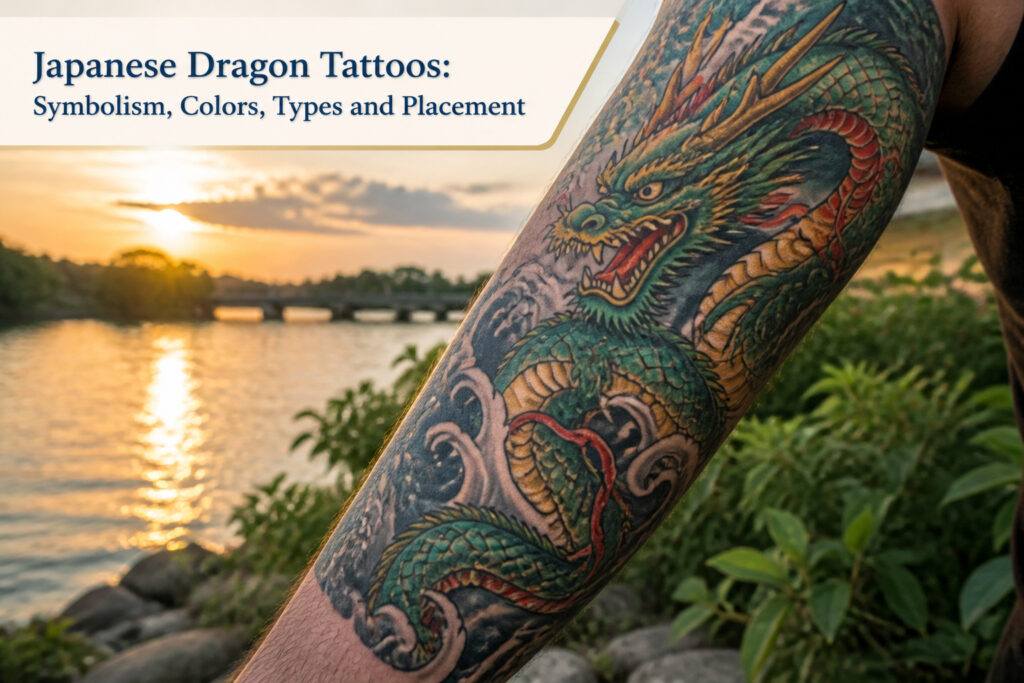
A Japanese dragon tattoo is a specific creature with specific rules, not merely a dragon drawn in an Asian style. The Eastern Ryū carries water, rain, and wind rather than fire, and that single change rewrites every meaning on the skin. Three claws mark the Japanese form, not four or five, and a five-clawed dragon reads as Chinese tradition to anyone who knows the difference.
What Japanese Dragon Tattoos Mean
Japanese dragons carry a different temperament than the fire-breathing hoarders Western stories gave us. The Eastern version, known as Ryū, is a benevolent creature tied to water, rain, and wind, and that distinction changes every meaning layered onto the skin.
Strength and courage come first in most readings, though the Japanese form pairs that power with compassion rather than domination. Wisdom and intellect follow closely; dragons are thinkers, not merely muscle. Protection and guardianship run through the tradition as well, with dragons serving as active defenders rather than threats to be defeated.
The link to good fortune and prosperity connects to their water association, since rain governs harvests and survival. Transformation and personal growth emerge from the dragon’s fluid, ever-shifting form, its body able to move between states and spaces. Balance and harmony round out the set, a meaning reinforced by the historical path these tattoos traveled from Buddhist art out of China into Japanese practice.
That Buddhist origin matters. The imagery arrived with religious teaching, not as mere decoration, and the dragon’s six core meanings still carry that weight of something intended as spiritual shorthand. A tattoo chosen for one meaning usually ends up wearing several, whether the wearer planned it or not.
What the Colors Say
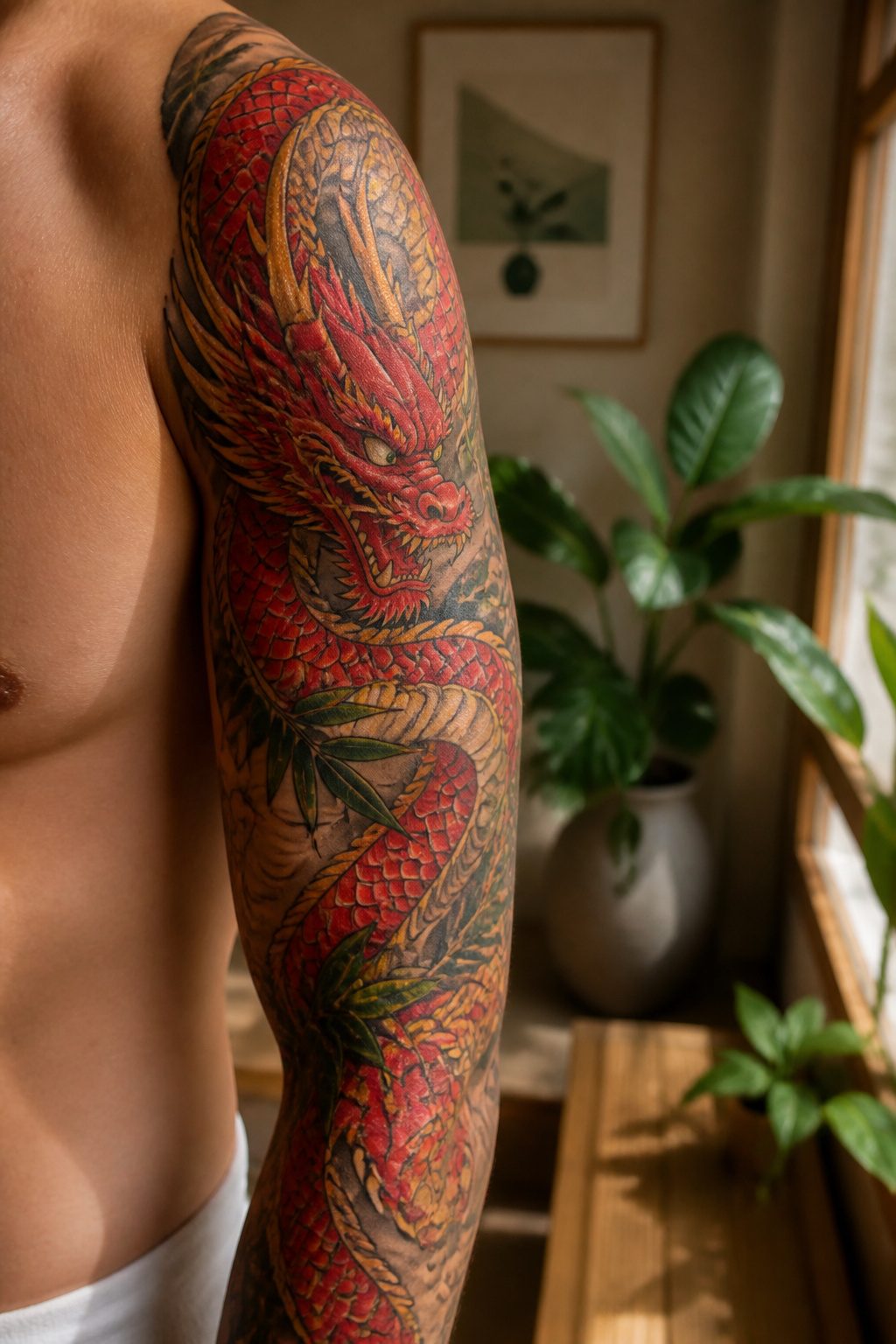
Color turns a Japanese dragon from a general symbol into a personal statement, and the palette is narrower than most people expect. Black dragons carry the weight of wisdom and experience, the kind earned rather than claimed. Red splits in interesting ways: strength and passion sit at the center, but some readings fold in love and compassion, which shifts the tone from warrior to protector depending on what the wearer wants emphasized. Blue keeps to serenity and forgiveness, a gentler register that still holds power. Green anchors to nature and renewal, the cycle rather than the climax. Gold claims prosperity and divine power, the most outward-facing of the choices. Yellow, less common in Western dragon imagery, holds knowledge and self-confidence, a quieter claim that reads as earned authority rather than displayed wealth. The gap between what a color means in Japanese tradition and what a casual viewer might guess is usually wide; a dragon that reads as aggressive to one eye might signal benevolence and forgiveness to another.
The Six Types of Japanese Dragons
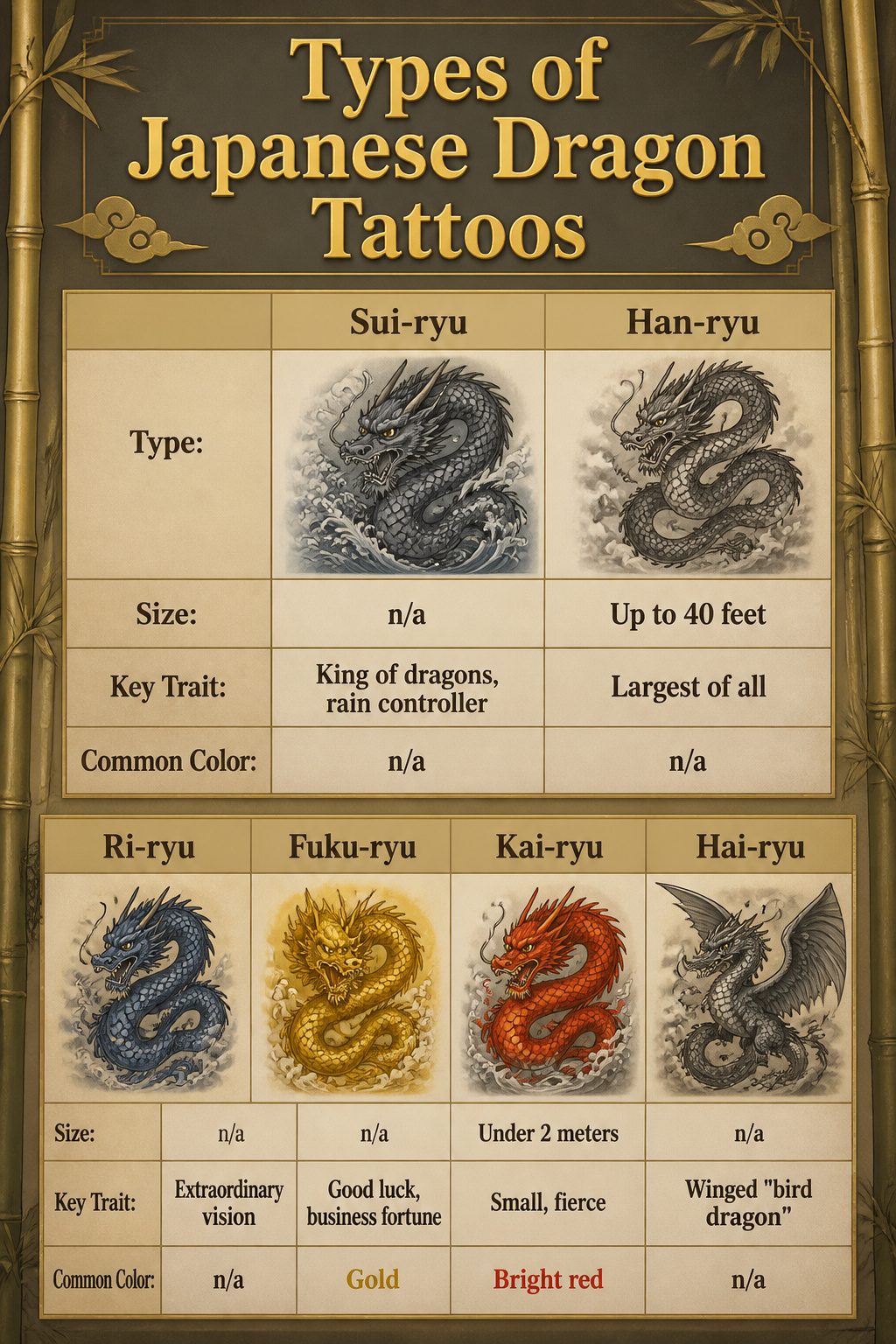
Japanese dragon tattoos draw on six distinct types, each carrying its own weight in a design. Sui-ryu sits at the top as king of dragons, controlling rain and weather. Han-ryu scales the other direction in sheer size, stretching up to 40 feet. Ri-ryu remains the rarest sight in ink, prized for extraordinary vision. Fuku-ryu handles the luck, typically rendered in gold and kept by shopkeepers. Kai-ryu runs small and fierce, often shown in bright red under two meters. Hai-ryu carries wings from its Chinese mythology roots, the most advanced form.
The claw count separates Japanese from Chinese depictions. Japanese dragons show three claws. Chinese dragons carry four or five.
| Type | Size | Key Trait | Common Color |
|---|---|---|---|
| Sui-ryu | n/a | King of dragons, rain controller | n/a |
| Han-ryu | Up to 40 feet | Largest of all | n/a |
| Ri-ryu | n/a | Extraordinary vision | n/a |
| Fuku-ryu | n/a | Good luck, business fortune | Gold |
| Kai-ryu | Under 2 meters | Small, fierce | Bright red |
| Hai-ryu | n/a | Winged "bird dragon" | n/a |
A tattoo artist working Japanese style should know the three-claw rule by hand. Mixing in a five-clawed dragon reads as Chinese tradition to anyone familiar with the distinction, not a blend but a slip.
Where the Tattoo Goes
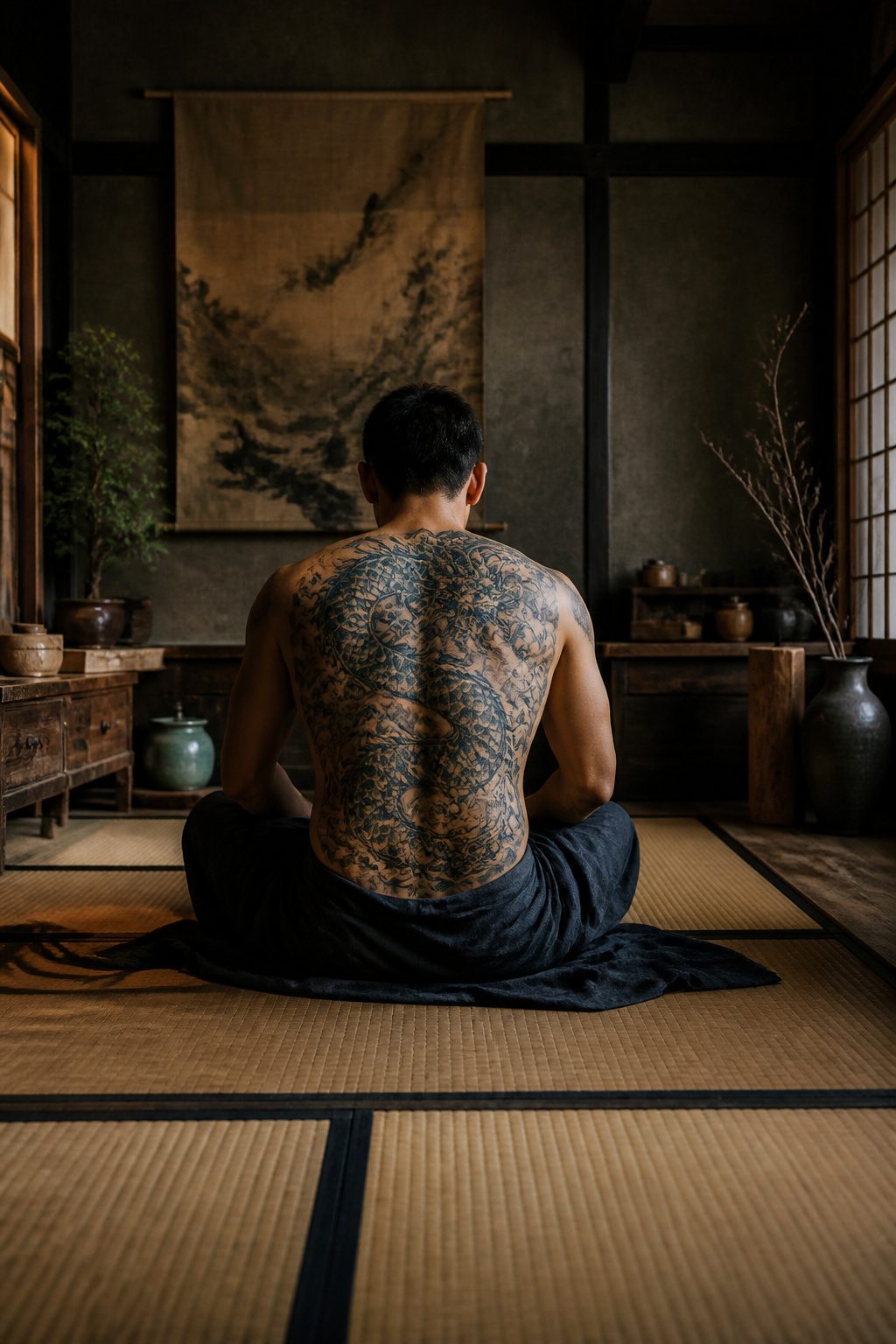
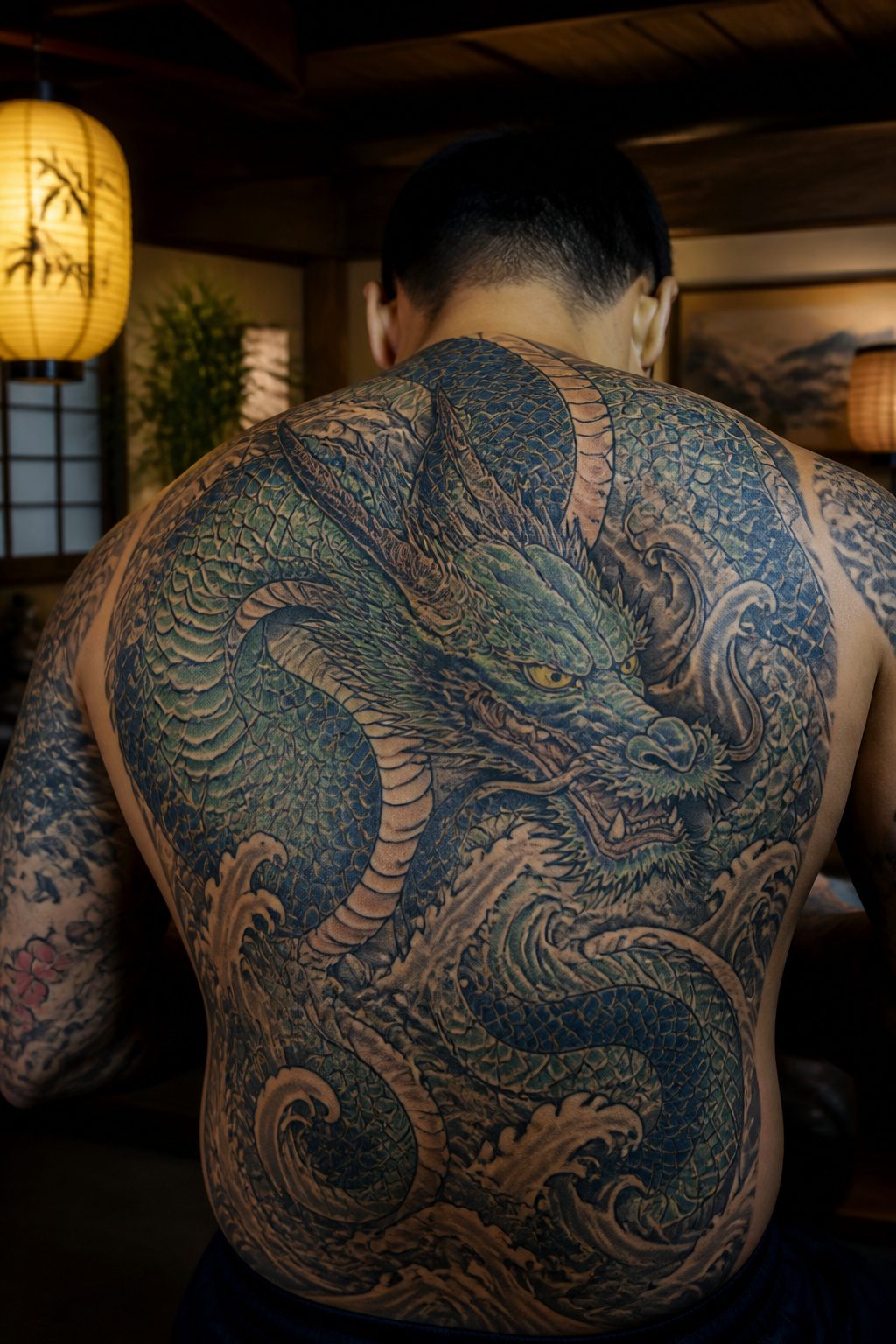
The full back remains the placement that lets a Japanese dragon breathe. The canvas is large enough for the full body, the claws, the wind bars, and the scales in detail that smaller areas simply cannot hold. A back piece can read as a guardian spirit watching over you, which is one reason the design has stayed popular across decades.
Sleeves and chest panels follow close behind. A sleeve lets the dragon coil around the arm with its natural flow, while the chest offers space to extend the design over the shoulder and down the arm in one continuous piece. Some artists treat the chest as the dragon’s vantage point, the eyes looking out as if guiding the wearer.
The ribcage and thigh work for those who want the motif without committing to the most visible real estate. The ribcage in particular follows the body’s long lines, though the bone makes the sitting tougher. Thigh pieces keep the option of coverage while still giving the artist room for a complete dragon form rather than a cropped segment.
Design Elements That Add Meaning
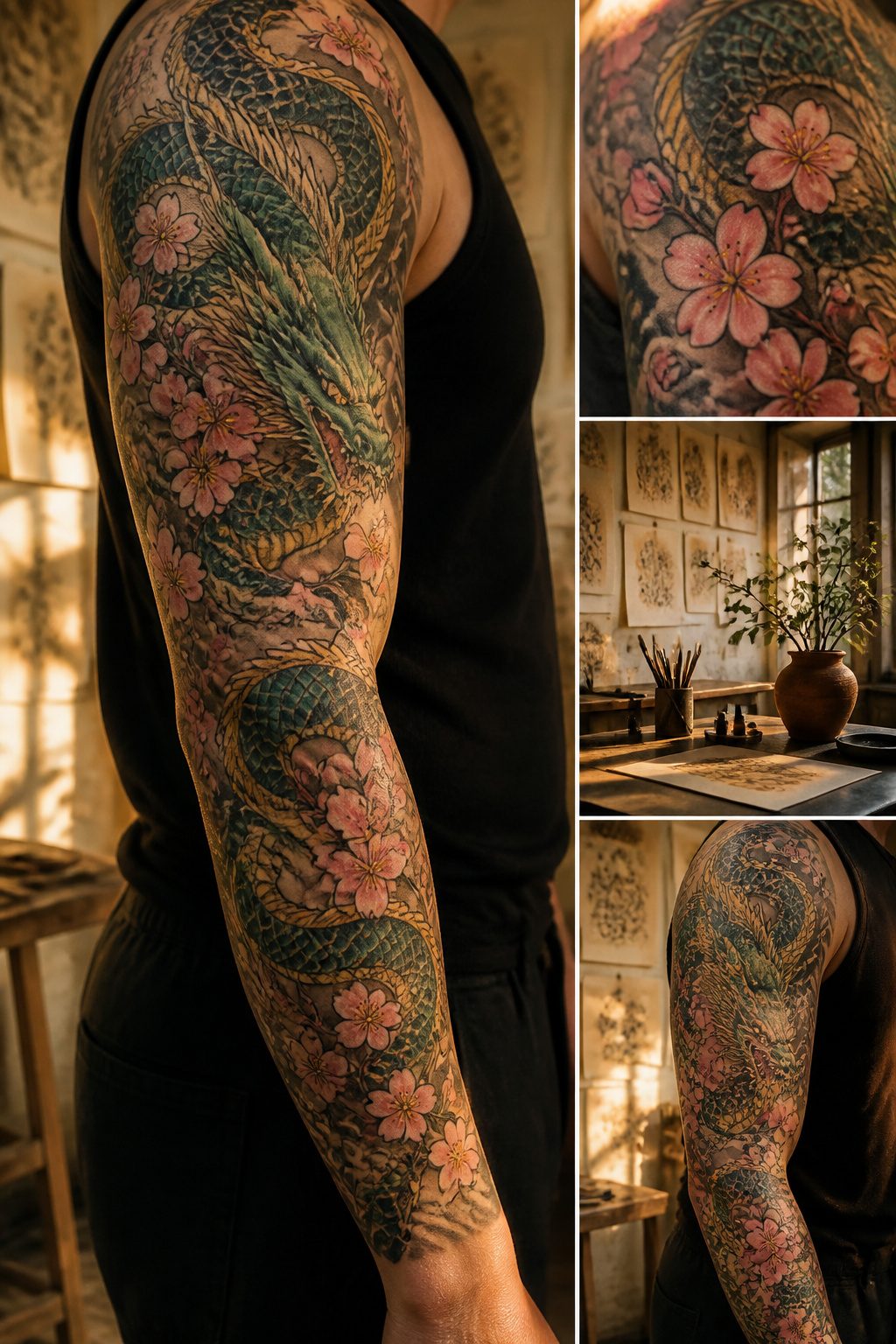
A Japanese dragon tattoo rarely flies alone. The symbols around it change the story as much as the dragon itself, and getting that pairing right matters more than most people realize at first.
Cherry blossoms are the pairing I see most often, and the contrast is deliberate. The dragon carries strength and wisdom; the blossom carries the shortness of a single life. Together they create a tension that neither achieves alone: power held against fragility, the reminder that even the strongest force operates inside something passing. Without the blossoms, the dragon is simply powerful. With them, it becomes a reason to notice what you have while it lasts.
Clouds and waves serve a different purpose. Japanese dragons stay connected to water, wind, and rain, so the background isn’t decoration; it is the dragon’s proper home. A dragon soaring through clouds reads as a guardian figure, benevolent, bringing fortune. One emerging from waves carries that same protective energy but tied more directly to natural force. The pearl that sometimes appears with Japanese dragons, unlike the flames you might see around Chinese designs, signals the pursuit of knowledge rather than raw dominance over elements.
The three-toed form marks the Japanese style visually, but the surrounding elements do the narrative work. A dragon with cherry blossoms asks you to consider mortality; a dragon with clouds asks you to consider protection. Same creature, different question. The tattoo’s meaning lives in that combination, not in the dragon isolated on skin.
Traditional, Neo-Japanese, and Realistic Styles
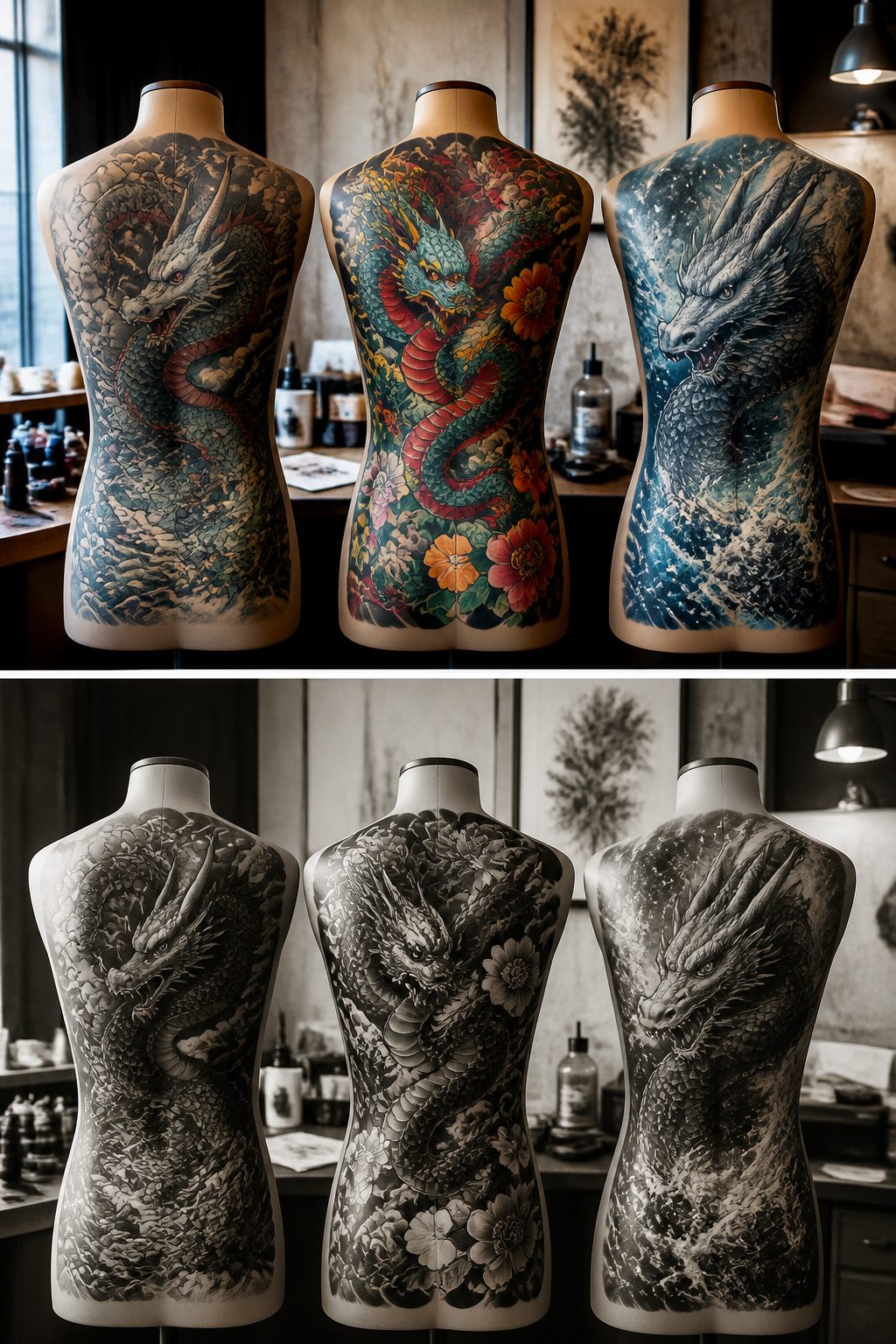
Traditional Japanese dragon work, Irezumi, literally means "inserting ink," a hand-poked method dating back to the Jomon period from 10,000 B.C. to 300 B.C. The technique builds skin-saturating saturation through repeated needle passes, and the dragons it produces follow strict conventions: three toes, not four or five, slender wingless bodies, and settings of clouds or waves rather than flames. The finished piece reads immediately as Japanese because every element was codified centuries ago.
Neo-Japanese loosens those rules while keeping the recognizable grammar. An artist might retain the three-toed dragon and the cloud scrollwork but render them with electric color saturation, mixed media textures, or compositional breaks that traditional work would not allow. The style suits someone who wants the cultural signature visible across a room but needs the design to sit comfortably beside other modern tattoos.
Hyper-realistic Japanese dragons abandon the stylized silhouette entirely. Scales catch light like photography, musculature follows anatomical reference, and the creature might emerge from water with droplets suspended at the snap of a shutter. The three-toe convention often disappears here, or becomes so naturalized that a casual viewer misses it. This approach trades symbolic readability for visceral impact, and it asks more of the skin it occupies: the detail demands larger scale and more sessions to hold, which is why you see it dominate backs and thighs rather than forearms.
Dragons in Yakuza Culture and Beyond
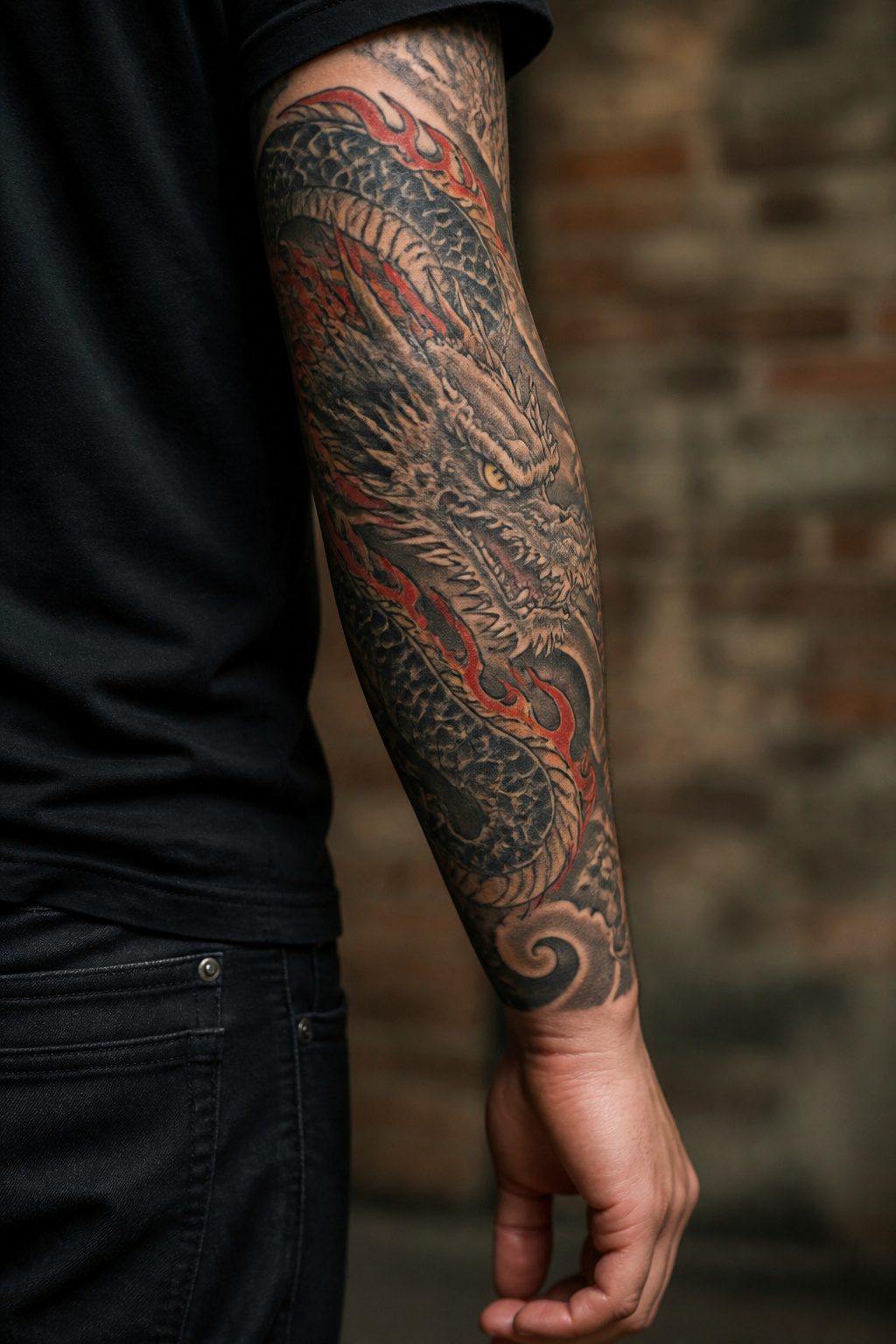
The Yakuza association still shadows Japanese dragon tattoos, though the link is looser than most people assume. Irezumi, the full-body traditional style, was used to mark criminals during the Edo period from 1603 to 1868, which planted the early connection between ink and outlaw status. For the syndicate, a dragon specifically signals wisdom and power, with color carrying its own weight: black for experience, green for nature, gold for wealth. Loyalty to the group is the unspoken message beneath the scales.
That criminal stigma has faded for younger collectors. What drives new interest now is anime, where dragons appear as guardians, rivals, or transformations of the hero. The slender, three-clawed Japanese form reads as balanced and benevolent on screen, not menacing, and that visual language transfers straight to tattoo choices. A client in their twenties often wants the same creature they watched protect a village, not the one that marked a gangster’s back.
The two paths split cleanly. Traditional irezumi still demands the full narrative: placement rules, background elements, years of commitment. The anime-influenced piece borrows the dragon’s shape and skips the social code. Both use the same centuries-old figure, but the meaning attached has shifted from what you prove to others to what you recognize in yourself.
Frequently Asked Questions
What does a Japanese dragon tattoo mean?
A Japanese dragon tattoo represents strength paired with compassion, wisdom, protection, good fortune, transformation, and balance. The creature, called Ryū, is tied to water, rain, and wind rather than fire, which shifts every meaning toward benevolence rather than aggression. Most people choose it for one meaning and end up wearing several, since the symbolism overlaps by design.
What are the different colors of Japanese dragon tattoos and their meanings?
Black signals earned wisdom and experience, red carries strength and passion with room for compassion, blue holds serenity and forgiveness, green anchors to nature and renewal, gold claims prosperity and divine power, and yellow marks knowledge and self-confidence. The gap between Japanese color tradition and Western guesswork is wide, so a dragon that looks aggressive to one viewer might read as gentle to another.
What is the difference between Japanese and Chinese dragon tattoos?
Japanese dragons show three claws, while Chinese dragons carry four or five. Japanese depictions also keep the body slender and wingless, set against clouds or waves rather than flames, and the overall temperament reads as guardian rather than conqueror. Mixing the claw count is a recognizable slip, not a blended style, to anyone familiar with the distinction.
Why do Yakuza have dragon tattoos?
Within Yakuza culture, the dragon signals wisdom and power, with specific colors carrying their own weight: black for experience, green for nature, gold for wealth. The connection started in the Edo period when authorities used tattoos to mark criminals, which later shifted into voluntary ink as outlaw identity. Loyalty to the group sits beneath the surface meaning.
What are the best placements for a Japanese dragon tattoo?
The full back offers the space for complete detail and reads as a guardian spirit watching over the wearer. Sleeves let the dragon coil naturally around the arm, while chest panels allow extension across shoulder and arm in one continuous piece. Ribcage and thigh work for less visible commitments, though ribs make the sitting tougher due to bone proximity.