These galaxy tattoo ideas run from a small wrist piece that hides under a watch band to a full sleeve needing multiple sessions and serious chair time.
The deciding factor is how much skin you are willing to commit and maintain, since watercolor washes on a thigh will shift and need touch-ups while black and grey on a hand demands refresh sessions twice as often as an arm piece.
One design puts a drinking deer at the water line, splitting earth from cosmos at a natural boundary where antlers in solid black silhouette frame the nebula rather than competing with it.
1. Galaxy Space Tattoo
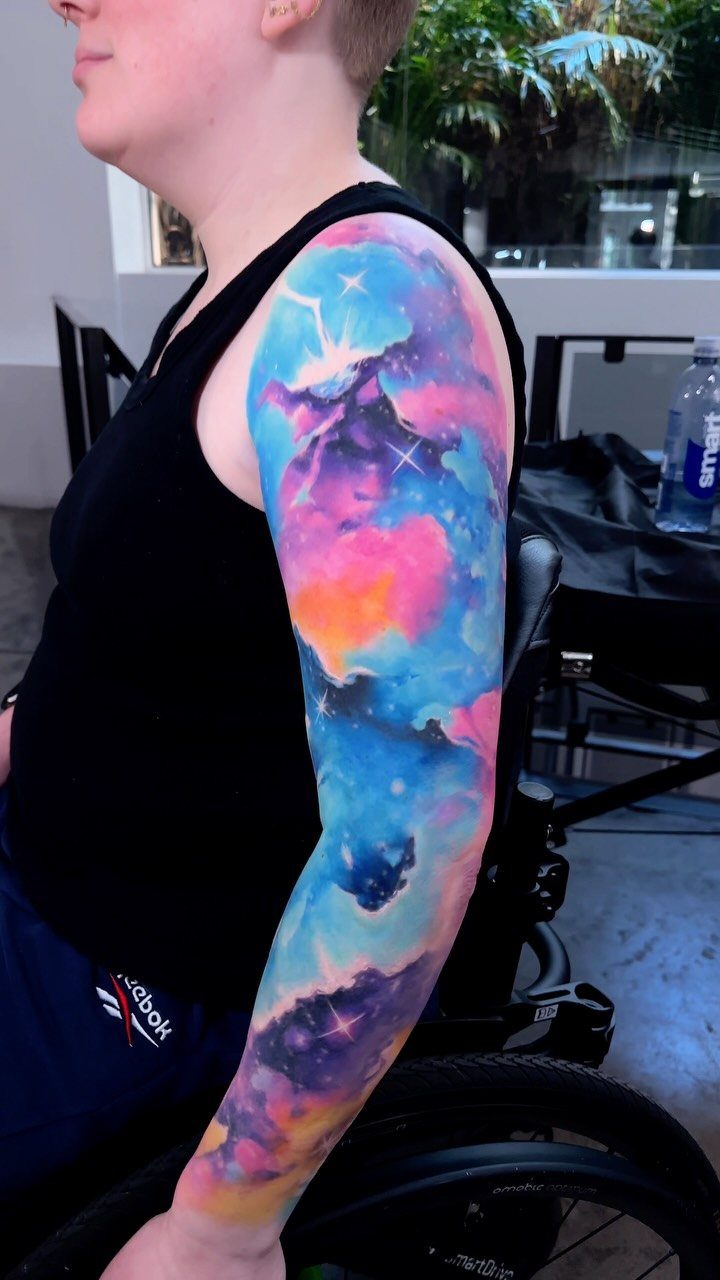
A full sleeve lets the nebula roll across the arm like actual sky, something a smaller placement cannot manage.
Purple and blue wash reads as depth rather than decoration when the colors sit dark at the edges and brighten toward the center, the way gas clouds do.
That gradient takes time, probably multiple sessions, and the white star points heal softer than they look fresh, so the artist needs to pack them in slightly heavier than final intent.
Anyone already covering a limb should consider this; for a first tattoo, the commitment and the chair hours are real.
2. Spiral Galaxy Tattoo
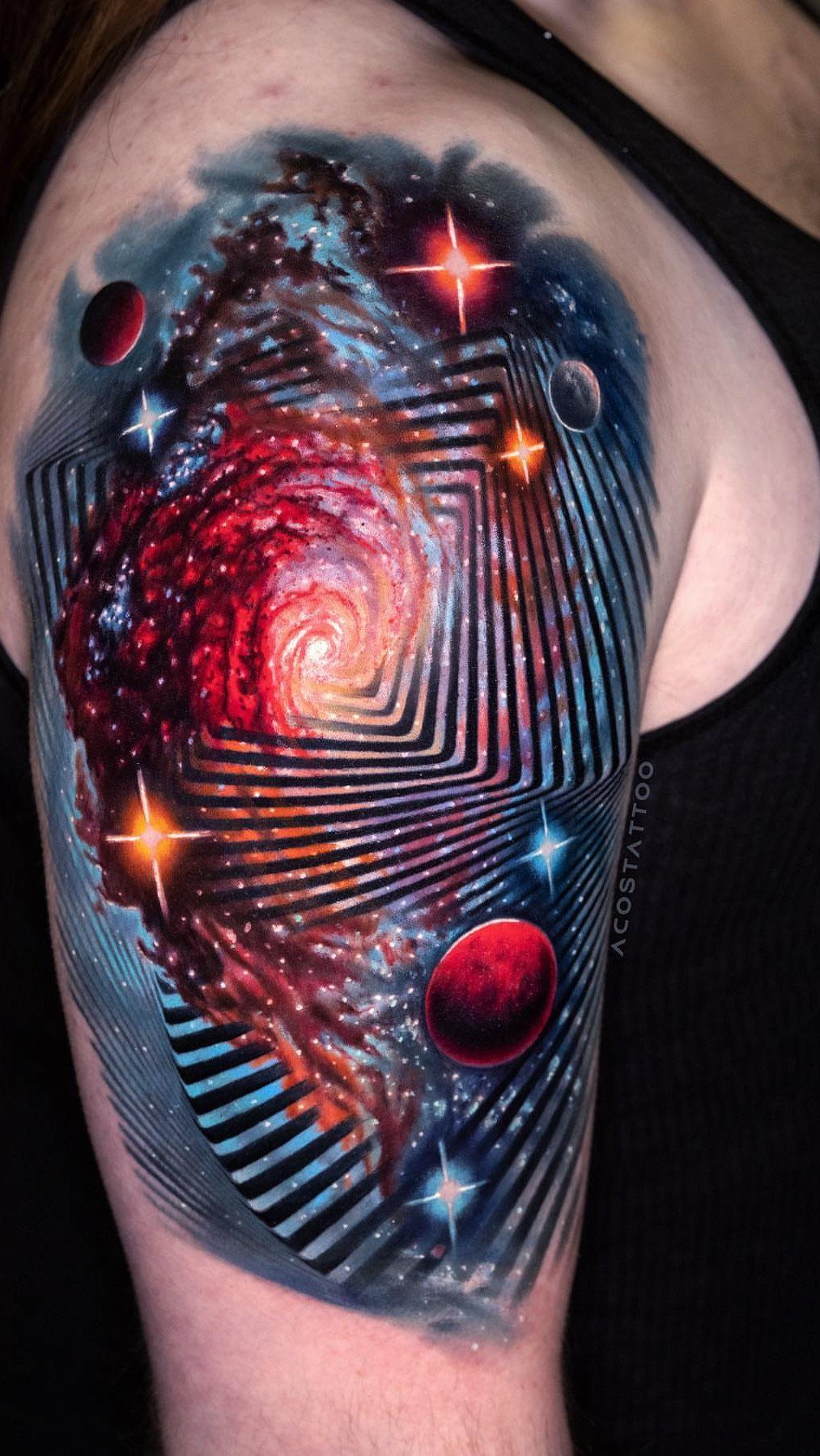
The spiral shape carries its own weight without needing extra symbols. Red and orange swirl against blue, a color split that reads as heat against cold rather than random brightness.
The geometric lines framing it keep the design from floating away into pure abstraction, and they give the eye somewhere to rest.
Blue and black versions trend more subtle, but the two-tone clash here suits someone who wants the shape noticed from across a room.
Self-discovery is a private reason to get marked; this design makes it visible whether the bearer intended that or not.
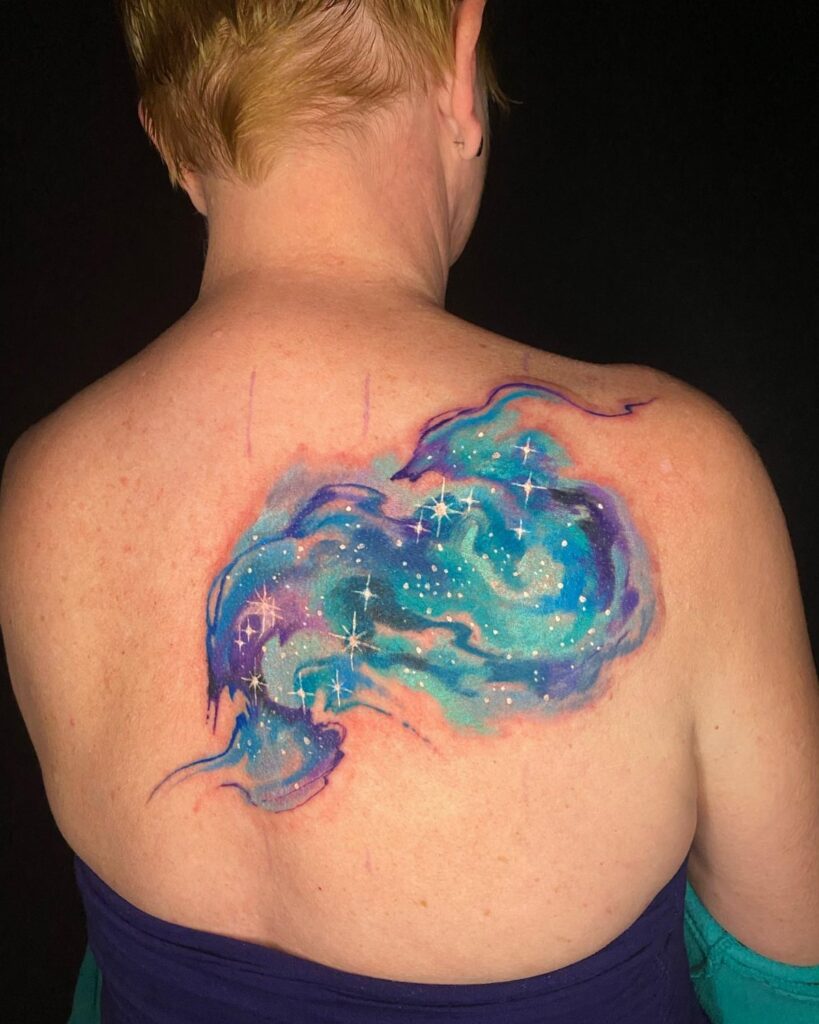
3. Galaxy Watercolors Tattoo
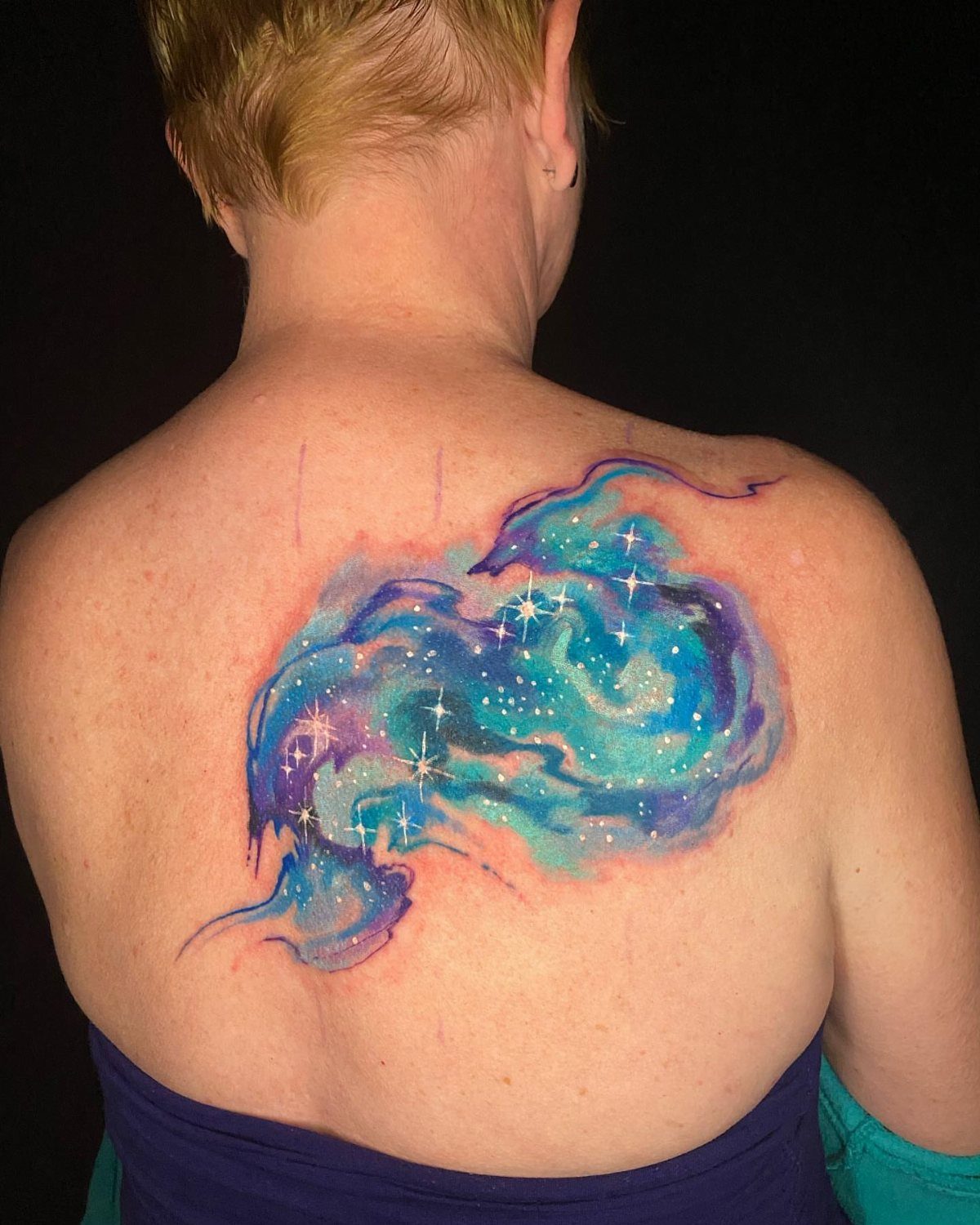
Watercolor technique bleeds pigment at the edges instead of holding a hard line, which means the galaxy looks like it is still expanding.
Teal into purple into pink works because the colors share darkness underneath; without that shared base, they would read as separate patches rather than one cloud.
The back placement gives the artist a flat canvas large enough for the blend to happen at scale. Thigh works too, though the stretch of skin there can shift the wash over time.
Expect touch-ups, especially where the color sits lightest.
4. Galaxy Rose Tattoo
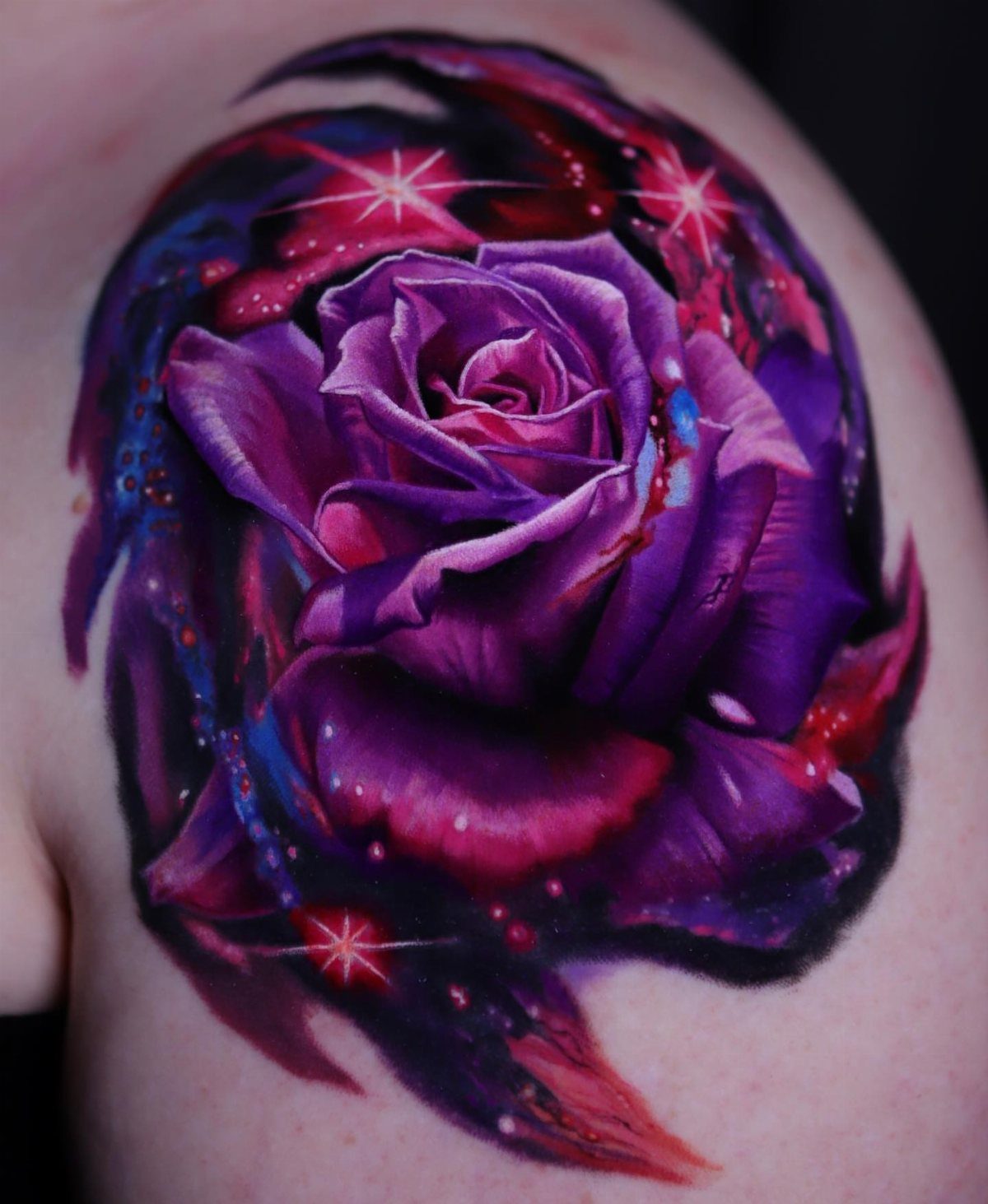
A rose holds still while space moves, and the contrast gives both elements more presence than either would alone.
Purple petals carry enough red undertone to read as living flower rather than graphic symbol, and the nebula behind them stays dark enough that the rose remains the foreground.
This suits someone who wants the cosmic reference without surrendering the whole design to it.
The shoulder cap frames the composition naturally; forearm or calf would need the artist to build the background around the flower differently, more wrap than backdrop.
5. Galaxy Wolf Tattoo
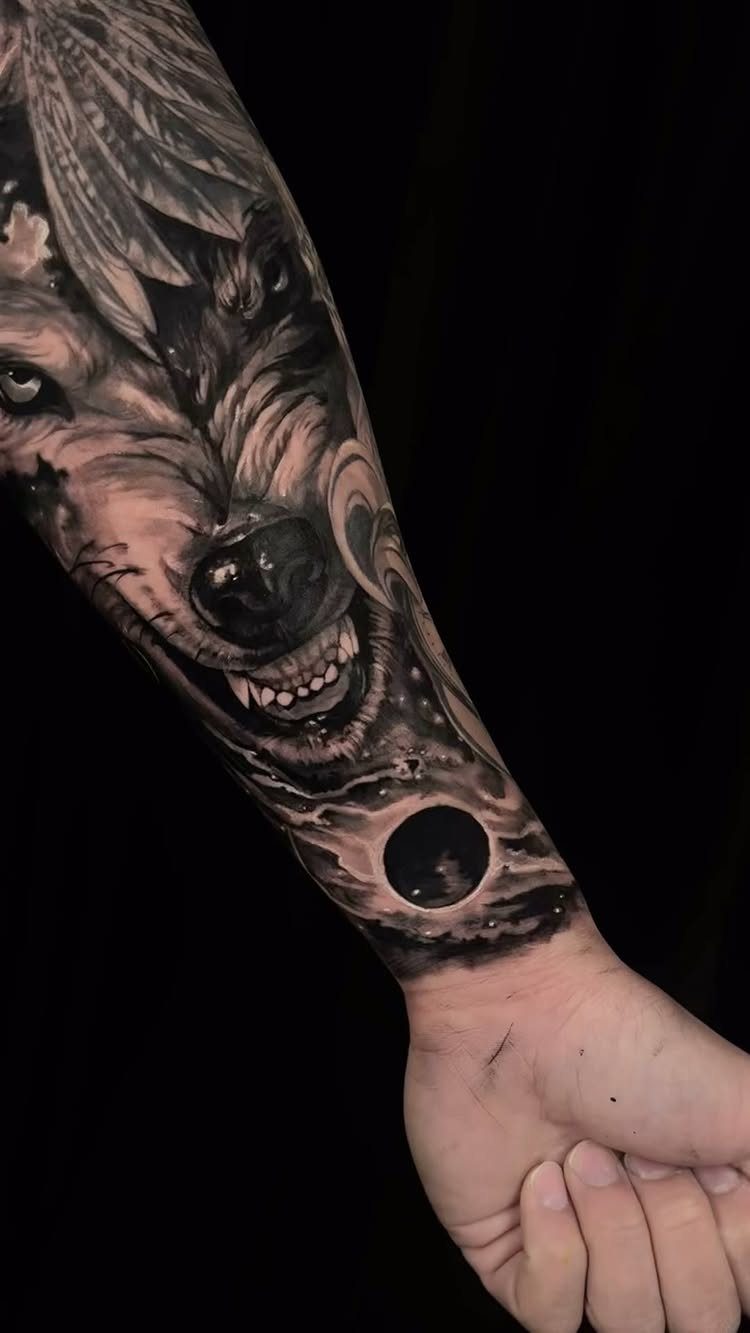
Wolf and eclipse share the same forearm, the animal facing out while the black hole pulls in behind it.
That tension between directed force and swallowing darkness is what makes the design hold, and a less aggressive wolf expression would lose it. The grey wash keeps the realism sharp against the void; color would split the focus wrong.
Someone drawn to predator imagery but wanting more than a nature tattoo gets the upgrade here. The wrist placement puts the eclipse where a watch would sit, visible to the bearer every time they check the time.
6. Galaxy Hand Tattoo
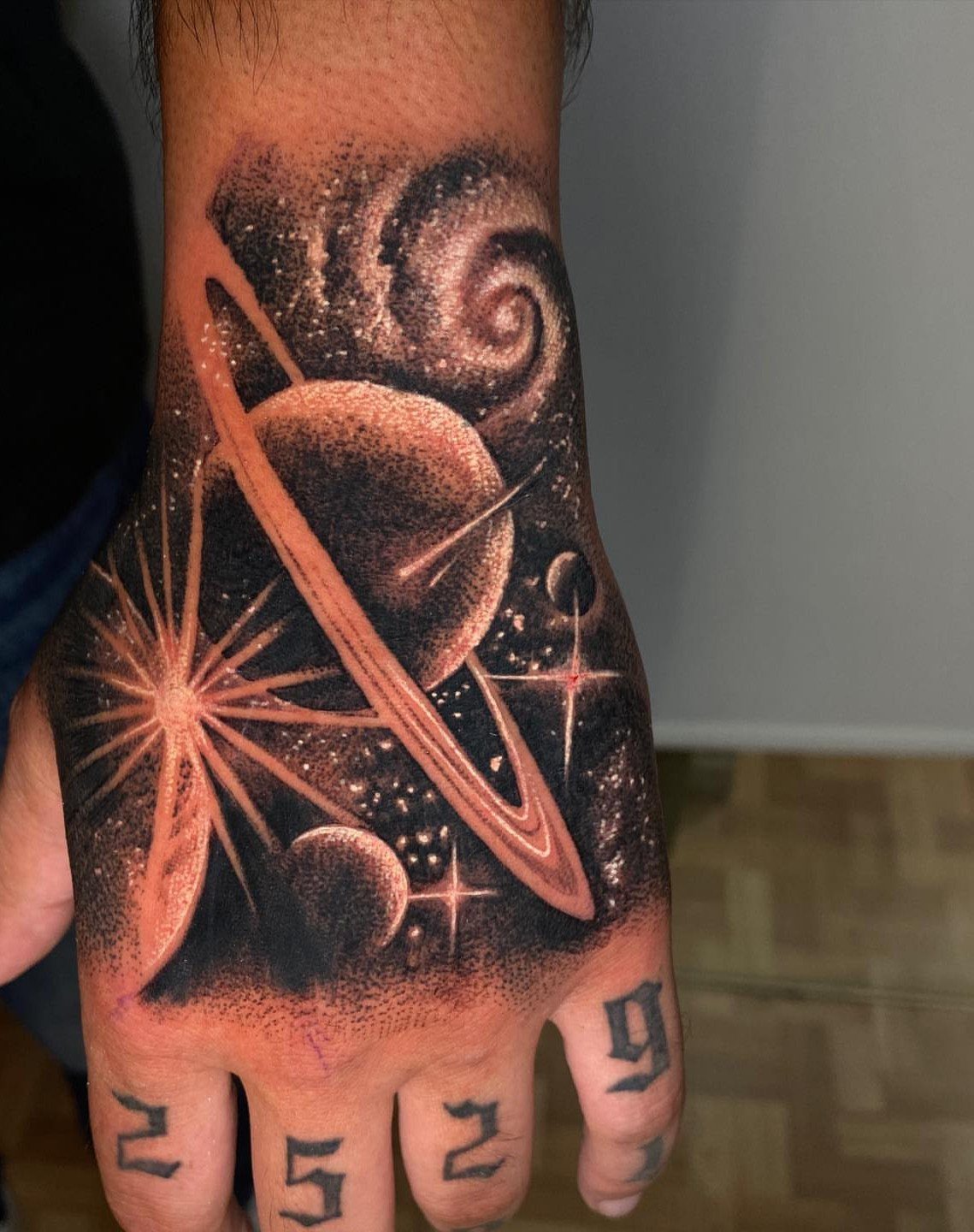
Hand skin turns over fast and takes ink unevenly, so black and grey is a practical choice as much as an aesthetic one.
Color would fade patchy within a couple of years; the planets and stars here stay readable because the artist worked with the limitation rather than against it.
The knuckle numbers are separate from the galaxy, a personal addition that shows how the design accepts neighboring ink.
This placement is always on display, which suits someone whose work allows it or who does not care. The cost is maintenance: plan for refresh sessions twice as often as an arm piece.
7. Galaxy Cat Tattoo
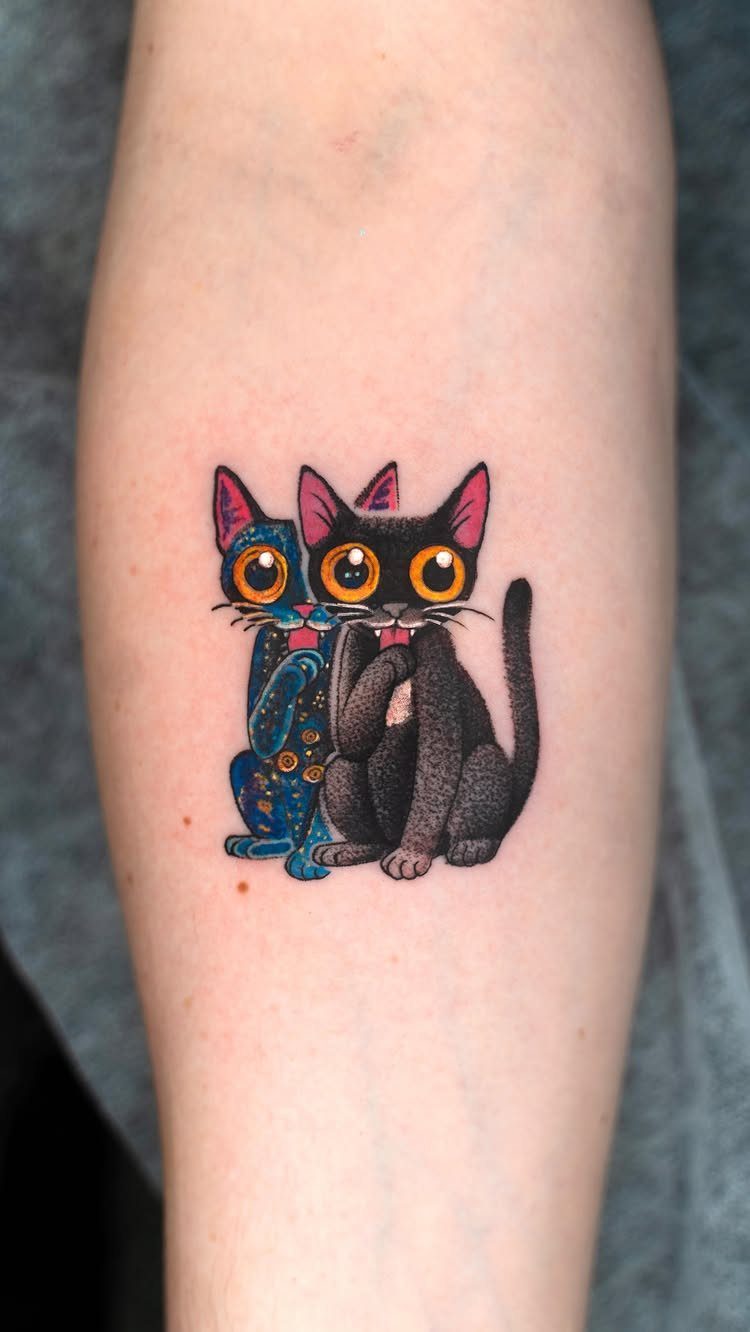
Cat galaxy tattoos work best when the animal’s silhouette stays readable against the swirl. A clean cat outline holds its shape best when the galaxy fill stays inside the borders instead of bleeding past them.
I’d ask the artist to map the darkest pigment where the cat’s spine and tail would cast real shadow; that anchors the creature in three dimensions while the nebula floats inside it.
Small placements, like a wrist or ankle, need restraint on star count or the cat becomes a blob. For two cats, matching forearms carry the idea without crowding either design.
8. Galaxy Tattoo Sleeve
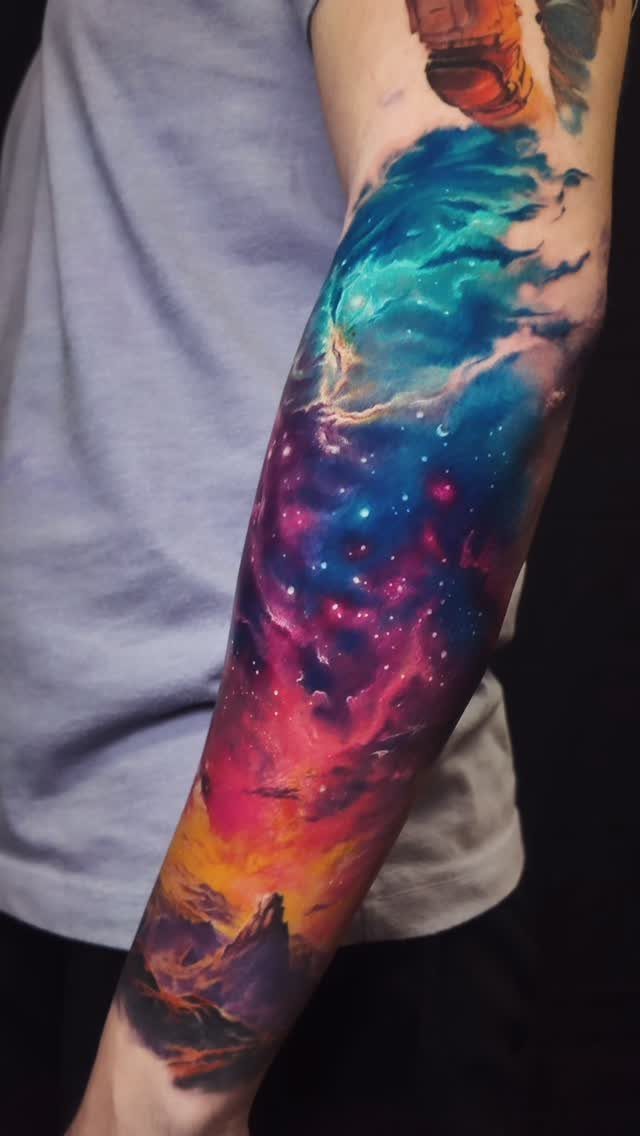
A sleeve demands a background that holds together from shoulder to wrist, not a stack of separate space clips.
A mountain-to-nebula sleeve works when the landscape sits low and the sky builds upward, giving the eye a clear path to follow. Full color saturation over a full sleeve takes time, and rushing the heal between passes costs vibrancy.
I’d schedule the astronaut or any focal figure for the outer upper arm, where it faces outward in conversation, and keep the wrist end softer so watches or bracelets still sit comfortably.
Black and grey heals faster and ages cleaner if your work keeps you in sun or chlorinated water.
9. Galaxy Tree Tattoo
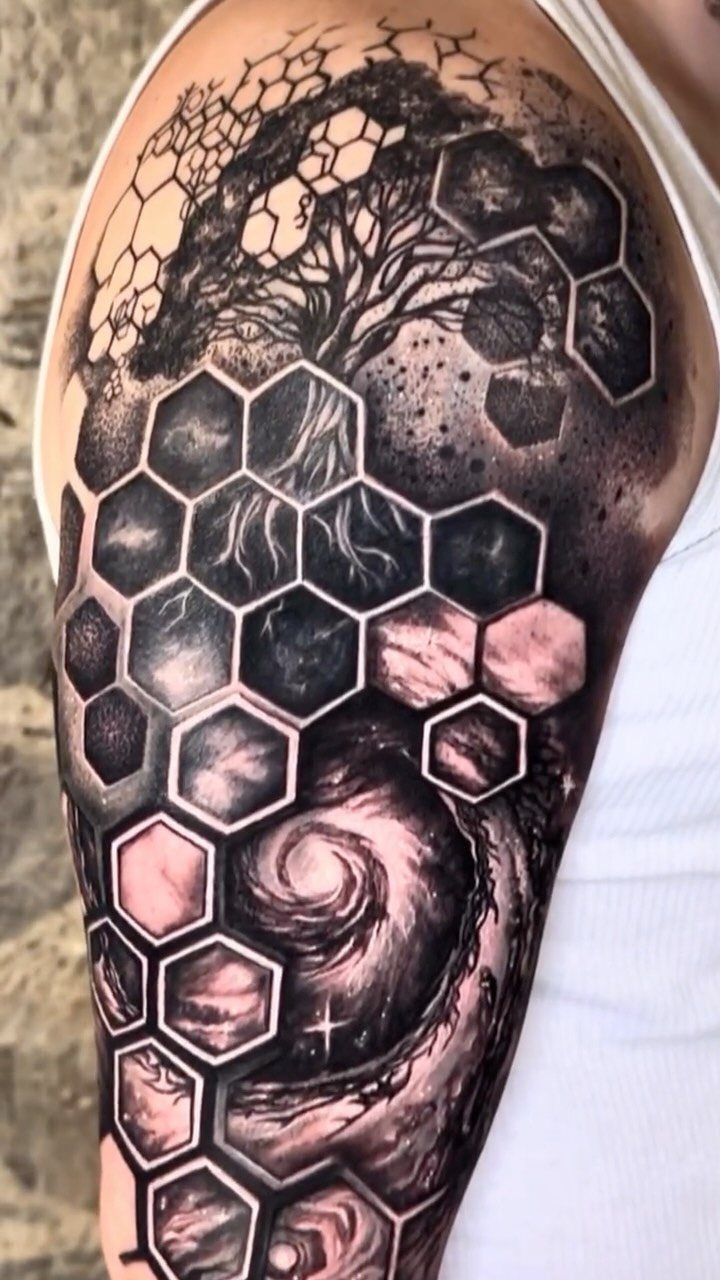
Tree galaxy tattoos risk looking like two ideas colliding unless the roots or canopy actually become the spiral. Honeycomb geometry acts as a fence between organic and cosmic, letting each side read clearly without fighting.
I’d place the galaxy in the canopy for growth symbolism, or in the roots for something more introspective; trunk-centered nebula rarely reads as intentional.
Fine line branches with bold color galaxy need an artist comfortable in both registers, since heavy saturation can bleed into delicate twig work. Check healed photos of their nature pieces, not just fresh posts.
10. Galaxy Shoulder Tattoo
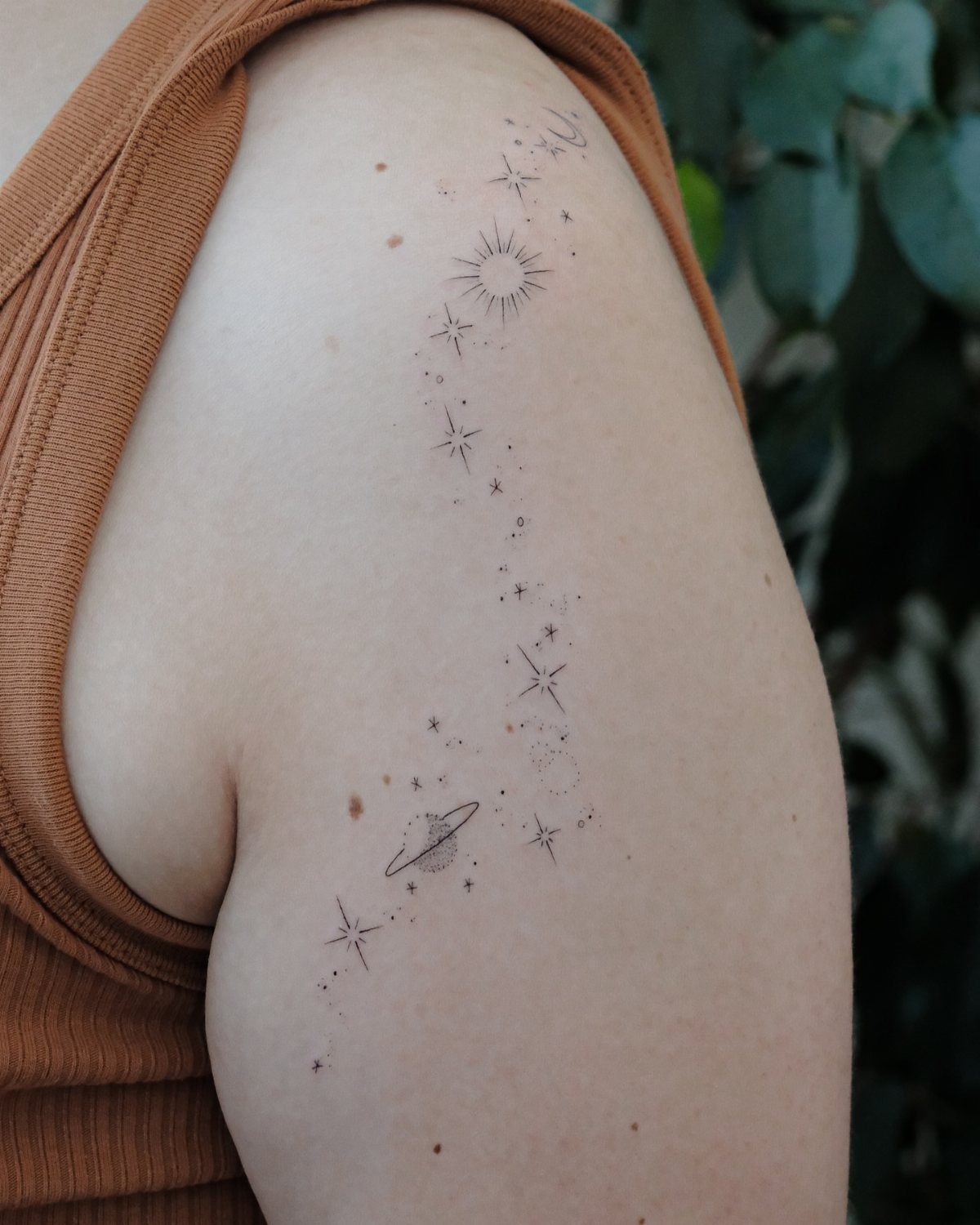
Shoulder placement follows the bone, so the tattoo moves when you move. Fine-line stars trailing down the cap catch light when sleeves are short and hide under a strap when needed.
I’d keep the design within the deltoid’s round front plane; wrapping too far onto the blade stretches the image when you reach forward. Single-needle work this delicate fades faster on sun-exposed skin, so plan touch-ups into your budget.
A sparse approach, planet plus scattered points, ages better than dense clusters that merge into grey wash.
11. Deer Galaxy Tattoo
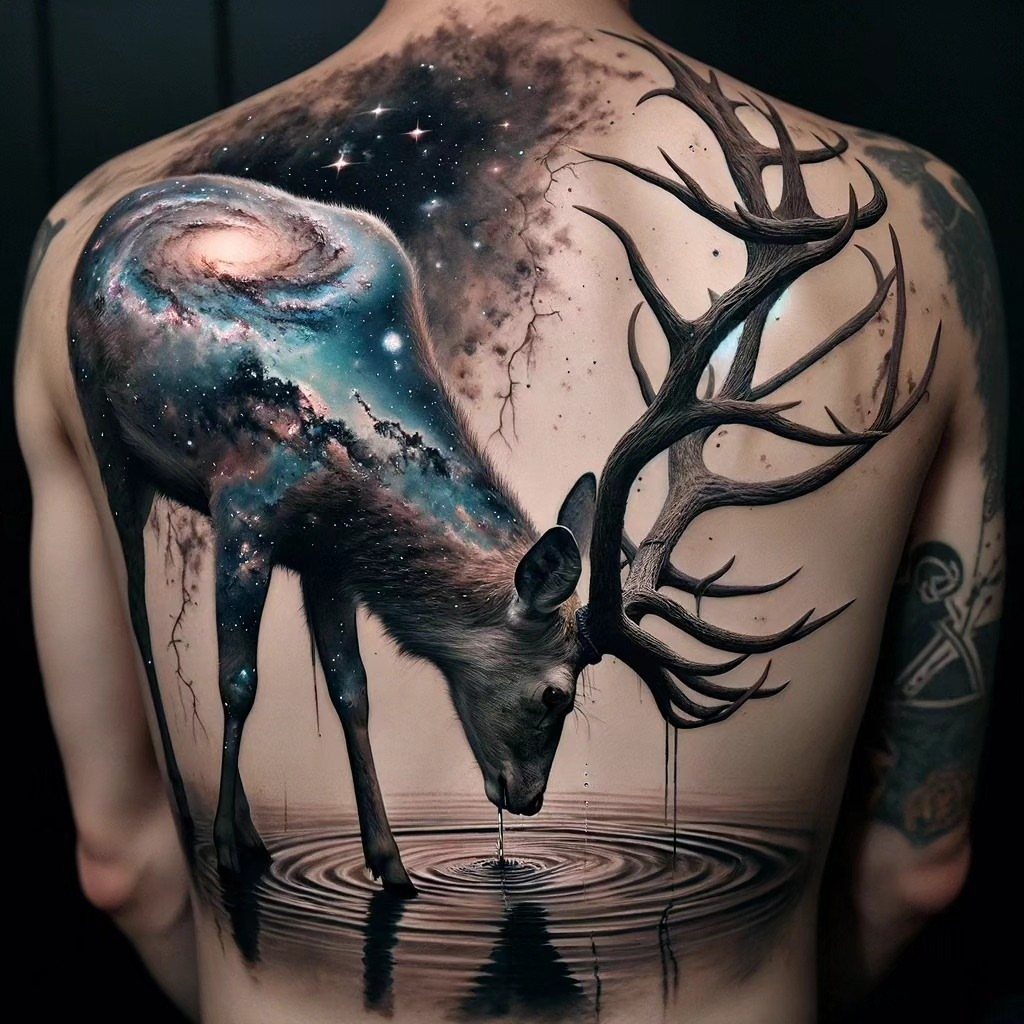
A drinking deer uses the water line as a horizon, splitting earth from cosmos at a natural boundary.
I’d keep the antlers in solid black silhouette so they frame the galaxy rather than competing with it; detailed rack work inside the nebula turns muddy.
The deer’s body needs enough width for color gradients to develop, so I’d hesitate on a torso piece too small to hold the shift.
For a smaller version, concentrate the galaxy in the flank only, leaving the head and legs in normal tones so the creature stays recognizable at distance.
12. Galaxy Constellation Tattoo
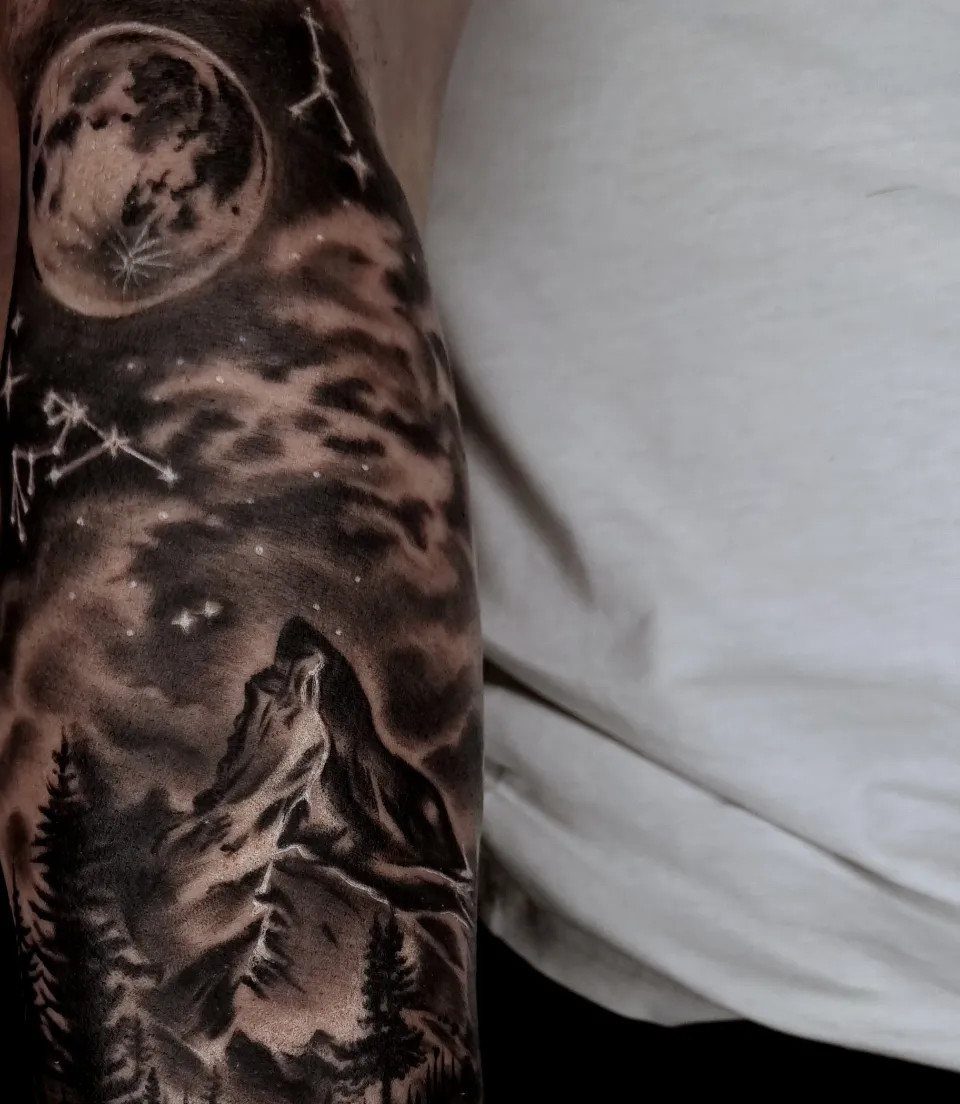
Constellation tattoos often fail by connecting dots too literally; a mountain scene lets the stars stay scattered while the landscape gives them context.
I’d name specific constellations only if they hold personal meaning, since accurate star placement constrains the composition and most viewers won’t verify Orion’s belt anyway.
The moon’s realism against graphic star lines works because the artist separated scale, not style; mixing detailed and simple in the same size range looks accidental.
Black and grey heals predictably on arms, but I’d add a single subtle blue or violet in the nebula background if you want color without the maintenance burden of a full spectrum sleeve.
13. Galaxy Skull Tattoo
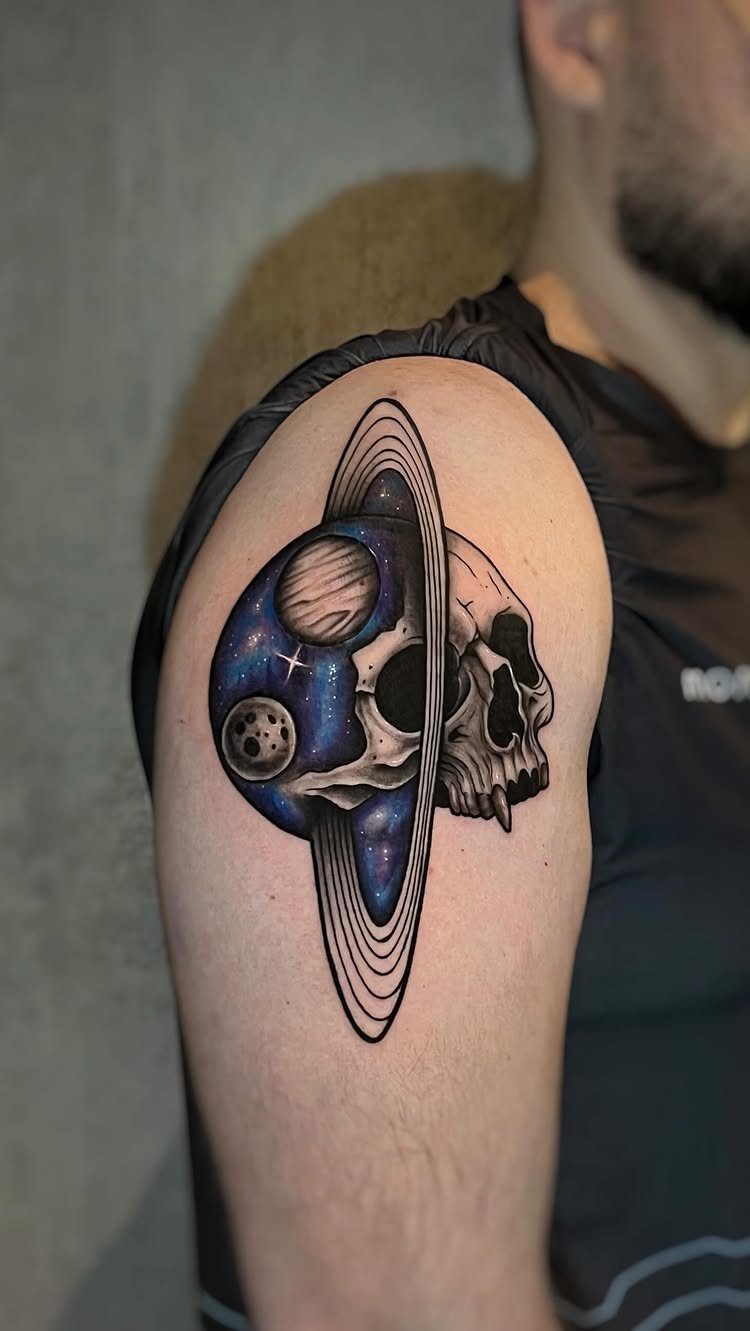
A skull half-finished with bone, half-finished with Saturn and its rings, turns the memento mori into something stranger.
The contrast reads from across a room: matte bone against glowing nebula tones, the eye sockets pooling with star fields instead of shadow.
I have seen this work best when the artist keeps the skull anatomically tight so the cosmic half feels like an invasion, not a decoration. The shoulder or upper arm gives it the flat real estate the split needs.
Temporary versions exist if you want to test the reaction first.
14. Moon Galaxy Tattoo
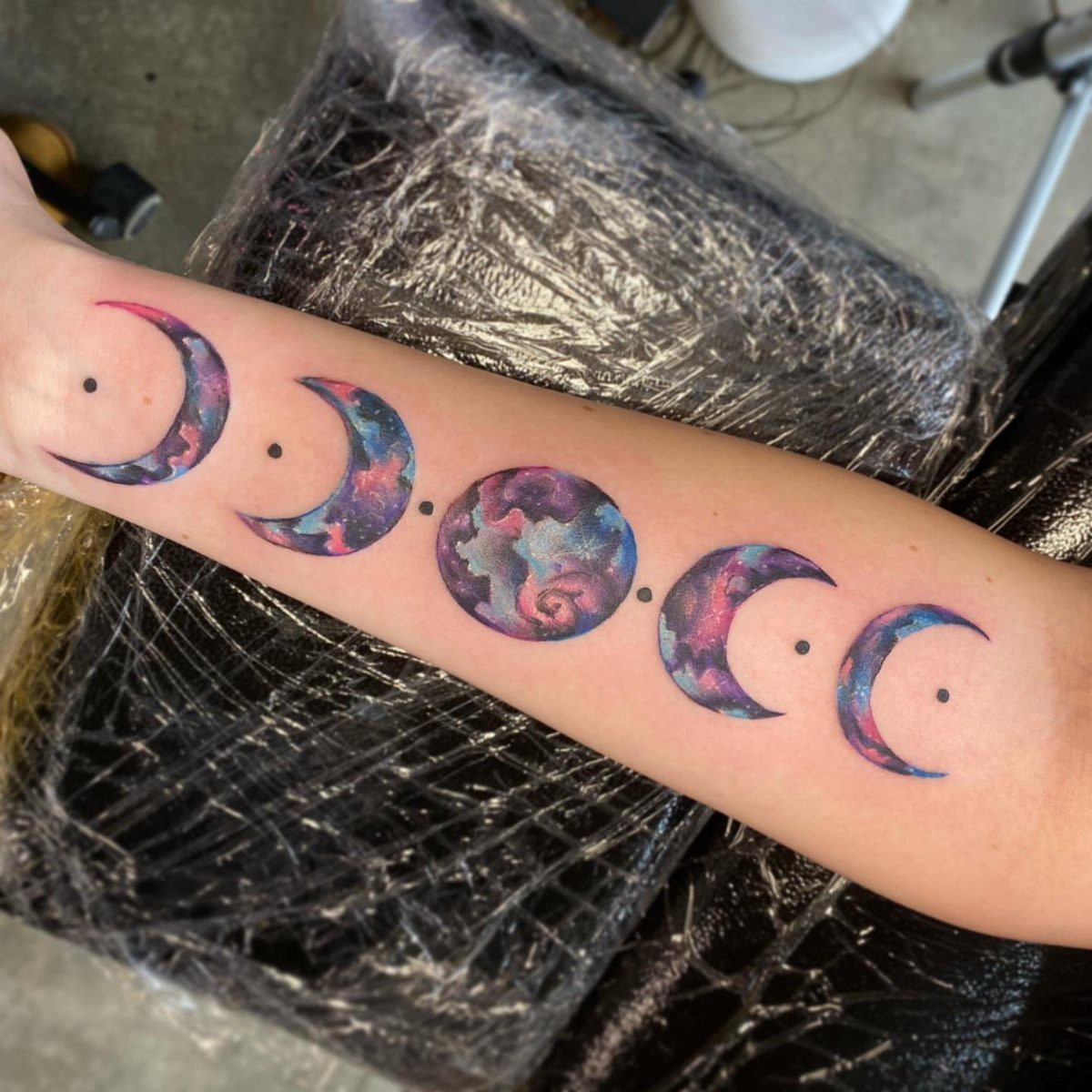
A row of moons, each phase carrying its own wash of pink, purple, and blue, turns the lunar cycle into a single breath.
The galaxy fill changes the meaning: new moon to full becomes hidden to revealed, or buried to born, depending on which color you weight toward.
Inner forearm placement keeps it visible to the wearer, which matters when the symbolism is personal. Check that your artist understands watercolor saturation; these pinks muddy fast if the ink is too wet or too dense.
I would ask to see healed photos of their color work before booking.
15. Galaxy Forearm Tattoo
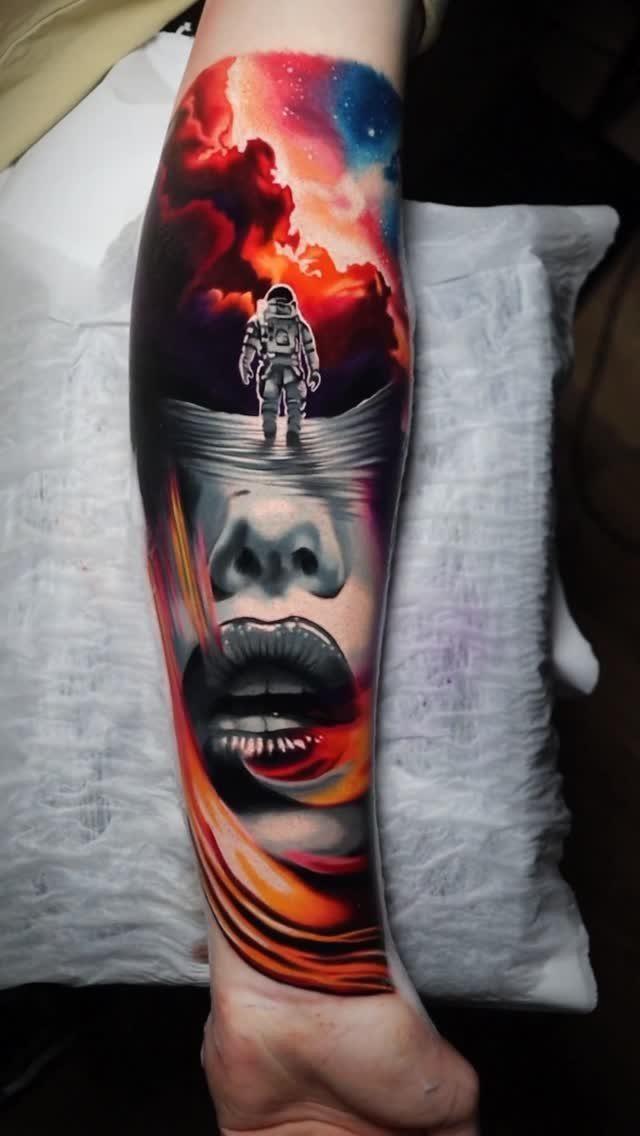
Forearm placement means you will see this tattoo against every keyboard, every steering wheel, every dinner table you sit at. That daily visibility changes what you should ask for.
The astronaut and face in the visible version need a large canvas to read as two separate images rather than a smear; if your forearm is slender, I would drop one element and let the galaxy breathe.
Red and blue together fight for attention in a way purple and black do not. Consider whether you want the story legible from a distance or the detail rewarding up close; the answer changes the sizing.
16. Most Amazing Galaxy Tattoo
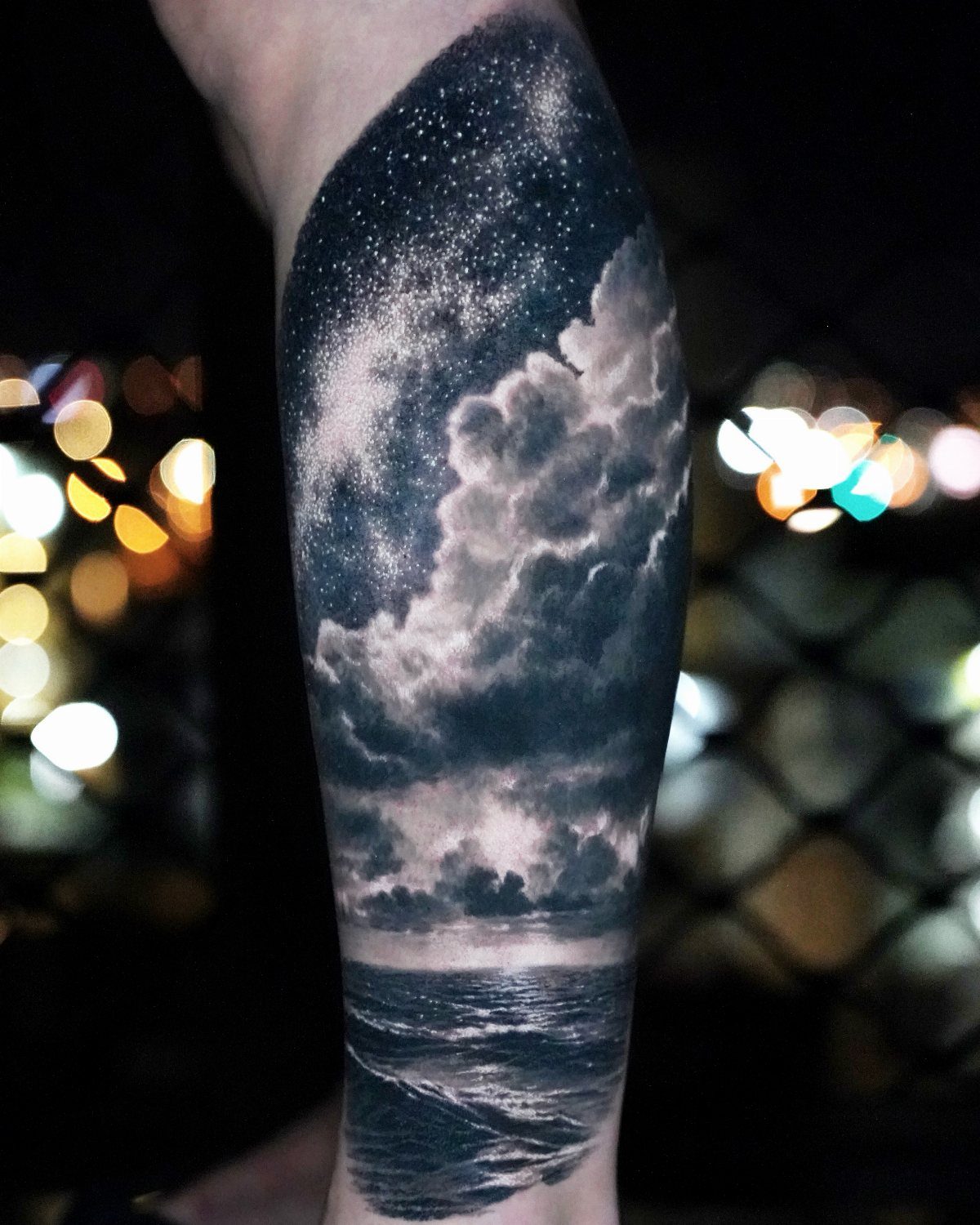
Black and grey galaxy work risks disappearing into itself without one anchor the eye catches first. Here, the storm clouds do that job, their hard edges pulling attention before the stars register.
The scale is serious; this is not a Saturday afternoon piece.
What I would verify before committing: whether your artist can carry consistent grey wash across a session long enough to finish a section, because stopping and returning shows at the edges.
Bokeh effects read as city light, not part of the tattoo itself; do not expect your skin to glow.
17. Minimalist Galaxy Tattoo
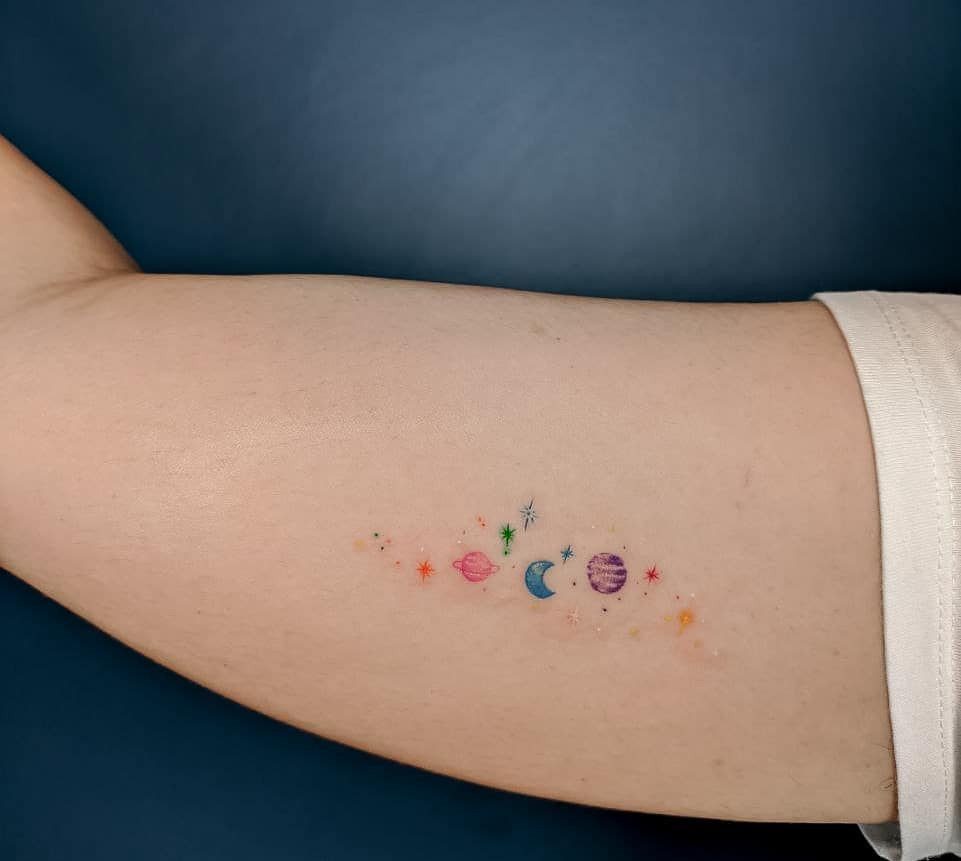
Small does not mean careless. The visible version keeps each planet, moon, and star distinct at a size that fits under a watch band if needed.
Fine line work this delicate has a shorter visual lifespan than bold traditional; I would plan for touch-ups, sooner if the placement sees sun. The color here is restrained, just enough to read as galaxy without the full neon treatment.
For a first tattoo or a hidden one, this is the entry point I would recommend. Ask for a stencil preview at actual size; what reads on paper can vanish on skin.
18. Galaxy Bottle Tattoo
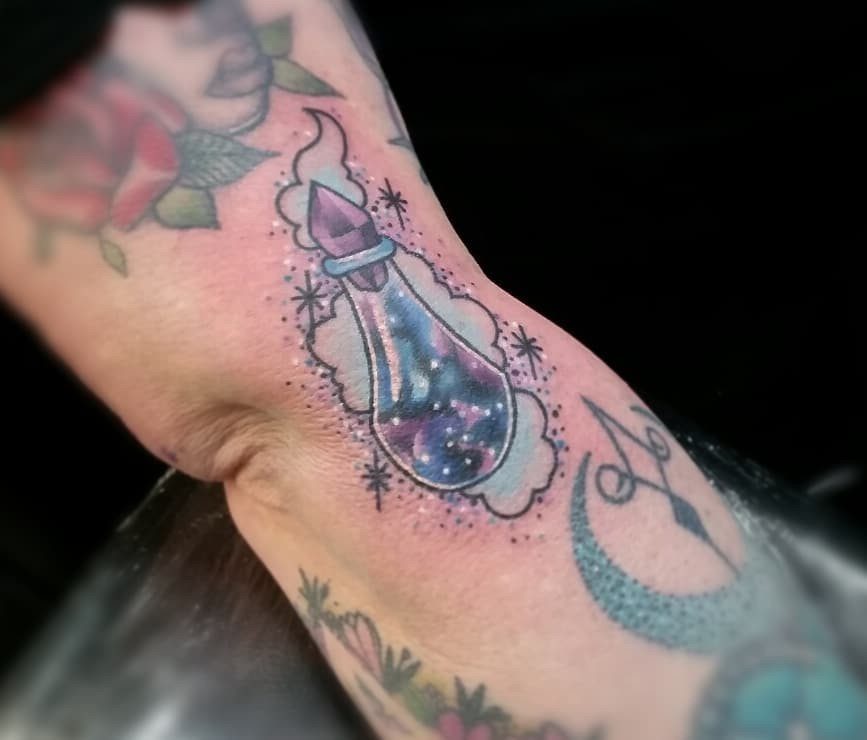
A bottle as frame does what a frame always does: it makes the wild contents feel captured, domesticated enough to carry.
The crystal stopper and glass thickness suggest an old apothecary jar, something you might find in a cabinet of curiosities. That vintage container against the infinite inside creates the tension.
The surrounding clouds and sparkles extend the design beyond the bottle’s silhouette, so placement needs clearance on all sides; a tight spot will clip the atmosphere.
I would consider this for an upper arm where the cylinder shape echoes the muscle, or a calf where it stands upright when you sit.
19. Galaxy Dog Tattoo
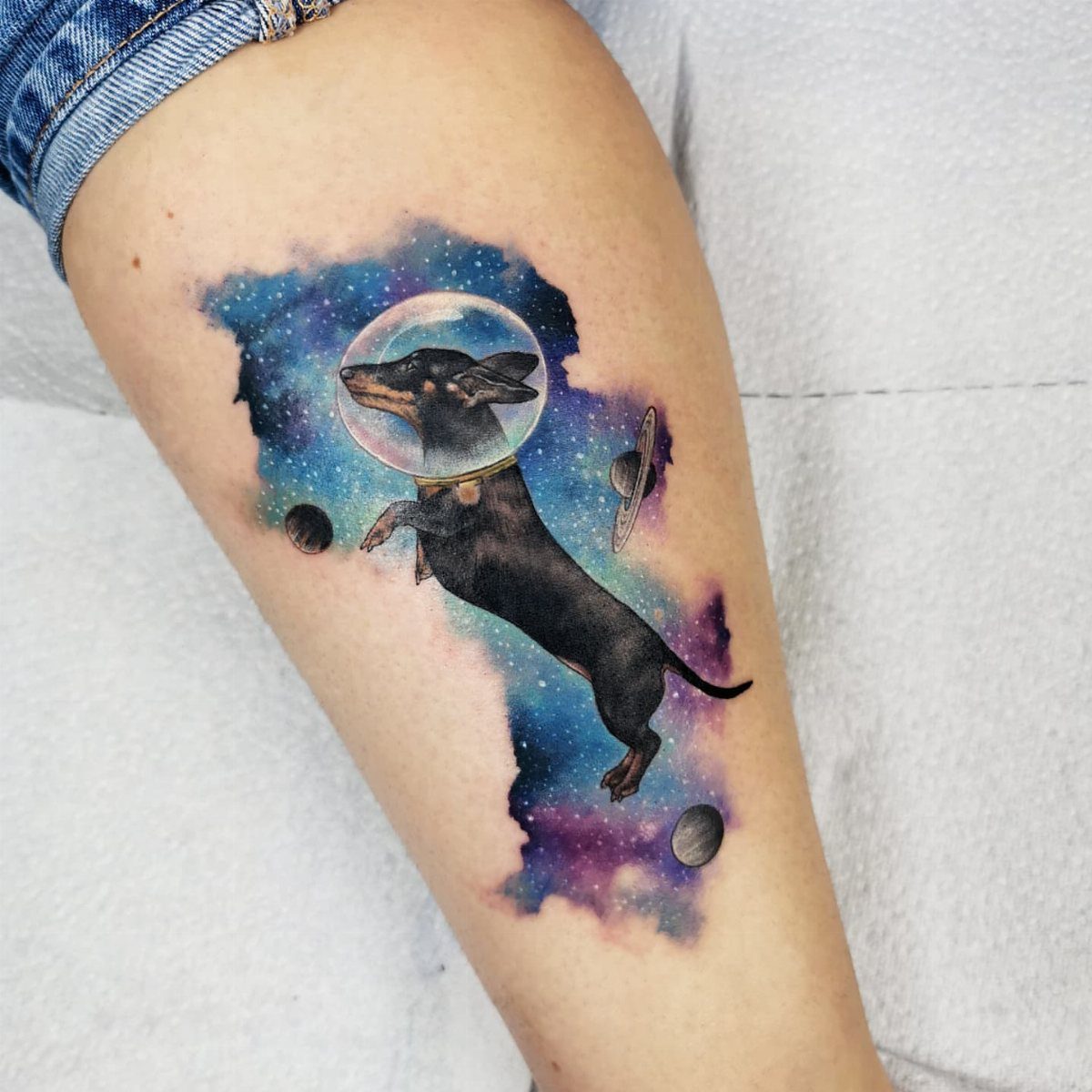
A dog in a space helmet turns a pet portrait into something nobody else at the dog park has.
The astronaut angle works because the helmet frames the face naturally, so the artist has a clean edge to fill with nebula color while the fur stays recognizable.
Breeds with long snouts carry the glass-bowl look best; a pug or French bulldog needs a wider helmet shape or the proportions go cartoonish fast. Custom work runs higher and needs a session to review reference shots.
This idea suits someone whose dog actually shaped a chapter of their life, not just a current favorite animal.
The galaxy part risks looking like clip art if the pet portrait is weak, so budget for the artist who nails animals first and backgrounds second.
20. Owl Galaxy Tattoo
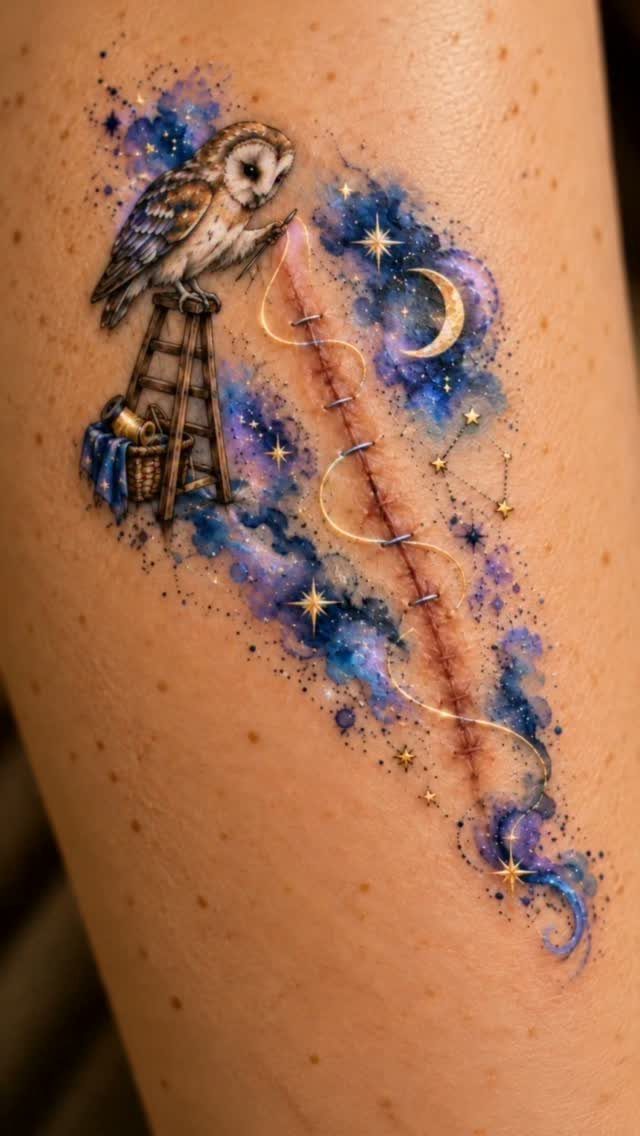
An owl galaxy tattoo suits someone who wants the night sky to feel alive and watching back.
The barn owl’s flat face and wide eyes already mirror the roundness of planets and moons, so the blend reads as one image rather than two forced together.
Watercolor nebula clouds work best here because the owl’s soft feather edges hide any bleeding that sharper lines would show.
A ladder or perch gives the bird a reason to sit in space instead of floating; without it, the composition can feel untethered.
The surgical scar integration in the visible piece is a custom touch, not standard. If you have a mark to work around, an owl’s body shape adapts well to long or curved lines.
This one demands an artist who mixes color realism with illustrative work. Pure portrait specialists often struggle with the loose galaxy background, and watercolor-only artists lose the owl’s detail.
A piece this detailed takes a full session at minimum, more if the bird spans a joint.
I’d steer someone toward this over a wolf galaxy piece if they want the design to feel quiet rather than fierce. Owls read as observers; wolves read as hunters.
That difference shapes what the tattoo says about you.
Best placement: thigh or ribs where the body cylinder gives the galaxy somewhere to wrap. Flat areas like the upper arm can leave the background looking pasted on rather than surrounding.
Meaning of Galaxy Tattoos
Galaxy tattoos carry weight because the image itself holds meaning without needing explanation.
The mix of light and dark in a nebula design maps onto growth that follows hardship; the color emerges from black, which reads as resilience rather than decoration.
Someone marking a private journey can keep the reason hidden while the tattoo still signals it.
You can carry wonder and spirituality in the same design without leaning on any religious iconography. The scale of the cosmos against a single body also works as a reminder of proportion, useful for perspective more than statement.
Styles of Galaxy Tattoos
Geometric framing gives the eye structure. Sharp lines against soft nebula keep the tattoo from dissolving into abstraction, and the contrast suits someone who wants order inside chaos.
Minimalist galaxy tattoos run fine line and limited color, which ages faster than bold work but reads as mystery rather than spectacle.
Realistic approaches need the most technical skill; a planet or moon rendered in detail beside graphic star fields only works when the artist controls scale between the two.
Placement Considerations
Arm and thigh placement carry color well because the skin is stable and the canvas is flat enough for gradients to read true.
Back placement offers the largest uninterrupted field, which matters for designs that need room to breathe, like a nebula that builds from dark edge to bright center.
Forearm visibility changes daily life; you will see the tattoo against every surface you work at, which suits some people and wears on others.
Hand and foot placement see more wear. Ink fades faster where skin turns over quickly and where shoes or gloves rub.
Black and grey holds up better there than color, which patches within a couple of years.
Choosing a Tattoo Artist
A galaxy piece piles on color and fine detail, so I would look past how fast an artist works and check their saturation and blend work first.
Check healed nature pieces too if your design mixes organic and cosmic elements.
Rib cage and spine placement intensify pain because the skin is thin and the bone close. Thigh and upper arm have more padding, which means longer sessions are possible.
If your threshold is low, smaller designs or those locations keep the experience manageable.
Frequently Asked Questions
What does a galaxy tattoo symbolize?
Galaxy tattoos carry the weight of scale, the idea that something vast sits behind or inside the person wearing it.
The nebula’s mix of light and dark reads as growth pressed out of pressure, the way stars form from collapsed gas.
Someone who chooses this is usually marking a period of change they did not control but came through anyway, or a curiosity that outruns what they can explain.
How long do galaxy tattoos last?
Permanent galaxy work stays for decades if you keep it out of sun and moisturize through healing, but the colors are not equal.
Those violet and cobalt layers keep their depth for years, but the white highlights that sell the starfield fade sooner; palm and finger placements demand touch-ups at double the rate of a forearm piece because that skin sheds faster.
Plan touch-ups for any watercolor wash where the pigment sat lightest.
Are galaxy tattoos painful?
The chair time matters more than the subject. A full sleeve nebula runs multiple sessions, and any spot where bone sits close to skin, ribs or spine, the needle vibration travels.
Thigh and upper arm carry more padding, so the same needle depth hits less hard. Watercolor technique adds time because the artist builds transparent layers; factor that into your tolerance.
What should I consider before getting a galaxy tattoo?
Placement shapes everything.
A full sleeve demands a background that flows as one continuous sky from shoulder to wrist, not a collage of disconnected scenes; a compact wrist design calls for fewer stars or the whole thing blurs into an indistinct smear.
Request healed shots of their color portfolio, watercolor especially, since those rose and aqua tones turn to sludge if the ink sits too wet or packs too tight.