Hummingbird tattoos span from single-needle wrist outlines to full back pieces with cherry blossom fields and sunflowers, and the gap between them is not just money and sessions: it is whether the design still reads as a hummingbird once the scale shifts. The bird collapses below two inches of body length, where feather texture turns to mud and the beak starts looking like a generic songbird’s. Above four, the delicacy that makes the subject worth choosing evaporates unless the artist builds context around the bird rather than inflating the bird itself.
1. Floral Hummingbird Tattoo
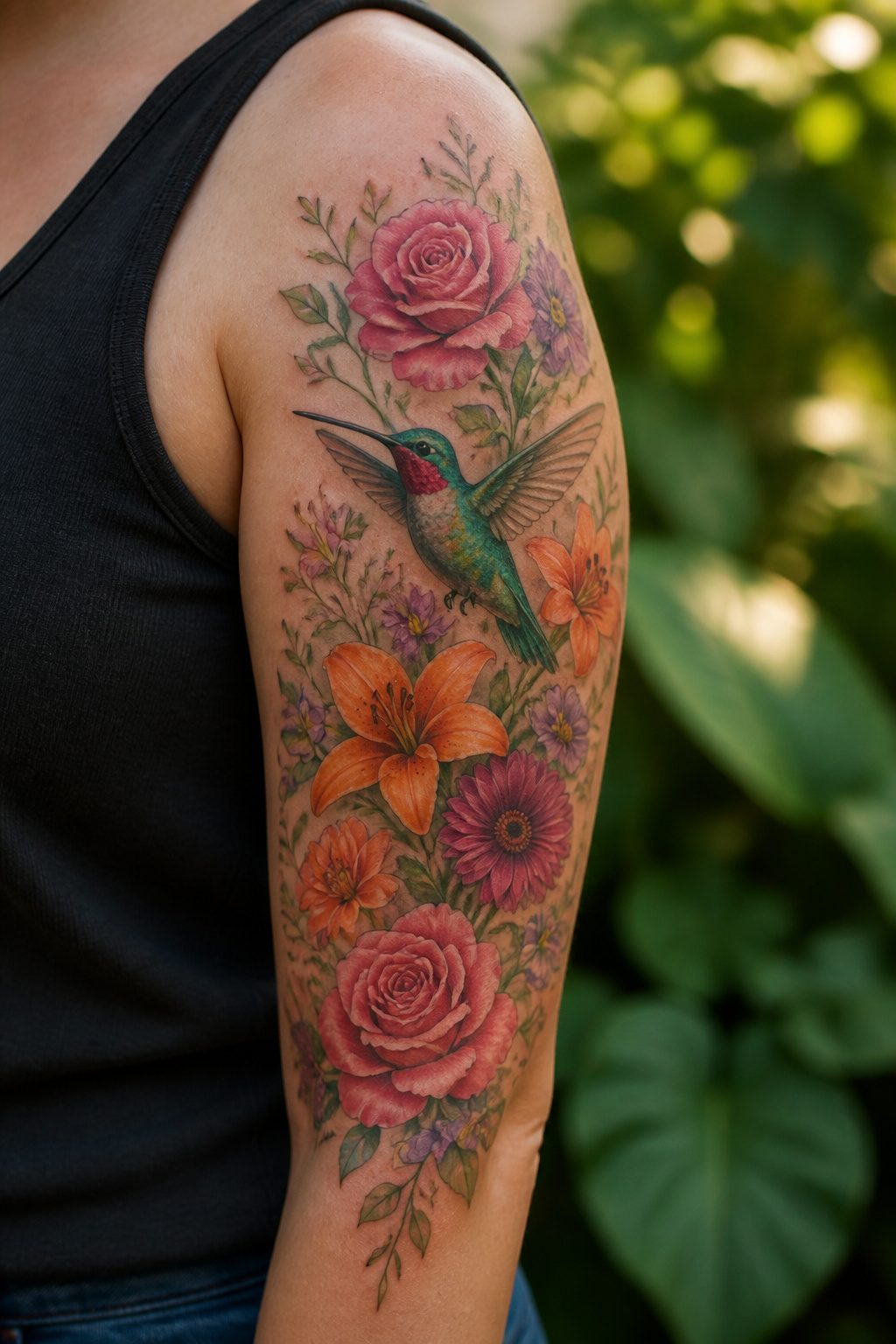
The floral hummingbird pairing is easily the most requested combination in most shops, and the reason is structural as much as symbolic. A hummingbird in mid-hover creates a natural focal point, and flowers placed along its flight path give the eye a route to follow rather than a static image to stare at. Roses, lilies, and daisies are the usual choices, worked in tight clusters that frame the bird without crowding it.
Placement tends toward the upper arm, back, or thigh, where the canvas is large enough to let the flowers breathe around the bird. Realistic rendering keeps the botanical details sharp, while an abstract approach lets the colors run looser. Either way, the flowers do the same job: they ground the hummingbird’s energy in something the viewer recognizes as rooted and still. The bird reads as motion, the blooms as pause, and the contrast is what makes the composition hold together.
For anyone weighing this against a standalone bird, the added surface area means more color saturation and a design that ages more gracefully as the ink settles. The trade is session length and cost, but the visual payoff is a tattoo that reads complete from across the room and still rewards close inspection.
2. Black Ink Hummingbird Tattoos
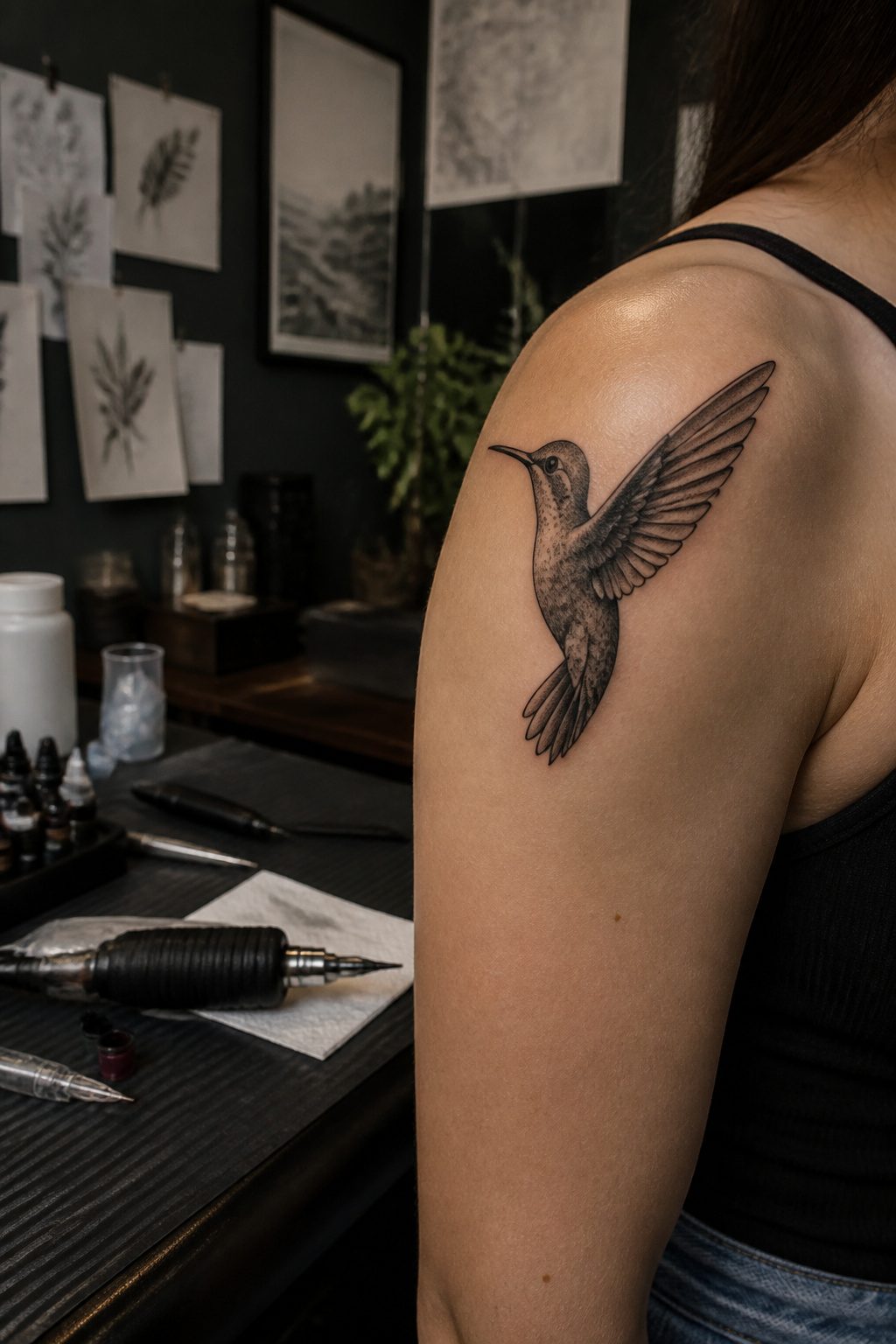
Black ink hummingbird tattoos strip the design down to contrast and line weight, letting the bird’s shape carry the whole piece. Without color to hide behind, every curve in the wing and taper of the beak has to earn its place. Shading builds the depth instead of pigment, and the result reads clearly from a distance while still rewarding close inspection of the linework.
The style suits placement almost anywhere on the body. A wrist-sized piece keeps the outline fine and the shading minimal so the details do not muddy at small scale. Larger versions on a shoulder or ribcage open up room for heavier black fill and more dramatic light-to-dark transitions. Either way, the absence of color ages well; there is no green or red to shift or fade unevenly over time.
What separates a lasting black ink piece from one that goes flat is the spacing between lines. Too tight, and the bird becomes a dark blob inside five years. Too open, and the form feels unfinished. The artists who handle this well leave breathing room in the body while tightening detail at the head and wing tips, where the eye naturally settles.
3. Watercolor Hummingbird Tattoo
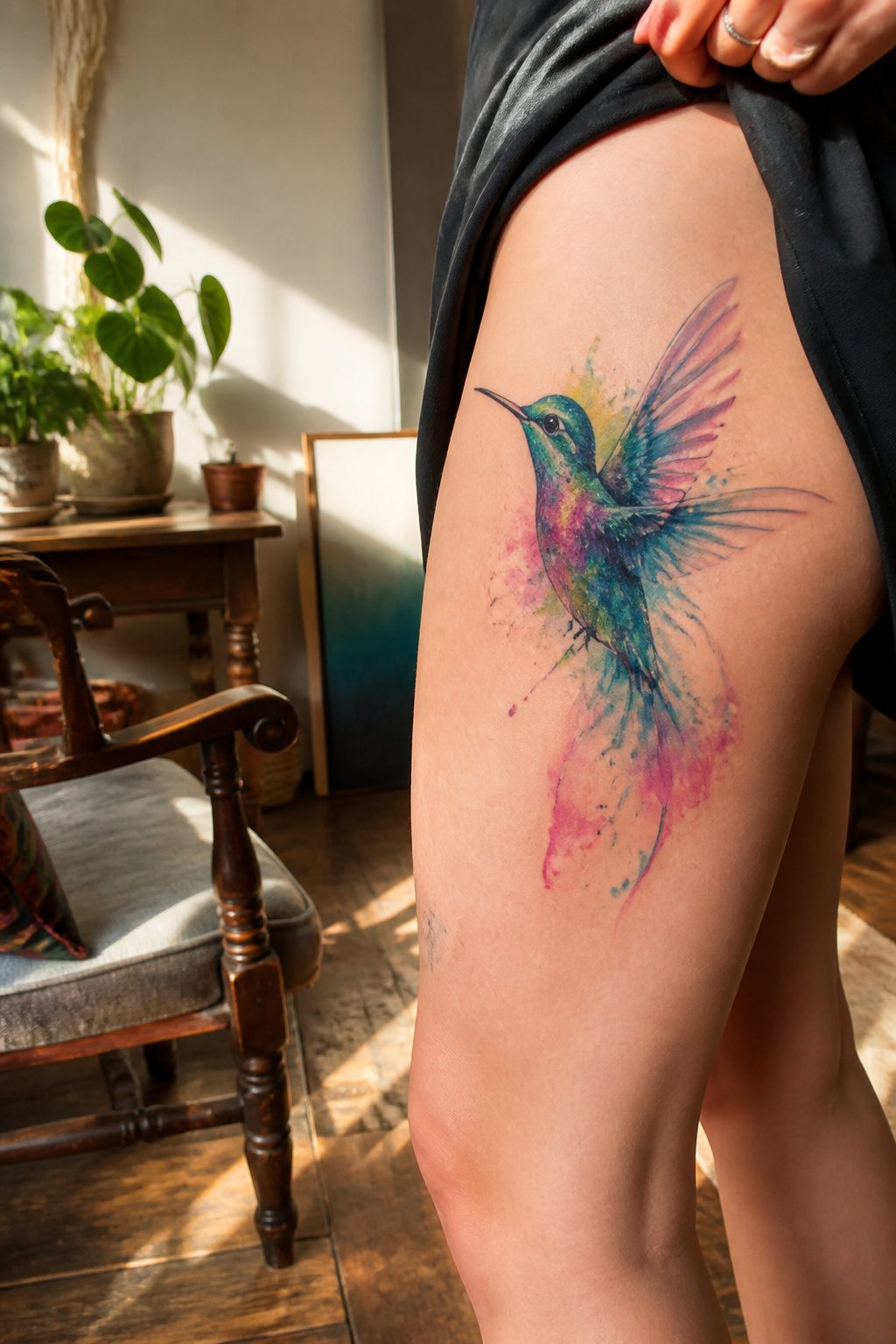
Soft washes of color and a dreamy, painterly effect make watercolor hummingbird tattoos feel almost weightless on the skin. The style leans into the bird’s natural delicacy, letting edges bleed and feather rather than holding a hard line. Joy and vitality sit at the center of the symbolism here, carried less by the image itself than by how the color moves through it.
The thigh offers a larger canvas if you want the color to stretch and the bird to read as truly in motion. An ankle placement keeps the same energy but draws the eye in closer, the detail compact enough to feel like a secret. Either way, the watercolor technique adds its own layer of meaning: creativity, individuality, the sense that this particular bird could not have landed on anyone else in exactly this way. What the style sacrifices in crisp definition, it pays back in the fluid look of something caught mid-flight, color still settling where the needle left it.
4. Minimalist Hummingbird Tattoo
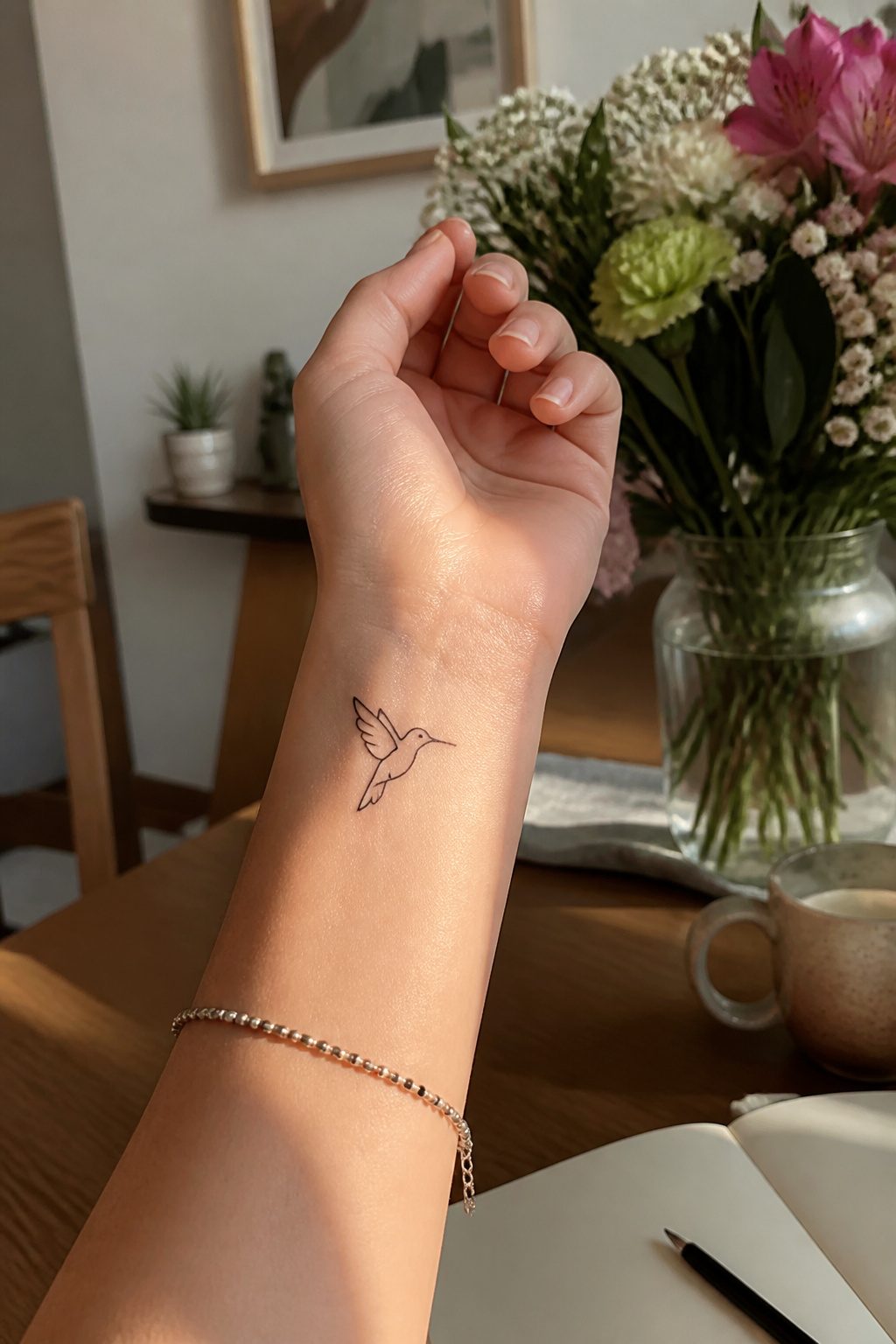
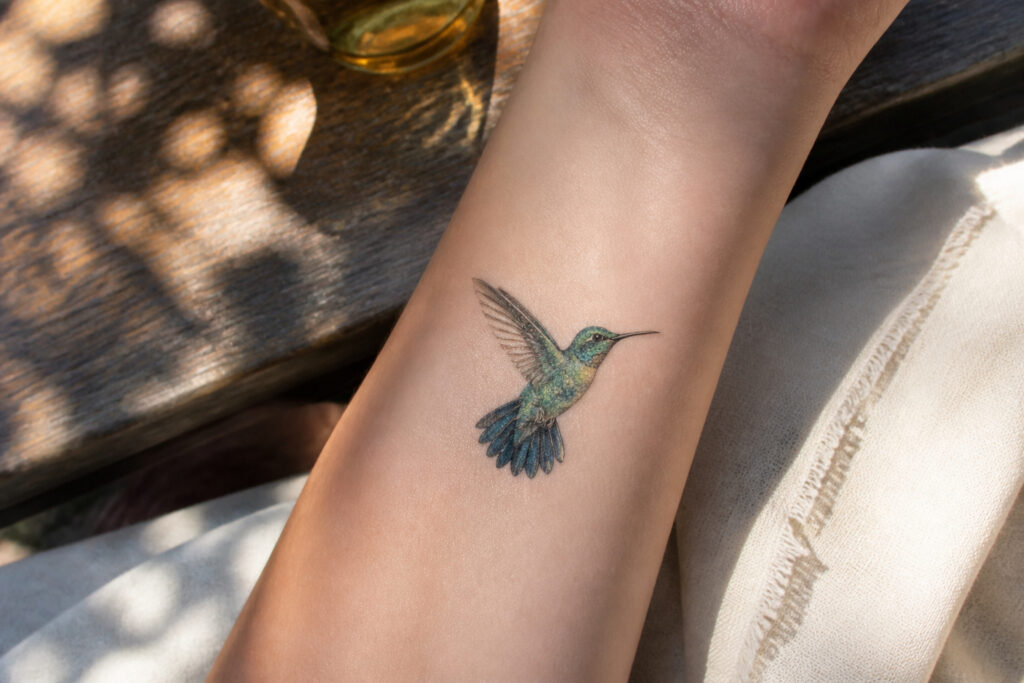
A small hummingbird design carries its detail in the negative space: the curve of a wing, the tilt of a beak, enough to read as motion without shading or second colors. The wrist and ankle are the placements that suit this restraint, spots where a viewer leans in close rather than sees the work from across a room. Behind the ear works too, though the skin there shifts more with talking and chewing, which can blur a line that started too fine.
Simplicity ages better than intricacy on small tattoos. A single-needle outline that looked crisp in 2026 will still read as a bird in 2036 because there is no feather texture to fuzz into a gray smudge. Color fills, even minimal ones, tend to migrate outward in thin skin areas; black ink holds its boundary longer. The tradeoff is that a minimalist piece lives or dies on placement precision. A wingtip that drifts half a millimeter off the stencil looks like a mistake, not a style choice, because there is no surrounding detail to absorb the error.
5. Traditional Hummingbird Tattoo
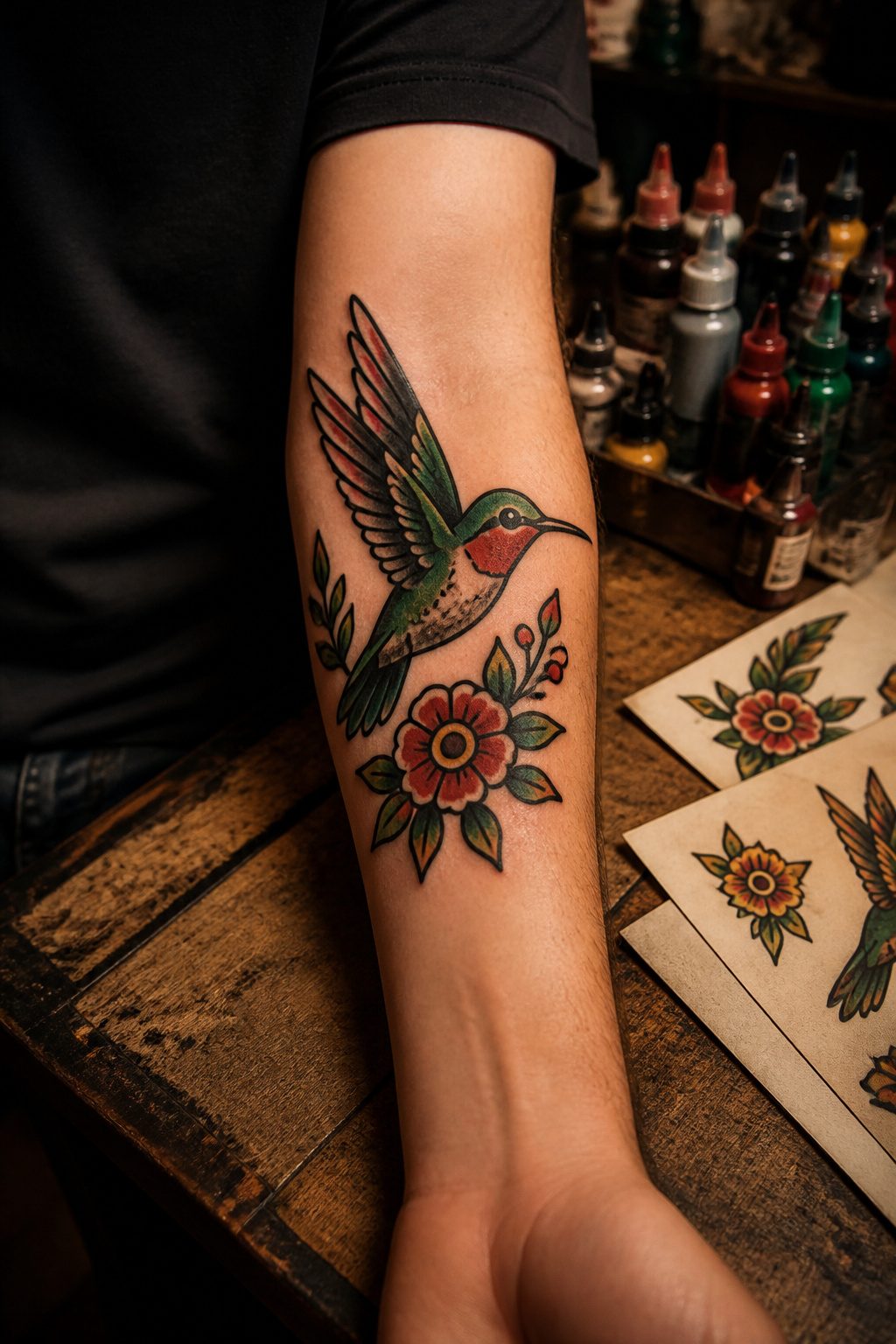
Bold outlines and a tight color range are what make a traditional hummingbird tattoo read instantly, even from across a room. The style grew out of American tattooing in the early-to-mid 1900s, when artists worked with a handful of reliable pigments and built their reputations on lines that held up for decades. A hummingbird in this vocabulary keeps the same black contour, the same saturated reds or greens, and the same clean shading that made sailor tattoos legible at a distance.
Neo-traditional pushes that same structure a little further. The bird might get a longer beak, more ornamental feathers, or a background of stylized roses or waves, but the bold outline stays non-negotiable; without it, the piece drifts into a different category altogether. Placement matters less than clarity. A traditional hummingbird on the foot, wings outstretched or perched, works because the style is built to stay readable even where the skin sees wear. The limited palette does the heavy lifting: one or two accent colors against black, no soft gradients to blur over time.
6. Hummingbird and Flower Combinations
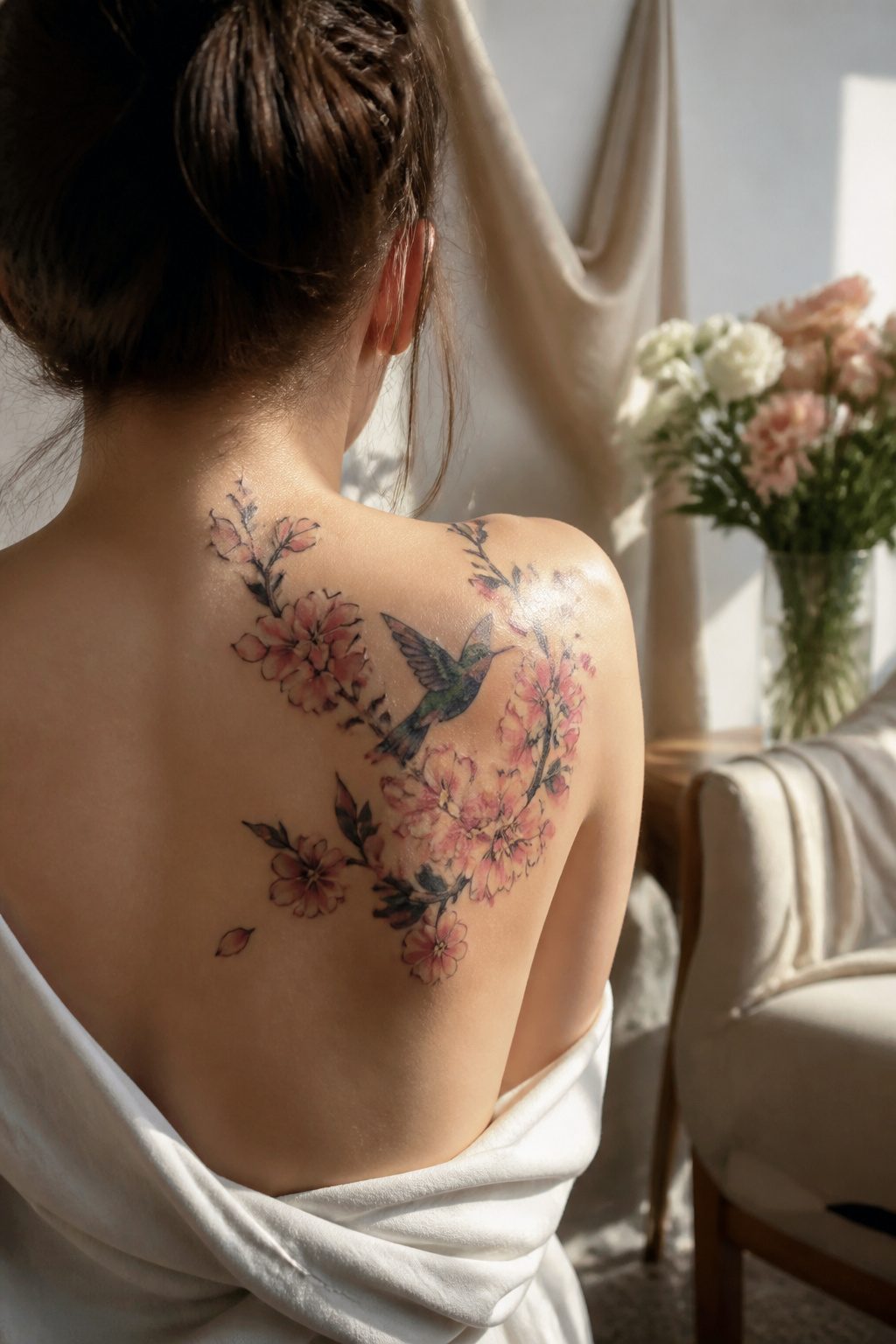
Cherry blossoms pair with hummingbirds more often than almost any other flower in the books I’ve flipped through, and the logic is immediate: both last only weeks, both read as pure motion. The branch curves, the bird hovers, and the pink petals scatter in a way that breaks up the back or shoulder without crowding it. Sunflowers hit a different note entirely. Their scale forces the hummingbird smaller, which sounds like a loss until you see it: the bird becomes the accent, darting above a head that fills the upper arm or ribs. A large sunflower back piece gives the artist room to layer detail that would crush a smaller design.
Lotus and hummingbird on the neck works because both symbols stay legible at that reduced size. The lotus carries its own weight: purity, regeneration, the whole spiritual set. Layer that with the bird’s usual joy-and-love reading and you have a combination that means something without needing a caption. Roses and lilies show up too, though less distinctly; they read as "flower" more than as specific choice. The neck placement keeps it concealable, the back lets it sprawl. Pick your canvas first, then your bloom.
7. Hummingbird with Symbolic Elements
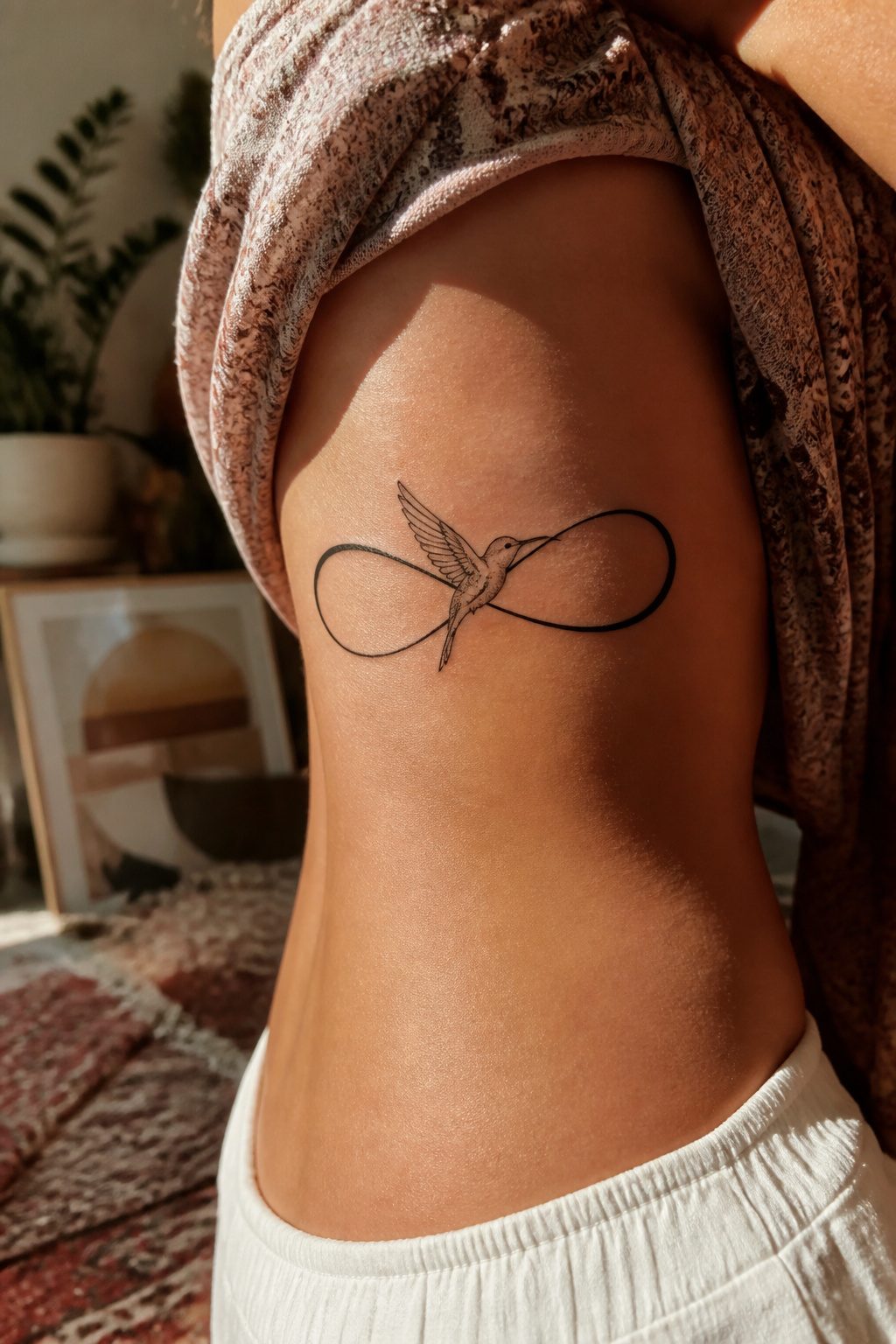
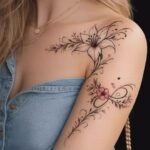
Some of the strongest hummingbird tattoos layer in symbols that carry their own weight. An infinity loop threaded through the bird’s flight path ties the hummingbird’s joy to the idea of endlessness, a pairing that works especially well if you want the design to read as eternal pursuit rather than fleeting moment. The sources show this can go ornate, with a rose worked in to add love and beauty to the loop, or stay spare: a single-line infinity outline with the hummingbird at one curve, quiet enough for a rib placement where only you see it regularly. Either way, the infinity sign does the job of stretching the bird’s natural symbolism past the present tense. Dreamcatchers serve a different function, filtering the hummingbird’s energy through protection and intention, though the passages do not detail specific combinations with that symbol. What matters is choosing a second element that actually means something to you, because the hummingbird’s resilience gets sharper when it is anchored to a symbol you already think about.
8. Hummingbird and Nature Elements
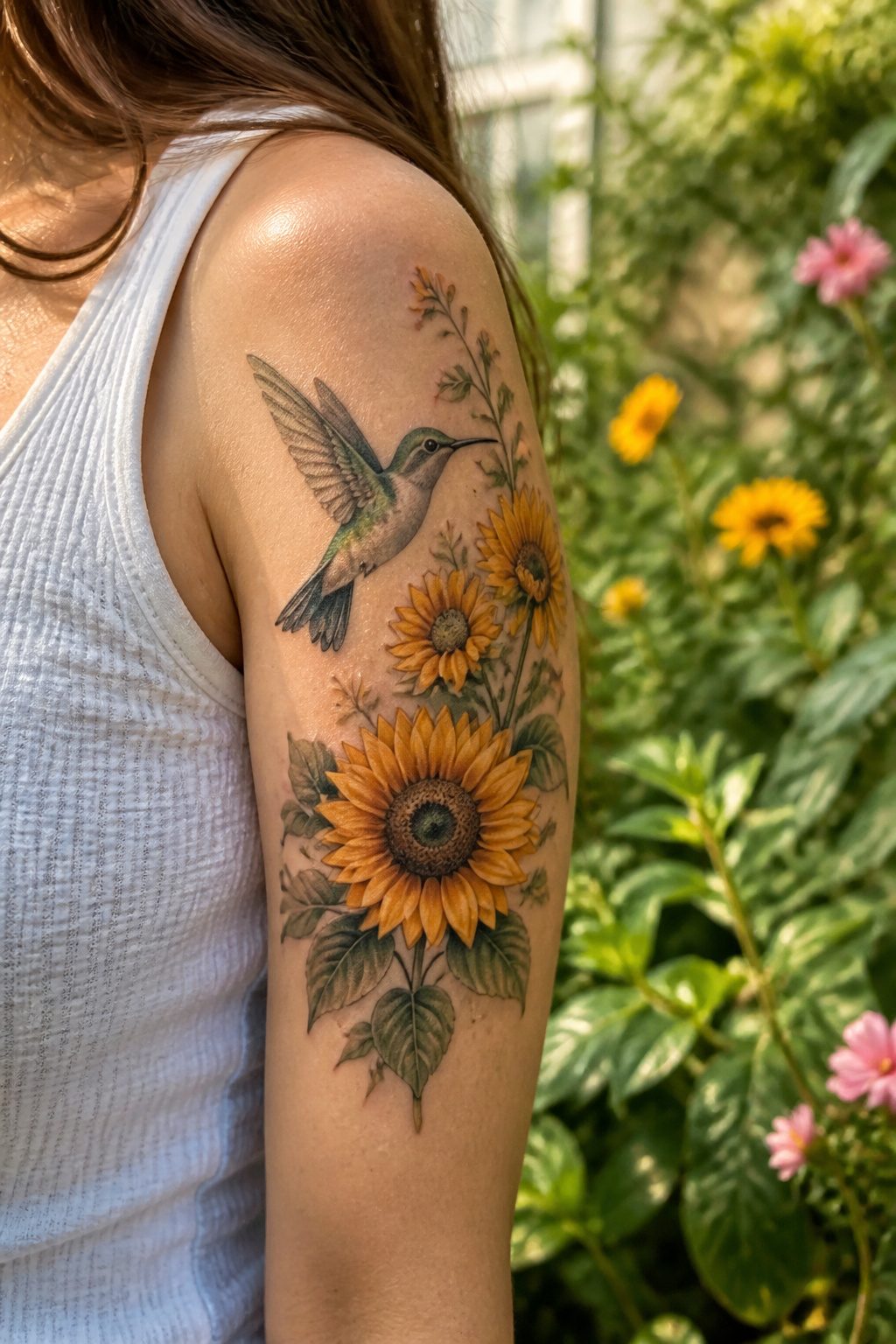
Pairing a hummingbird with cherry blossoms or sunflowers shifts the design from a posed portrait to a scene that looks like it could exist somewhere real. Cherry blossoms frame the bird in soft, drifting petals that suggest early spring and the brief window when both appear together. Sunflowers do the opposite, giving the composition weight and height, the bird suspended above thick stalks and broad faces that catch the same light.
The difference is spatial. A single flower next to a hummingbird reads as symbolic, a chosen emblem. A field of sunflowers or a branch of cherry blossoms in full drift creates depth, background, a sense the bird flew in and might fly out. The tattoo becomes a window rather than a badge.
Scene work asks more of the artist. Overlapping elements, atmospheric fading, the scale shift between foreground bird and midground blooms all need planning so the image holds together as the arm moves or the back stretches. The payoff is a piece that feels observed rather than arranged, something that happened to catch the eye rather than a symbol selected from a menu.
9. Hummingbird and Other Animals
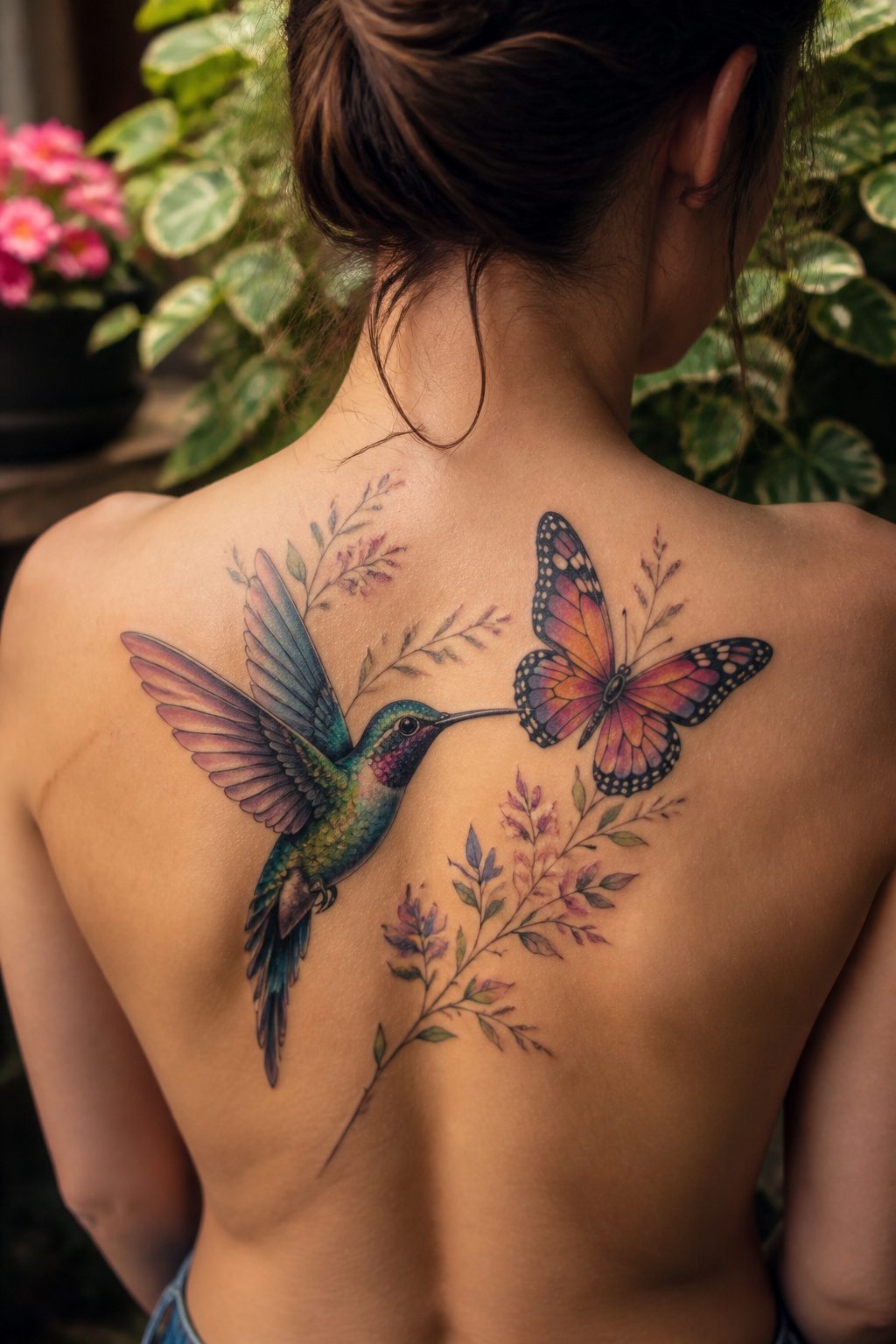
Pairing a hummingbird with another creature opens up stories that a single bird cannot carry on its own. A frog and hummingbird together catch the same moment in two bodies: one anchored at the water’s edge, the other mid-hover, both drawn to the same bloom. The contrast in scale and posture gives the artist something to work with that repeats of the same species never quite manage.
Butterflies are the more expected partner, and that familiarity cuts both ways. Done with attention to wing pattern and flight angle, the two pollinators share a frame without competing for it. The risk is the calendar-tattoo look, where every element sits polite and separate. What saves the design is overlap: a hummingbird’s beak breaking the plane of a monarch’s wing, or both figures oriented toward a single light source so the shadows connect them.
Other pairings are harder to find in portfolios but worth asking about. A snake coiled near the nectar source turns the sweetness into tension. A moth, nocturnal counterpart to the day-feeding bird, lets the tattoo mark a transition or a balance the wearer wants to hold. The less common the pairing, the more it depends on the artist’s comfort with that specific animal’s anatomy. Not every specialist in feather texture has spent equal time on amphibian skin. Ask to see their relevant work before committing to the combination, or the weaker figure will flatten into decoration while the stronger one does all the visual work.
10. Hummingbird Cover-Up Tattoos
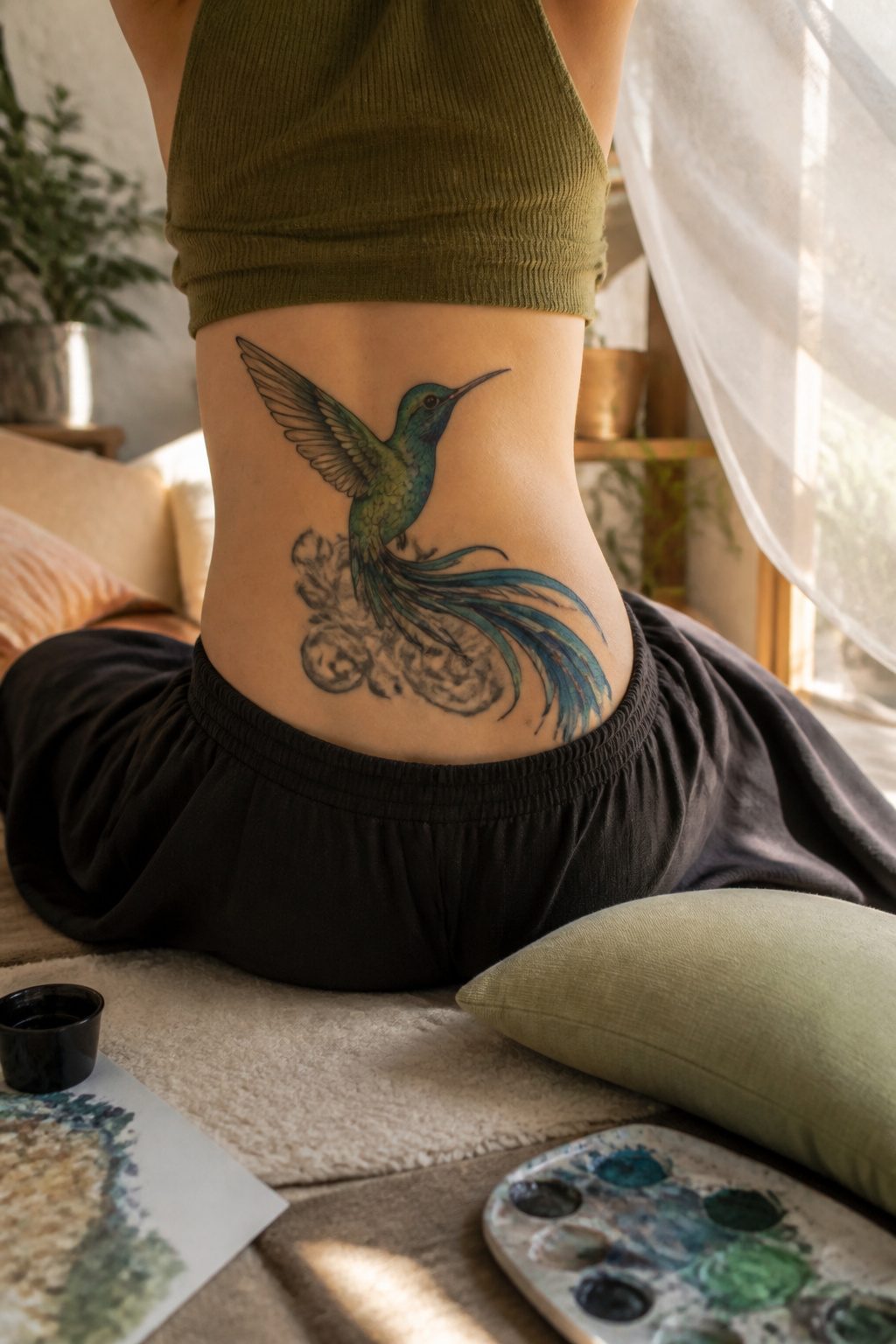
A hummingbird’s spread wings and elongated body give the artist room to work outward from the old ink rather than layering directly on top, which rarely hides anything completely. The bird’s tail feathers can extend to mask a lower design, while the head and throat angle upward to draw the eye away from whatever sat there before. Color helps too: the iridescent greens and reds typical of these tattoos bounce light differently than flat black cover-ups, so the old lines read as shadow instead of mistake.
The catch is size. A hummingbird detailed enough to distract from existing work needs real estate, and a bird scaled to a few inches won’t carry enough pigment or pattern to do the job. The old tattoo also dictates placement: a bird in flight needs open skin to read as movement, so heavy blackwork on the shoulder or chest limits where the wings can stretch. Some artists solve this by pairing the bird with flowers or vines that fill the gaps, though that shifts the design from cover-up to full sleeve territory.
What Hummingbirds Symbolize in Ink
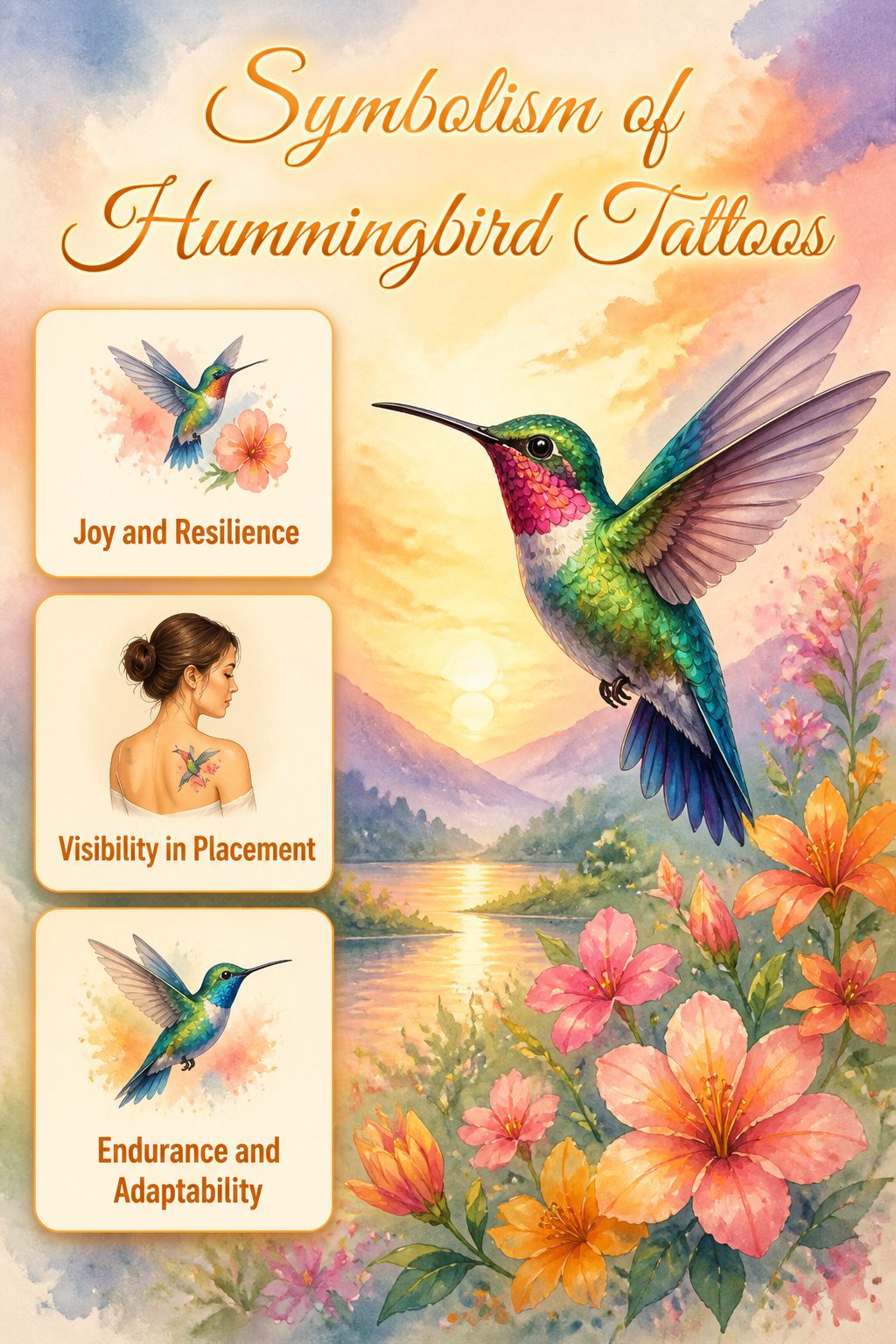
A hummingbird tattoo carries joy, resilience, and the beauty of life in a way that few other small subjects manage. The bird’s ability to fly thousands of miles and adapt to varying environments gives it a specific weight: it marks survival through change rather than just prettiness. That distinction matters when someone is choosing between a hummingbird and, say, a butterfly or a songbird. The butterfly reads as transformation, the songbird as freedom, but the hummingbird lands on endurance with color still intact.
The practical result shows up in placement and pairing decisions. Someone who has navigated significant life changes often wants the image where they can see it, not hidden. The bird’s backward flight and hovering add motion options that a static perching bird simply doesn’t offer an artist. Versatility follows: the design works small enough to cover easily or large enough to anchor a shoulder piece, and it pairs naturally with flowers without looking like an afterthought.
I notice the hummingbird wins out when the wearer wants the symbolism to do actual work. A tribute to resilience in adversity needs a subject that earned its colors, not one that started with them.
Where to Place a Hummingbird Tattoo
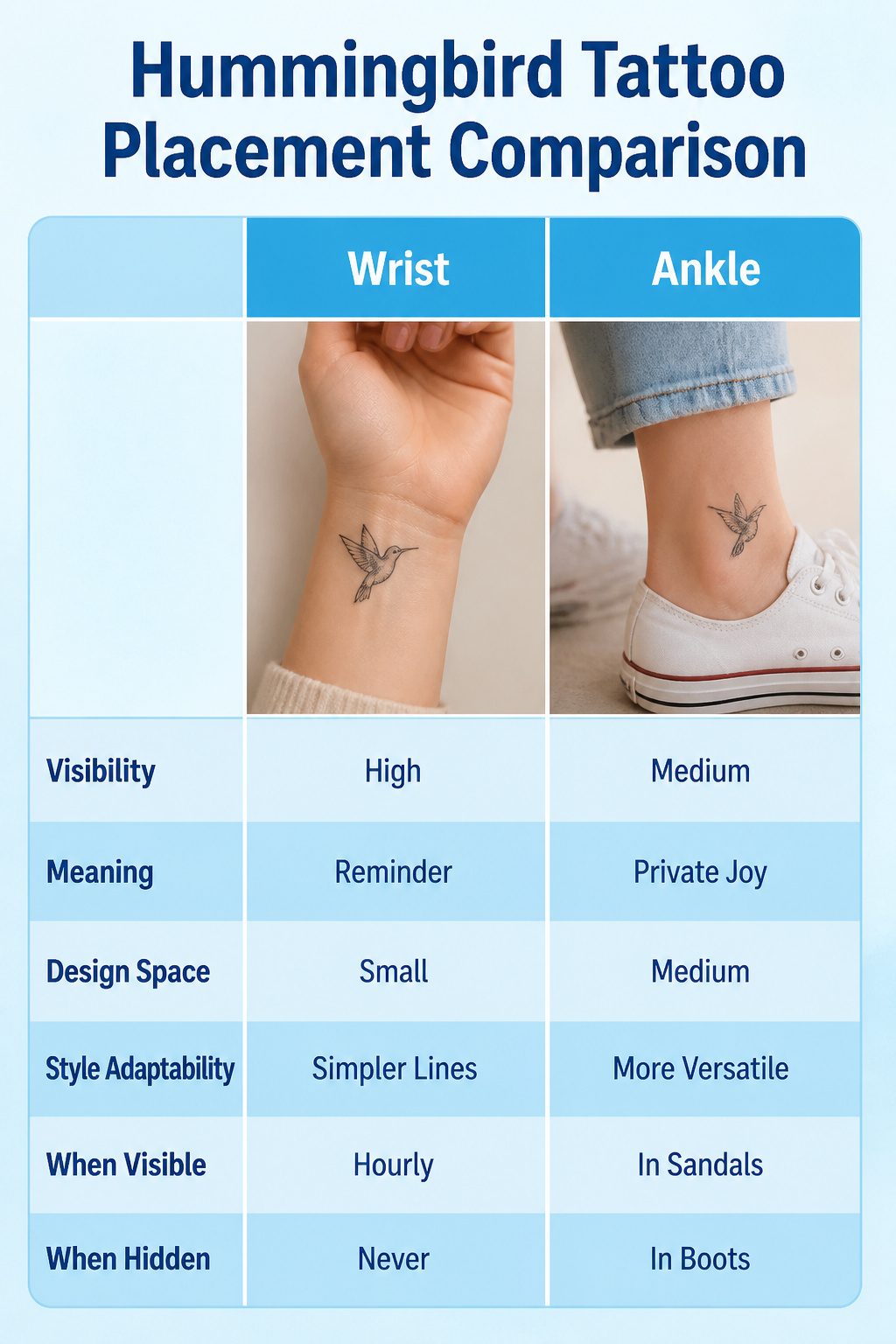
A wrist hummingbird tattoo sits where you see it hourly, so the meaning stays present rather than stored away. That visibility suits a reminder of resilience or a memorial you want to keep in motion. The ankle offers the opposite contract: visible to you in sandals, hidden in boots, which lets the flight read as private joy rather than public statement.
The shoulder and back give the bird room to travel. On a shoulder, the design can arc toward the collarbone or away toward the arm, and the flight direction changes what the placement says. A hummingbird flying upward on a shoulder reads as aspiration; the same bird pointed downward toward the heart carries a different weight. The back allows the longest flight path, a horizontal line from spine to side that no smaller placement can match.
Size and style bend to the spot, not the other way around. A shoulder piece holds color and surrounding foliage without crowding; a wrist demands simpler lines if the bird is to stay legible years out. The choice is less about what the bird means in the abstract and more about how often you want that meaning in your line of sight.
How Artists Customize Hummingbird Designs
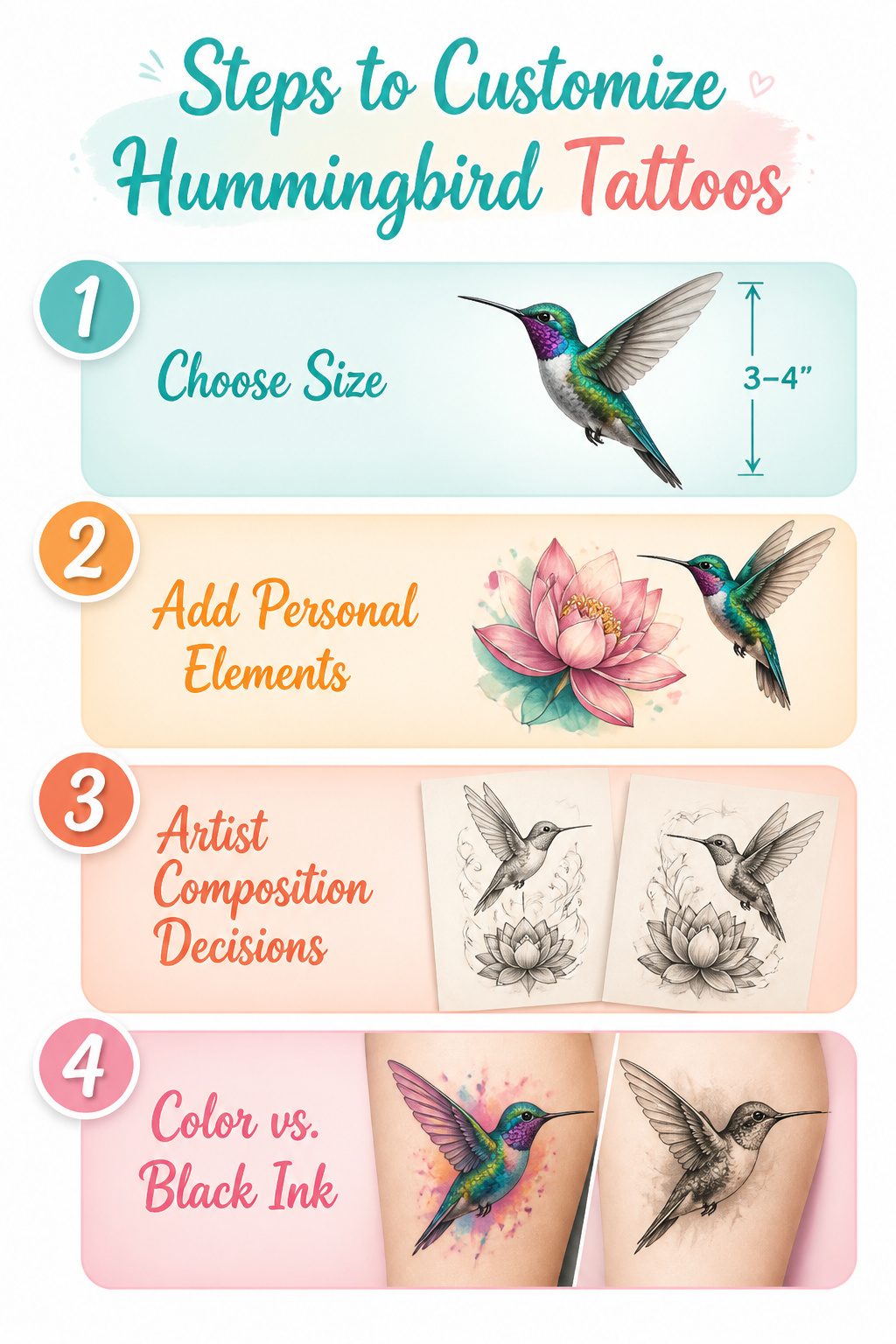
Hummingbird tattoos adapt to almost any scale, but the subject itself sets hard limits. The bird’s real wingspan runs about three to four inches for the species most people picture, so a design smaller than two inches wide starts losing the feather detail that makes the image read as a hummingbird and not a generic blur. Artists working in black ink lean on line weight and selective shading to keep those details legible at smaller sizes, while color pieces need more room for the gradients that suggest iridescence.
The consultation changes once you bring in personal elements. A lotus added for spiritual meaning, for instance, shifts the composition from a simple portrait to a narrative piece. The flower’s layered petals compete for attention with the bird’s wings, so the artist has to decide which element leads and which supports. I’ve watched this play out in portfolios where the lotus dominates and the hummingbird becomes an accent, versus layouts where the bird hovers above a smaller blossom. Neither is wrong, but the choice affects placement, since neck or shoulder pieces need that hierarchy resolved before ink touches skin. Color versus black ink becomes a practical question too: a single-color design keeps the focus on form and movement, while full color risks muddiness if the two elements carry equal visual weight.
Hummingbirds Across Cultures
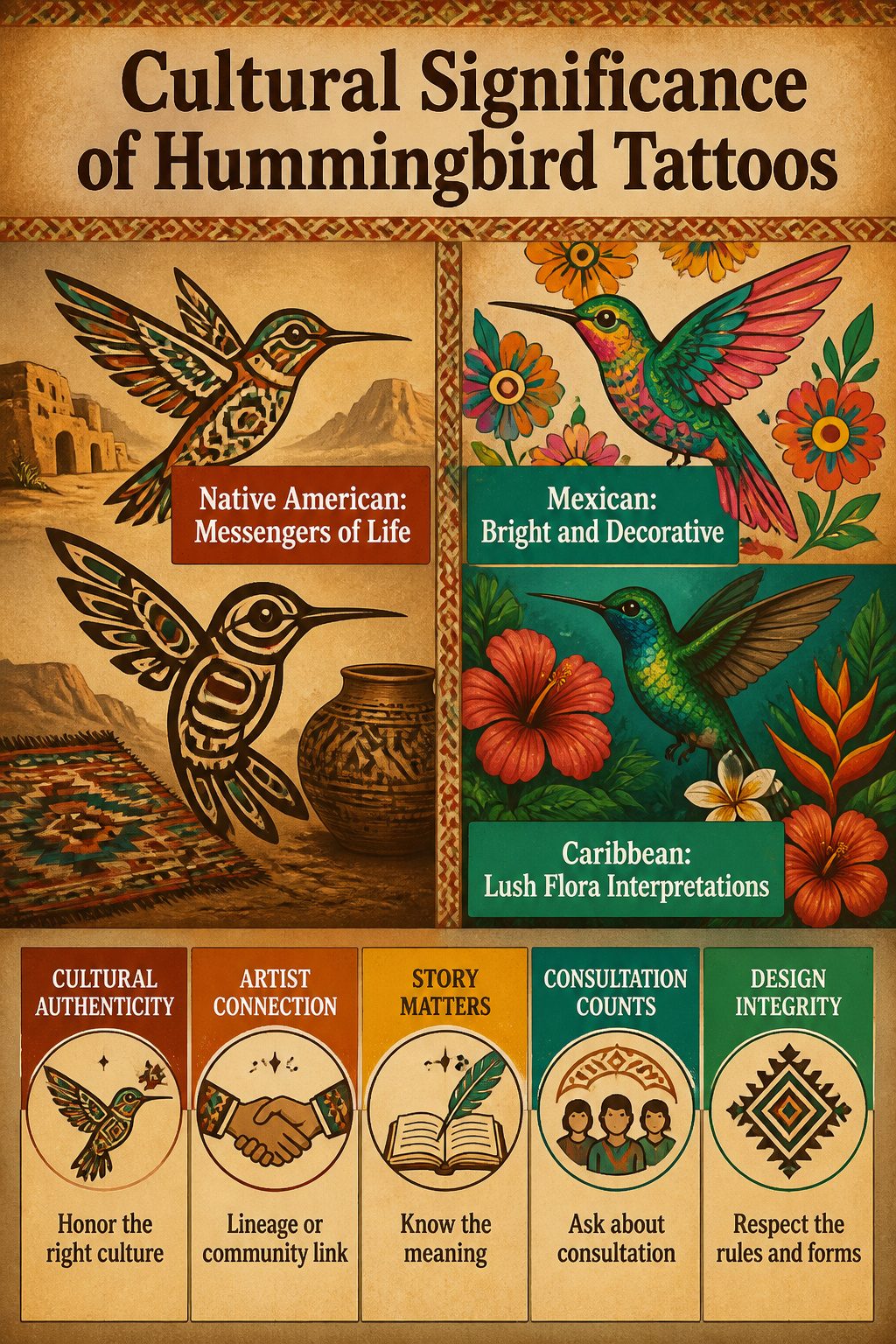
Native American traditions carry some of the richest hummingbird symbolism in tattoo work, and the designs that come out of it tend to look nothing like the generic flash sheets. In Pueblo stories, the bird appears as a messenger or a bringer of life to arid land. A Navajo piece might carry geometric borders that reference weaving patterns, while a Northwest Coast formline design renders the bird in bold black ovals and U-shapes that read as abstract until you know the grammar.
The gap between respectful reference and careless borrowing sits in the details most artists miss on their own. Ask whether the specific nation, style, and story belong to the artist’s own lineage or community, and if not, what consultation happened before the design was drawn. A hummingbird rendered in Tlingit formline without that relationship is a design problem, not just an etiquette one; the shapes carry clan history and their rules of construction are taught, not copied from books.
Other traditions open different visual paths. Mexican folk art favors bright, flat color and decorative patterning. Caribbean interpretations lean toward lush, overlapping flora. Japanese tattooing rarely centers hummingbirds at all, which matters if you are mixing it with koi or cherry blossom work; the combination can look assembled from separate catalogs rather than grown from one garden.
The practical check is to bring reference images from the culture you want honored, then watch how the artist responds. Someone who redraws rather than copies, who asks about the story behind your choice, who pauses on elements they are not qualified to render: that conversation tells you more than any portfolio spread.
Size and Scale for Hummingbird Tattoos
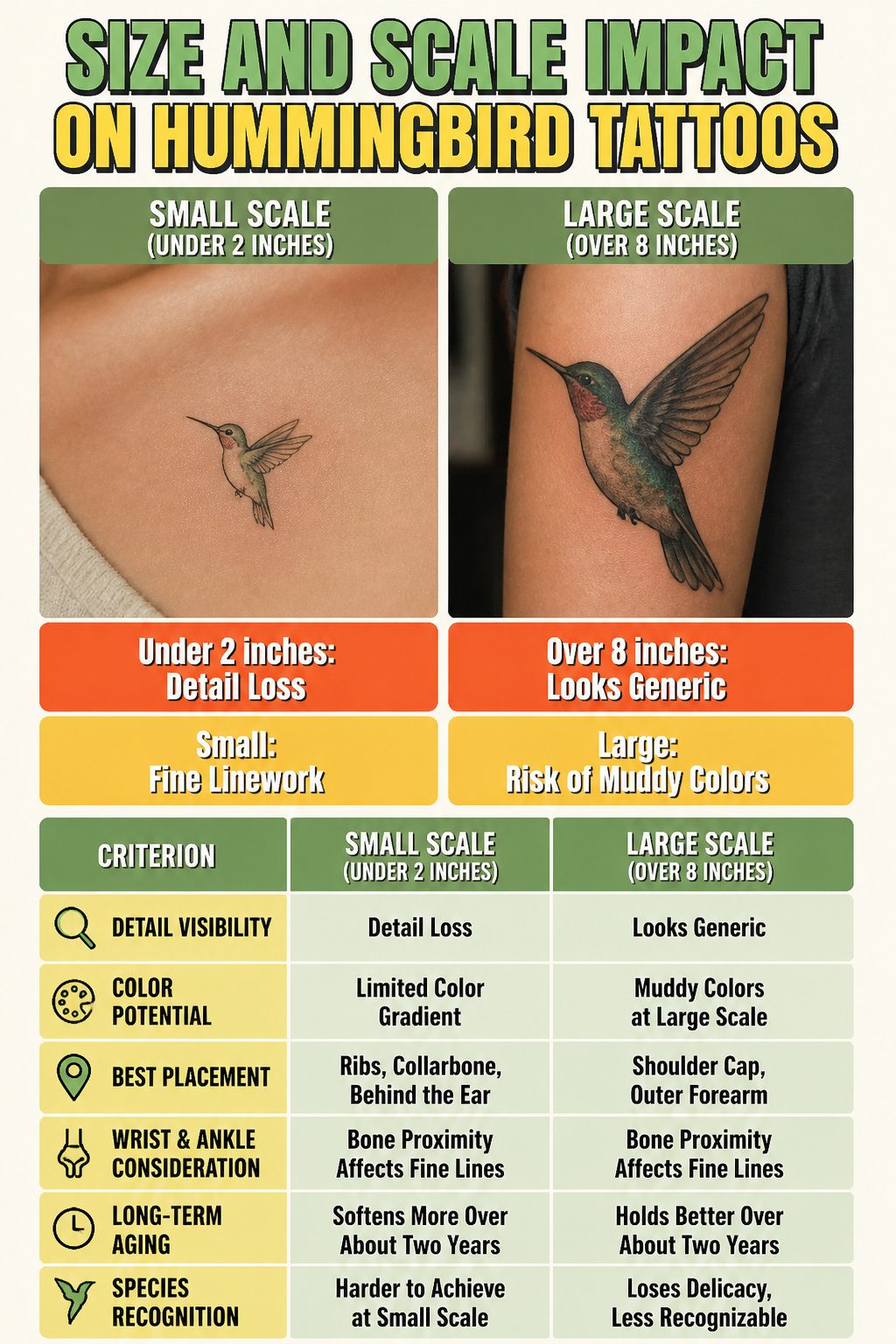
A hummingbird tattoo shrinks poorly. The beak, the iridescent throat patch, the wing blur that makes the bird recognizable in ink: all of that collapses below about two inches of body length. At that scale the needle has room for maybe three color passes before the feather texture turns to mud. Artists who work small regularly will tell you the honest limit, and the ones who refuse below a certain size are usually the ones worth booking.
The other edge is less obvious. Blow a hummingbird up to sleeve scale and the delicacy that makes it interesting evaporates. The bird starts looking like a generic songbird with a long bill. What reads as energy and motion at three inches turns static at eight. The long beak that looked elegant starts looking proportionally wrong against a heavier body, because our eyes know the real bird weighs less than a nickel.
Placement follows from this. Ribs, collarbone, behind the ear: these work because they force a smaller, tighter design. A shoulder cap or outer forearm gives more room, but the temptation is to fill it. The better move there is to let the bird stay small and build context around it, flowers or motion lines or negative space, rather than inflate the bird itself. The wrist and ankle are popular for visibility, though the bone proximity makes fine linework harder to hold. After about two years, a detailed piece there is likely to soften more than one placed over muscle.
Size also decides whether color is even viable. A full iridescent throat needs enough surface for the gradient to read; without it, you are left with flat green or flat red that does not shift in light the way the real feathers do. Black and grey solves this at smaller scales, but then you lose the species recognition that draws people to hummingbirds in the first place.
Frequently Asked Questions
What do hummingbird tattoos symbolize?
Hummingbird tattoos stand for joy, resilience, and the beauty of life. The bird’s real endurance, flying thousands of miles and adapting to new conditions, gives it weight as a mark of survival through change rather than just decoration. That difference sets it apart from butterflies or songbirds, which carry softer meanings.
What are the popular styles of hummingbird tattoos?
The most common styles are floral pairings, black ink, watercolor, minimalist, and traditional or neo-traditional designs. Floral combinations lead in requests because the flowers give the eye a path to follow. Black ink strips the image down to line and contrast, while watercolor trades crisp edges for a fluid, caught-mid-flight look.
Where are the best placements for hummingbird tattoos?
Wrist and ankle placements suit small, personal pieces you see often or keep hidden. The shoulder and back allow longer flight paths and more surrounding detail, with direction mattering: upward flight reads as aspiration, downward toward the heart carries different weight. Ribs, collarbone, and behind the ear force tighter, smaller designs.
Can hummingbird tattoos be customized?
Yes, and the consultation shifts once you bring in personal elements. Adding a lotus for spiritual meaning, for instance, changes the whole composition from portrait to narrative, forcing the artist to decide which element leads. Size, color versus black ink, and accompanying symbols all bend to what the specific combination needs.
What are some unique hummingbird tattoo designs?
An infinity loop threaded through the bird’s flight path ties its joy to endlessness, working as either an ornate piece with roses or a spare single-line design for hidden placement. Less common pairings include frogs at the water’s edge, snakes coiled near nectar for tension, or moths as nocturnal counterweights, though these demand an artist comfortable with that second animal’s anatomy.