Anime tattoos are character portraits and symbols from Japanese animation inked into skin, but the designs that hold up are the ones built for how ink ages rather than how a screenshot looks fresh. A watercolor Totoro fades faster than saturated blackwork, which means aftercare and needle choice decide whether the piece still reads in year five. With over 305,000 posts under #animetattoos on Instagram, the gap between trending reference and healed result is where most of these pieces fail.
1. Totoro from My Neighbor Totoro
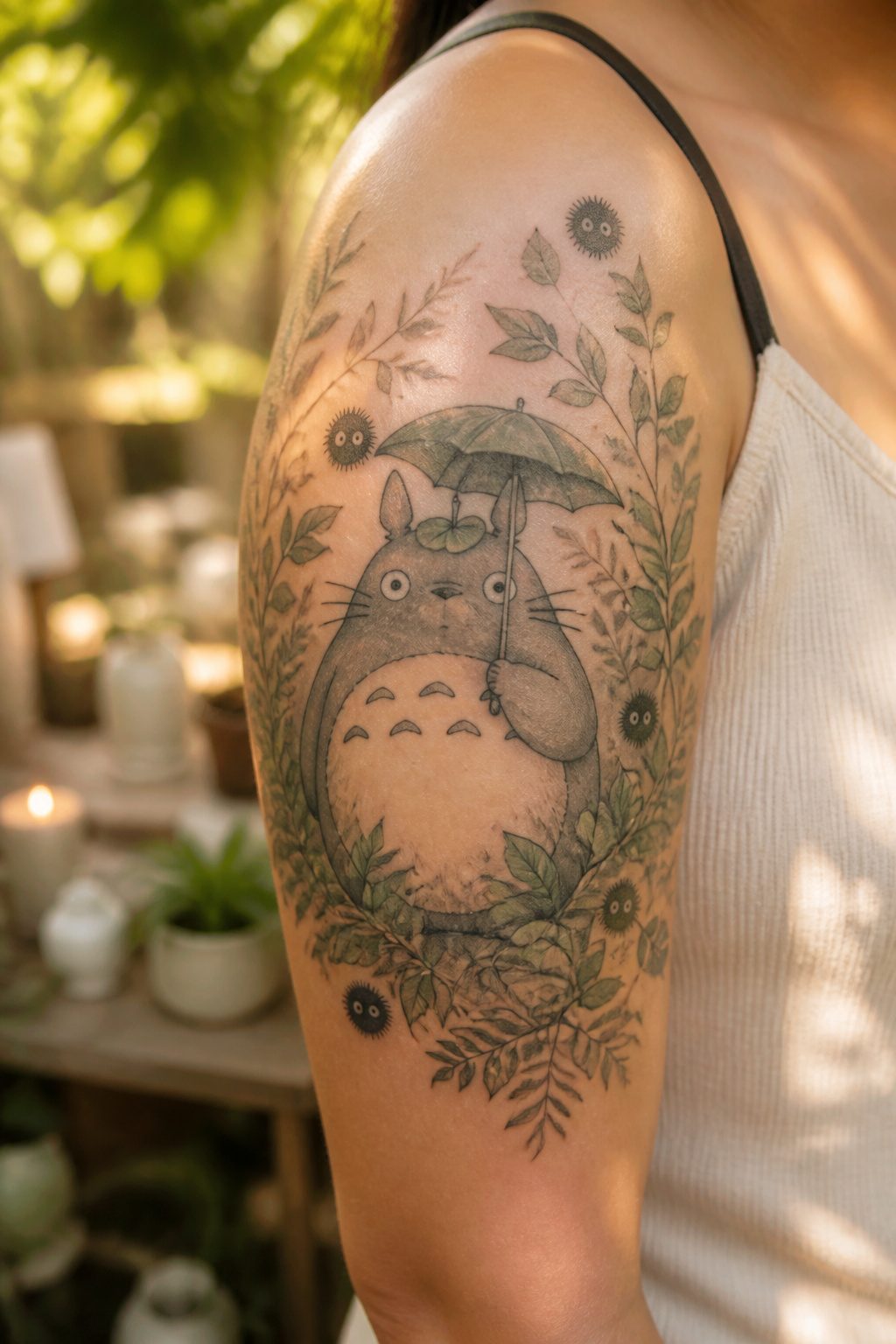
Totoro holds up for anime tattoos because the design asks for softer linework rather than the hard edges most character portraits need. A good artist can render the forest spirit in watercolor or minimalist line, and either approach keeps the roundness that makes him readable at a glance. The leaf umbrella and the smaller soot sprites are the usual companions, and they give the piece structure without crowding it.
The real consideration is color maintenance. Watercolor blends of light blue and grey fade faster than saturated ink, so aftercare matters more here than with bolder palettes. Specialized tattoo cream through healing keeps those tones from washing out in the first year. Placement is flexible; the rounded shape works on an arm, a shoulder, or a smaller scale behind an ear. What makes Totoro endure as a reference point is that the design does not depend on anime fandom alone. The appeal is broader, which matters if you are weighing whether a character tattoo will still sit right in ten years.
2. Nine Tails Seal from Naruto
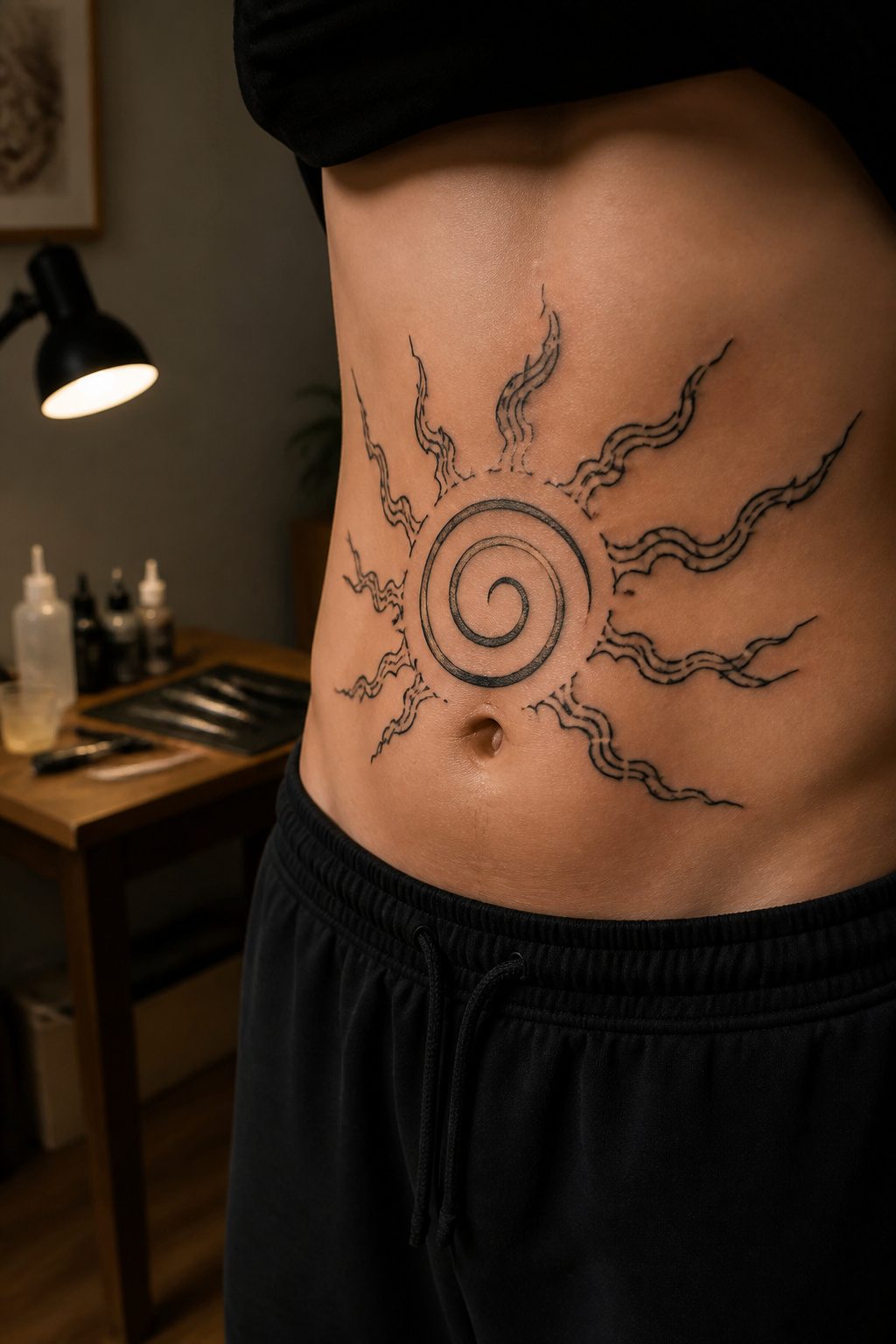
The Nine Tails seal sits as a spiral pattern on the stomach or chest, mimicking the actual seal that contains Naruto’s power. Fine lines carry the swirl, and the design stays recognizable without turning into something that demands a full session and a stretched budget. I have seen it pulled from three different tattoo collections, which tells me the idea has settled in as a standard choice rather than a passing reference. Placement matters here: the stomach keeps it personal, the chest makes it visible when you want it to be. Either way, the swirl reads instantly to anyone who watched the series and still holds meaning for fans who followed Naruto’s full arc.
3. Gojo from Jujutsu Kaisen
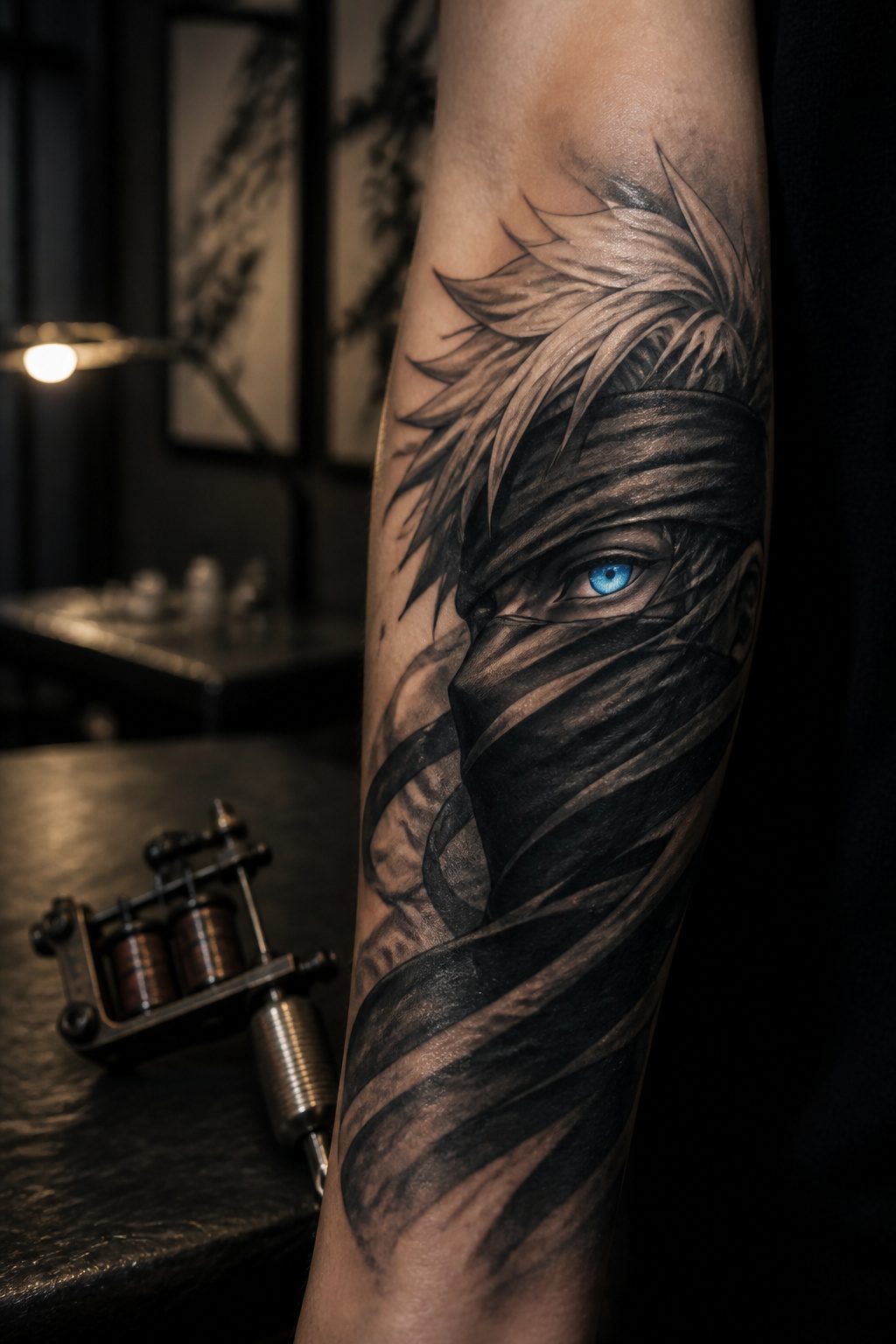
A blindfolded Gojo portrait lives or dies on the moment the fabric lifts. The design that keeps surfacing shows one eye breaking through, and that single exposed Six Eyes iris carries the whole piece. The artist has to nail the glow against matte fabric without letting either element flatten out. The eyelashes need the same precision as the Infinite patterns inside the iris, which is why the fine-detail work matters here more than on most portrait tattoos.
What strikes me about how fast Gojo entered the canon is the sheer visual efficiency of the character. Jujutsu Kaisen premiered in 2020, yet the blindfold-and-eyes combination already reads as iconic in a way that usually takes a decade to settle. The contrast does the heavy lifting: the blindfold suggests restraint, the revealed eye promises overwhelming power, and the tattoo compresses both into one static image. An artist who can render that tension without overworking the linework gives you something that holds up at distance, not just in the reference photo.
4. Deku from My Hero Academia
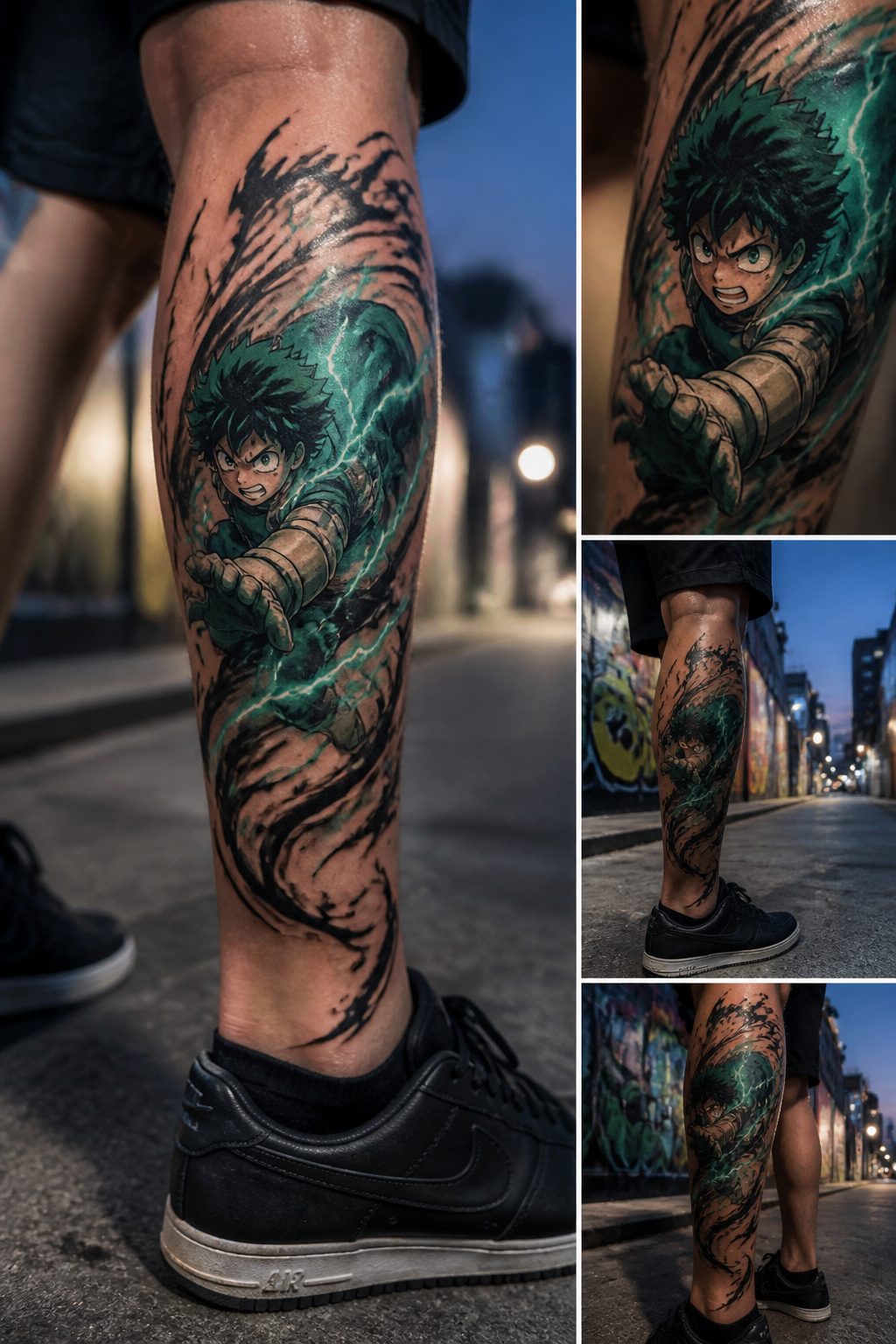
The black tendrils and green lightning of Deku’s carnage form make for a tattoo that lives or dies on motion. Static portraits let an artist hide a shaky line in the shading; an action shot exposes every hesitation. The tendrils need to read as forward momentum, not spaghetti, and the green lightning has to carry enough punch that it still registers when the surrounding black settles into skin over the years.
Motion-heavy designs demand more skin real estate than a simple face study. The arm or leg gives the artist room to let those tendrils wrap with purpose, to make the lightning feel like it is cracking across muscle rather than sitting on top of it. Intricate detail compressed onto a shoulder blade or ribs tends to mud together as the lines spread.
What holds up is contrast and direction. The black of the tendrils against clean skin, the green ink laid in bold enough that it does not fade to a bruise-like grey. Thin lightning bolts drawn too delicately will disappear; the ones that last have weight behind them. After five years, the energy in the composition comes down to whether the original artist committed to strong darks or tried to save the drama with finesse alone.
5. Sailor Moon
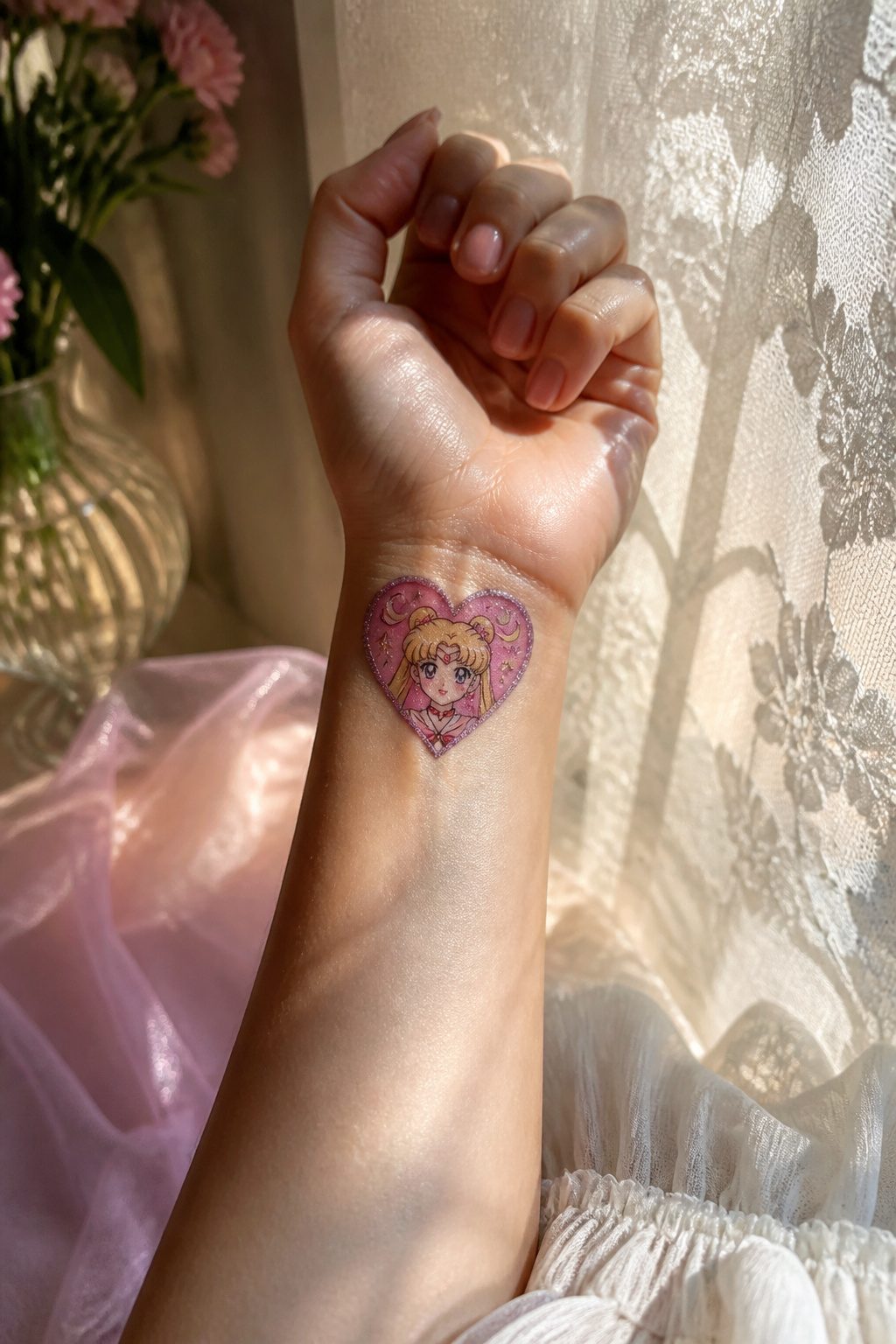
Sailor Moon sits at the center of more anime tattoo requests than almost any other character, and the reason starts with color. Bright pinks, purples, and golds make up the magical girl palette, and artists reach for very thin tattoo needles to render the tiny glints of light that turn a Moon Stick or Crisis Moon Compact into something that looks like it is actually glowing on skin. The teary-eyed portrait of Usagi Tsukino works because it captures the character’s emotional core; some clients frame that face inside a heart or surround it with sparkles and transformation ribbons. What surprised me, looking at how these bookings break down, is the age spread. Sailor Moon debuted in 1992 and ran 200 episodes, so the original fans are now in their forties, but the 2023–2024 revival and continued streaming access pull in viewers who were not born until decades later. A mother and daughter can walk into the same shop requesting the same character for fundamentally different reasons: nostalgia for one, discovery for the other. The design adapts to both. A small silhouette of Luna the cat suits someone who wants the reference to read only to those who know it, while a full transformation brooch with magical elements broadcasts the fandom openly.
6. Wings of Freedom from Attack on Titan
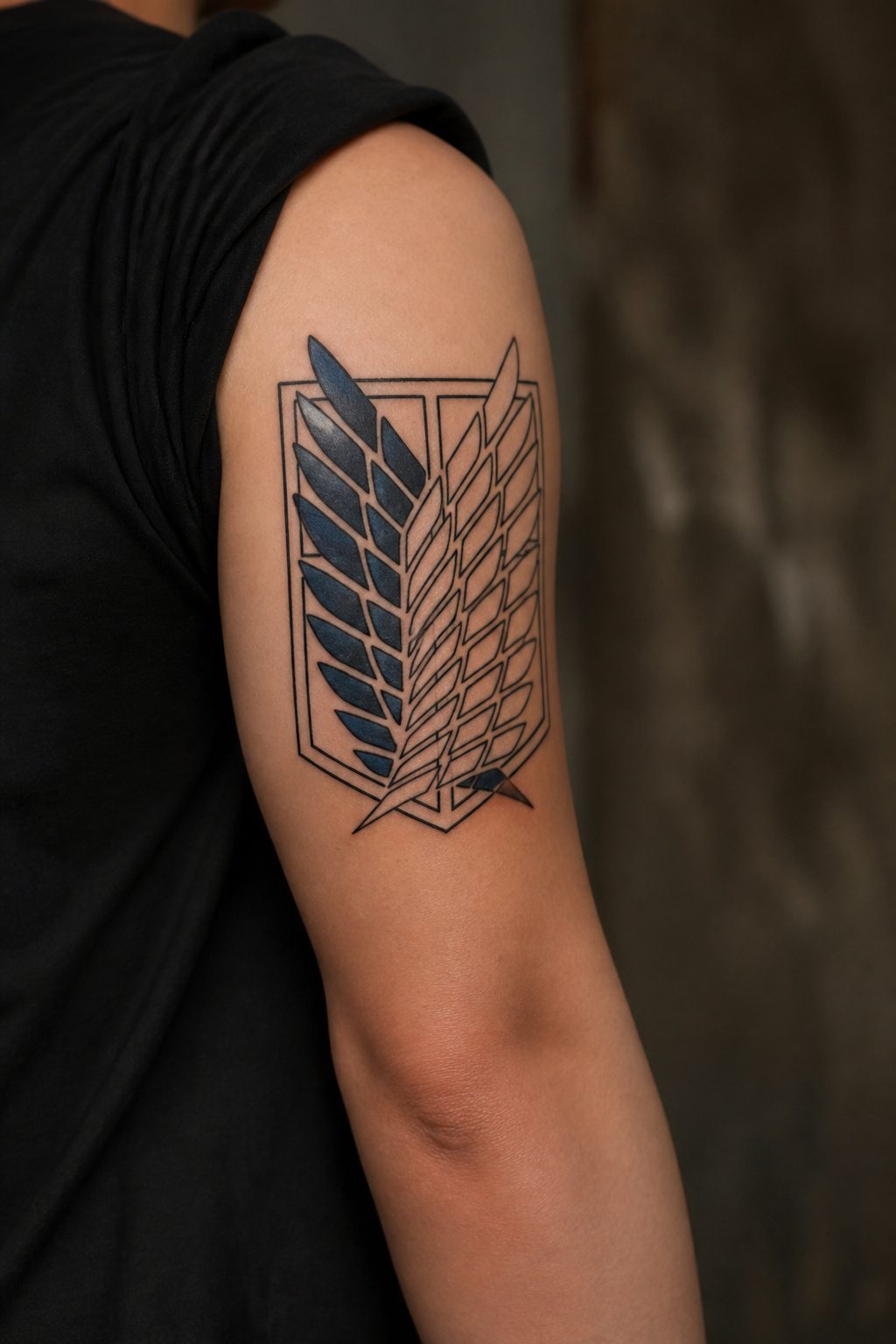
The Wings of Freedom from Attack on Titan sits on the arm more often than anywhere else, and that placement is doing quiet work. An emblem tattoo reads differently from a character portrait because it rewards the people who already know the reference while keeping the meaning invisible to everyone else. The overlapping blue and white feathers carry the Scout Regiment’s spirit without requiring a face or a scene to explain it.
Clients who choose symbols over portraits usually want that layered recognition. A full-color Eren Yeager on your forearm tells the world exactly what you watch. The Wings of Freedom only speaks to someone who has already lived inside the story. That difference matters more as anime tattoos move further into mainstream spaces. The design still needs sharp edges to hold the feather detail, so the artist’s line control matters here in a way it does not for softer, more forgiving shapes. The shoulder and chest work too, but the arm keeps it visible to you without turning every conversation into an explanation of the source material.
7. Goku from Dragon Ball Z
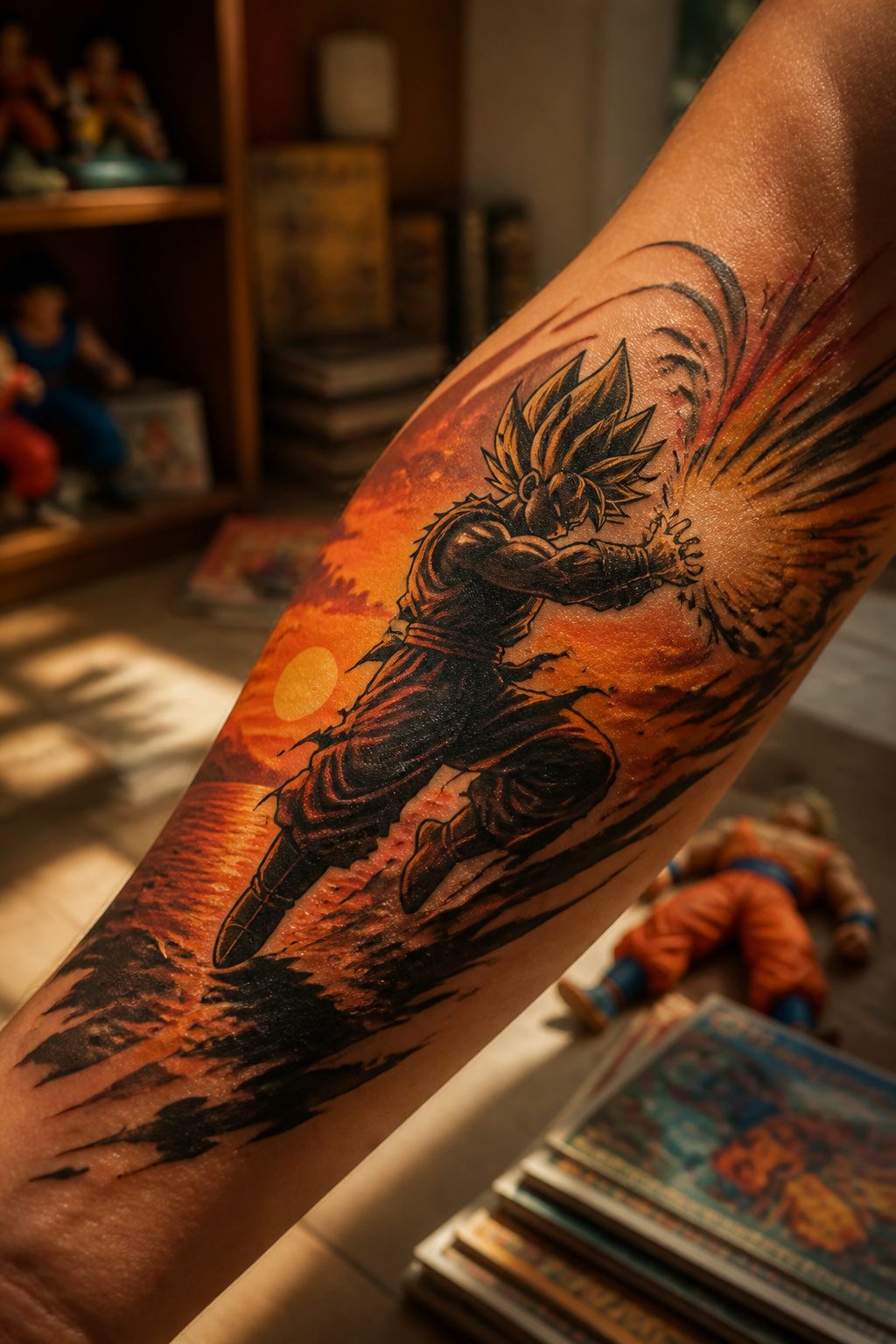
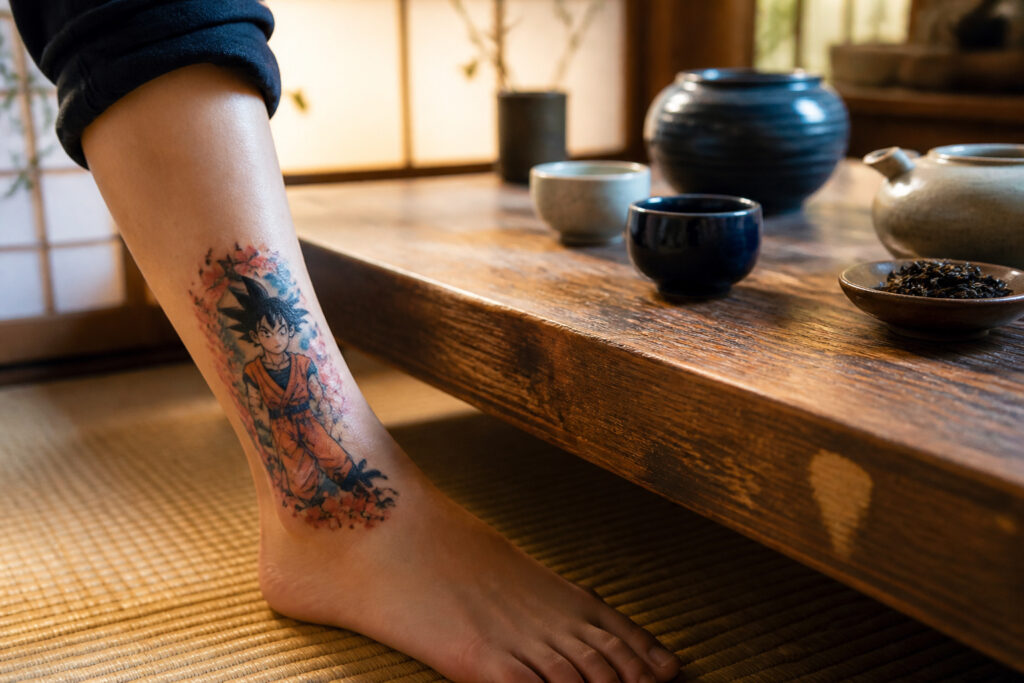
Goku’s silhouette mid-Kamehameha, golden hair catching light that isn’t there, lands on skin with the same permanence the series found in memory. Dragon Ball has outlived three decades of broadcast cycles, and the clients who ask for him usually trace the request back to Saturday mornings they can still smell, cereal bowls and CRT static and the first time a power-up felt like possibility.
The kanji on his uniform reads "wisdom," a detail most viewers missed in the rush of combat but that carries weight once you know it. That single character, the "Go" emblem, works as a subtler piece than full-color Super Saiyan work: forearm or calf, clean lines, no need for the color-packing needles that push pigment dense enough for Goku’s hair to glow. Some artists build the whole design around the circular seal alone.
The action poses demand more space and more commitment. Dynamic combat stances, the blue-white energy wave held between his palms, these need room to breathe across a shoulder or down a thigh. What the series gave a generation was transformation as a visual language, and that translates to skin more directly than most anime references. The tattoo holds because the source material never stopped being rerunning somewhere, some platform, some midnight block.
8. Alphonse Elric from Fullmetal Alchemist
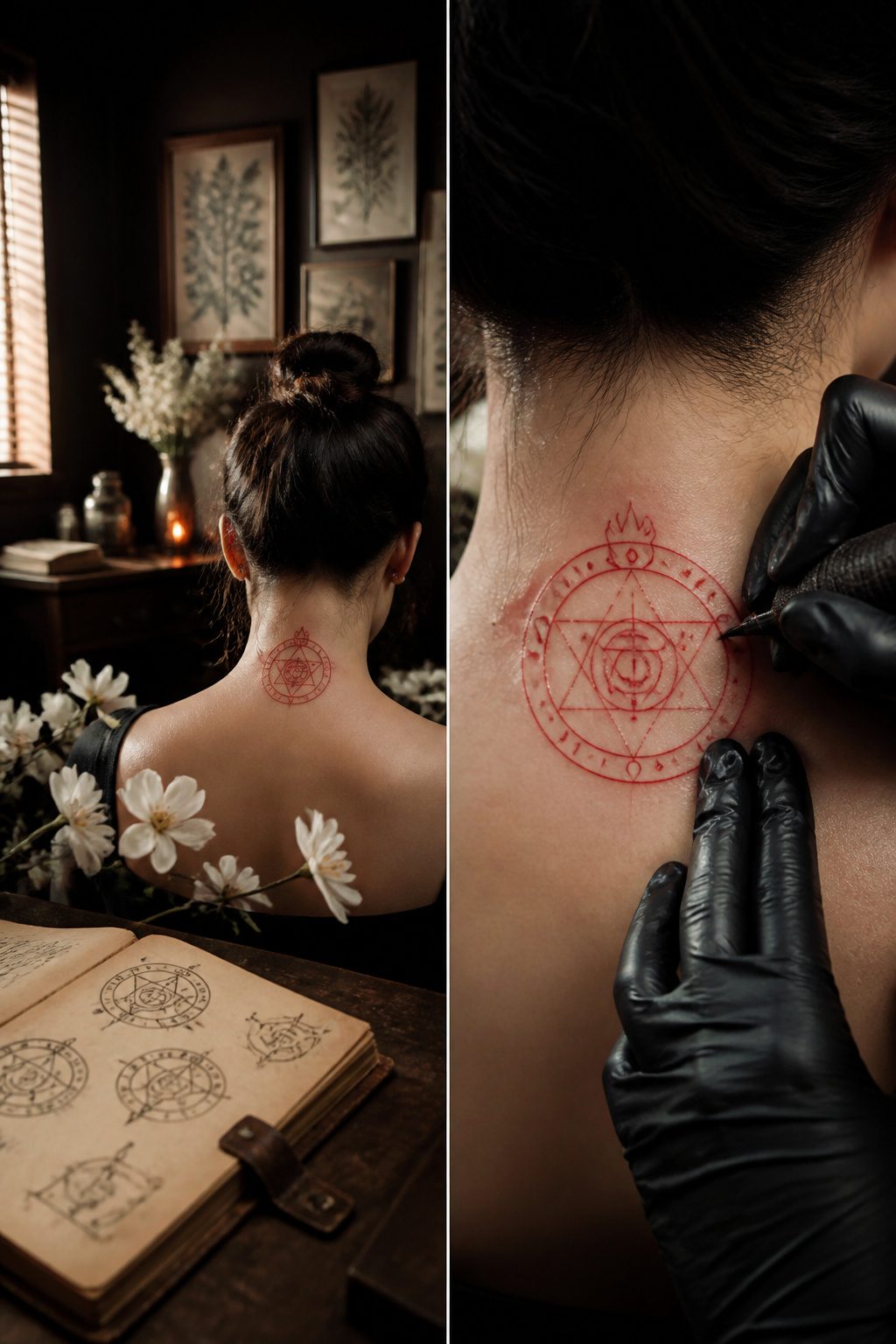
Alphonse Elric’s design splits cleanly into two camps, and the blood seal wins for anyone who wants meaning without announcing it to every room they enter. The seal itself is a simple circular symbol, a red ring of alchemical script that binds his soul to the armor. It reads like something drawn in actual blood when the ink is deep enough, and it sits well on the back of the neck or the inner wrist, places a shirt cuff or collar hides easily.
The full armor is the opposite move: a full-body metal shell in neo-traditional style, heavy linework and chrome highlights, usually taking the outer bicep or a full limb to do justice. That piece declares the character outright. It is a commitment of skin and session time that the seal avoids entirely.
I have watched people choose between these two and the difference is almost always about how much they want the tattoo to explain itself. The armor needs no footnote; the seal earns a second glance from those who know, and passes as abstract geometry from those who do not. Both are faithful to the same story. One just trusts the viewer to recognize it.
9. Brand of Sacrifice from Berserk
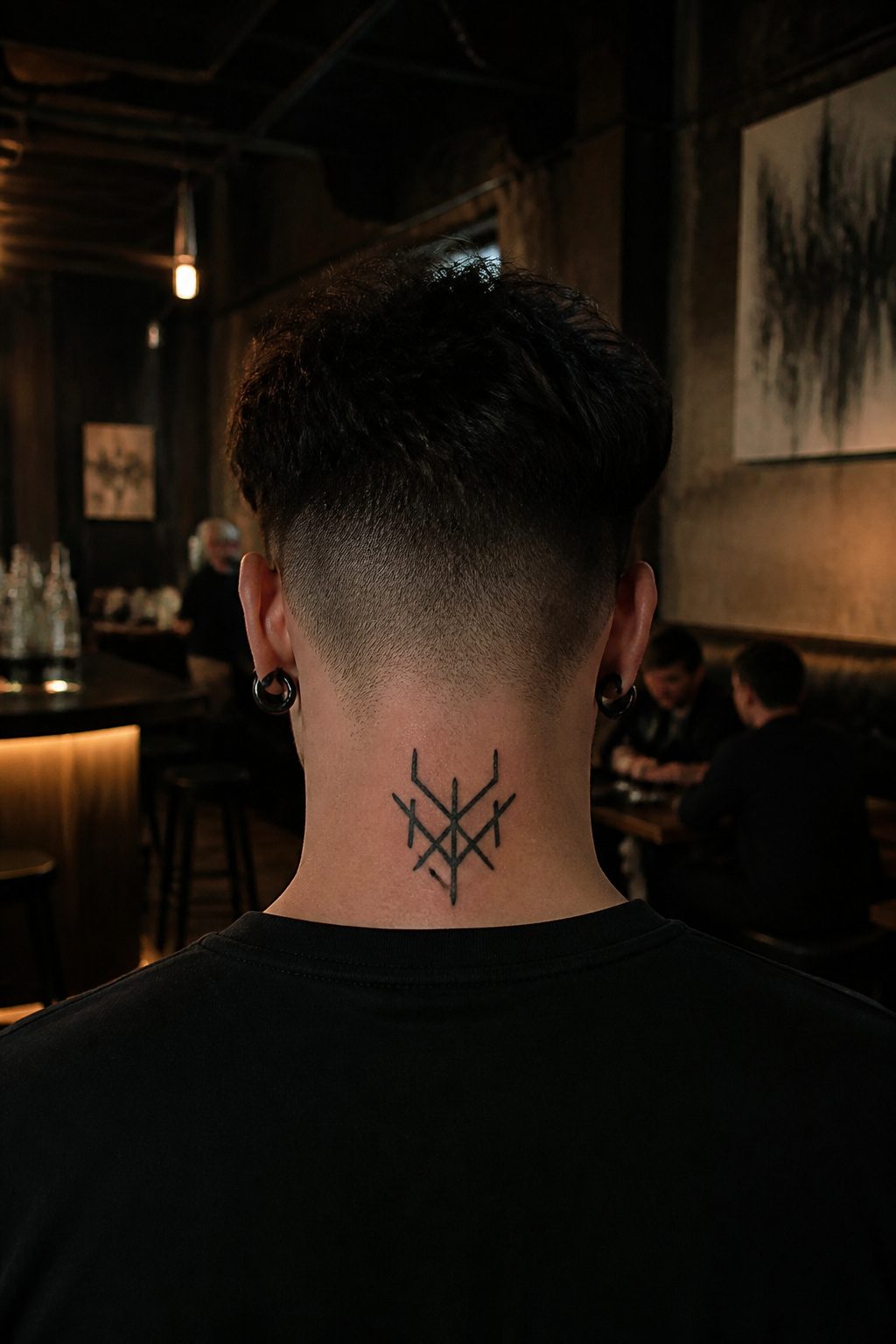
The Brand of Sacrifice from Berserk works because it carries weight without needing color or scale. A small, jagged black mark, usually placed on the neck to match Guts, it heals fast if you keep the skin hydrated that first week with a quality tattoo cream.
Darker source material like Berserk draws a particular kind of request. The mark signifies suffering within the story’s logic, a curse earned through sacrifice rather than chosen as decoration. Clients who gravitate toward it tend to want the symbolism intact, not softened. They are often the same people who would wear the Akatsuki cloud, another small, recognizable symbol that reads clearly even to viewers unfamiliar with the anime.
Solid black line work keeps the design legible at any size and ages well over time. The simplicity is the point.
10. Akatsuki Cloud from Naruto
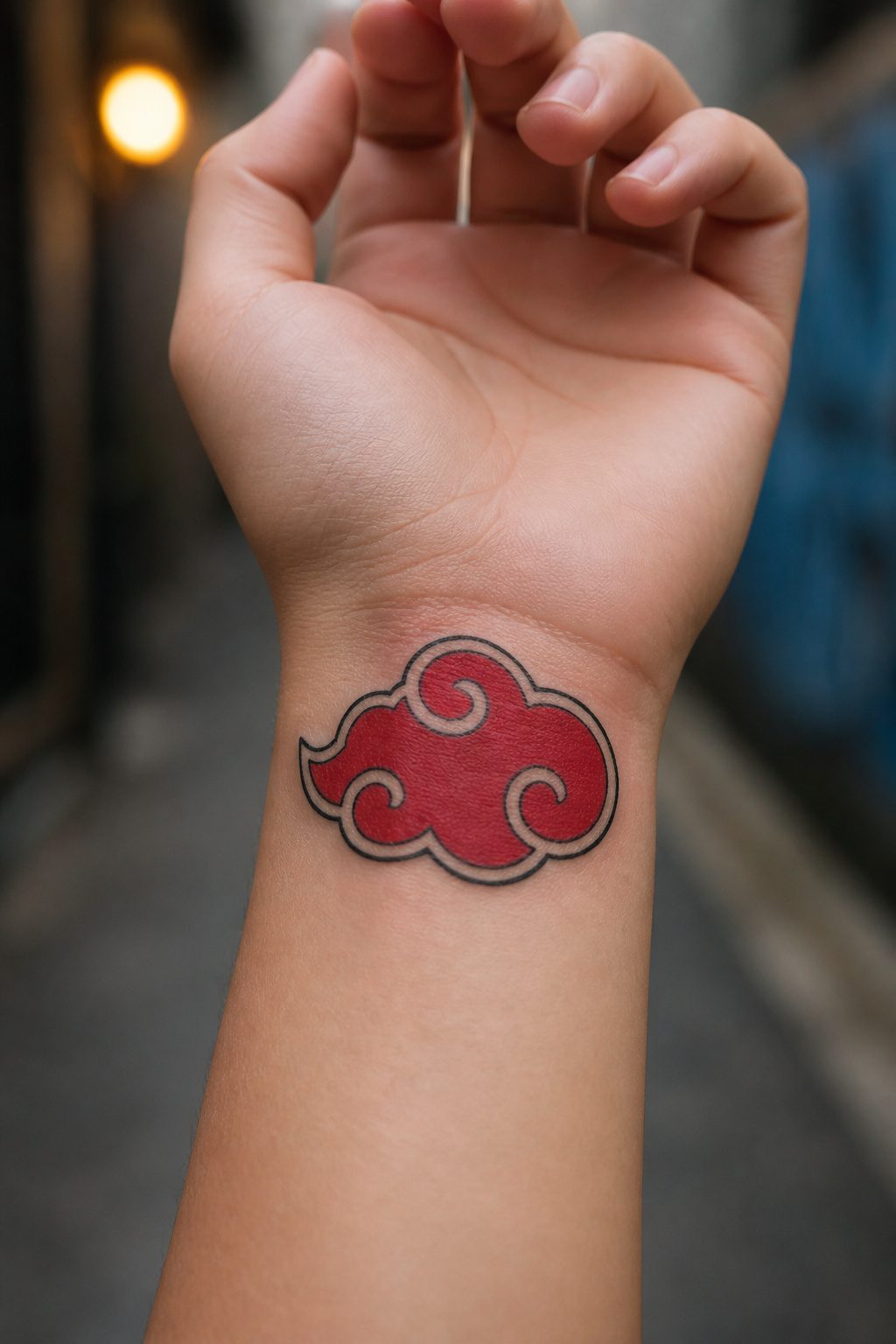
The red cloud from Naruto’s Akatsuki carries as much weight as any full-scene portrait, and it does so at sizes where a face would collapse into a smudge. A tiny finger tattoo still reads instantly as rebellion and power because the symbol was built for recognition: flat red shape, thick white border, nothing that demands fine-line precision to survive.
I kept noticing this while comparing options. Complex anime tattoos shrink badly; a character’s eyes need room for ink gradation that simply doesn’t exist below a few square inches. The cloud avoids that problem entirely. Its geometry holds whether it sits alone on a wrist or repeats into a sleeve pattern.
The real risk is color, not form. Red pigment fades faster than black, and keeping it bright demands quality ink and a machine that can saturate evenly. A washed-out crimson cloud looks like a weather stain, not a statement. That technical requirement is what separates a crisp Akatsuki mark from the amateur work that discolors within a year or two.
11. Chainsaw Man Denji
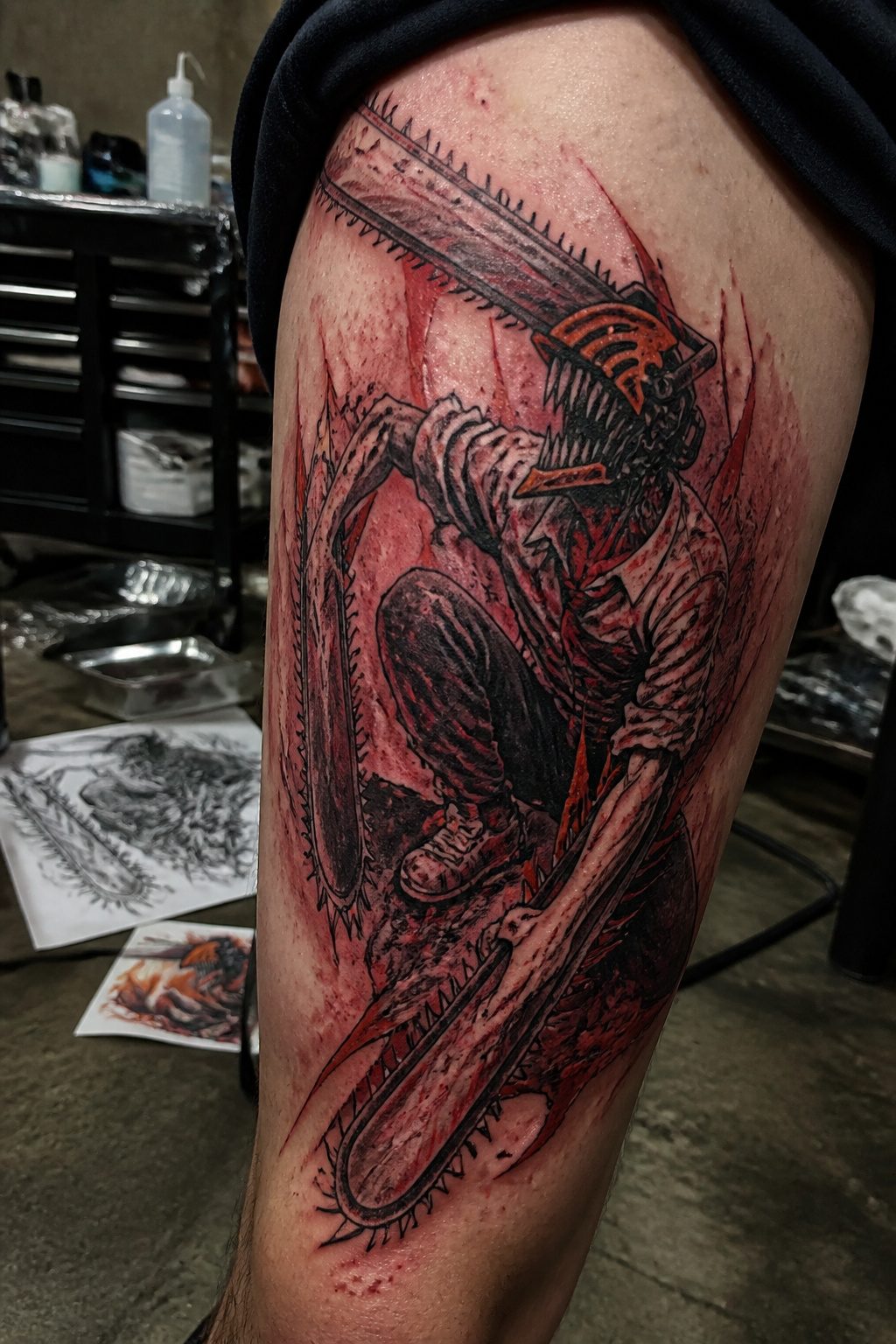
Denji’s transformed state, with saws ripping from his head and arms, lands differently on skin than a 1990s Goku line drawing ever did. The newer, more extreme series generate requests where the appeal is the mess itself: every drop of blood rendered in full color, the visceral quality not a challenge to work around but the entire point. An artist handling this source material needs confidence with thick outlines and bold colors, the same technical foundation that makes Pochita work in sticker style, applied now to flesh tearing and arterial spray. The grit is not an obstacle; it is the subject. Where classic anime tattoos often simplify for readability, Chainsaw Man demands the opposite: an artist who will commit to the chaos rather than sanitize it into something prettier and less true to the series.
12. Haku from Spirited Away

Haku’s dragon form is the rare anime tattoo that actually demands scale to work at all. The serpentine body, somewhere between Eastern dragon and river spirit, needs enough length to show the undulating movement that defines the character. On a calf or forearm, the shape collapses into a static lizard; wrapped across a shoulder blade down toward the hip, or curling from thigh to ankle, the flowing form finally breathes.
The color palette carries most of the visual weight. Teal scales against white fur create the gradient that separates a competent piece from a striking one, and that shift from green to blue in the mane takes serious shading hours. I have seen finished Haku pieces where the ink sat too heavy in the white sections and the whole dragon flattened into a single tone. The artist has to build those layers slowly.
As a river spirit, Haku carries a specific compositional advantage: water justifies any direction the body turns. Waves, splashes, or simply negative space shaped like current can fill gaps without looking like filler. The tattoo moves because the character is movement, and the body placement should let him swim.
Symbolic Meanings in Anime Tattoos
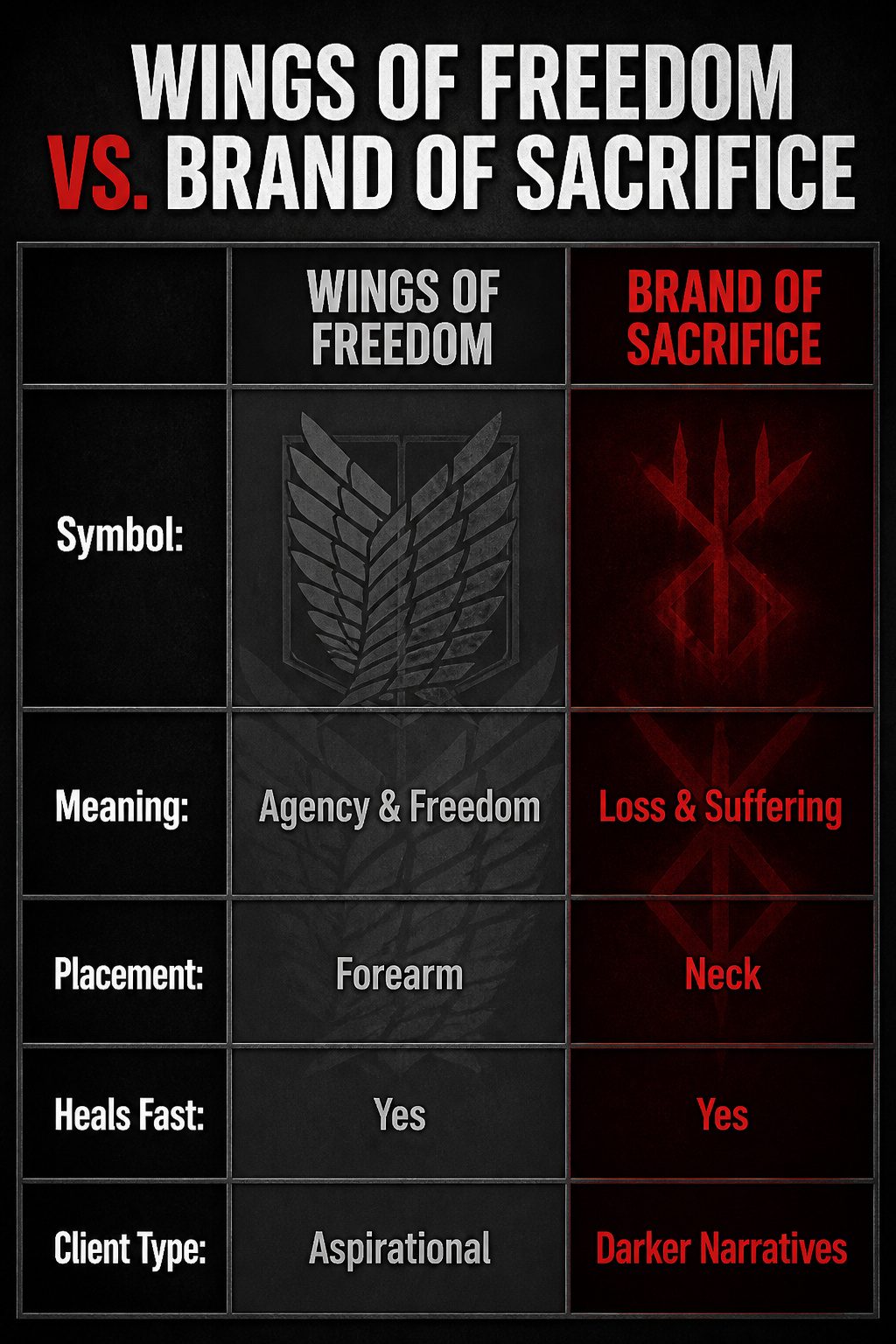
The symbols people carry say something about whether they want to be reminded of what they are moving toward or what they have survived. The Wings of Freedom from Attack on Titan sit on one end, a mark of wanting to break past walls and claim agency. The Brand of Sacrifice from Berserk sits at the other, a jagged black emblem that means something was taken, not earned. Both are small enough to place almost anywhere, both read instantly to anyone who knows the source, and both heal fast as solid black work if the aftercare is kept up that first week.
Most clients who come in for anime tattoos already know which register they live in. The aspirational ones ask after symbols of friendship and collective courage, the moments where characters stand together against odds. The darker ones gravitate toward marks of cost, of survival, of what was paid to still be here. The choice is less about which show they prefer and more about which story they are currently telling themselves. A winged crest on the forearm faces forward; a brand on the neck faces the mirror.
Tattoo Styles That Carry Anime Art
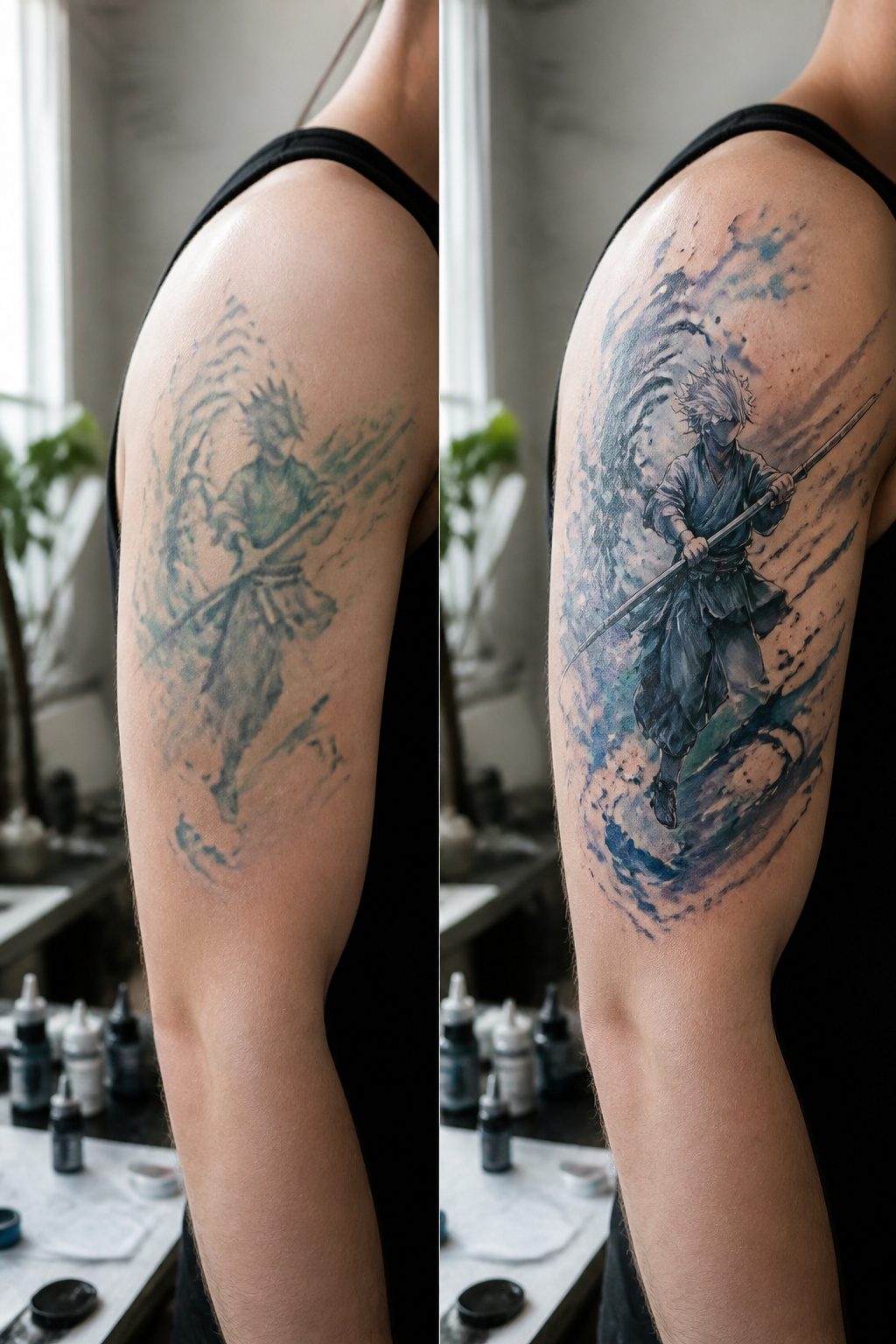
Watercolor tattoos borrow the soft, bleeding edges that anime itself uses for sky and magic, but that same lightness means the pale blues and greys can settle into a murky wash if aftercare slips. Blackwork carries the bold silhouettes of Ghibli forest spirits or Akatsuki symbols with less risk of decade-two fading, though it sacrifices the pastel mood that makes some scenes recognizable at a glance. Minimalist linework strips a design to its essential read, a leaf umbrella or a single character outline, and tends to outlast busier pieces on hands or wrists where detail blurs fastest.
The style that survives best matters less than whether your artist arrived there naturally. Someone whose portfolio is already thick with blackwork will render Gojo’s blindfold with sharper intent than a color specialist forcing themselves into linework they rarely touch. An anime reference does not carry the tattoo; the artist’s existing specialty does. Ask to see healed photos, not fresh ones, and match the person to the technique rather than hunting the reverse.
Placement and Visibility
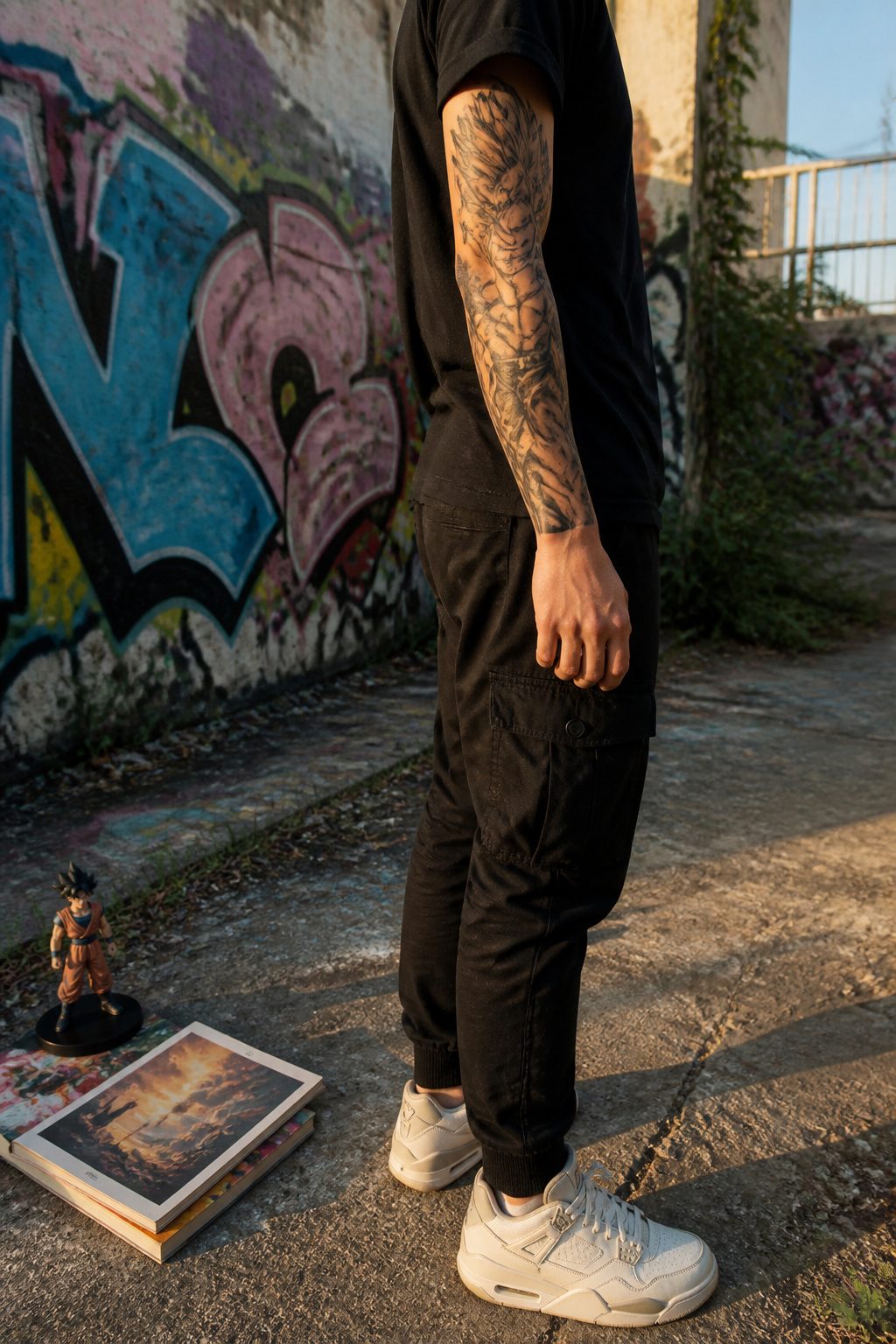
Long swords and tall characters sit better on the forearm or calf, where the limb gives the design room to breathe. Round symbols like the Fullmetal Alchemist blood seal settle well on the shoulder, chest, or back of the neck. The wrist works for smaller marks, a single kanji or a compact emblem you can check at a glance.
Anime tattoos carry a different kind of social weight than a rose or a nautical star. A coworker might ask about a generic sleeve; a visible Goku or Sailor Moon invites a conversation about the show, the episode, the arc. That visibility is part of the appeal for some collectors and a liability for others. Before committing to placement, most clients weigh whether they want the tattoo recognized from across a room or kept somewhere a shirt cuff covers. The artist’s eye matters here too, since they understand how the body moves and where ink will stretch over time.
Finding an Artist Who Understands Anime
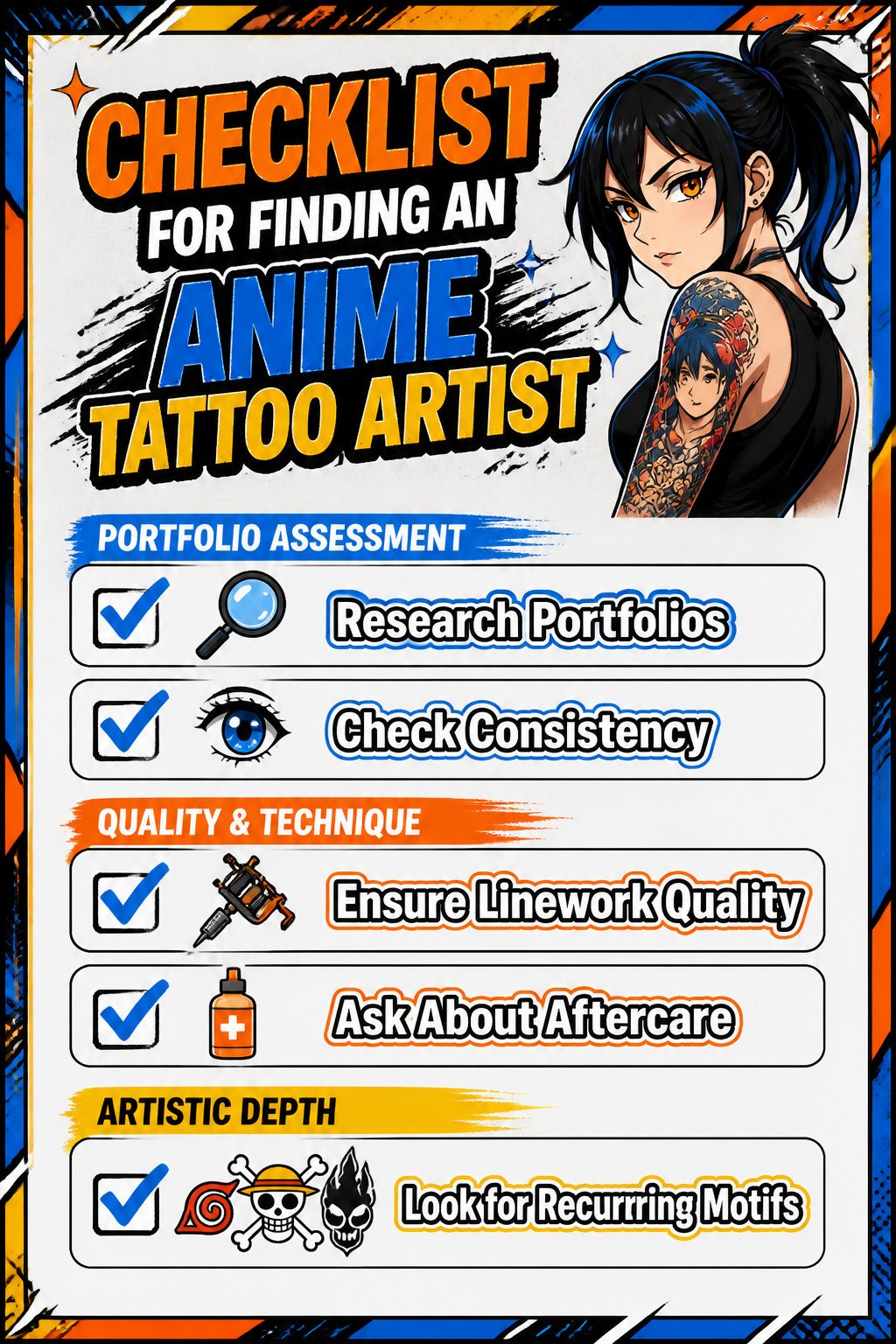
Anime tattoos live or die on the artist’s ability to handle bold linework and exaggerated proportions without letting them collapse into something generic. The demand is real: over 305,000 posts sit under #animetattoos on Instagram, which means plenty of portfolios to scroll through but also a crowd of artists who picked up the style last year because it was trending.
What separates the ones worth your skin from the rest isn’t technical skill alone. Clean lines and solid color packing are baseline; what you want is evidence they have translated anime’s specific visual language, not just borrowed its characters. Look for consistency in eye shapes across different pieces, because anime eyes are where proportion goes wrong fastest. Check whether their colors stay saturated in healed work, not just fresh photos. An artist who understands anime will have recurring motifs from multiple series, not one or two copied reference images mixed among unrelated work.
The risk is paying for a piece that reads as "cartoon" to anyone who actually watches the source material. That distinction matters if you care about the work holding up to scrutiny from fellow fans, which most people getting anime tattoos do.
Frequently Asked Questions
What are the best anime tattoo ideas?
Character portraits, symbolic marks, and action scenes from series like My Neighbor Totoro, Naruto, Jujutsu Kaisen, and Attack on Titan rank among the strongest choices. A portrait of Gojo with one eye exposed carries instant recognition, while the Wings of Freedom emblem rewards fellow fans without broadcasting the reference to everyone. The best design depends on whether you want the image to explain itself or stay personal.
How do I choose the right placement for my anime tattoo?
Long swords and tall characters fit the forearm or calf, where the limb gives vertical designs room to breathe. Round symbols like the Fullmetal Alchemist blood seal settle naturally on the shoulder, chest, or back of the neck. Your artist can advise on how body movement and skin stretching will affect the piece over time.
What styles work best for anime tattoos?
Watercolor suits the soft edges of Ghibli spirits but fades faster and demands careful aftercare. Blackwork carries bold silhouettes like Akatsuki clouds with less long-term risk. Minimalist linework strips a design to its essential read and outlasts busier pieces on hands or wrists. Match the artist to the technique they already specialize in, not the reverse.