Shark tattoos can stay small and quick, a single fin in black ink finished in minutes, or stretch across sessions for full sleeves that layer in realism, color, and movement.
The list below runs from the whole animal to a single part of it, from literal portraits to symbols and scenes, so the starting point is deciding which layer of the idea you want on your skin.
Clean-line minimalist work has picked up serious traction; shops like Holistic Ink now see first-timers asking for it at rates about 60% above where they sat three years ago.
1. Hammerhead Shark
The cephalofoil, that wide flattened head with eyes set at each tip, gives this shark a silhouette no other species matches.
In Polynesian tradition, the manokihikihi serves as a guardian spirit, watching over swimmers and sailors; children born under its sign were believed to grow into natural warriors.
A hammerhead tattoo carries that same protective weight, suited for someone who sees themselves as a defender of family or crew.
The form reads instantly even at small sizes, though the full shape opens up on a shoulder or thigh where the shadow beneath the head can be worked in.
Black and grey holds the detail; color risks flattening the planes that make the head strange.
2. Great White Shark
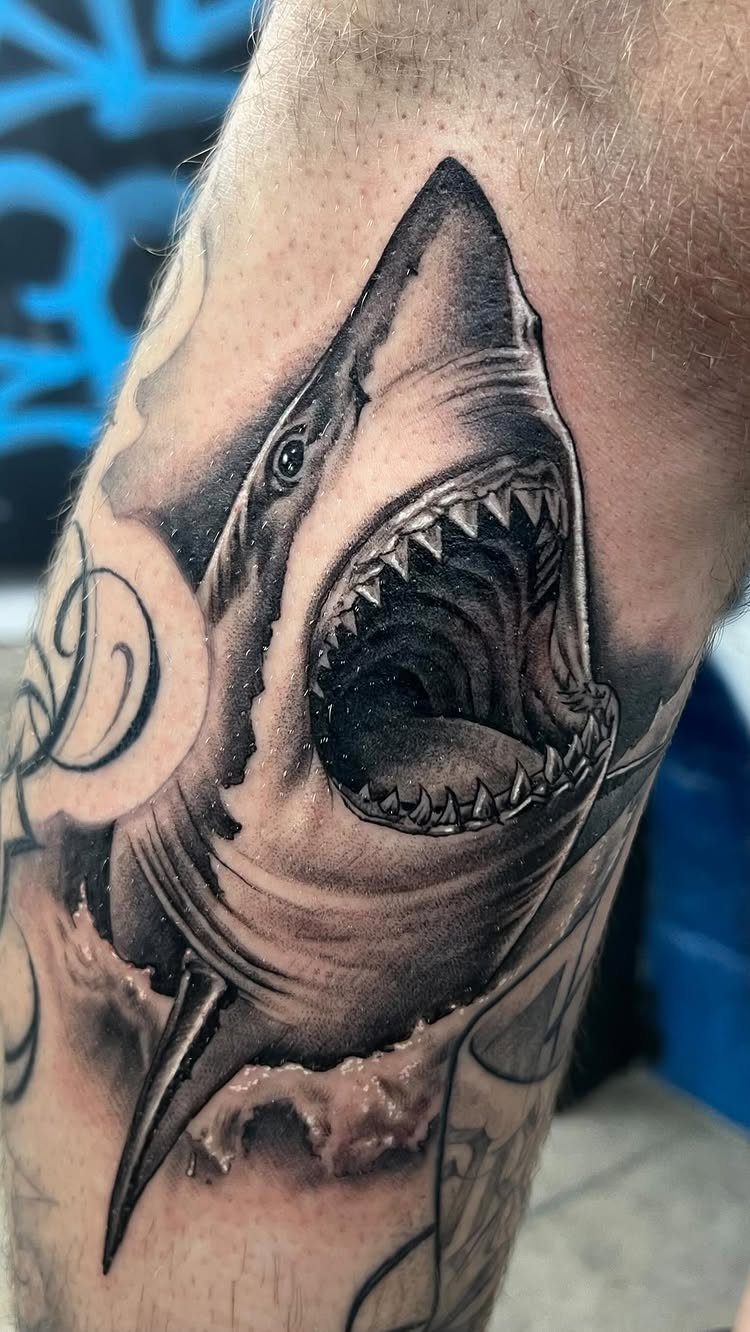
This is the shark that movies made infamous, and the tattoo leans into that reputation whether you fight it or own it. A great white demands realism or near-realism to land; stylized versions look like generic fish.
The open mouth with teeth displayed is the classic pose, and it works best large enough to separate the individual serrations, 15–20 feet of actual shark translated to forearm or calf at minimum.
The countershading, grey over white, gives the artist something to do with tone rather than line.
Someone who wants menace without camp goes black and grey; the neo-traditional route with bold outlines and limited color keeps it graphic without looking like a movie poster.
3. Tiger Shark
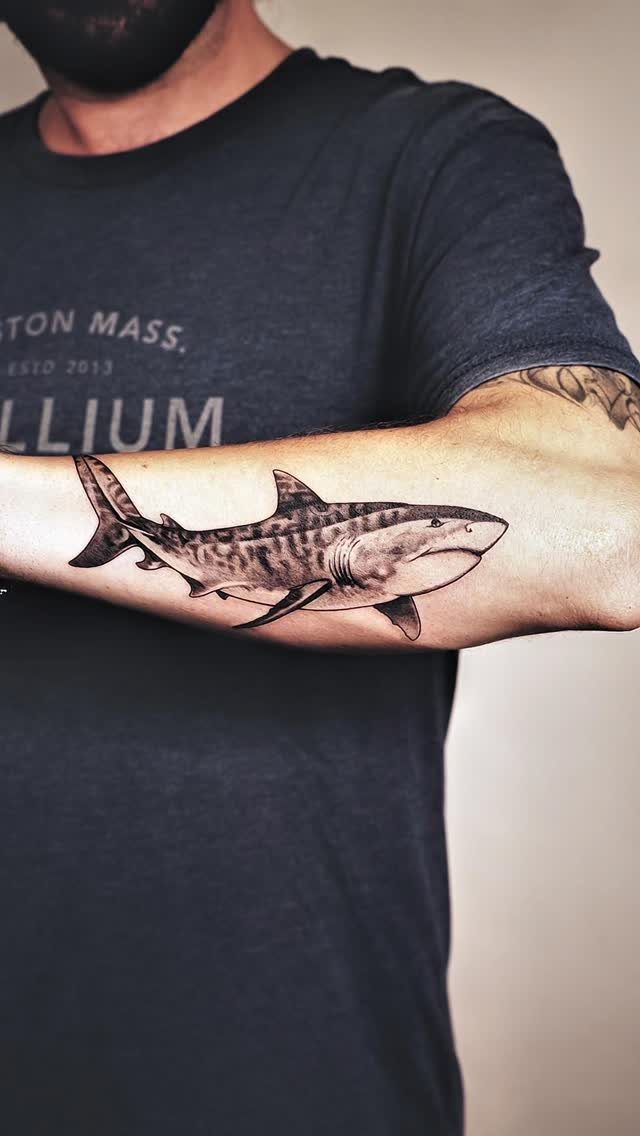
Dark vertical stripes on a bulky body give the tiger shark its name and its visual hook, though the stripes fade as the shark ages, something to consider if you want the animal at full ferocity.
This shark runs smaller than the great white in nature but carries a different energy: the garbage-can diet, the tireless teeth that replace themselves endlessly, the sense of an animal that survives on refusal to quit.
A tiger shark tattoo suits someone who values persistence over dominance, the long haul over the single strike.
The striped pattern offers built-in texture for black and grey work, and the body shape, less elongated than the great white, sits well on a forearm running vertically or across a chest with the head turned.
4. Tribal Shark
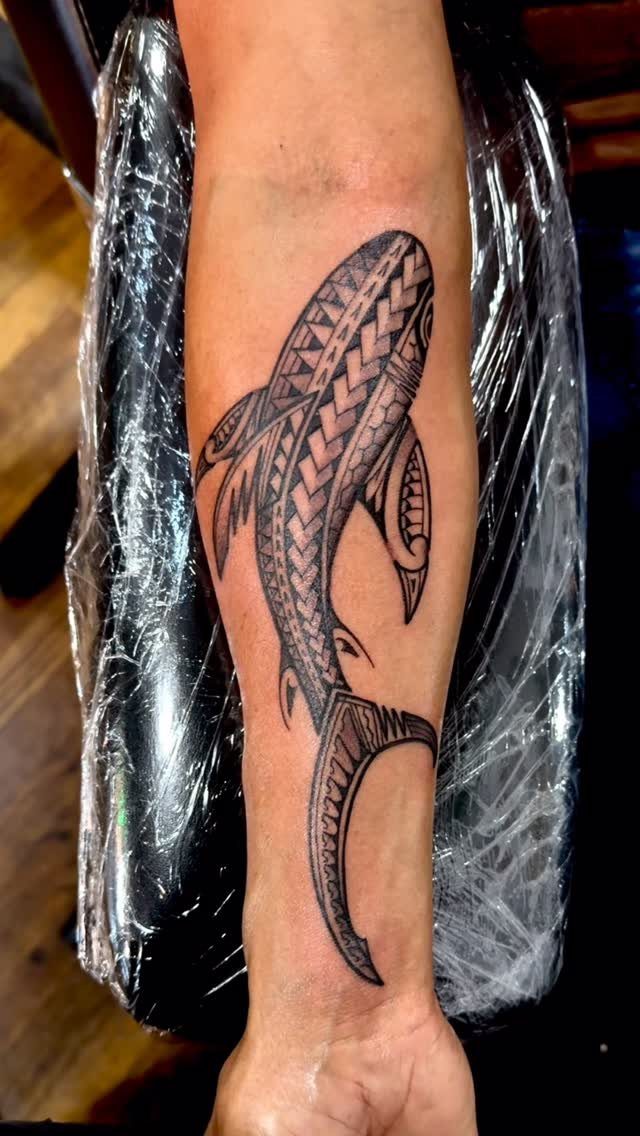
Polynesian and Maori traditions treat the shark as aumakua, an ancestral guardian, and the tribal style carries that spiritual weight in every repeating curve and spearhead pattern.
The work is built from thick black lines and negative space, no shading, no color, the form emerging from geometry rather than outline.
This is not a style to borrow lightly; the patterns belong to specific families and regions, and a good artist will know which motifs are open use and which are closed.
For someone with actual Pacific Islander heritage, the tribal shark is a reclamation. For others, it is a choice that requires homework and respect.
The bold ink ages well, holds up on darker skin, and reads clearly from across a room.
5. Minimalist Shark
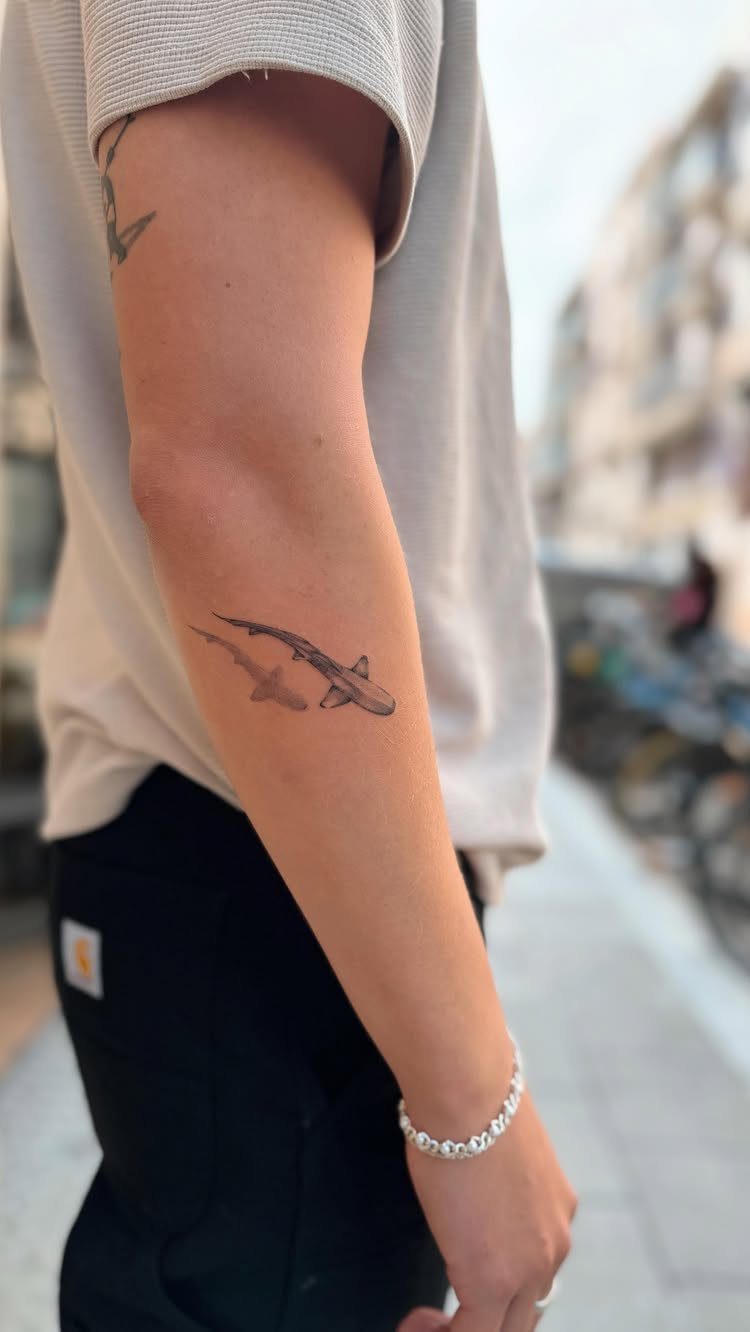
A single continuous line, or two, can suggest the whole animal without ever closing the shape.
The minimalist shark lives in negative space and implication, the fin breaking a clean horizon, the body a curve that might be wave or might be muscle.
This style has surged in popularity at shops like Holistic Ink, where first-time clients now request clean-line work at rates up to 60% higher than three years back.
The appeal is obvious: small scale, quick session, easy concealment, and a design that ages gracefully because it never depended on fine detail to begin with.
A shadow cast beneath the shark, as in one common version, adds depth without breaking the spare vocabulary. Best for someone who wants the symbol, not the spectacle.
6. Cute Shark Tattoo
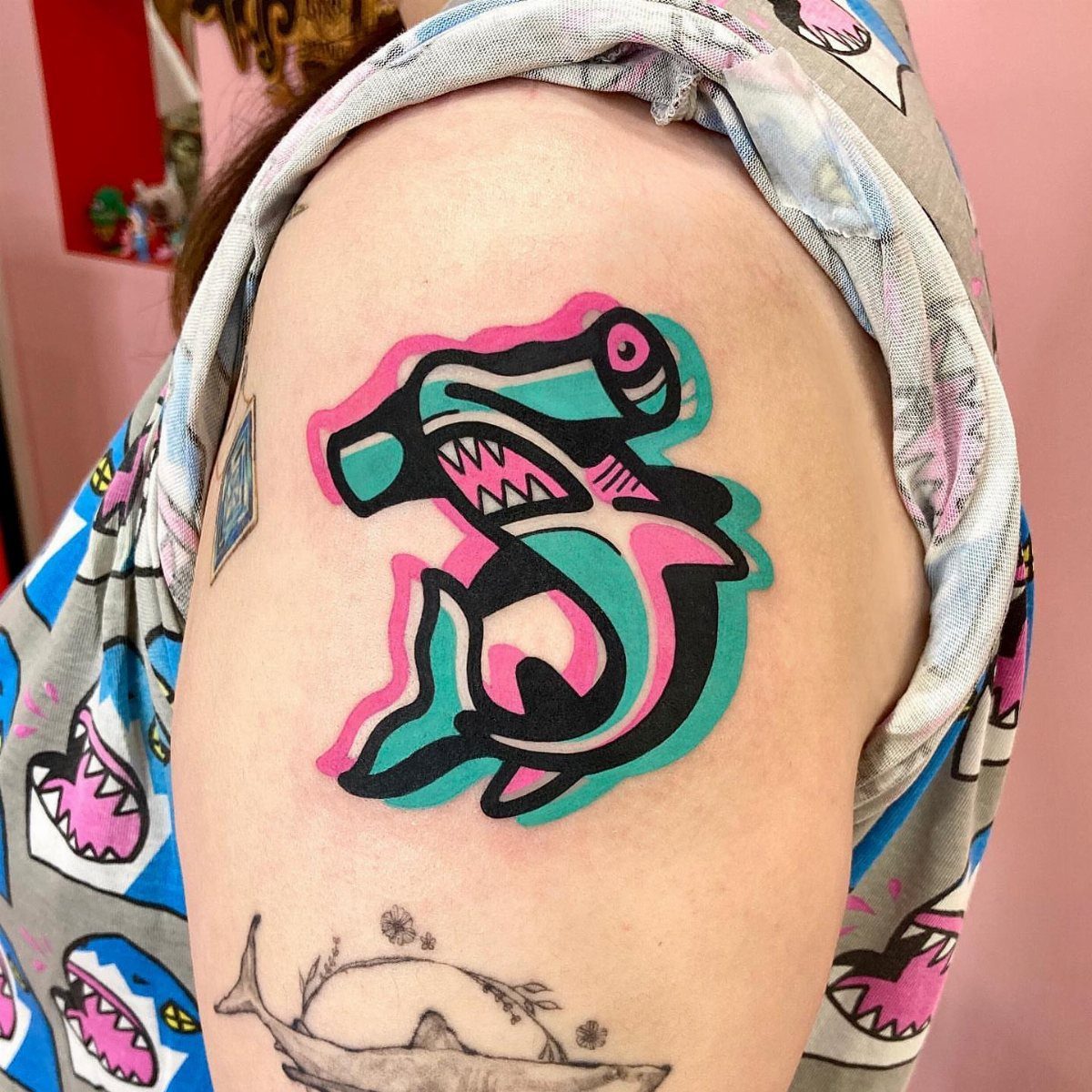
Not every shark needs to hunt. The cartoon or stylized version, with rounded fins and oversized eyes, turns the predator into something closer to a mascot.
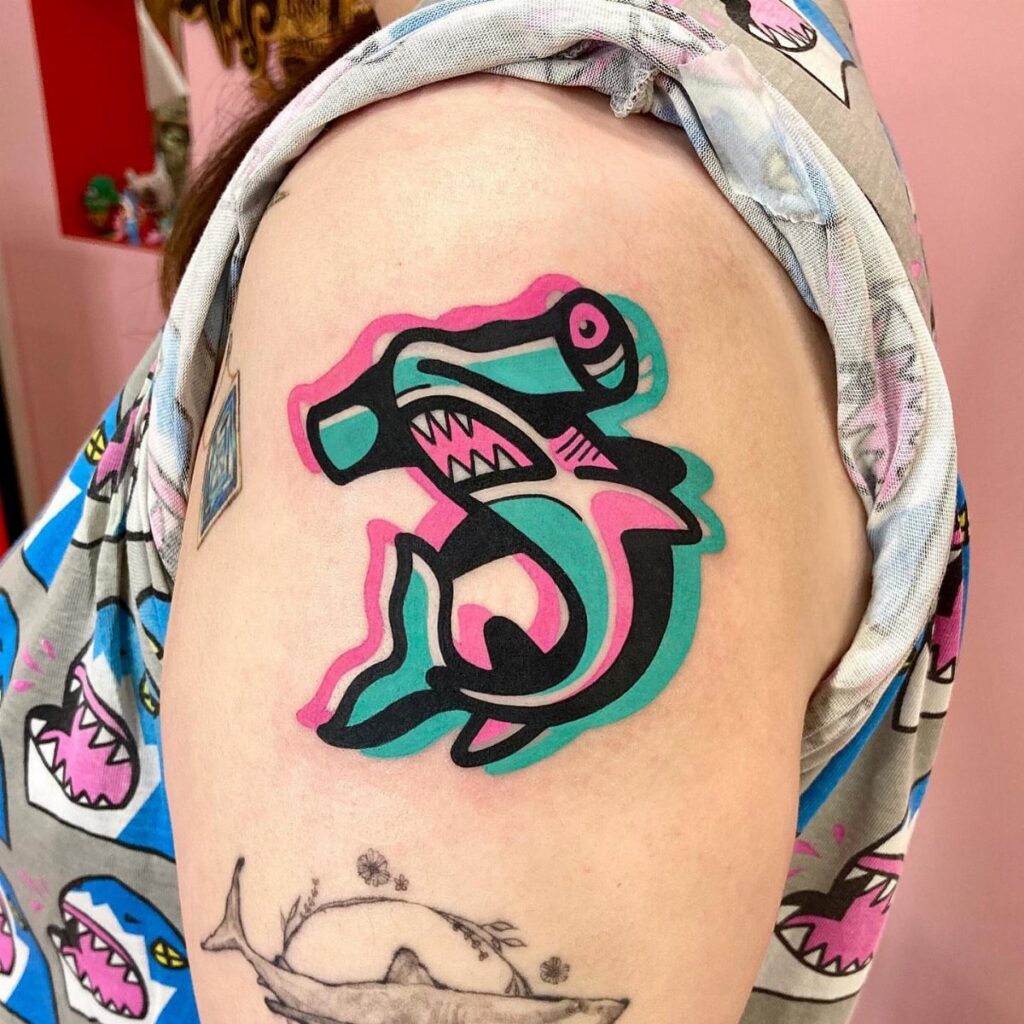
Chromatic aberration effects, that pink and cyan split, give it a screen-born energy that reads as digital-native rather than retro.
This approach works for the whale shark in particular, the spotted giant that filters plankton and has no record of harming humans; the natural pattern becomes decoration, the size becomes joke.
The cute shark suits someone who wants the ocean without the menace, or who likes the contrast of a fierce form defanged. Color is almost required; black and grey cute reads as unfinished rather than intentional.
7. Shark and Anchor
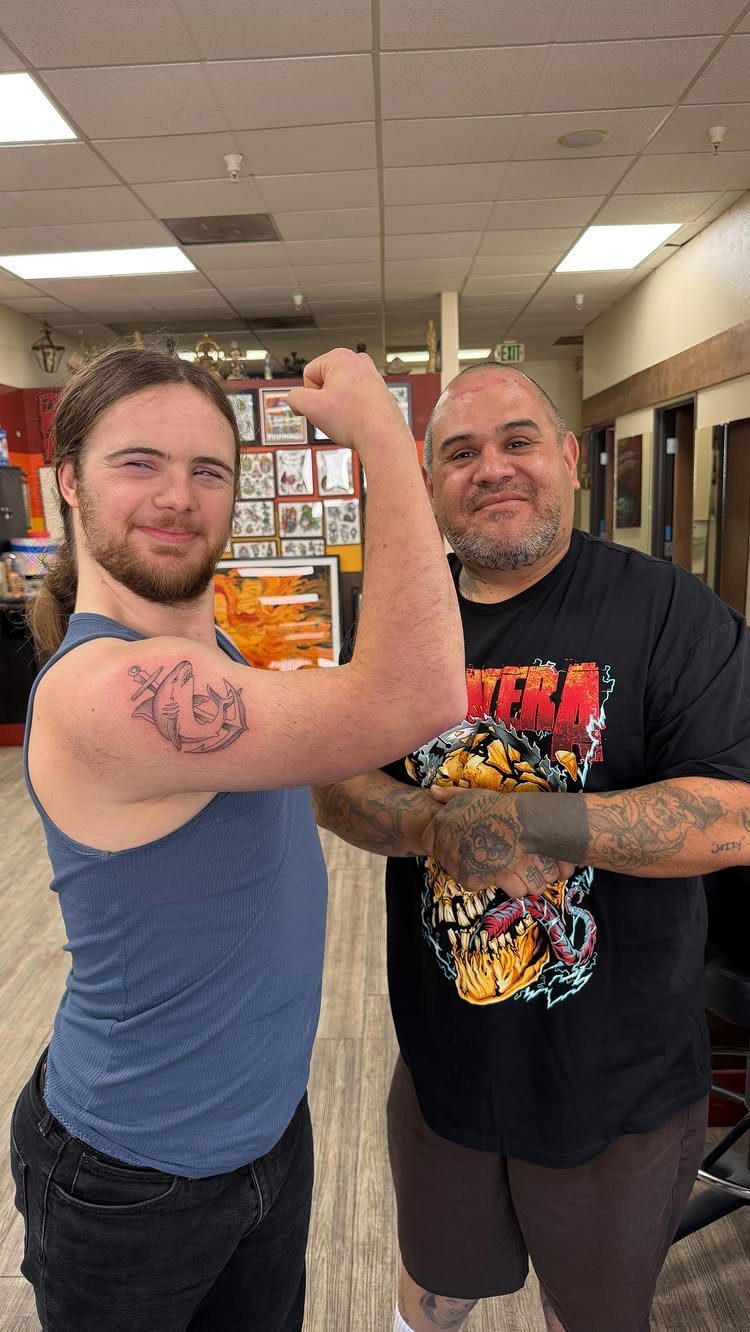
A shark and anchor tattoo works best when the two pieces share the same weight, so neither overpowers the other.
The anchor grounds the design literally and figurically, while the shark cuts across it or circles below to keep the motion alive. Black and grey shading suits this pairing because both objects carry enough detail to hold interest without color.
The combination reads as stability tested by danger, or danger held in check by resolve, depending on which element your artist draws larger.
I would place this on the upper arm or calf where the vertical line of the anchor follows the muscle and the shark can wrap around it naturally.
8. Realistic Shark
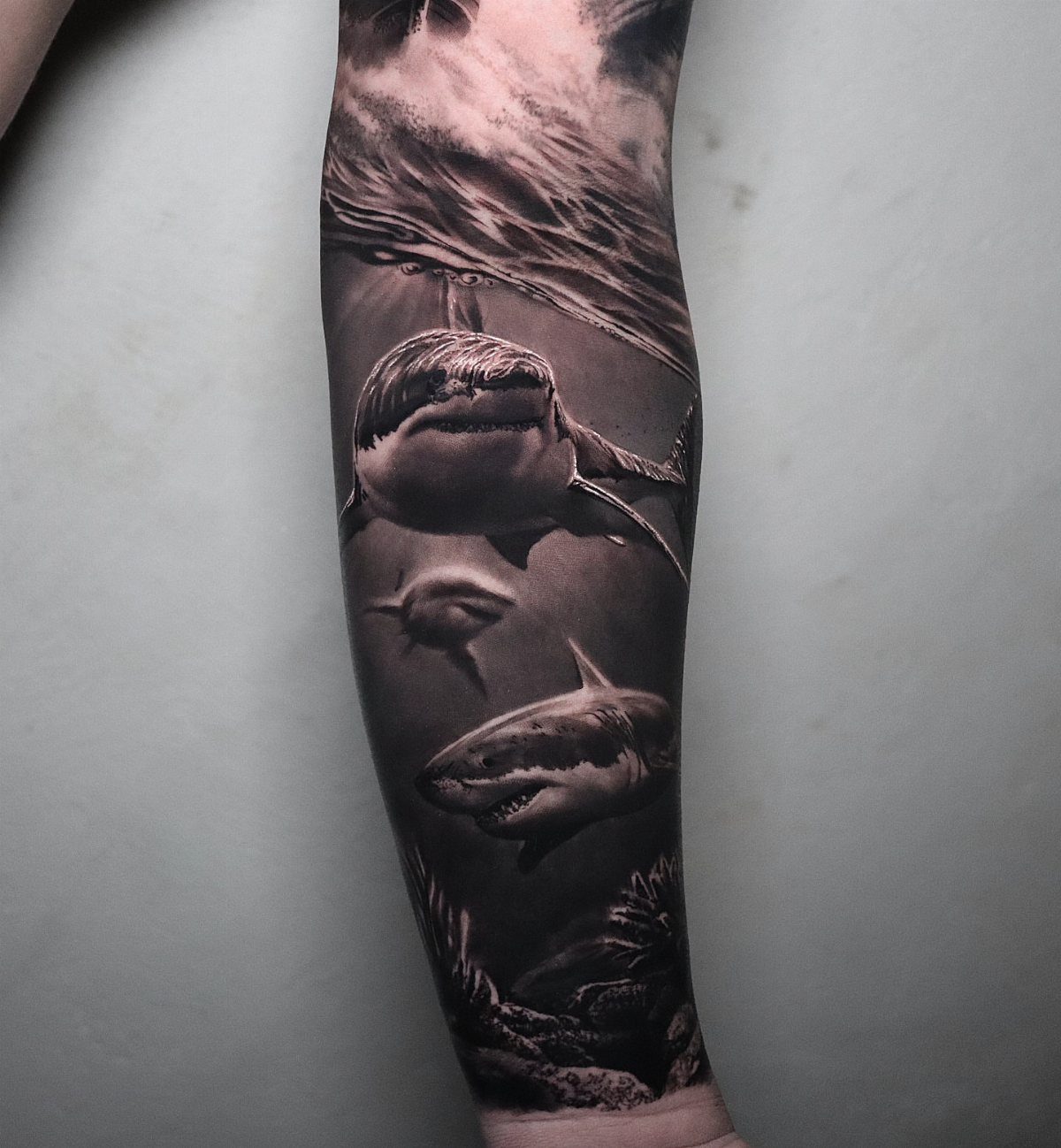
Three sessions is the minimum for a realistic shark sleeve with this much depth, and five is more honest if your artist works methodically.
The key decision is whether to add an environment, coral and light rays and all, or let the shark float on clean skin. Environment gives context and scale but competes for attention; a solitary shark reads as portrait, almost documentary.
Ask to see healed photos before you commit. Realism this dense settles over months as the darkest blacks soften and the skin tone rises through the grey wash.
Budget for touch-ups in year two.
9. Watercolor Shark
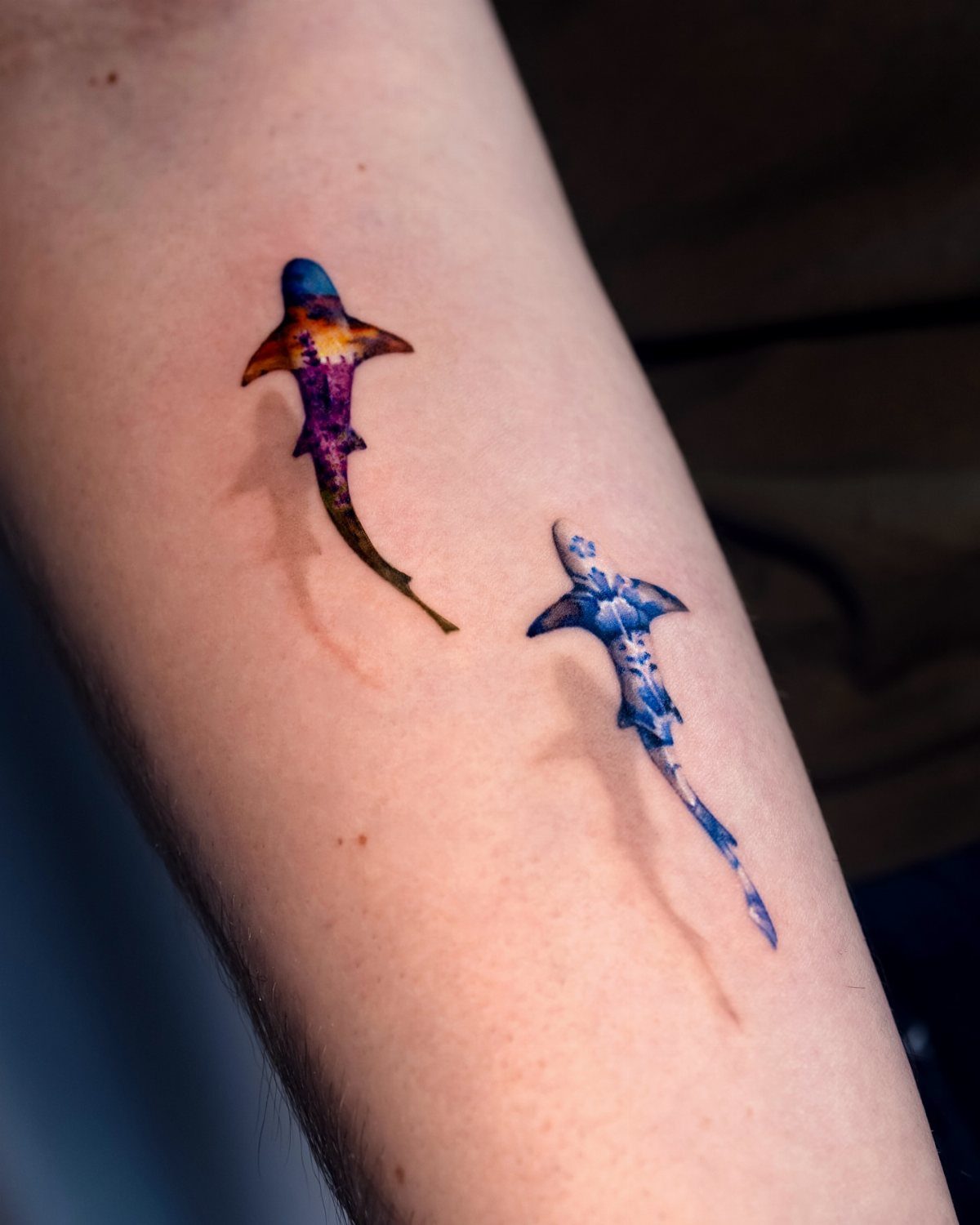
Watercolor shark tattoos live or die on the artist’s control of bleed. The style skips black outlines, so the color itself must carry the shape, and shark silhouettes are distinctive enough to survive that gamble.
Warm sunset tones against cool water, or the reverse, give the eye somewhere to rest in all that fluidity. The risk is fade: without the ink reservoir of a bold line, watercolor washes lighten faster and blur at the edges.
Pick placement with less sun exposure, and ask to see healed pieces from their portfolio, not just fresh work. Fresh watercolor always looks better than aged; the question is what you are signing up for.
10. Shark Skeleton
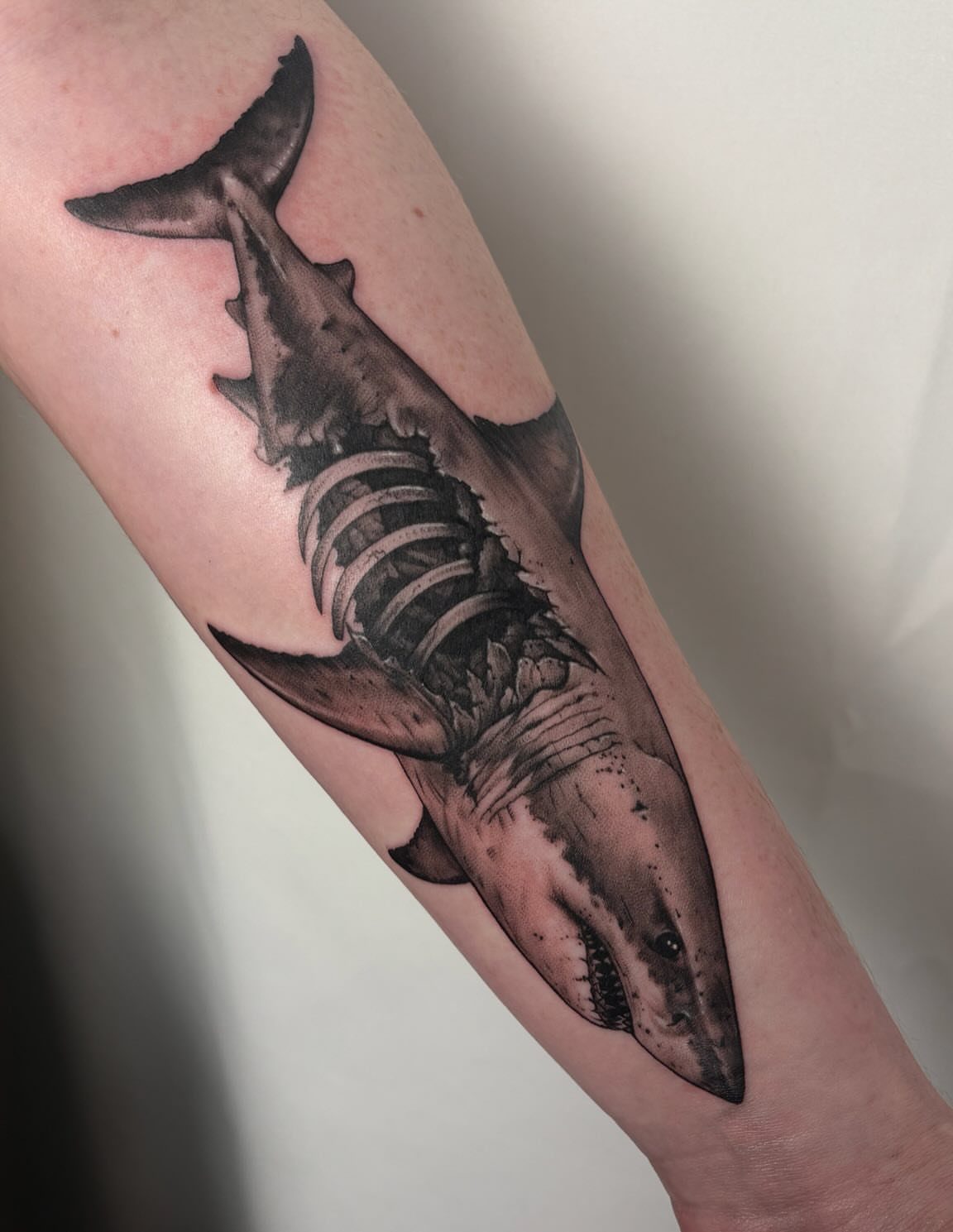
The torn-flesh reveal in this design is technically demanding because the artist must render two textures, skin and bone, and make the transition convincing.
Shark skeletons are cartilage, not bone, but tattoo convention simplifies this to a ribcage and spine that read immediately as death’s-head. The metaphor is blunt: what survives when the surface is stripped away.
I find it works better at scale, large enough that the anatomical detail does not collapse into noise. Smaller versions lose the shock and just look busy.
Consider whether you want the tear jagged, as from violence, or clean, as from surgery or decay; that choice changes the whole tone.
11. Shark Tooth Tattoo
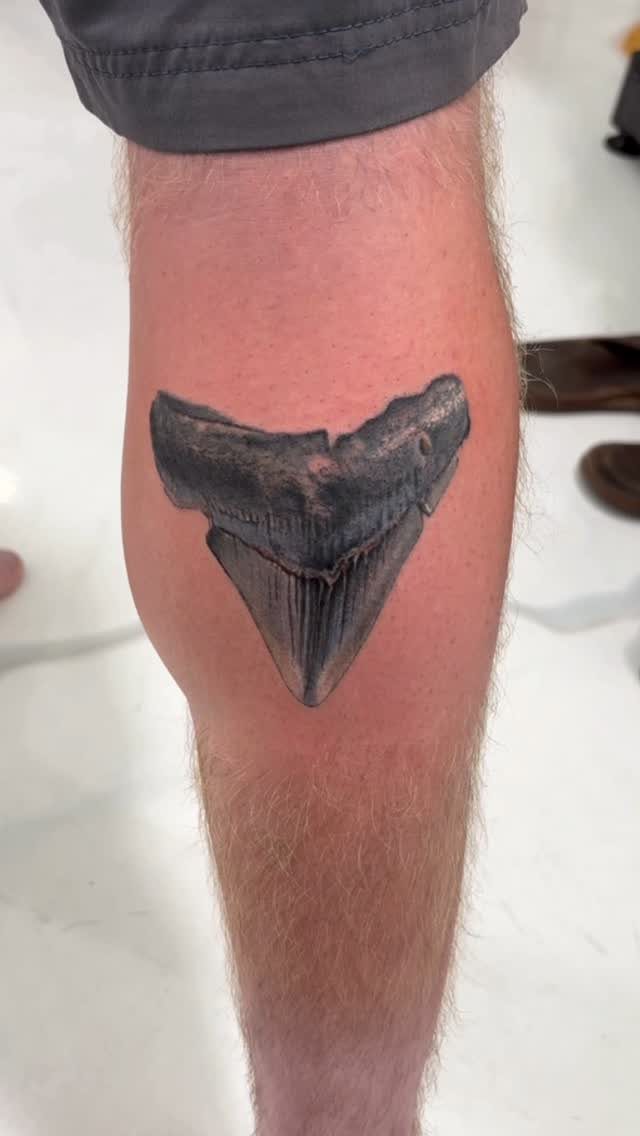
A single shark tooth isolates the animal’s most feared feature and shrinks the commitment to something you can place almost anywhere. Sharks replace teeth constantly, tens of thousands across a lifetime, so the image carries renewal as well as threat.
Size matters here: too small and the detail becomes mud, too large and the isolated tooth looks like a weapon rather than a specimen.
12. Mermaid Shark
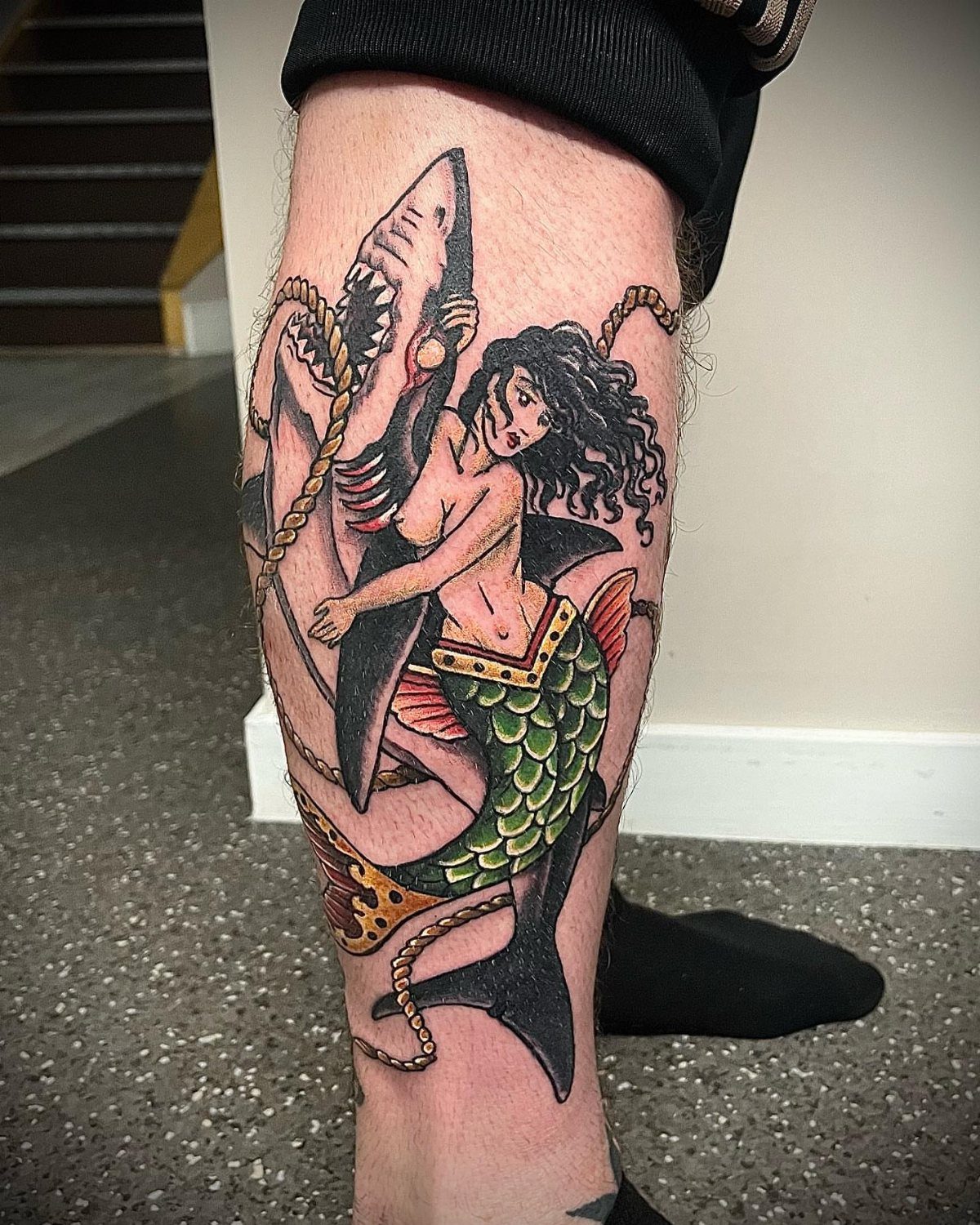
American traditional handling saves this combination from pure kitsch. The bold lines and limited palette force the mermaid and shark into the same visual language, so they read as one composed scene rather than two images collided.
Rope entanglement gives the artist a way to link the figures physically and narratively; without that connective tissue, they would float apart.
The style’s flat color and heavy black also age better than a more illustrative approach would, which matters for a design this complex.
I would not try to update this with realism or watercolor; the charm is precisely in its vintage directness.
13. Shark and Octopus
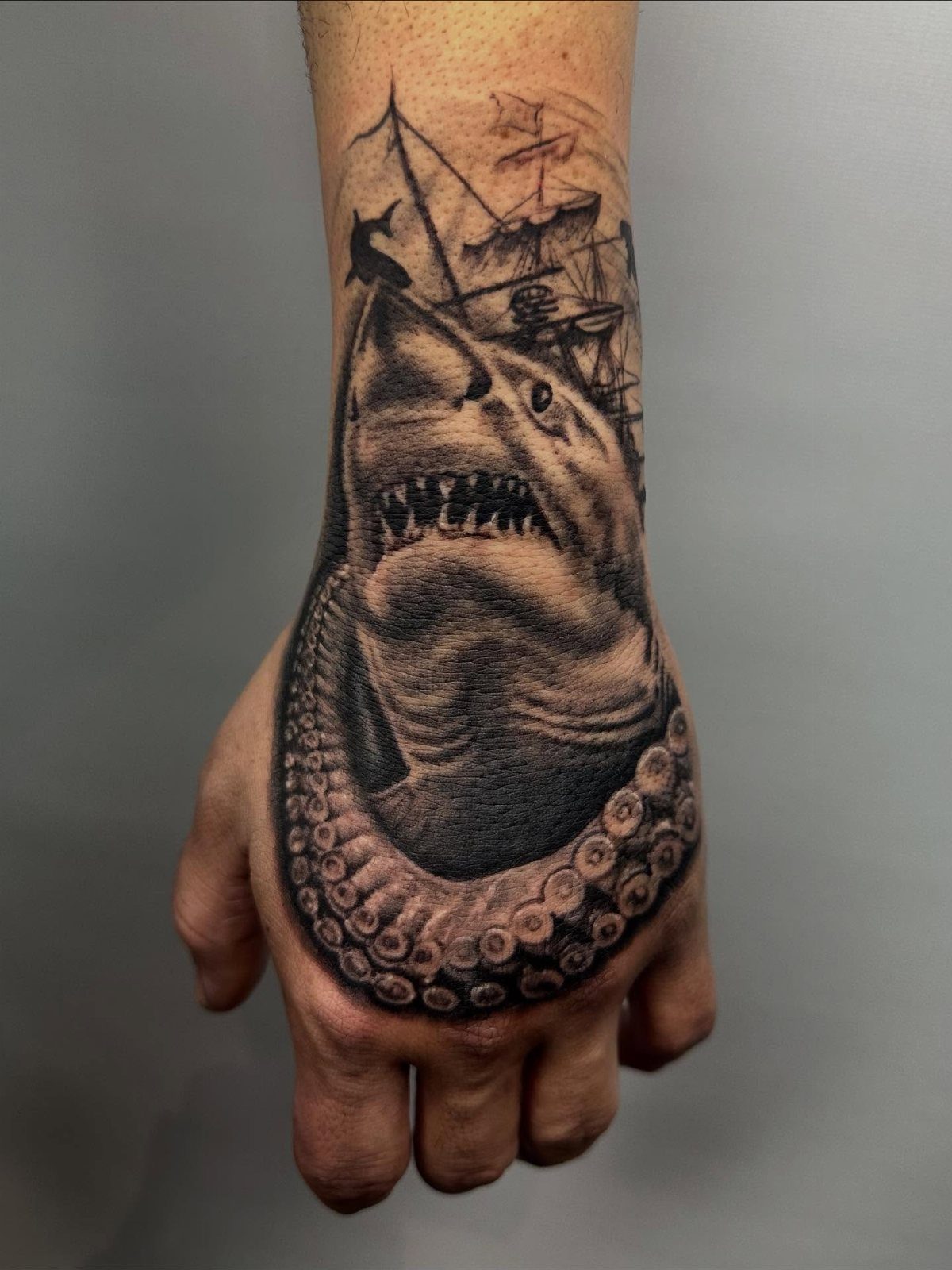
A shark and octopus pairing pits two apex predators against each other, each representing something different. The shark carries raw power and instinct; the octopus brings intelligence, camouflage, and problem-solving.
That tension is what makes the pairing work.
Placement matters more here than with single-creature designs. Both animals need room to interact, so the forearm, thigh, or a full back panel gives the artist space to weave tentacles through open water or around the shark’s body.
Black and grey realism handles the contrast in texture well, the octopus’s soft suction cups against the shark’s sandpaper skin.
I’d skip this one if you want a quick session. The interlocking forms take time to map, and rushing it leaves both animals looking pasted together.
For anyone who values brains as much as brawn, though, the combination earns its space.
14. Shark and Boat
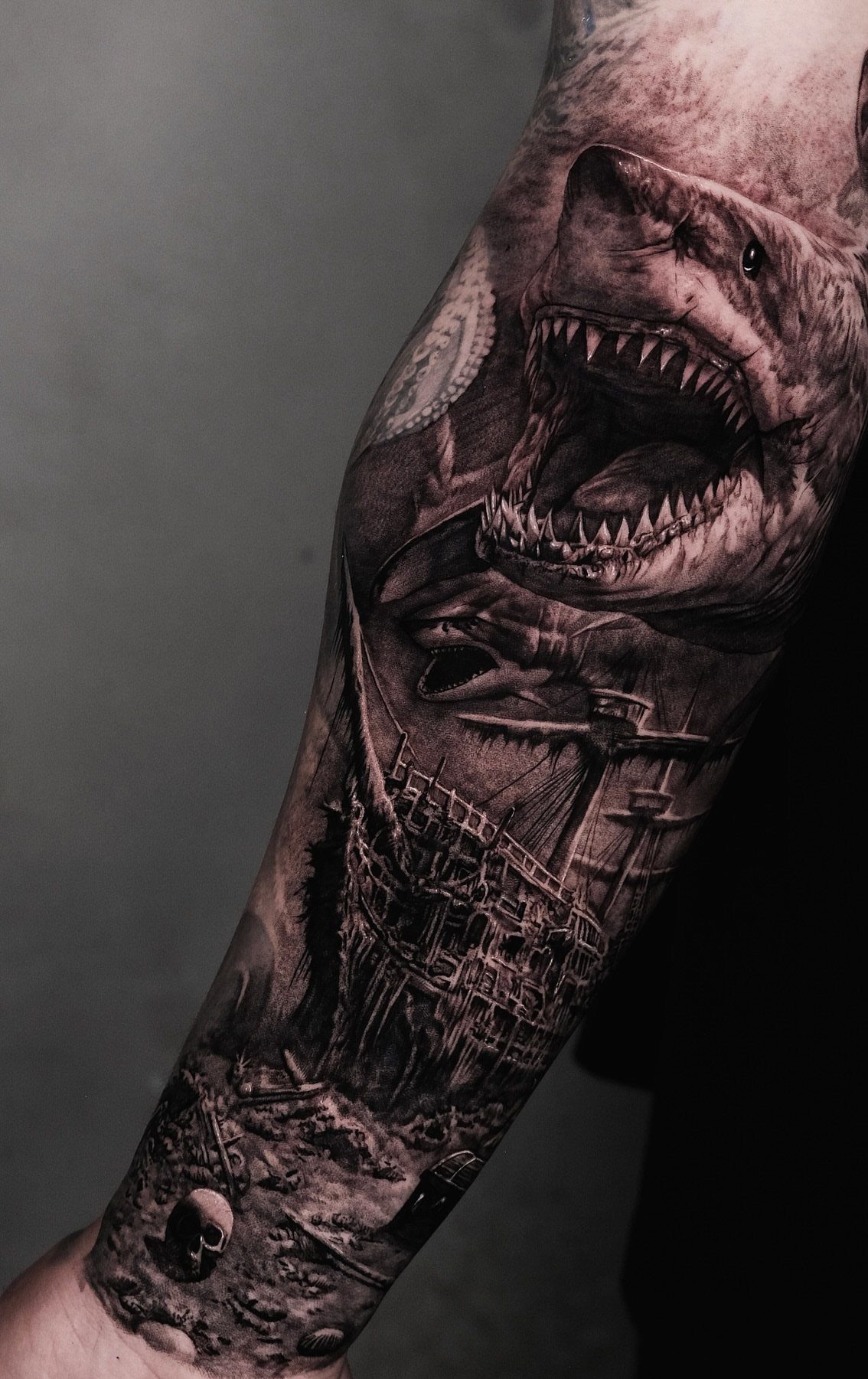
The shark and boat pairing works best when the boat looks like it has history. A weathered wooden hull, snapped masts, or barnacle growth tells the viewer this vessel has seen something, and the shark circling below completes the story.
Black and grey realism suits the mood, though traditional American styling can push it toward vintage maritime poster territory if that fits your taste.
The ship can ride the surface or rest on the ocean floor; the shark’s position changes the meaning. Above, it’s threat and pursuit.
Below, it’s guardian or scavenger.
This design asks for vertical space. A forearm works for a small schooner; a full ship with rigging needs a calf or ribs.
For anyone with actual sea time, the detail in the hull and rope work becomes a point of pride. Landlocked dreamers should consider whether the imagery holds enough personal weight to carry.
15. Bull Shark Tattoo
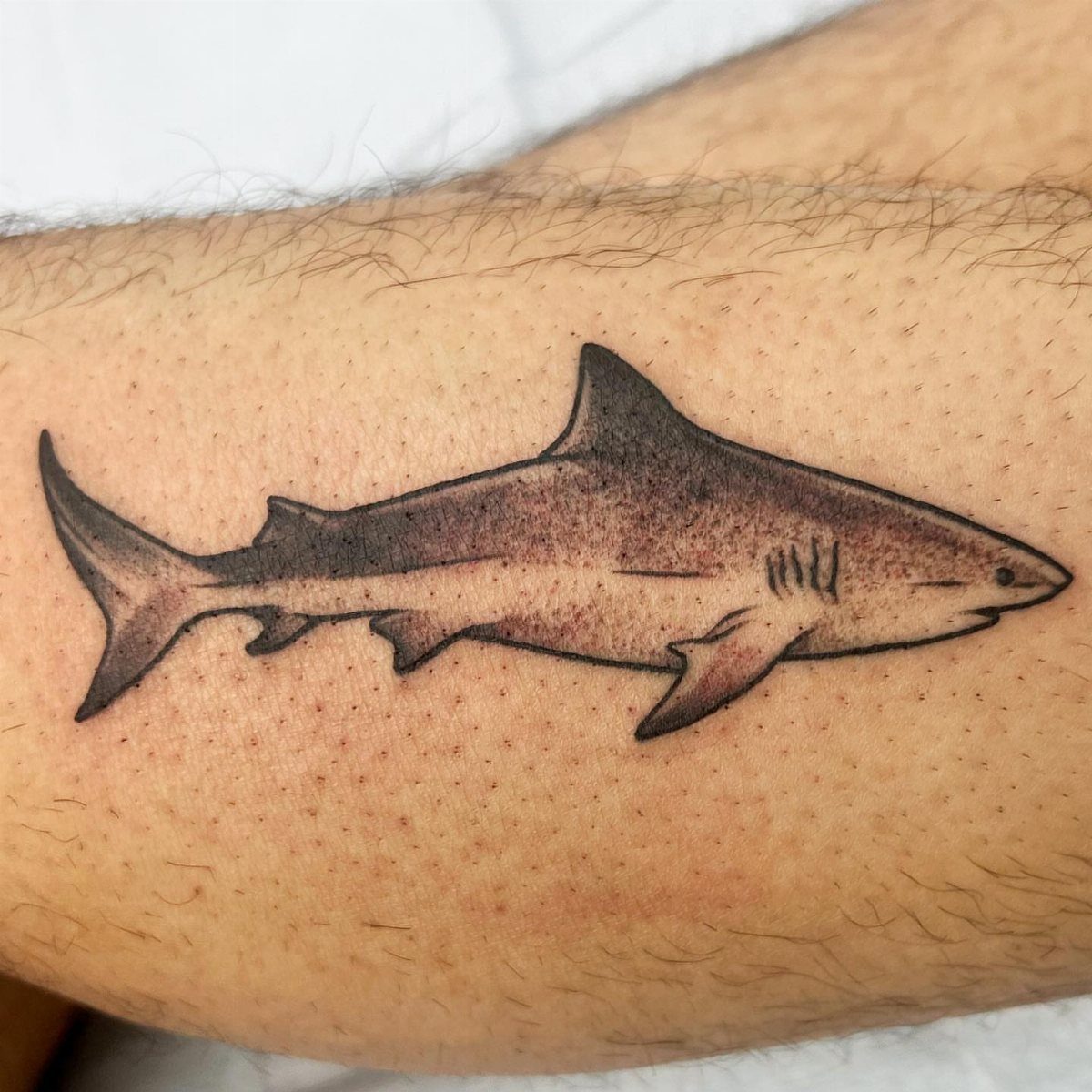
Bull sharks earn their name from that blunt, rounded snout and a body built like a linebacker. Unlike the streamlined great white, they look like they were designed for close-quarters combat, and that stocky profile carries into ink differently.
The species’ real claim to fame is its tolerance for freshwater. Bull sharks have turned up in the Mississippi River and Lake Nicaragua, hundreds of miles from salt water.
That range makes them a fit for someone who connects to inland water as much as the coast, or who sees their own adaptability as a core trait.
Stippled shading catches the rough texture of their skin better than smooth gradients. On a hairy arm or leg, the stippling also ages more gracefully than fine lines that blur against the hair growth.
For a bolder statement, the open-mouth threat display plays up their reputation as one of the more aggressive species. A profile view keeps it quieter, more biological specimen than horror show.
16. Shark with Flowers
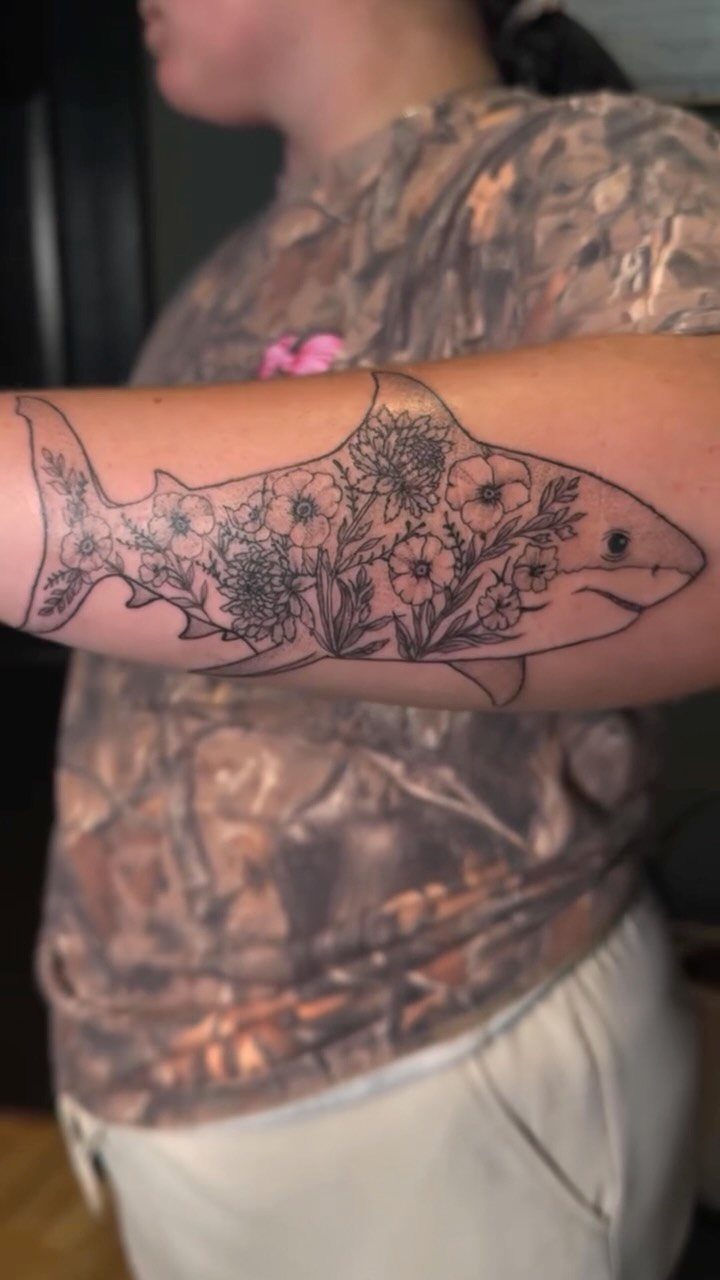
Flowers inside a shark silhouette, or wrapping around its body, soften the animal without defanging it. The contrast is the point: something cultivated against something wild, something temporary against something ancient.
The floral choices carry weight. Roses read as classic and slightly masculine; peonies or cherry blossoms push more feminine; tropical blooms place the shark in specific water.
Roses and daisies in black ink line work keep the mood serious, but color would shift it entirely, bright and almost playful.
This design scales well. A small forearm piece keeps the flowers readable; a full back lets the artist detail each petal and gill slit with room to breathe.
I’d watch the balance. Too much flower and the shark becomes background; too little and the flowers look like an afterthought.
For anyone who wants their toughness to show its tender side, the combination lands better than either element alone.
17. Shark Fin Tattoo
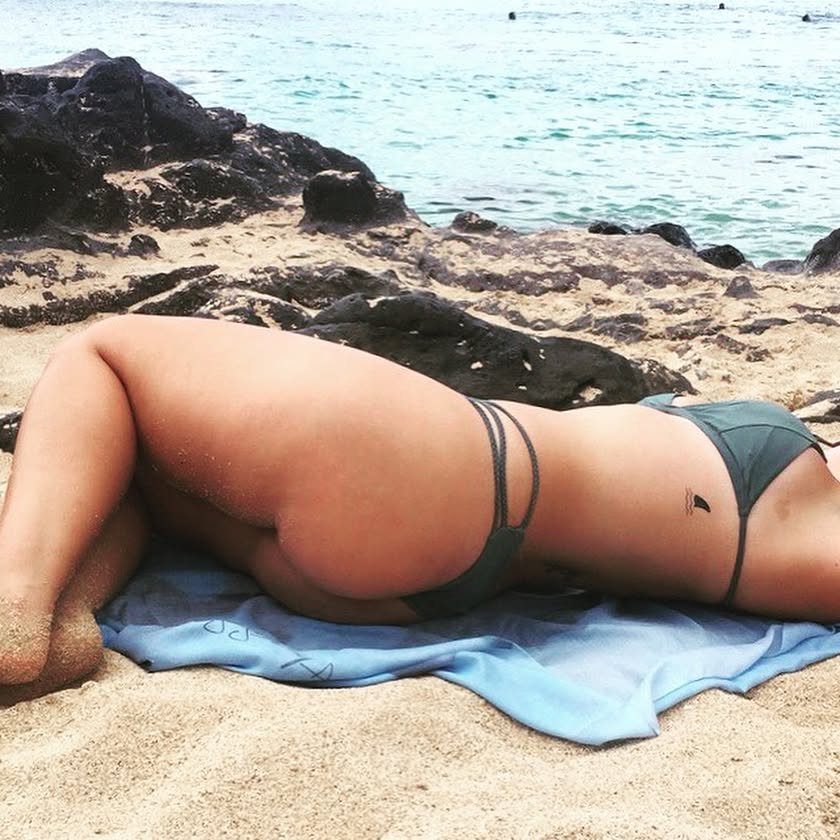
A single fin breaks the surface, and the mind fills in the rest. That economy is the whole appeal.
The design takes minutes to ink and a lifetime to explain, which suits people who prefer their body art to start conversations rather than finish them.
A ribcage placement keeps it hidden under most clothing, visible at the beach or in a swimsuit. Ankle, wrist, or behind the ear work for smaller versions; the shoulder blade gives a fin more natural curve against the body’s geometry.
Black ink holds up. Color on a design this small tends to blur over time, and the fin’s power comes from its sharp edge, not its palette.
For anyone weighing this against a full shark, the fin trades detail for mystery. You lose the species identification and the anatomical accuracy.
You gain the moment before the attack, the warning sign, the thing still unseen.
18. Shark and Waves
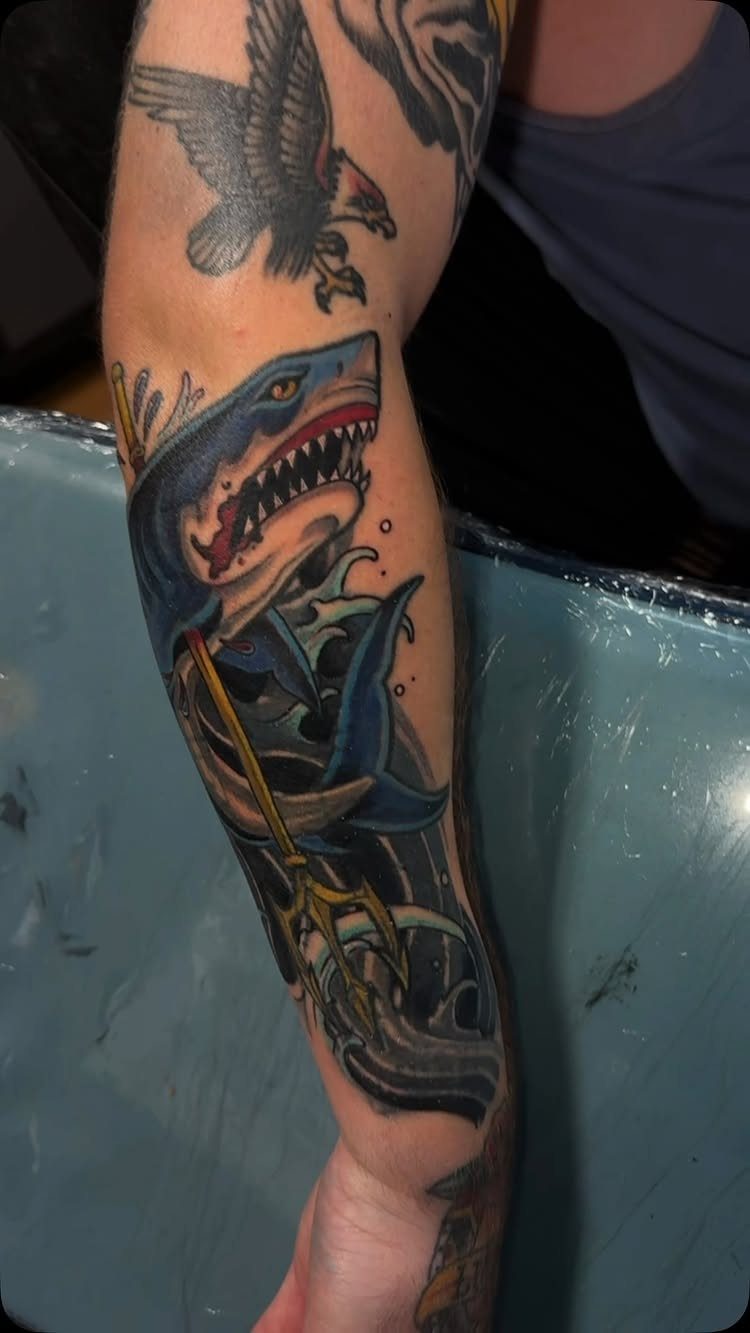
Waves give a shark somewhere to move. Without them, even a well-drawn animal looks suspended, aquarium-bound.
With them, the whole tattoo gains speed and direction.
Dark blue and white caps with a golden trident read as classic naval flash updated with more refined shading.
That palette works; so does black and grey with negative-space foam, or full color with turquoise depths and blood-red gills for a more aggressive take.
The wave style changes the shark’s character. Crashing, chaotic surf frames the animal as a force of nature.
Gentle swells make it a swimmer, almost peaceful. Over 80% of large shark designs include water elements for good reason: the context completes the subject.
For anyone committed to a bigger piece, the waves are not decoration. They are the environment that explains the animal.
19. Geometric Shark
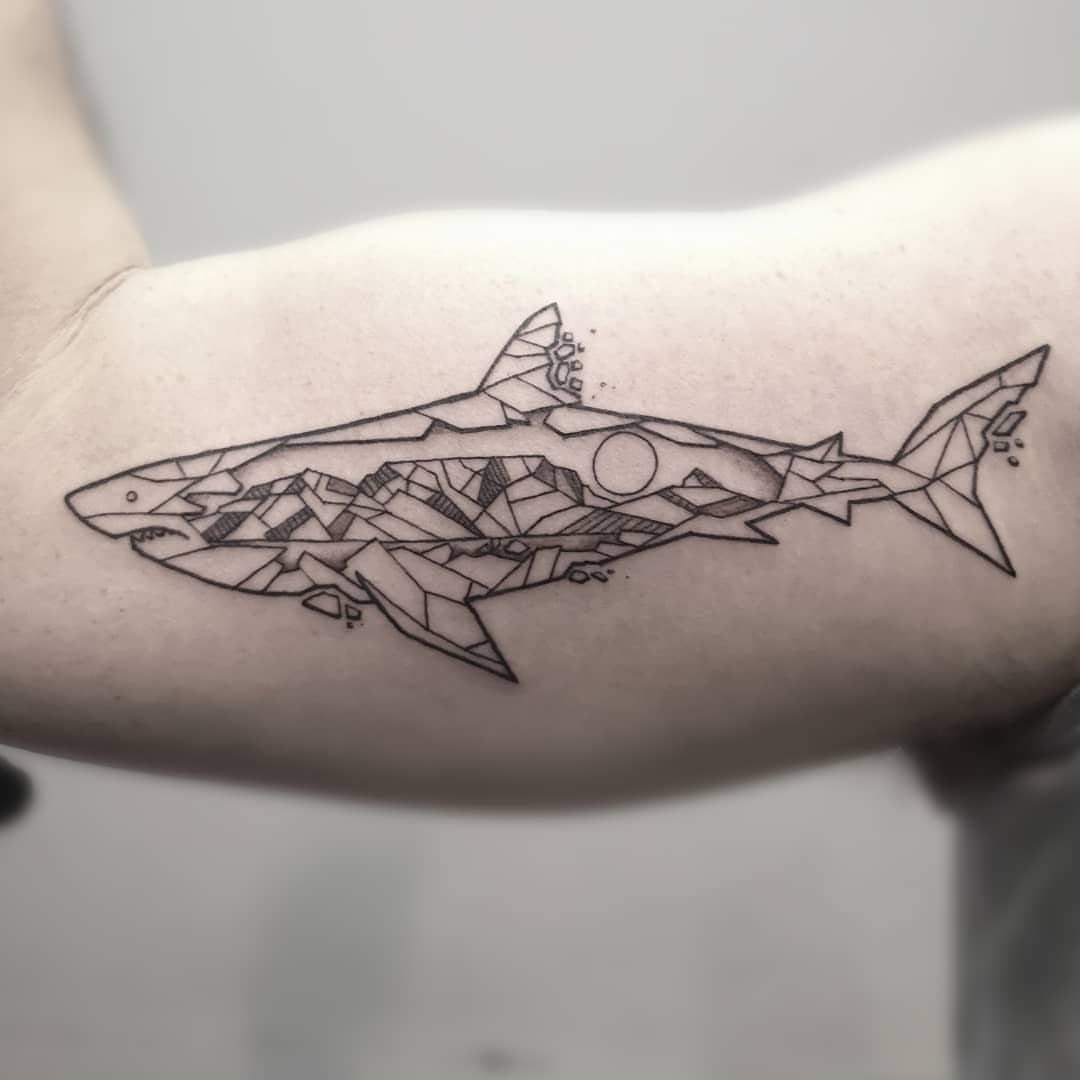
Geometric sharks work best when the shapes actually follow the animal’s anatomy rather than fighting it.
The facets should trace the jaw line, the dorsal ridge, the pectoral fins; otherwise you end up with a polygon puzzle that happens to have teeth.
I’d put this on a flat area like the inner arm or the thigh where the geometry reads cleanly. A dot-work fill in the hammerhead version adds texture without clutter.
Recognizability from a distance is the catch: up close it’s striking, across a room it can blur into abstraction.
20. Zombie Shark Tattoo
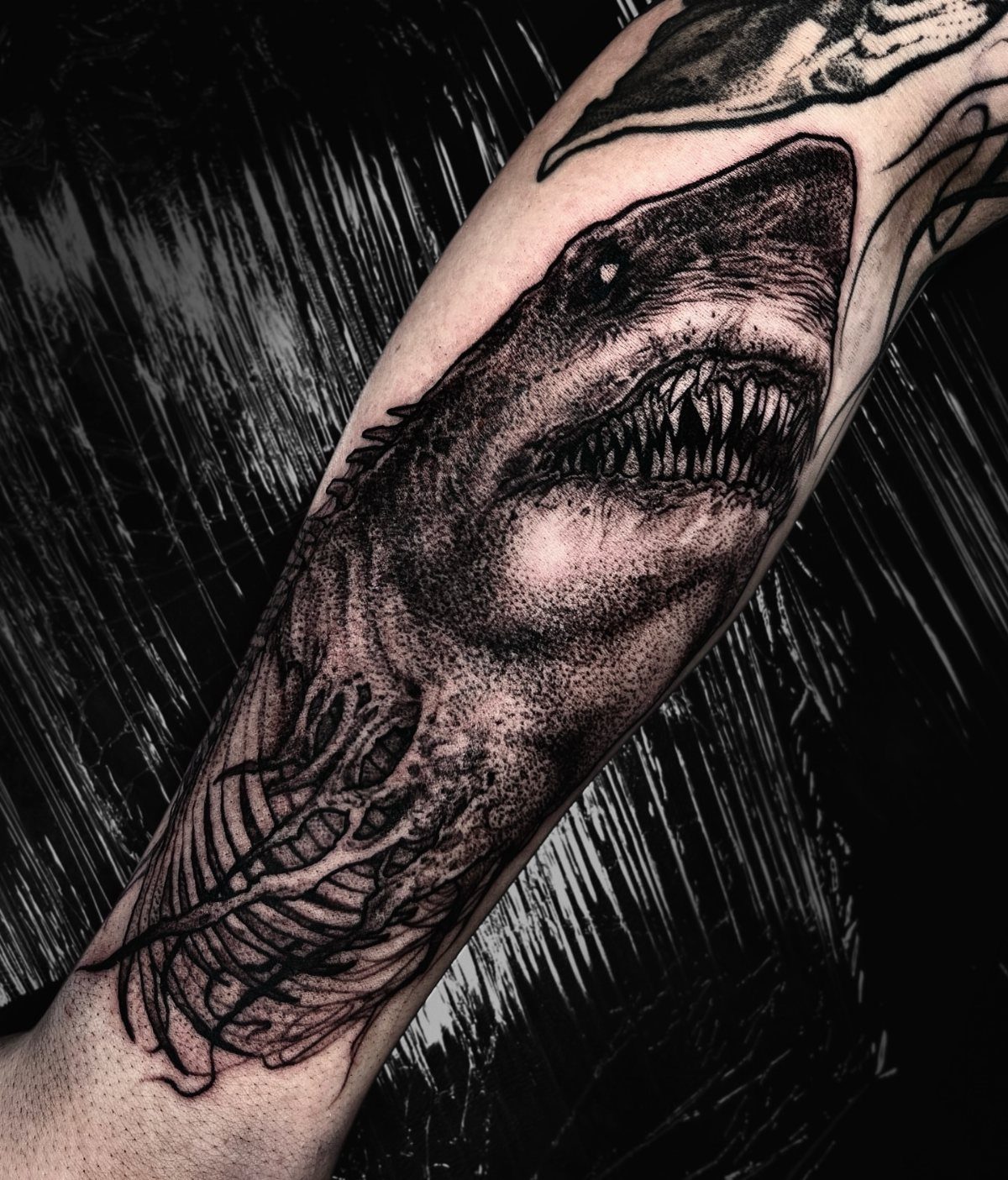
A zombie shark only lands if the artist commits to the rot. The ribs showing through, the sunken eye socket, the skin peeling back from the jaw: these need the same anatomical care as a living shark, just inverted.
Grey wash handles the decayed flesh; solid black anchors the hollows. The humor comes from the premise, not from cartoon exaggeration, so keep the rendering tight.
This suits someone who wants a shark tattoo but balks at the earnestness of traditional nautical meaning. It reads as horror fan first, shark fan second, which is fine if that’s your split.
Small size kills it; the detail demands at least a half-sleeve span.
21. Pinup Girl Riding Shark
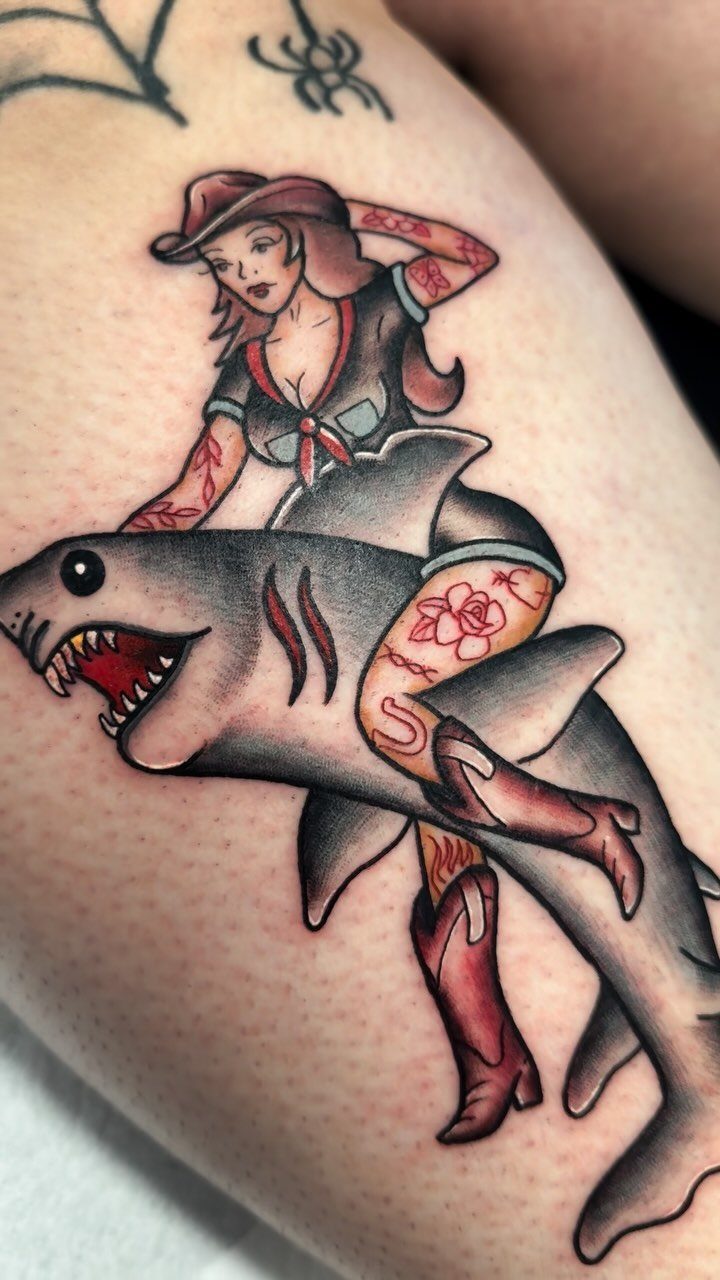
The pinup girl riding a shark lives or dies on the artist’s hand with faces and with traditional American tattoo structure.
The girl needs period-appropriate proportions, the shark needs to read as alive beneath her, and the two have to interact rather than float separately. Bold outlines hold the color blocks: red hair, blue top, the shark’s grey-green body.
I’d look for an artist who actually paints flash in this style, not one who dabbles. The meaning is upfront: fearless, a little cheeky, not interested in subtlety.
That directness is the point. It suits someone who collects trad pieces or wants one statement tattoo that starts conversations.
22. Shark and Turtle
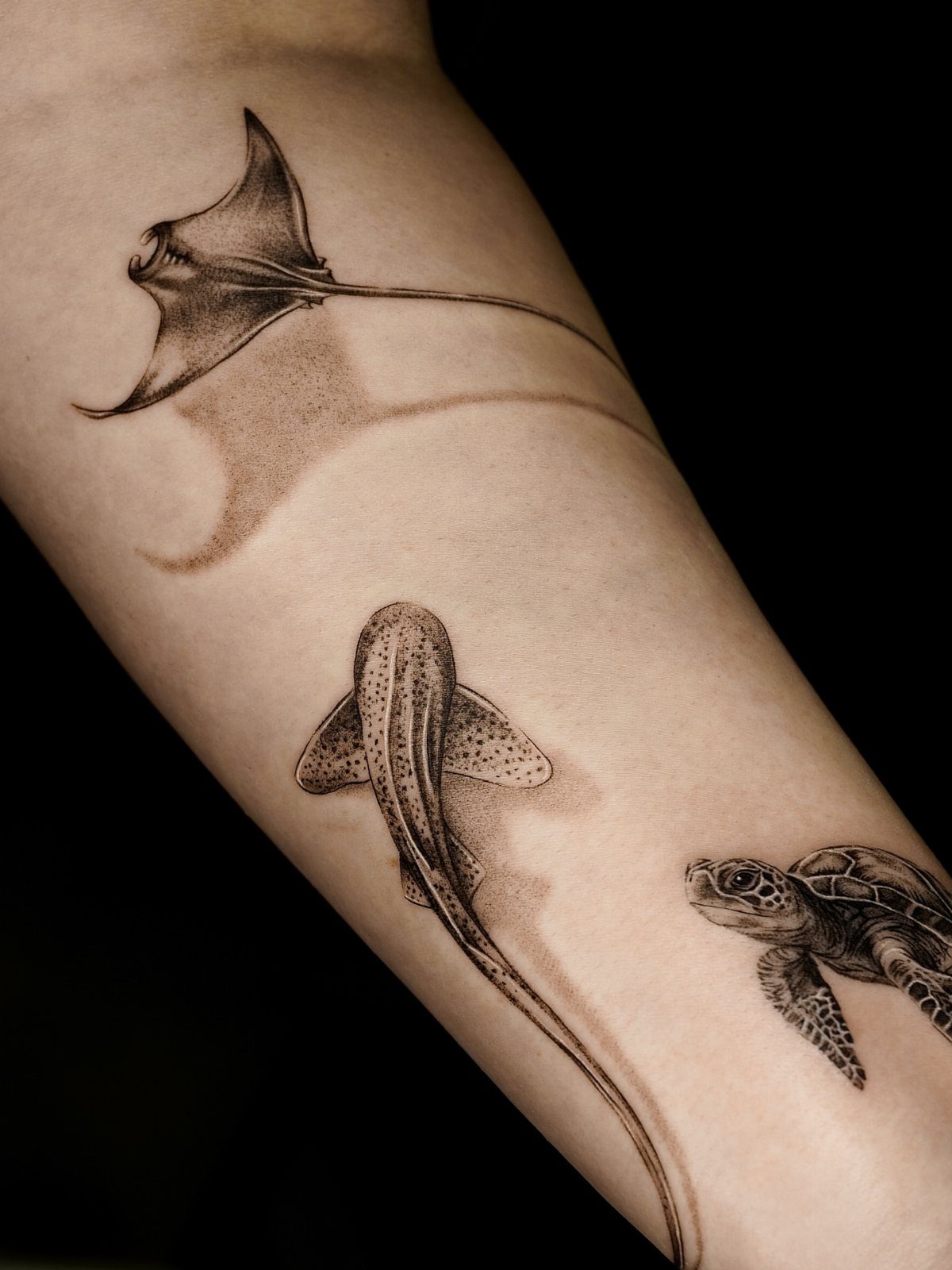
Pairing a shark with a turtle only works if the composition solves the speed mismatch. The shark glides; the turtle drifts.
Soft shadows underneath each figure ground them in the same water. Black and grey keeps the two animals in the same register; color would split them into separate tattoos that happen to share skin.
This reads as balance, coexistence, the ocean’s variety held together. It suits someone who wants marine life broadly rather than shark specifically, or who needs a piece that calms rather than confronts.
23. Shark and Compass
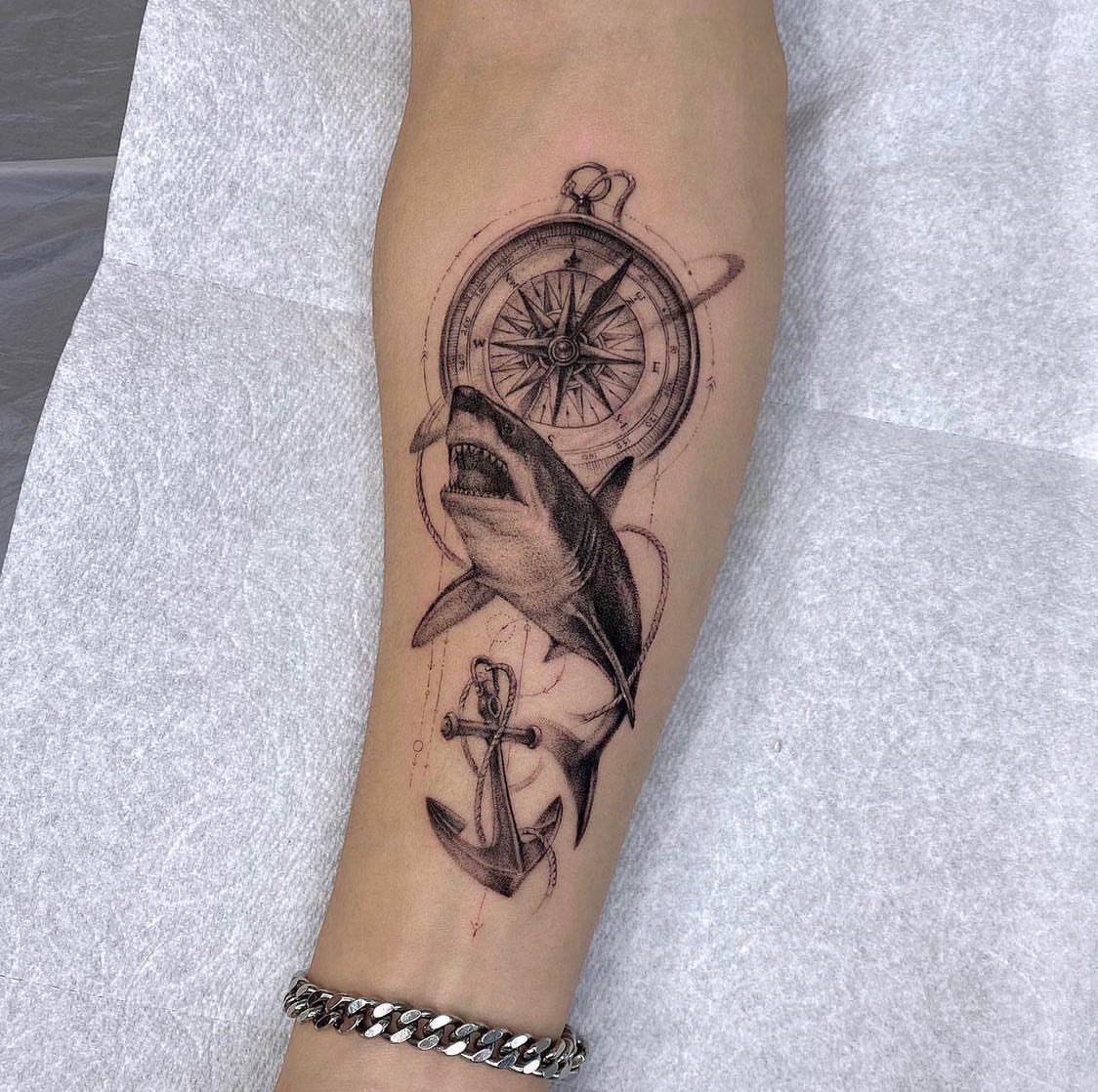
The compass gives the shark a job beyond menace: direction, purpose, a reason to keep moving. The vintage style with rope and anchor underneath anchors the composition literally and visually.
Fine line work on the compass face demands an artist steady enough to keep the degree markings legible; blown lines here ruin the whole piece.
The shark should swim across the compass rather than sit on top of it, so the two forms interlock. This suits travelers, naval veterans, or anyone who sees the shark as survivor rather than predator.
Three elements in one forearm piece needs careful scaling or it crowds.
24. Shark and Rose
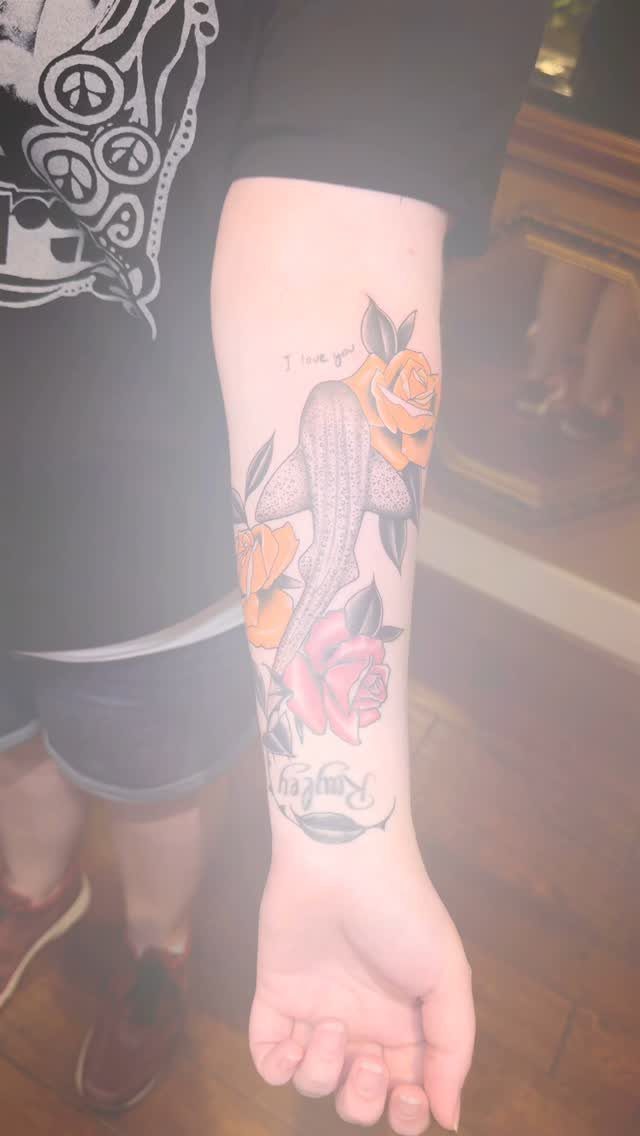
The shark and rose pairing only avoids cliché if the rose color goes bold enough to hold its own against the grey shark. Orange and pink, saturated and warm, do this; muted reds sink and disappear.
The leaves give you green to bridge the two subjects. Text underneath, names or dates, needs spacing that respects both images; tucking it too close to either one creates a caption instead of a composition.
I’d keep the shark in black and grey so the roses pop, or commit to full color throughout. Halfway color on the shark looks indecisive.
This suits someone balancing toughness with tenderness, or memorializing a specific person the roses and text name.
25. Whale Shark Tattoo
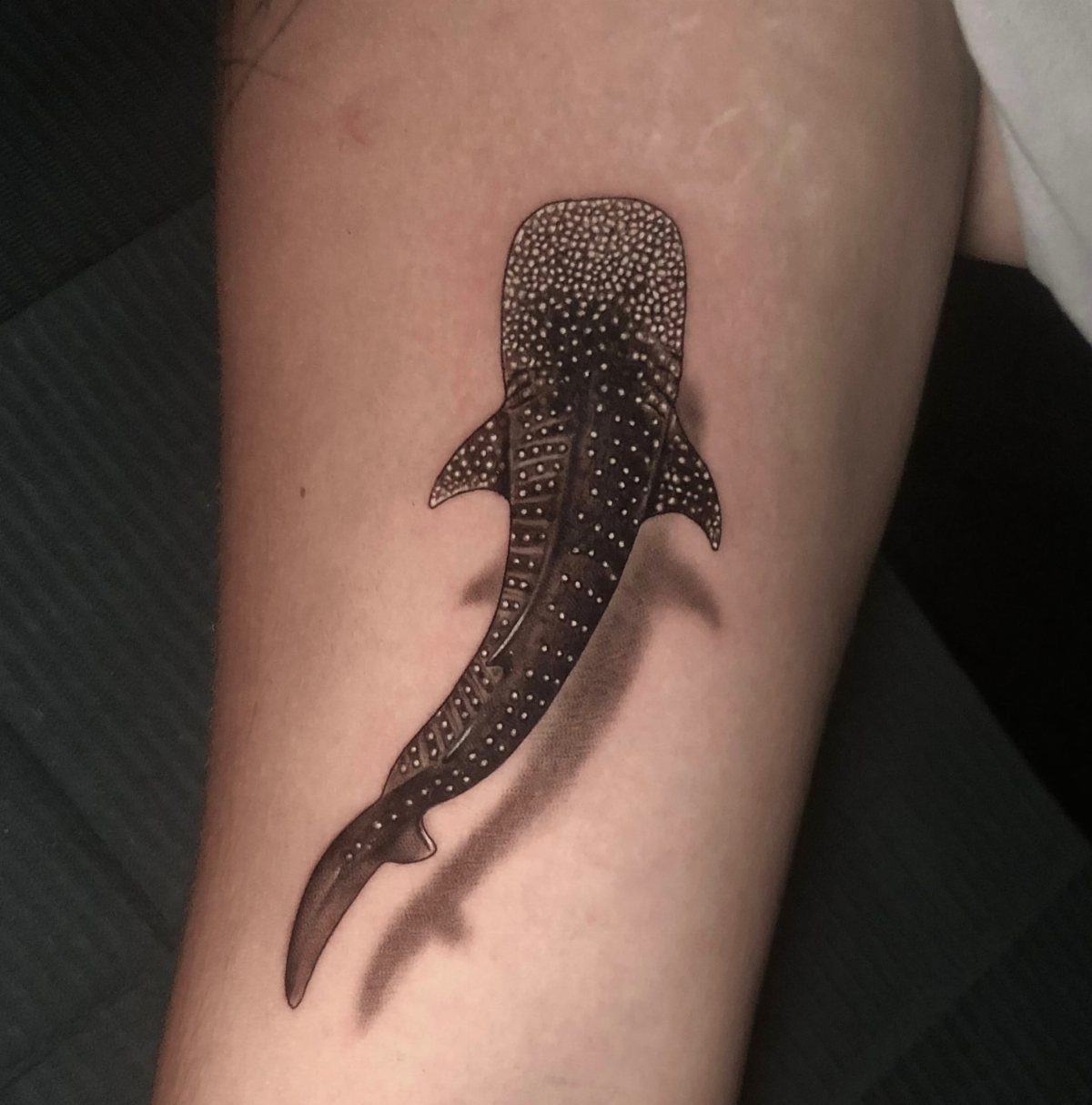
A whale shark tattoo carries the largest fish in the sea at a scale that still fits a calf or forearm.
The white spots and stripes are the identifying mark, and since each animal’s pattern is unique, the spot placement can be personal: a birth month mapped in speckles, or no meaning at all beyond the look.
Black and grey with white ink highlights gives the most reliable result for those spots. UV-reactive blue splashes are an option if the shop offers fluorescent work, though that ink fades faster and not every artist stocks it.
The gentle filter-feeder reputation suits someone who wants shark imagery without the aggression.
26. Skeleton Riding a Shark
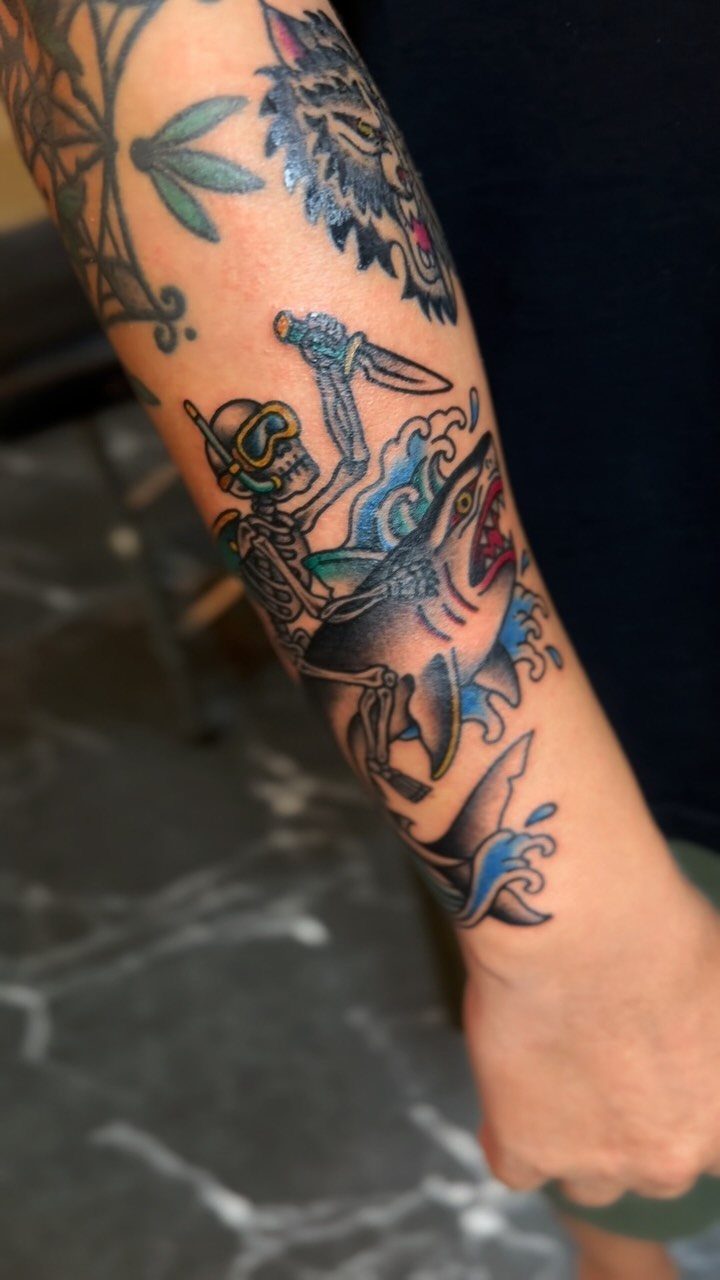
The skeleton in goggles and swim knife turns the shark-rider motif into something closer to deep-sea salvage or old naval folklore.
Traditional color saturation carries it: bold blues for the water, clean reds or yellows on the diving gear, heavy black outlines to keep it readable as it ages.
The knife matters less as weapon than as period detail. A bare-bones version without it reads more playful; with it, the tone shifts toward something harder.
The shark’s expression carries that weight either way, snarling or neutral.
Placement on the forearm gives the leaping curve room to breathe. Someone with a sleeve in progress can tuck this into a gap between larger pieces.
27. Colorful Shark Tattoo
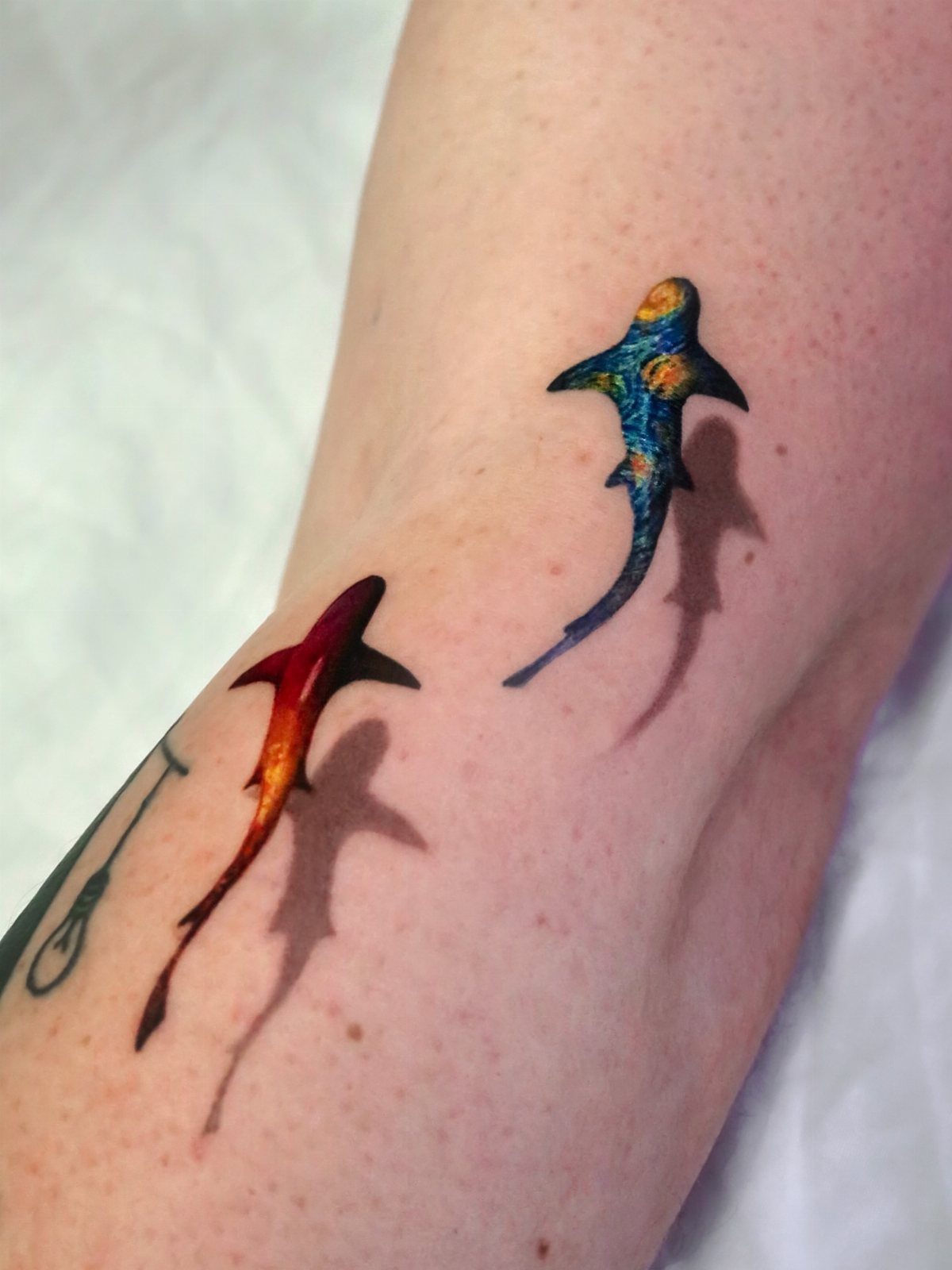
Small sharks in flat, saturated color read as stickers or decals pressed onto the skin, which is exactly the appeal. Two main hues per shark is the limit at this scale; add a third and the color turns muddy fast.
Drop shadow beneath each figure is the technique that separates this from a flash sheet look. It takes extra time and a steadier hand than the color fill itself, so the hourly rate reflects it.
Ask to see healed photos of similar shadow work; fresh ink always looks sharper than it settles.
Best for someone building a collection of small pieces rather than committing a full limb.
28. Celestial Stardust Shark
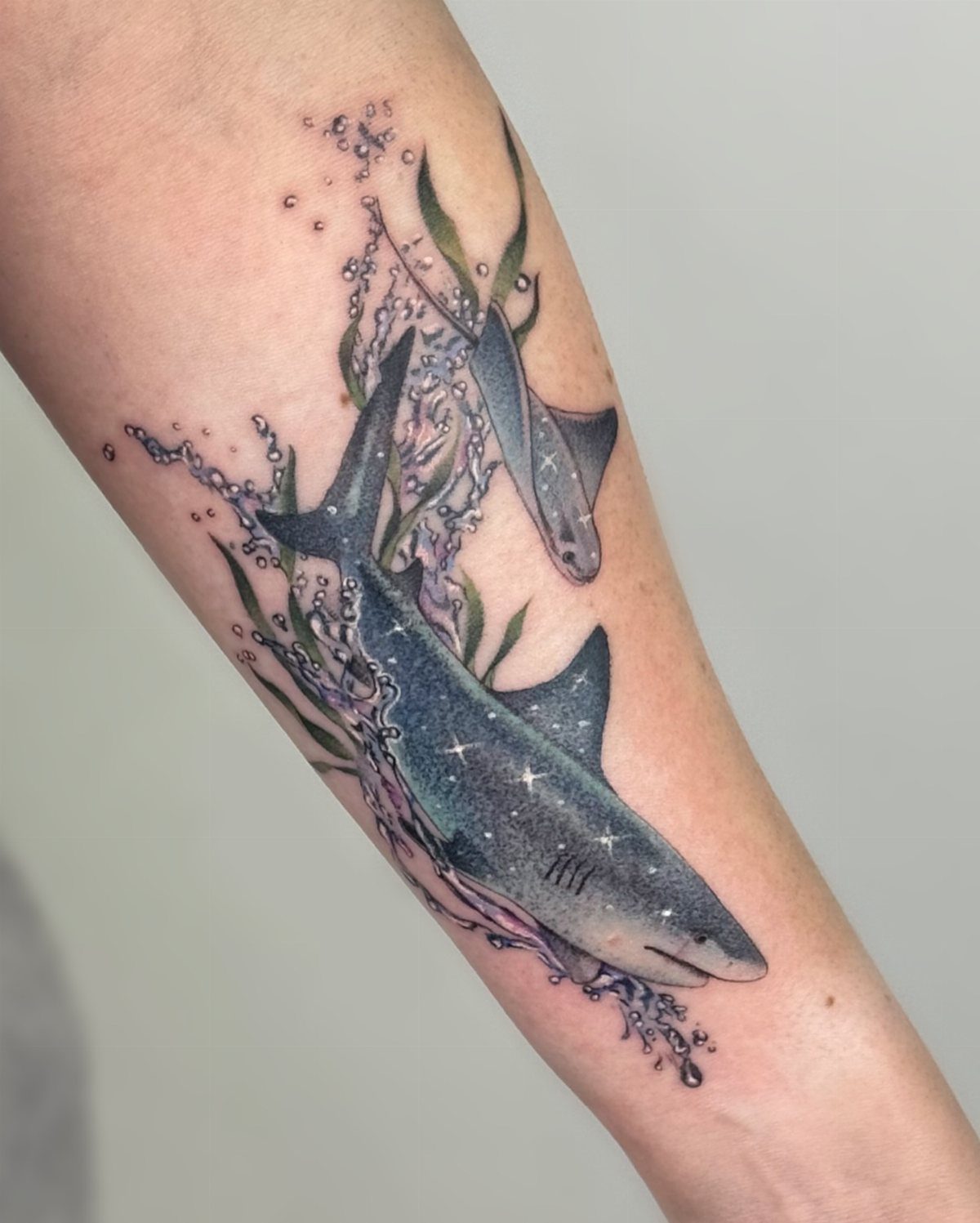
Galaxy fill replaces the shark’s natural coloring with star fields and nebula tones, turning the animal into a vessel for something larger.
Dark blue base with white stardust speckles is the standard approach; the texture reads as depth from a few feet away and breaks into individual stars up close.
Seaweed and bubbles around the pair keep the ocean context from getting lost in the cosmic shift. Without them, the design drifts toward generic space tattoo territory.
The two-shark composition works as parent and child, or as two phases of the same person. Single-shark versions need more surrounding detail to balance the visual weight.
29. Multiple Swimming Sharks
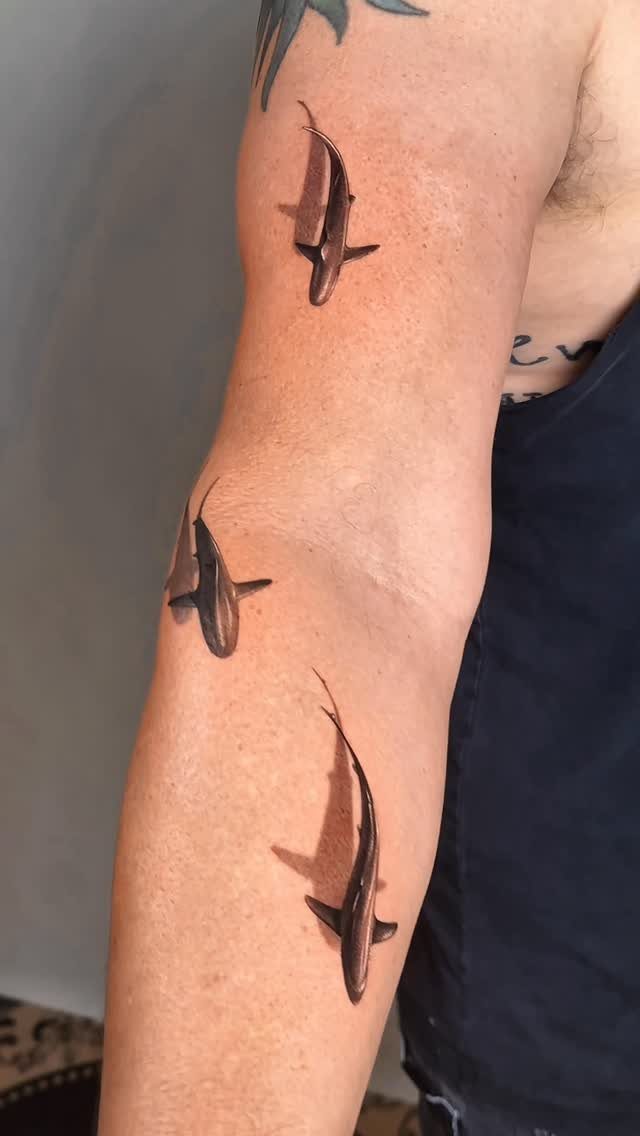
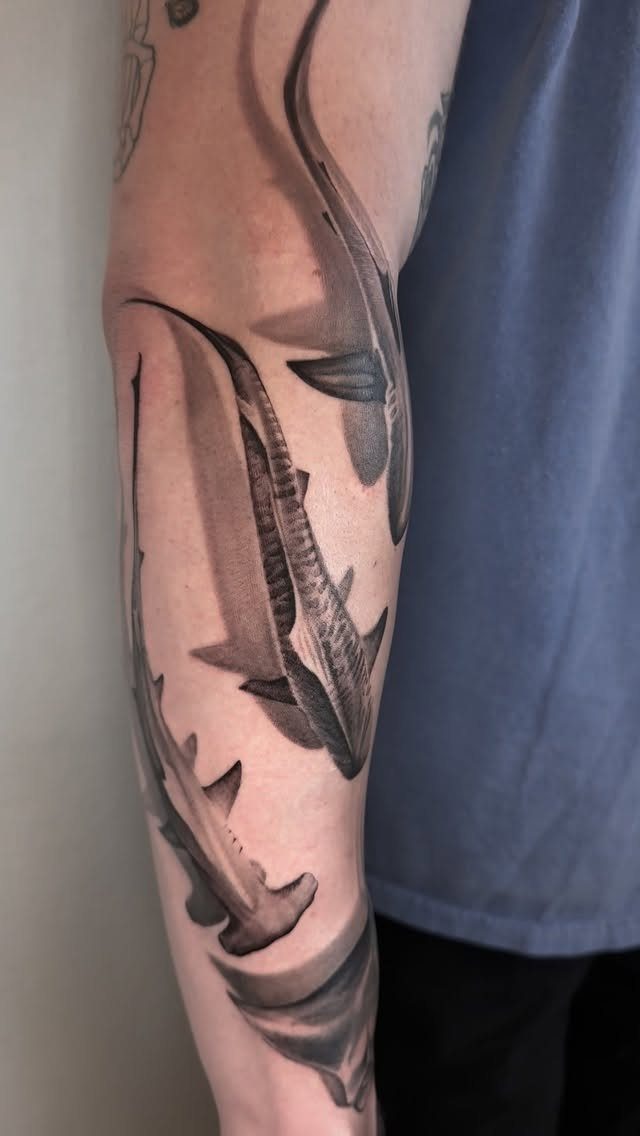
Three sharks in a vertical line, top-down view, turn the arm into a current they swim through. The spacing is the decision that matters: too tight and they read as a cluster, too loose and the connection breaks.
The artist who placed these for a father’s children measured by eye, letting the arm’s natural taper guide the interval.
Cast shadow beneath each shark is what sells the 3D effect. It requires the artist to commit to a single light source and hold it across all three figures; inconsistency there collapses the illusion.
Vertical placement limits daily visibility, which some prefer. The shoulder-to-elbow path suits someone who wants the option to show or cover.
30. Shark and Starfish
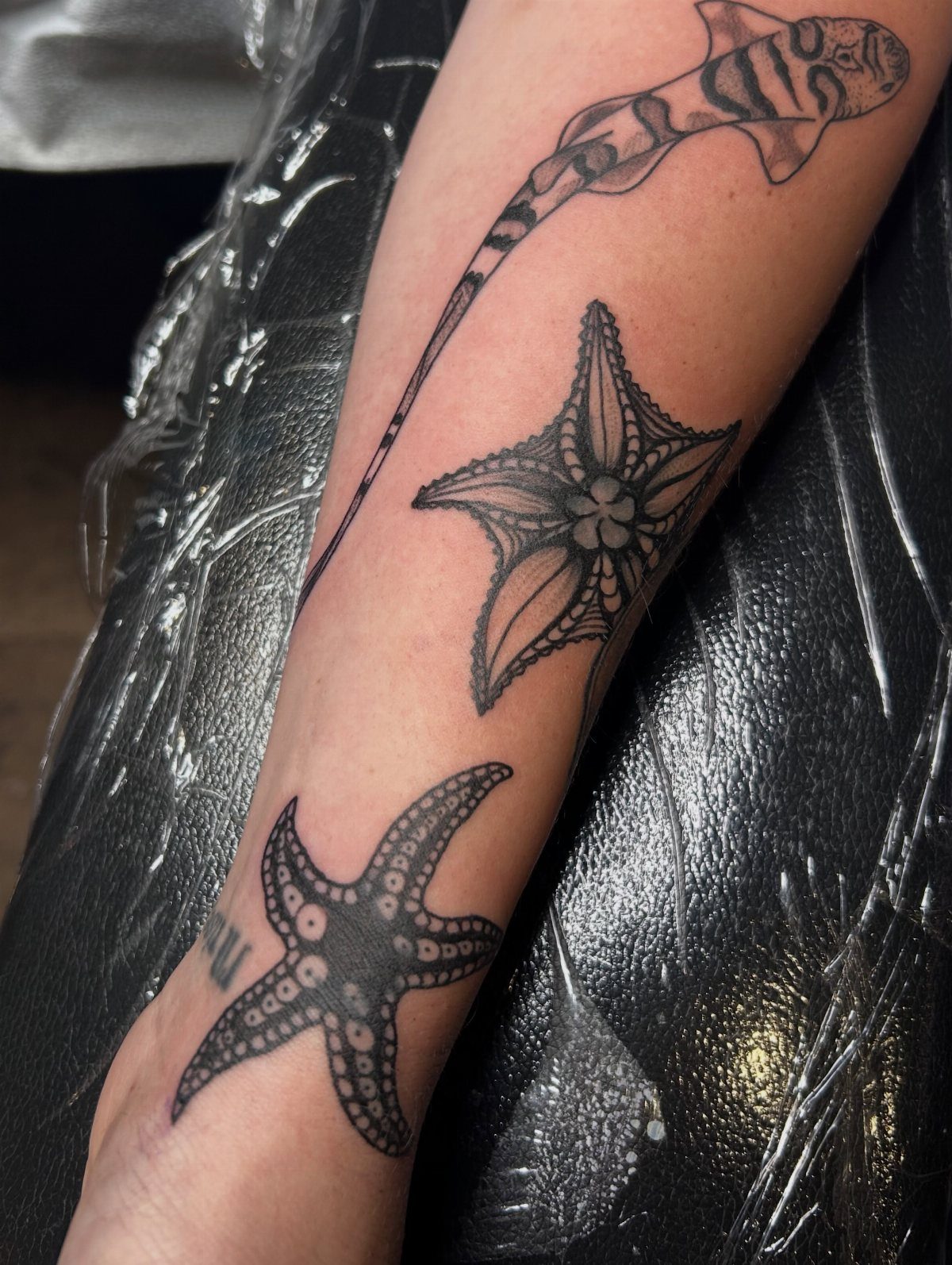
The banded shark’s long, slender body pairs naturally with starfish on a vertical forearm: similar silhouettes, both bottom-dwellers, both reading clearly in black ink without color dependency.
The size gap between the two starfish creates rhythm; matching sizes would flatten the composition.
Starfish carry their own weight symbolically, regeneration and safe passage both, though most people choose this pairing for the visual balance rather than the meaning.
The shark does not need to be identifiable to species; the banded pattern is enough to signal "shark" without demanding biological accuracy.
Someone wanting softer edges can ask for whip shading on the starfish arms, though that technique blurs faster over time.
Symbolism of Shark Tattoos
Sharks made it through multiple mass extinctions that killed off most other species, and that 450-million-year run is why people who have survived near-fatal moments of their own often connect with the image.
A hammerhead or great white on the skin becomes a marker of having come through something, not just of wanting to look tough.
The specific species matters for what you are claiming. A bull shark, with its documented freshwater runs far inland, speaks to adaptability and refusal to stay in expected territory.
Pick the shark whose biology matches your story, or the meaning collapses into generic menace.
As one of the ocean’s apex predators, a Shark Tattoo symbolizes dominance, strength, and fearlessness, representing someone who is strong-willed, unyielding, and ready to face challenges head-on.
Placement Ideas for Shark Tattoos
The forearm takes roughly 45% of shark tattoo placements for good reason. The curved surface follows the natural swimming posture of most species, and the visibility means you do not have to plan around clothing to show it or hide it.
The arm and shoulder suit larger pieces where the shark’s full length matters.
A great white with open mouth needs the vertical space of a calf or the width of a thigh to separate the teeth; cramped onto a wrist, the detail becomes mud.
For something minimal, a single fin breaking the surface works almost anywhere. The ribs or sternum give it a horizon line that the mind completes automatically.
Styles of Shark Tattoos
Minimalist lines, single continuous curves, have surged in popularity.
Cultural Significance of Sharks
Geometric Polynesian patterns follow the body’s lines so closely that the tattoo seems to move the way a shark does through water. About three in ten Polynesian shark tattoos use these protective geometric patterns deliberately.
The spiritual role varies by region and family. Some lineages claim direct descent from shark ancestors; others receive the animal as a guardian spirit assigned at birth.
This is not imagery to borrow without understanding. The patterns are not decorative; they encode genealogy, region, and status.
For those without, it demands the respect of someone wearing a borrowed uniform.
Frequently Asked Questions
What does a shark tattoo symbolize?
A shark tattoo carries strength, resilience, and adaptability as its core meanings. Polynesian tattooing has long treated the shark as aumakua, a family guardian spirit believed to watch over anyone in the water.
The animal’s millions of years of survival, constant forward movement, and ability to thrive under pressure make it a fit for someone who sees themselves as unyielding or quick to adapt.
Different species add their own shade: the hammerhead leans guardian, the tiger shark persistence, the great white raw dominance.
What is the best shark tattoo design?
The best design depends on what you want the image to do. A great white needs the room to show individual teeth clearly; forearm or calf is about the minimum that holds the detail.
A hammerhead stays recognizable even at small sizes, though the full cephalofoil spreads better across a shoulder or thigh.
Minimalist line work suits someone who wants the symbol without spectacle; tribal carries spiritual weight but requires homework on which patterns are open use.
For first-timers, shops like Holistic Ink report clean-line requests up 60% over three years, partly because the style ages well and hides easily.
What are some tattoos to avoid?
A few shark designs carry risks: the open-mouth pose can distort as skin ages, and a too-small geometric shark often ends up reading as a random triangle cluster.
Stylized great whites tend to look like generic fish; realism or near-realism is the safer route. Tribal patterns without Pacific Islander heritage or proper research borrow closed motifs disrespectfully.
Watercolor fades faster and blurs at edges without bold outlines to hold it, so fresh portfolio pieces mislead; ask to see healed work instead.
Cute sharks in black and grey read unfinished rather than intentional, so color is almost required for that approach.