Dragonfly tattoos range from a single straight-line body to full Starry Night swirls across the shoulder, and the deciding factor is how much daily visibility you want to live with.
Forearm pieces fade faster and need touch-ups every few years; thigh or shoulder placements stay hidden under work clothes and keep their detail longer.
The spread below starts with quiet black ink and ends with fluorescent green that shifts toward yellow-green as it ages.
1. Lotus Dragonfly Tattoo
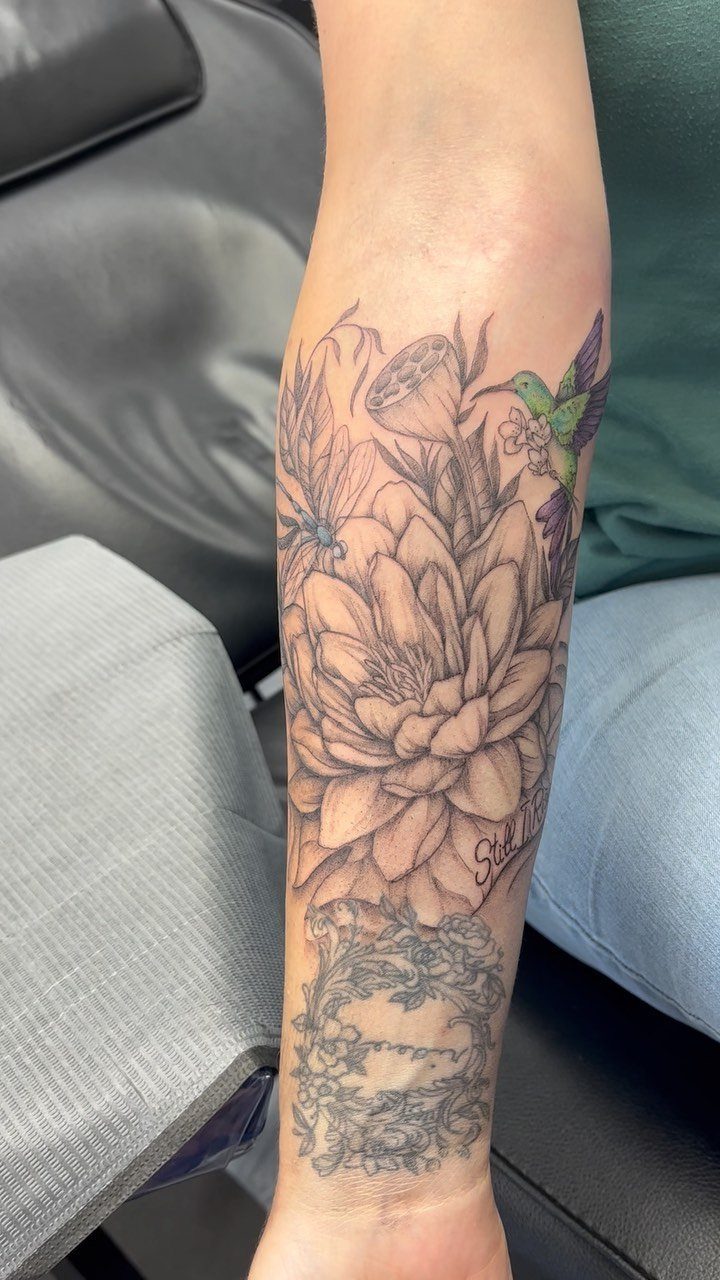
A lotus and dragonfly pairing works best when you want the tattoo to carry weight without shouting. The flower grounds the design in calm; the insect adds motion.
Both point to getting through hard change with your head still level.
A forearm placement lets you read the piece yourself, which matters if the reminder is personal. Size needs to be enough for the lotus petals to hold detail; too small and the two symbols blur together.
Black and grey keeps the focus on form, though color on the hummingbird can mark one element as the spark that started the shift.
I’d suggest this for someone mid-change: new city, new role, ended relationship. The skin heals; the reason you got it stays fresh longer than you expect.
2. Adorable Colored Dragonfly
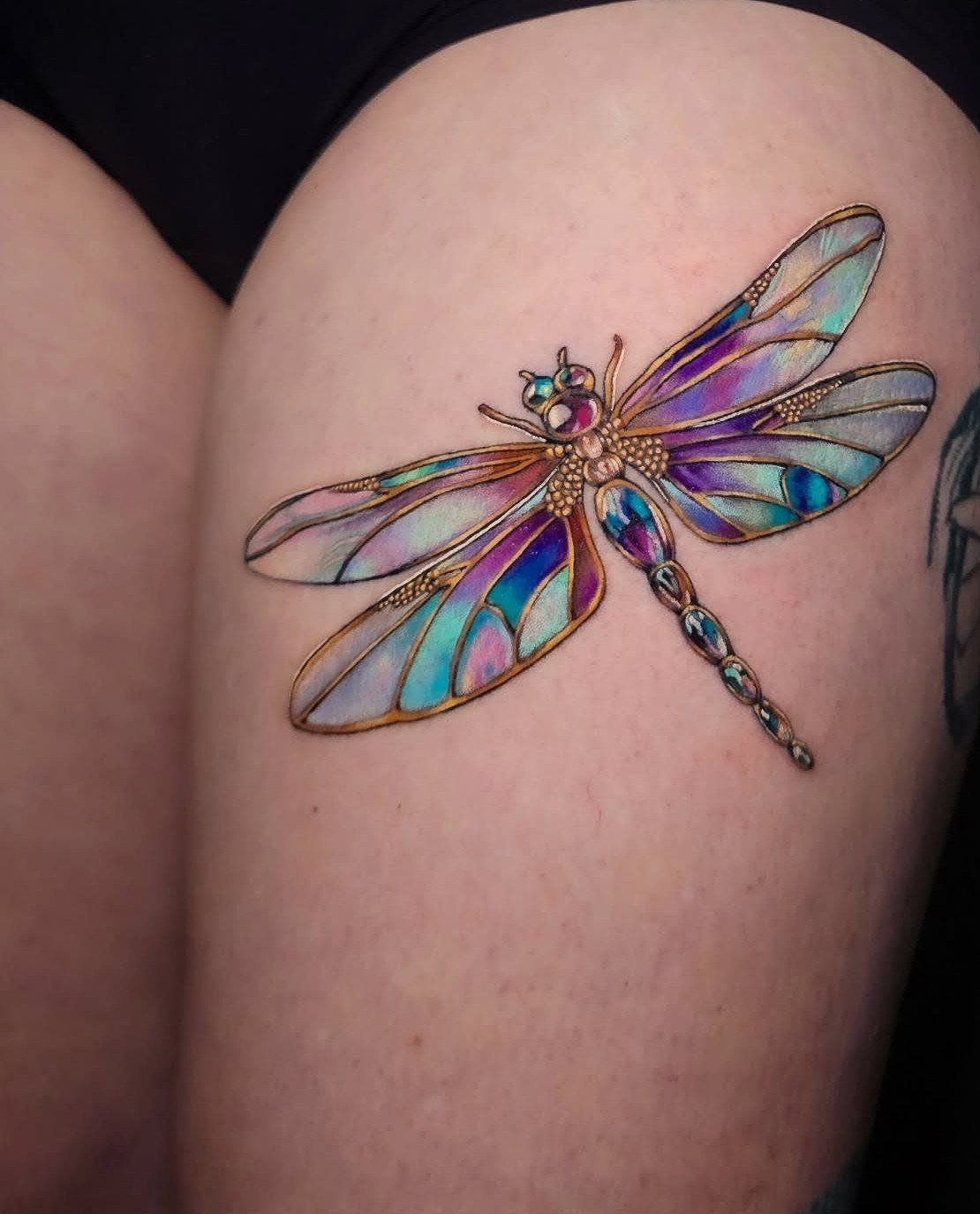
Dragonflies in nature shift color as they turn, and a tattoo that catches that quality needs an artist who mixes iridescence well. Purple, blue, and gold layered in stained-glass panels gives the wings depth that flat color blocks lose.
The thigh offers space for the wing span and hides easily under work clothes. Forearm works too, but the colors fade faster there with sun exposure.
Expect touch-ups every few years if you choose a spot that sees daylight daily.
This suits someone who wants the tattoo to read as ornament first, meaning second. The cuteness is genuine; the symbolism sits underneath for you to explain or not.
3. Geometric Dragonfly Forearm Tattoo
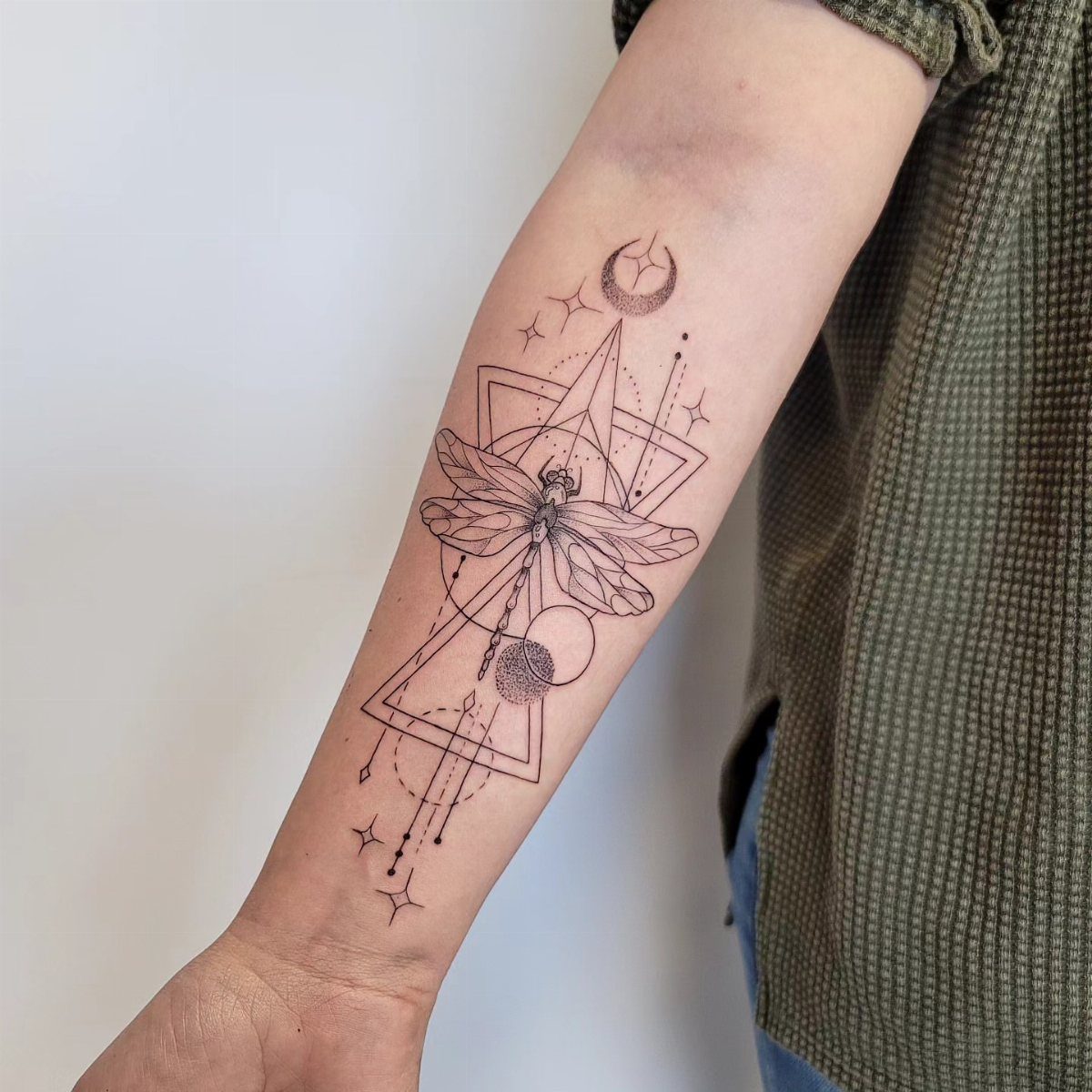
Geometric framing around an organic subject only holds up if the lines are precise.
The circles and triangles in this forearm piece serve as scaffolding; the real work is in the wing patterns, where fine lines mimic vein structure without copying it exactly.
A black-ink specialist with steady hand-work matters more here than with a watercolor piece where a bleed adds character. Ask to see healed photos of their line work; fresh tattoos always look sharper than they settle.
The moon and stars tucked in keep it from reading as pure math. I’d add those small cosmic touches unless you want the design to feel colder.
This one fits someone who plans their tattoos as a sleeve eventually; the geometry links forward to other pieces.
4. Dragonfly and Key
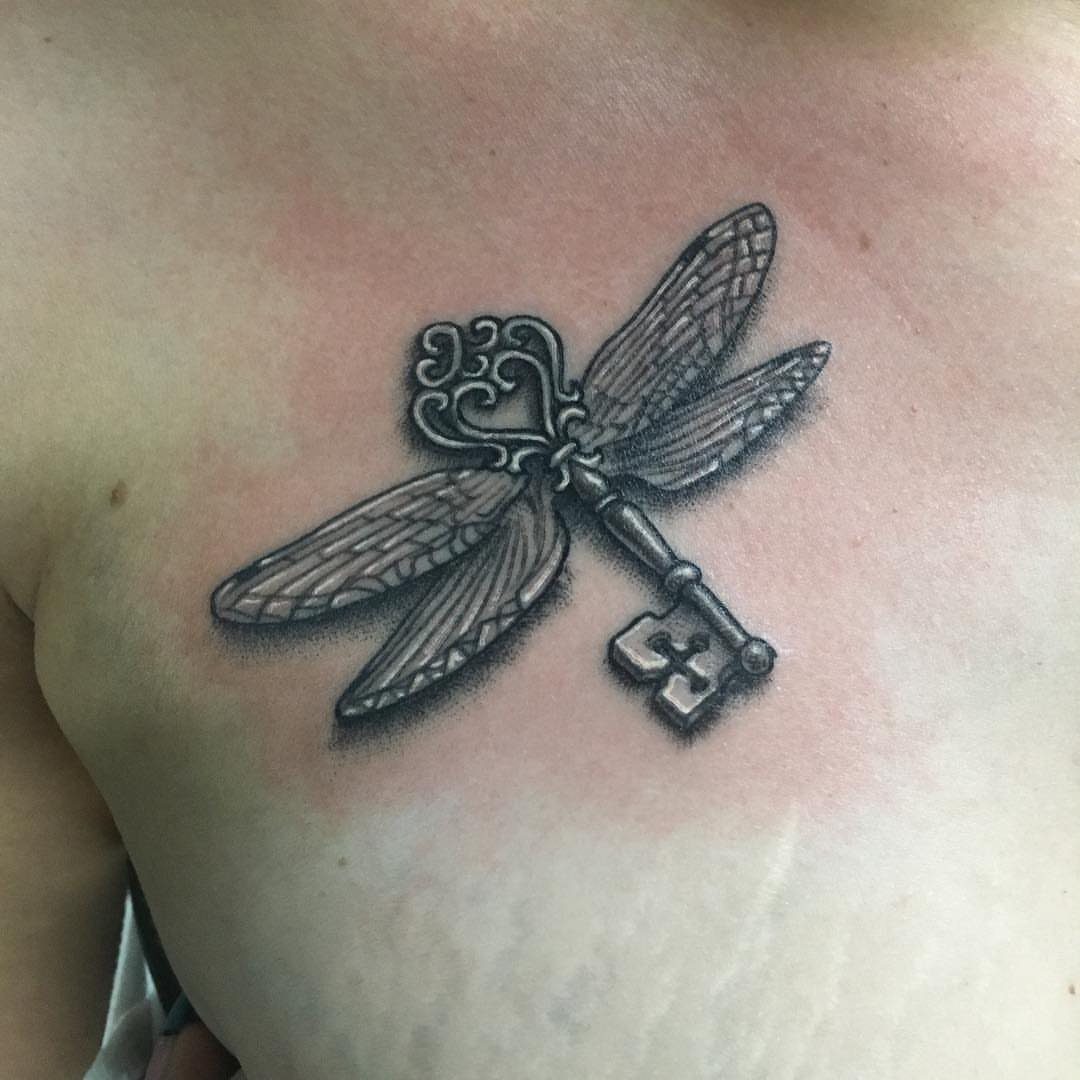
Merging a key’s shape with a dragonfly’s body takes an artist who thinks in symbols, not just images. The skeleton key form keeps the antique feel; the wings soften it so the design does not lock into one gendered reading.
Hand placement puts the message where you see it constantly, which fits the theme. Fingers and palms wear fast; I’d choose upper chest for longevity unless you accept rework.
The meaning is direct enough to risk sentimentality. A more ornate key bow, as here, adds visual interest that keeps the tattoo from reading like a motivational poster.
Best for someone who made a hard choice and wants the reminder close.
5. Dragonfly and Moon Phase
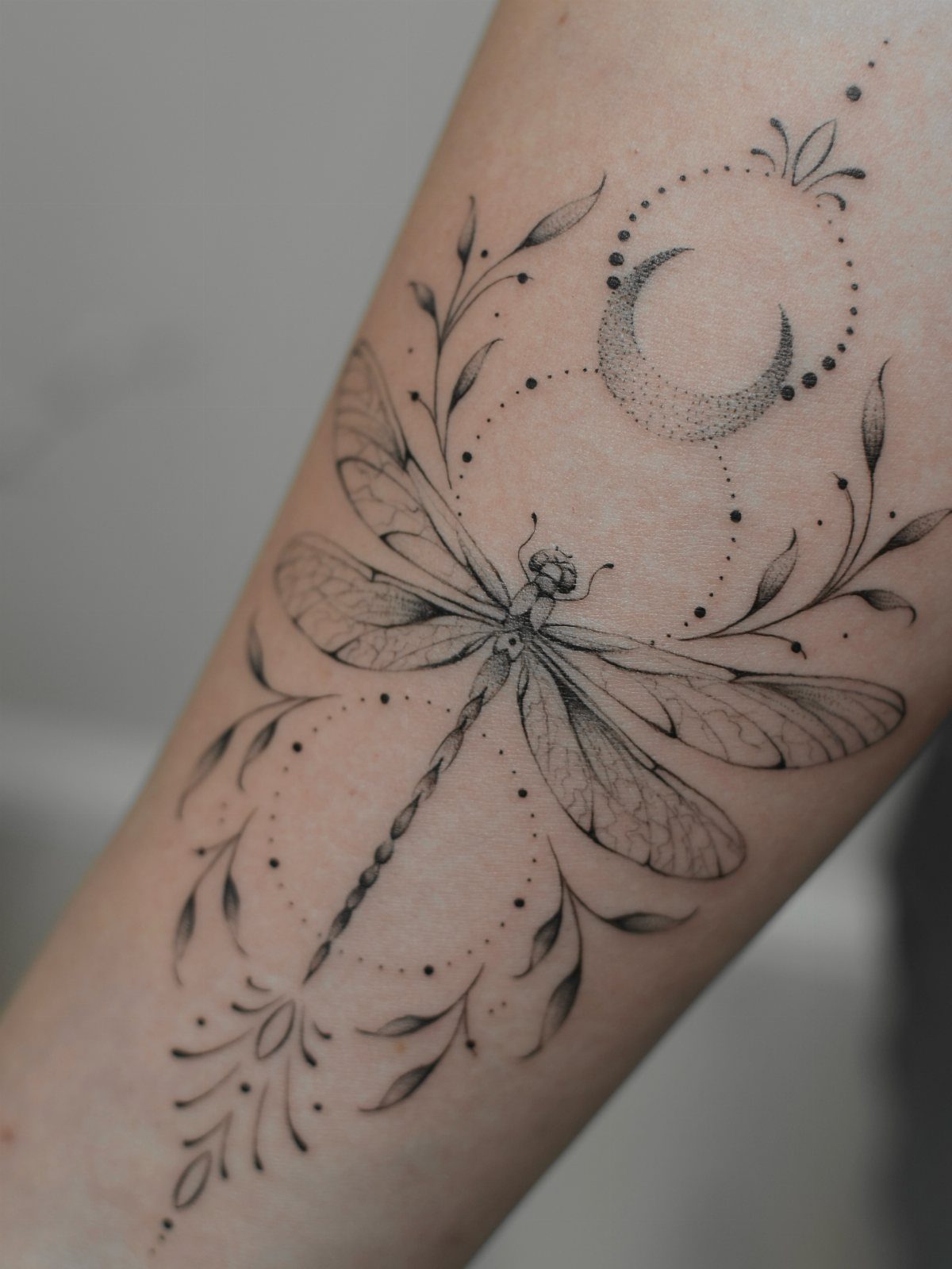
Moon phases paired with a dragonfly make the symbolism explicit, which can help or hurt depending on your taste.
The crescent and dotted circles in this arm piece keep the layout balanced; the leaves fill gaps without adding another symbol to interpret.
Fine-line work like this needs a light hand and a patient sitter. The lines will spread slightly over time; starting too bold turns delicate into muddy.
Chest placement is an option if you want it more private than the forearm.
I’d pick chest for a first tattoo in this style; you learn your pain tolerance on skin that does not show if you need to stop early.
6. Green Dragonfly
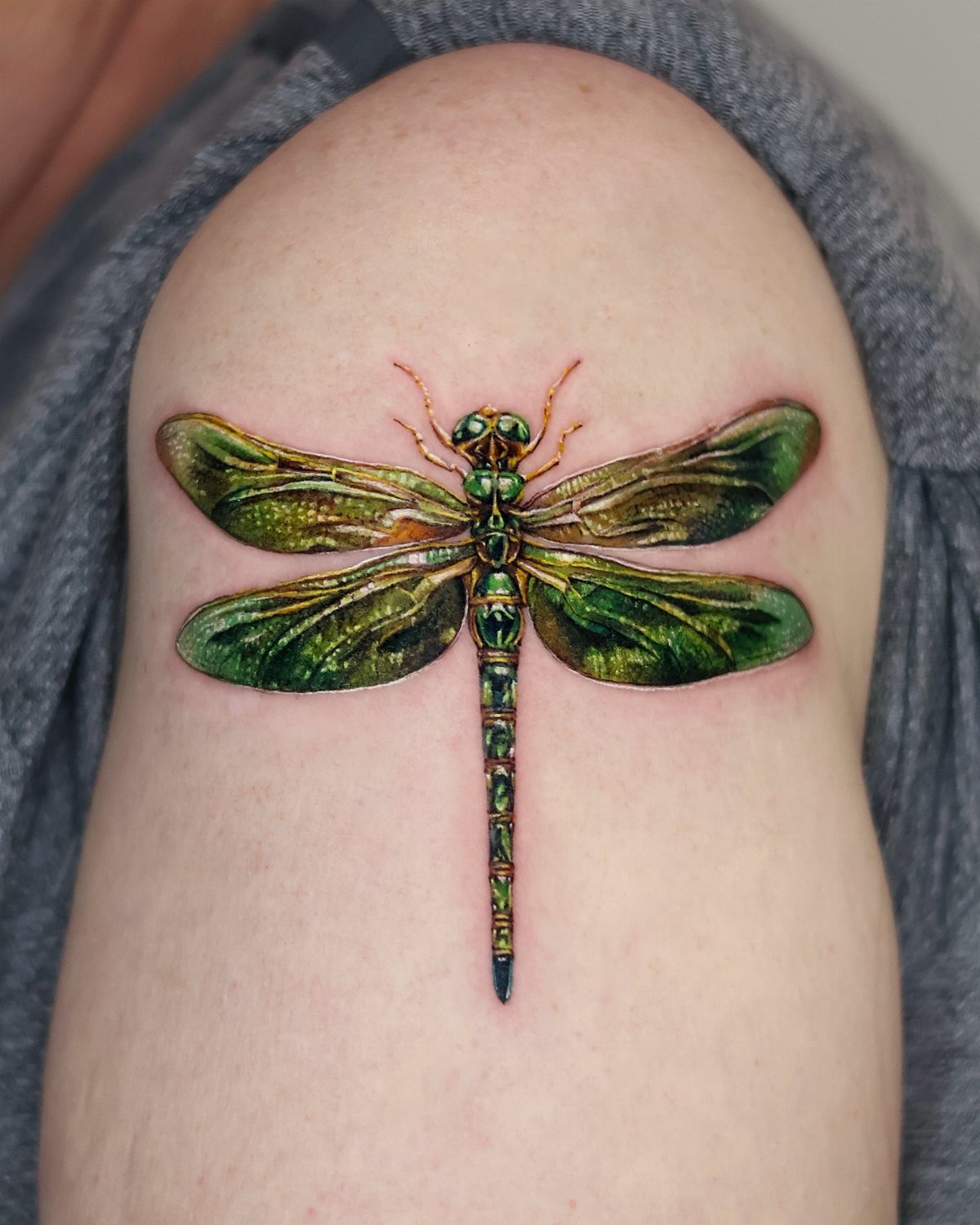
Fluorescent green in tattoo ink is a gamble. The color pops against skin in ways darker greens do not, as this shoulder piece proves, but it fades toward yellow-green faster than earth tones.
Gold accents give it somewhere to go as it ages; pure fluorescent alone can look sickly.
Realistic dragonfly tattoos need an artist comfortable with insect anatomy. The segmented body and wing transparency here are specific; a generalist will flatten the form into a generic bug.
Small size, as noted, actually helps this one. Large fluorescent areas draw the eye too hard; a compact shoulder or ankle placement lets the color surprise without overwhelming.
I’d recommend this for someone who already has tattoos and wants one piece that reads as jewelry rather than statement.
7. Simple Dragonfly Tattoo
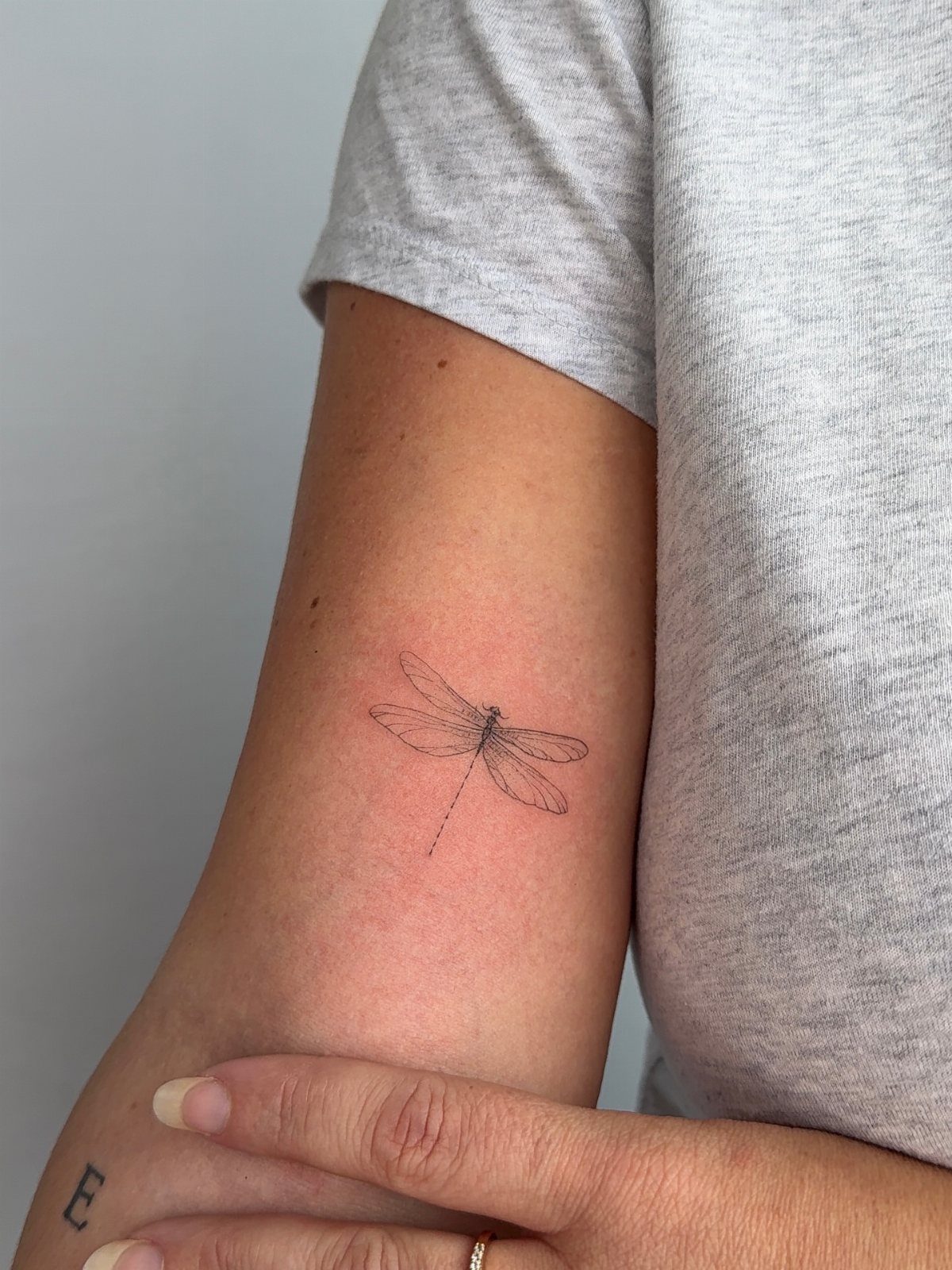
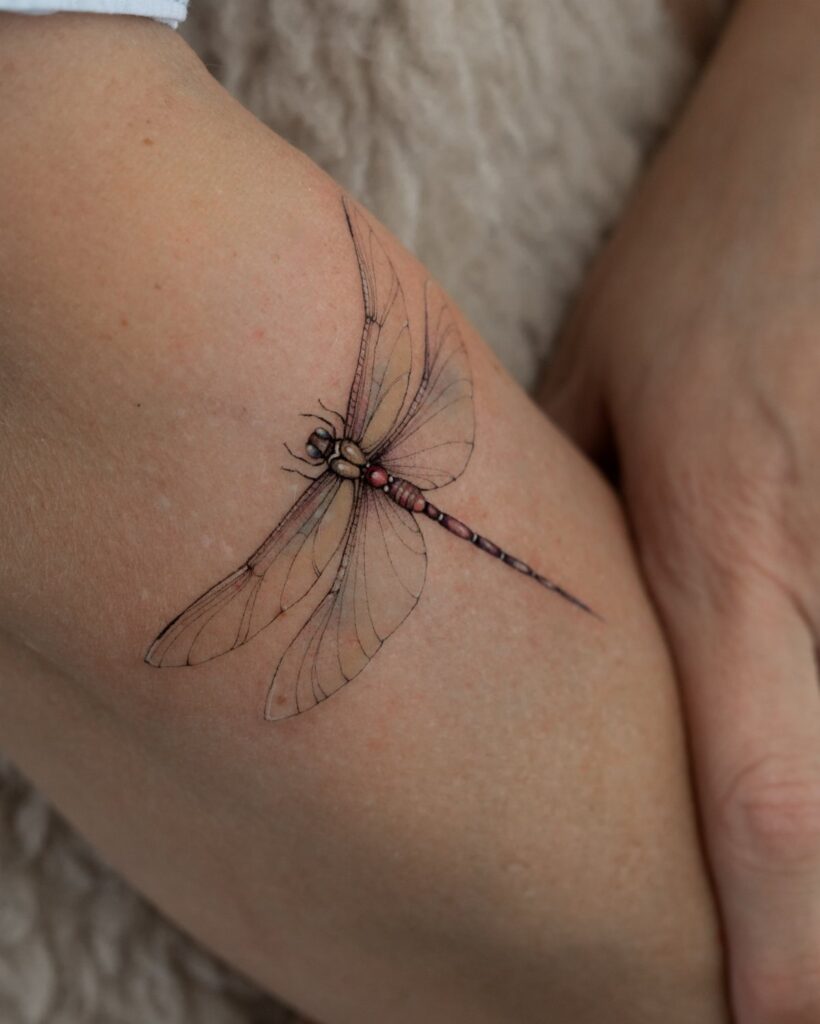
A simple dragonfly tattoo works when you want the symbol without the clutter. A single straight line for the body keeps the design quiet, while fine patterning across the wings supplies the interest.
That balance keeps it readable from across a room but interesting up close.
Fine line work ages faster on high-friction spots like the inner wrist, so the upper arm or shoulder blade holds the crisp edges longer.
If your skin tends to blur ink, ask the artist to pull the wing lines slightly thicker than the body.
This style suits someone getting a first tattoo or adding a small piece to an existing collection without starting a sleeve. It also covers easily for jobs that still care about that.
8. Matching Dragonfly Wrist Tattoos
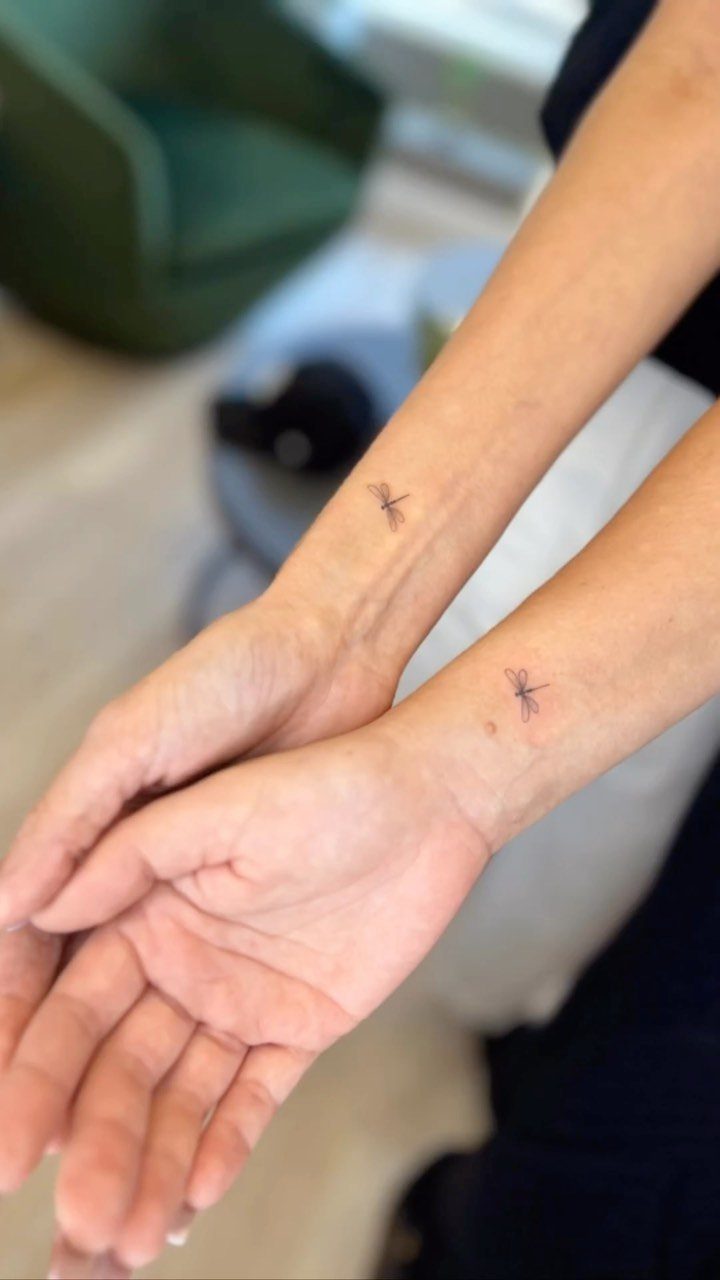
Matching tattoos usually read as fresh romance, but dragonflies carry a different weight. The pairing signals a relationship that has already weathered enough to earn the symbol of maturity.
Wrist placement keeps the image private until you choose to show it, which matters for couples who share a home but not a need to announce.
Size matters here: small enough and the matching pair reads as a private emblem rather than a paired set, so the connection becomes a quiet nod instead of an announcement.
One person should book the appointment and both should go to the same hand. Two artists working from the same stencil still drift apart in line weight.
If one of you heals poorly, the other waits to touch up until both need it.
9. Small Dragonfly Flower Tattoo
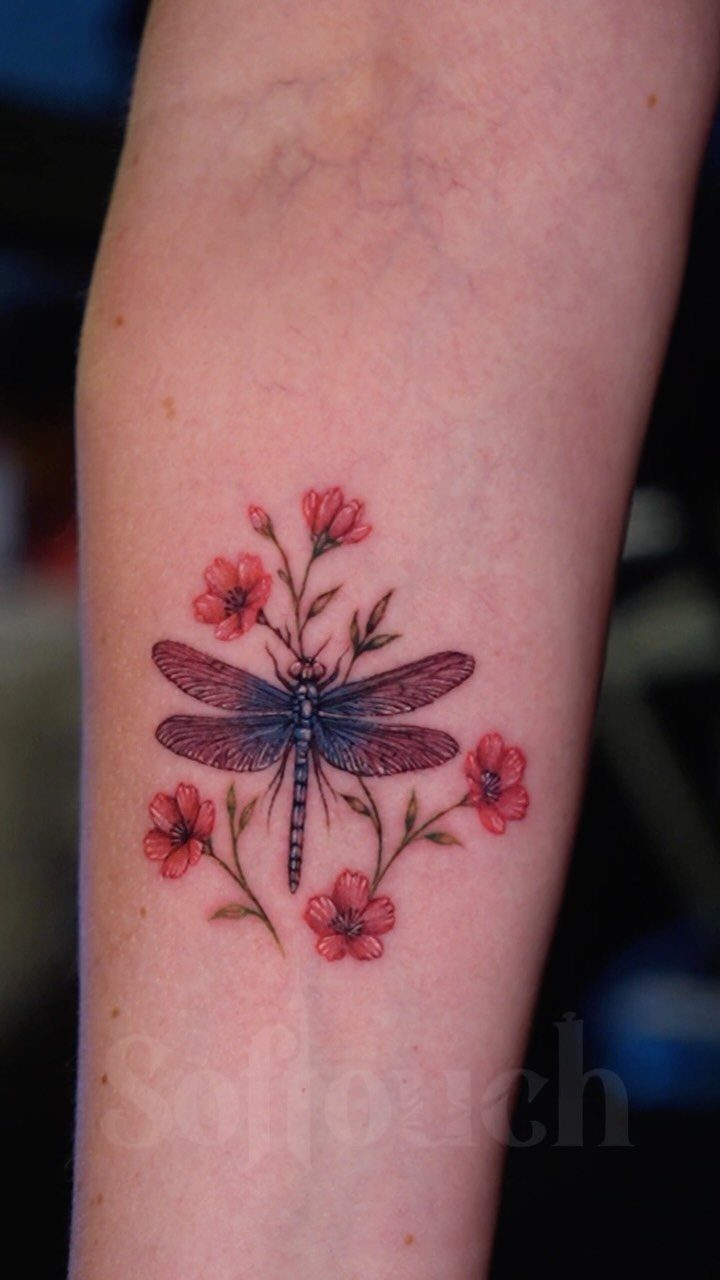
Flowers turn a dragonfly tattoo toward a specific mood, and the choice of bloom matters more than the dragonfly itself.
Pink blossoms with a purple body make one combination, but the color matters less than the meaning behind whichever flower you select.
Rose for love, lily for renewal, cherry blossom for the briefness of beauty: each species carries its own language, and mixing two sends a compound message whether you intend it or not.
A good artist will ask what you want the combination to say, not just how you want it to look.
This style works best at a scale where the dragonfly stays the focal point and the flowers read as atmosphere rather than competition. Forearm or outer upper arm gives the width for that hierarchy.
Ankle or behind-the-ear placements force the flowers to shrink into blur territory.
Dragonfly tattoos are also having quite the moment. Yes, they’re not quite as sought after as butterflies, but they sure do make amazing tattoos.
10. Starry Night Dragonfly
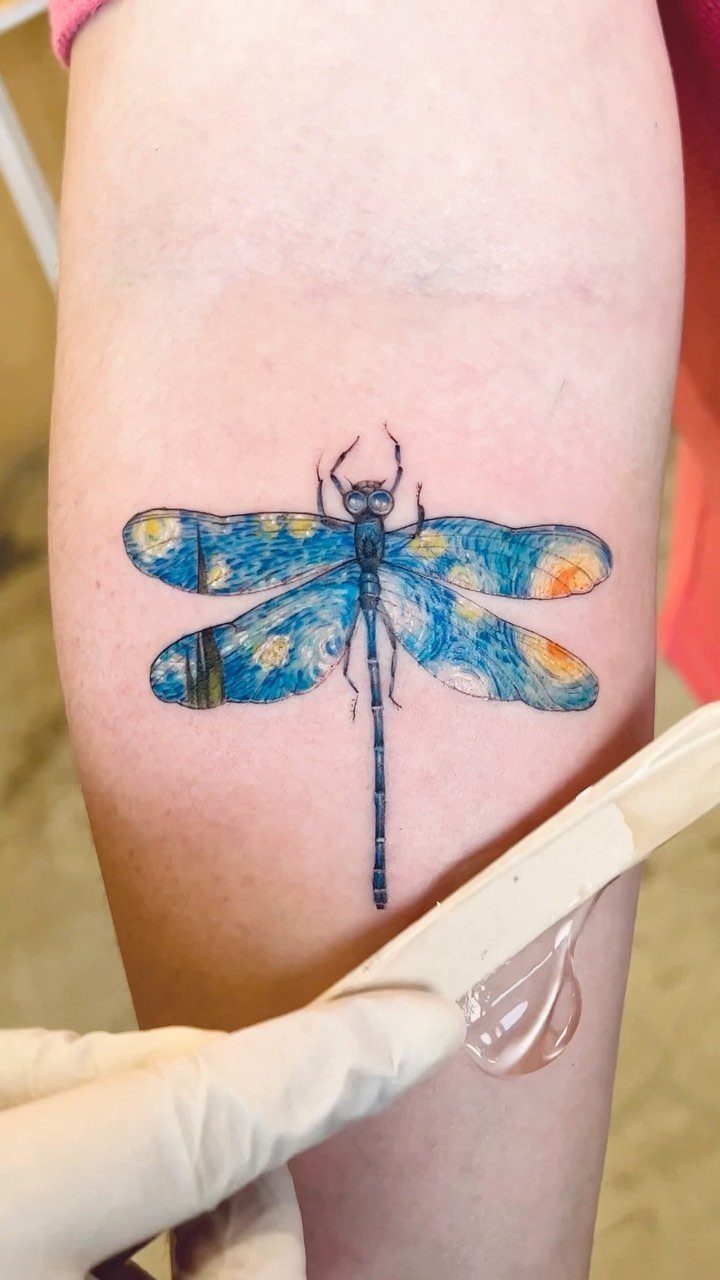
Borrowing a painting for a tattoo usually fails because canvas texture does not translate to skin.
The Starry Night swirls work here because the dragonfly wings already divide the image into sections small enough to hold detail without demanding precision across a flat field.
The blue and yellow palette needs a tattooist comfortable with color packing, not just lining.
Water-based pigments in the lighter yellows tend to shift greenish as they age, so budget for a refresh or ask the artist to anchor the yellow with more blue than the original painting uses.
This design demands a placement with enough flat surface to let the wings spread. Calf, outer thigh, or a broad shoulder blade work.
A curved rib or bicep distorts the spiral pattern in a way that breaks the reference.
11. Dragonfly Shoulder and Collarbone Tattoo
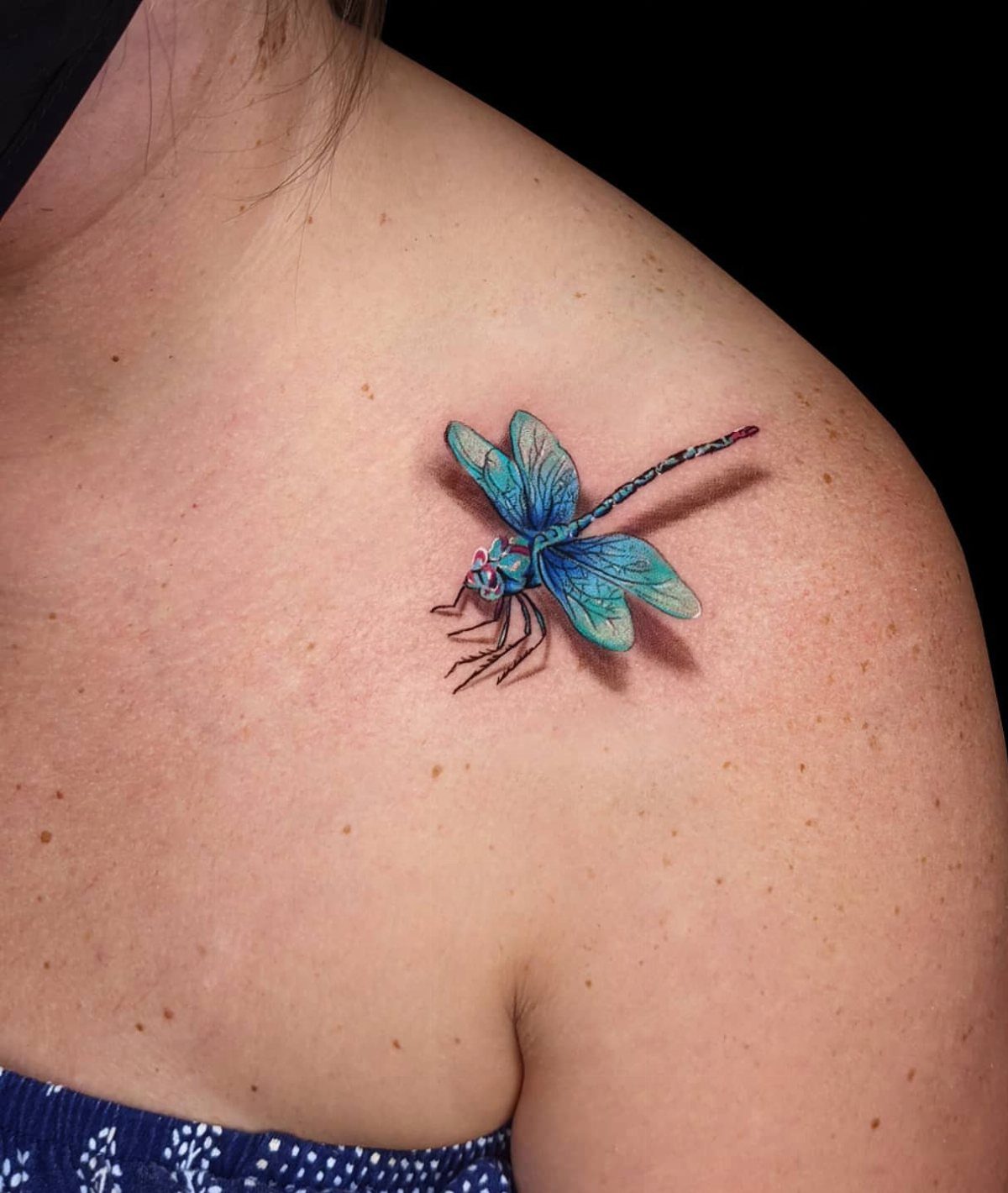
Shoulder and collarbone placement follows the body’s architecture instead of fighting it. Extending the tail along the bone line uses the natural edge of the body as a frame rather than floating the image in empty skin.
The 3D effect comes from drop shadows dropped beneath the wings, a technique that reads as depth on camera but can muddy in person if the shadows are laid too heavy.
Color saturation matters here because this area sees sun whenever a neckline dips or a sleeveless shirt appears. Plan touch-ups into the long-term cost, or keep the pink minimal.
12. Antique Dragonfly Thigh Tattoo
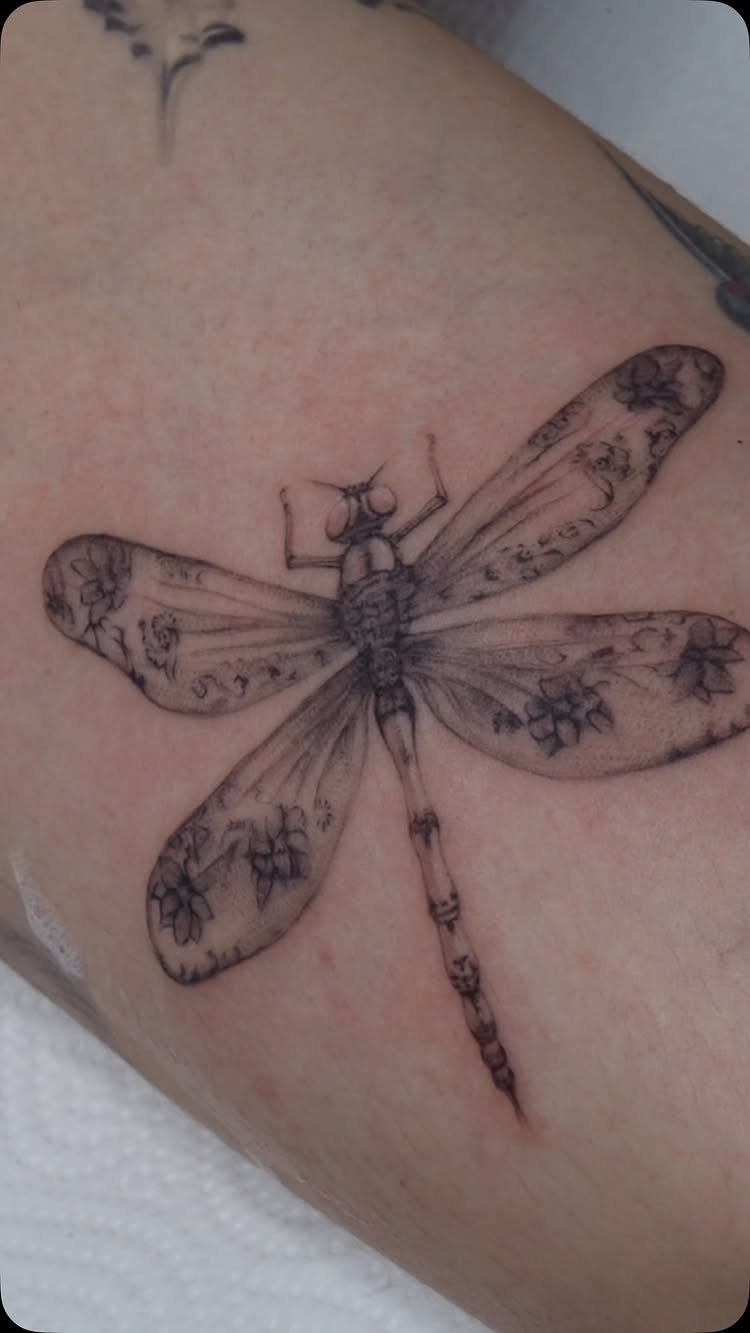
An antique-style thigh tattoo trades movement for stillness. Lace-patterned wings fix the insect like a specimen pinned under glass, which is the point of the vintage reference.
Thigh skin takes ink well and stretches less than belly or upper arm, so the fine lines and delicate shading in this piece have a better shot at aging intact.
Visibility is the cost: this placement hides under work clothes and reveals only when you choose, which suits the jewelry-like quality the style aims for.
Black and grey with ornamental detail needs an artist who specializes in ornamental or mandala work, not one who usually does bold traditional.
The overlap of techniques looks simple but requires steady, consistent needle depth to keep the lace from closing up during healing.
13. Seamless Patterned Dragonfly
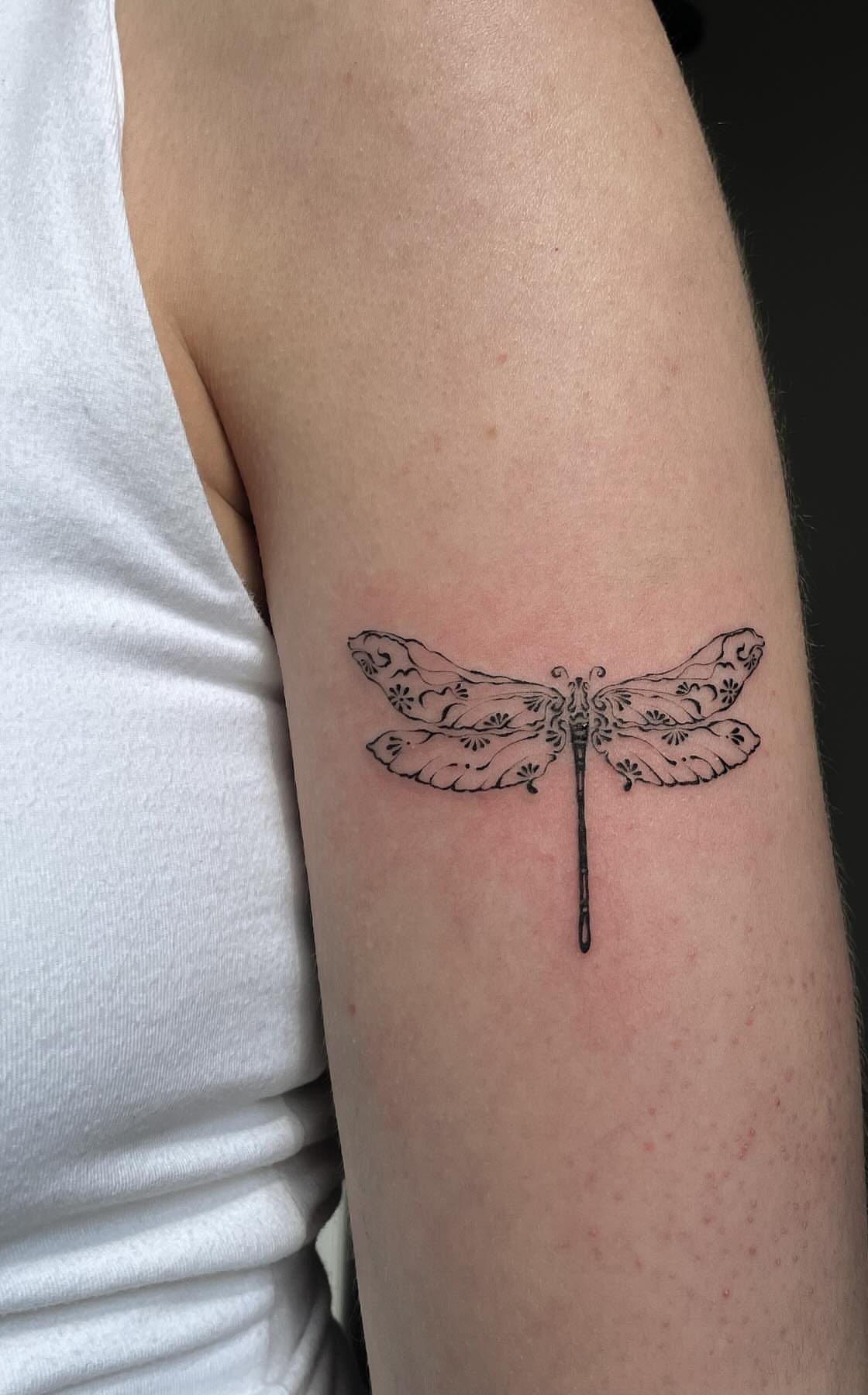
A patterned dragonfly turns the wings themselves into open space for whatever motif fits the wearer.
Black ink filigree can swirl through each wing panel, dense enough to read as texture from across a room, still legible as pattern up close.
This style suits someone who wants the insect form to carry personal meaning without adding separate symbols around it.
Oriental florals, geometric repeats, or freehand scrollwork all work; keeping the pattern consistent across both wing pairs keeps the dragonfly from breaking apart visually. The artist needs steady line control, since any wobble in the repeating elements multiplies.
I would check an artist’s healed fine-line work before committing. Solid black holds; greywash patterns can muddy inside small wing cells.
Someone with existing ink nearby should match the pattern density to what is already on the arm, or the dragonfly will float disconnected.
14. Artistic Dragonfly Tattoo
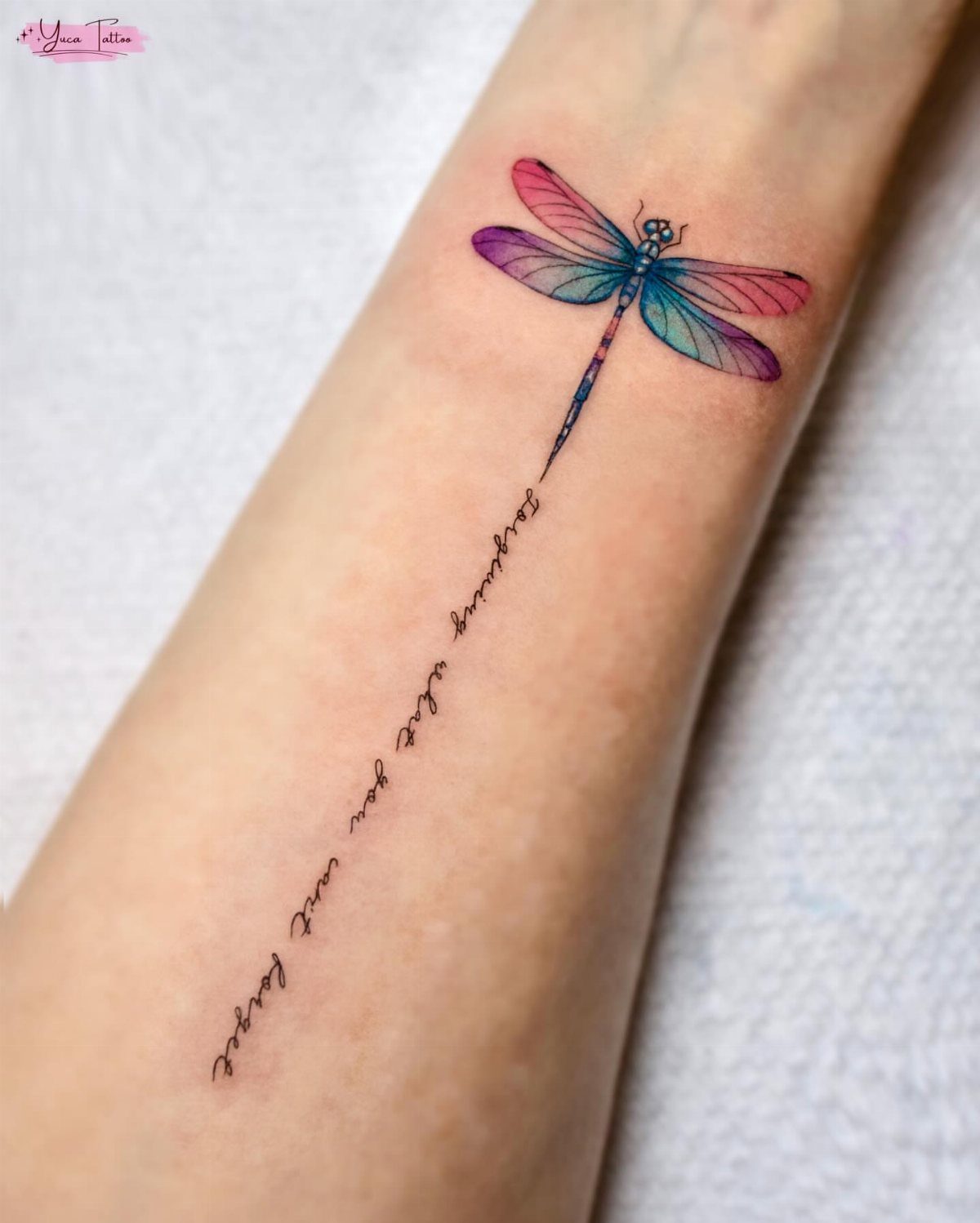
The colors need enough separation to read as distinct patches; too blended and the wings turn muddy. The text should follow the body’s natural line, here the forearm’s length, rather than fighting across bone or curve.
Someone adding a quote should keep it short; long phrases shrink to illegibility over time.
This approach trades the dragonfly’s usual delicacy for statement. It suits a first visible piece or a collector who wants one bold item rather than scattered small ones.
The color commitment means touch-ups every few years, especially on a sun-exposed forearm.
15. Dragonfly Resting on Leaf Tattoo
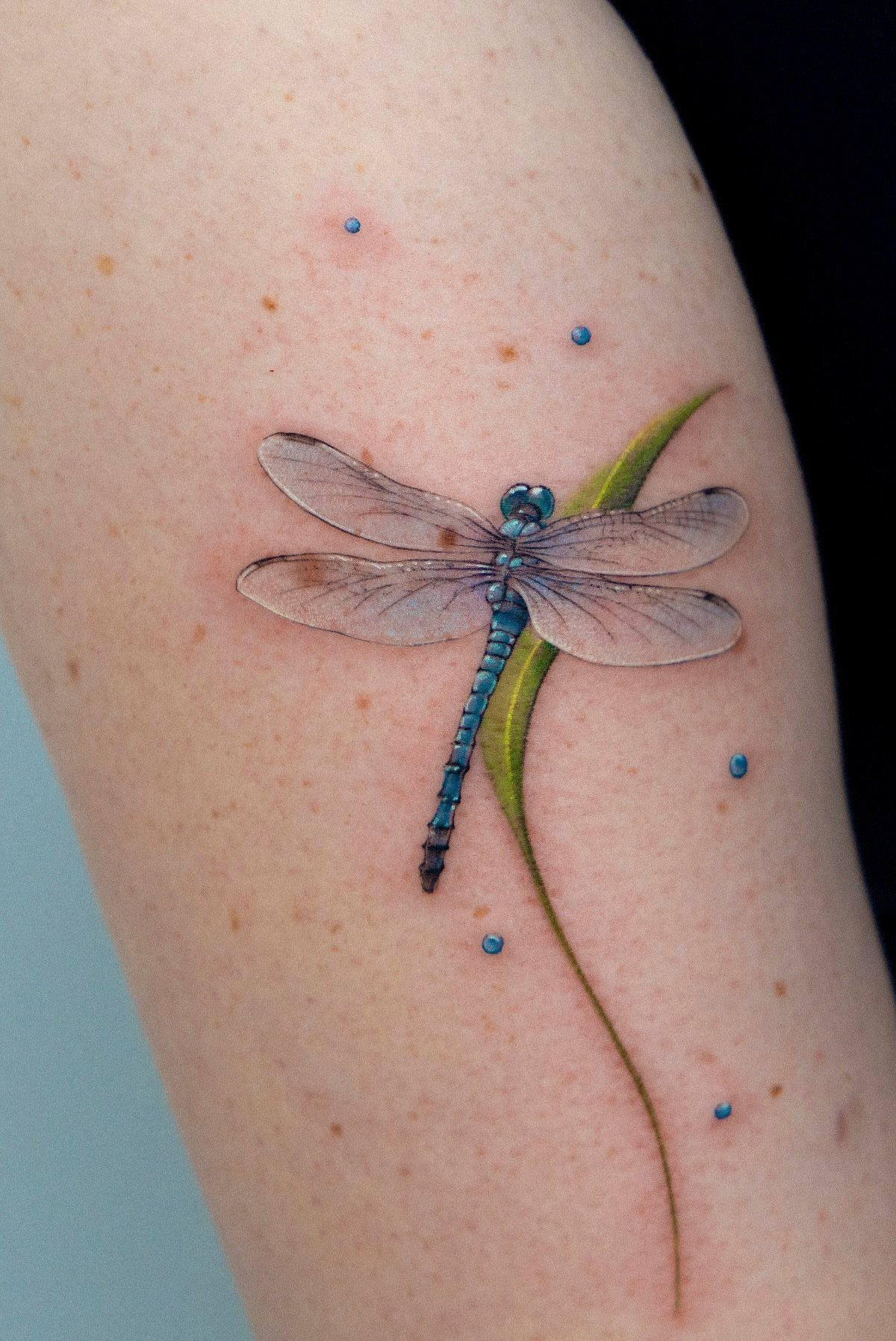
A dragonfly resting on a leaf reads as a moment caught mid-breath rather than a symbol in flight.
The water droplets scattered nearby turn skin into morning garden, which suits anyone who wants the tattoo to feel like a scene rather than an emblem.
The leaf curves with the body, so placement matters: the inside of a forearm, a calf, anywhere the natural line of muscle follows the stem.
Color holds up here because the blue body against green leaf gives the eye two places to land; a black-and-grey version would flatten the contrast that makes the droplets read as wet.
I’d ask the artist about the dots last. Too many and they clutter; too few and the leaf floats instead of rests.
The balance is what sells the pause.
16. Red Ink Neck Tattoo
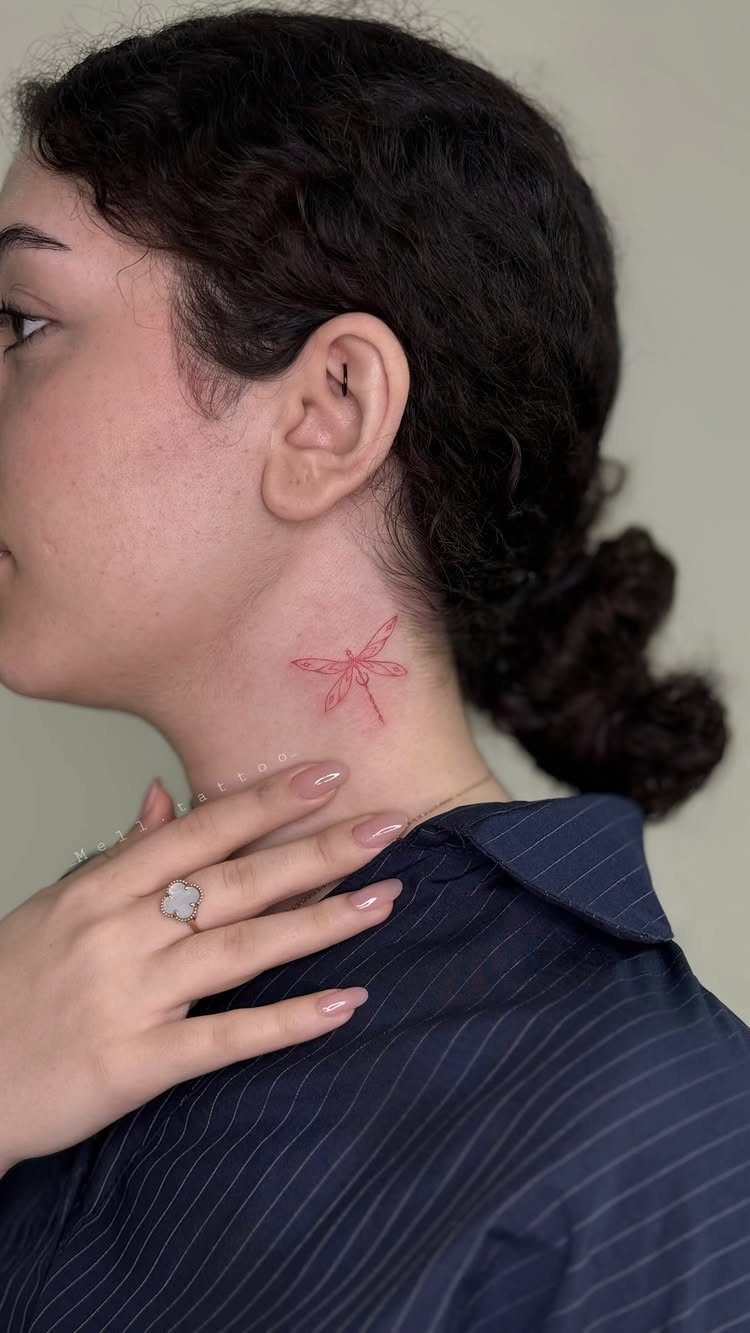
Red ink on the neck commits to visibility; there is no long-sleeve option for this placement. The color reads warmer than black, less institutional, more like a birthmark or a freckle pattern someone chose.
Neck skin turns over faster than most spots, so the line stays fine by necessity; bold weight would blur long before it settles in. The dragonfly stays small, simple, no wing veins that would muddy at scale.
I would check my own collarbone length: too high and it competes with the jaw, too low and it hides behind a shirt.
This one wins for someone who already has work elsewhere and wants a punctuation mark, not a paragraph. The trade is maintenance; red fades toward pink, and the neck sees sun almost daily.
17. Watercolor Cherry Blossom Dragonfly
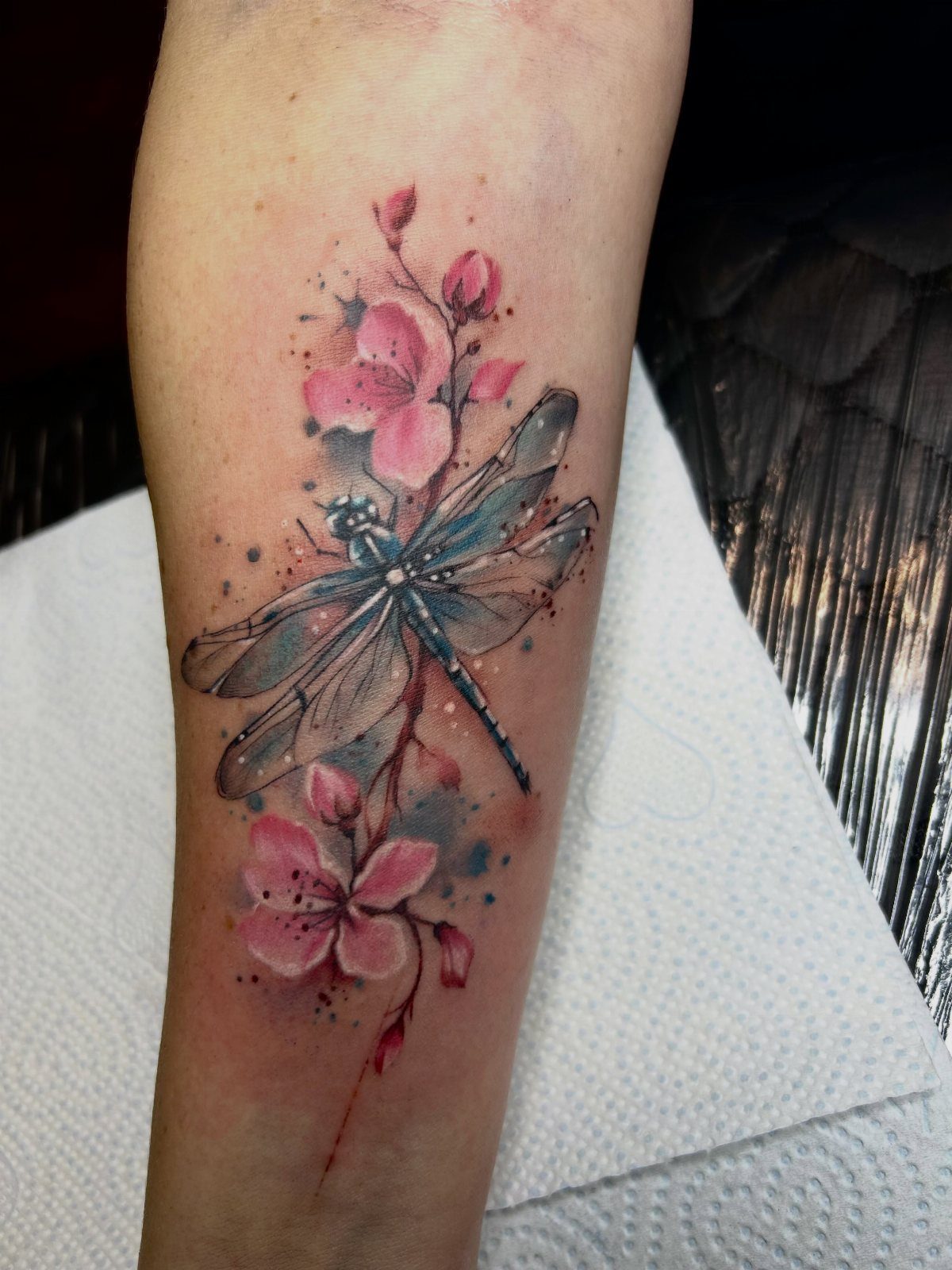
Watercolor backing turns a dragonfly into something closer to a painting that happens to live on skin. The cherry blossoms frame rather than compete; their soft pink keeps the blue body from reading cold.
The technique needs skin that takes color evenly, since washes show every patch and pull. I would plan for two sessions: linework first, color second, so the black has time to settle before the pigment floods around it.
The splatters look accidental but are placed; ask to see healed photos of the artist’s other watercolor pieces, since fresh splatter and settled splatter read as different tattoos.
This suits someone with existing color work who wants the collection to feel looser, more studio than flash. Watercolor sits lighter in the skin and asks for more visits over time.
18. Dragonfly Ankle Tattoo
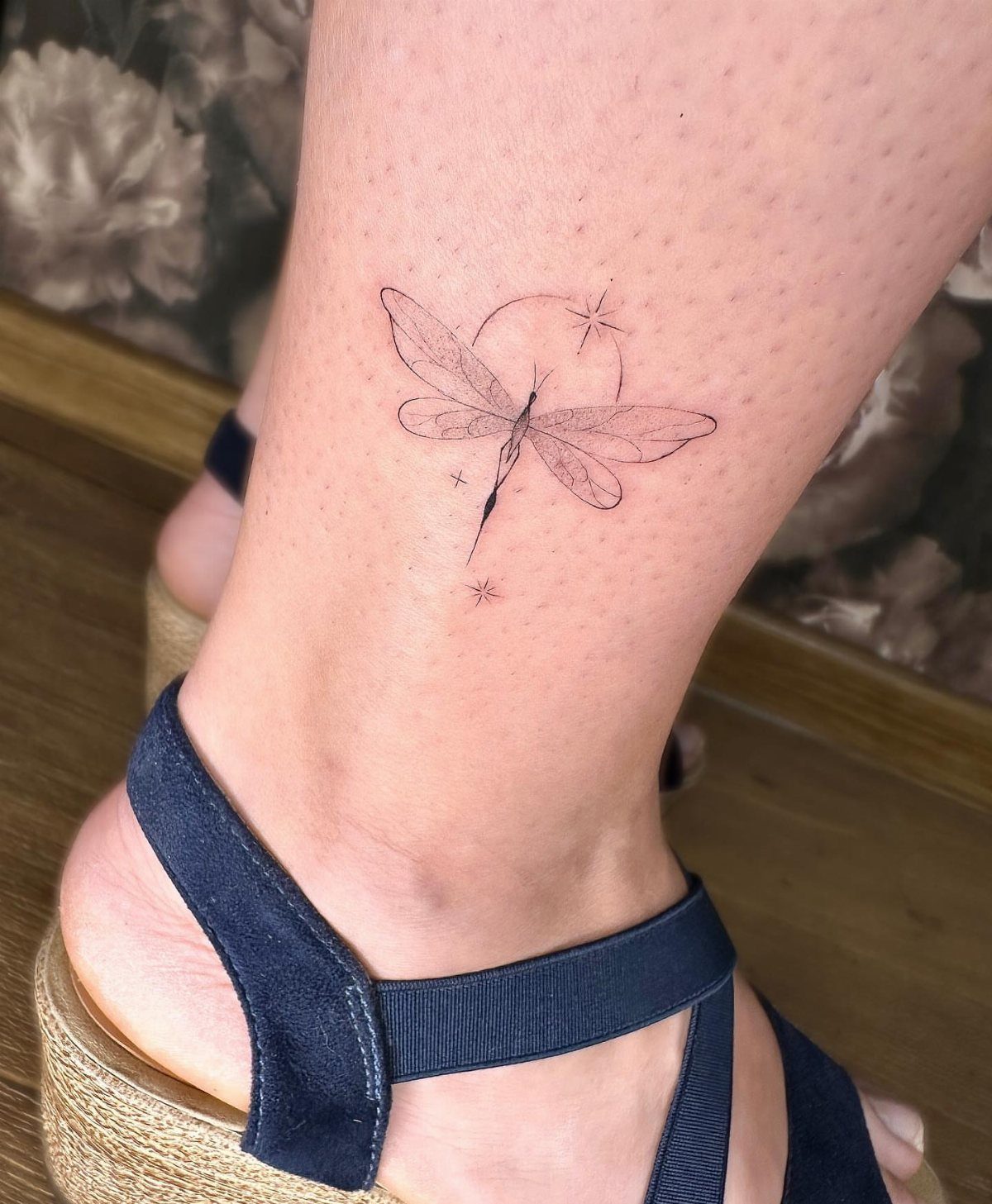
Ankle tattoos hide in boots and appear in sandals, which gives the wearer control most placements don’t. The circle and stars here turn a single insect into a small system; the dragonfly becomes a planet with satellites.
Fine line on ankle bone hurts more than muscle, and the skin moves with every step, so healing takes patience. I would avoid the Achilles tendon itself; the circle sits better on the outer ankle bone where it reads flat.
The stars are small enough that any one of them could blow out; a single-needle artist matters here.
This one fits someone whose work allows covered legs but who wants something private for themselves. The trade is that ankle tattoos often need a touch-up at the one-year mark; the friction of socks and shoes works against them.
19. Realistic 3D Shoulder Dragonfly
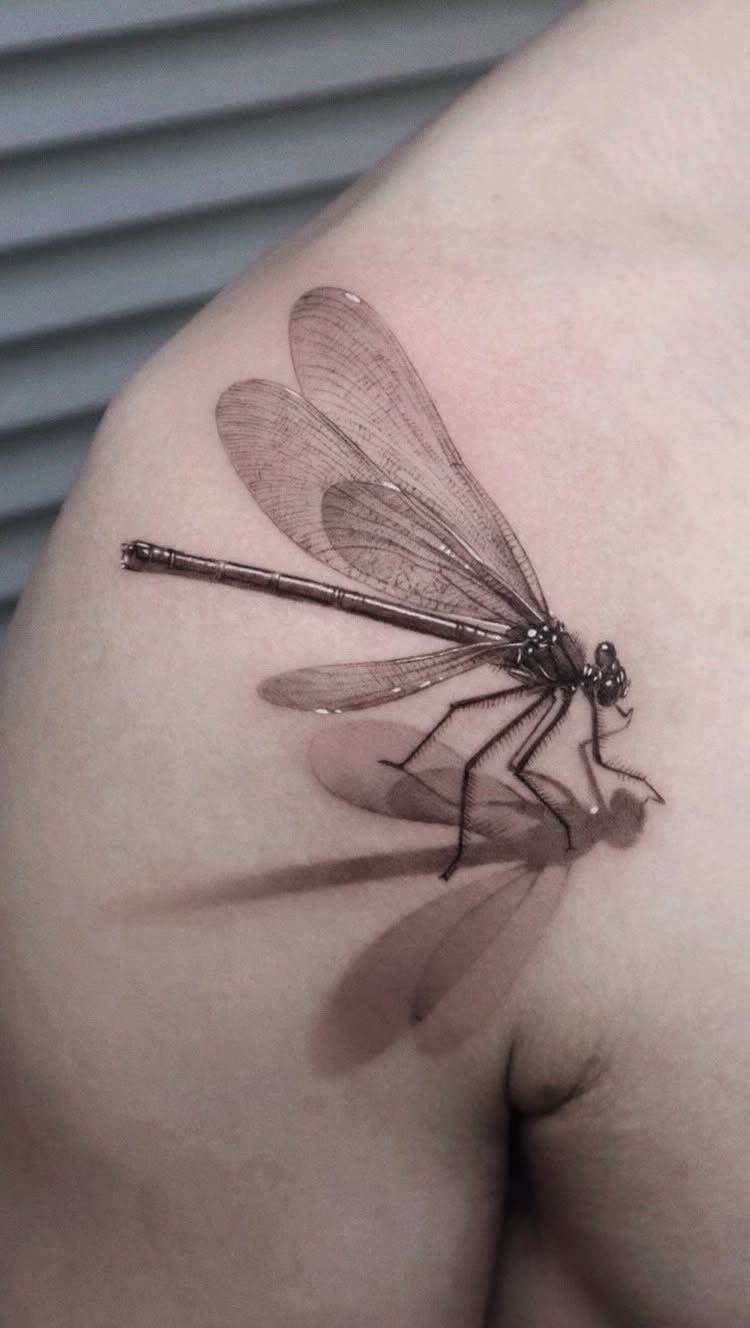
Shadow work tricks the eye into reading depth where there is only ink.
Black-and-grey realism demands a large enough canvas that the veins stay legible; the shoulder gives that space without the distortion of a joint that bends constantly.
I would budget for time rather than flash speed; a cast shadow only works if the light source is consistent across every element, and that takes planning. The artist needs to choose one angle and hold it.
This suits someone who wants their tattoo to stop conversation rather than start it. The shadow makes people look twice, which is the point.
The trade is size; shrink this and the shadow becomes a smudge.
20. Iridescent Wing Dragonfly Tattoo
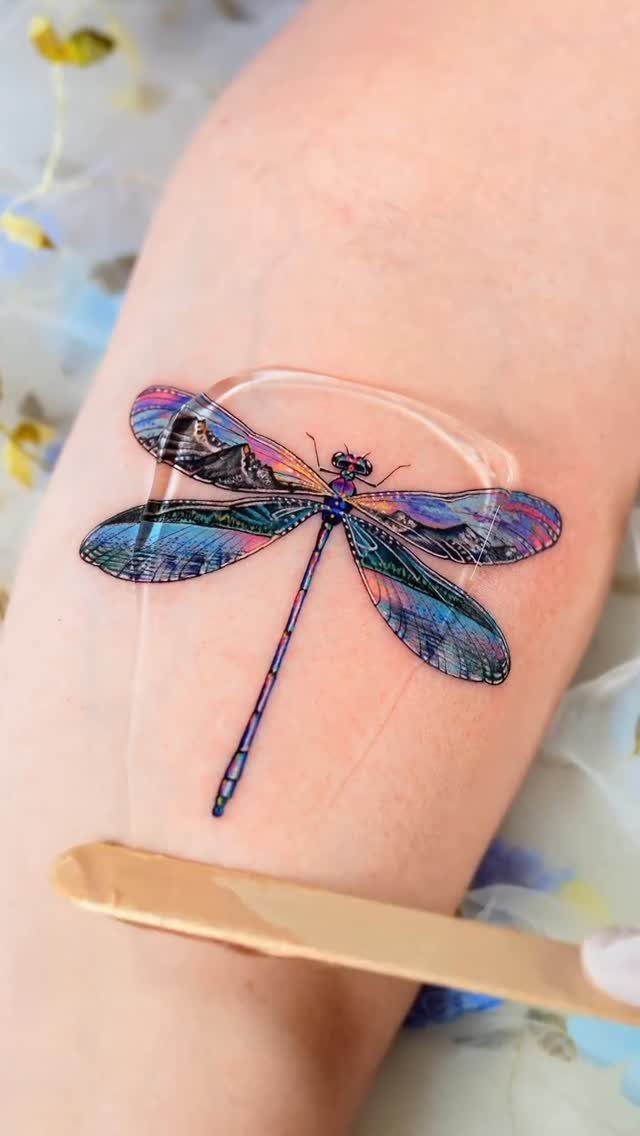
Iridescence on a dragonfly wing is not one color but several held in tension; the tattoo shifts as the arm moves, which is the closest ink comes to life.
The purple, blue, and pink here are laid in thin passes so the skin shows through and mixes them optically.
This technique asks for an artist who works in color layers, not blocks. Rushing the passes leads to mud where the hues should shimmer, so the chair time needs patience.
The fine black veins hold the chaos together, so their placement matters as much as the color itself.
This one wins for someone who collects color pieces and wants a showpiece. Iridescent ink has no actual shimmer; it relies on contrast and placement to fake the effect, and that fakery only holds under good light.
21. Blue and Gold Dragonfly
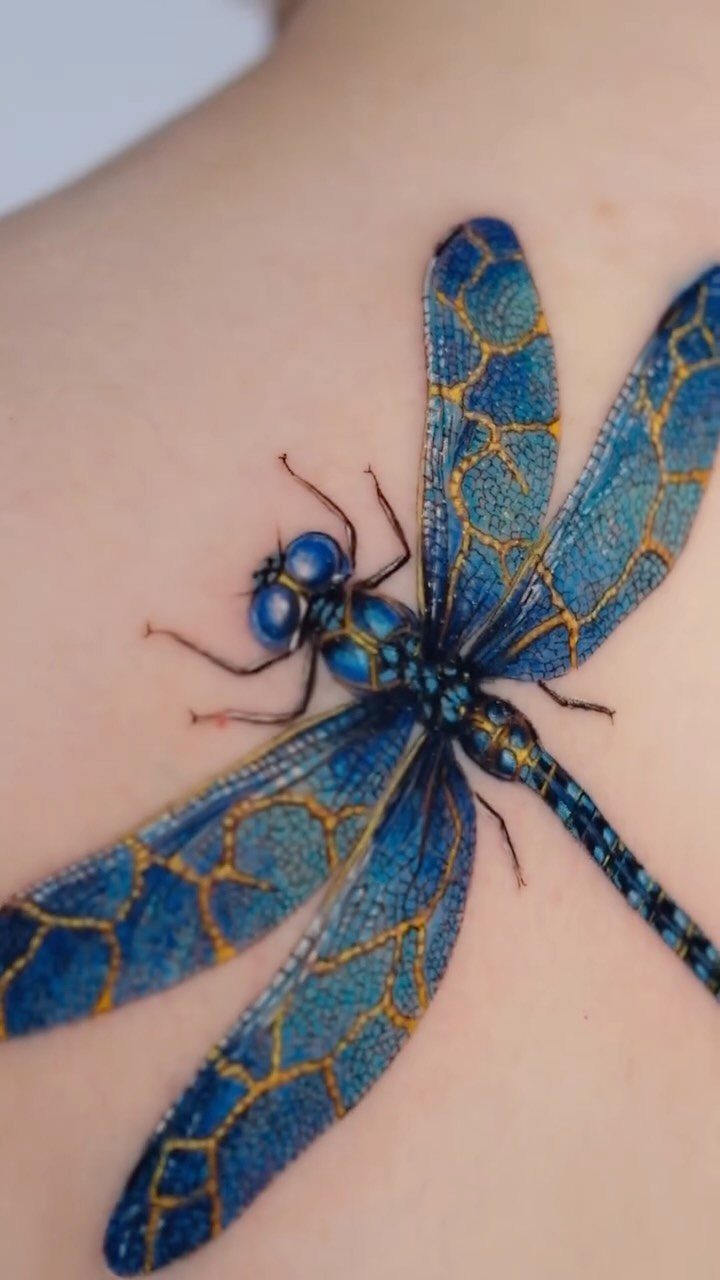
Deep blue wings laced with gold veining turn the dragonfly into something closer to jewelry than insect.
The pairing reads as luxury without flash, the kind of tattoo that holds up under office lighting and still looks deliberate at a beach.
Color saturation matters more here than in most pieces. The blue needs enough density to carry the metallic accents; a washed-out base makes the gold look like an afterthought.
I’d ask to see healed photos of similar palettes before committing, since bright blues can shift toward teal or gray depending on skin undertone.
This one suits someone who wants their tattoo noticed without it shouting. The trade is upkeep: metallic pigments fade faster than standard blacks, so plan for touch-ins every few years to keep the contrast alive.
22. Fine Line Forearm Dragonfly
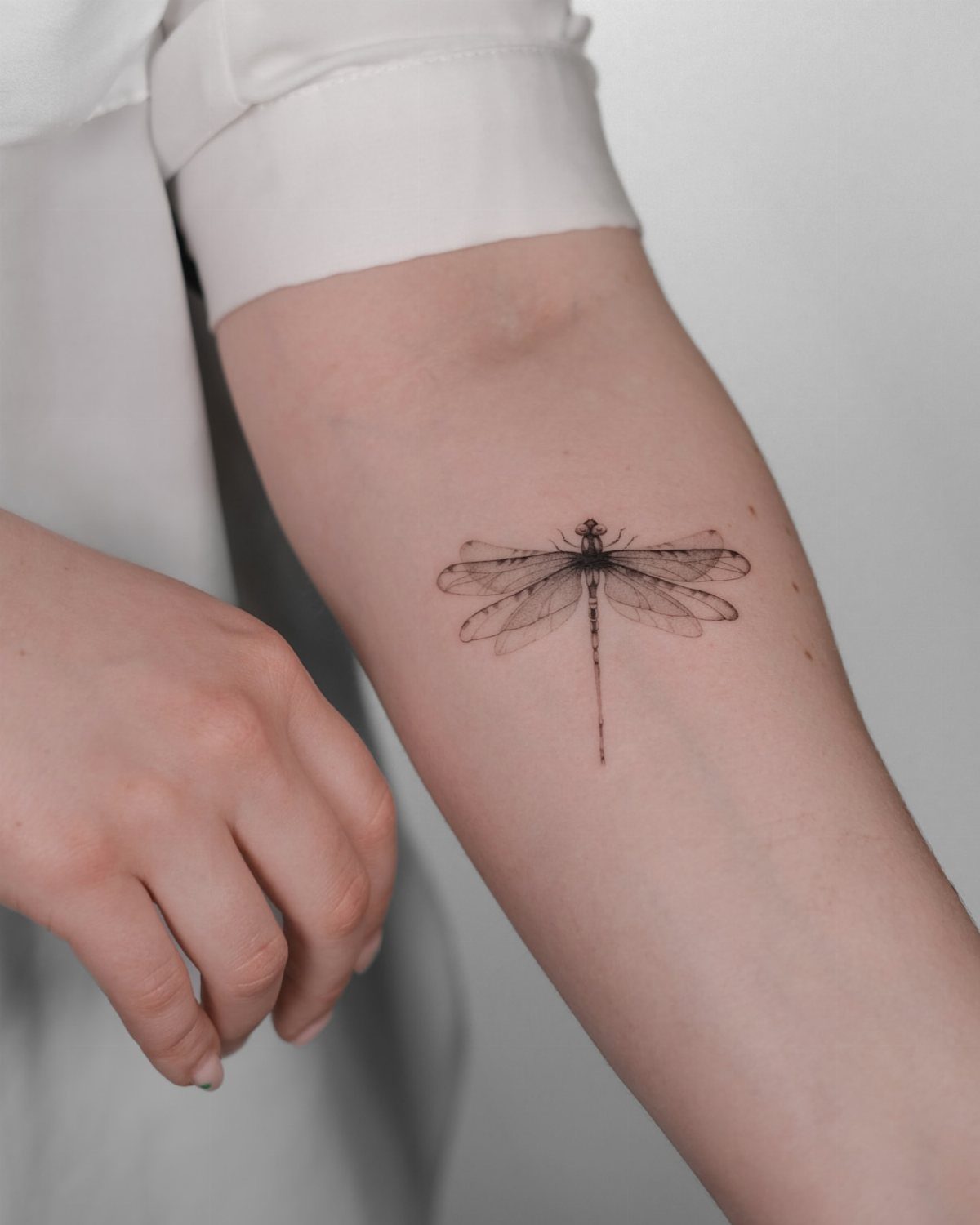
A single needle and steady hand leave the wings almost transparent, more suggestion than structure. The fine-line approach keeps the dragonfly light enough that it reads as movement even when the arm is still.
Placement along the inner forearm follows the bone line naturally. The segmenting in the wings gives the artist reference points to keep symmetry honest; without those breaks, thin lines wander over time.
I’d schedule this with someone whose portfolio shows healed fine-line work, not just fresh photos, since the style blurs faster than bolder work.
This suits a first tattoo or a collector’s gap-filler equally. The limit is size: too small and the linework collapses, too large and the delicacy reads as unfinished.
A small wingspan hits the balance for a forearm piece: large enough to show the wing veins, small enough to read as delicate.
Meaning of Dragonfly Tattoos
Dragonflies carry meaning that shifts depending on which culture shaped the symbol. In Japanese tradition, they stood for courage and victory; Samurai wore them on armor as emblems of resilience.
Native American tribes, particularly the Zuni, tied dragonflies to harvest and healing, with folklore telling of a dragonfly that saved a village from starvation.
Celtic reading connected the insect to magic and mystery, linking it to fairy stories rather than battlefield virtue.
The shared thread across most readings is transformation, drawn from the insect’s actual life cycle. A dragonfly lives most of its life as a water nymph before emerging in its final, winged form.
That long wait followed by sudden change makes the symbol fit for anyone marking a late arrival into a new phase.
A tattoo can lean into whichever cultural strand matches your own story. Japanese-influenced design tends toward bold linework; Celtic-leaning pieces favor more ornamental, delicate treatment.
Popular Placements for Tattoos
Ankle placement stays hidden under most pants and shoes, which suits a design you want for yourself more than for display.
The bone sits close to the surface there, so the needle hits harder than on fleshy spots; budget for a shorter session or split the work across two appointments.
A back placement gives room for scale that wrist or shoulder designs cannot match.
A full back piece lets the wing span stretch to actual insect proportions, while a shoulder blade placement keeps the design medium and frames it against flat bone.
For any placement, consider your daily wardrobe. A collarbone tattoo shows in any neckline below the clavicle; a thigh piece stays under work clothes unless you choose otherwise.
Match visibility to whether the meaning is private or public.
Styles of Dragonfly Tattoos
Flatten any of those and the realism collapses into cartoon.
Abstract and colorful treatments trade accuracy for impact. Stained-glass paneling on wings, watercolor bleeds, or geometric framing each need different artist skills.
Geometric work requires steady line control; watercolor needs an artist who knows how pigments spread in skin, not just on paper.
A simple straight-line body keeps the design quiet and uncluttered.
Cultural Significance
Historical dragonfly use in Japan went beyond decoration to active emblem. Samurai chose the insect for armor and weapons, treating it as a practical symbol of courage rather than a decorative one.
That martial association has softened in modern tattoo culture, but the design still carries a backbone of strength if you choose bolder linework and placement.
European folklore took a different turn, linking dragonflies to dragons and magical qualities through name resemblance rather than observed behavior.
Celtic art once tied dragonflies to fairy imagery and mystery, though that thread shows up more in illustration now than in tattoo work; a client wanting a magical tone might still reference it, but most artists today do not treat it as a living tradition.
The Native American harvest and healing associations, particularly Zuni, offer an alternative for someone wanting the symbol to carry protective or restorative weight.
Pairing the dragonfly with water elements, as some tribal stories do, can signal that specific reading without needing text to explain it.
Frequently Asked Questions
What do dragonfly tattoos signify?
The meaning starts with the insect’s own biology: a long stretch in still water, then a sudden break into the air.
Some traditions add luck or healing to that core meaning; a Zuni story credits the dragonfly with saving a village from starvation, and certain Native American tribes associated it with medicinal properties.
Where to put a dragonfly tattoo?
A small dragonfly sits well on the wrist or ankle; the shoulder and back give more room for detail if you want the wings spread wide.
Wrist and ankle keep the image small and personal but sit on high-friction skin that blurs fine lines faster. Shoulder and collarbone let the design follow bone structure as a natural frame, though sun exposure means color fades quicker there.
Thigh or upper arm hides easily under work clothes and holds detail longer because the skin stretches less.