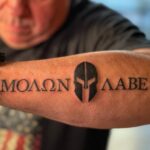
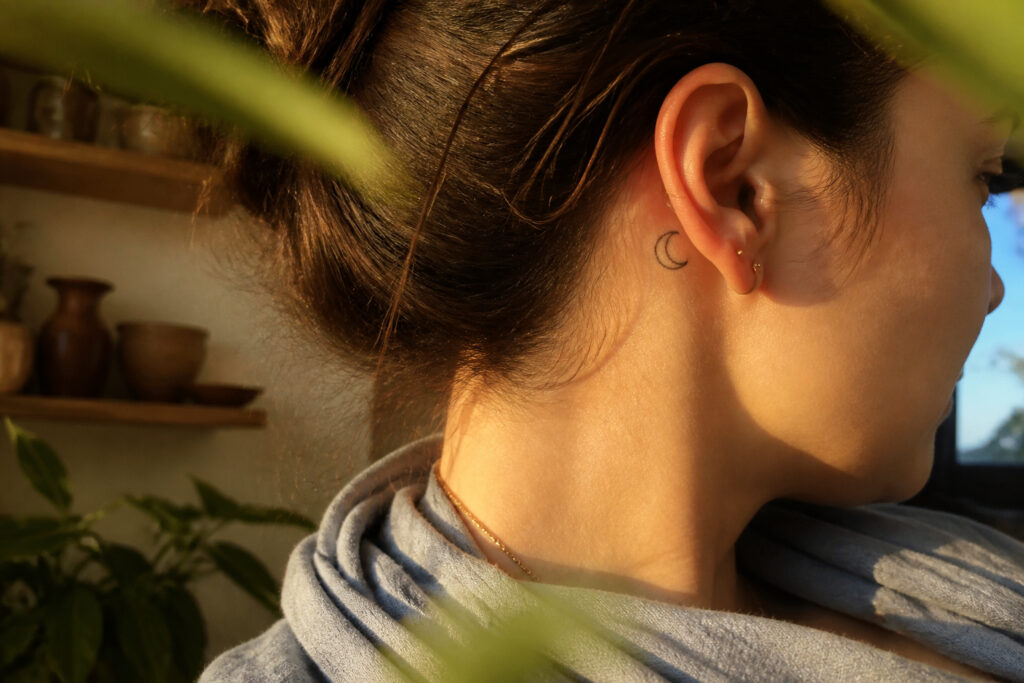
Behind the ear tattoos range from a single star to a full scorpion, but the deciding factor is how much you need to control who sees it.
The placement only works if you accept the catch: thin skin over bone means higher sensitivity, and any detail too fine will blur within a year.
Rihanna’s Pisces piece curves with the ear’s natural shape rather than fighting it, which is why the placement reads as intentional rather than squeezed in.
1. Flowers
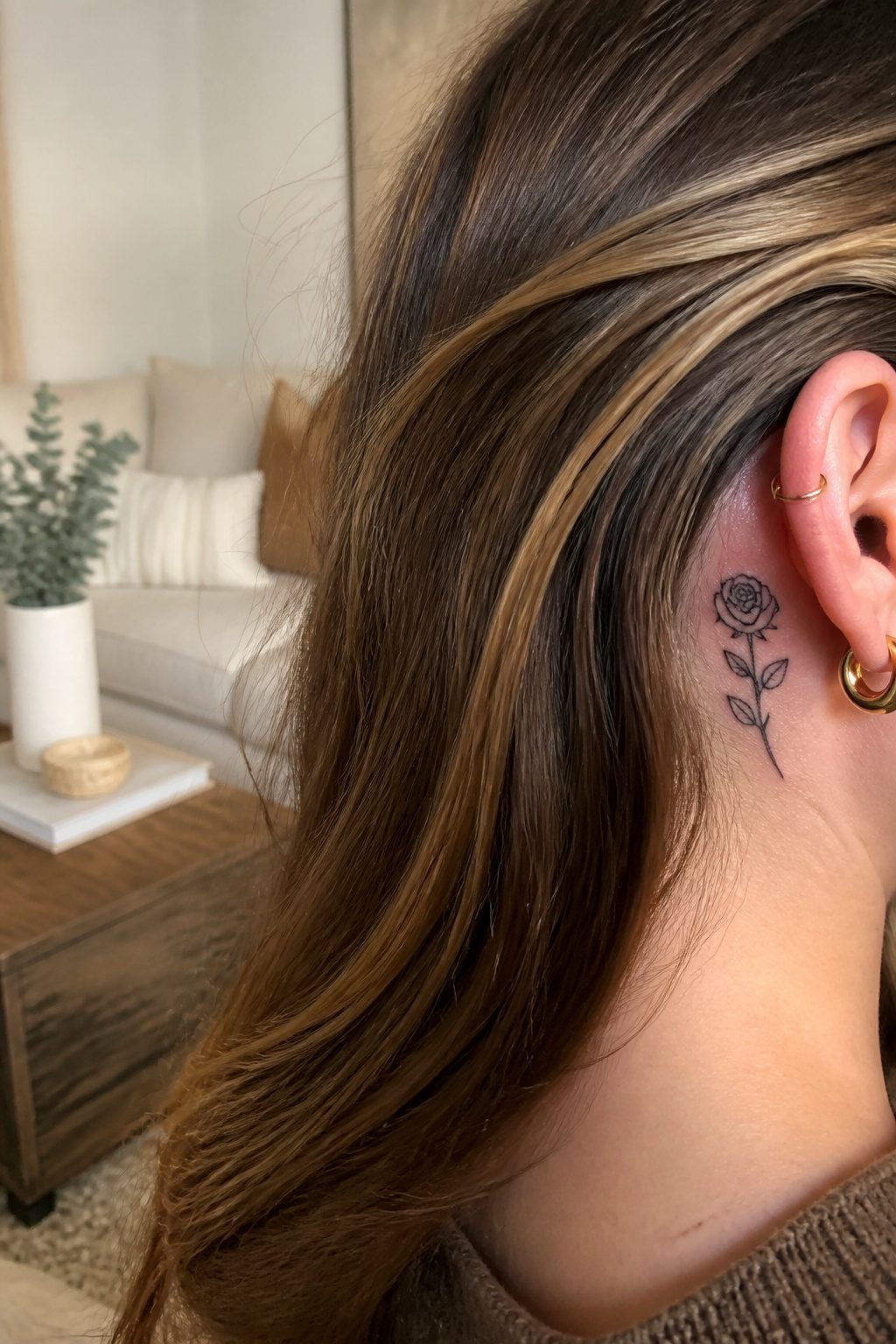
A single rose behind the ear reads differently depending on how the artist handles it. Fine linework keeps the petals readable at a small scale, which matters in a spot where too much detail can blur together.
Color saturation changes the mood entirely: a black-and-grey stem feels graphic and quiet, while a wash of pink or red turns the same shape into something softer and more visible from a distance.
Lavender and wildflower clusters work here for the same reason roses do. Multiple small blooms fit the narrow curve behind the ear better than one oversized shape, and spacing them along the hairline follows the natural architecture of the area.
Zoë Kravitz and Ariana Grande both wear delicate pieces in this placement, which helped push the style from niche to mainstream over the last few years.
What I notice in their examples, and in most of the florals that age well, is restraint.
The hair hides it when you want coverage and reveals it when you pin up, which is the practical advantage this placement sells on.
A neck piece that climbs upward can extend the design if you want more than a standalone bloom, though that shifts it from subtle to statement.
2. Zodiac Signs

A zodiac glyph fits the behind-the-ear space almost by accident. The symbols are built from simple lines and dots, so they stay legible at the size that spot demands.
Rihanna’s Pisces tattoo curves with the ear’s shape rather than fighting it, which makes the placement feel intentional instead of squeezed in.
Constellation styles work the same way. The connecting lines between stars map naturally onto that narrow strip of skin, and the negative space keeps the design from crowding.
An astrology believer gets a symbol that reads as personal without needing to explain it; everyone else sees a small pattern that happens to sit well.
The area behind the ear is small enough that detail gets lost fast. A zodiac symbol avoids that problem because the shape is already familiar.
You recognize the glyph or the constellation even at a glance, which means the tattoo holds up when hair covers half of it or when someone sees it from across the room.
Minimalist line versions are the safer bet for longevity. The single-weight lines age cleaner in that location than filled shapes, which can blur where the skin is thin and close to bone.
3. Butterflies

A single butterfly wing, traced in fine line work, follows the natural curve behind the ear like it landed there.
The shape of the ear itself invites this placement; the wing’s arc mirrors the helix so closely that the tattoo reads as part of the anatomy rather than sitting on top of it.
For a fuller silhouette, a complete butterfly fits the same space with the body tucked into the crease and the wings spreading upward toward the temple. Either way, the symbolism lands cleanly.
The caterpillar-to-butterfly story is one of visible, irreversible change, and people choose it after divorce, recovery, career pivots, or any moment when the person walking out no longer matches the one who walked in.
What I like about this spot for that meaning is the privacy of it. The tattoo hides under hair for job interviews or family dinners and shows only when you tie it back or turn your head.
That controlled reveal matches the symbolism; transformation is personal before it is public. A single wing typically needs less than an inch of vertical space, while a full butterfly with both wings and body asks for closer to two.
The smaller option heals faster and blurs less over time, though the full form gives you more detail in the antennae and wing patterns if your artist has the steady hand for it.
4. Moon
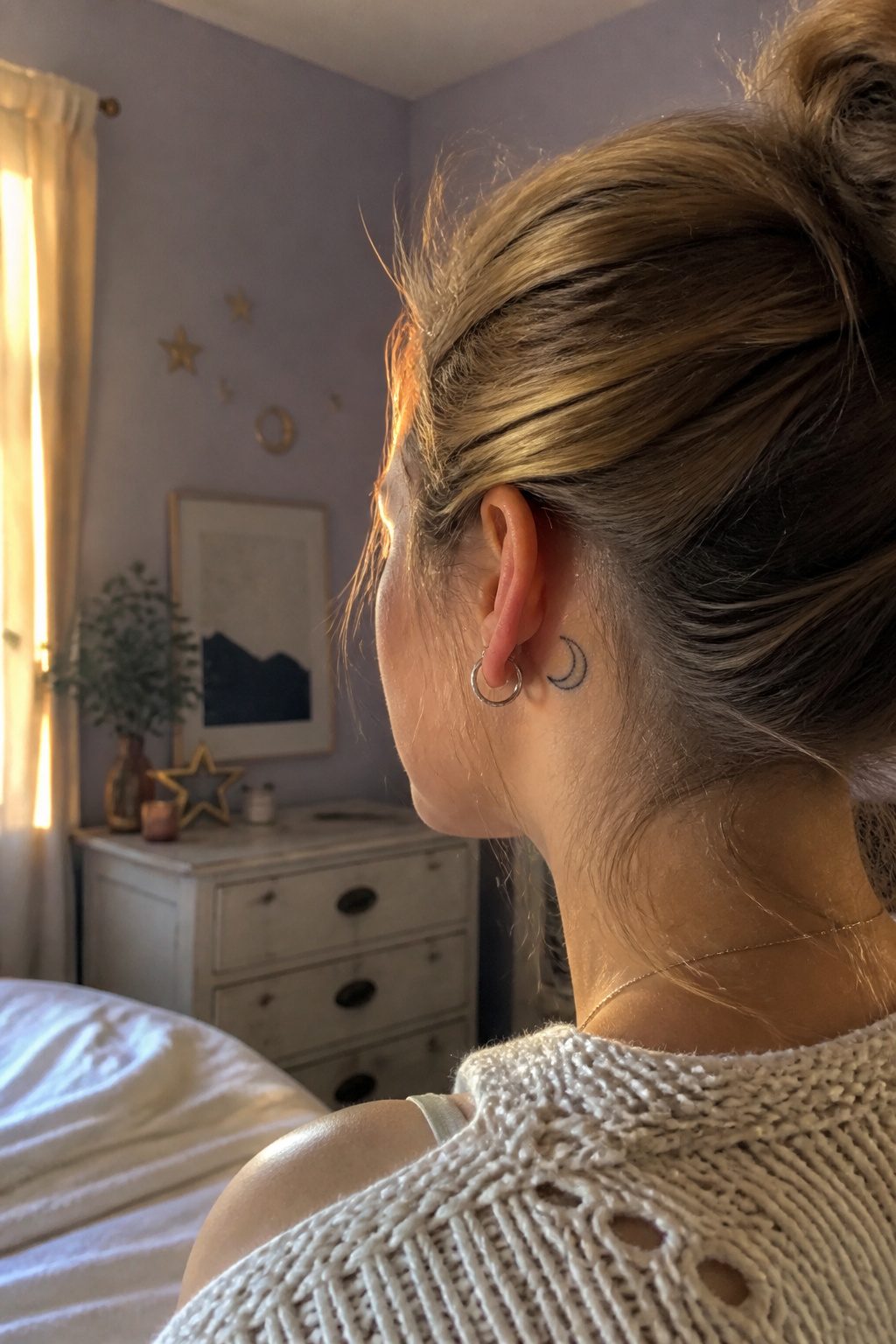
A crescent moon tucked behind the ear follows the curve of the skull so naturally that the placement almost designs itself.
The thin horn of a waxing or waning moon traces the same arc as the ear’s outer ridge, leaving no awkward gap or forced angle.
Single moons read as quiet and personal. A sequence of phases, from slim crescent through full and back again, turns that same curve into a timeline you read upward.
The space behind the ear is narrow, so most phase sequences stay small, three to five stages at most, spaced close enough to read as one flowing strip rather than separate stamps.
Full moons work here too, though the circle fights the area’s natural geometry more than a crescent does. What saves it is scale: a small enough disk sits like an earring you never remove.
The appeal is partly concealment. Hair worn down hides the ink entirely; swept up, it becomes a deliberate reveal.
That control over who sees it and when keeps this spot popular even as other placements come and go.
5. Scorpion
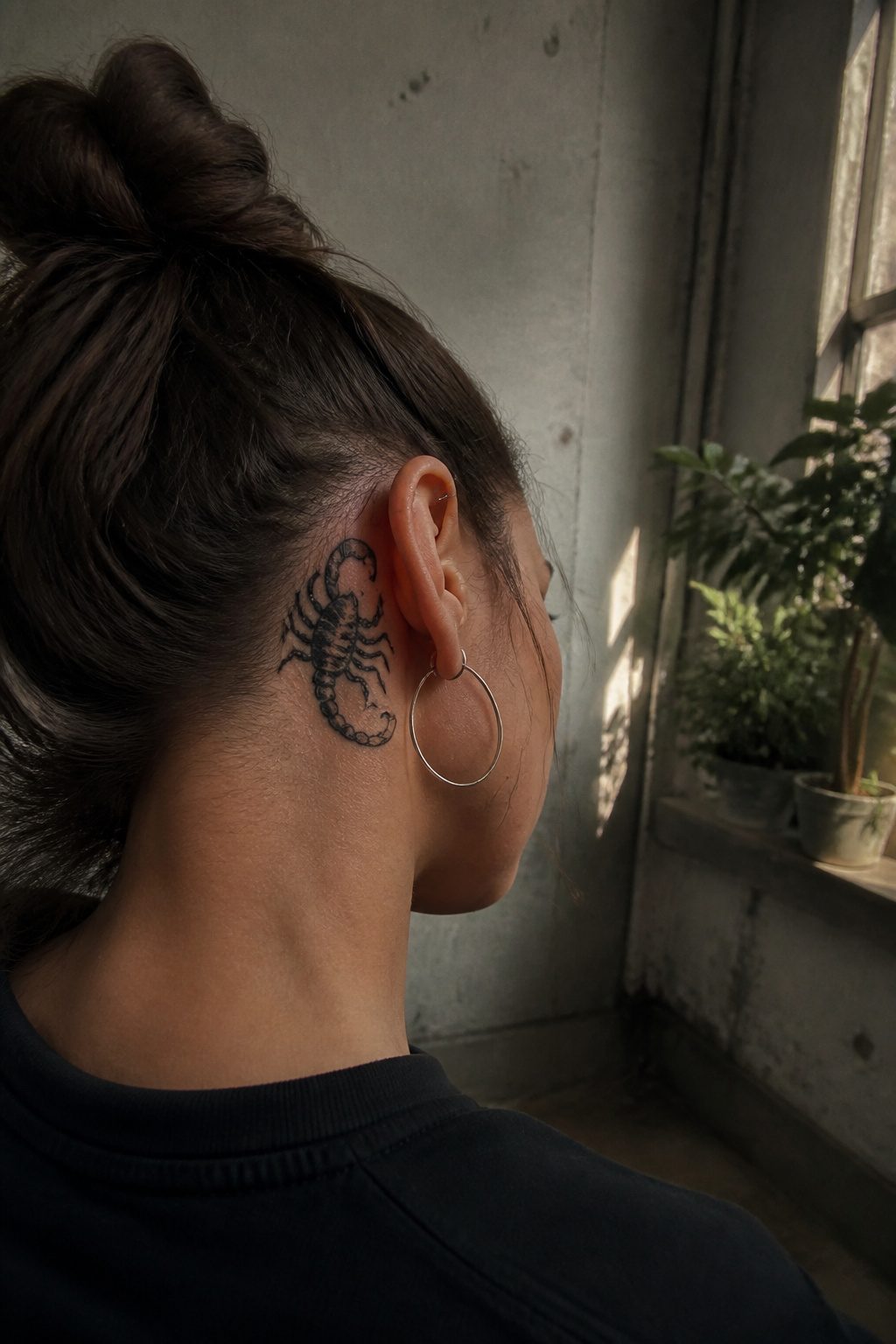
A scorpion behind the ear carries the weight of its own reputation. The creature stands for intensity and protection, a warning and a shield at once.
The tail’s curve can follow the ear’s natural shape, wrapping the shell and stinger around that delicate ridge so the design feels built for the spot rather than forced onto it. That placement matters.
Putting something fierce in such a fragile, hidden place creates a tension that reads as deliberate boldness. The scorpion also marks the Scorpio zodiac sign, which draws people born under it toward dangerous-looking imagery that suits their own intensity.
What reads as threatening from across the room resolves into fine detail up close, and the contrast between the subject and the placement is the whole point.
6. Snakes
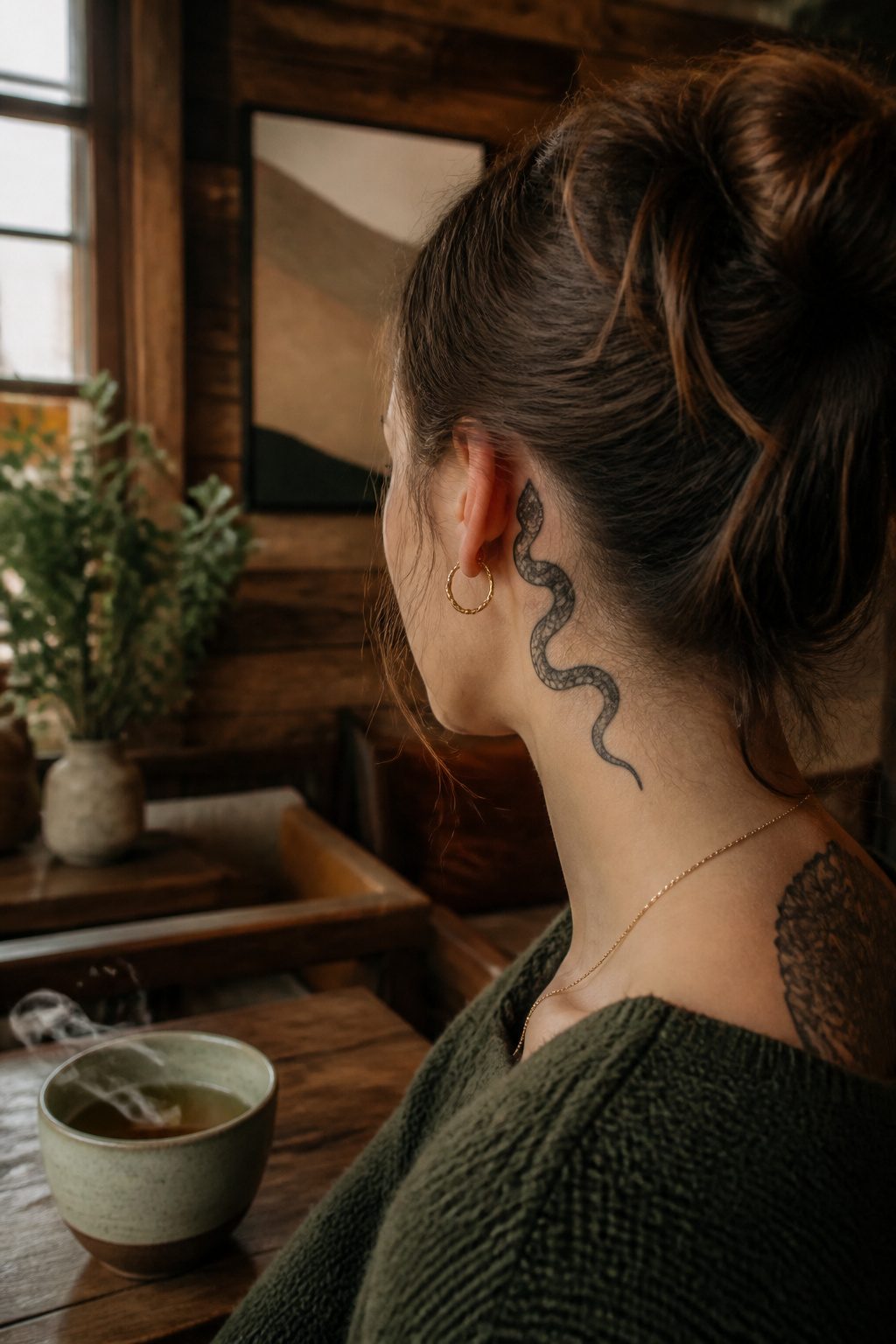
A snake winding behind the ear carries meanings that shift depending on whose symbols you trust. In some readings, the serpent speaks to rebirth, the shedding of skin made visible.
In Japanese tradition, the same figure becomes a talisman, worn against bad luck and illness.
The curve of the body matters here more than in most placements: the spine of the snake follows the ear’s natural crescent, the head settling near the lobe with fangs visible or hidden depending on how far the hair is swept back.
The head at the lobe turns the tattoo into something seen in profile, a flash of danger when the angle is right.
I have watched this design go wrong when the scale detail crowds too small for the space, bleeding together inside a year. Keep the line weight single and the body in motion, not coiled tight.
7. Script
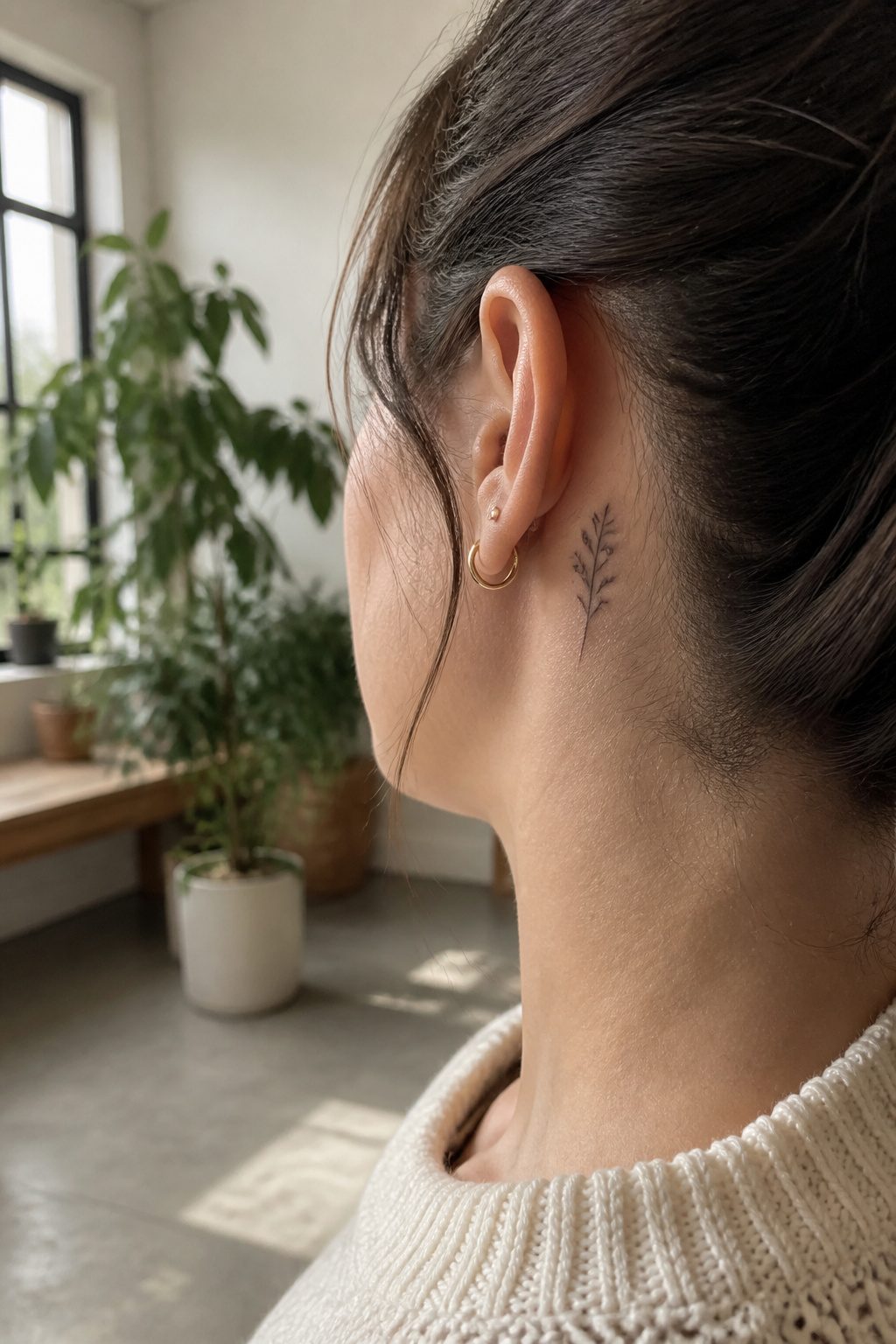
Script behind the ear carries a built-in tension: the space begs for something personal, but the curve fights every straight line you feed it.
Names, short quotes, single words, they all work here, yet the same five-letter name can look crisp on one person’s anatomy and collapse into a blur on the next.
The skin behind the ear is thin, mobile, and wraps around bone. A line of text that reads perfectly flat on paper will bend, shorten, and sometimes stack into itself when transferred to that surface.
Keep the character count low if you want it readable from conversational distance. Hawkes, the artist at Top Boy Tattoo, notes that behind the ear pieces suit being quite small, since it is such a small area to work on.
Too much detail gets lost at that scale, and the specialization of the artist matters more than usual. Check their portfolio for blackwork or fine-line script specifically, not just general skill.
There is not a correct size, and some pieces extend up from the neck or down from the head, but the tighter the script, the more that curve becomes your enemy.
A two-word phrase with tall ascenders and deep descenders will fight the anatomy less than a blocky all-caps line that has nowhere to bend.
The fun part, if you want to call it that, is the openness of content. The tattoo can say anything: a name, a joke, a fragment of something you do not need to explain.
What reads as meaningful to you may scan as generic to a stranger, which is exactly the point of the placement. Hair down, it hides.
Hair up, it shows. The script is for you and whoever you turn to face.
8. Stars and Sparkles
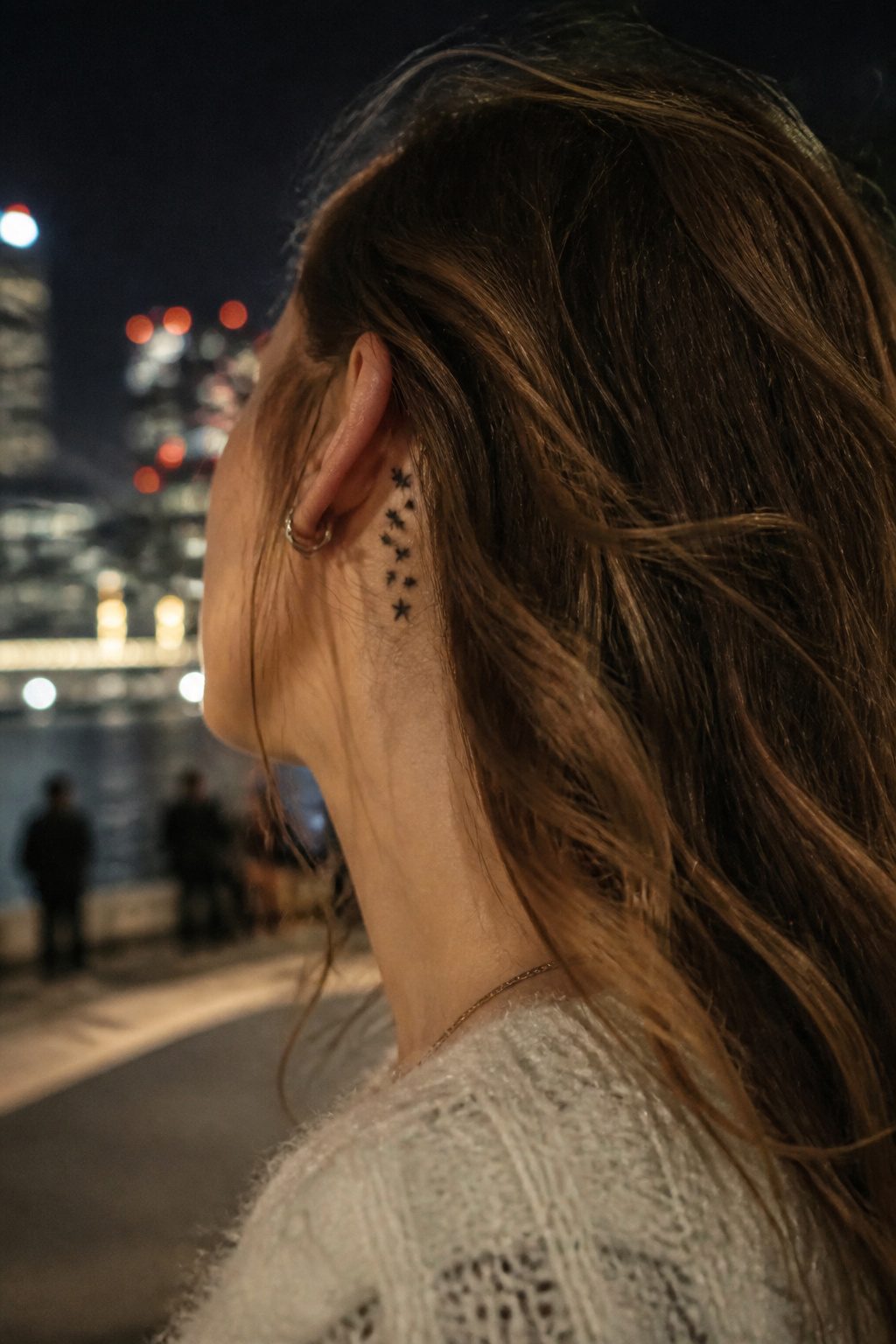
A single star sits clean and reads instantly from across the room, which matters when the canvas is barely an inch wide. Cluster three or four together and the shape fills out without crowding the fold where ear meets skull.
Shooting stars work if the tail trails upward toward the temple or down onto the upper neck, using that slight extension to suggest motion the static placement cannot.
Constellations demand more planning than most behind the ear tattoos. The connecting lines can blur over time in such thin skin, so an artist who specializes in fine line work is worth seeking out.
Too much detail will muddle at this scale, and the area offers no room for a viewer to step back and parse complexity. What succeeds is restraint: Orion’s belt as three dots, the Big Dipper’s outline with minimal linking strokes.
The sparkle motif carries the same advantage. A few small points, maybe with one slightly larger, read as light rather than as a literal object.
They tuck into the hairline and catch when the hair is up, hide cleanly when it is down.
That visibility toggle is the practical appeal of this placement, and star or sparkle designs lean into it rather than fighting the space.
9. Initials
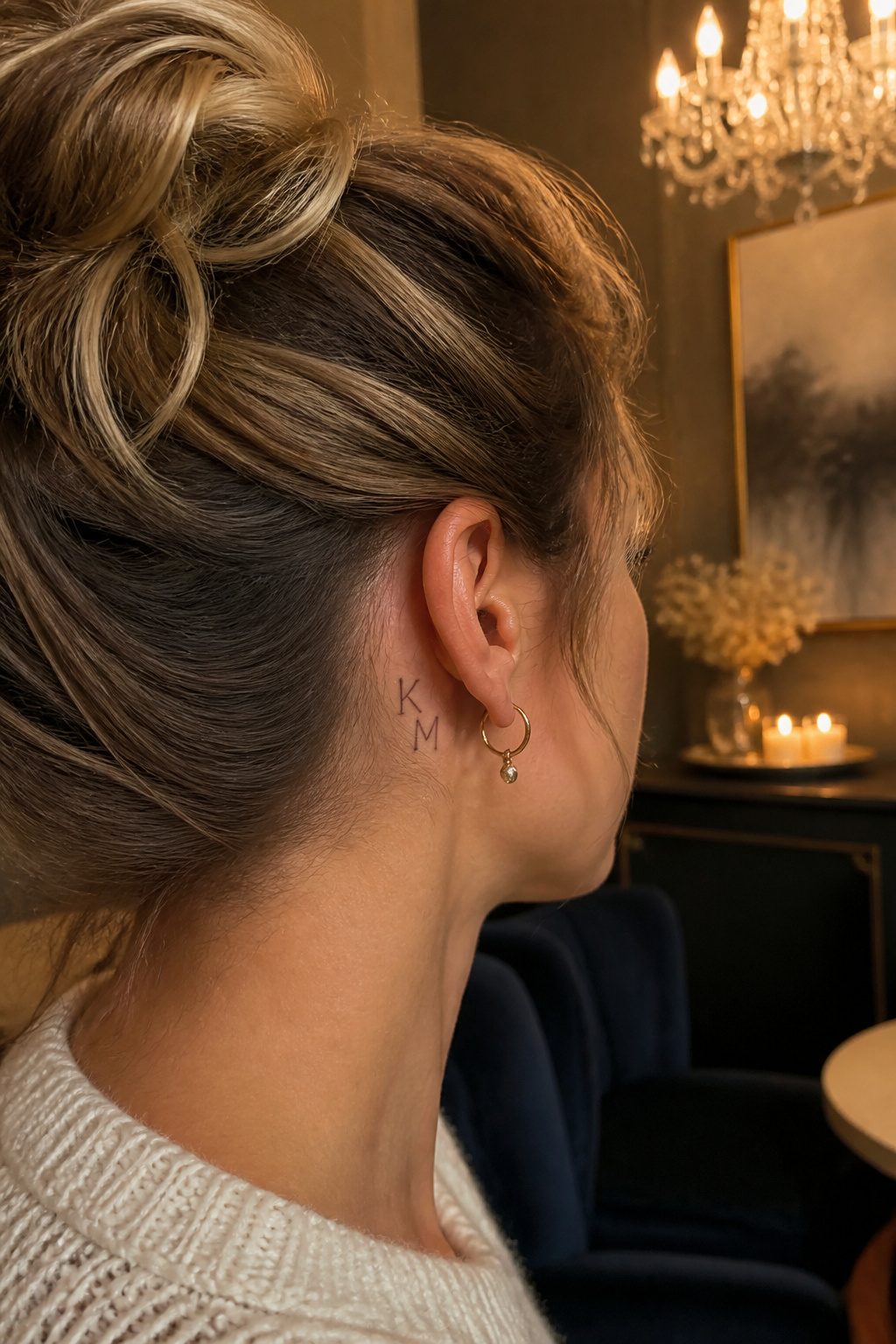
Single initials behind the ear work because the spot is already private, and a letter you do not explain keeps that feeling.
Rita Ora wears one cursive initial there, simple enough that it reads as a signature rather than a label. The same approach suits a partner’s letter, a child’s first initial, or one memorial character.
A clean serif or understated script keeps tiny ink readable as it settles, where overly thin lines or dense ornament can blur together by year three. Paired initials, one behind each ear, turn the placement into a quiet balance.
You feel them more than you display them, and that is the point.
10. Sun and Celestial Pairings
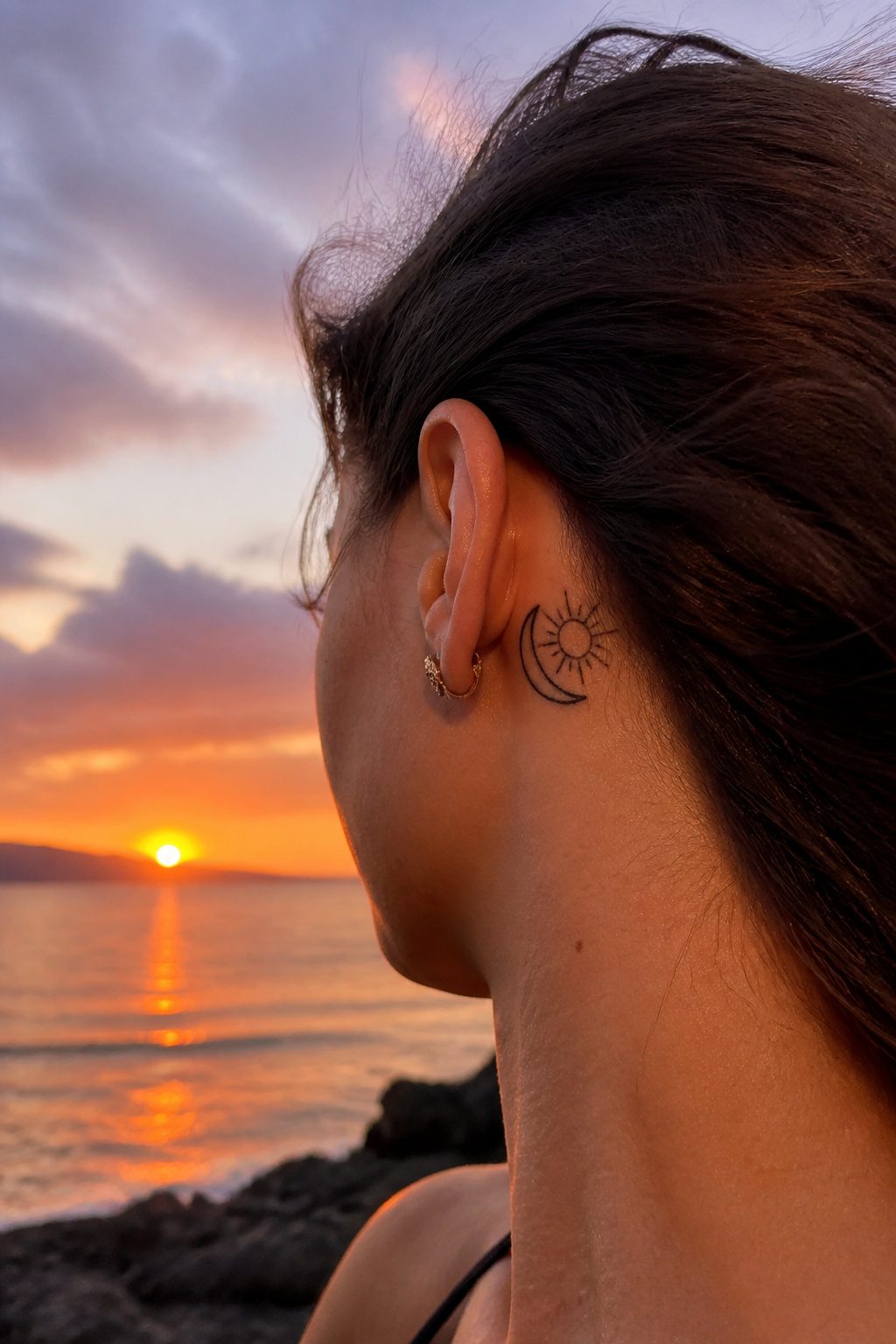
A circular sun sits naturally in the hollow behind the ear, its curve tracing the bone without fighting the space.
The shape reads instantly even at the small scale this spot demands; too much detail and the lines blur together, so the best sun pieces keep the rays simple or drop them entirely for a clean disk.
Pairing sun and moon imagery opens two ways to play it. Some split them across both ears, which gives a deliberate, balanced look when the hair is up.
Others stack sun over moon on the same side, layering the two phases vertically so they move with the head’s turn rather than sitting static.
The second reads as one composed piece; the first reads as a set, and both work depending on whether you want the tattoo to feel like jewelry or like a single statement.
Fine line work suits these designs especially well.
The skin behind the ear shifts with jaw movement and heals unevenly if the artist pushes too much ink, so a sun-moon pairing in thin black lines tends to hold its shape better than heavy black fill.
A crescent moon beside a simplified sun, both under two inches, is the combination I see carried longest without a touch-up.
11. Abstract Symbols

A question mark tucked behind the ear carries its meaning in the negative space, not in any image the passerby can name. That ambiguity is the whole point.
The shape signals curiosity, a refusal to accept what is given without asking, and it does so without pinning the wearer to one story.
Geometric forms work the same way. A thin triangle, an incomplete circle, a line that breaks before it closes: these read as private notation rather than public symbol.
The skin behind the ear is narrow, so the design must be small and the linework clean. A busy pattern will blur; a single shape holds its edge.
What convinced me, looking through portfolios, was how often people returned for touch-ups on literal imagery (the flower that no longer fit their life, the date that aged badly) while abstract marks stayed.
The meaning shifts with the person, which is exactly what a non-literal design promises. If you want a tattoo that asks rather than answers, this placement rewards restraint.
12. Bees and Whales
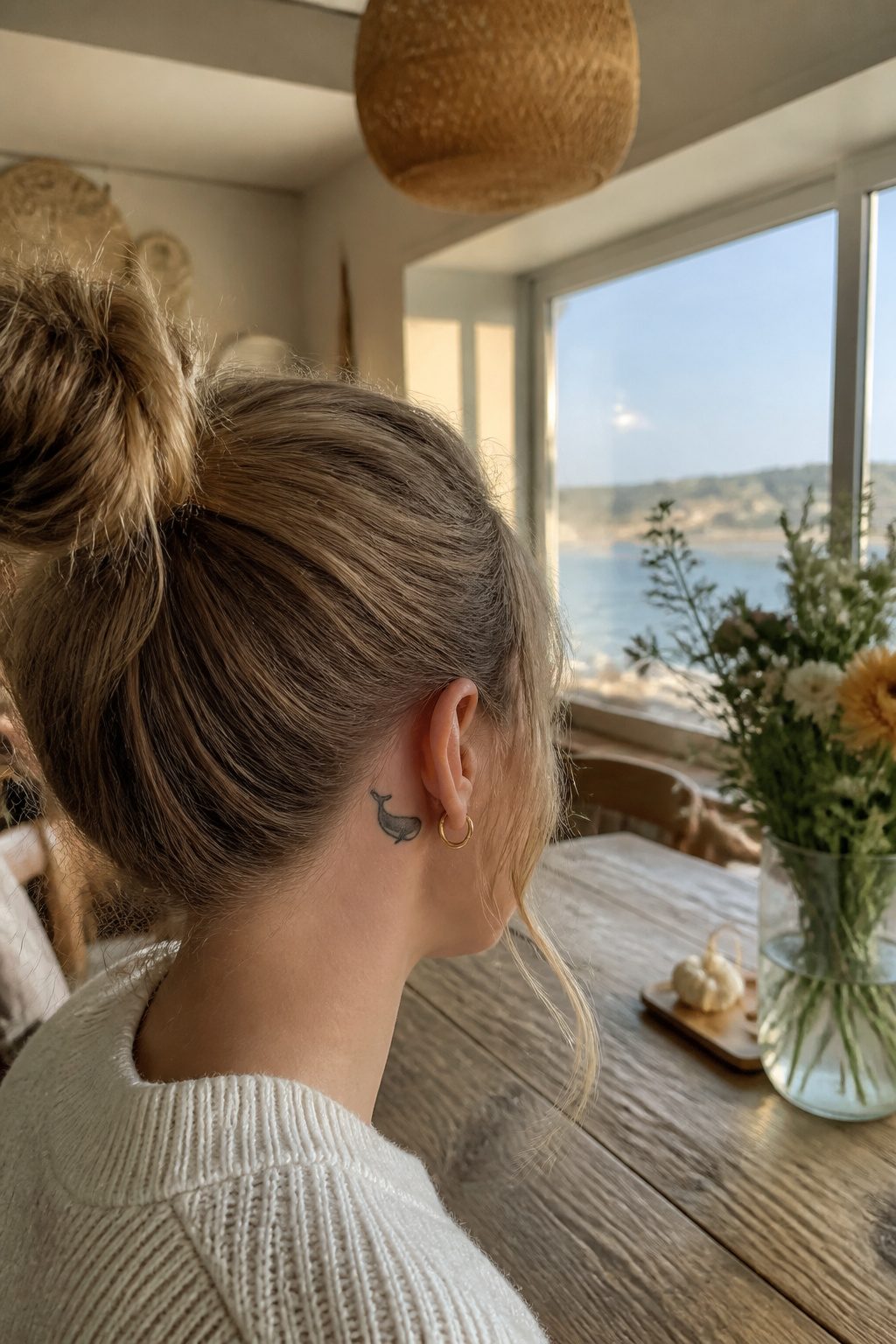
Small animal designs behind the ear live or die by how much detail the skin can hold.
A bee works because the stripes read instantly even at thumbnail size: bold bands of black and yellow that the eye catches before the brain processes what it is. The whale succeeds for the opposite reason.
A clean silhouette, maybe with a single spout line, stays recognizable when a finch with feather texture would blur into a gray smudge within a year.
The placement itself forces the choice. Behind the ear, the skin moves, the hair rubs, and the sun hits unevenly.
Designs with one strong outline shape age better here than busy patterns. My preference runs toward the whale for longevity, though I understand why people want the bee’s personality.
If you choose the bee, ask the artist to keep the stripe count low and the edges crisp. Extra legs or wing veins that look cute on paper will close up and muddy inside six months.
Hawkes, whose behind-the-ear work I’ve followed, notes that this spot suits small pieces, and I’ve seen that play out: the best ones read from across a room, not just in a mirror inches away.
13. Feathers and Knots
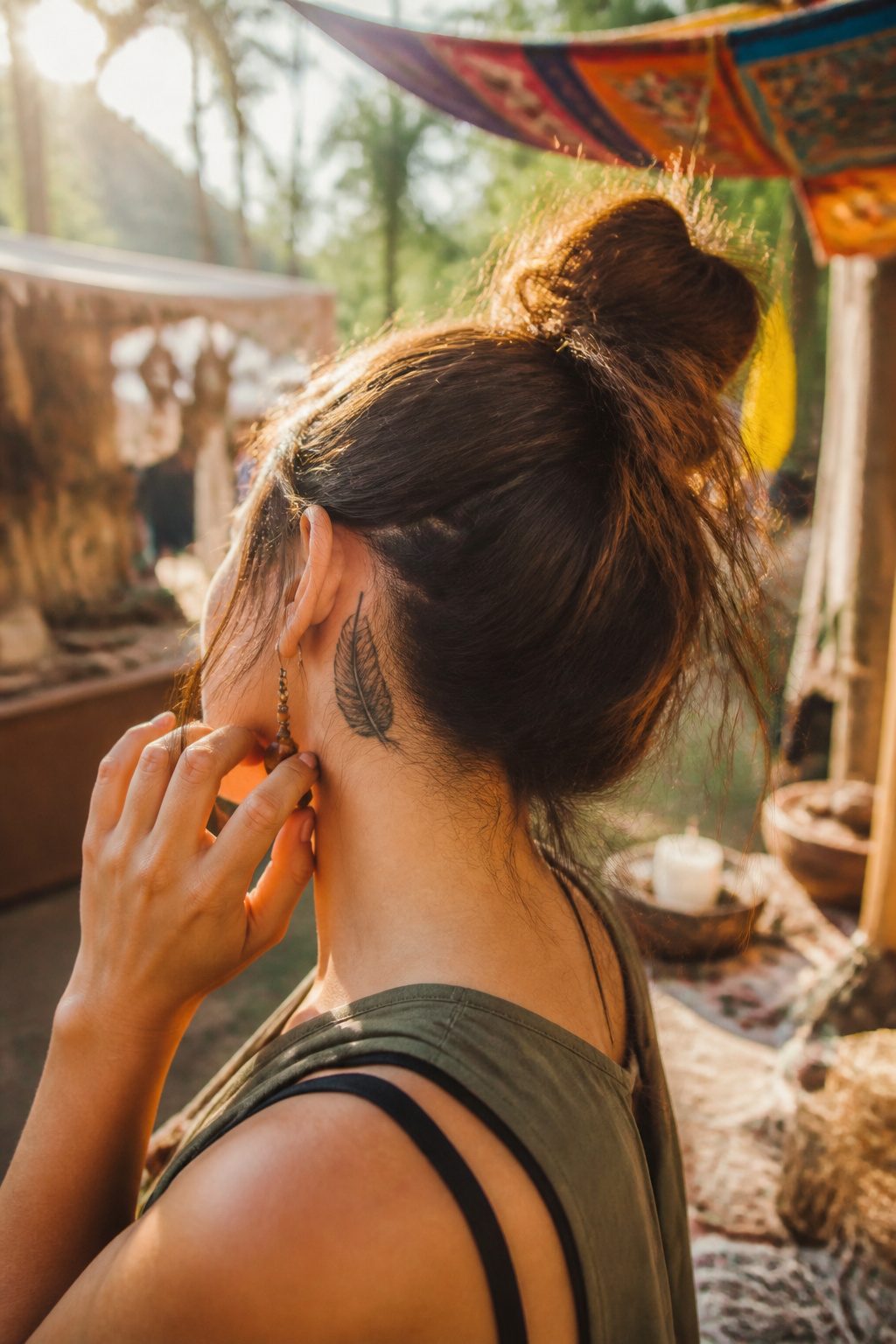
Feathers settle naturally into the hollow behind the ear, their shape following the curve without fighting it.
The catch is barb detail at small scale: individual strands blur together within a year or two if the artist tries to pack in too many. A cleaner approach keeps the vane smooth and lets negative space do the work.
Knotwork, Celtic or otherwise, faces the opposite problem. Complex interlacing that reads beautifully on a forearm turns to mud when compressed behind the ear.
The workable version drops half the crossings and thickens the remaining lines so they do not bleed into one another.
I have seen pieces where the artist preserved the looped feel but simplified the weave to three or four repeating turns, and those held their shape far better than attempts at museum-faithful reproduction.
Both designs benefit from checking the artist’s portfolio for small-scale work before booking. Behind the ear is a small area, and not every specialist in large pieces translates cleanly to it.
14. Musical Notes and Molecules
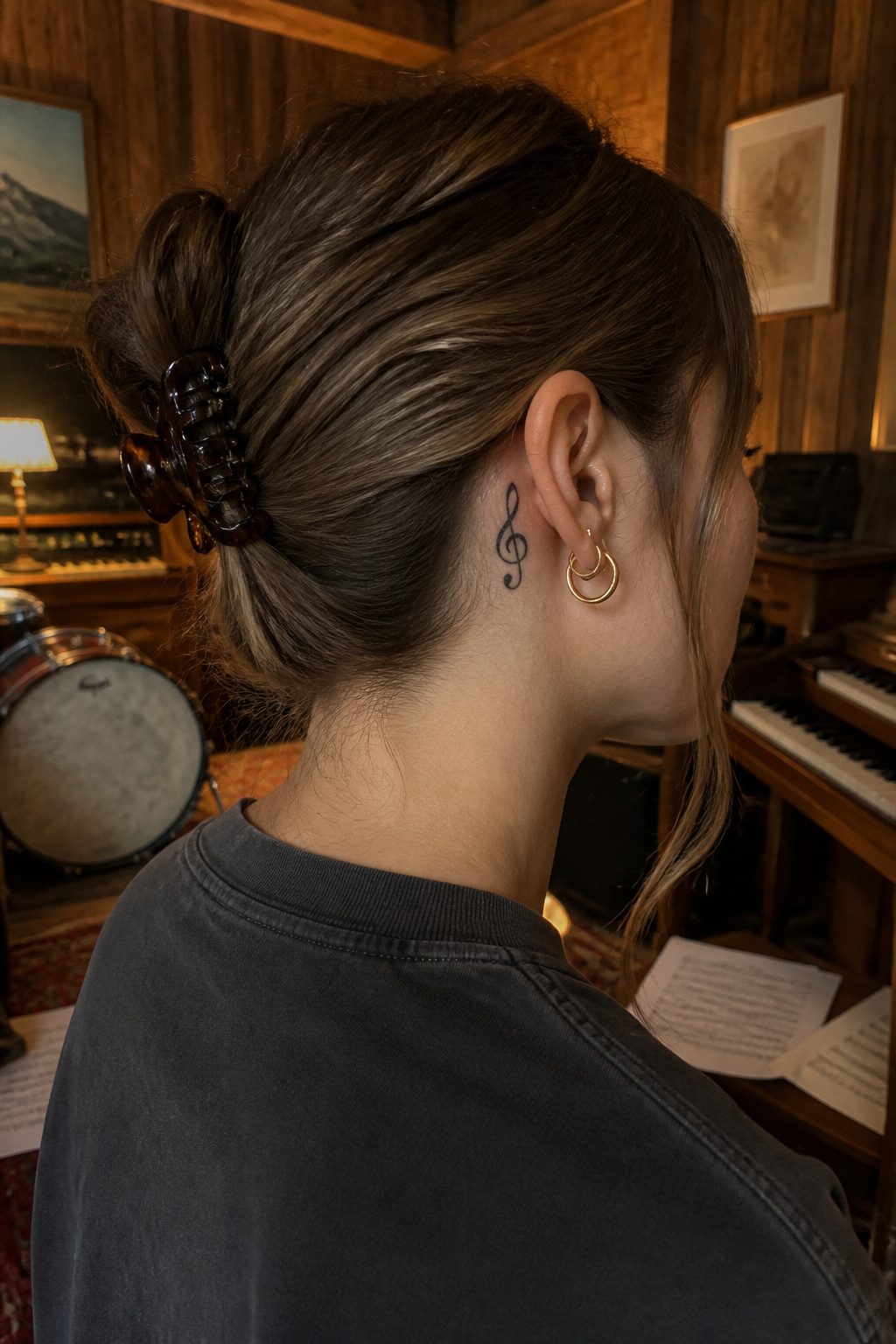
A single treble clef behind the ear reads as shorthand for the hours spent with an instrument, not a generic love of music.
The space is too small for a full staff, so the symbol itself carries the weight, and placement matters: too high and it floats; tucked along the natural curve where ear meets skull, it looks like it belongs there.
Molecular structures work the same way. A serotonin molecule, a caffeine ring, even something as simple as H2O rendered in clean lines, marks a specific fixation rather than a broad aesthetic.
What convinced me, looking through portfolios, is how these designs age. Notes with too many flags or beams blur faster than a plain eighth note.
Molecules with double bonds and angles hold their shape better than the cluttered ball-and-stick models. The people who sit best with these tattoos are the ones who can name the compound or hum the measure without thinking.
A treble clef you cannot draw from memory is decoration; one you have scribbled a thousand times is identity. That distinction is what makes the behind-the-ear spot worth the extra pain of the needle against bone.
What the Pain Actually Feels Like
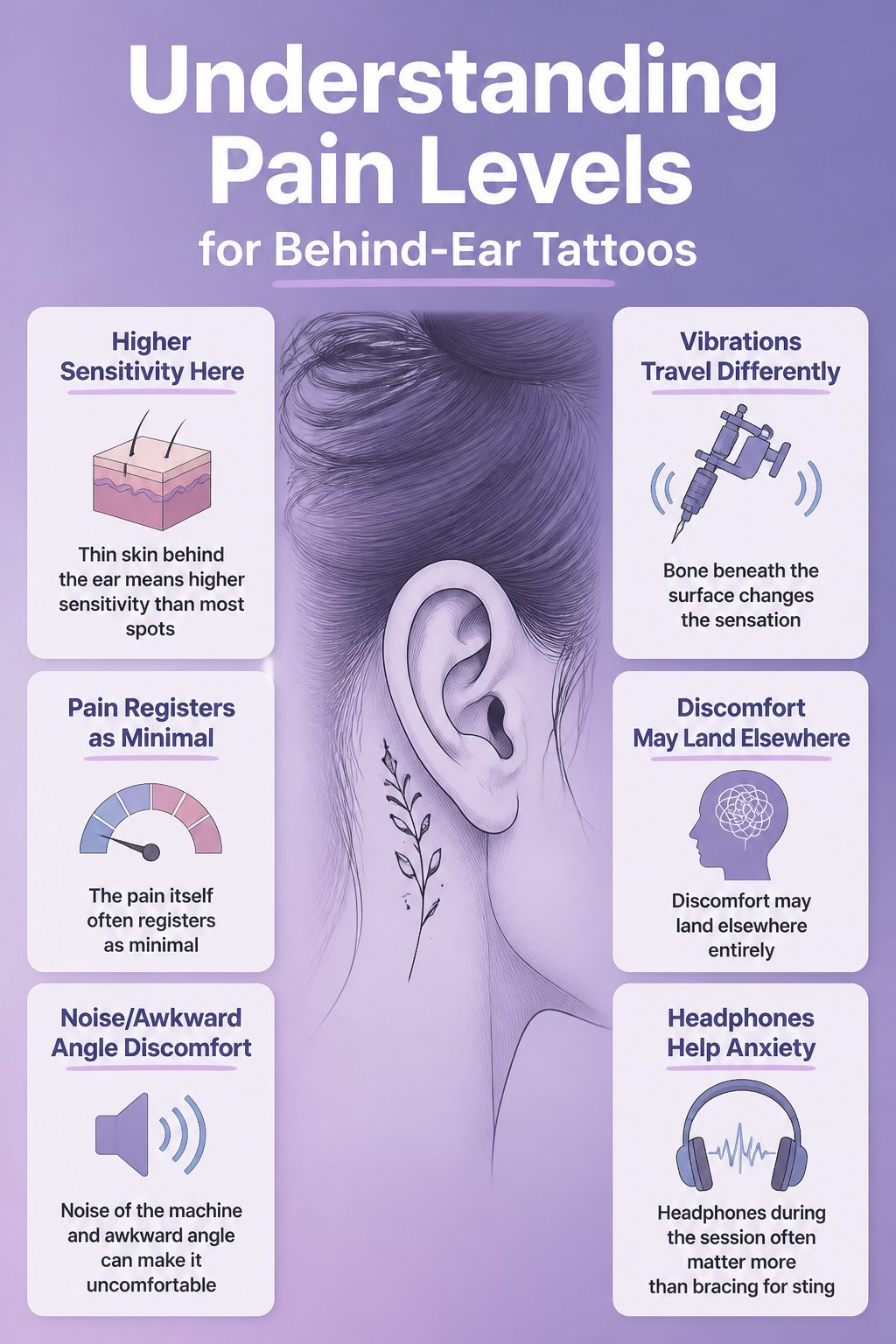
Thin skin behind the ear means higher sensitivity than most spots, yet the pain itself often registers as minimal.
What rattles some people more is the machine’s noise and vibration sitting that close to the skull, or the awkward angle of holding still while the artist works.
The bone sitting right beneath the surface changes the sensation too; every buzz travels differently when there is no muscle or fat to absorb it.
"Clients that have had pieces done in that area have said that the pain is minimal… it’s actually the noise of the machine, the slight vibrations or the way they have to sit that can make it uncomfortable."
— Elle
For anyone anxious about the needle, the discomfort may land elsewhere entirely. Bringing headphones you can actually wear during the session, or asking the artist for a break to reposition, often matters more than bracing for sting.
Keeping It Clean Around Hair Products
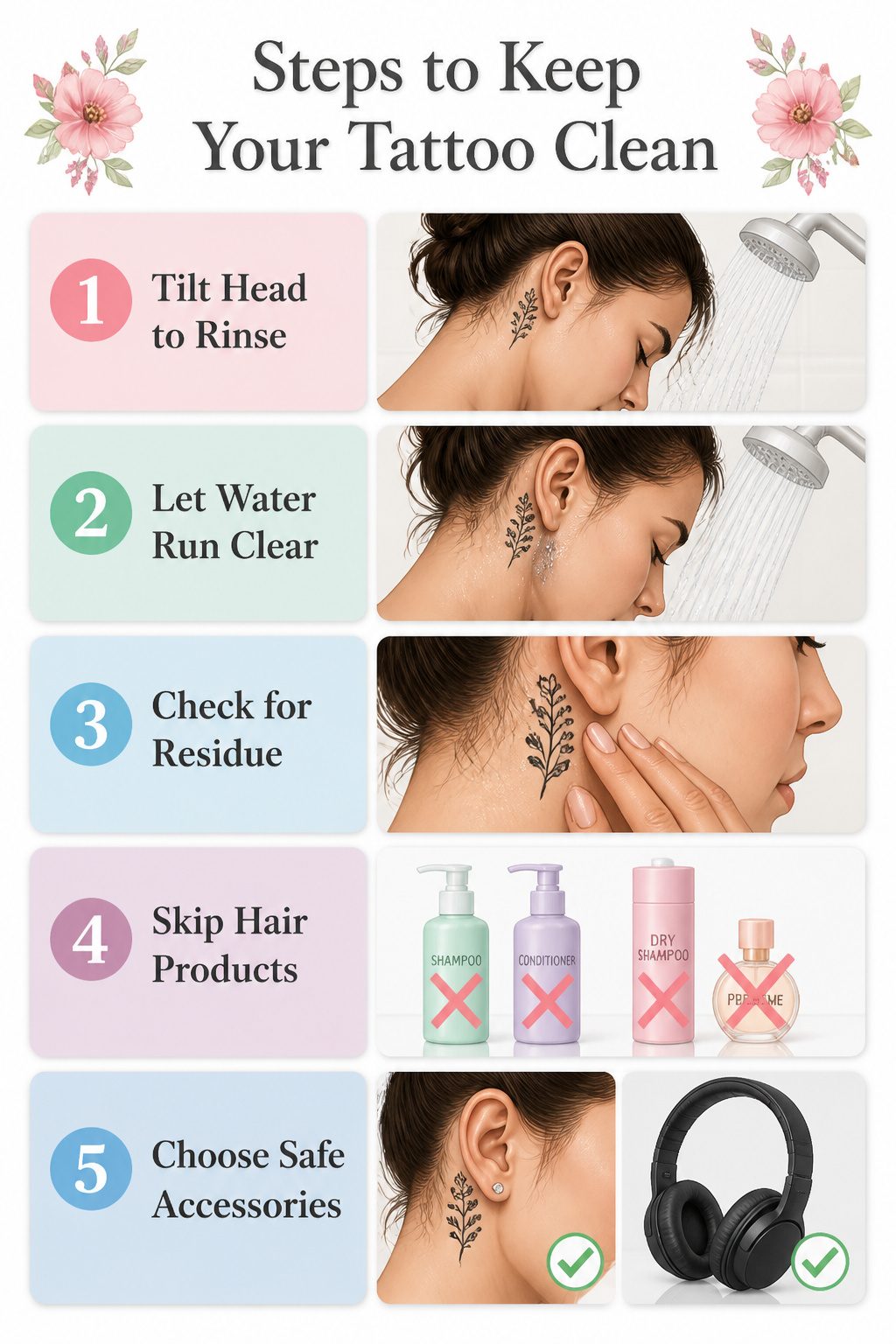
Hair falls over a fresh behind the ear tattoo constantly, and that contact matters more than you might expect.
Shampoo and conditioner residue left in that crevice will irritate the skin and cloud the ink during the first two to three weeks, so the rinse needs to be deliberate: tilt your head, let the water run clear, and check by touch that nothing slippery remains.
Dry shampoo and perfume sit in exactly the same spot and build up without warning, so skipping them there until healing finishes is the safer call.
Earrings that brush the back of the ear or neck carry enough everyday bacteria to risk transferring onto broken skin, and the same goes for headphone bands that press and rub.
I swapped to over-ear sets with a looser clamp for that stretch, and kept stud backs flush so nothing touched the area.
Hiding It or Showing It Off
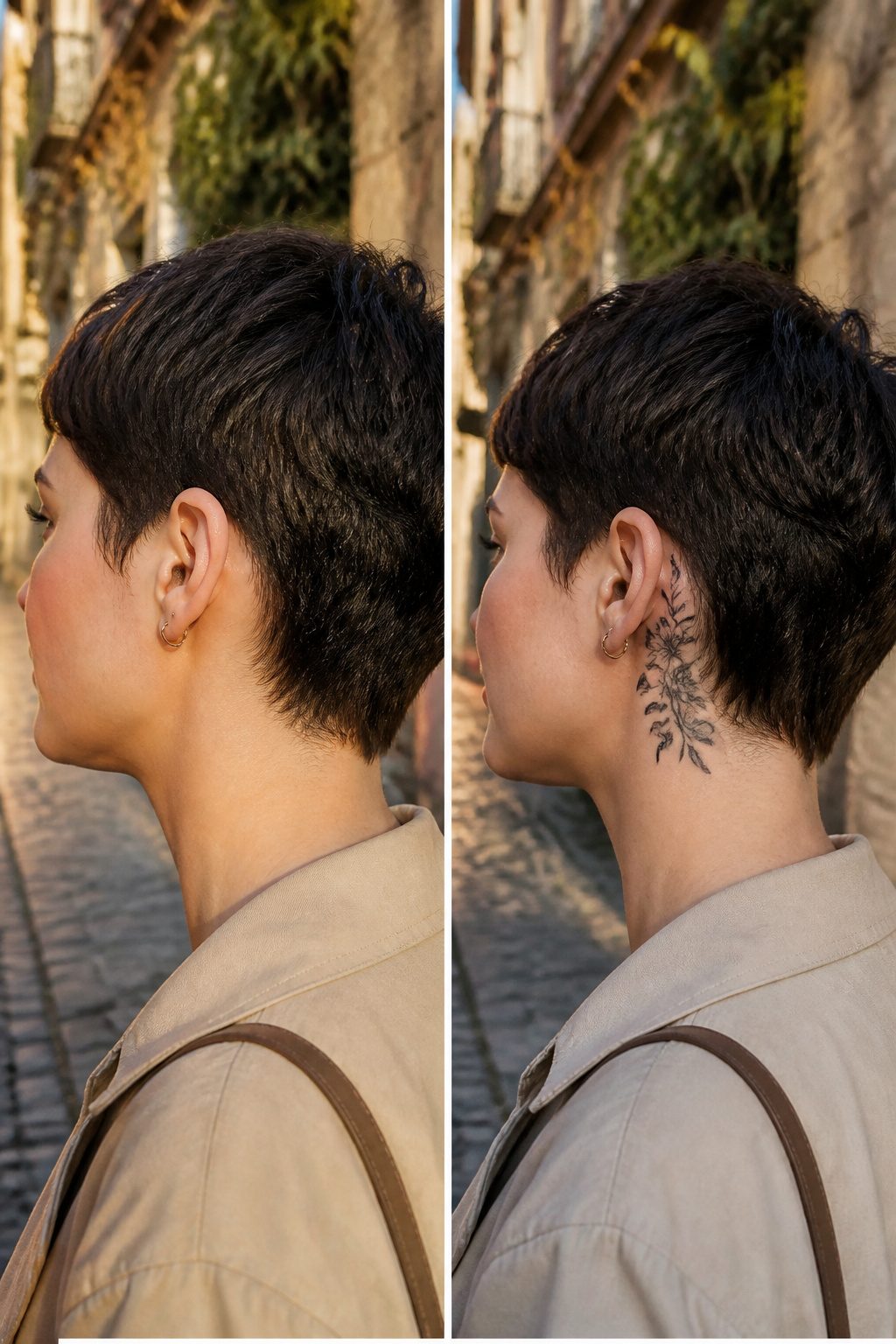
Long hair down, and a behind the ear tattoo disappears completely. Sweep it up or cut it short, and the same ink becomes the focal point of a profile view.
That dual nature is what drew me to the placement years ago, and it is what still makes it one of the most practical choices for anyone who wants control over when their body art shows.
The spot works especially well if you answer to a dress code during the week.
A low bun or loose waves keeps the design under wraps for meetings, while a weekend ponytail or pixie cut puts it on display without any extra effort.
Rihanna, Demi Lovato, and Selena Gomez have all used this area for ink that reads as bold or barely-there depending on styling, which tells you the versatility is not theoretical. It is built into the real estate itself.
Pain does factor in, and honestly more than I expected. The skin back there is thin, and the vibration from the machine travels straight to bone.
Most people I have talked to who have sat for this spot mention a sharper, more insistent sensation than on fleshier areas.
The tradeoff is that the work stays small by necessity, so the session ends faster than a sleeve or a rib piece.
For me, that math has always checked out: a few minutes of discomfort for years of choosing your own visibility, day by day.
Why This Spot Keeps Trending
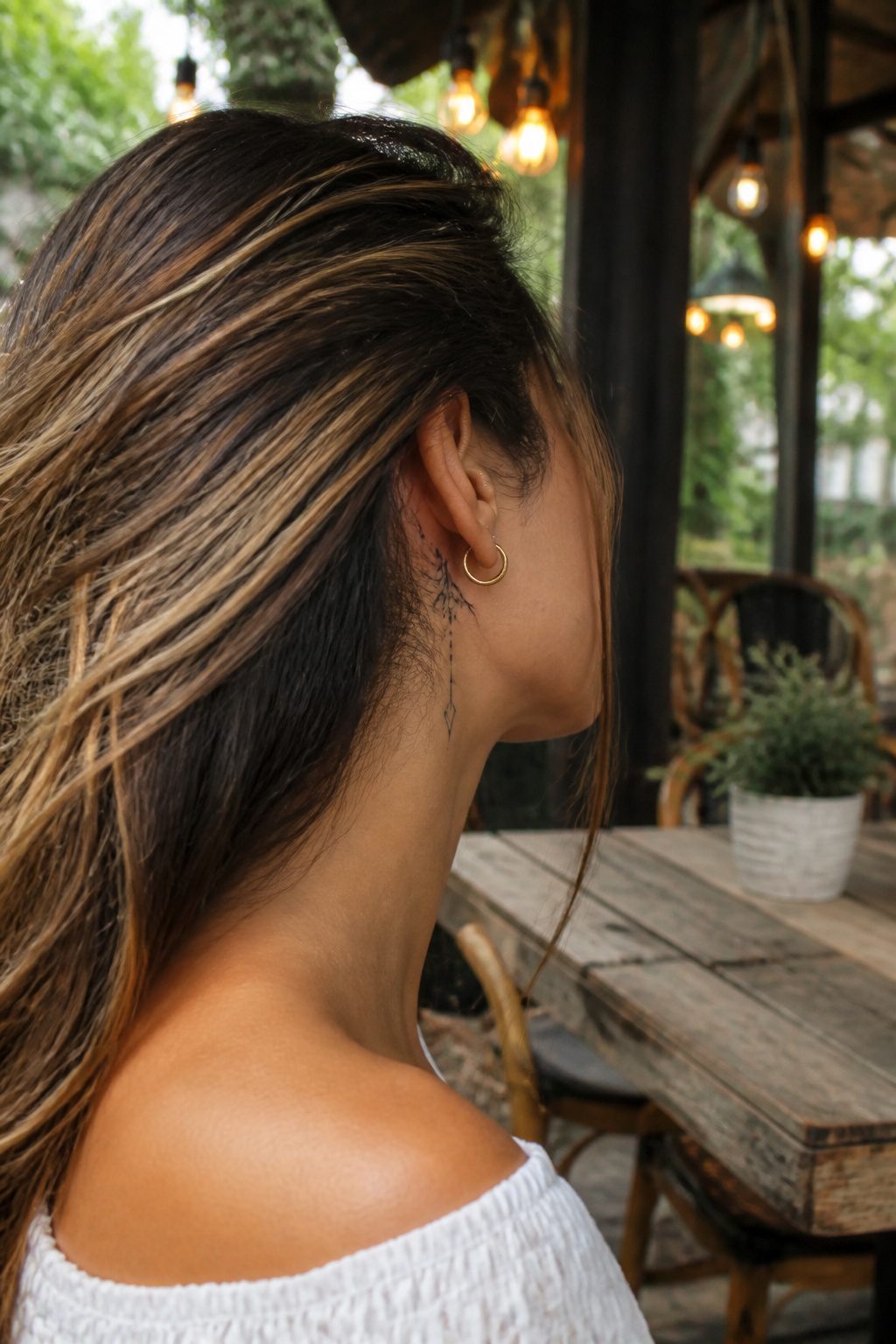
Behind the ear tattoos hit that sweet spot between private and public that earlier placement trends never quite managed.
The shift started around 2021, when the visible statement piece, the full sleeve or collarbone script everyone saw immediately, began feeling like too much commitment for people who still wanted the ink.
Celebrities helped normalize the hide-and-show dynamic: Rihanna, Demi Lovato, and Selena Gomez all have work in that spot, and Zoë Kravitz and Ariana Grande added their own delicate pieces more recently. What changed was the social math.
Instagram rewards tattoos that photograph well in an updo but disappear for a job interview, and the area behind the ear delivers exactly that toggle.
Long hair down means complete coverage; a ponytail or pixie cut turns the same piece into a focal point. Tattoo artist Gee Hawkes at Top Boy Tattoo puts it simply: clients love that the tattoo isn’t visible straight away.
The placement also reads as intentional rather than leftover, the way a wrist piece can feel like a first-tattoo default.
For anyone weighing whether the trend has peaked, the better question is whether the flexibility itself stays useful, and that answer looks solid through 2026.
Frequently Asked Questions
Do behind the ear tattoos hurt?
The pain is usually minimal, though the thin skin and proximity to bone can make the vibration and noise of the machine feel more intense than the needle itself.
Most people find the awkward sitting position and buzzing sensation near the skull harder to handle than the actual tattooing. Sessions stay short because the space is small, so the discomfort ends quickly.
What behind the ear tattoo should I get?
Pick a design with clean lines and limited detail, since too much complexity blurs in such a narrow space. Symbols, simple shapes, and single objects like moons, stars, or zodiac glyphs age better than busy patterns.
The best pieces read clearly from across a room rather than only in a mirror inches away.
What aftercare do behind the ear tattoos need?
Rinse shampoo and conditioner thoroughly from the crevice behind your ear every time you wash your hair; residue left there will irritate the skin and cloud the ink.
Skip dry shampoo, perfume, and earrings that touch the area until healing finishes, and keep headphone bands from pressing or rubbing against the fresh tattoo.