A back piece ranges from a single afternoon to two years of sessions, and the difference is not ambition but whether you can live inside one image long enough to finish it.
The skin between shoulder blades is thick and forgiving; the spine itself demands precision where any waver shows.
Most men who start with wings or a cross between the blades do so because that placement heals easier and hides under a T-shirt until they choose otherwise.
1. Japanese Irezumi
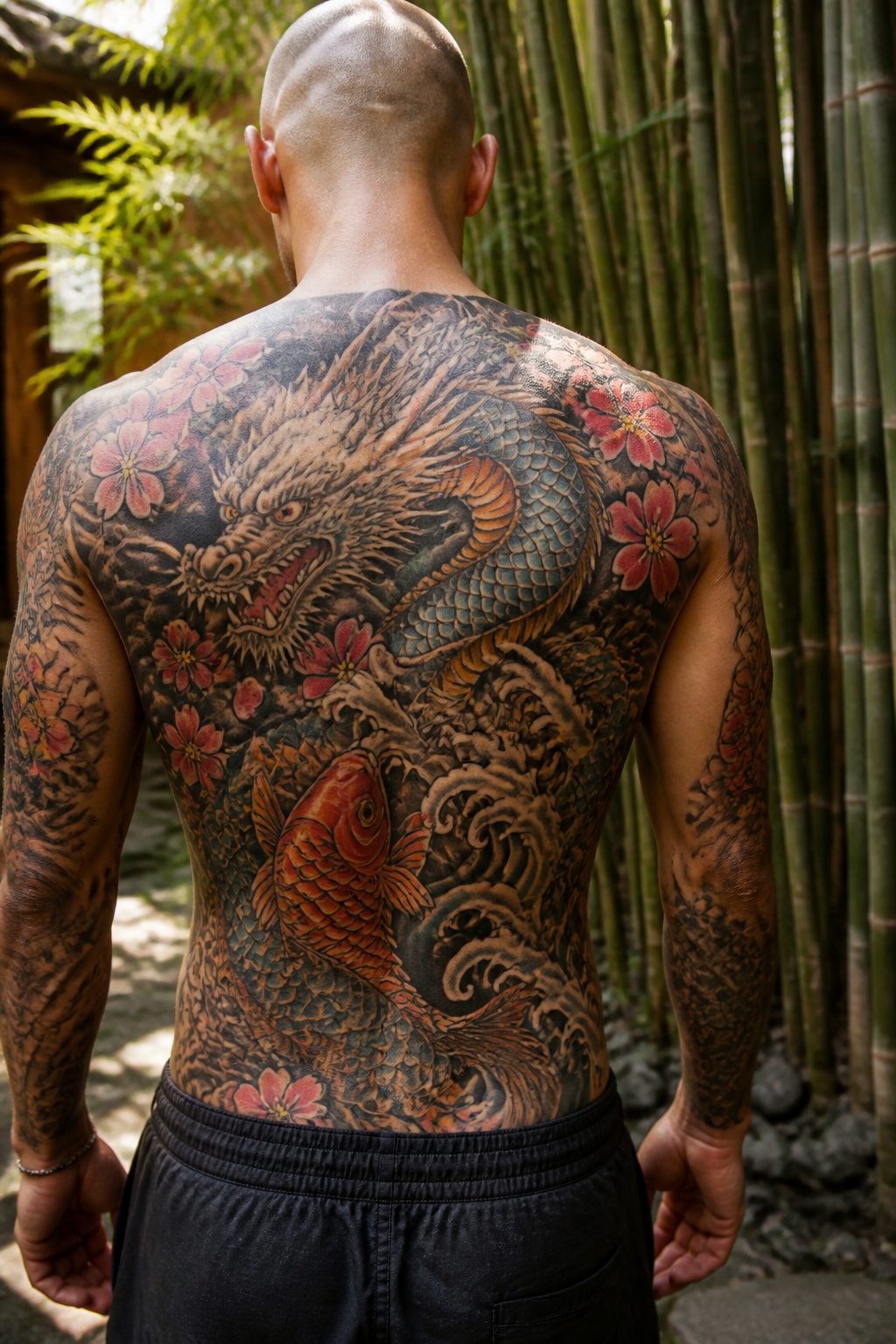
A Japanese irezumi back piece reads less like a single image and more like a mural you walk through, with dragons, koi, cherry blossoms, and hanya masks arranged so the spine becomes the natural center line the whole design hangs from.
The traditional method, tebori hand-poking, still happens in some shops, though most artists now use machines for the work. Either way, this is a specialist’s game.
The scale demands it, and the cultural symbols lose their weight fast in hands that do not understand their context.
I have watched sessions where the skin needed weeks between passes to settle, and the calendar stretched across months, sometimes years, before the back was finished. The old belief held that the pain earned the tattoo.
That part is optional now, but the time is not.
A true irezumi back piece is narrative, not decoration: each creature and flower carries meaning about perseverance, mortality, or protection, and the whole tells a story in sequence from shoulders down.
Skip the research on what each element means, and you are wearing someone else’s language without the grammar.
2. Tribal Patterns
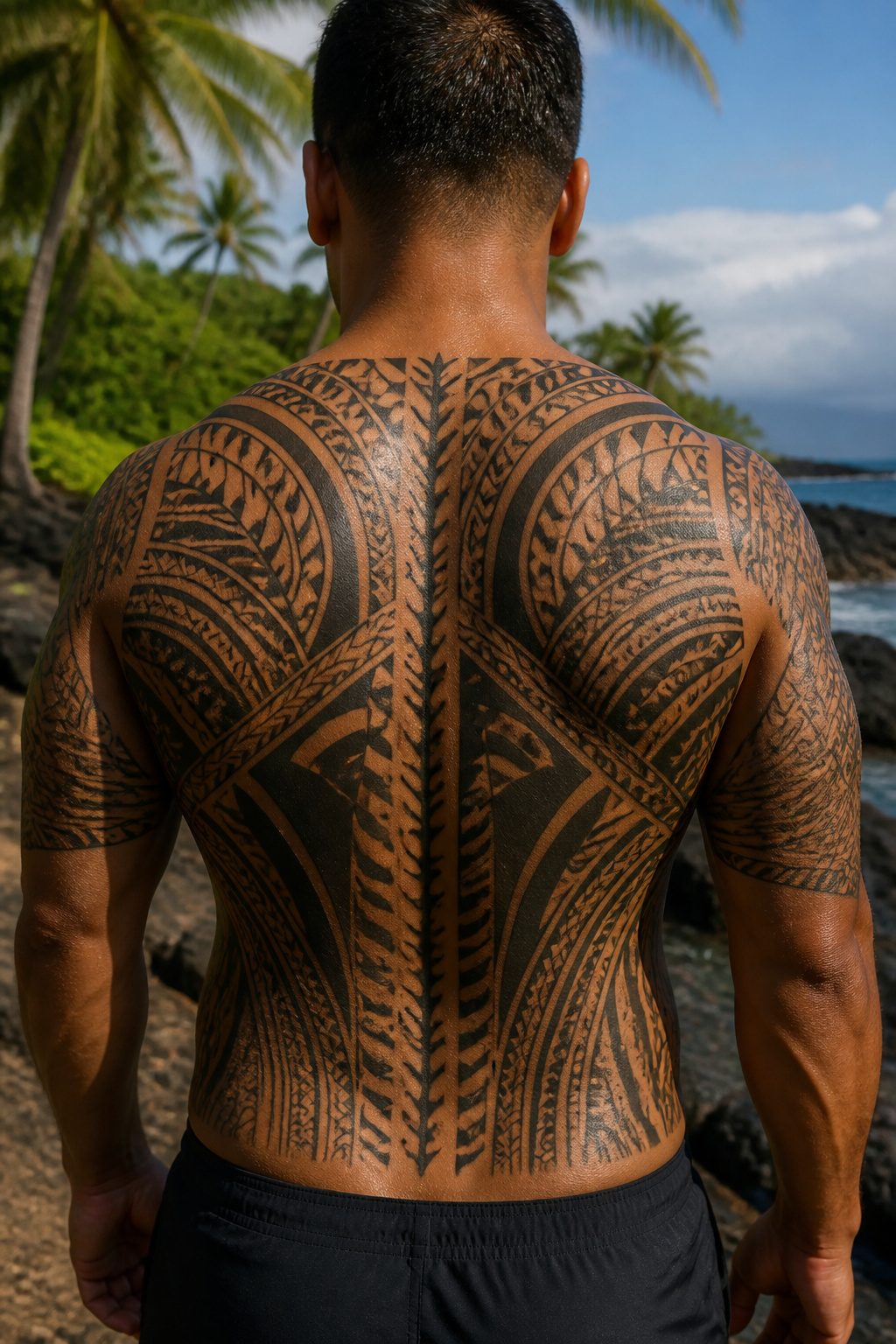
Polynesian tribal work carries a language older than the tattoo itself.
The enata, a simple human figure, marks family or ancestors in Maori and Samoan traditions, while niho mano, the shark tooth pattern, speaks to adaptability and protection in Polynesian systems. These were never decorative choices.
Placement, scale, and combination followed rules passed through generations, with the full pe’a or malu reserved for specific rites.
Modern tribal back pieces often flatten this into generic blackwork. A sleeve or shoulder cap might borrow Maori koru curves, Samoan tatau bands, and Polynesian spearheads in one piece, none of it tied to the wearer’s lineage or earned status.
The result reads as pattern without weight.
If cultural heritage matters, commission an artist trained in the specific tradition you claim. The difference shows in the spacing, the flow around the spine, and whether the motifs face directionally as they should.
Otherwise, acknowledge you are wearing geometry, not story.
3. Animal Motifs
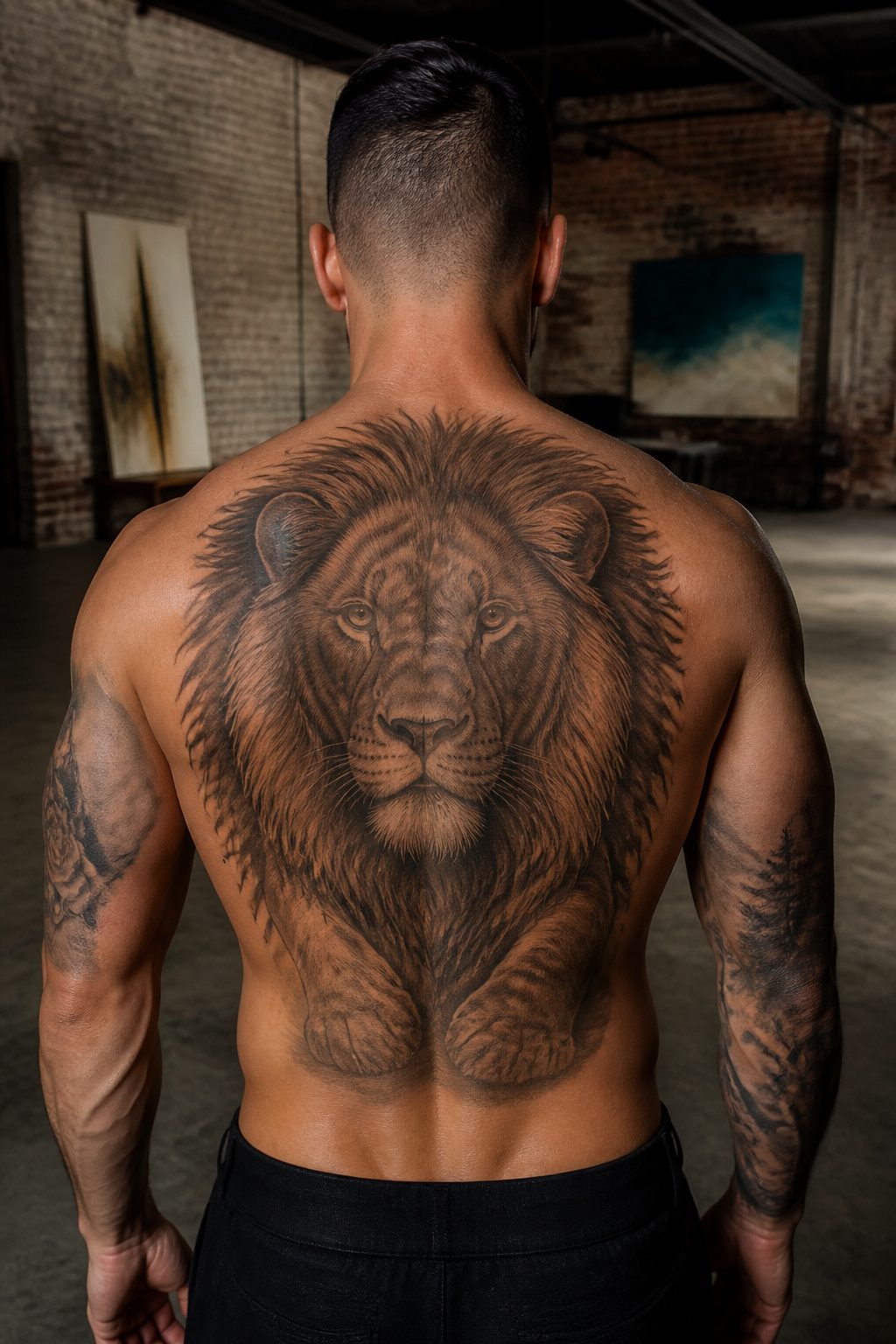
Wolves, lions, eagles, and trees scale up gracefully on a back canvas in ways smaller placements never allow. A predator needs room to actually feel large, or the whole point of choosing one falls flat.
Placement changes what the animal says. A lion spread across the shoulder blades reads as protection, guarding what’s behind you.
The same lion centered on the lower back loses that watchful quality and becomes pure display. A snake tracking down the spine suggests transformation in a way a coiled snake on one shoulder simply cannot; the body becomes the path.
Every artist I have asked gives the same advice: choose one strong subject and let it own the space.
Crowding several animals together wastes the back’s real advantage, which is the chance for a single figure to carry weight and dimension.
Heavy black and grey shading gives the design depth that flat color misses, and the spine works as a natural center line to anchor the composition.
Skin on the upper back and shoulder blades is thicker and well padded, so most men find it one of the more comfortable places to sit through if this is a first serious piece.
4. Skull Designs
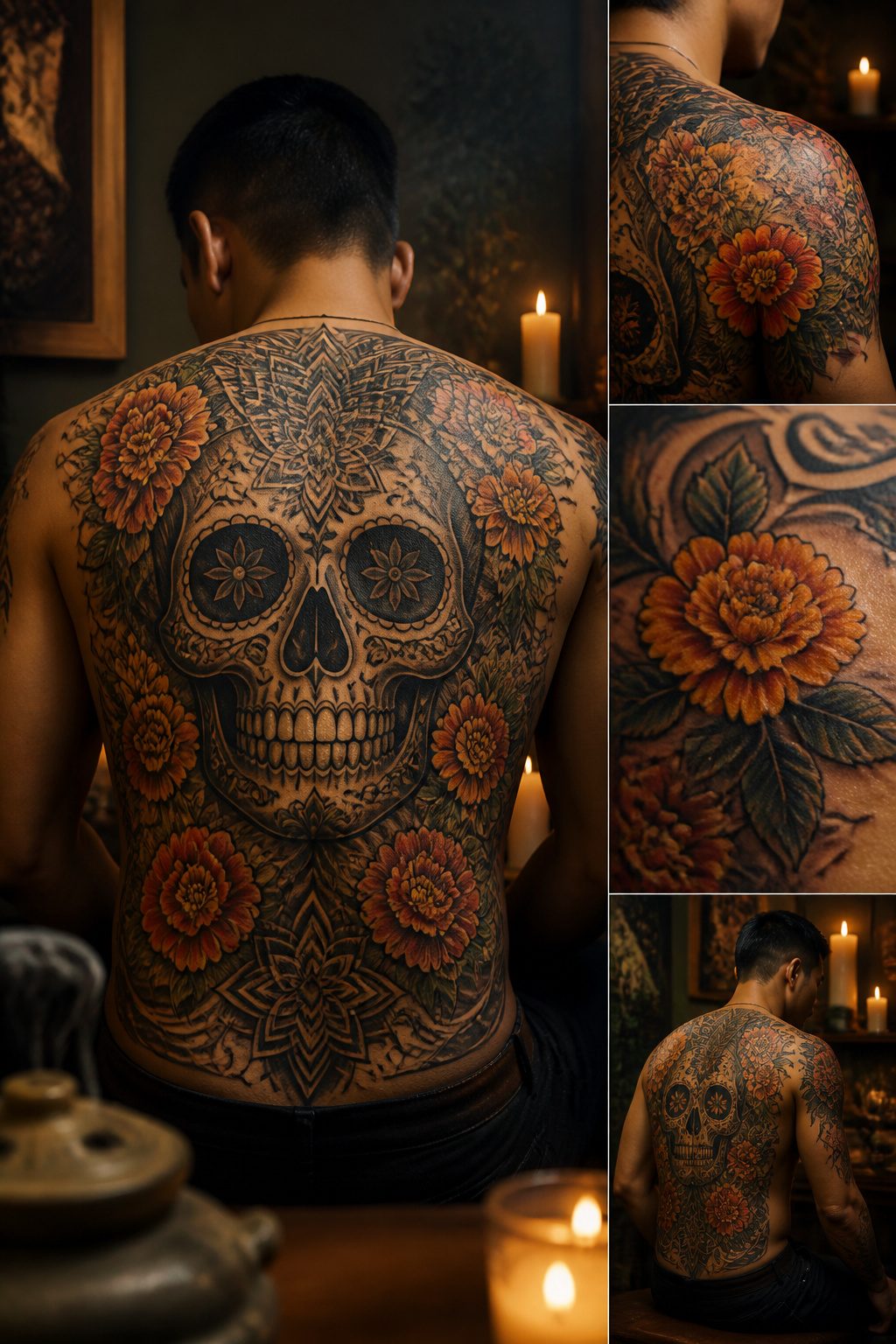
A skull on a man’s back carries two conversations at once: the hard fact that bodies fail, and the quieter argument that something outlasts them anyway.
The sugar skull tradition layers marigolds and geometric color around the bone to mark Día de los Muertos, turning mourning into reunion; photorealistic cranium work strips that back to the thing itself, no ornament, no comfort.
Roses threaded through eye sockets soften the design toward romance or memory, while keeping the stem thorned reminds the viewer that beauty costs.
Clock faces frozen at a specific hour, or candles burning down to pooled wax, turn the abstract into the particular: this loss, this date, this person. The back’s scale matters here.
A small skull between shoulder blades reads as decoration; the same image spread across the full canvas becomes something closer to a ledger, a body keeping its own account of who did not make it through.
Most men who choose this pairing put the living elements below the dead ones, flowers rising from the cranium base as if feeding from it, though the reverse arrangement, bloom crowned with bone, carries its own logic: everything beautiful ends here.
5. Floral Work
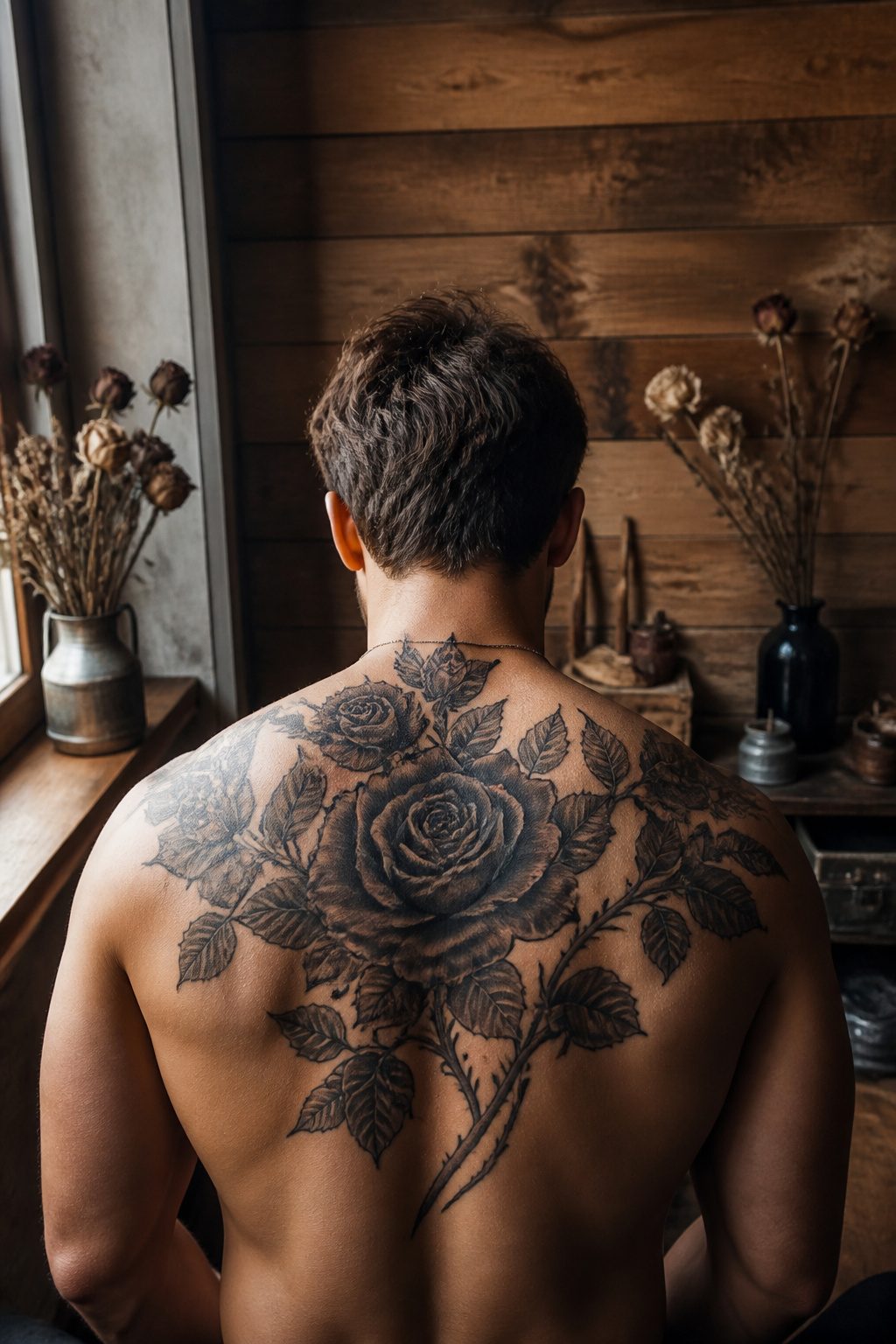
Floral back pieces carried a feminine code through the 2000s, and I watched that assumption limit what guys would ask for in chair consultations.
The shift came through two established traditions: Japanese irezumi, where cherry blossoms and peonies carry specific meanings about the fleeting nature of life, and black-and-grey realism, where roses and lilies render as texture and shadow rather than decorative color.
Roses still dominate, but the specific flower changes the message. Peonies signal risk-taking and masculine honor in Japanese work.
Cherry blossoms mark the acceptance of impermanence. A skull nested in florals, a pairing that has grown common, uses the bloom to soften mortality rather than celebrate it.
The duality reads as lived experience, not sentiment.
The men choosing this now are not reclaiming a feminine symbol. They are using a vocabulary that has been in tattooing for centuries, just coded differently in American shops for a few decades.
6. Geometric Pieces
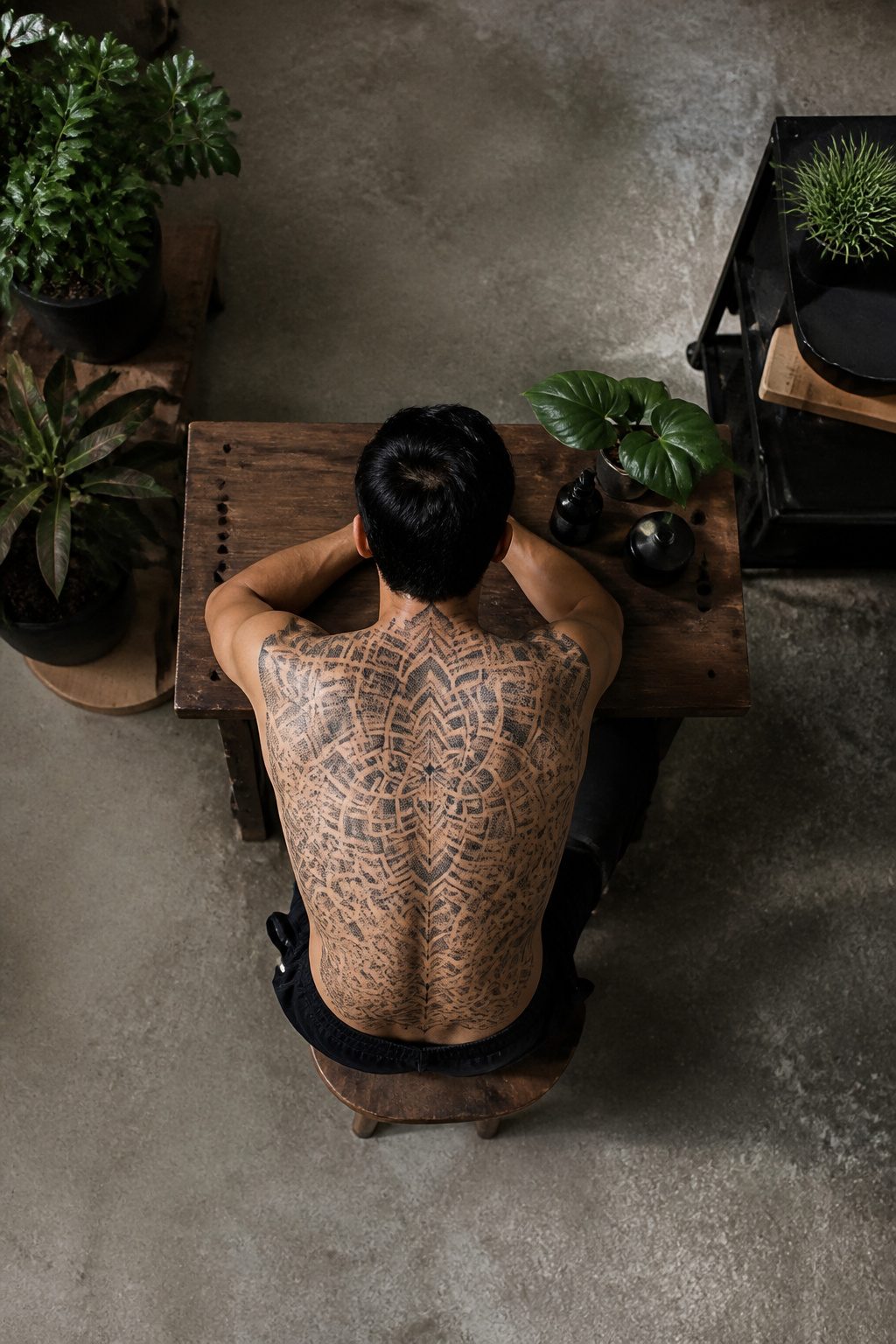
Clean lines and repeating shapes give geometric back tattoos their contemporary edge.
Sacred geometry carries weight here: the Flower of Life, Metatron’s Cube, and similar patterns rely on precision down to the millimeter, and the healed result depends more on steady hands and careful aftercare than on flashy shading.
The back’s natural planes practically beg for this treatment. The rhombus between the shoulder blades frames symmetrical pieces with built-in structure, while the triangle of the lower back anchors designs that need a stable base.
Dotwork technique softens the edges without losing the outline, adding dimension through density rather than gradient.
What separates a striking geometric piece from a flat diagram is how the pattern maps to your specific frame.
A design that traces the spine with perfect symmetry reads as deliberate and architectural; one that ignores those landmarks looks like a sticker applied at random.
The masculine feel comes from sharp angles and mathematical structure, but the balance matters more than the aggression. Strength shows in restraint.
7. Biomechanical Art
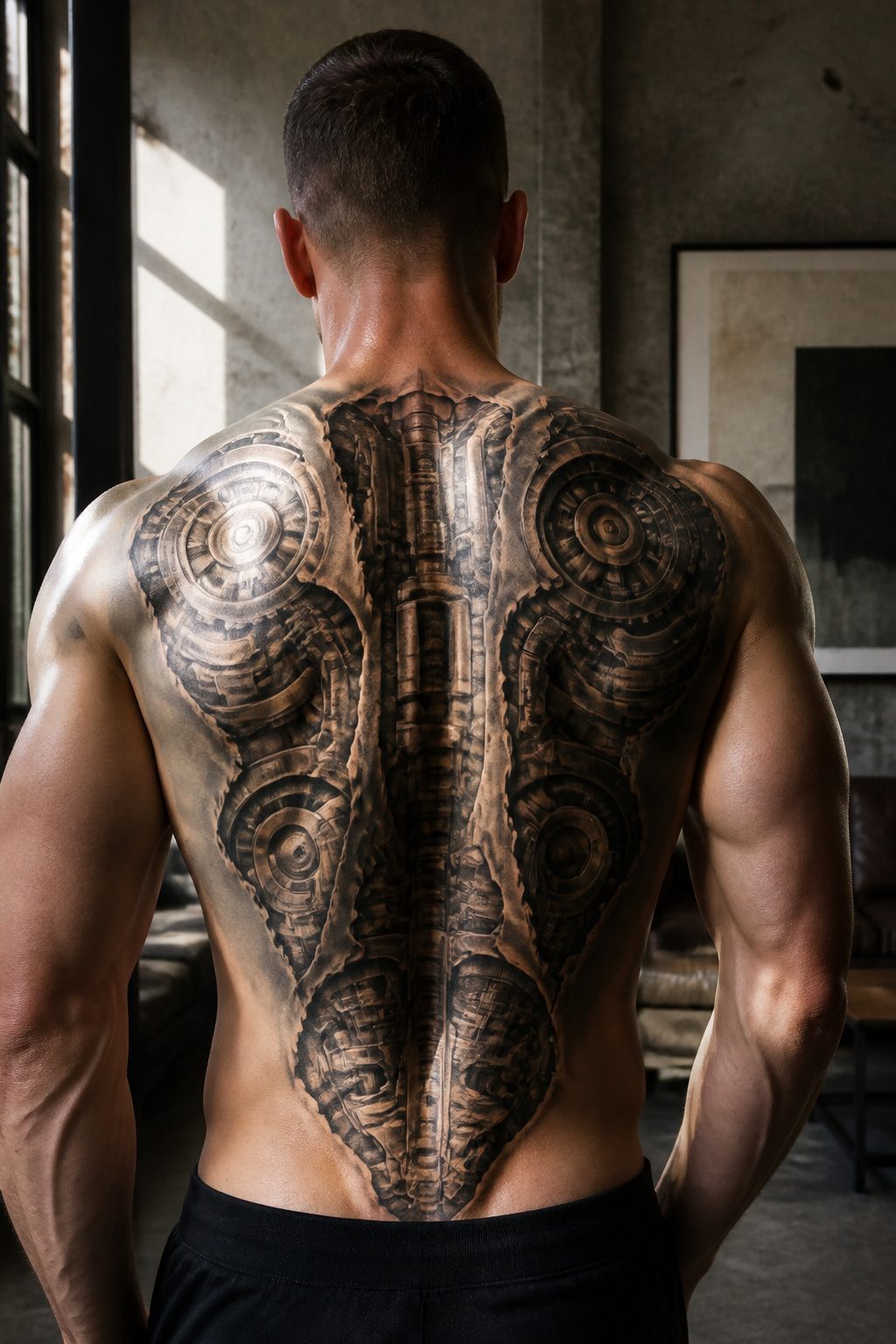
The ribs and vertebrae running down a man’s back already look like engineering under skin, which is exactly why the back is the only place a biomechanical piece truly works.
H.R. Giger built his reputation on making flesh and piston indistinguishable, wet chrome emerging from hip bone and shoulder blade as if the body had always been half machine.
That lineage matters because too many copies paste gears onto skin like stickers and call it done.
Anatomy knowledge separates the convincing pieces from the embarrassing ones. The latissimus dorsi fans outward from the spine; the trapezius rises toward the neck.
A piston that ignores where those muscles actually pull reads as decoration, not integration. The design has to follow the mechanical logic of the body beneath it.
Movement finishes or kills the illusion. When the shoulder rolls back, the mechanical elements need to look like they are driving that motion, not fighting it.
The back’s broad canvas lets the artist build depth that shifts with every flex, turning the wearer into something that appears to be assembling itself in real time.
8. Full Back Narratives
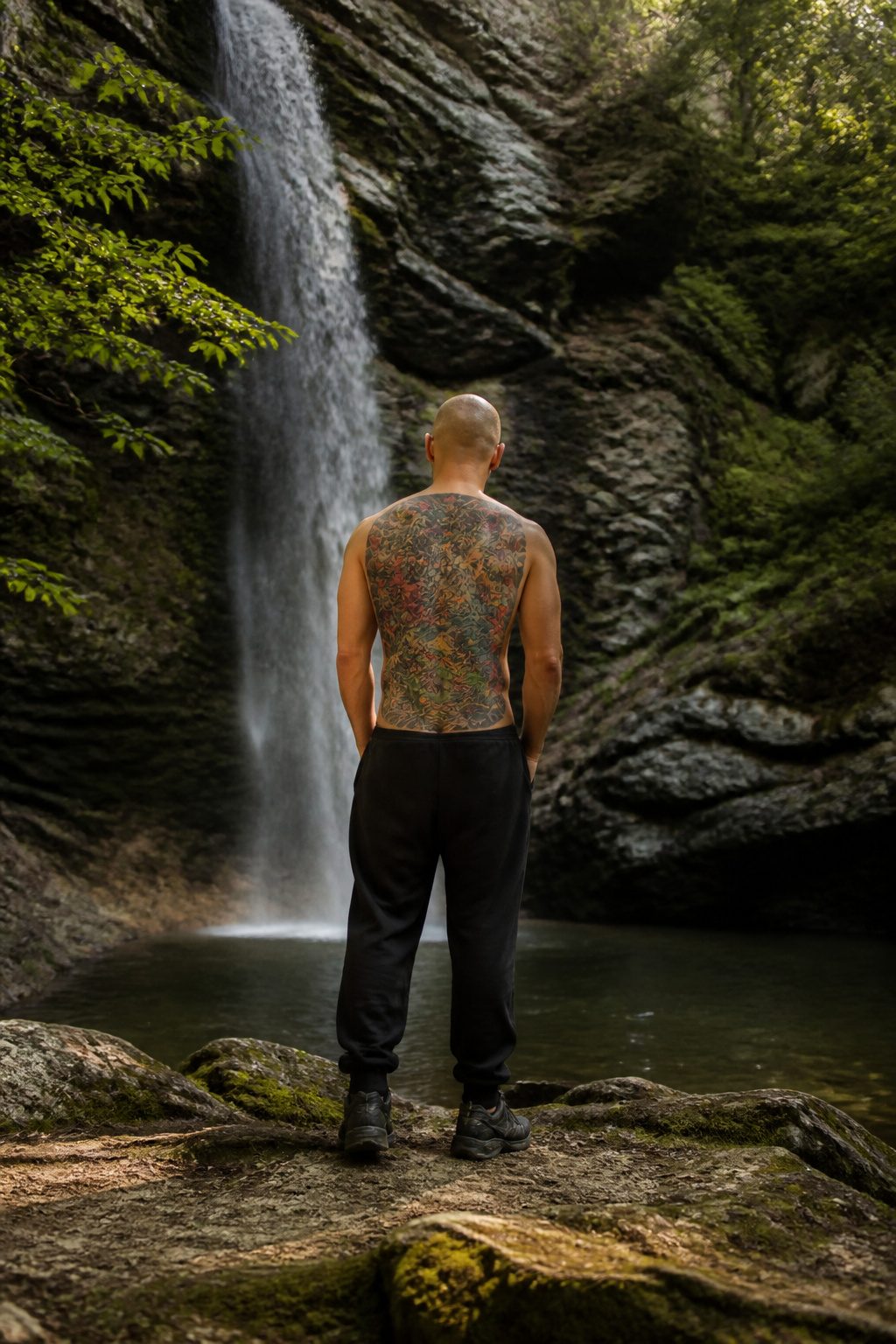
A full back piece is the last thing anyone books on impulse.
Fifty to a hundred hours in the chair, spread across months of healing between sessions, and a price that lands somewhere between $5,000 and $15,000 depending on the artist and the density of the work.
The skin needs time; rushing it punches the detail and the skin both.
What separates a back piece from three large tattoos that happen to share a body is planning for movement. The composition has to hold when the wearer stands straight, sits slouched, reaches overhead.
An artist mapping this out works from photographs in multiple poses, not just the flat tracing of a back pressed to a stencil table.
For tattooers, the full back piece functions as a career milestone, the project that proves endurance in design and in client management both. The commitment runs both directions.
Not every artist wants to live inside one image for two years, and the ones who seek it out are making a statement about their own stamina as much as the client’s.
9. Angel Wings
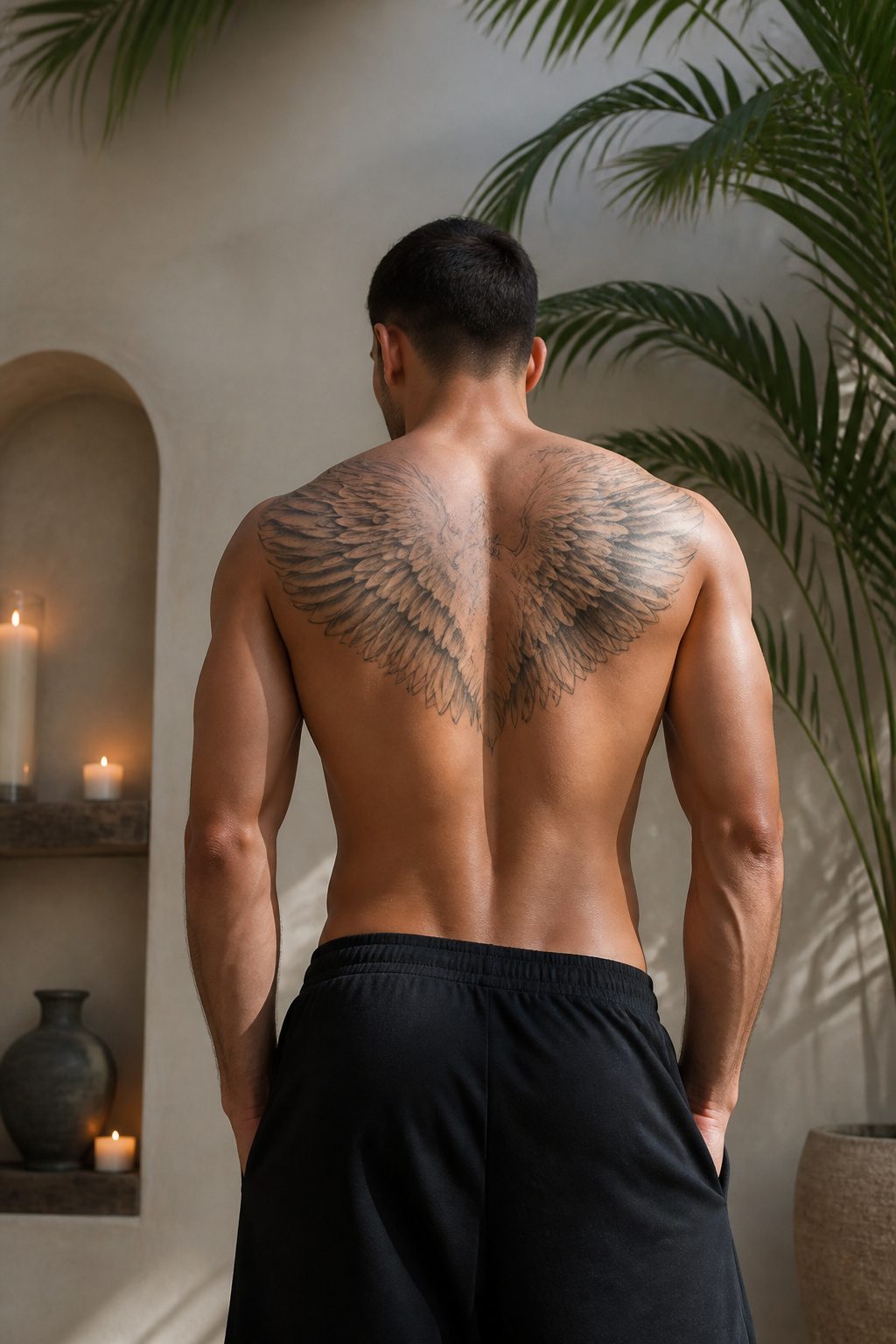
Freedom and protection sit at the core of angel wings stretched grand across the upper back, a placement that surged in popularity during the 1990s and later took hold as a military memorial tradition.
The design fails dramatically when scaled too small or dropped too low on the back; without sufficient span, the feathers collapse into indistinct shading rather than the intended illusion of flight.
Shoulder blade placement wins because the wings appear to spread when the wearer moves, the muscles shifting under skin to animate what would otherwise stay static.
The upper back and shoulder blades give you a wide, slightly curved surface that frames the symmetry beautifully, and the thicker, well-padded skin there makes the sitting more comfortable than lower back work.
Most men who start here choose a contained piece with room to grow toward a sleeve or full back-to-shoulder flow later.
Soft shadow work adds dimension without softening the outline, though healing a large piece solo is harder than it looks; you will not see the center of your own back easily for weeks.
10. Mandala Designs
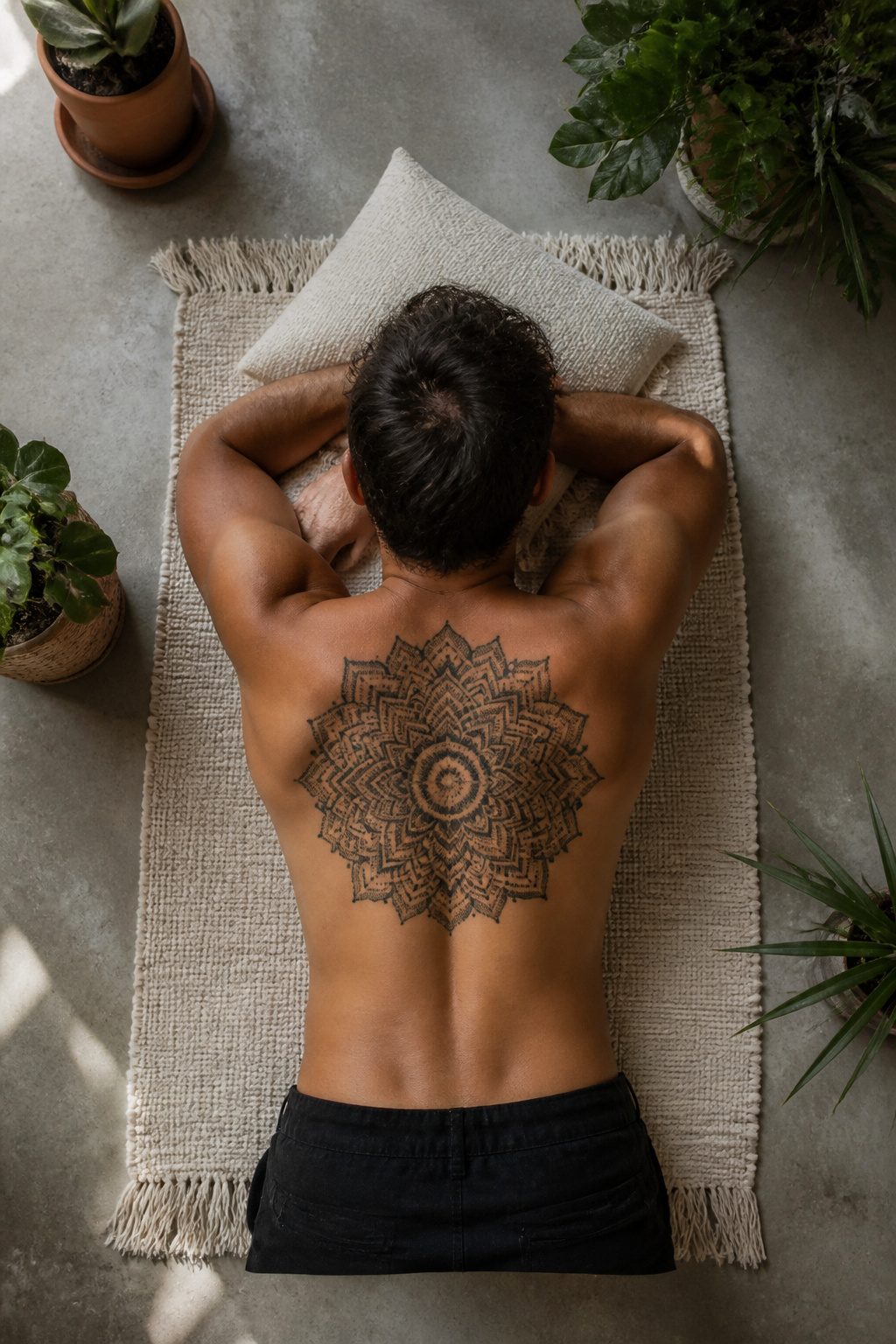
Mandala back tattoos for guys carry weight because the geometry itself means something. A proper mandala builds outward from a center point in repeating layers, and on a man’s upper back that radial symmetry faces a real challenge.
The skin between and across the shoulder blades curves slightly and shifts with every reach of the arms, so the tattooer has to map the design to a surface that moves.
Most artists I have watched work this placement stretch the stencil with the client standing, then check it again seated, because the difference matters for a design that lives or dies by its balance.
Placement usually sits the mandala dead center, spanning or nesting between the shoulder blades. This frames the piece in the widest, most stable plane of the upper back and leaves room for the pattern to breathe.
Some men run the mandala smaller and centered high, near the base of the neck; others let it spread wide enough to touch both blade edges.
The wider spread reads as deliberate, almost architectural, but it also demands more sessions and more skin committed.
Dotwork ages softer than linework on the back. The passages note that clean linework keeps a back tattoo readable from a distance, and solid blackwork holds its shape as it ages.
Dotwork sits between those two: the stippled gradients heal with a lived-in quality, but individual dots can blur together over years of sun and skin turnover.
Linework stays sharper longer yet shows every wobble where the needle crossed a shoulder that twitched. For a mandala, where the eye expects perfect repetition, that risk of drift is real.
My own bias leans toward a mix, bold linework defining the structure with dotwork filling select rings, so the geometry survives even if the texture softens.
11. Portrait Work
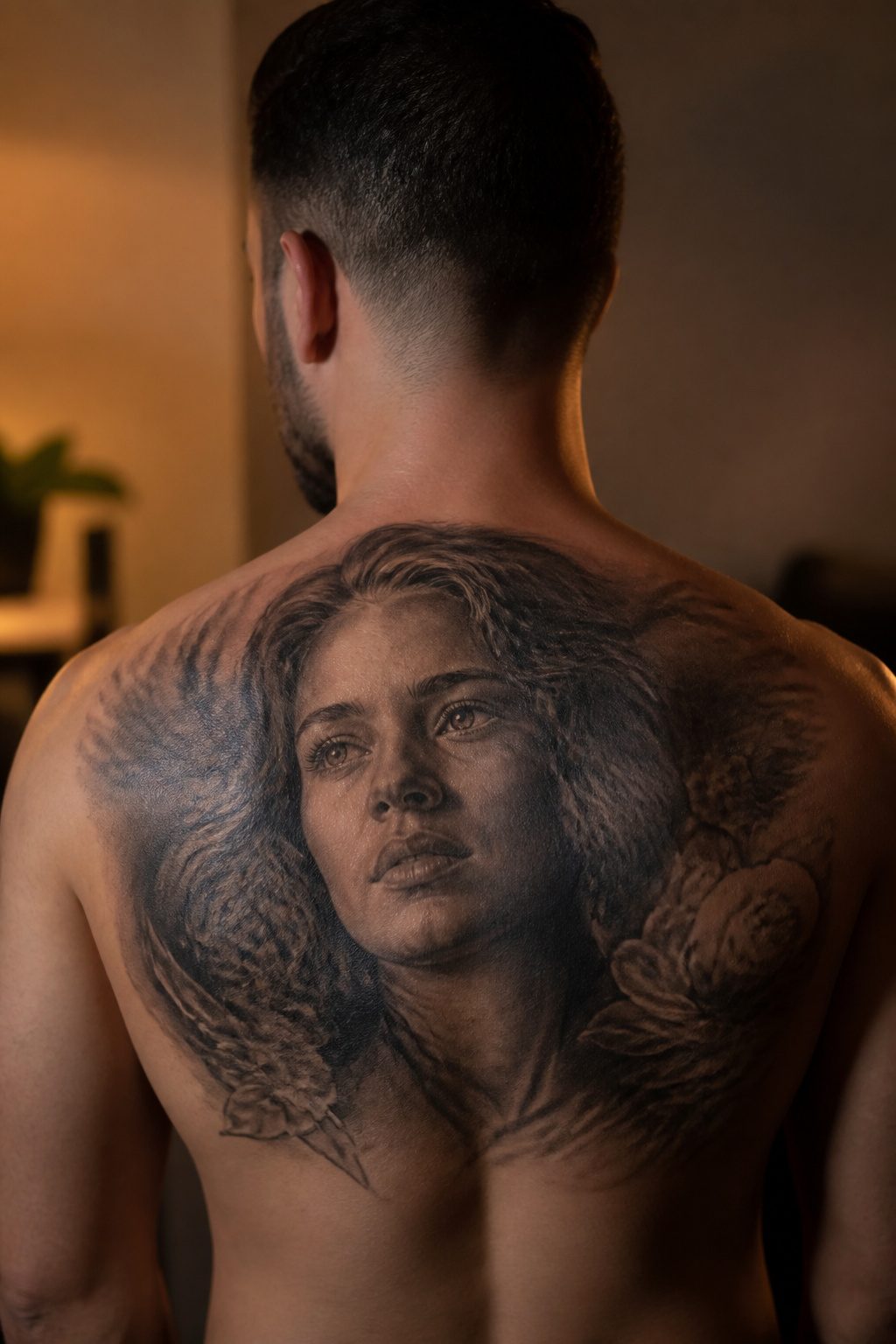
A portrait across the upper back lets an artist work at a scale where eyes actually read as eyes, not the compressed versions that wrapping around a bicep or calf forces.
The latissimus and trapezius muscles create broad, relatively flat planes that keep facial proportions honest; a cheekbone stays where a cheekbone belongs instead of distorting with every step or flex.
The technical load is heavy. Portraiture demands smooth gradations in tone, usually achieved through greywash or stipple shading, and skin texture this large shows every hesitation in the needle.
A back piece gives the artist room to build those transitions gradually, which is why the format suits subjects that carry real weight: a child’s face rendered at actual size, a parent’s photograph translated to ink, or a cultural figure whose presence the wearer wants felt rather than merely recognized.
The commitment runs deeper than with other subjects. A portrait is not a dragon or a cross; it is a specific face, and that specificity means living with the likeness daily.
Most men who choose this route select someone whose absence or influence shaped them, not a celebrity crush or passing admiration.
The back becomes the place where that relationship sits, visible to others in a shirtless moment but carried against the spine, which feels like the right location for memory rather than display.
12. Mythological Creatures
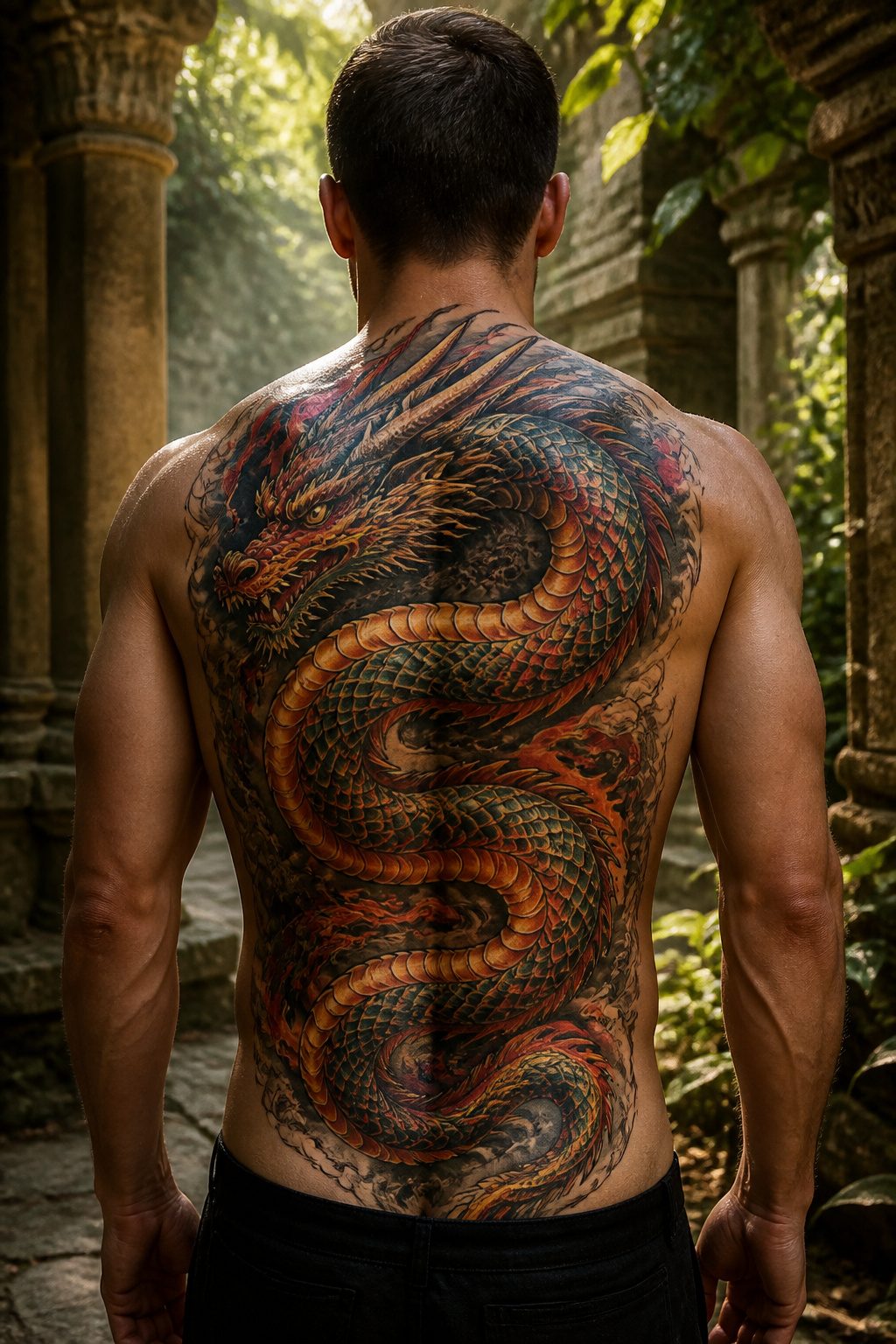
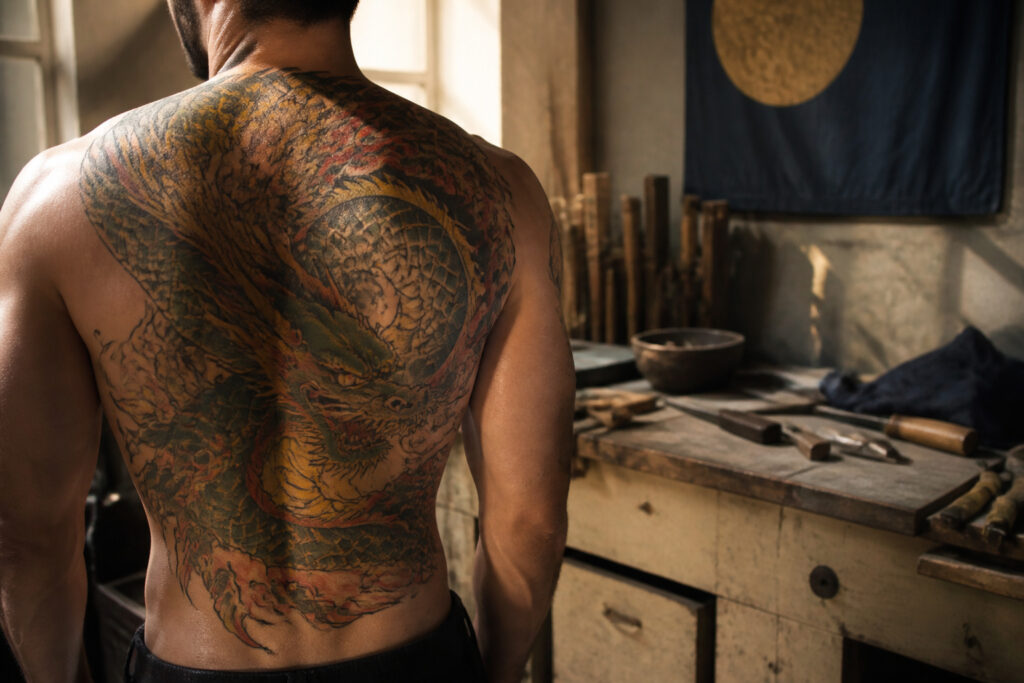
A dragon across the back reads differently depending on which tradition you pull from. Western dragons, with their folded wings and coiled bodies, tend to fill the canvas in a static confrontation pose; the viewer meets the creature head-on.
Eastern dragons, serpentine and legless in the old depictions, suit a spine climb that turns the back’s vertical length into ascent, head at the nape and tail disappearing toward the waist.
The skin over the vertebrae is among the more tender areas to tattoo, so a spine-centered piece demands a slower session than work spread across the shoulder blades.
The phoenix carries a different narrative weight. Where the dragon claims territory, the phoenix suggests passage through it; rising from flame translates naturally to a back piece that starts low and builds toward the shoulders.
Clean linework keeps either design readable from a distance, and solid blackwork holds its shape as the piece ages. The center of the back remains the primary placement choice, with either side as the alternative for a wide, framed look.
13. Scene Tattoos
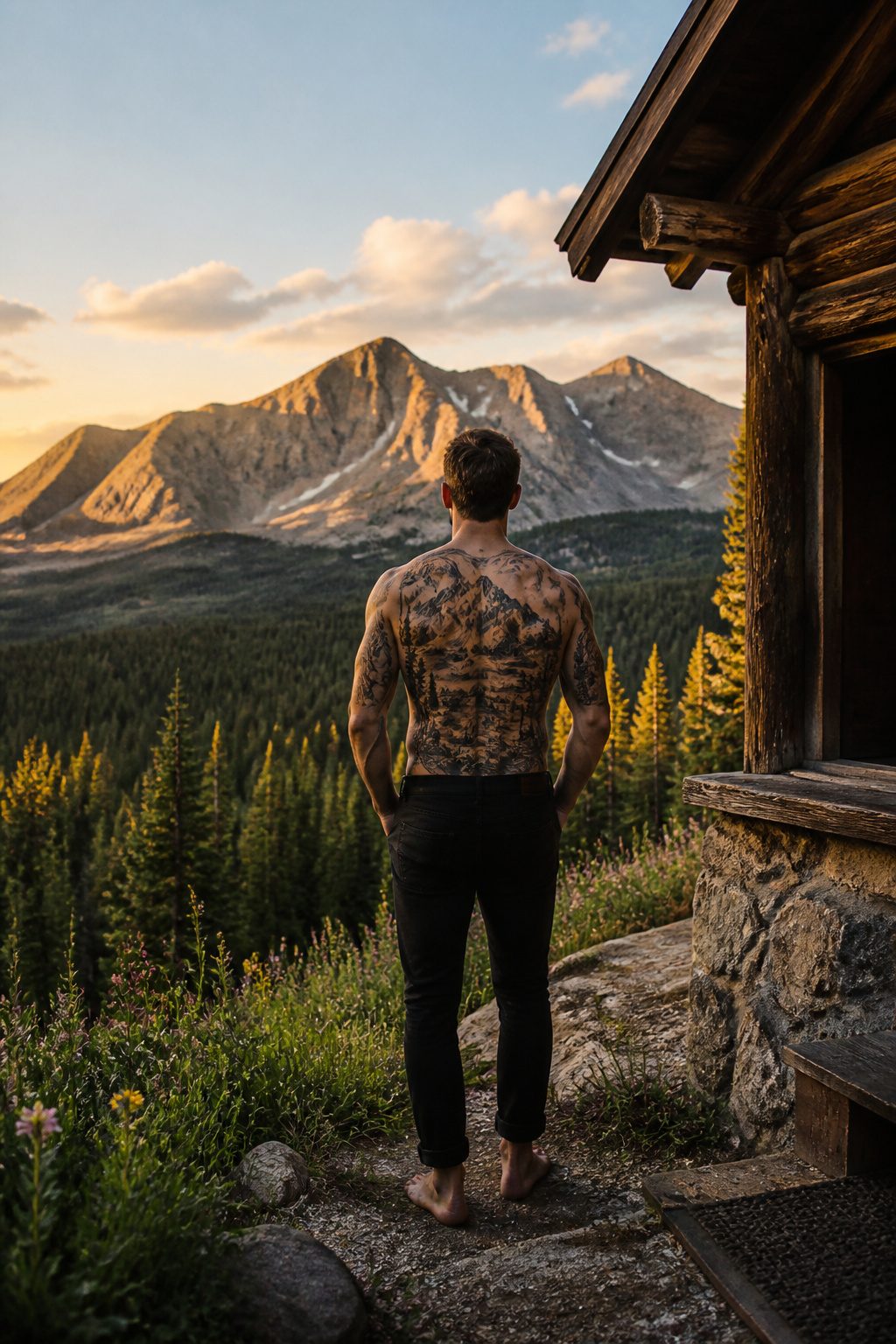
Scene tattoos turn the back into a window someone else wants to look through.
A crucifixion rendered across the shoulder blades, St. Michael driving a spear through Satan at the spine’s center, a clipper ship riding heavy swells above the waistline: each one depends on placing the horizon line where the back’s curve won’t bend it out of true.
The flat sketch on paper lies; skin over scapula and latissimus rounds, and a horizon drawn straight across reads bowed once the body stands relaxed.
Religious scenes carry the longest tradition in this form, built for churches and adapted to flesh, where the back’s scale finally matches the ambition of the original altarpiece.
Nautical themes came later, tied to Navy men who wanted their service readable from across a locker room.
The trick with either is deciding what happens at the edges: a scene that runs to the armpits or tucks under the waistband looks cropped by accident, not design.
Full back pieces solve this by treating the whole canvas as a single field, shoulder to hip, where the narrative has room to breathe.
14. Cross Designs
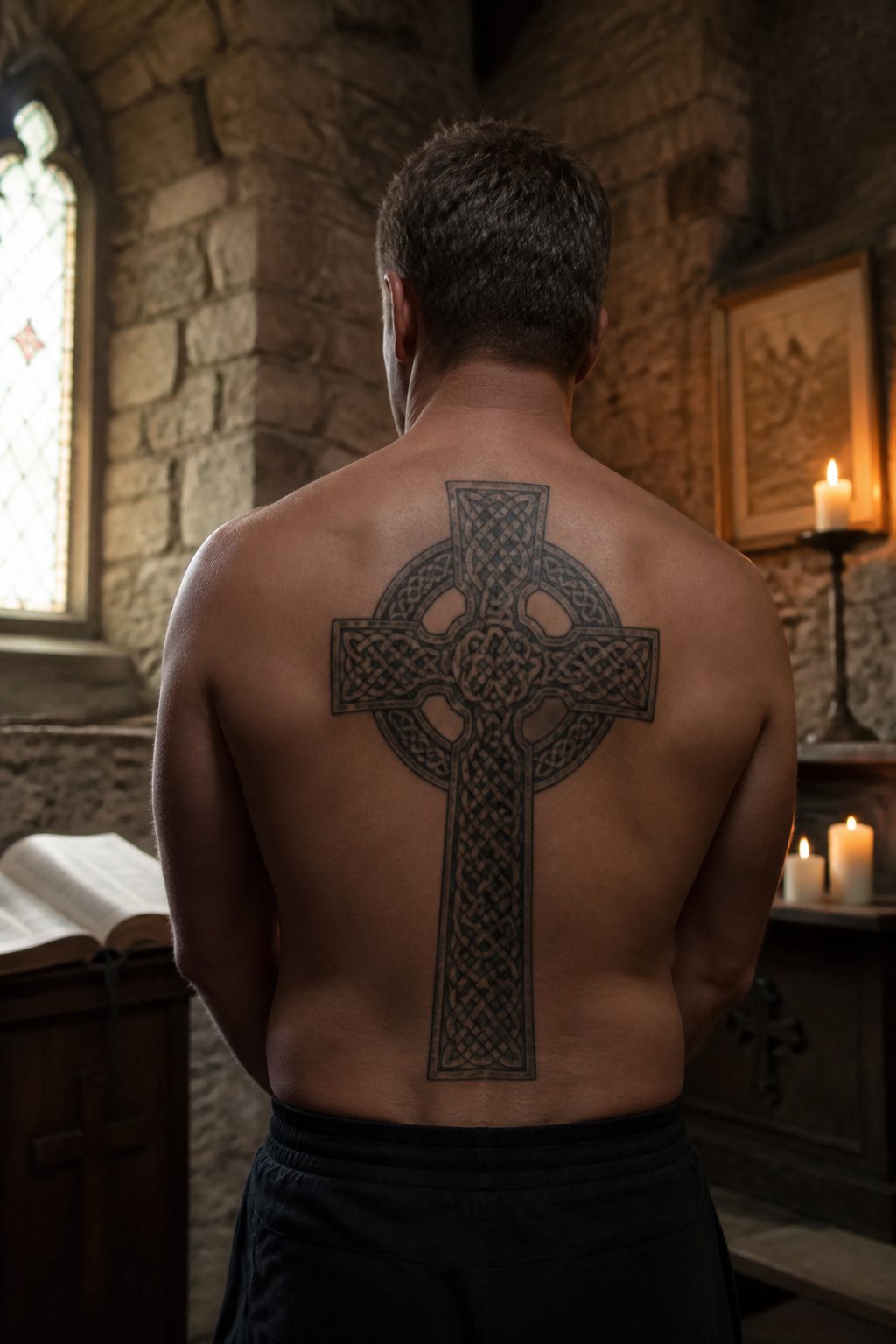
A cross on the back carries weight that smaller placements rarely match. The spine’s natural line becomes the vertical beam, and the shoulder blades give the horizontal bar room to spread without crowding.
That verticality is why the back, from neck to waist, has been the default canvas for cruciform work for decades.
The Celtic cross, with its ring and knotwork, reads as heritage first and faith second.
A plain Latin cross strips that back to the essential statement, and the men who choose it often treat the tattoo as memorial rather than declaration.
Names or dates on a banner across the horizontal bar are the most common addition; the banner’s curve follows the bar’s line instead of fighting it.
The upper back keeps the cross visible in a tank top; the full back lets the arms of the cross extend to the shoulders.
Either placement risks the design looking narrow if the artist does not account for how muscle shifts the proportions when the client stands straight versus relaxed.
15. Abstract Compositions
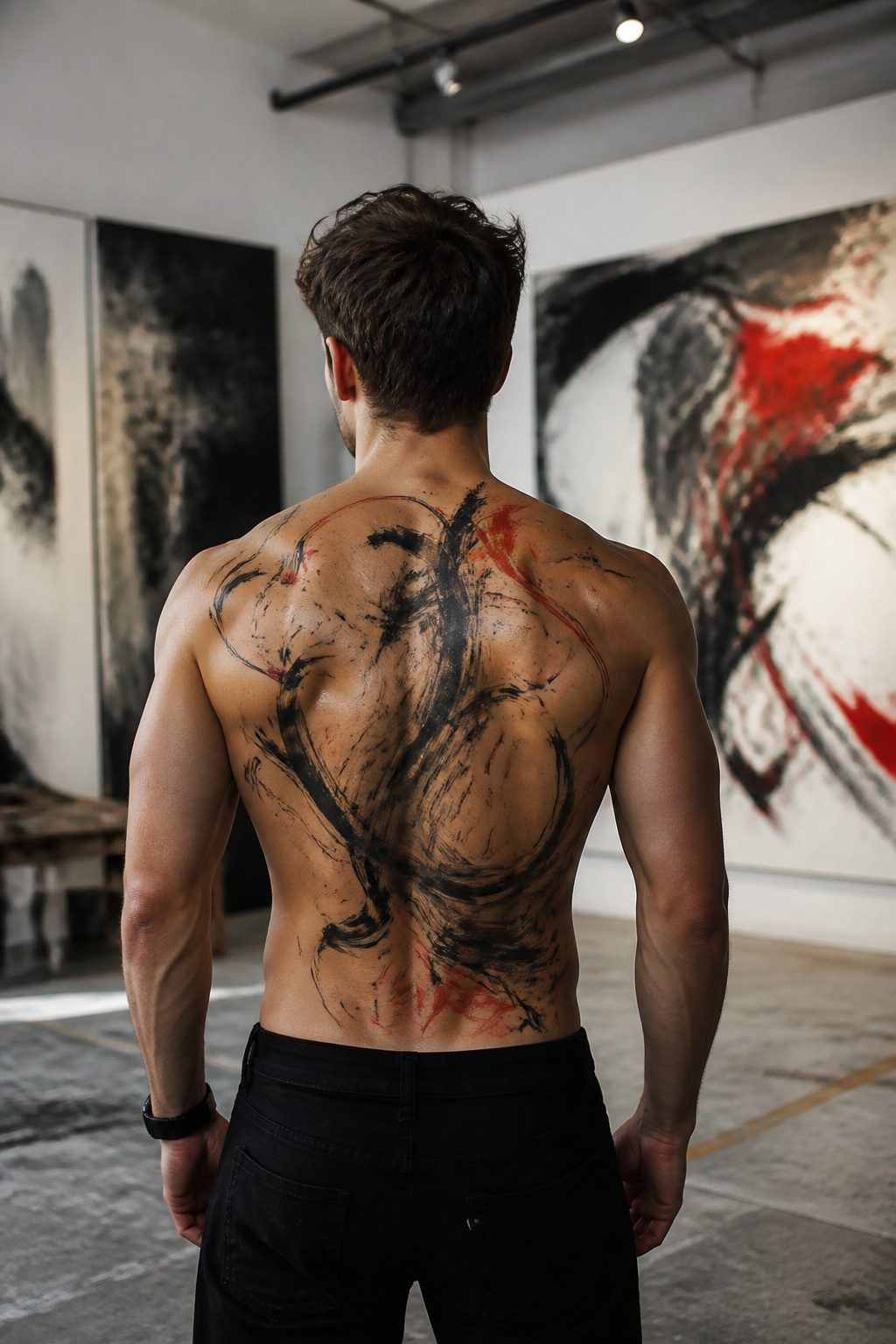
Abstract compositions on a man’s back carry a particular tension: with no dragon, no clock, no face to anchor the eye, the whole design stands or falls on whether the shapes feel right together.
Trash polka builds this balance from deliberate chaos, throwing photorealistic fragments against bold black brushstrokes and splatters of red. Watercolor backgrounds work the same territory softer, letting pigment bleed and pool where a more controlled style would draw hard outlines.
Both demand an artist who understands negative space across a wide canvas, because the back offers room that can swallow a weak composition or let a strong one breathe.
The risk runs sharper than with recognizable imagery. A viewer who cannot name what they are seeing judges only whether the flow holds, and the eye catches every awkward gap.
This same ambiguity makes abstract work a practical choice for covering older tattoos.
Where a solid black tribal band or faded lettering would show through a new rose or eagle, abstract shapes can absorb the old ink into texture itself, turning scars of previous choices into part of the visual noise.
The cover-up succeeds not by hiding but by redirecting, and the back’s flat planes give the artist space to graduate tone until the old work disappears into the new.
Where on the Back It Goes
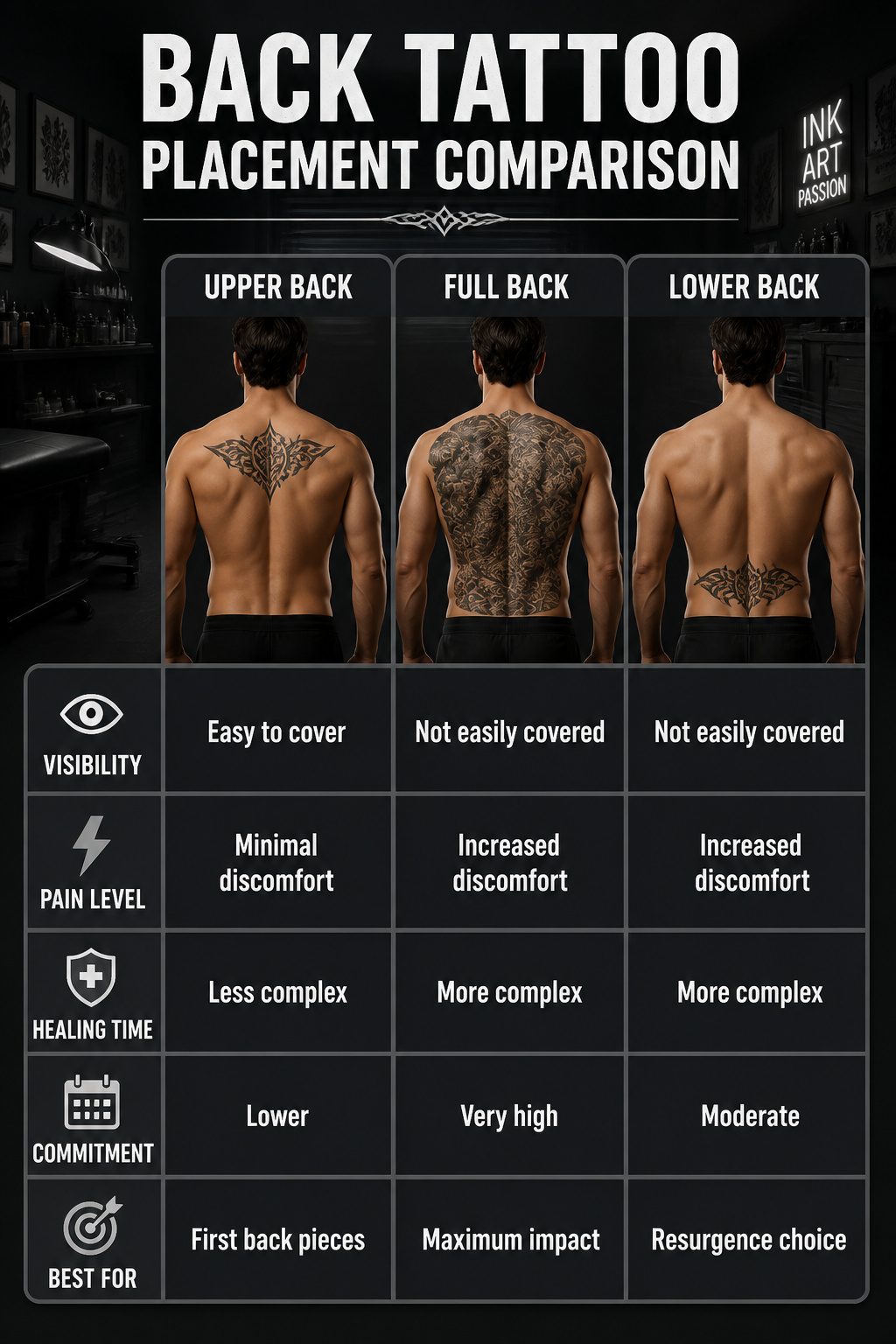
The upper back gives you the easiest arrangement with daily life. Shirts cover it without thought, yet a tank top or unbuttoned collar puts the work on display exactly when you want.
Muscle and padding up there mean the needle sits less sharply than elsewhere, and that visibility without constant exposure is why so many first back pieces land between the shoulder blades.
A full back is the traditional canvas for a reason. Artists treat it as a single mural, hanging the whole composition from the spine as a natural center line.
The impact is maximum; the commitment matches it, with multiple sessions spread over months and a healing rhythm where each section settles before the next goes in. This scale demands time and money most other placements do not.
Lower back work has seen a genuine resurgence in men’s tattooing, though the curvature there reshapes how a design reads. Bone sits closer to skin near the lumbar spine, so the pain sharpens.
Spine tattoos themselves run the central channel where nerve proximity makes the sensation more intense and demands linework precise enough that any waver shows instantly.
Healing differs by placement in ways that affect the result. The upper back moves less and rubs against clothing more predictably.
Lower back skin flexes with every bend and twist, and waistbands sit right on the healing line.
A full back means managing all of these zones at different stages, each with its own timing for when the scabbing quiets and the color settles true.
What the Chair Actually Feels Like
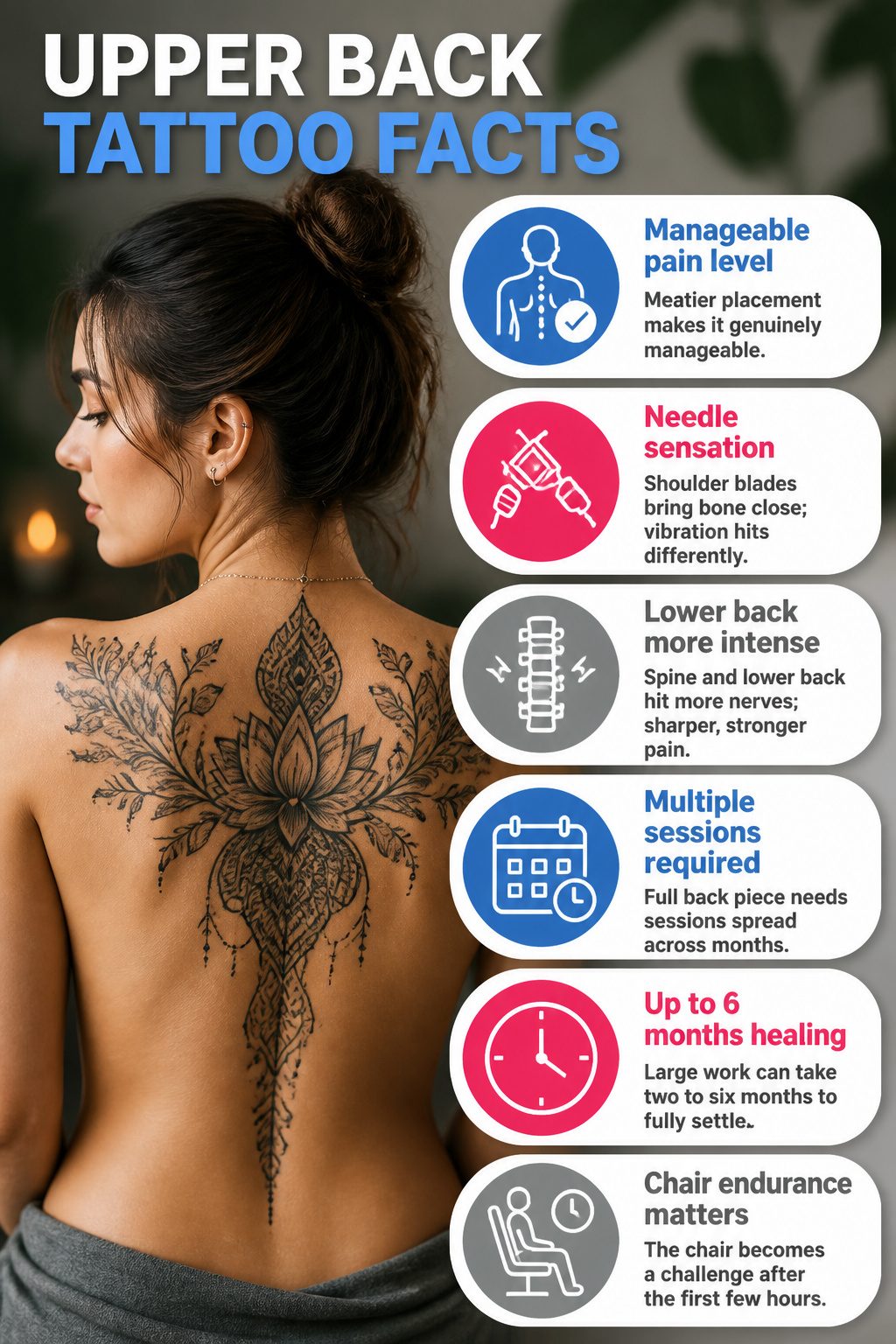
The upper back sits over the thickest muscle on the torso, and most people find that meatier placement genuinely manageable.
The needle vibration changes once the work moves toward the shoulder blades, where bone sits close to skin and the buzz travels through the frame in a way flesh alone does not.
Lower back sessions and anything tracing the spine hit more nerve endings and register sharper, more insistent pain than the upper regions.
A full back piece needs multiple sessions spread across months, with the skin requiring time to heal between passes. The chair itself becomes a separate challenge from the needle after the first few hours.
Large work can take two to six months to fully settle depending on complexity and how saturated the color is. Trying to power through in marathon sittings is hard on both the result and the person wearing it.
Aftercare for a Spot You Cannot See
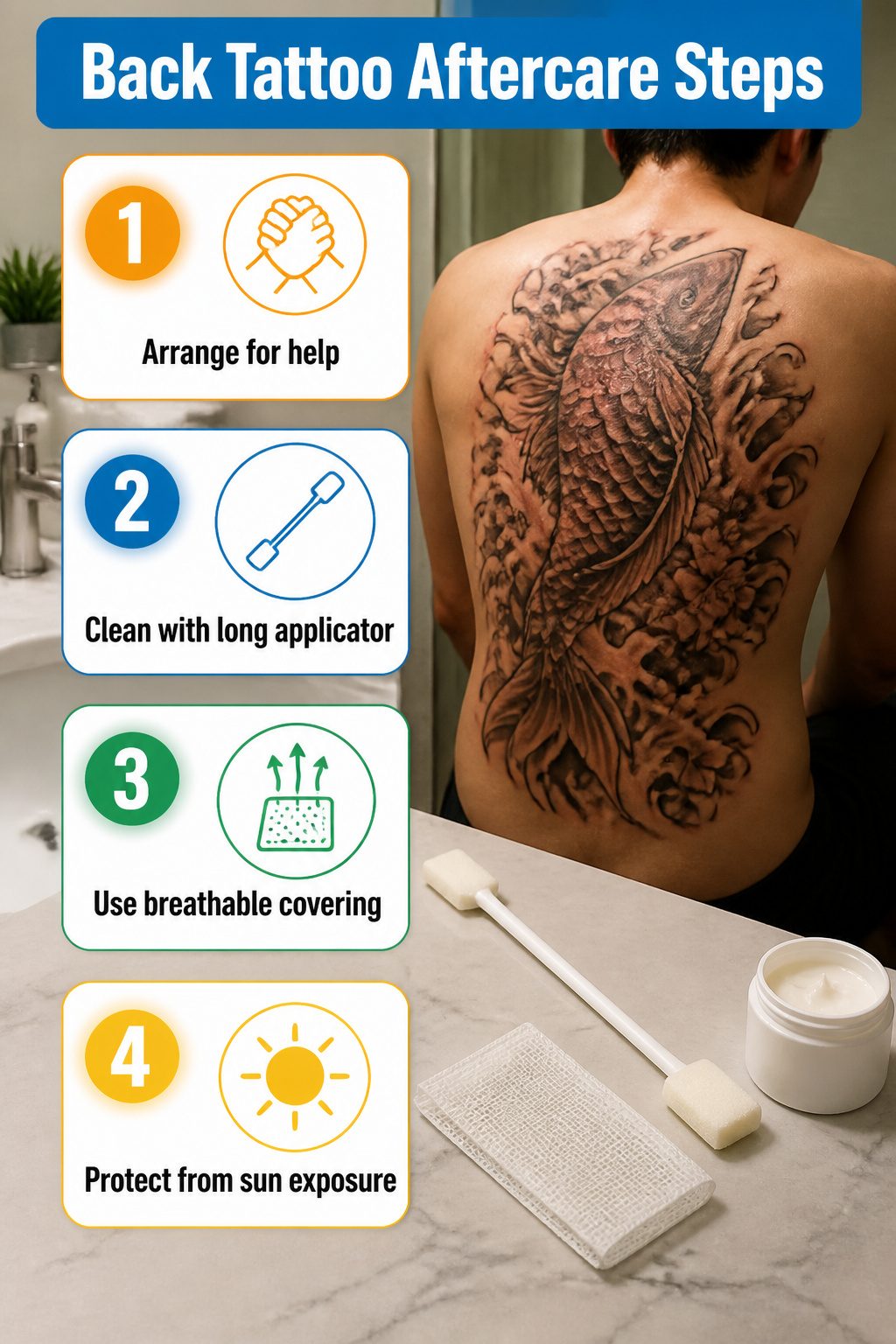
The real problem with healing a back piece starts the moment you stand up from the chair and realize you cannot see what the artist just finished.
A bathroom mirror catches the upper back if you twist, but the center and lower back stay blind spots for the full two to three weeks it takes skin to close over fresh work.
Line up help before you leave the shop, because washing and ointment application fall somewhere between awkward and impossible alone. A clean, long-handled applicator works in a pinch, though another set of hands is the surer bet.
Sleeping turns into a project. Stomach or side are the only positions that keep pressure off the work for those first weeks, and even then, fresh plasma can glue you to the sheets by morning.
Pulling fabric free tears at the forming scab, so many artists recommend a thin layer of breathable covering for the first few nights. Sun protection is its own headache.
The back seems covered until you are loading groceries, walking the dog, or sitting outside with coffee, and a shirt riding up or a tank strap slipping is all it takes for accidental exposure.
UV fades pigment and damages healing skin, so plan for coverage you do not have to think about. If any spot turns hot, swollen, or starts oozing, that is not normal healing.
The back is hard to monitor yourself, and guessing is not a treatment plan.
Size, Style and the Meaning Behind It
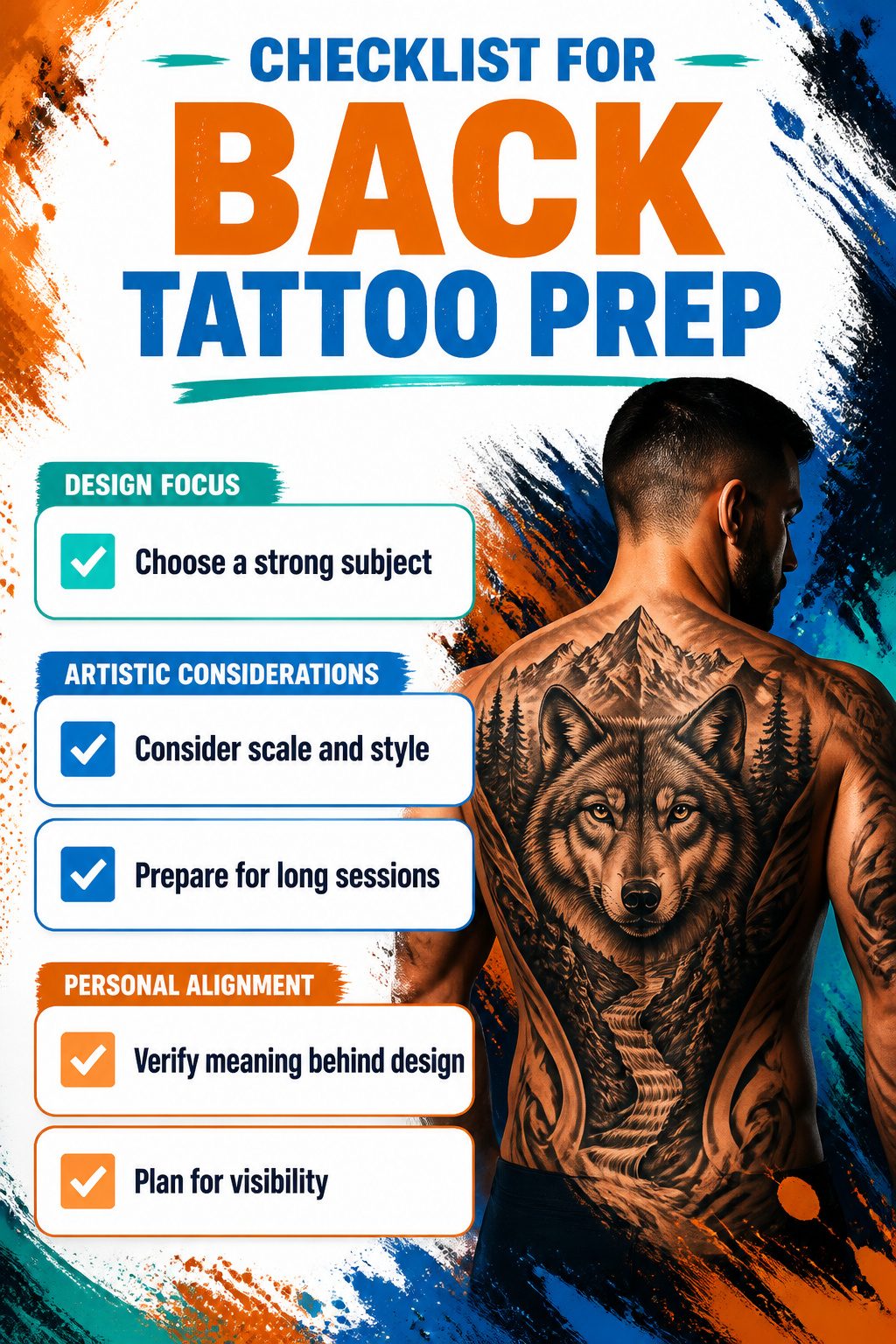
The back is the one place on the body where a tattoo can actually breathe.
A full back piece gives a wolf the room to feel large, a landscape the depth to recede, a portrait the scale for realism that still reads clearly at fifty.
Every artist I have spoken with about this says the same thing: choose one strong subject and let it own the space. Crowding several images together turns the back into a collage, not a statement.
Style and subject need to match. Realism demands the back’s flat planes for a face to hold its expression.
Tribal patterns flow with the musculature underneath them, tracing the shoulders and spine so the body itself completes the design. Bold lines carry further over decades than fine detail packed into too small a space.
The pieces that age worst are the ones chosen for display, not meaning. A back tattoo is seen by others more than by the wearer, and that asymmetry tempts people toward impressing an audience.
The work that holds up is the work that would matter even if no one else saw it.
Cultural Weight Some Designs Carry
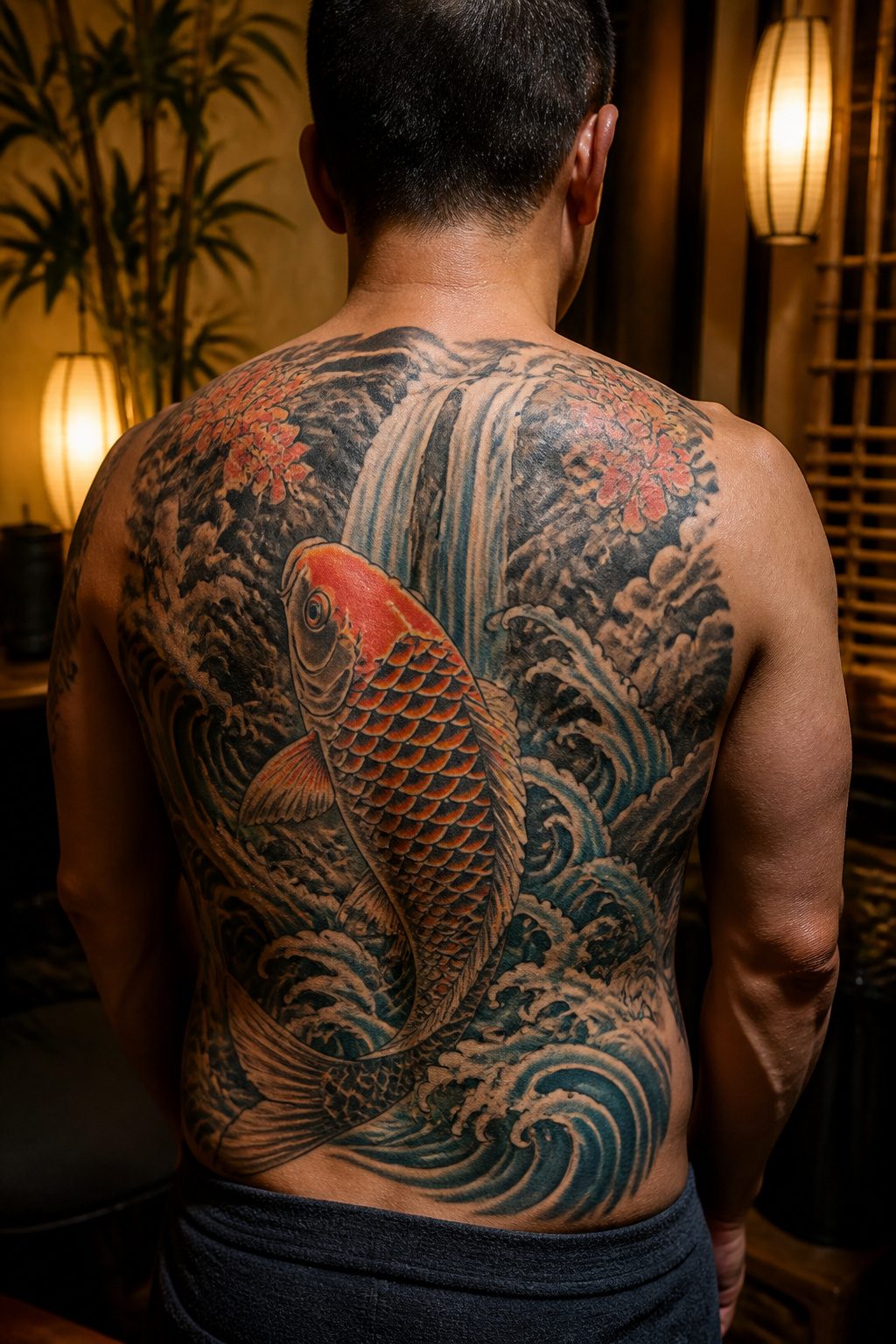
Some back designs carry histories that outlast the person wearing them. Japanese irezumi began as a mark of punishment, applied to criminals as a visible record of their crimes.
The practice reversed over centuries: the same full-back pieces became an art form so demanding that the pain itself became part of the meaning, applied through hand-tapping tebori across years of sessions.
The yakuza adopted these pieces as proof of loyalty and endurance, and that association still distorts how Western wearers approach the style, skipping the research that would reveal what koi ascending a waterfall or a hanya mask actually signals within that system.
Polynesian tatau carries a different weight. The patterns mapped across a warrior’s back recorded rank, lineage, and rites of passage earned, not chosen from a flash sheet.
Each line and placement held specific meaning within a living tradition.
Wearing either tradition without that connection draws the criticism it deserves. Not every back piece carries this burden.
A geometric composition or biomechanical design invented last year does not. But the ones that do require more than liking how they look on Pinterest.
The research is the minimum price of admission, and skipping it does not go unnoticed by the people whose histories are being worn.
Frequently Asked Questions
Why are back tattoos so desirable?
Back tattoos give you privacy and a large canvas for almost any design, which is why they rank among the most sought-after placements for men.
The full back lets an artist build a single mural that smaller areas cannot support, while upper back work stays hidden under a shirt and visible exactly when you want it.
How long does it take for back tattoos to recover?
Large back tattoos need two to six months to fully recover, depending on complexity and color saturation.
The skin requires weeks between sessions to settle, and a full back piece stretches across months or even years of appointments before it is finished.
Are back tattoos painful?
Pain varies sharply by placement. The upper back sits over thick muscle and feels genuinely manageable for most men.
Work near the shoulder blades, lower back, or spine registers sharper because bone sits close to skin and nerve density runs higher there.
What are popular designs for back tattoos?
Japanese irezumi, tribal patterns, animal motifs, skull designs, floral work, geometric pieces, biomechanical art, angel wings, mandalas, portraits, mythological creatures, scene tattoos, crosses, and abstract compositions all scale well on a back canvas.
Each style uses the spine as a center line or the shoulder blades as framing anchors.