Daisy tattoos run from a single fine-line bloom you can hide in a minute to a three-hour thigh piece with stems that cross like a hand-picked bunch, and the list ahead covers minimalist lines, full bouquets, watercolor washes, bees and butterflies mixed in, chains, black and gray shading, realistic petals, and where to place them.
The deciding factor is how much room you can give the design, because realism under four inches goes muddy while a half-inch chain blurs into a dotted line, and placement matters as much as style when you are choosing from the ideas ahead.
I would build any realistic daisy around genuinely dark darks; that contrast is what still reads years later when mid-grey pieces have gone flat, and the black and gray option later in the list carries that same lesson in softer tones.
1. Minimalist Daisy Tattoo
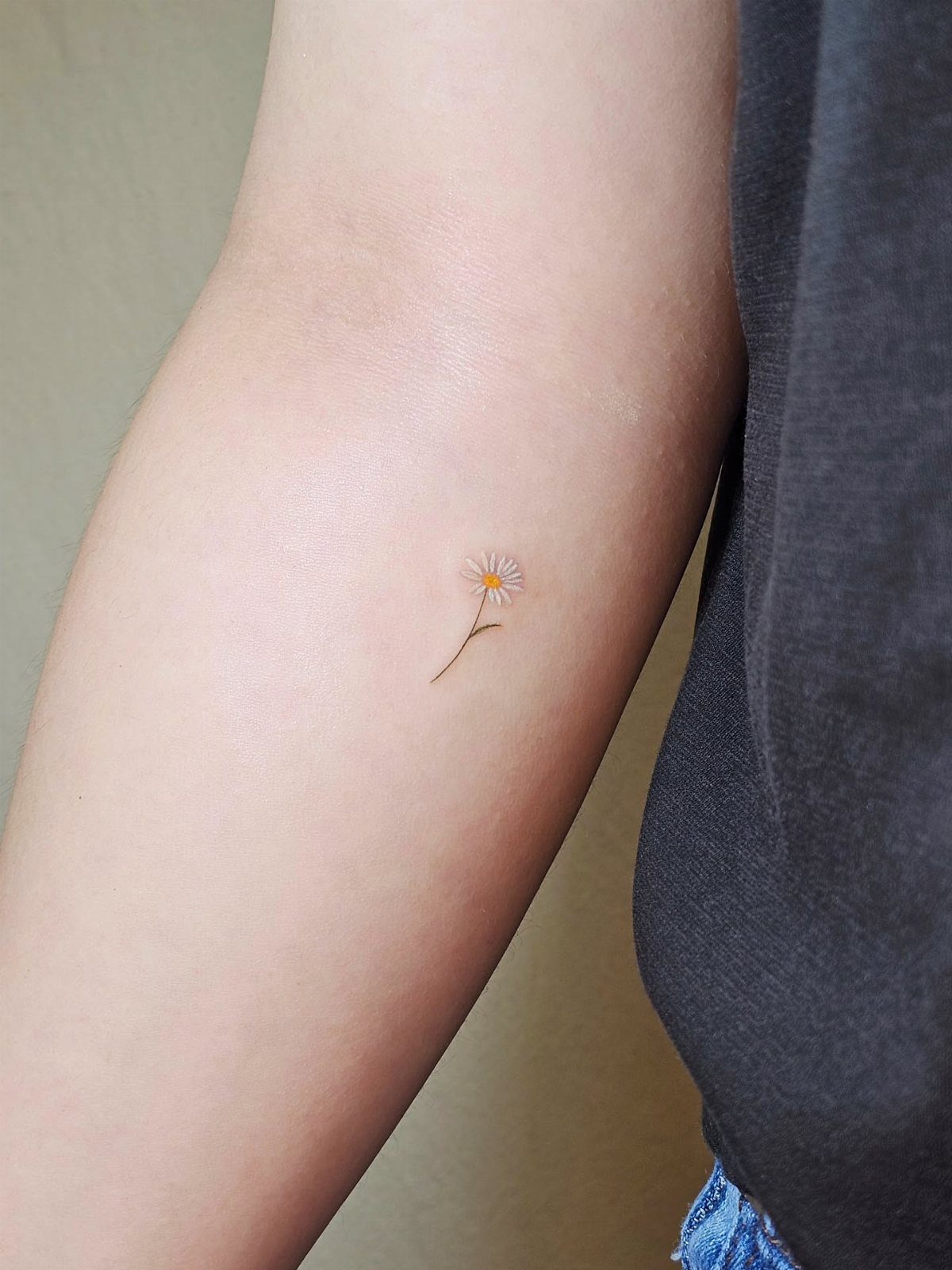
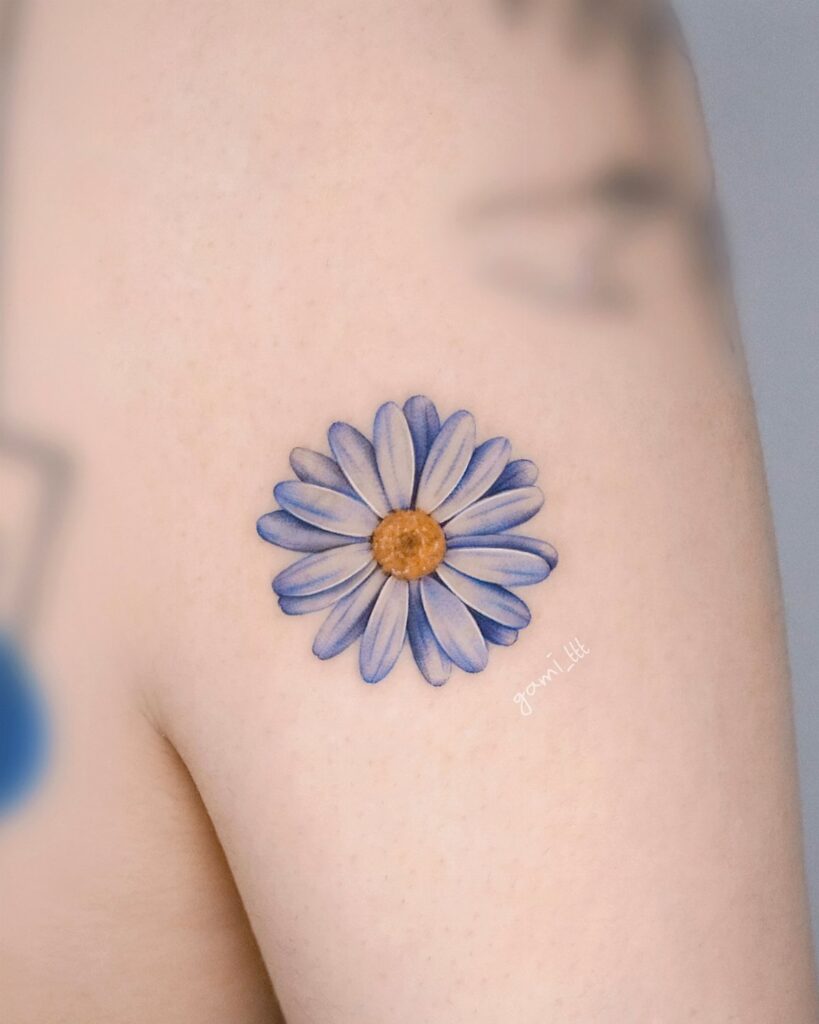
One clean line weight, no shading, no fill, a single daisy on the inner forearm reads like a pressed flower.
The silhouette does the work; the daisy reads instantly from across a room where a stripped-down rose would turn to scribble.
I would ask the artist to leave visible gaps between the petals, since fine lines placed close together spread as the ink settles. This is the least permanent style you can get, so expect touch-ups.
It suits someone who wants the option to show or hide, and who values understatement over detail.
2. Daisy Bouquet Tattoo
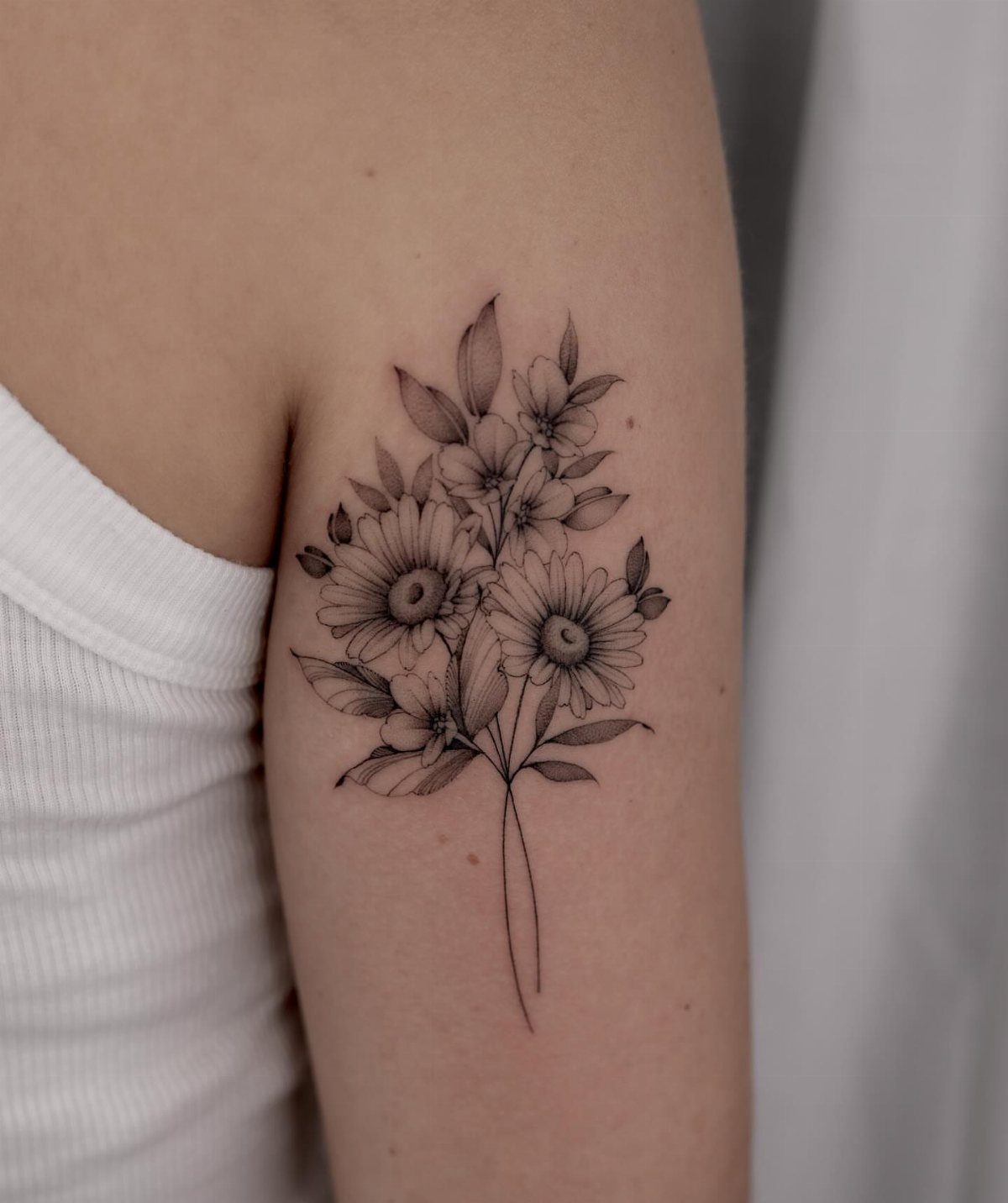
Several stems gathered into one arrangement turn a daisy from accent into real piece. The thigh or upper arm gives the blooms room to open fully, and three hours or more is typical.
I would vary the bloom sizes deliberately: one dominant, two mid-size, a few buds. Uniform spacing looks arranged; let stems cross and petals overlap the way they would in a hand-picked bunch.
3. Watercolor Daisy Tattoo
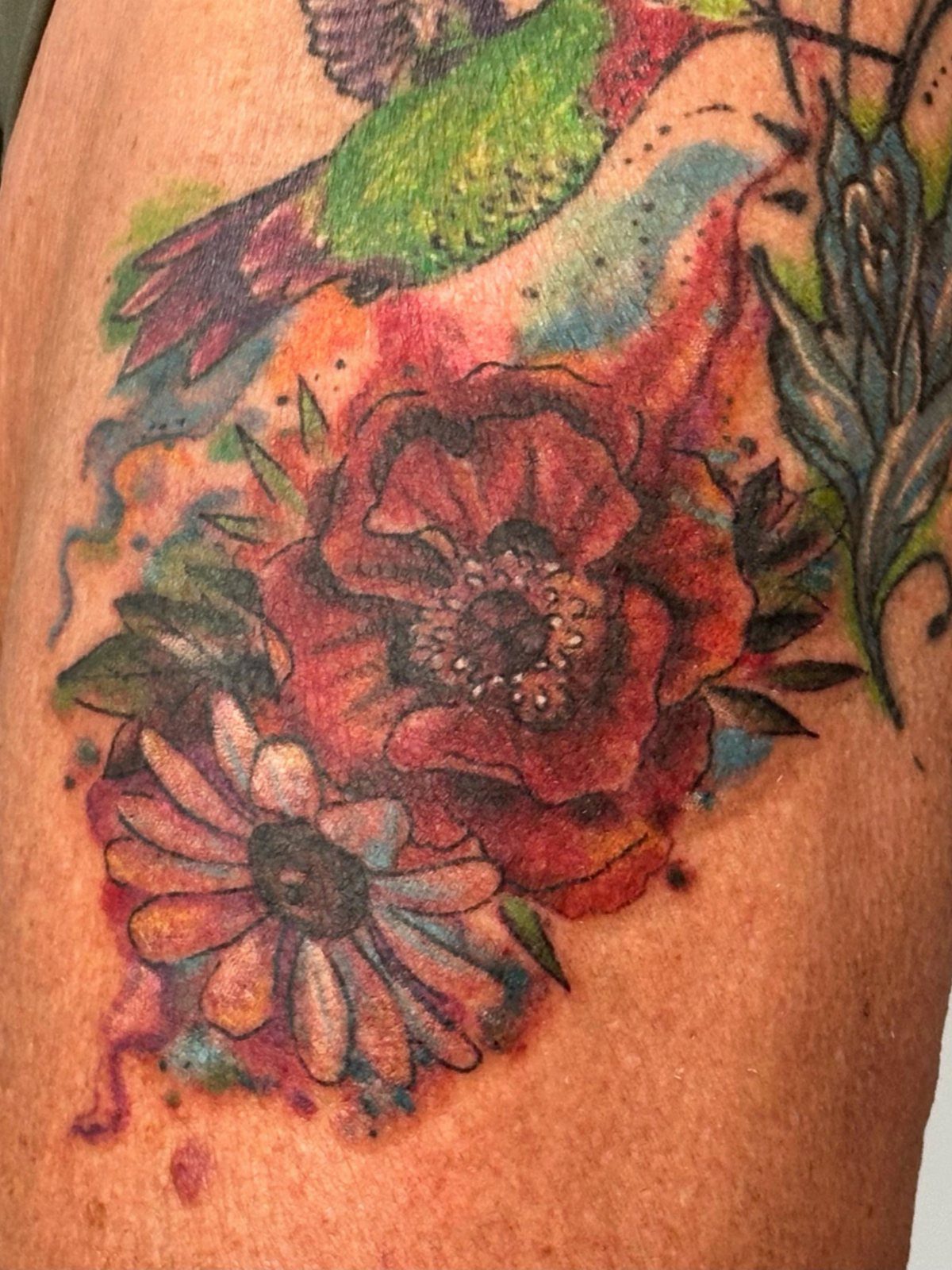
Loose color washes with soft or absent outlines give the daisy an expressive, emotional quality that tighter styles do not always reach. This suits someone who wants their daisy to feel personal and artistic rather than simply decorative.
4. Daisy and Bee Tattoo
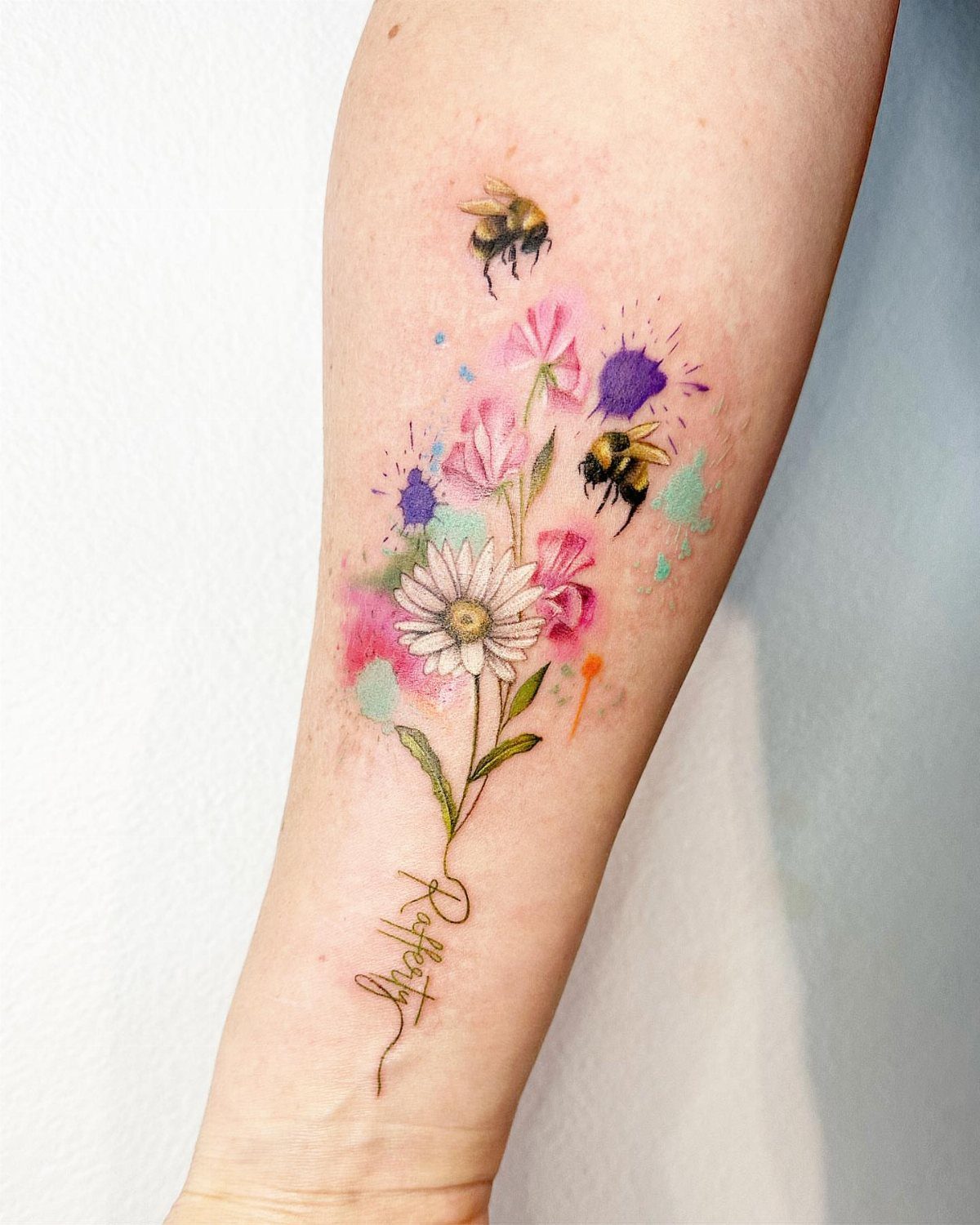
Legibility beats accuracy every time. The forearm or shoulder carries the composition well, and the contrast between the bee’s textured body and the clean daisy petals creates a dynamic that feels like a frozen second from a summer afternoon.
5. Realistic Daisy Tattoo
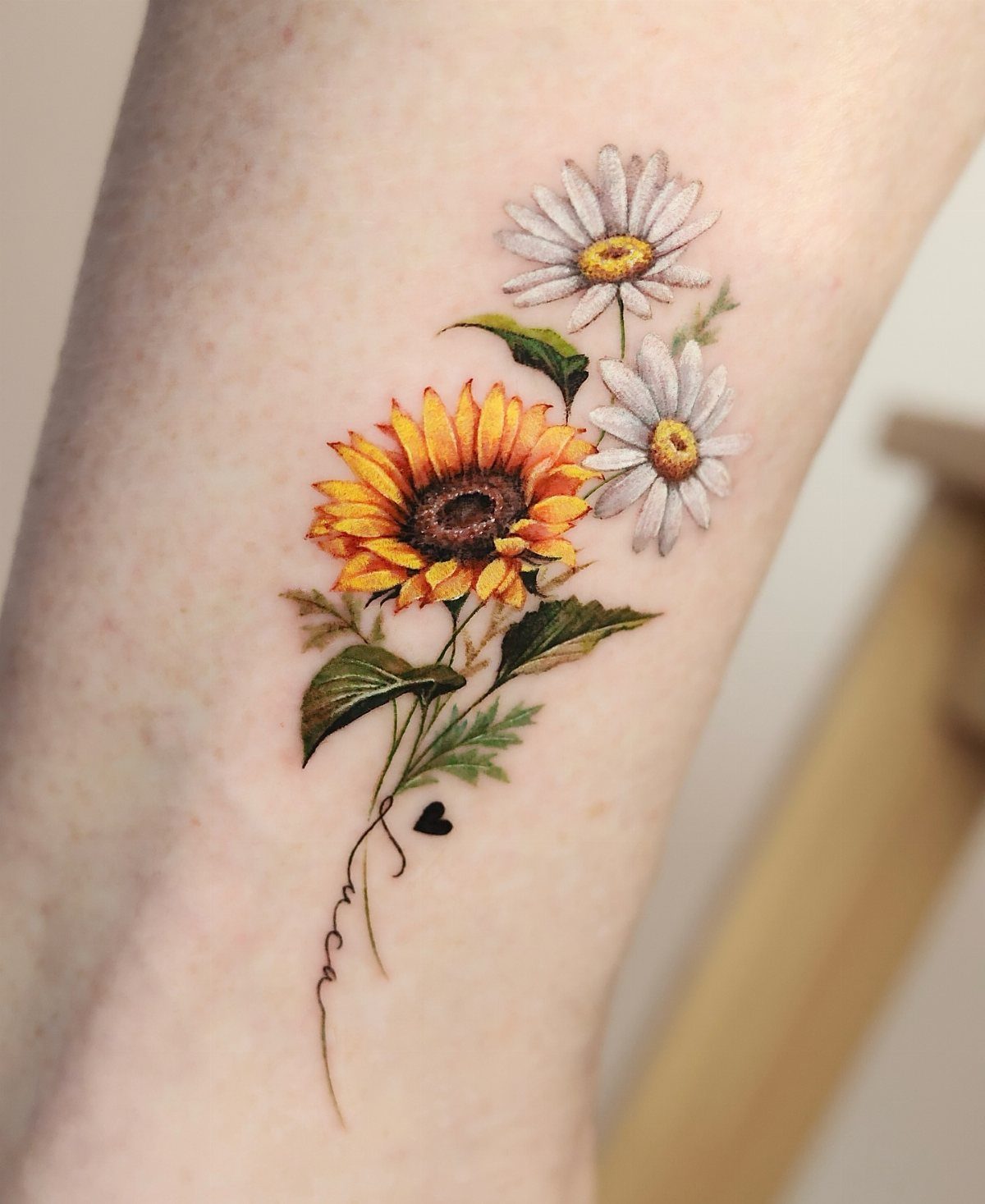
Black and grey realism, or full color, with petal curl and center texture rendered properly, is the most technically demanding daisy on this list.
The petals are thin and pale, so the illusion depends almost entirely on the shadows between and beneath them. When I have compared realism florals that held up against ones that went muddy, the difference was almost always contrast.
Pieces built with genuinely dark darks still read years on; pieces built entirely in mid-greys go flat. Give it size.
Under about four inches, realism detail has nowhere to live. The forearm, upper arm, and thigh earn the sitting time.
6. Daisy Chain Tattoo
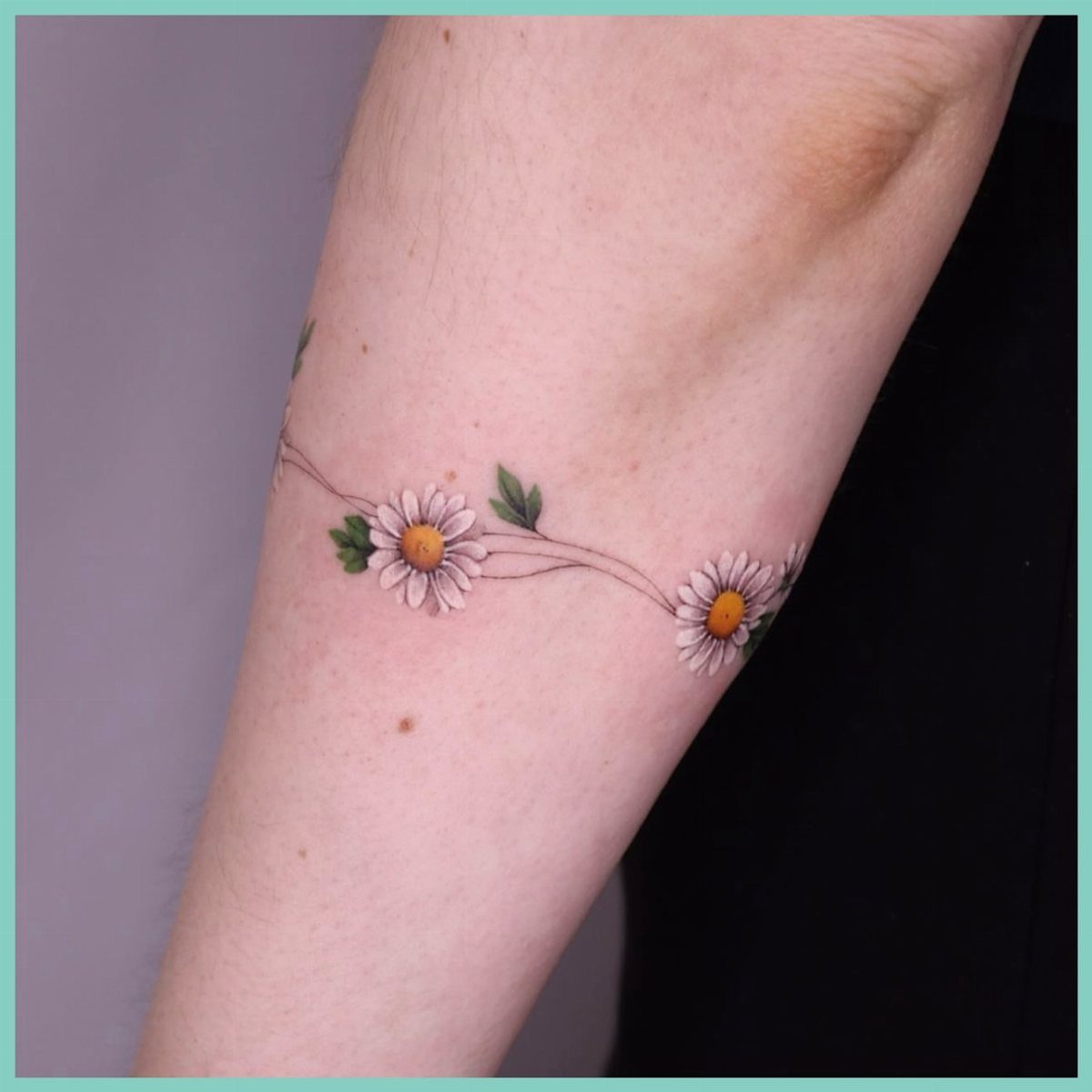
A visible break looks intentional; a bad join looks like a mistake forever.
Daisies much smaller than half an inch across tend to blur into a dotted line over the years, so scale up slightly if you want the chain to stay readable.
7. Black and Gray Daisy Tattoo
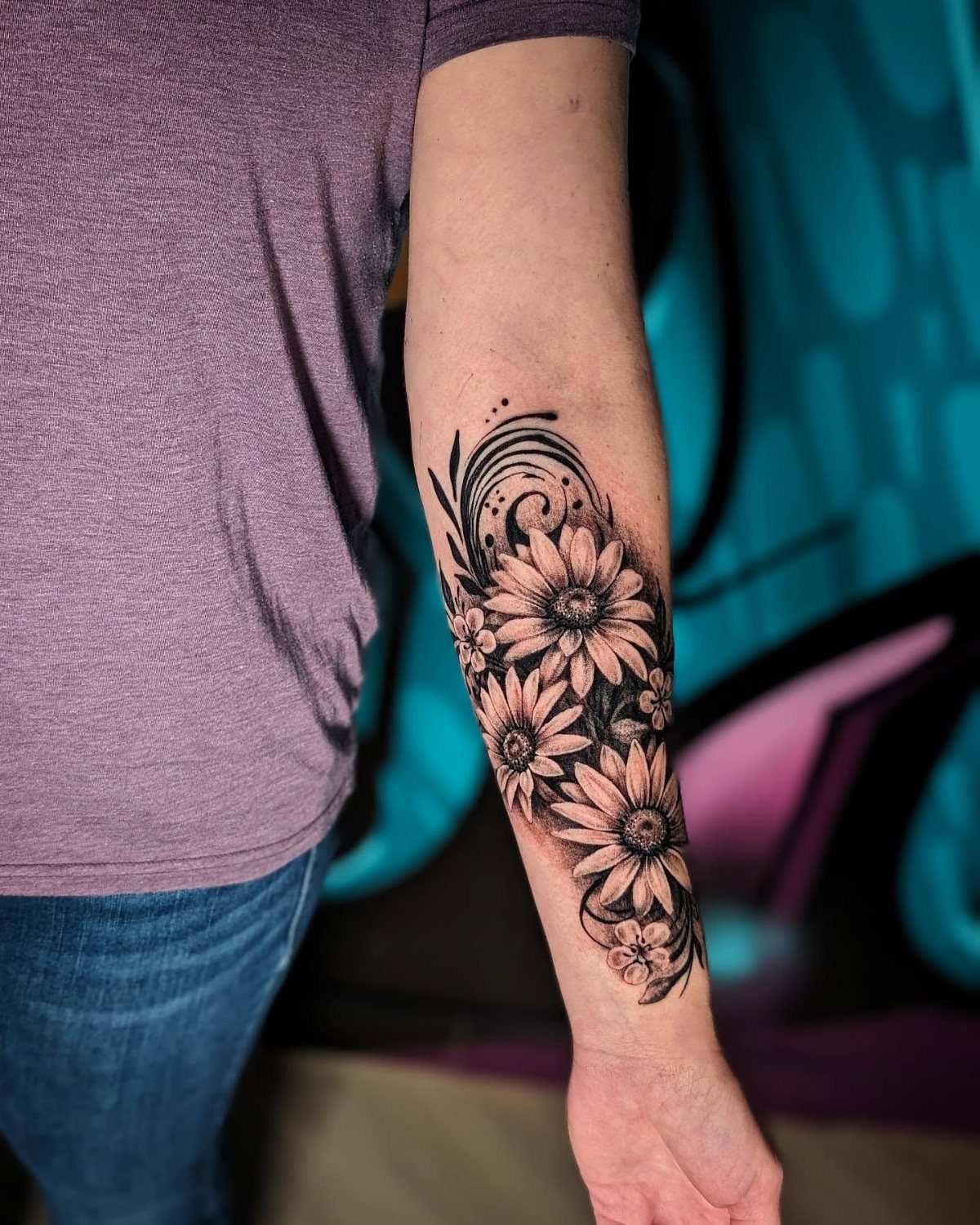
Black and gray strips a daisy down to pure form: light, shadow, and the geometry of the silhouette. Petals turn into exercises in contrast, and the round center picks up real depth when the gradation is built up slowly.
The mood reads more serious than color without stripping away the flower’s particular warmth.
Forearm or calf both suit the tonal range well.
I’d point anyone toward this who wants a daisy that reads as considered rather than playful. What you give up is the cheerfulness of yellow and white.
What you gain is a tattoo that still looks intentional at forty.
8. Daisy and Butterfly Tattoo
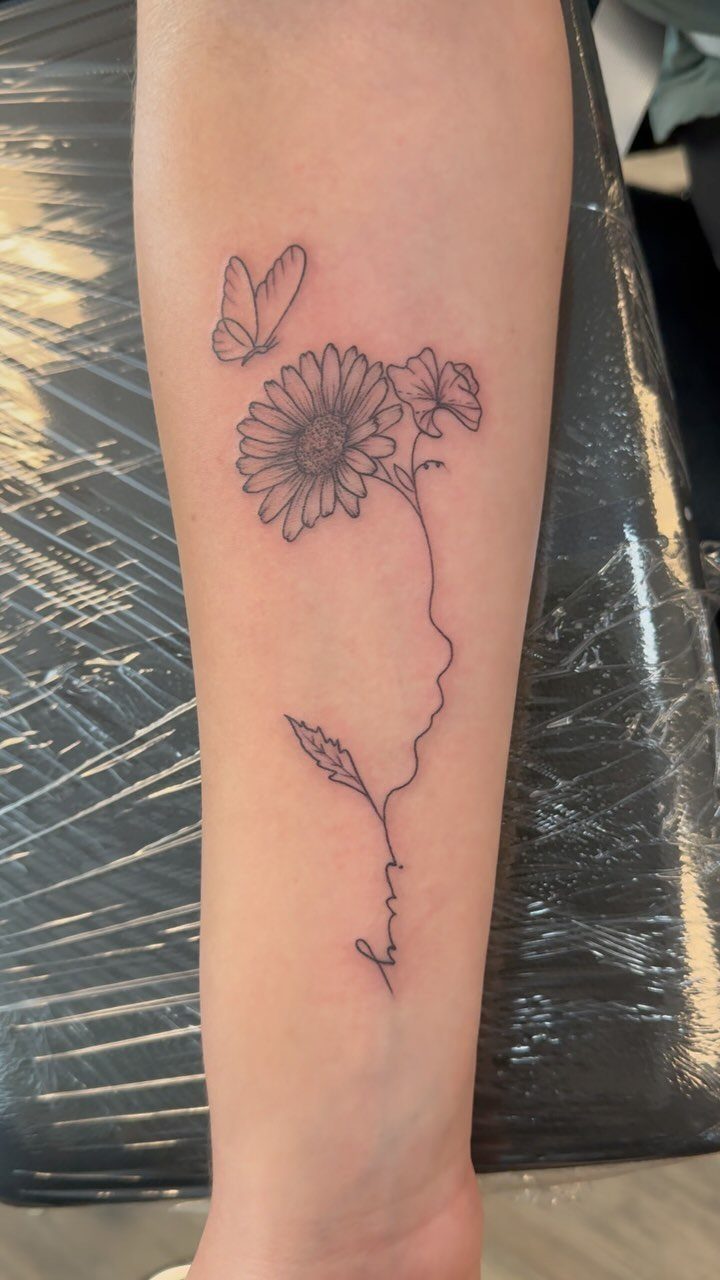
A daisy paired with a butterfly is the most requested combination for a reason. The flower carries new beginnings; the insect carries transformation.
The thematic fit is natural.
Fine-line work keeps the pair light enough that neither overpowers the other.
9. Sweet Pea and Daisy Tattoo
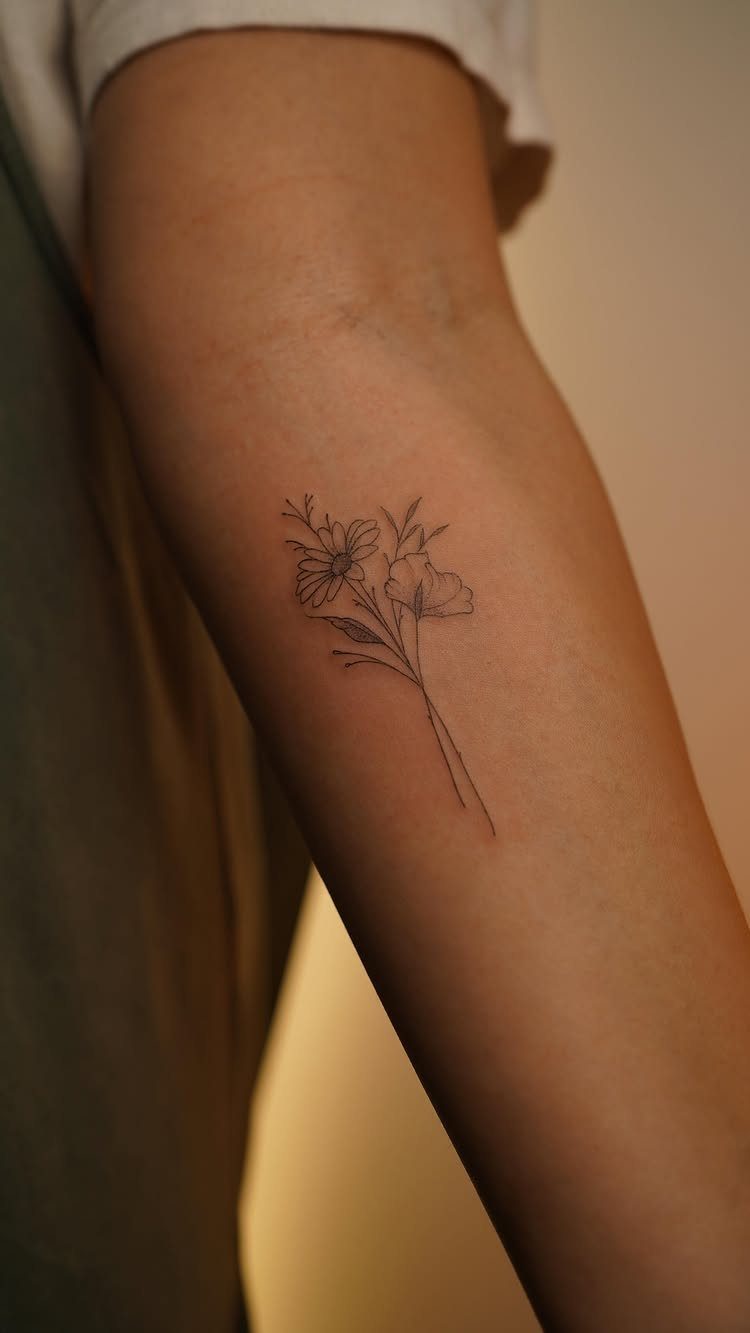
Sweet pea and daisy together blend two different kinds of delicacy. The daisy reads open and direct; the sweet pea brings a ruffled, climbing softness that complicates the composition in a good way.
The stems and leaves need the same light hand to keep the bouquet from collapsing into a dark mass.
This combination carries the usual daisy associations of innocence and joy, with sweet pea’s added layer of departure or gratitude. Birth flower meaning matters to some people; April gets daisy, and sweet pea shares the month.
For placement, the arm works well because the vertical growth habit of both flowers lets the design travel with the limb rather than fighting it.
10. Small Daisy Flower Wrist Tattoo
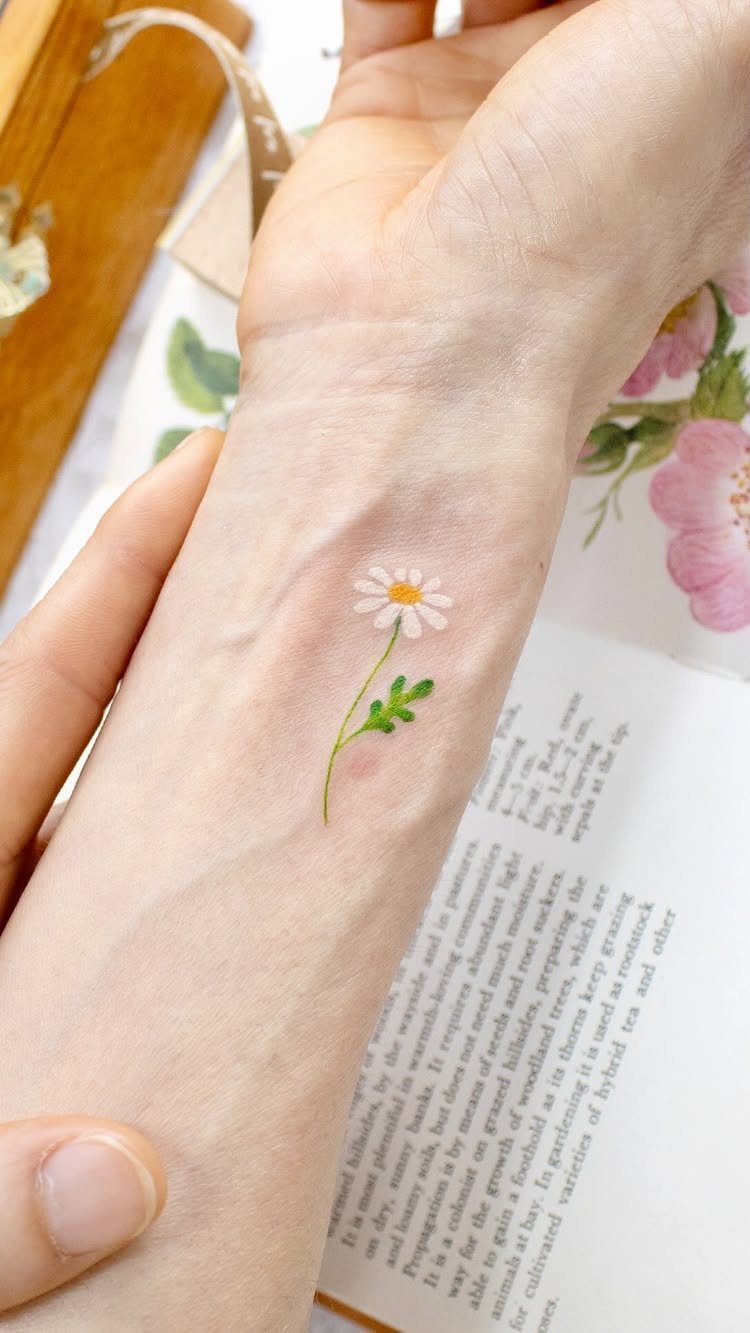
The tradeoff for constant visibility is constant sun and friction.
This is the choice for someone who wants the daisy as a private marker rather than a statement. The size keeps it personal; the placement keeps it present.
11. Daisy Flower Shoulder Piece
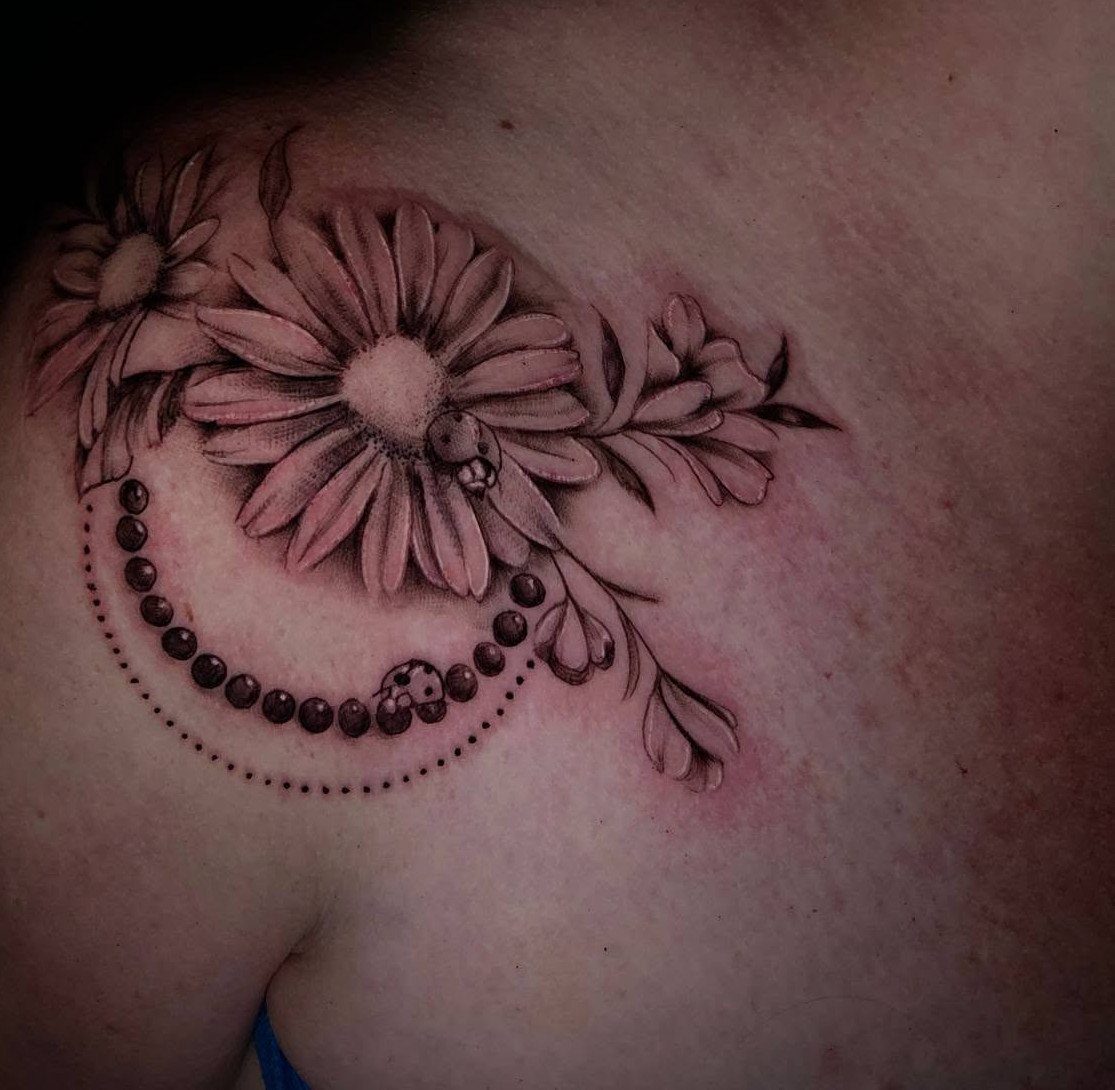
A generous cluster of daisies across the shoulder cap reads natural and relaxed from behind, visually strong from the side.
The shoulder forgives more detail than bonier placements. A beaded chain or secondary blossoms sit comfortably in the space without crowding the main blooms.
Black and gray keeps the composition unified; color would need more careful planning to avoid a scattered look.
12. Daisy with Quote Tattoo
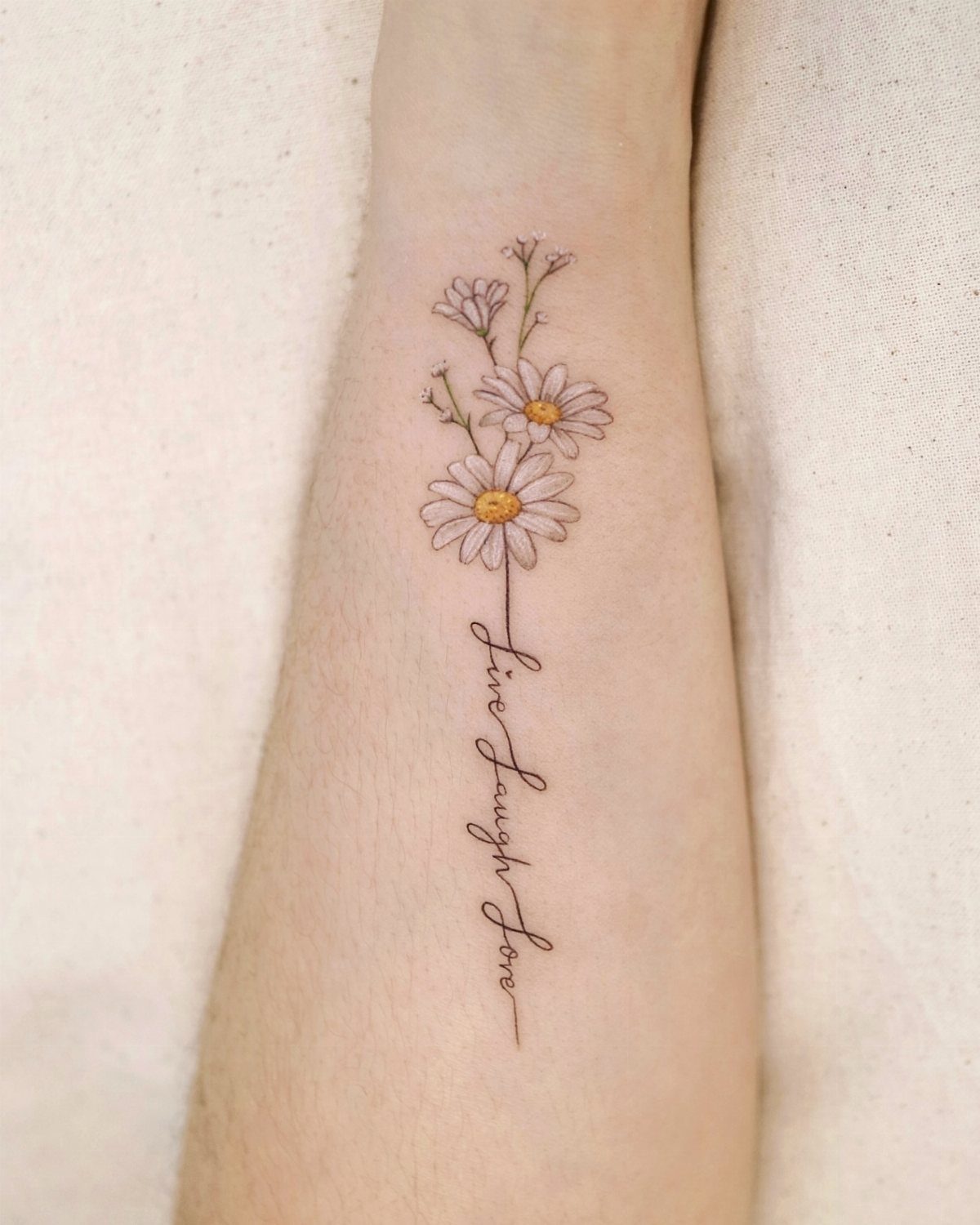
A short line of text anchored by daisies looks like a page from a notebook when done well, a poster when done badly. Length is the whole game.
Letting the stem form the words is another clean solution that integrates the two elements rather than stacking them.
Choose a font that matches the daisy style. A cursive, handwritten stem suits a casual phrase; a more formal script needs crisper, more separated blooms.
13. Gerbera Daisy Tattoo
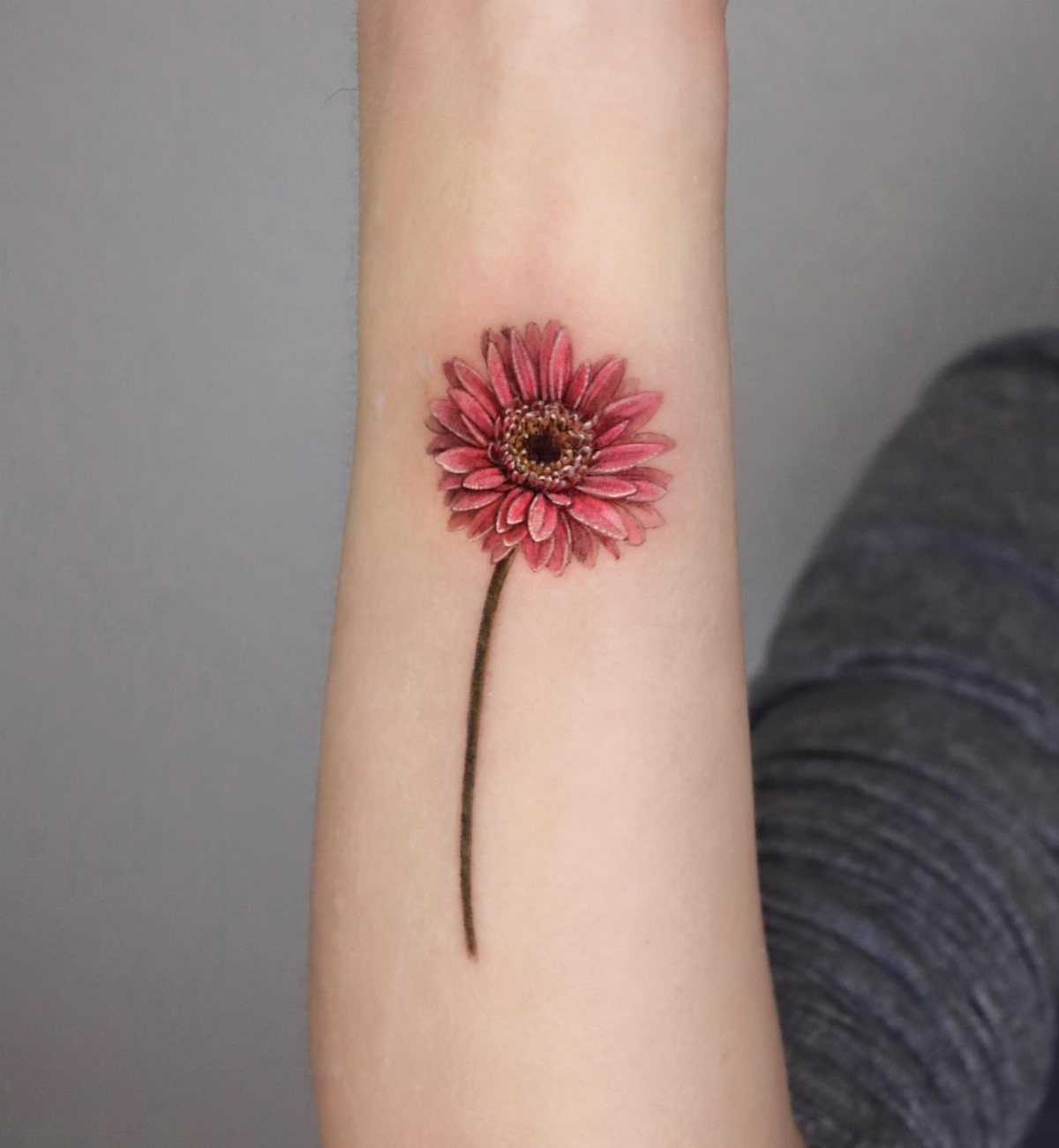
Gerbera daisies carry a different energy than their smaller cousins.
The petals are broader, the center is darker and more pronounced, and the stem runs longer, so the tattoo reads well on a forearm or along a collarbone where the line has room to stretch.
Pink or orange both work; orange leans warmer and more energetic, pink softer.
The color is what sells the happiness angle this flower is known for, so I would not do this one in black and gray unless you are specifically subverting that brightness.
A name or initials tucked into the stem, or small stars or hearts floating near the petals, keeps the personal connection without cluttering the main bloom.
Shading gives the petals weight and the center real depth in a realistic Gerbera daisy. That level of detail needs an artist comfortable with color saturation and the patience to sit for it.
Skip this if you want something discreet; the gerbera’s size and color draw the eye. Pick it if you need a daily visual lift and do not mind the visibility.
14. Daisy and Moon Tattoo
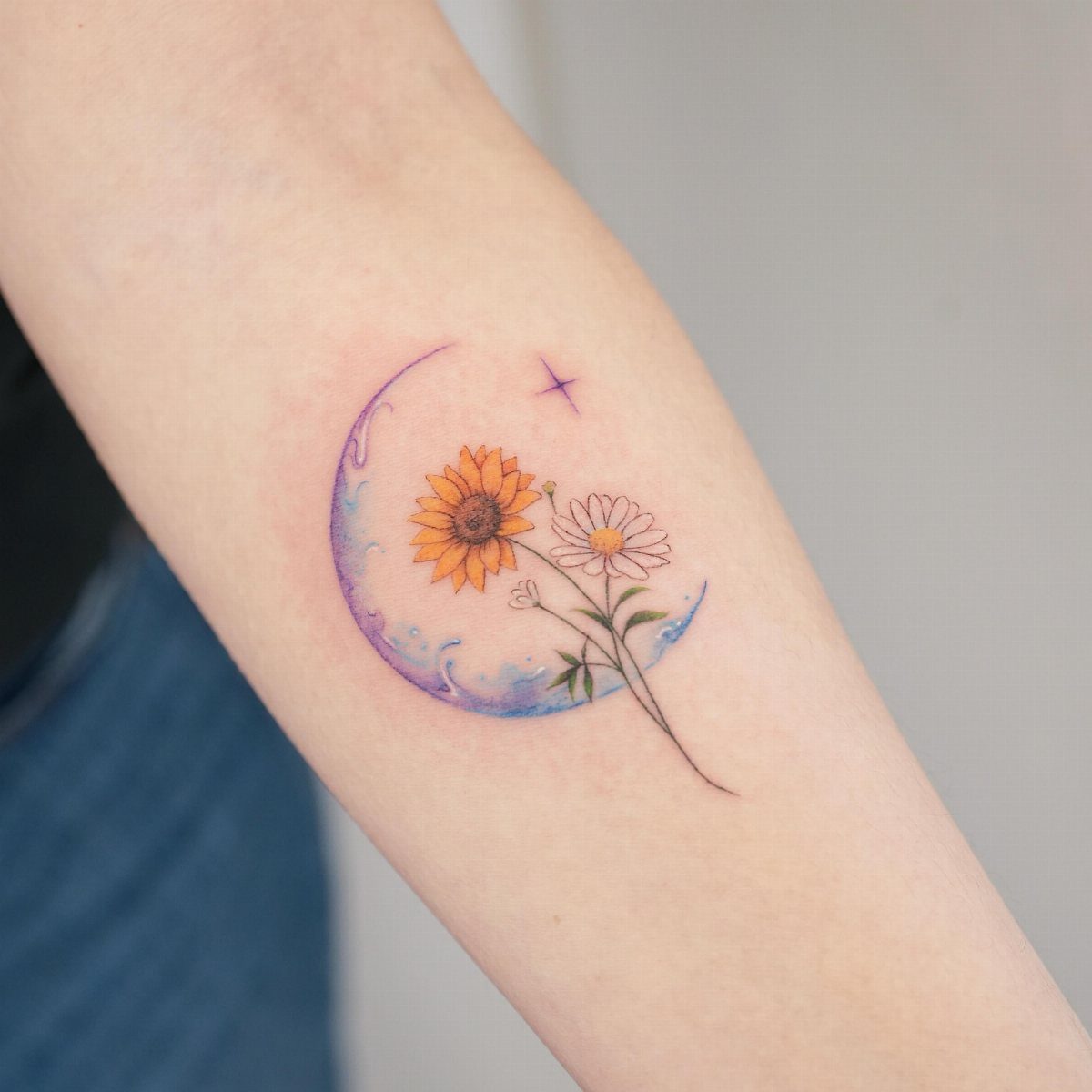
A crescent moon framing one or two daisies gives the whole piece a night-garden feeling that a daisy alone cannot reach.
A purple and blue wash behind the moon sets the atmosphere; orange and white flowers in front pop against it because those colors sit opposite each other on the wheel.
Watercolor shading for the moon keeps the look soft, but the moon’s edge still needs a clean line so it does not bleed into a blur over time. Fine line keeps both elements clean without them competing for attention.
Moon phases work as a more structured alternative to a single crescent. A row of small circles arcing above a daisy cluster, each circle a phase, turns the tattoo into a timeline.
The crescent shape wraps the muscle nicely on an arm; a horizontal phase reading fits the forearm, collarbone, or ribs better.
The whimsical quality here is real, not forced, but it needs color to land. A black and gray moon with a white daisy would feel colder, more memorial than magical.
Choose based on which mood you are after.
15. Daisy and Sunflower Tattoo
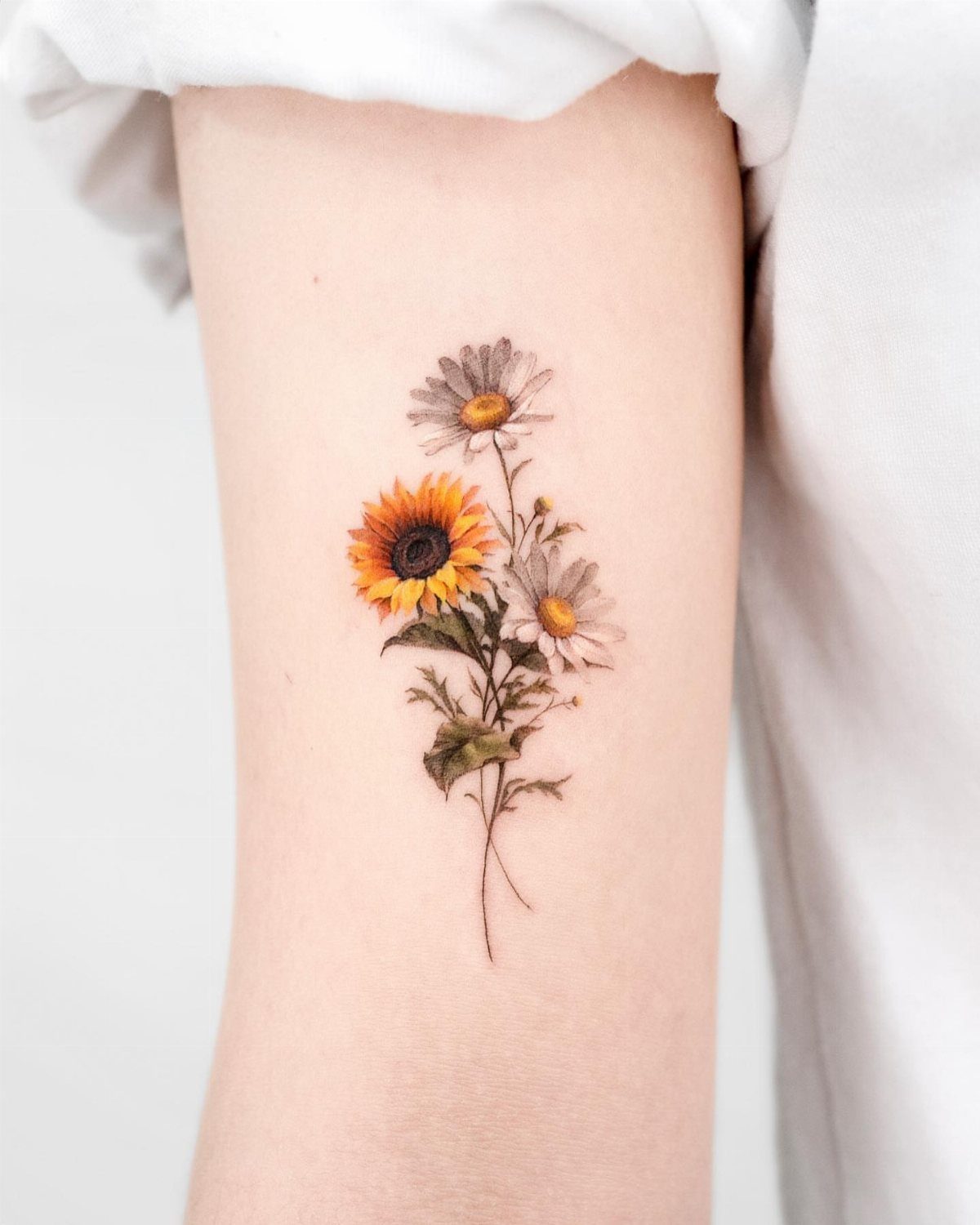
Sunflowers and daisies share a growing season and a yellow center, but the contrast in scale gives this pairing its pull. The sunflower reads as warmth and openness; the daisy keeps it from feeling heavy.
For someone who wants color without a full sleeve, two or three stems climbing the upper arm carry enough detail to reward a closer look.
The green stems tie the two flowers together, so the artist’s choice of leaf shape matters more than usual. Too broad and the sunflower dominates; too narrow and the daisy stems look skimpy.
Ask to see healed photos of color work, especially yellow, which fades fastest on skin that sees sun.
16. Fine Line Daisy Forearm Tattoo
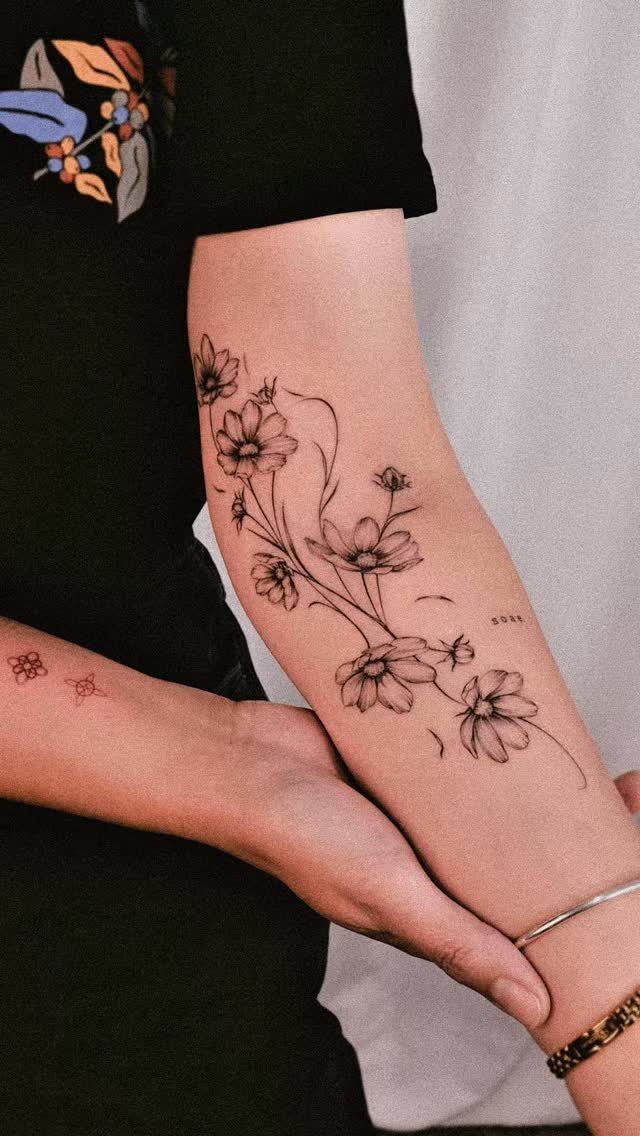
A single needle and a steady hand turn the daisy into something you can read from across a room or miss entirely, depending on the light.
Fine line work keeps the tattoo quiet; it only speaks up when you roll up your sleeve.
The forearm offers flat, predictable skin, which helps the thin strokes age evenly. Lines this slim blur faster on fingers, feet, or anywhere the skin moves hard.
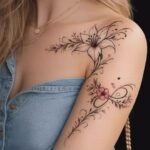
"Soar" beside the stems is one choice; a date, a name, or nothing at all works just as well. The placement above the wrist bone keeps it visible without competing with a watch.
Budget extra time in the chair. Clean linework at this weight cannot be rushed, and touch-ups are harder when there is no bold outline to fall back on.
17. Celestial Daisy Tattoo
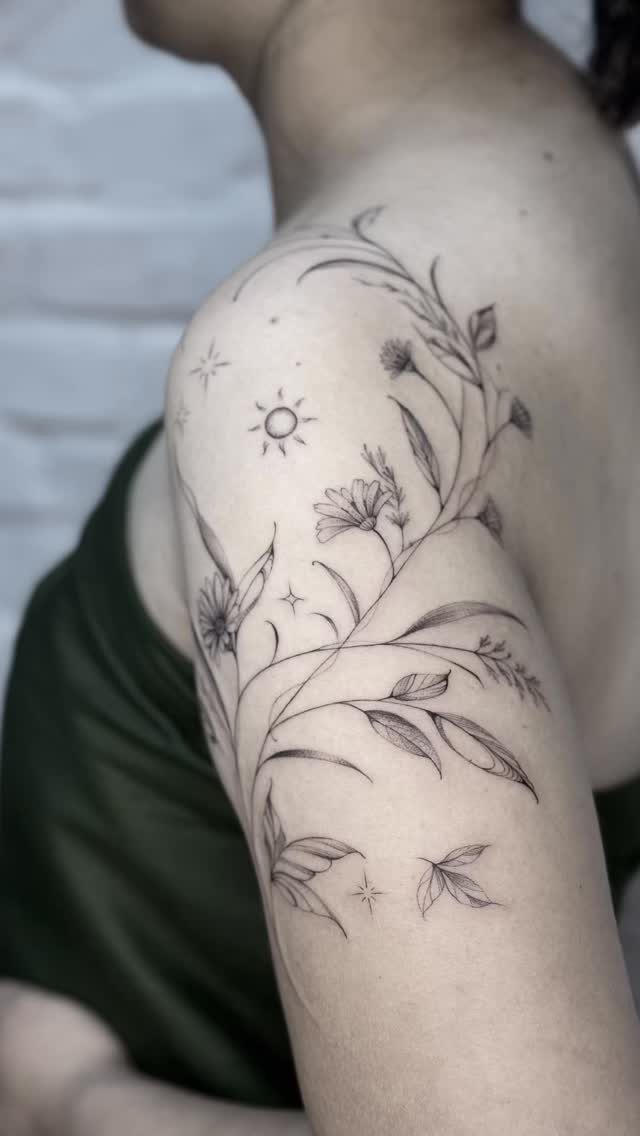
Daisies close at night and open at dawn, so the sun and stars are not just decoration; they fit the flower’s actual habit.
A fine-line sun tucked behind a petal and a few scattered stars turn a floral piece into something that reads as a small scene rather than a botanical study.
The shoulder and upper arm give the artist room to spread the elements without crowding. Black and gray keeps the celestial symbols from looking like clip art; color would push the sun toward cartoon and away from quiet.
Someone who wants meaning without a literal quote gets it here, though the symbolism stays private unless you explain it.
18. Falling Daisy Petals Leg Tattoo
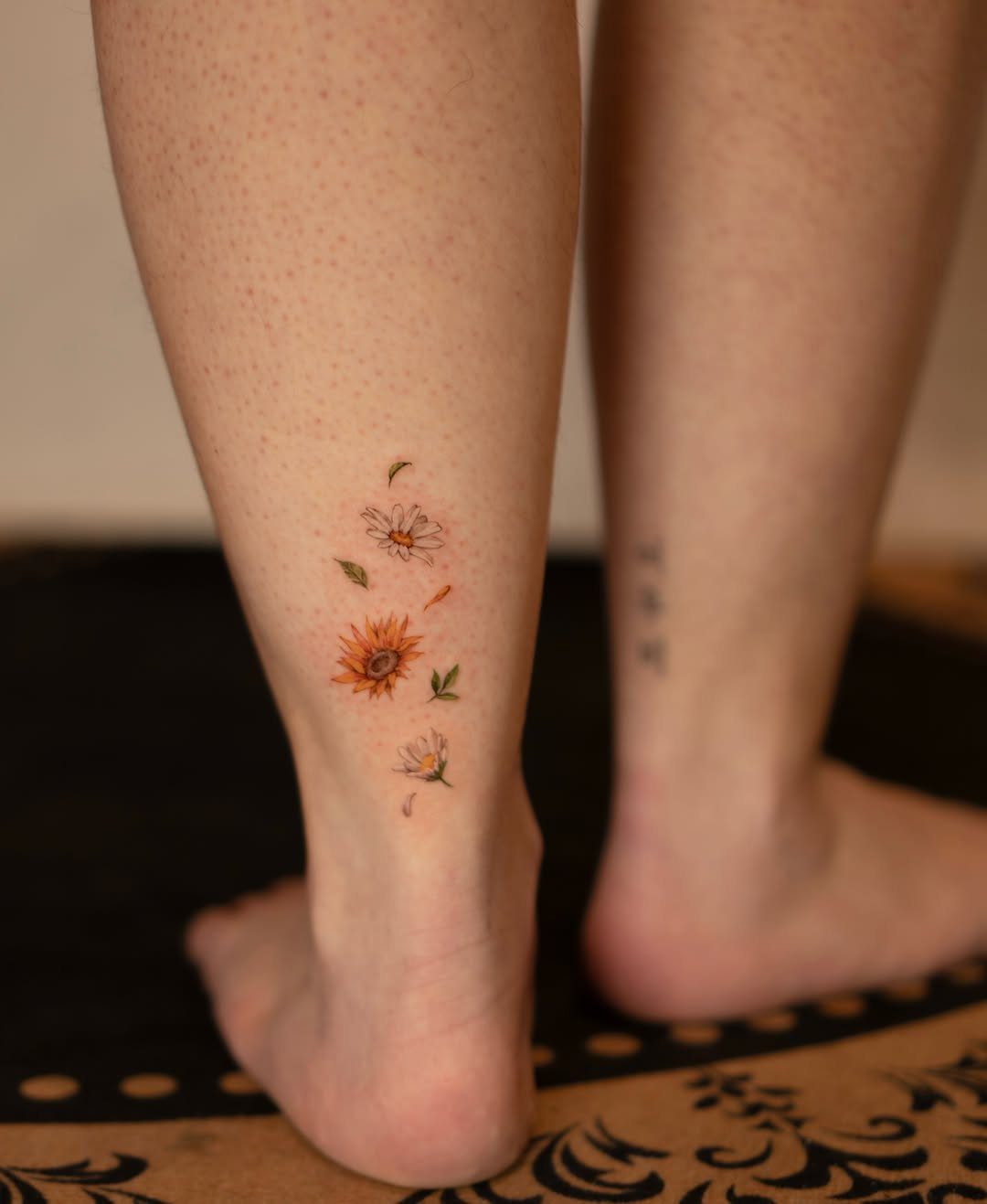
Loose petals solve the problem of how to end a floral piece. A stem stops abruptly or trails off; petals let the tattoo dissolve the way the flower actually does.
The lower leg runs vertical, which suits a falling motion better than a horizontal placement on the thigh or forearm.
White ink on the petals needs enough yellow or orange in the centers to keep the contrast from washing out over time. Orange centers, not brown, read warmer against most skin tones.
A piece this size sits above the ankle bone to avoid the rubbing of socks and boots. The drifting petals also draw the eye upward, which lengthens the leg rather than cutting it off at the joint.
For someone who wants color and movement without a full calf piece, this placement earns its space.
Daisy Tattoo Placement
Inner wrist, ankle, behind the ear, and forearm suit a single daisy or small cluster because the flower’s compact shape fits without crowding. Thigh, upper arm, and upper back earn the space for larger bouquets or realism work.
Fine lines on fingers and the outer edges of the feet take a beating from daily friction, so touch-ups there are almost expected. If you want low maintenance, skip them.
Size and stems decide placement more than preference. A design with multiple flowers, long stems, or falling petals needs length; a forearm or thigh gives it.
A simple bloom without stem tucks into smaller spaces.
Pain tolerance and sun exposure matter. Ribs and feet hurt more; wrist and forearm see daily light.
A good artist sizes up skin tension and curve the moment you point to a spot, and you’ll know fast if your design belongs there.
Daisy Tattoo Styles
Minimalist fine line work is the quickest sit of the bunch, done before the numbness fully sets in. It softens over time and may want a touch-up, so I would place it somewhere discreet for a first tattoo.
Bold traditional pieces with their heavy black outlines ask for more time and more skin, but that weight is exactly why they outlast thinner work. Thick lines hold longest; this is the style for arms or calves when longevity matters.
Black and grey realism builds its depth from shadow rather than color, so the sitting runs longer and the piece needs enough flat area to let those gradients breathe. The aging depends on whether real contrast was built in.
I would keep this to forearm, thigh, or upper arm where the detail has room.
Daisy chain or band wraps the limb in one to three hours.
A daisy chain that wraps a wrist or ankle only reads as a band if the artist leaves breathing room between each bloom; packed too tight, it becomes a blur of petals.
A full bouquet or clustered arrangement spreads across a thigh, back, or upper arm and earns its complexity with the longest session of any style here.
The silhouette strength determines how well it ages; thigh, back, or upper arm carry it best.
Cultural Significance of Daisies
Celtic stories sent daisies to parents mourning a child, a small gesture of light after loss. That association with motherhood and parenting still holds; a bouquet given to new parents carries the echo.
Freya, the Norse goddess who ruled love and fertility, counted the daisy among her sacred flowers. A tattoo tied to birth or new beginnings draws on that thread without needing to name it.
The Roman myth of Vertumnus and Belides gives the flower its other face: a nymph transformed to escape pursuit. The daisy as escape, as self-protection, is there for anyone who needs it.
Medieval Europe named it "day’s eye" for the habit of folding its white petals over the yellow disk at dusk, then spreading them again at first light. "Fresh as a daisy" comes from that movement, the visible sign of rest.
A tattoo placed where the wearer sees it on waking carries that particular logic.
By the 1800s, calling something "daisy" meant it was a standout, a doozy of scale or surprise. The flower’s simplicity against its loaded history is the point; a daisy tattoo does not have to choose one meaning.