Clock tattoos run from a small digital readout behind the ear to a full chest piece with Roman numerals over the heart, and the right one depends on how much skin you are willing to commit and whether your job lets you show it.
A grandfather clock needs the forearm’s length or the calf’s height to carry the case, while a melting clock follows the body’s own curves to sell the distortion.
1. Broken Clock Tattoo
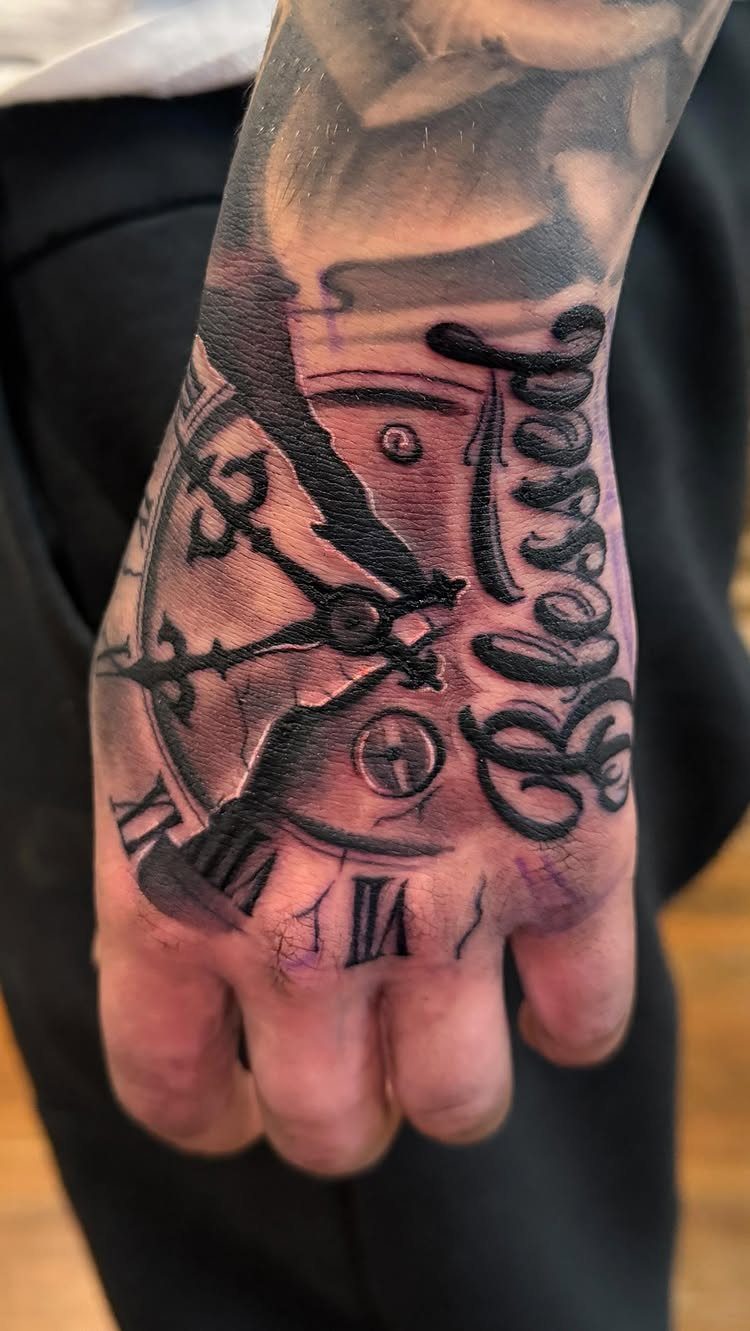
A broken clock tattoo stops the hands at a fixed moment, the glass cracked or the face split. That frozen time can mark when something ended or when you decided to stop letting schedules run your life.
The cracks read as damage or as release, depending on what you pair with them. Skulls push toward mortality; roses soften the same idea into memory.
The broken edges need clean lines so they read as deliberate breaks, not as a tattoo that aged badly. I’d keep the clock face simple, Roman or plain numerals, so the damage stays the point.
This one suits someone who wants meaning without sweetness. It reads as a little defiant, even when the message is gratitude.
2. Hourglass Tattoo
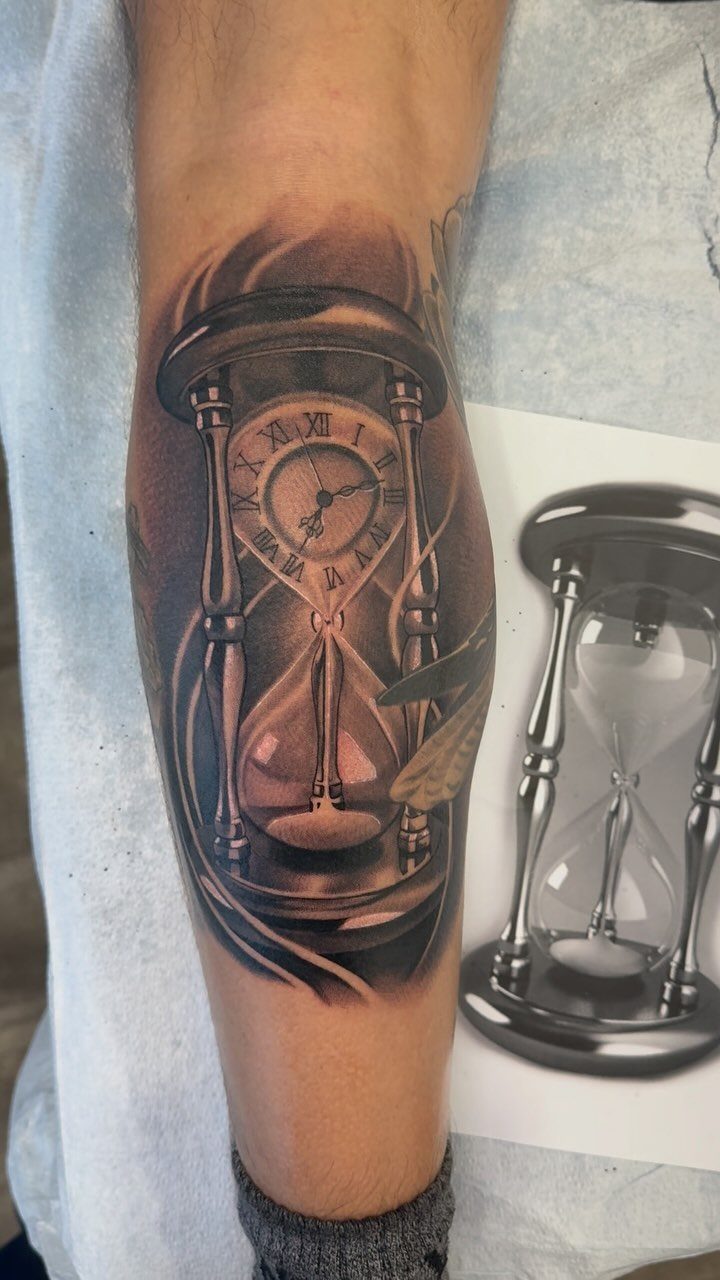
Hourglass tattoos measure time as something you can see moving. Sand in the upper bulb, sand in the lower, and the narrow waist between them where the moment passes.
A clock face built into the top globe layers two time symbols into one piece. That combination works best at a size where both read clearly; the forearm placement gives enough height for the glass curves and the falling sand.
Realistic black and grey handles the texture well, the glass gleam against the matte sand.
Color can work too, especially if you want fire or wings around the frame, though that shifts the mood from quiet observation toward something more urgent.
A birth date or name fits on a banner below, or you can leave it unmarked and let the form speak. The hourglass suits someone comfortable with time’s limits rather than fighting them.
3. Birth Clock Tattoo
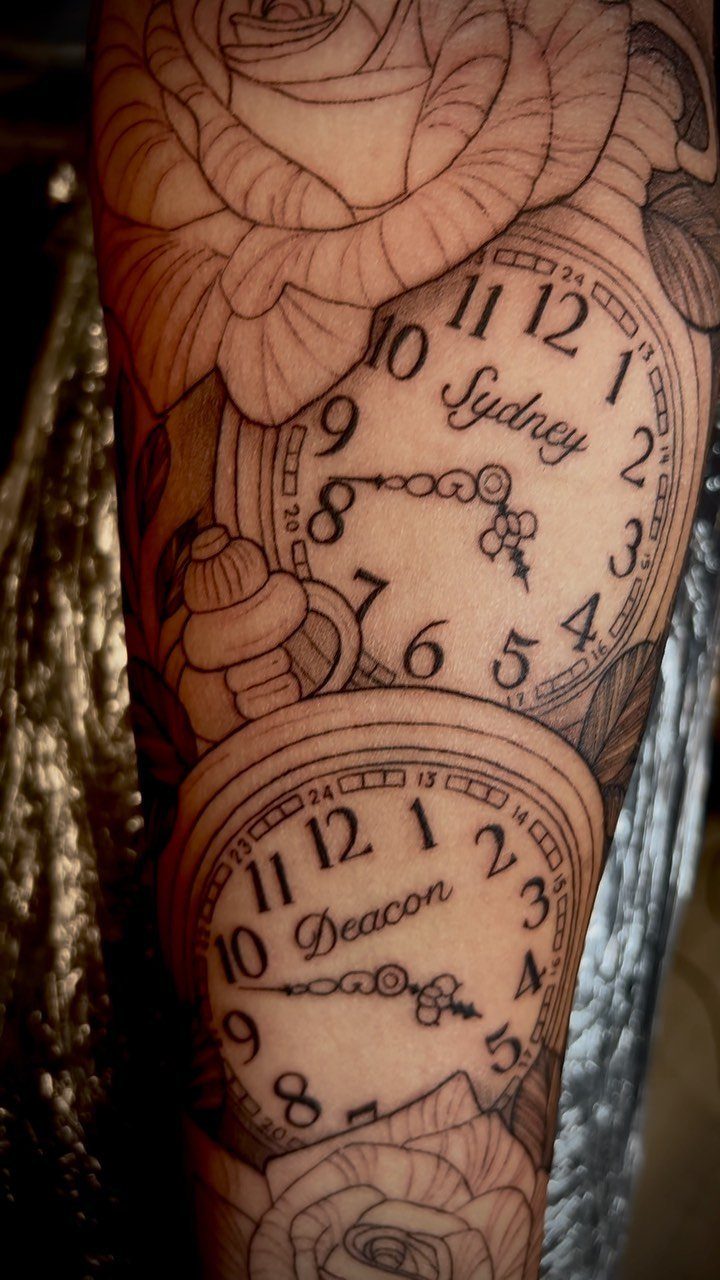
A birth clock tattoo sets the hands to the exact minute someone arrived. Two watches, two names in cursive, times that matter enough to carry.
What makes it matter is the personal detail. The clock shape matters less than the accuracy; a pocket watch, a wristwatch, even a digital face can hold a birth time.
Roses frame these two faces, but birth flowers for each month are the more specific choice, and filigree can fill gaps without adding more symbols.
Names go inside the face, on a banner below, or tucked into the case engraving. Script or block letters both work; the photo’s flowing cursive suits the rounded watch shape.
This design asks you to check the time twice: once with the person who was there, once with the hospital record. Minutes matter for accuracy, and the tattoo lasts longer than memory’s version.
Best for parents, children, partners, anyone whose start you want fixed.
4. Rose Clock Tattoo
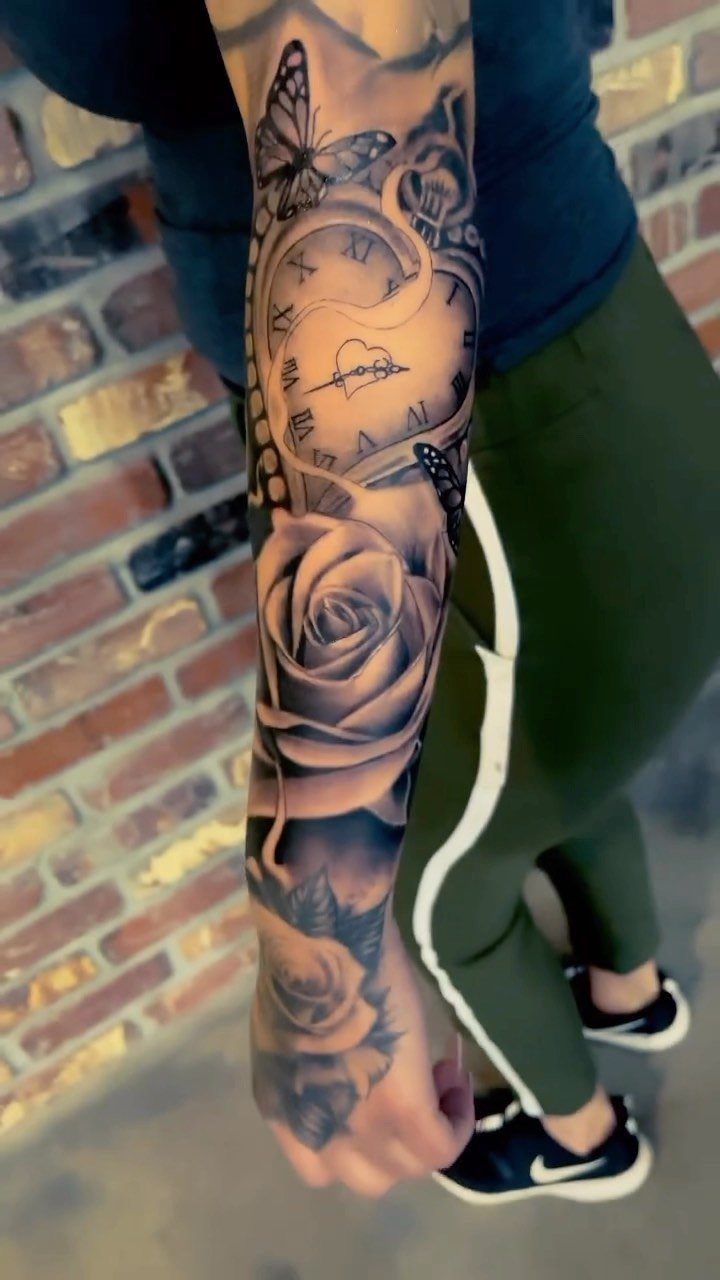
Roses wrapped around a clock face pull together two old tattoo traditions. The flower softens the mechanism; the clock gives the bloom something to climb.
Older clock styles pair best with roses. Pocket watches, grandfather cases, cuckoo housings, all have the curves and ornament that roses naturally follow.
A heart-shaped face makes the love reading explicit, though a standard circle leaves more room for interpretation.
Roman numerals keep the vintage feel. Butterflies, like the one visible here, add a brief-life counterpoint, or you can stay with just the two main elements and let them balance each other.
Black and grey realism dominates this combination, the petals shaded to velvet, the metal getting a softer treatment than actual steel. Color works if you want the roses to read as specific varieties, though that narrows the symbolism.
This one suits a romantic piece with weight behind it, not light sentiment.
5. Melting Clock Tattoo
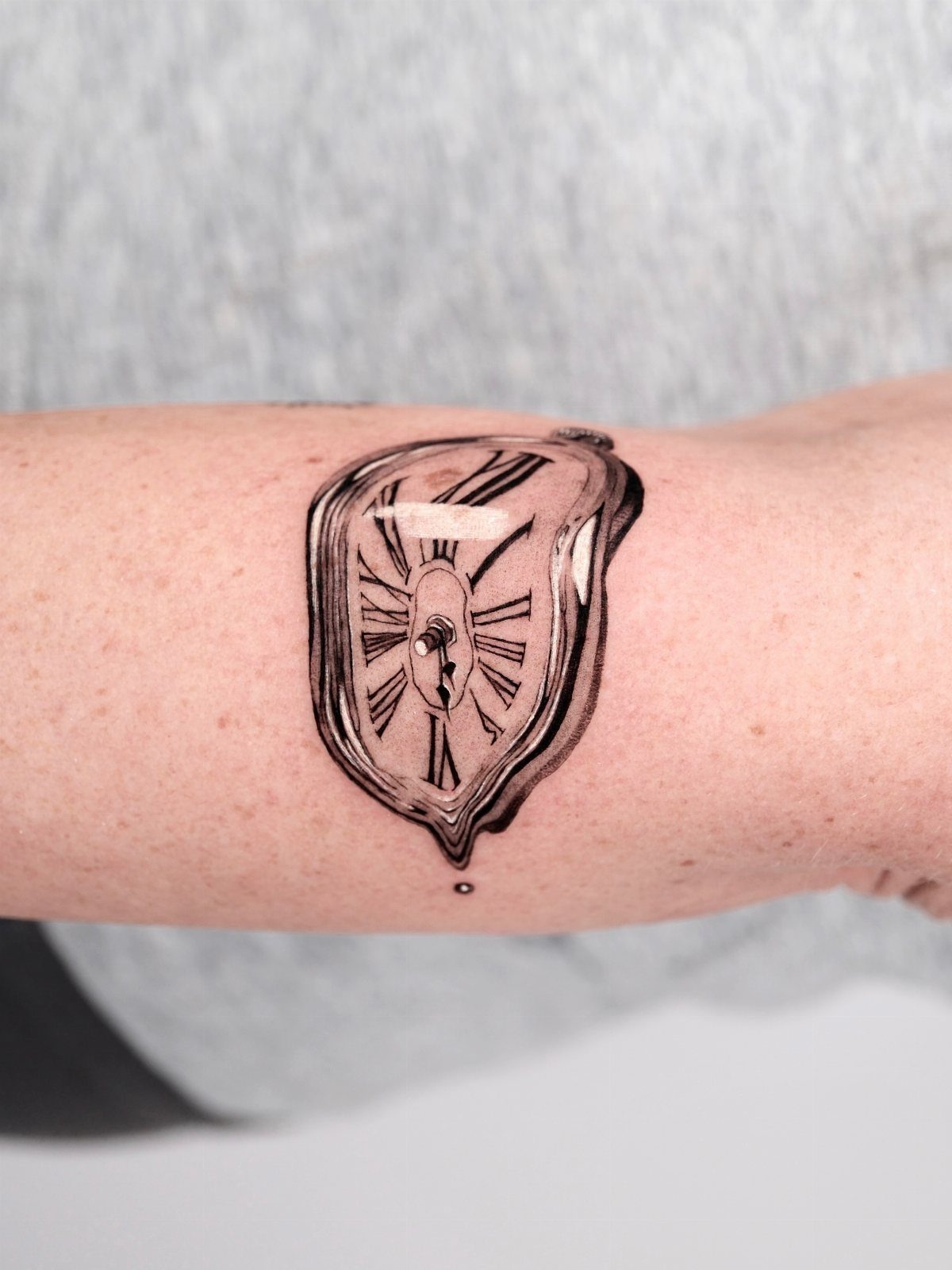
Melting clocks come from Salvador Dalí’s 1931 painting, the soft watches draped over branches and edges as if time itself were runny cheese left in sun.
The tattoo version keeps that same liquid distortion, the face drooping, numerals stretching, the whole thing refusing to keep proper shape.
The surrealism is the message. This tattoo says time bends, or your perception of it does, or that you refuse to treat it as solid.
The distortion follows the body’s own curves, the melt running with the arm’s natural line.
Two colors or careful shading give the dimensional twist that makes the melt read as real. Flat black won’t carry the same depth; you need the contrast of light and shadow to sell the impossible shape.
This one asks for a viewer who knows the reference or doesn’t need to. It works as pure image, the way a song lyric works before you catch the source.
Best placed where the distortion can run with the muscle or the bone beneath.
6. Grandfather Clock Tattoo
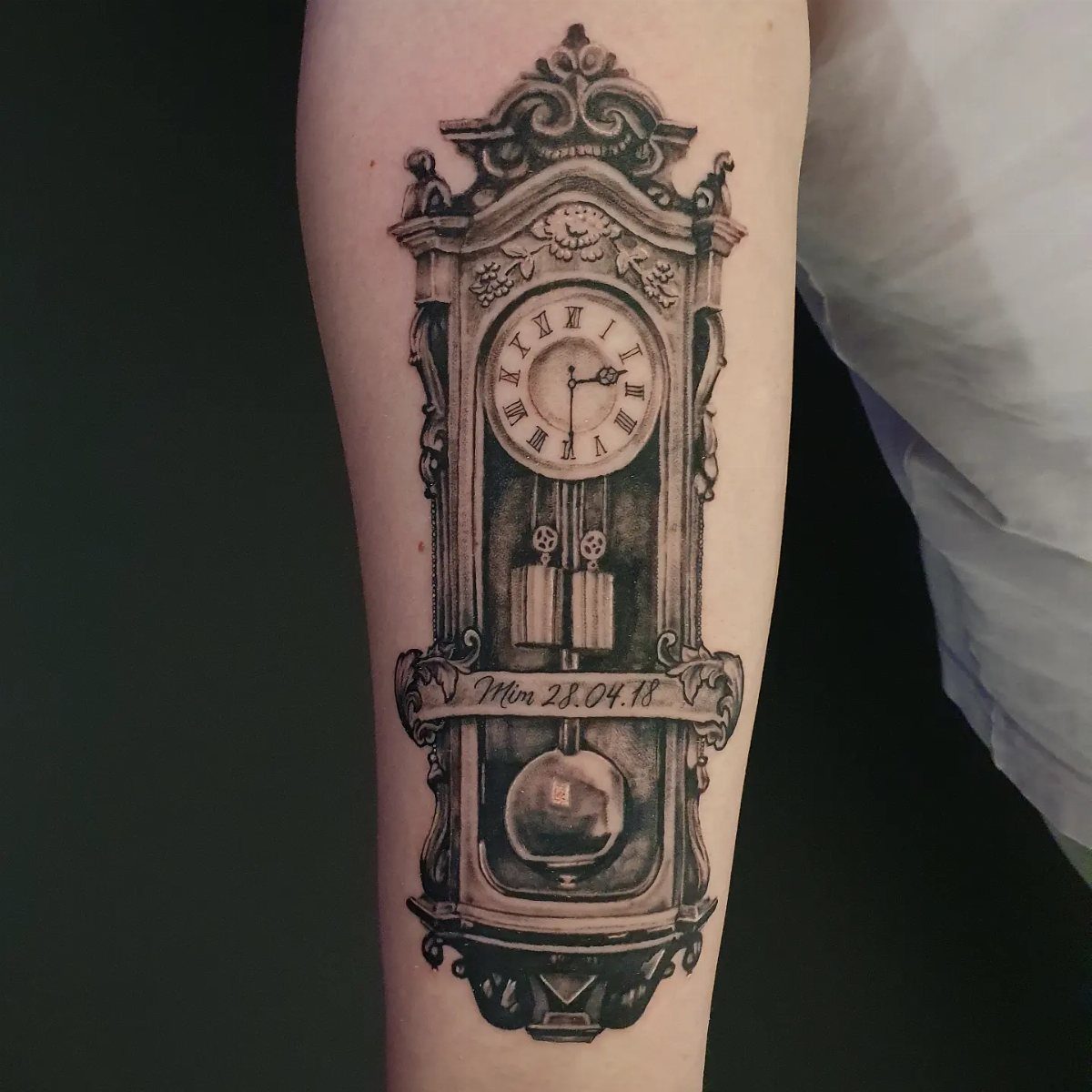
Grandfather clocks carry the weight of inheritance. The tall case, the visible pendulum, the chime that marked hours in a house before you were born.
The tattoo version keeps the vertical format, which suits the forearm’s length or the outer calf. Ornate carving fills the case, and American Traditional style handles that decoration well, bold lines holding the detail at smaller sizes.
A banner with a date, like the "Mim 28.04.18" here, anchors the piece to someone specific.
The nostalgia reads whether you actually inherited such a clock or not. The form itself carries the meaning: slow, deliberate, made to outlast a single life.
Pendulums swing or hang still; movement adds life, stillness adds memorial.
This one suits someone with patience for the sitting and for the reference. It asks more space than a pocket watch, and rewards it with presence.
7. Skull Clock Tattoo
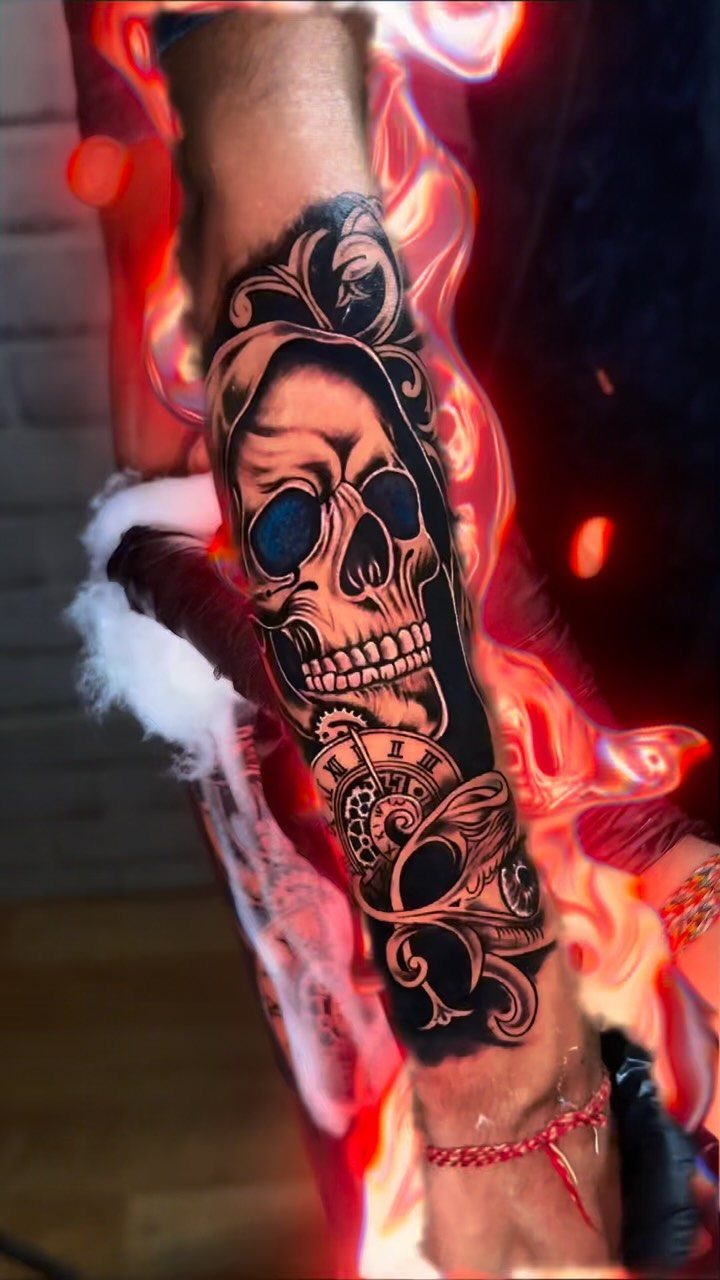
A skull clock tattoo works best when you want the design to carry weight without needing to explain it. A hooded skull paired with Roman numerals carries the old memento mori warning: time runs out for everyone.
Dark shading and black and grey ink keep the mood serious; an eye motif or digital flame effects can push it further toward street or horror styling if that fits your other work.
This piece demands a larger canvas, forearm or calf minimum, to keep the clock face readable as the details close in.
Skip color unless your artist specializes in saturation over black; the contrast of bone-white highlights against deep shadow does the heavy lifting already.
8. Digital Clock Tattoo
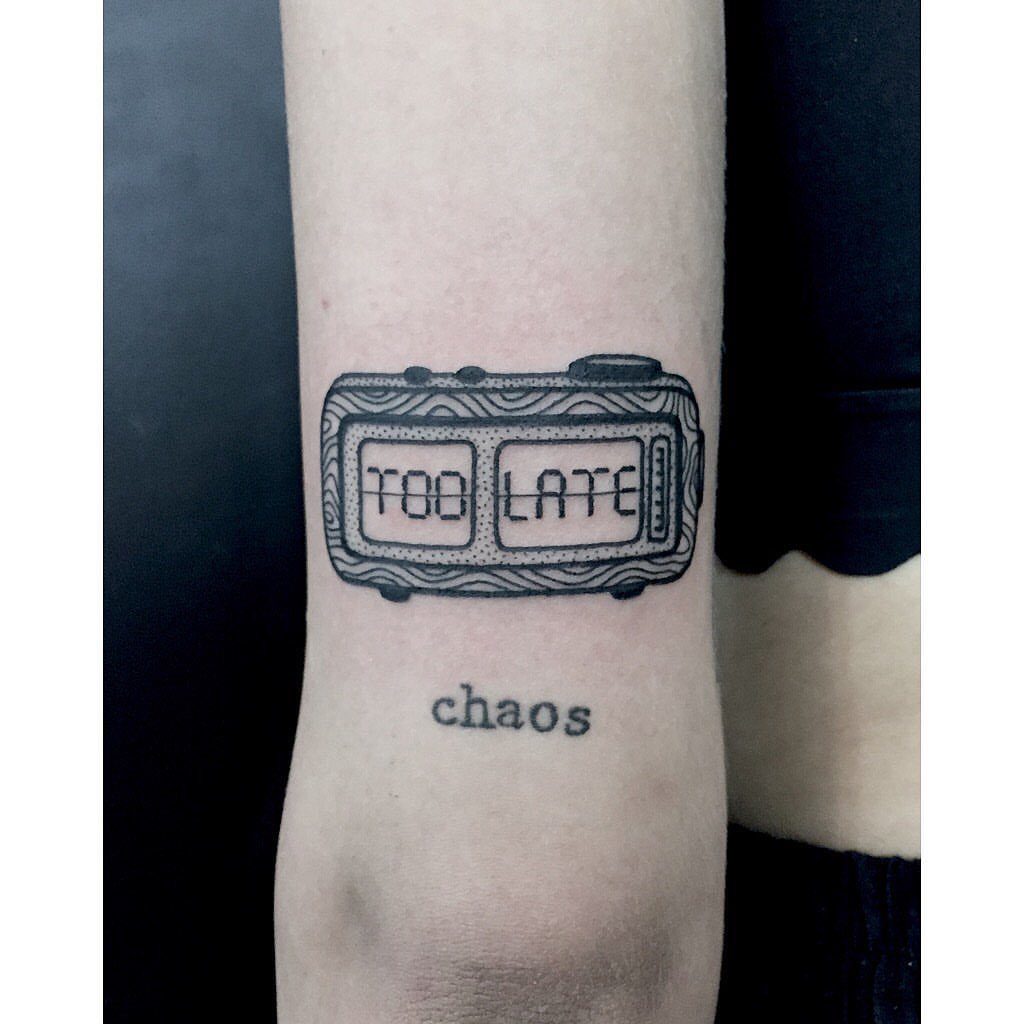
Retro digital displays read differently than ornate clock hands, and that difference is what makes them work.
A blocky "TOO LATE" in bright ink hits with the bluntness of an alarm you slept through, which is exactly why someone chooses this over filigree.
The rectangular frame and pixel-style numbers suit smaller placements, inner arm or behind the ear, where a traditional pocket watch would blur together.
Personalize the time or swap the text for a date that matters; the digital format makes the message feel stamped, official, unavoidable. Color choices run wider here than with realism, electric blue or faded green both work.
Keep the surrounding skin clean, one or two lines max, so the display reads as gadget, not clutter.
9. Traditional Clock Tattoo
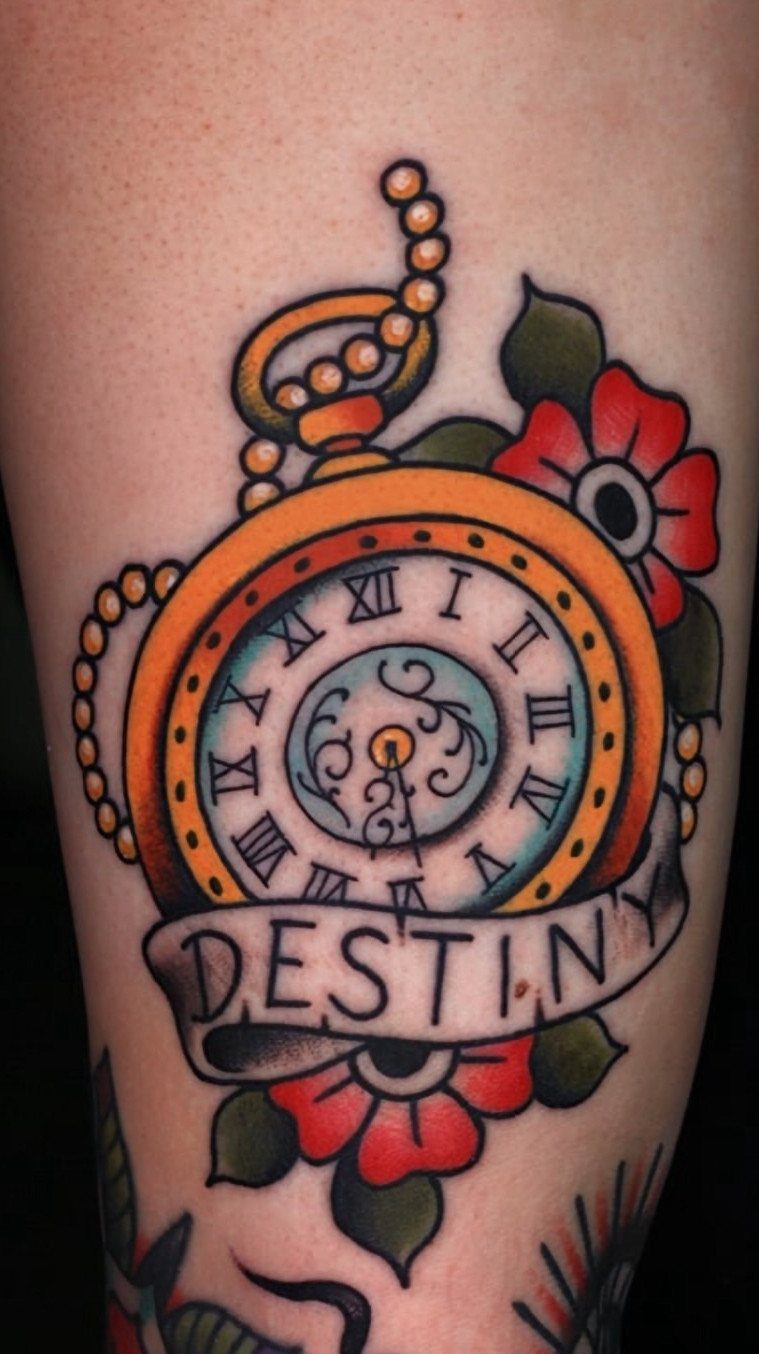
Bold lines and limited color palettes age better than most trends, which is why the American traditional pocket watch still books steady appointments.
Gold faces, red roses, and banners like "DESTINY" follow rules set decades ago: black outlines thick enough to hold, saturation in the red and green kept flat and even.
Anchors, swallows, or nautical stars pair naturally if you want to build a larger piece; the clock becomes one element in a story the arm tells over years. This style asks for confidence in your artist’s linework.
A shaky banner or bleeding color kills the whole effect, and cover-ups in this tradition are harder than they look.
10. Owl Tattoo with Clock
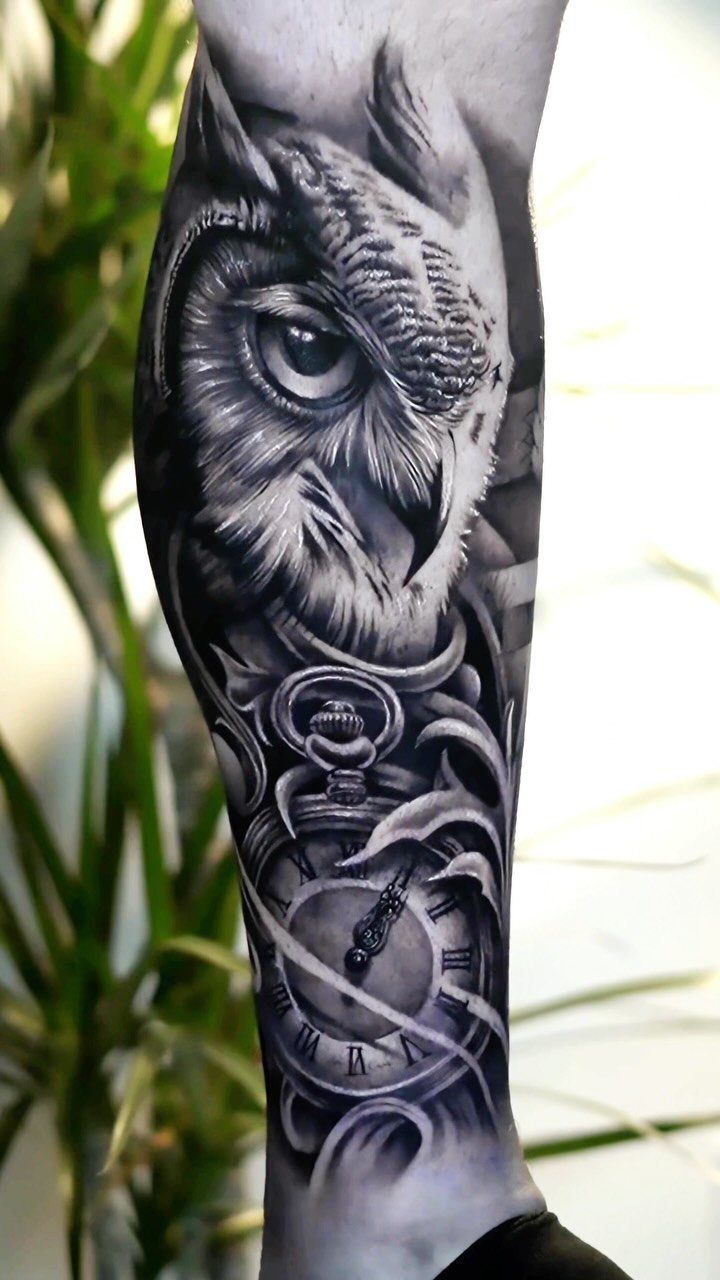
An owl’s flat stare above a pocket watch creates tension that either element alone would lack.
Black and grey realism lets the feathers dissolve into shadow while the clock face stays sharp, a contrast that holds up as the skin ages and the ink settles.
The mythology helps if you care about it, guardians of the underworld and finite time and all that, but the visual impact works regardless.
Placement matters for the owl’s scale; the face needs room for those concentric feather rings to read as detail, not mud. A calf or outer thigh gives the bird its space without the distortion a shoulder cap would bring.
11. Lion and Clock Tattoo
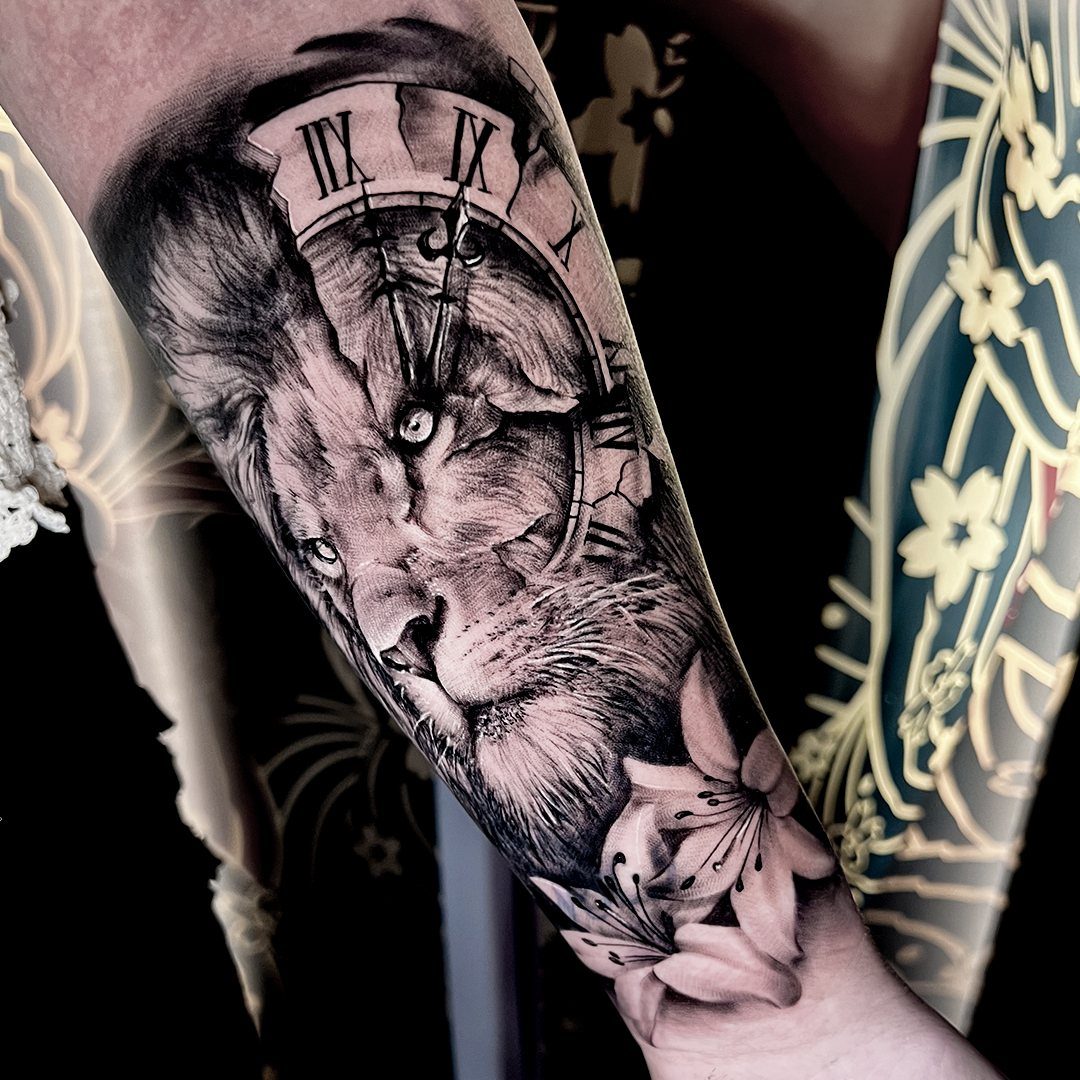
Lion and clock combinations work when the timepiece marks a specific struggle you came through. Weaving the clock face into the lion’s mane, with Roman numerals half-lost in fur, keeps the two elements from feeling pasted together.
Lilies at the wrist soften the aggression if that balance matters to you; leave them out for a harder line. Black and grey shading with no color reads more serious, more permanent.
Chest or back placement carries the weight this pairing asks for, arms work only if the lion’s head stays large enough for the eye to hold detail. A small version loses the expression that makes the lion matter.
12. Clock Tattoo Forearm
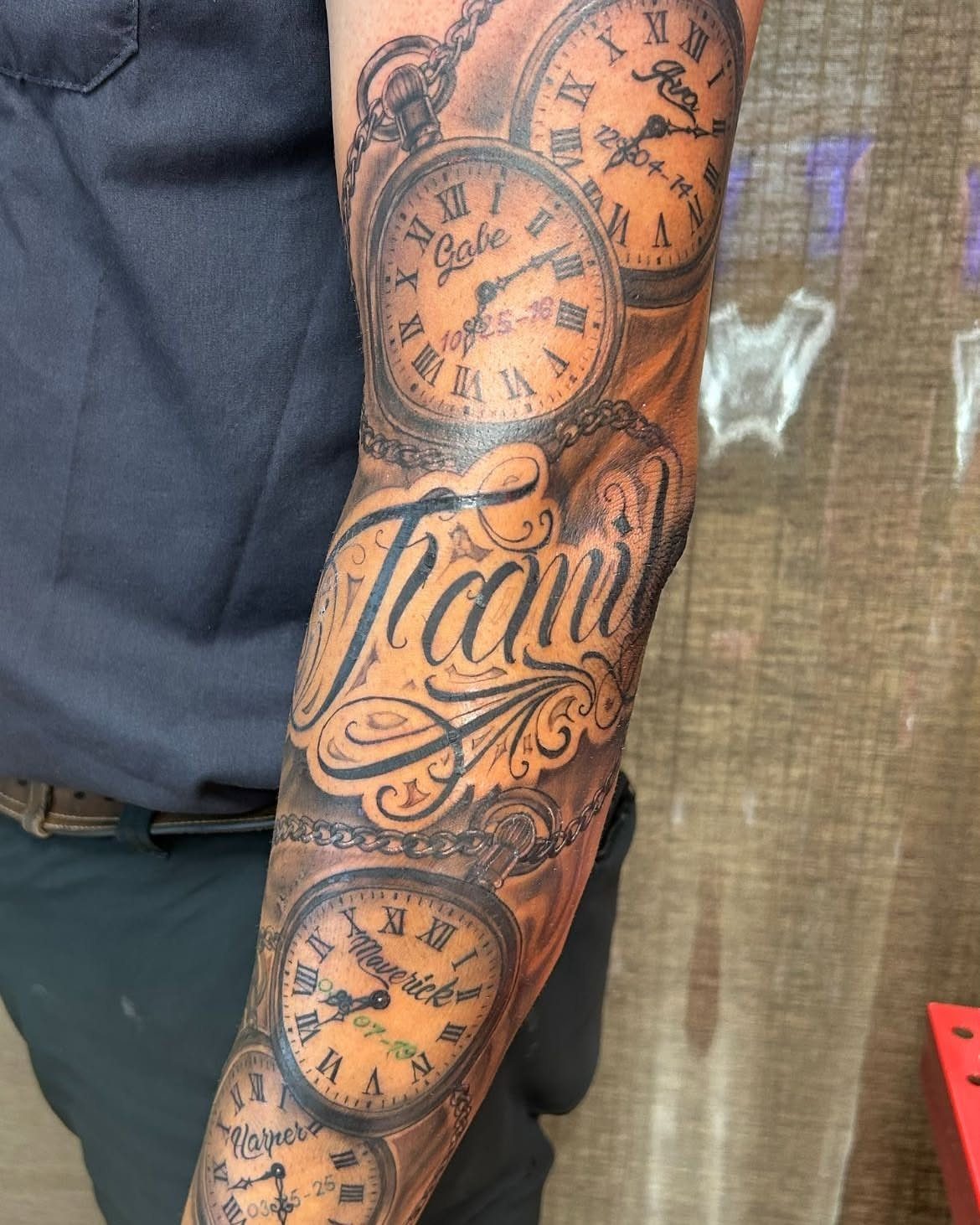
Forearms suit clocks because the shape is already there, a natural cylinder for round faces or a flat plane for digital readouts.
Chains and banners fill gaps between main elements, but the forearm’s length limits how many large clocks fit before the design crowds.
A single watch with one meaningful time often carries more impact than a crowded timeline, and it heals faster too.
13. Clock Neck Tattoo
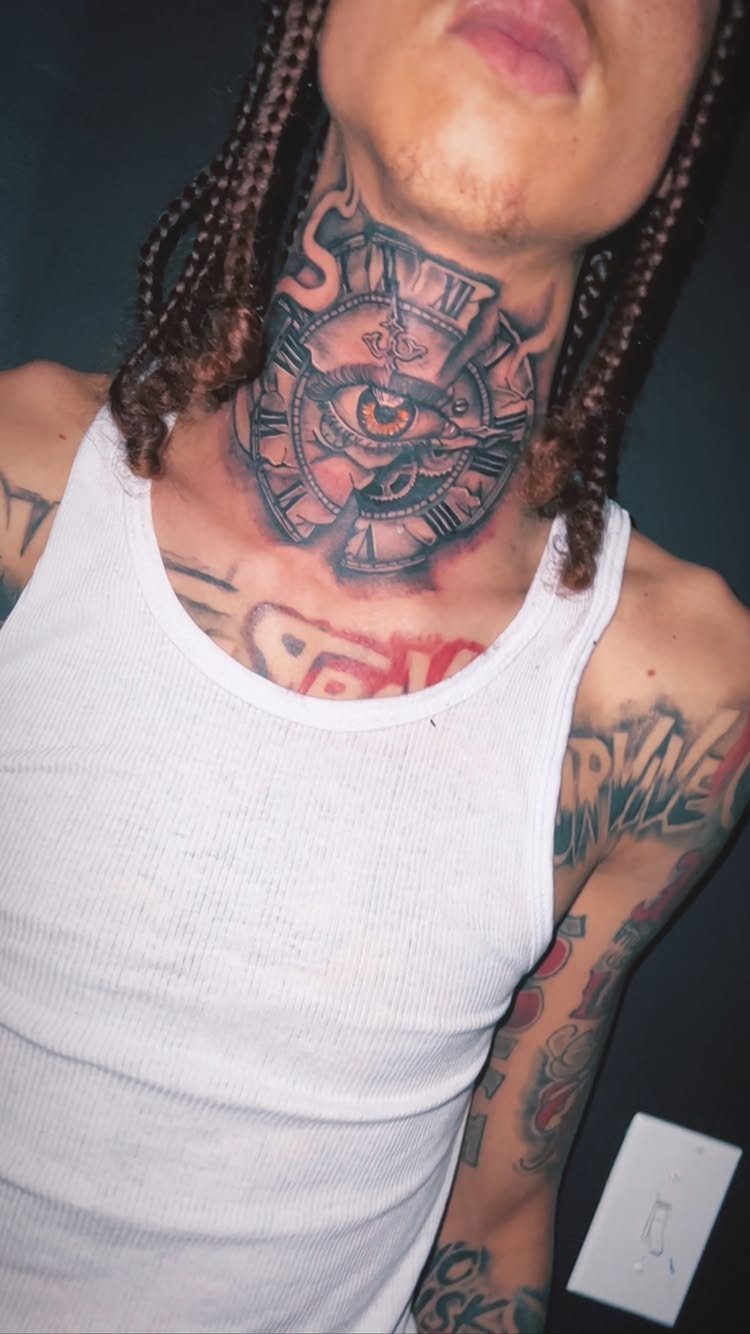
A clock on the throat leaves no room for hiding, which is exactly why some people choose it.
You present this tattoo rather than hide it, and the neck’s curve distorts the clock face slightly in a way that looks deliberate.
Behind the ear keeps the design small and lets hair cover it for work. Under the chin delivers the real impact, though it hurts more and limits your artist pool to those who regularly work that spot.
The skin there moves constantly with speaking and swallowing, so the lines will soften faster than on a forearm or shoulder.
This suits someone whose job allows visible ink and who has already lived with tattoos long enough to know they do not shock anyone anymore. If you are not that person yet, start somewhere you can cover.
14. Clock Chest Tattoo
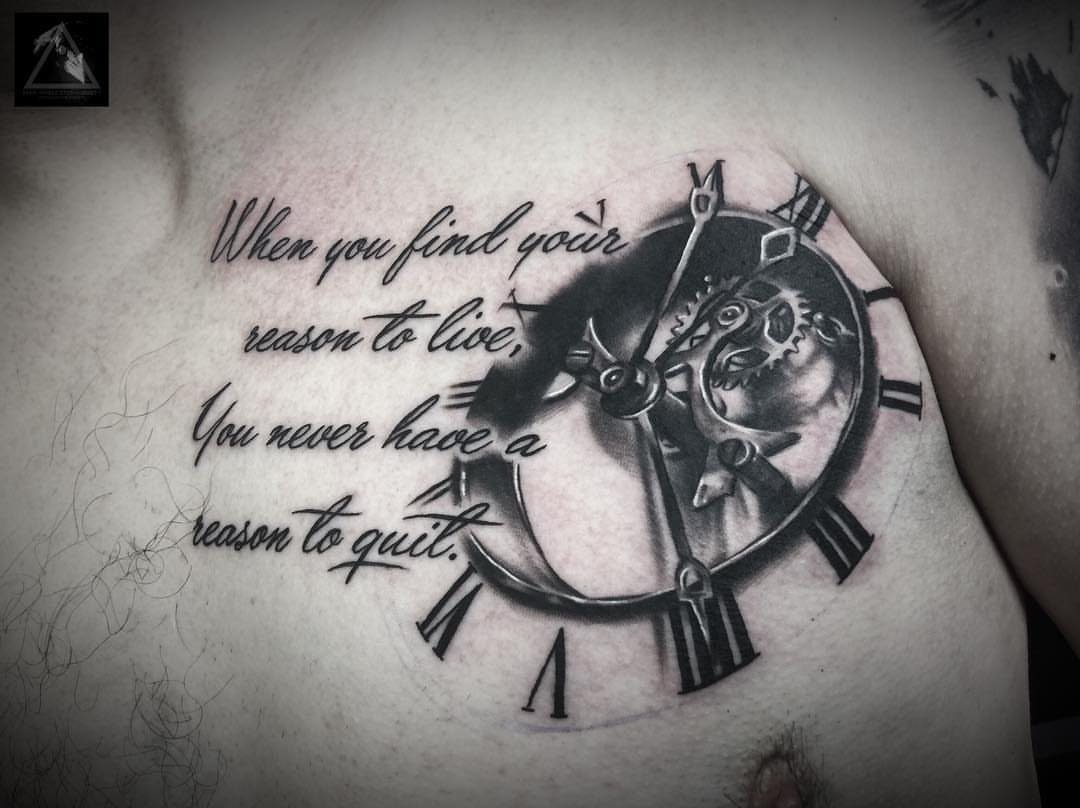
The chest spreads wide and flat, which lets a clock run large enough to show gears, numerals, and script without crowding.
Placing it over the heart adds meaning for those who want it, though the notes make clear a symbolic reason is not required.
Roman numerals read cleanly against the muscle and bone structure of the chest, and black-and-grey shading holds up well on skin that sees sun only when you choose.
Script works best kept to one line or placed as a banner; too many words turn busy against the mechanical detail of clockwork.
This placement is harder to cover. A chest piece takes multiple sessions, costs more than a small single-needle job, and shows in any shirt with the top two buttons open.
It also ages better than a hand or foot tattoo, protected from the abrasion and sun that fade ink fastest.
A date or time that matters to you sits here where you will see it often and can point to it when asked.
15. Overlapping Clock Faces Tattoo
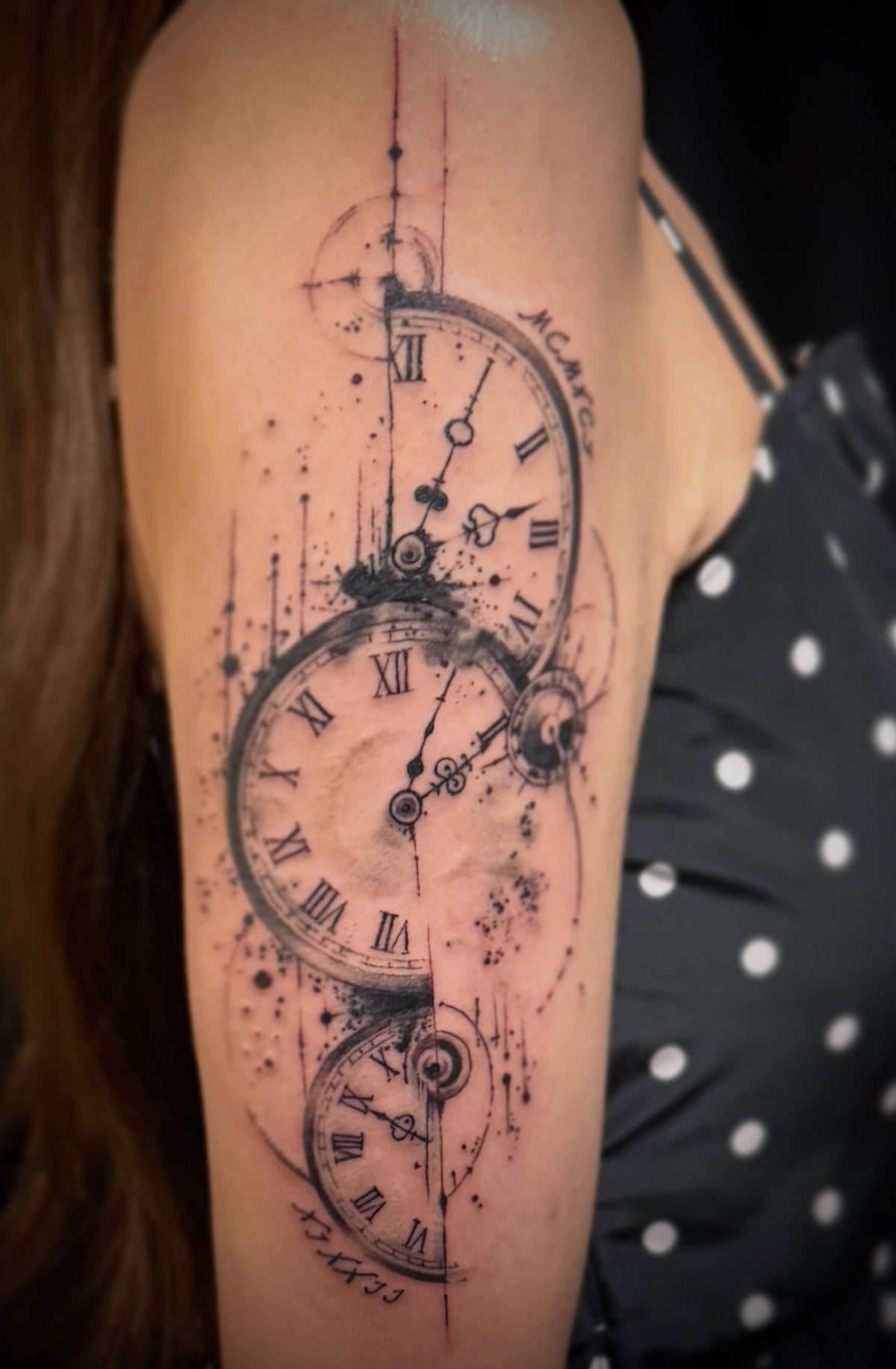
Overlapping clock faces layer multiple timepieces at once, usually two or three, each stopped at a different hour. Roman numerals read cleanly through the stack, and ink splatter keeps the edges from looking too arranged.
The gaps between the faces are where your dates or initials go. A single clock looks like a standard memorial piece; three overlapping read as a whole family timeline.
Font choice matters more here than on a single clock, because the eye has more to sort through. Script between the faces works; block lettering fights the numerals.
The upper arm carries this well because the curve lets one face sit forward and the others tuck behind. Flat areas like the chest make the layering harder to read.
Plan for multiple sessions and a touch-up after healing to keep the overlap points sharp.
This build suits someone with two or three dates that matter equally, not one dominant moment. Legibility suffers at a distance: from across a room it reads as texture, not as time.
16. Hand Clock Tattoo
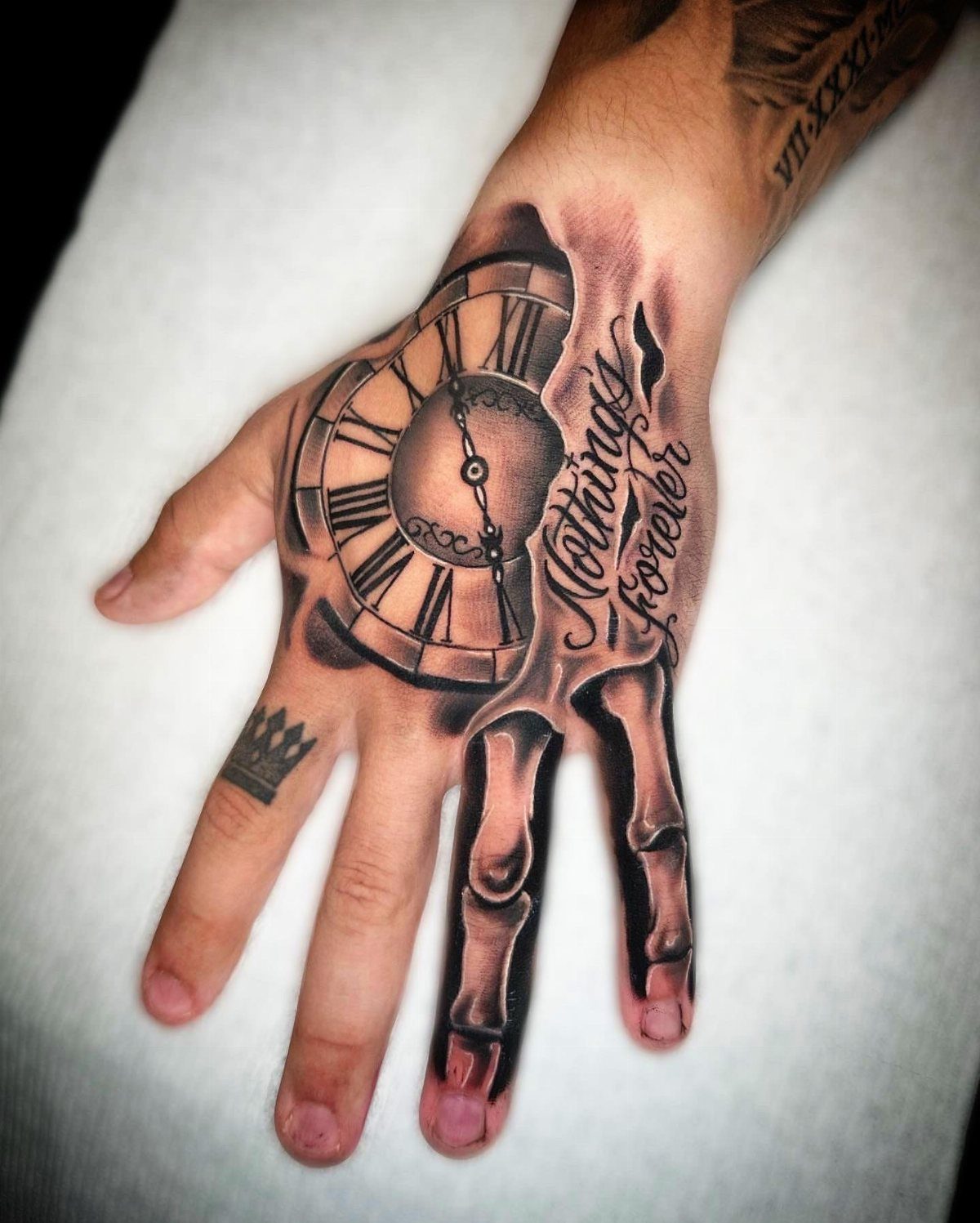
Hand skin holds ink poorly and fades fast, so a clock here is a commitment to regular upkeep, not a one-time decision.
A Roman numeral face across the back of the hand pairs well with skeletal bones running down the fingers and script below, though the bone detail will blur faster there than on the upper arm.
That pairing matters. The clock alone on a hand looks like an afterthought; paired with bone structure or lettering it becomes a composition that uses the whole canvas.
Script on the hand risks blurring sooner than numerals, so "Nothing’s Forever" is a phrase that ages well even if the edges soften.
Pain level runs high here, and most artists want a deposit or a prior relationship before booking hand work. Few shops take walk-ins for it.
The fingers especially: bone proximity and thin skin make the session vocal. Budget for two sittings if the color or saturation is deep.
Choose this if the hand is the place you want to read your own reminder daily. Otherwise the same design translates to the inner forearm with less fading and half the healing trouble.
Best Placements for Clock Tattoos
The spot is easy to show or cover with a cuff, and a single watch shape fits without wrapping too far around the bone.
Upper arms take bolder pieces, the cylinder giving enough width for Roman numerals at a size that won’t blur together.
Chest and back spread flat and wide, which suits gears, multiple faces, or script that would cramp anywhere else. A chest piece sits where you see it daily, but it also shows past the second button.
Behind the ear and ankle stay hidden until you choose otherwise. The ear’s curve limits the design to something small and simple; the ankle’s bone makes sitting through the session harder than flesher spots.
Collarbones carry light, delicate work well, the clock face reading clean against the flat plane. Throats and under-chin placements exist for people whose work already allows visible ink and who have enough tattoos to know the novelty fades.
Personalization of Clock Tattoos
The time on the face is the detail that changes a clock from stock image to specific memory. Hospital records beat family recollection for birth times; minutes matter if accuracy is the goal.
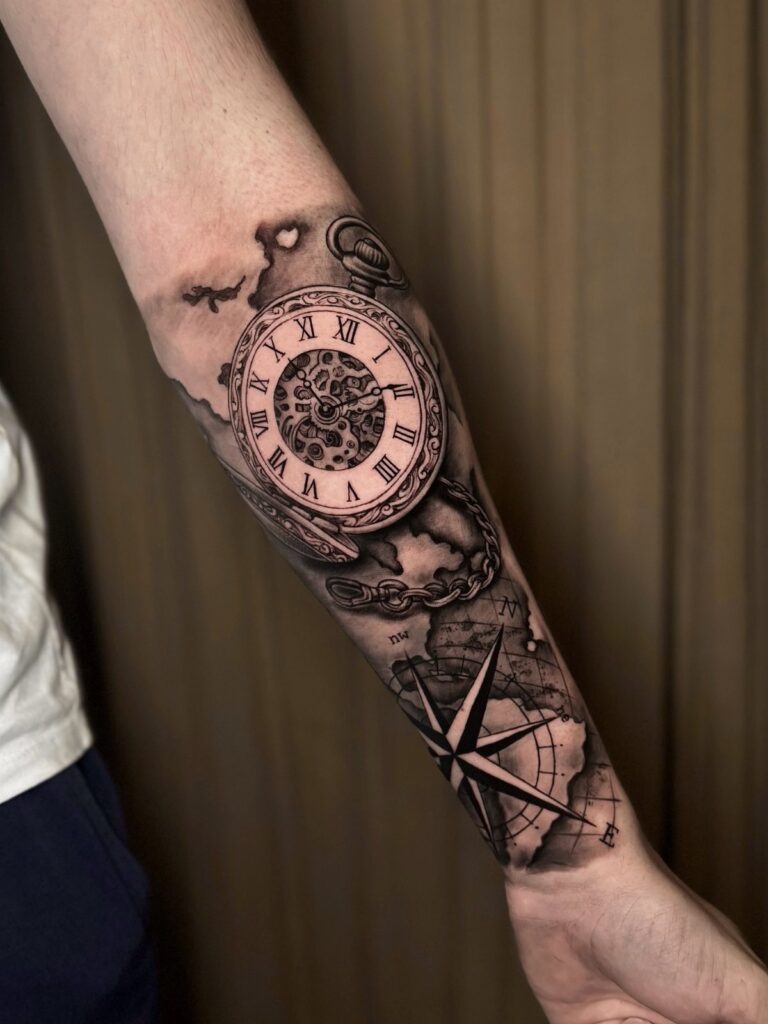
Sleeves rarely run clocks alone. A compass, a Celtic band, or an animal that stands for someone you lost turns the clock into one chapter of a longer piece.
The clock usually sits as the largest element on the lower or upper arm, the surrounding scene giving it context.
The shape and mechanism matter too. A pocketwatch, a grandfather case, a digital block: each carries a different tone, and the choice says something before the time is read.
A clock tattoo can represent time passing or an extraordinary date or hour; it can symbolize the beginning or end of life itself.
Styles of Clock Tattoos
American Traditional keeps its rules from decades back. The style ages better than most; the bold lines stay readable as finer work blurs.
A shaky banner bleeds the whole effect.
Small clocks run in any style and any mechanism: mechanical, pocketwatch, digital. The minimal size forces a single clear choice, one clock type without the clutter that hides the shape.
Surrealist work takes the Dalí melt, the liquid face and stretched numerals, and needs two-color or careful shading to sell the impossible depth.
Realism handles feathers, glass gleam, the velvet of rose petals. Black and grey dominates, though color narrows the symbolism when you name a specific flower variety.
Frequently Asked Questions
Why do people get clock tattoos?
Clock tattoos mark something a person wants fixed: a birth minute, a death, a decision to stop letting schedules run their life.
Some pair the clock with roses for memory, skulls for mortality, or leave it broken to say they have stepped outside time’s pressure.
What does a tattoo of a clock with no hands mean?
A clock without hands removes the measurement from the instrument. It suggests time as presence rather than countdown, or a refusal to mark minutes at all.
The blank face reads as open or as stopped, depending on what surrounds it.
What does a clock tattoo symbolize in jail culture?
In jail culture, a clock tattoo can mark time served, the literal years inside measured by the same instrument that regulated the days. The meaning stays close to the surface: passage of time as something endured, not celebrated.
What time should a clock tattoo be?
There is no traditional or set time; the hands stop where your own significance demands. Birth minutes are the most common choice, though any moment you want fixed works.
Memory shifts; a birth certificate or a witness confirms what the clock should hold.