Neck tattoos for men span from a single needle line along the jaw to full throat pieces that rewrite the silhouette people see first. The decision is not which design looks best in the stencil, but whether your life still fits the frame once the healing is done. A throat mandala shifts with every swallow; a geometric piece that wanders by a millimeter reads as a flaw, not character. The skin here is thin, close to bone, and the artist must plan for motion, not just the photograph.
1. Skulls, Hearts, and Wings
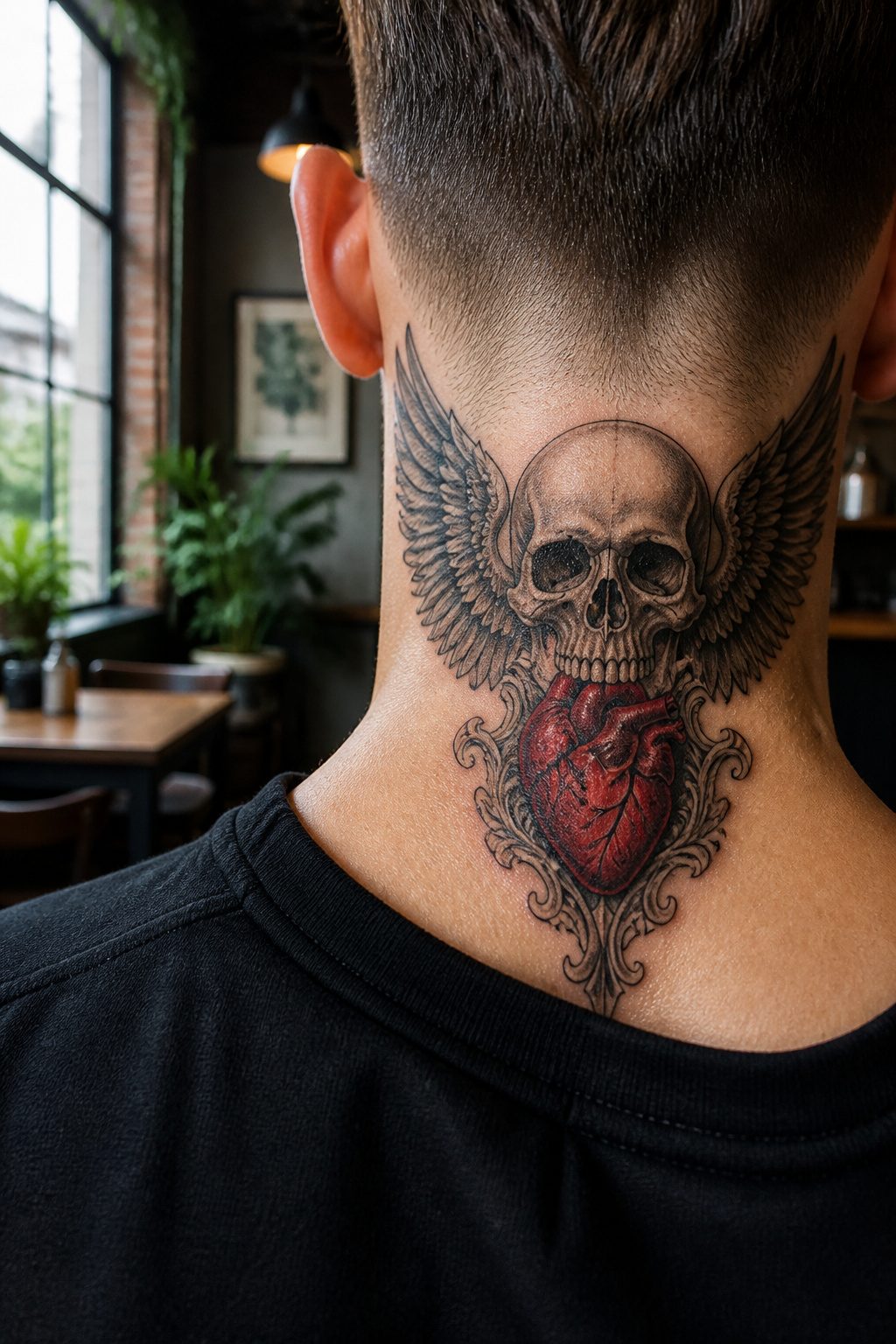
Skulls, hearts, and wings keep showing up together in neck tattoo design because each motif carries weight that the others balance out. A skull reads as mortality and edge, the hard fact that time runs out. A heart, set against that, becomes loyalty or lost love, the emotional stake that makes the edge personal rather than just posturing. Wings finish the triad with freedom or ascension, a way out of the tension the first two create. Two separate design guides group these three explicitly, which says something about how tattooers and clients have settled on the combination as a working vocabulary. The neck’s long curve suits the arrangement: wings can follow the fade of a haircut, a skull anchors the throat, a heart sits at the pulse point. Dark, bold shading with fine detail adds the depth that keeps the piece from flattening into clip art. A bleeding heart paired with angel-like wings along those contours brings dimension that a single symbol on its own rarely achieves. The grouping works because it refuses to resolve: mortality, love, escape, all three present at once, none canceling the others.
2. Religious Themes
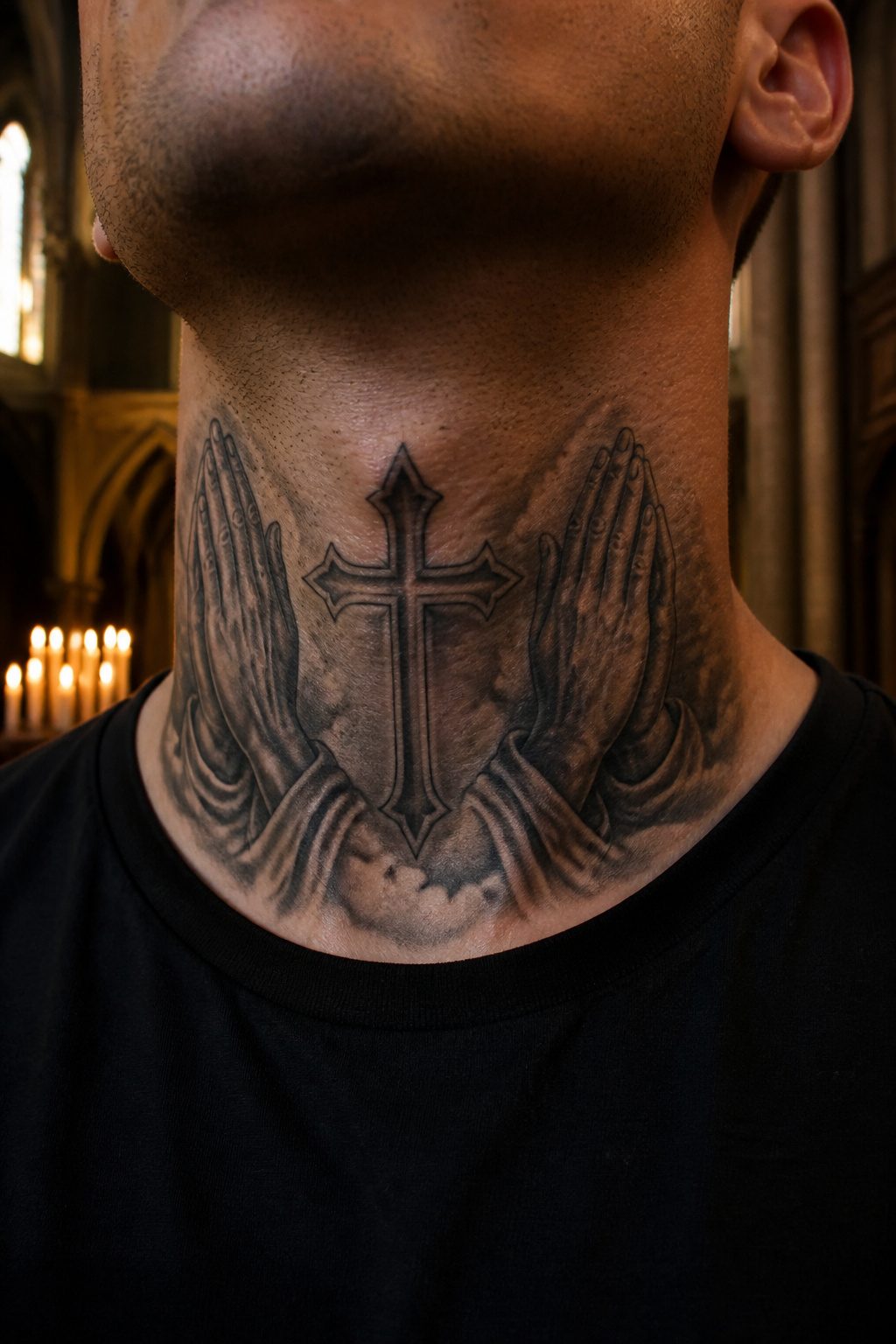
A cross at the throat reads differently than one on the shoulder. The placement carries devotional weight for wearers who want the symbol visible to themselves in the mirror and to anyone they face. Praying hands follow the jaw’s natural line, fitting the side of the neck so the shape flows with the body rather than fighting it.
Biblical verses and iconography work best when the script size matches the space. Too small and the ink blurs as it ages; too large and the words wrap awkwardly around the tendons. Dark, heavy shading around rays or crosses brings dimension, but the real decision is whether you want the piece to read as hope and guidance or as something more gothic. An ornate arch at the base of the skull anchors the design and gives the artist room to build light and shade upward toward the jaw. Flying birds can suggest ascension, though that imagery sits at the edge of cliché unless the drawing itself is strong enough to carry it.
The throat placement also means the tattoo moves with speech and swallowing. A design that looks still in the stencil will shift constantly in life, so the artist needs to plan for motion, not just for the photograph.
3. Lotus Flower
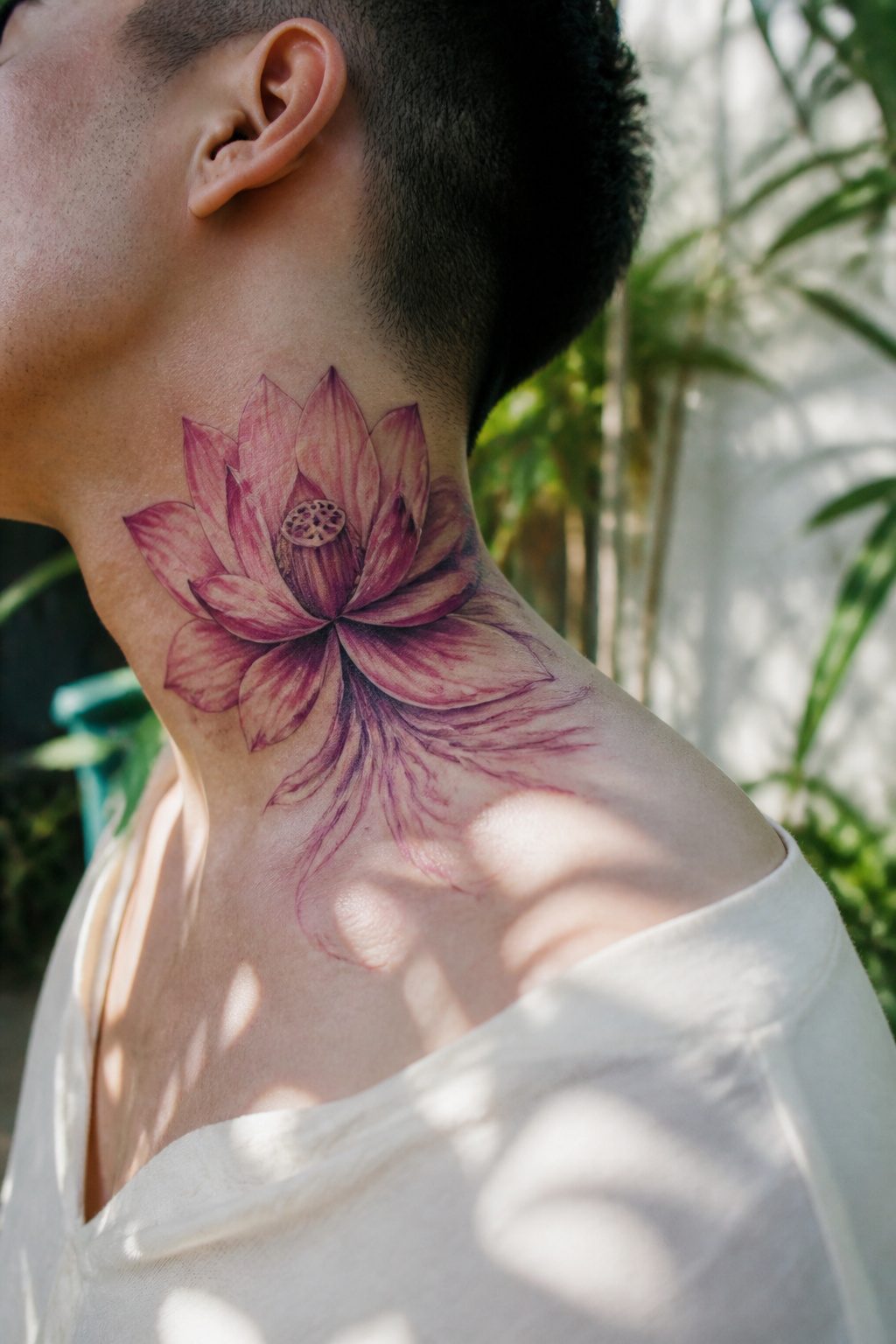
A lotus on the neck carries two stories at once. In Eastern traditions it signals enlightenment, the flower that pushes through murky water to open clean. Western wearers usually land on the second reading: resilience, the same rise-through-hardship arc but stripped of religious weight. Either works for neck placement because the curved surface lets petals frame the throat and spill toward the collarbone, something a flat back or chest panel cannot replicate.
The masculine reading needs weight. Geometric lines, tribal elements, or heavy shading behind the bloom keep it from reading as purely decorative. Front placement reads boldest; the throat is sensitive skin and the commitment shows. Sides offer more room for the petal spread to wrap naturally with the neck’s cylinder.
Pain sits higher here than on the shoulder or arm, and healing means keeping the area clean while collar friction works against you. Still, the visibility is the point. A neck lotus says the growth it marks is not private.
4. Japanese Designs
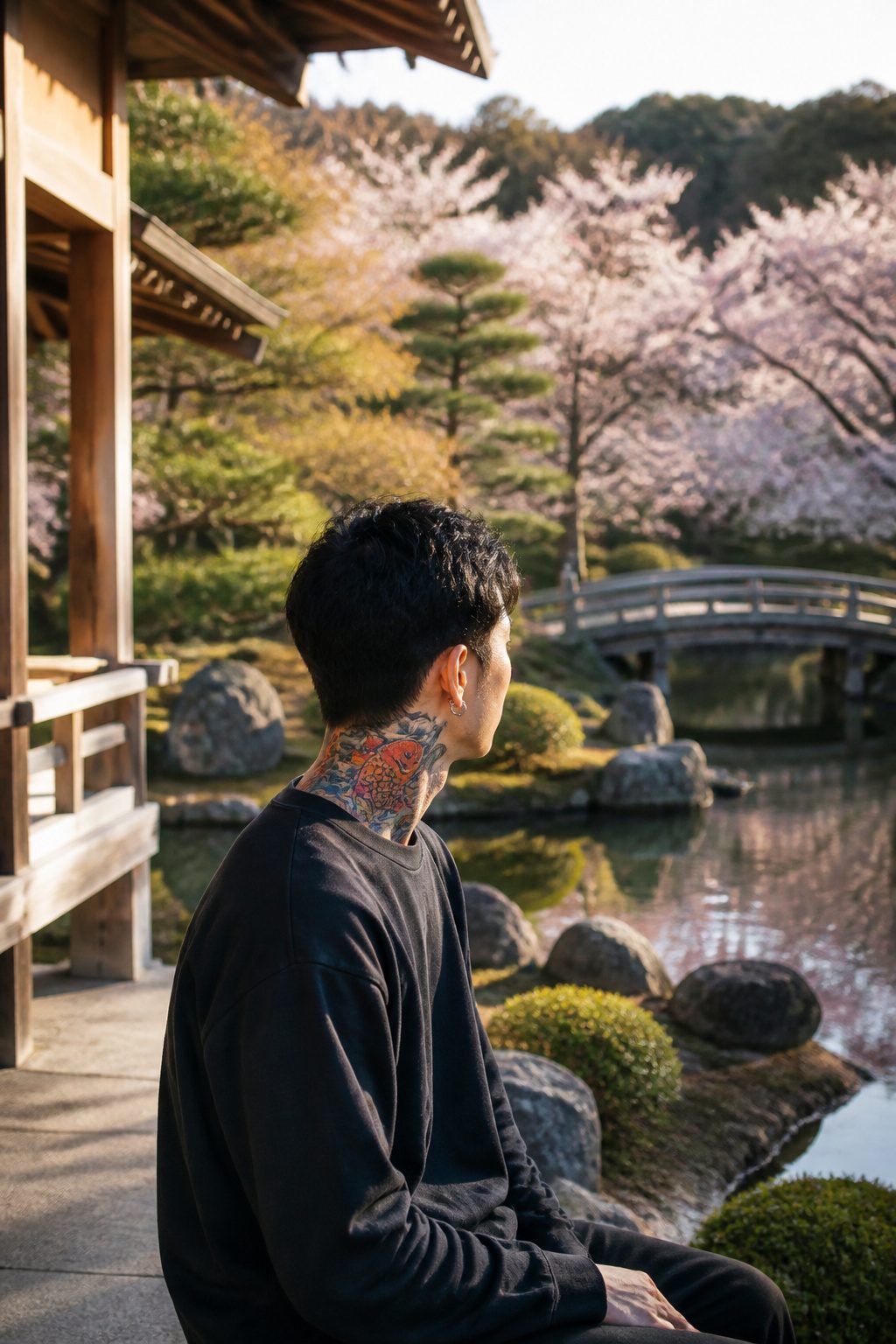
Japanese neck work borrows directly from the full-body tradition of irezumi, where koi, dragons, cherry blossoms, and waves carry specific meanings rather than serving as generic decoration. A koi swimming upward signals perseverance; a dragon paired with wind bars suggests protection. The throat’s cylindrical shape changes how these read. Flatten a wave across a chest and it flows naturally; wrap that same wave around the Adam’s apple and the curve distorts the crest unless the artist plans for the bend.
Saturation is where this style gets technically demanding on neck skin. The throat moves constantly with speech and swallowing, so packing solid black or dense color into the center of the neck risks blowouts and faster fading than you’d see on a shoulder or thigh. Most experienced artists keep the heaviest saturation toward the sides and back, letting the more exposed front carry linework or negative space. Cherry blossoms work well here because their petals need only light pink washes, not the solid fills that would stress the skin. The collarbone line also acts as a natural stopping point; running a dragon’s body straight across it tends to look interrupted, while flowing the design down toward the chest or up behind the ear keeps the composition intact.
5. Full Neck Tattoos
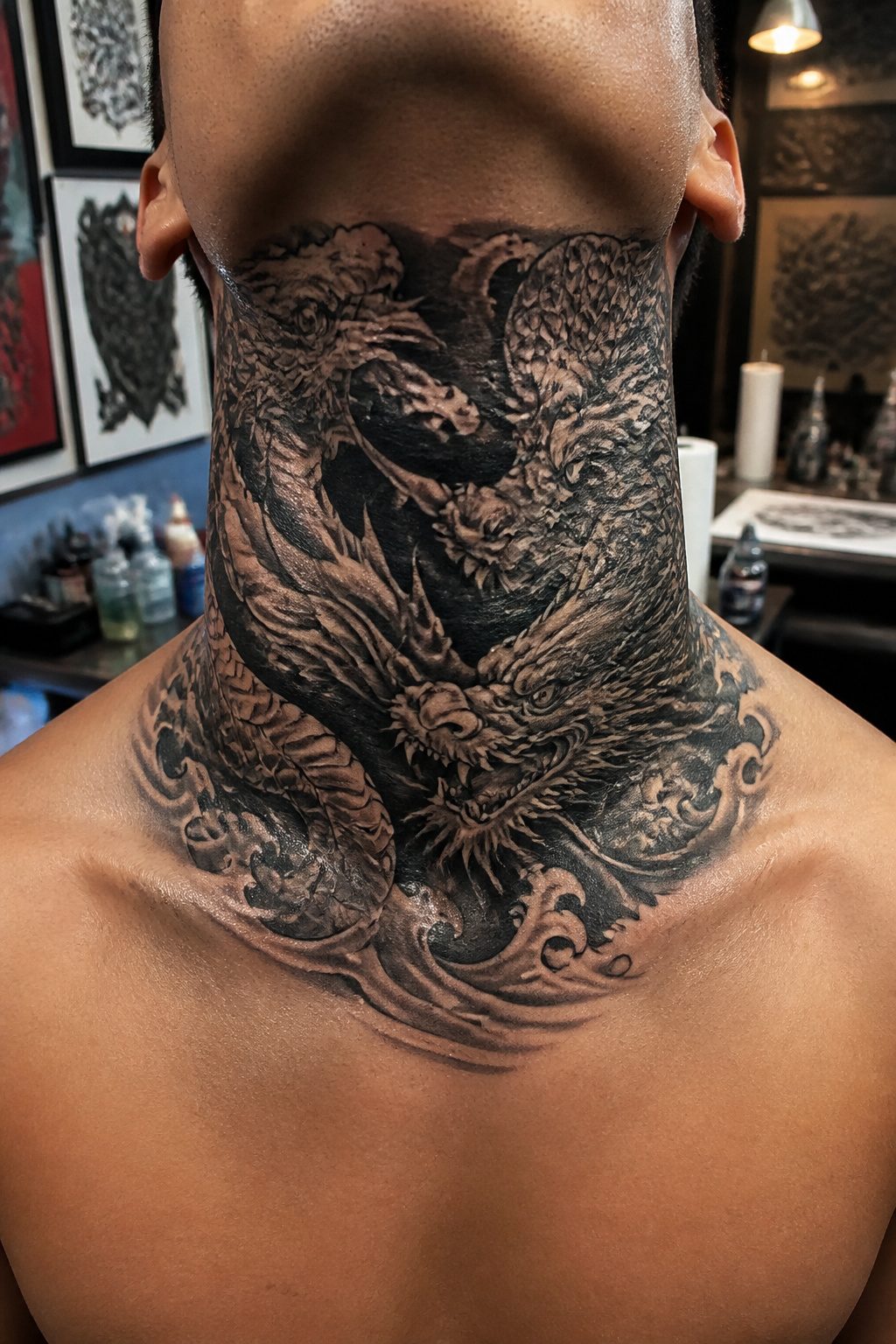
A full neck tattoo rewrites the silhouette people see first. The jawline, the throat, the tendons that move when you speak, all become canvas, and that canvas is permanent in a way that sleeves are not: a turtleneck hides arms, but only a scarf or a very specific collar hides a neck. In tattoo culture, this piece has earned the blunt nickname "job killer," and the name sticks because the visibility is total. You do not ease into it. The commitment is immediate and public.
The sessions stretch longer than most people budget for. Skin on the neck is thin, sits close to bone and lymph nodes, and the artist works around a cylinder that shifts with every swallow and turn of the head. What reads as one flowing image from the front may require the artist to rebuild the composition from behind, where the canvas disappears from their sightline and the client’s. Healing is complicated by movement you cannot stop: breathing, speaking, sleeping on a pillow. The result, when it holds, is a piece that frames the face itself. Whether that trade is worth it depends on whether you are building a life where the frame matches the picture inside.
6. Geometric Patterns
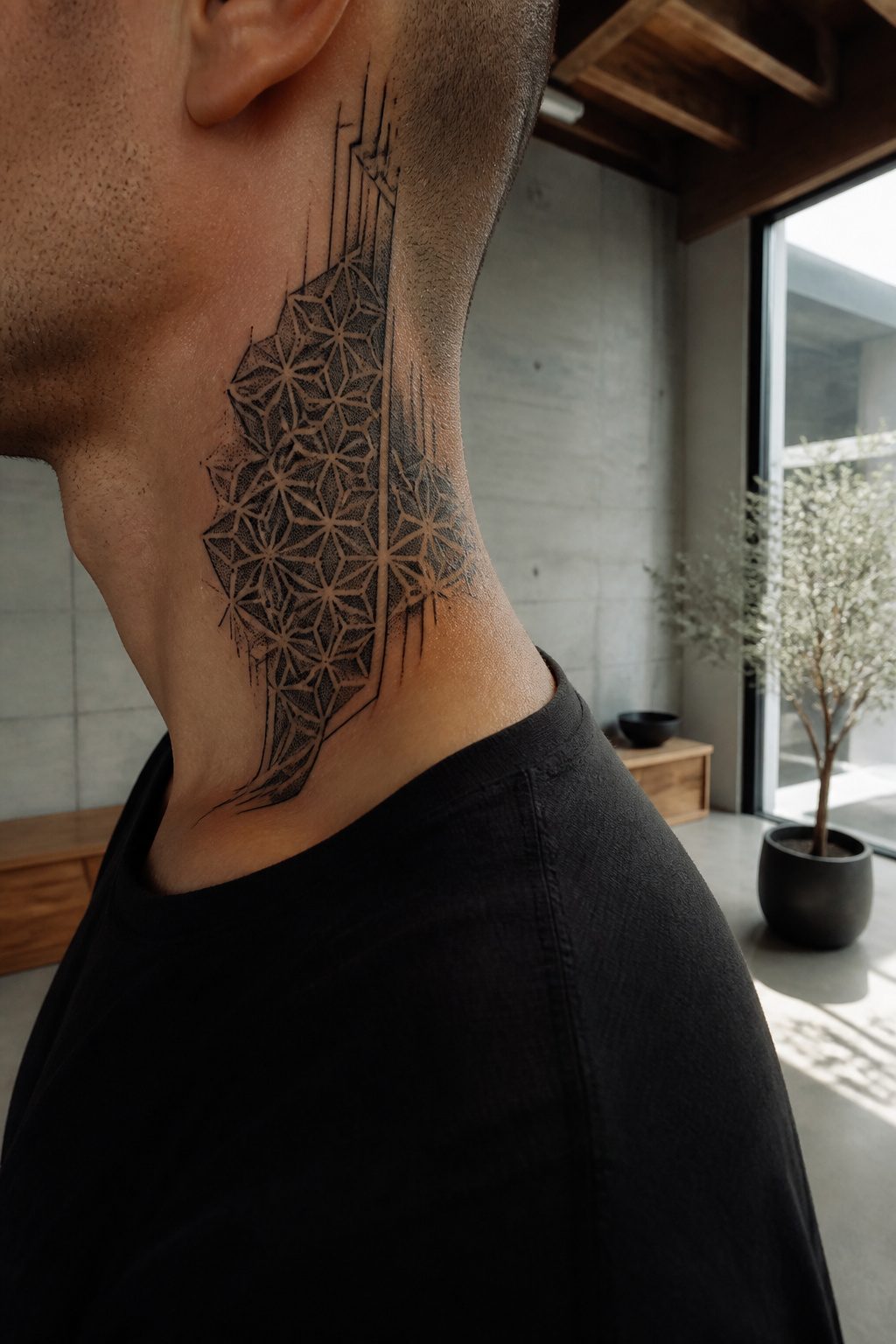
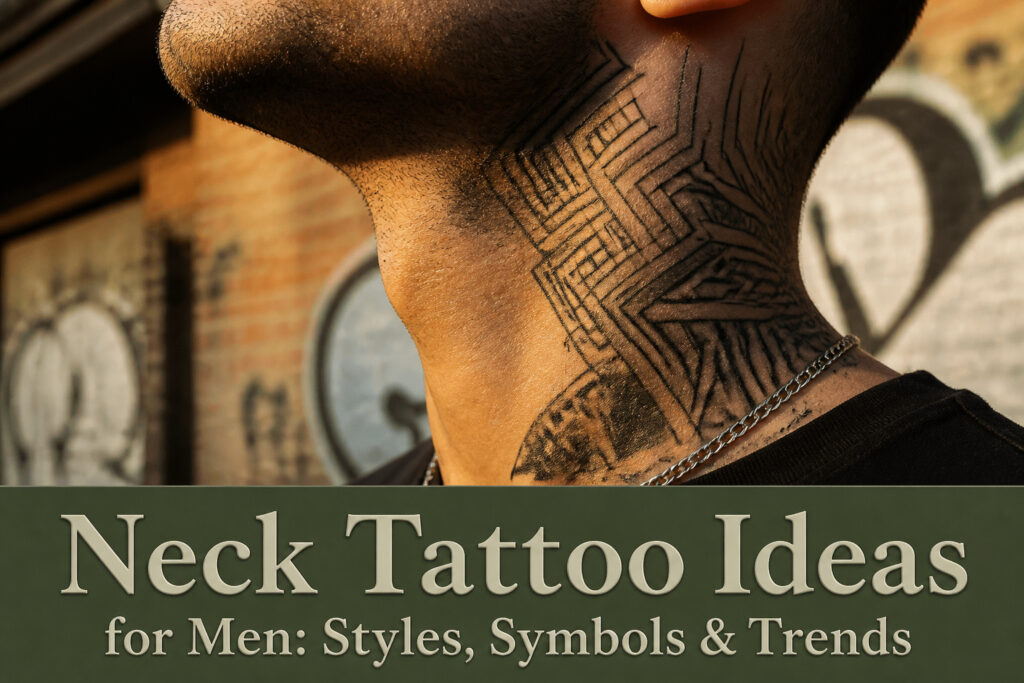
Dotwork and linework sit at the core of what makes geometric neck tattoos for men hold up over time. The precision matters more here than on a shoulder or forearm; a line that wanders by a millimeter reads as a flaw on the throat, not character. Sacred geometry and mandala-adjacent patterns build outward from that foundation, using triangles, diamonds, and interlocking shapes that draw the eye vertically down the neck.
A full geometric mandala spread across the neck carries weight differently than a single icon. The interconnected shapes read as unity and balance from a distance, but up close the dotwork and negative space keep the piece from flattening into a solid mass. That contrast between dense stippling and open skin is what separates a geometric piece that ages well from one that blurs into a gray wash in five years.
Placement on the throat itself, running triangles or rectangles in a vertical line, adds immediate structure. The symmetry flatters most jawlines, and the sharp edges play against the softness of the neck’s natural curves in a way rounder designs rarely manage. The risk is the same as the reward: there is no hiding a geometric piece that shifts even slightly off-center, so the artist’s steadiness matters more than their speed.
7. Swords with Flowers
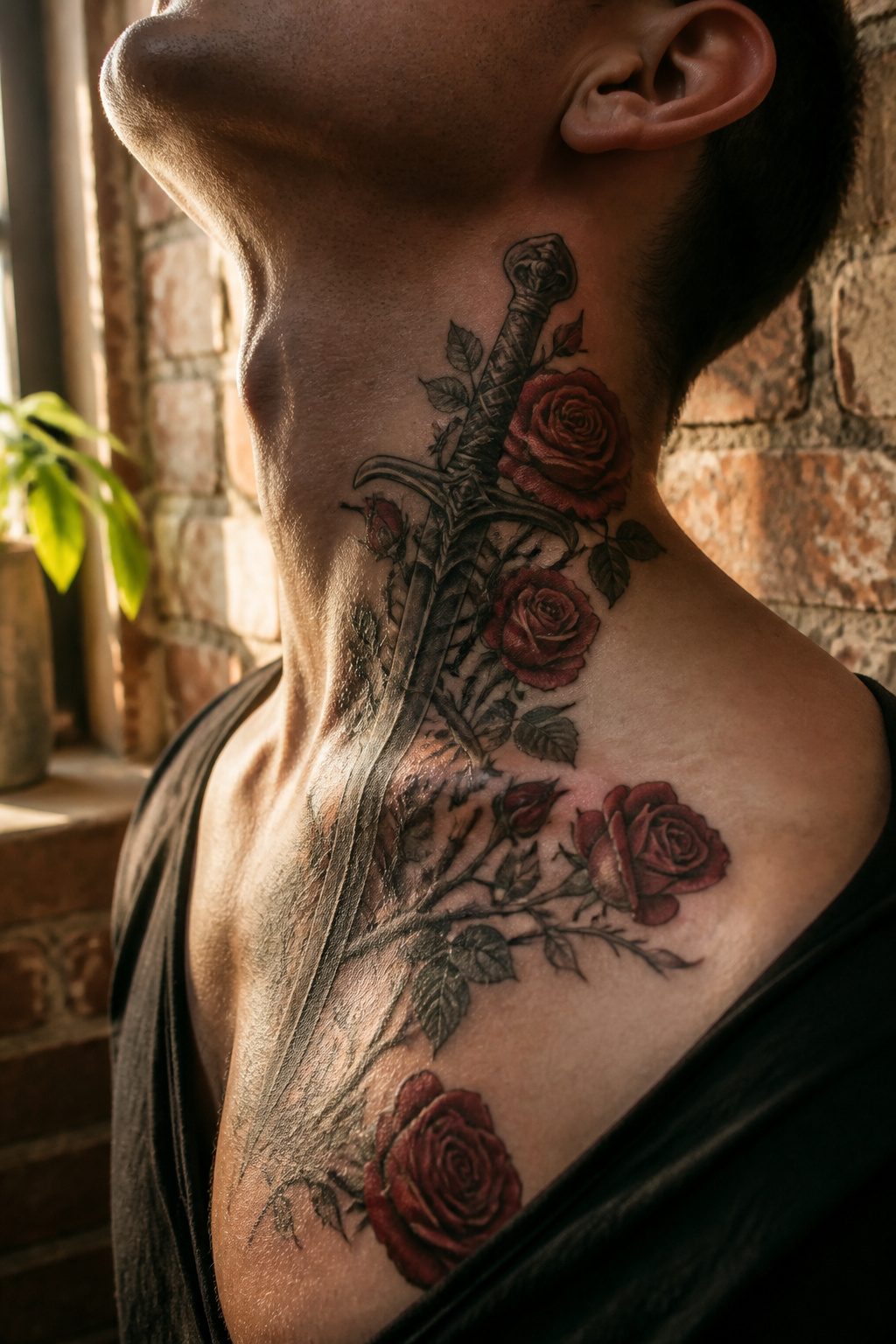
A blade wrapped in roses or daisies reads differently on the neck than it would on a shoulder or chest. The neck is already a line between vulnerability and display, so the contrast lands harder there. Strength and softness share the same skin, and the viewer has to decide which one they are looking at first.
Roses and lilies carry their own weight. Roses lean toward rebirth, lilies toward mourning and moving on. Either way, the flower does not soften the sword so much as complicate it. On the throat or the side of the neck, that complication is the whole point. The piece turns with your head, so the blade catches light one moment and petals the next.
The geometry of the neck matters. Curves along the jaw or the skull let the design break and restart, using negative space where the ink stops. A compact blade works better than something drawn out. Too long and the sword fights the natural lines; too ornate and the flowers get lost at speaking distance. What reads as resilience from three feet away is what survives the choice.
8. Compass
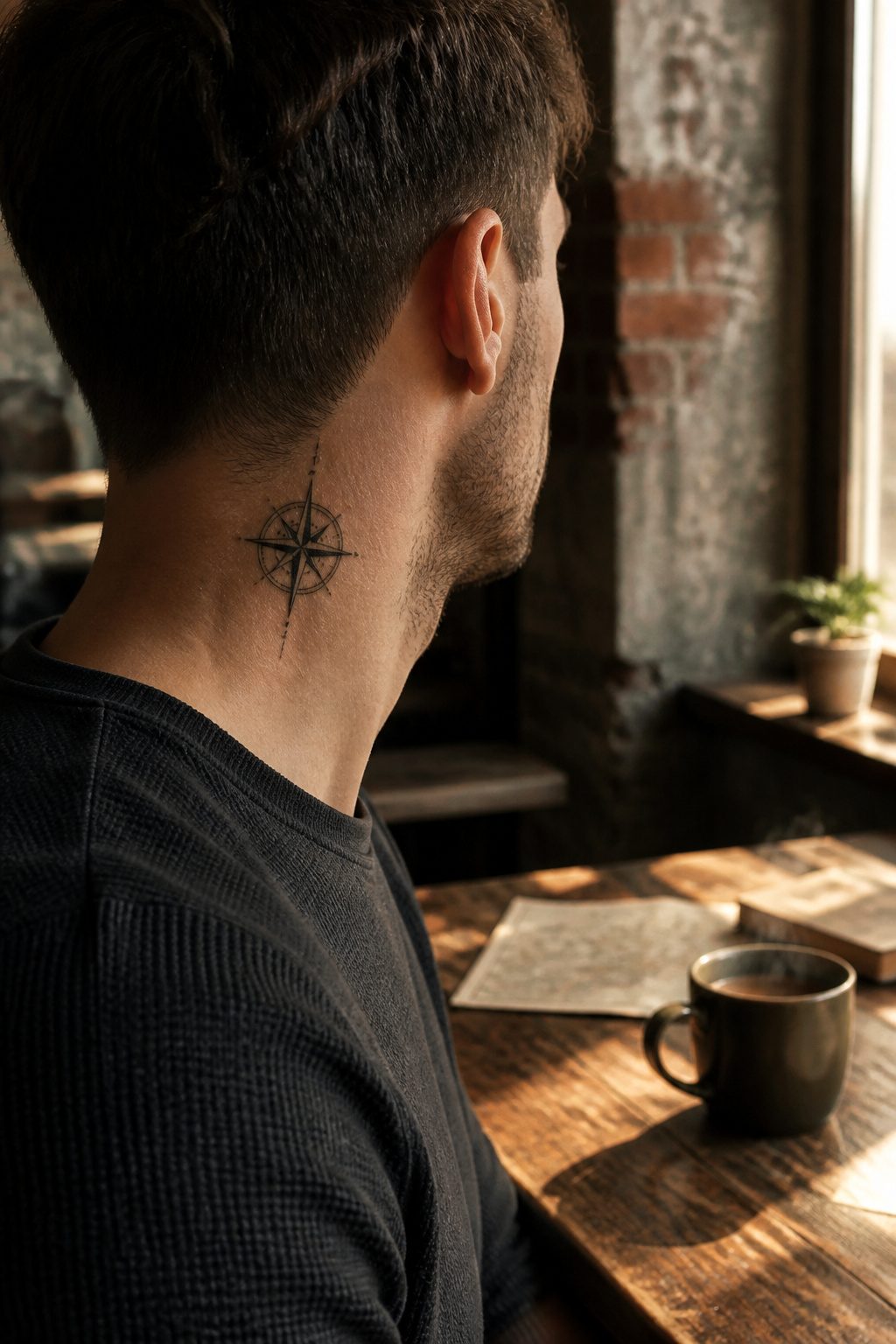
A compass on the neck works because the circle sits naturally against the side of the neck’s curve, following the body instead of fighting it. The design reads as navigation for some men, moral direction for others, or a pinned memory from a specific trip. Grey and black shading with negative space keeps the look bold without clutter, and keeping the piece small and minimal helps it stay office-appropriate while still drawing conversation.
The needle’s orientation carries the personal weight. Point it toward a birthplace, a city where something changed, or true north if the symbolism is enough. The detail is what separates a stock image from something that actually belongs on your skin.
9. Butterfly
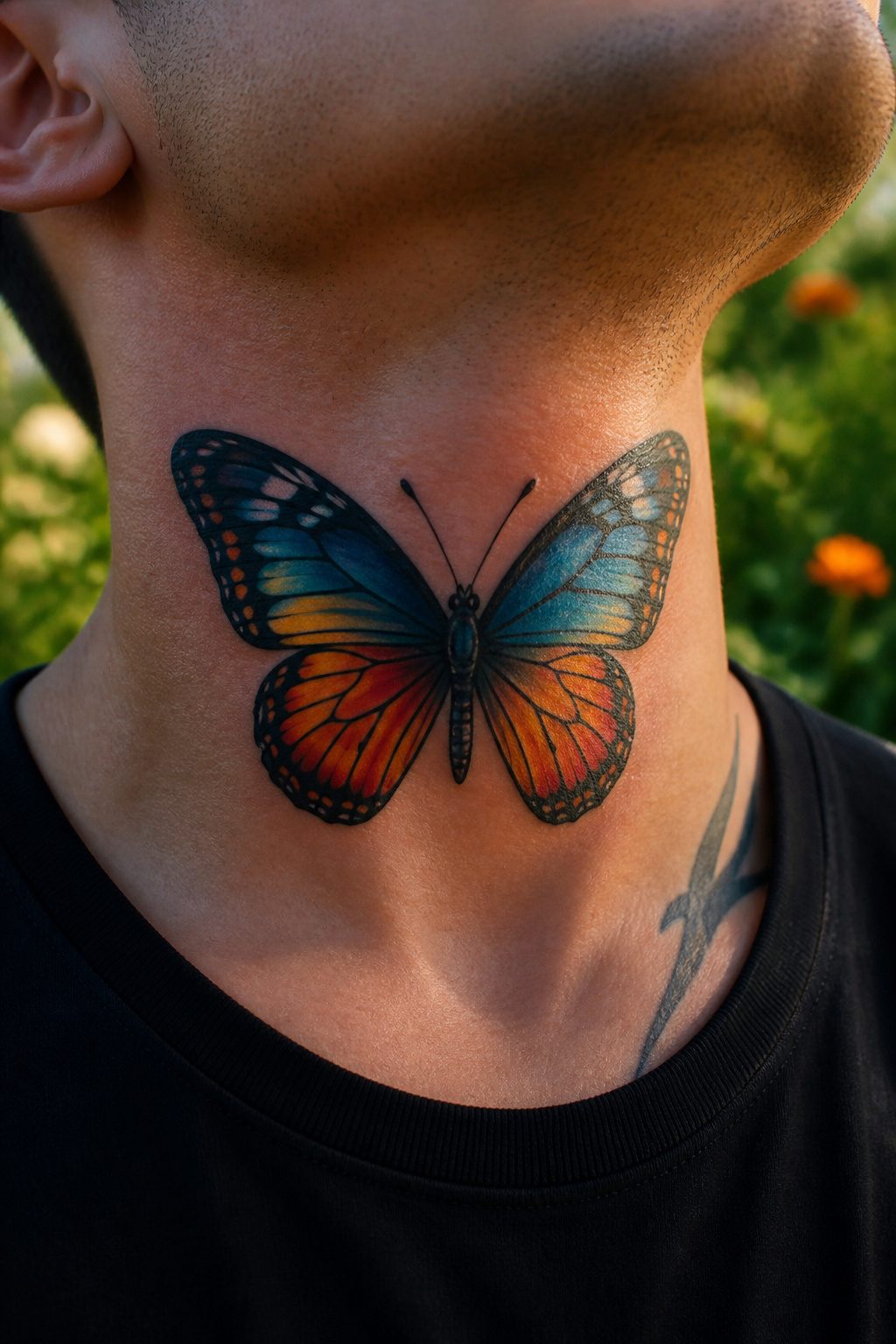
The butterfly on a man’s neck still catches a second look, mostly because the design spent decades shelved as feminine iconography before crossing over. That shift matters less than the meaning underneath. A butterfly throat piece speaks to transformation and resilience, the same reading it carried long before gendered marketing touched tattoo culture. Monarch wings layered across the front carry an added layer: in some traditions they pay tribute to the departed, turning the neck into a visible memorial rather than a hidden one.
Placement here is the real commitment. The throat sits front and center, impossible to conceal in most professional settings, and the skin itself is thin and sensitive, which means the session tests endurance more than a shoulder or forearm would. The pain is part of the point for many men choosing this spot, signaling openness about identity and a willingness to endure visibility rather than hide it.
Design choices have broadened as the symbol migrated. Solid black linework, geometric breakdowns of wing structure, or pairing the insect with daggers, skulls, or clock faces all push against the softer historical associations. The core symbolism stays intact regardless of styling: metamorphosis, survival, the visible evidence of having been through a change and emerged marked by it.
10. Rose
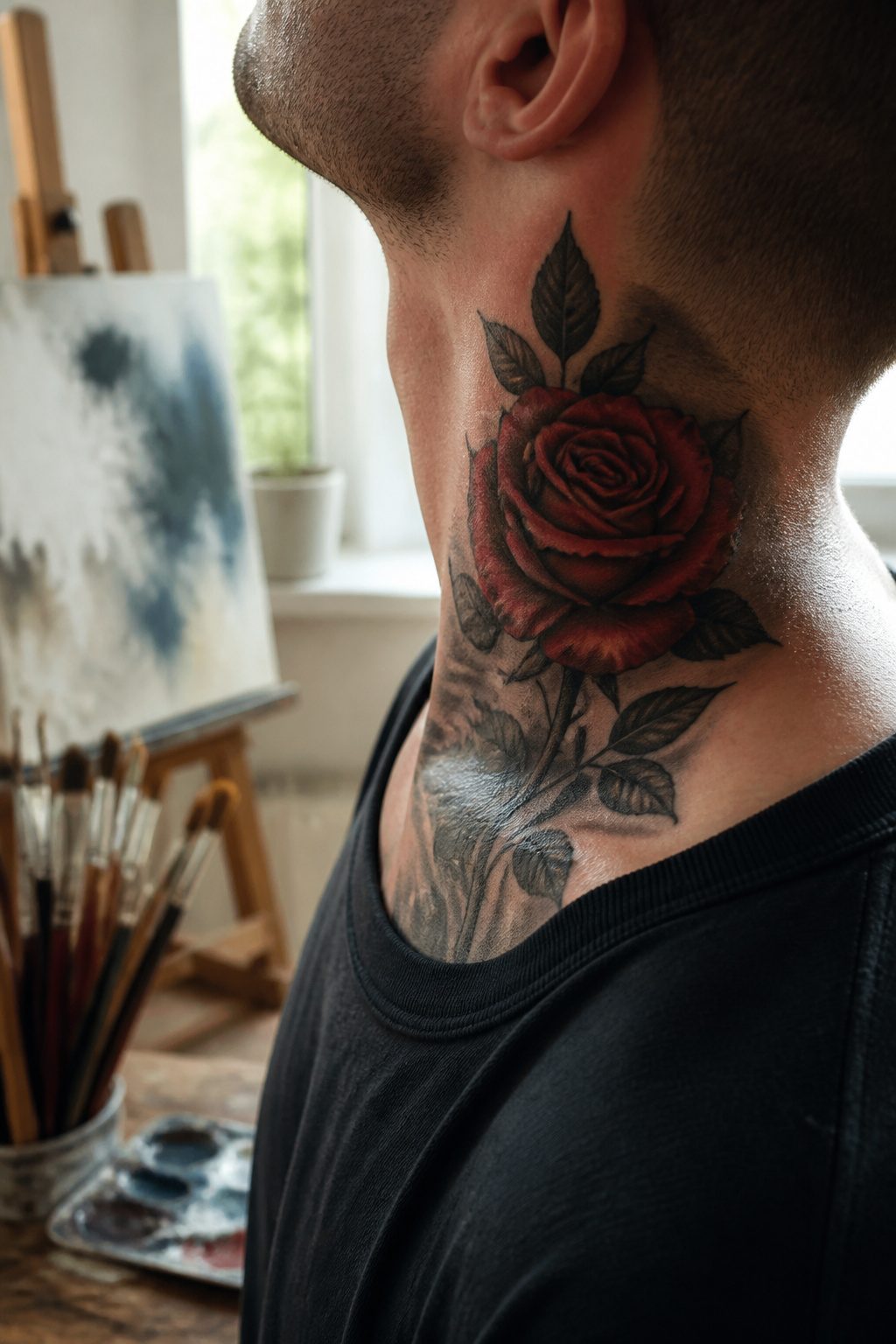
The rose holds its place as the most enduring floral choice for masculine neck work, and for good reason. Stem-wrap designs that coil from the collarbone up toward the jawline frame the neck’s natural structure without fighting it. A single bloom centered on the throat, petals and leaves filling the remaining space, reads as confident rather than delicate; the placement turns a traditionally romantic symbol into something closer to the boldness of American traditional tattooing.
Color versus black-and-grey is where personal preference and maintenance split. Grey shading on petals paired with stark blackout ink on leaves creates the contrast that keeps a rose from looking soft, a combination that lets the same flower signal both beauty and endurance. Full color ages faster on neck skin, which sees more sun and movement than most placements, so the choice becomes whether you want the initial pop or the long-term readability. Black-and-grey wins for guys who treat their tattoos as permanent fixtures rather than statements that need refreshing.
11. Eagle
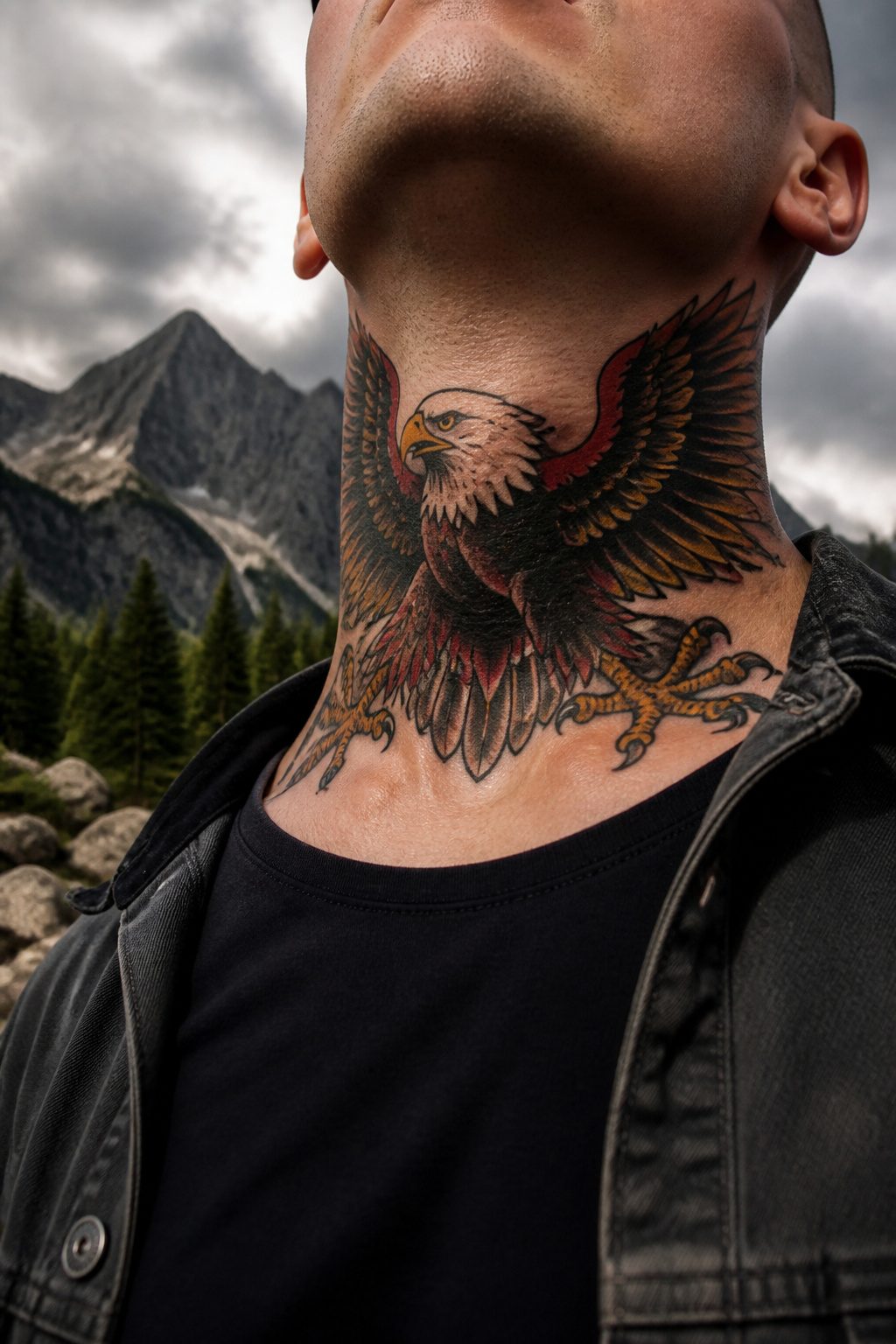
American traditional eagle designs carry a specific visual grammar: bold black outlines, limited color blocks of red, gold, and deep green, and a posture that reads instantly from across a room. On the neck, the spread-wing composition follows the jawline like a natural extension of the bone structure, with feathers tapering toward the collarbones. The style leaves no ambiguity about what sits there, which is exactly why it has persisted since the early 1900s.
Realistic eagles demand a different approach. Heavy shading builds depth into individual feathers, and the wings curve downward to follow the fade of a haircut rather than fighting the hairline. The effect is hyper-detailed, almost photographic, but the placement carries the same symbolic weight: pride, vision, the nationhood that the bird has carried since before the country’s founding.
Two ways to play the throat placement. A bold bird with wings and talons reaching toward the collarbones reads fiercer, more dominant. The back of the neck lets the wings sit under the hairline and flow with the body’s natural lines, visible when you want it, concealed when you don’t. The throat wins for presence; the nape wins for control over who sees it.
12. Spider with Web
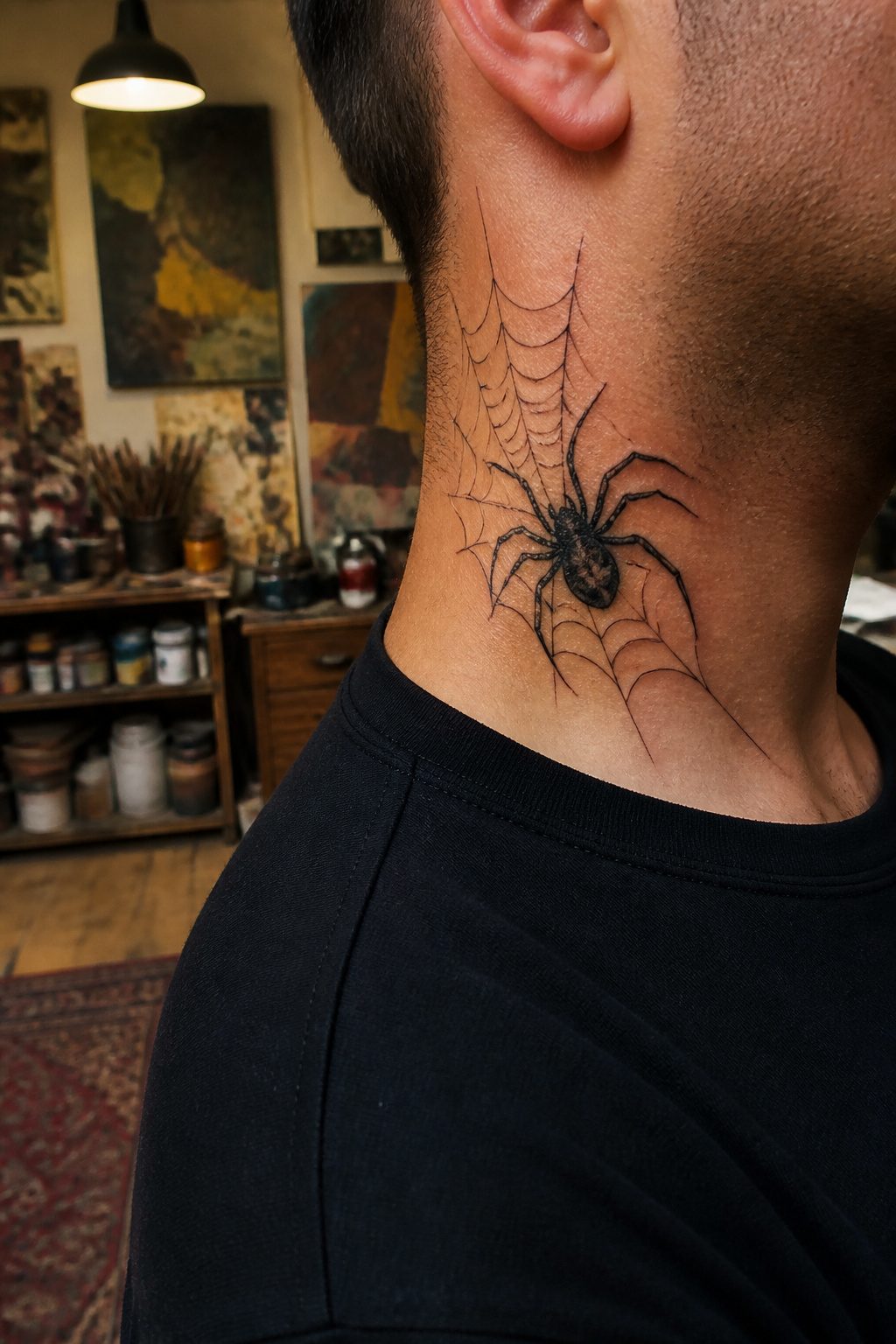
The spider and web on a neck carries weight that shifts hard depending on who is looking. In prison tattoo culture, the design marked time served, each ring of the web counting a year inside. That history still sits in the piece, whether the wearer knows it or not, and artists working neck skin often have to explain why a client might get side-eye from someone who reads that code.
Outside that context, the imagery has spread for its own visual logic. A spider waits, builds, and waits again, which reads as patience to some and entrapment to others. The web itself, strung across the throat or wrapping the side of the neck, follows the body’s lines in a way that flat symbols rarely manage. The web’s geometry has to be drawn to the specific neck it sits on, or the straight lines read crooked the moment the head turns.
I’ve watched this design go from hard prison coding to something men choose for craft symbolism, the spider as maker rather than predator. The shift works when the detail is precise enough to show intent: a widow’s red hourglass plays differently than a garden spider’s orb web, and placement matters as much as species choice. Side neck leaves the throat open and the meaning slightly ambiguous; front placement under the jaw commits harder to whatever version of the symbol the wearer wants claimed.
13. Geisha with Mask
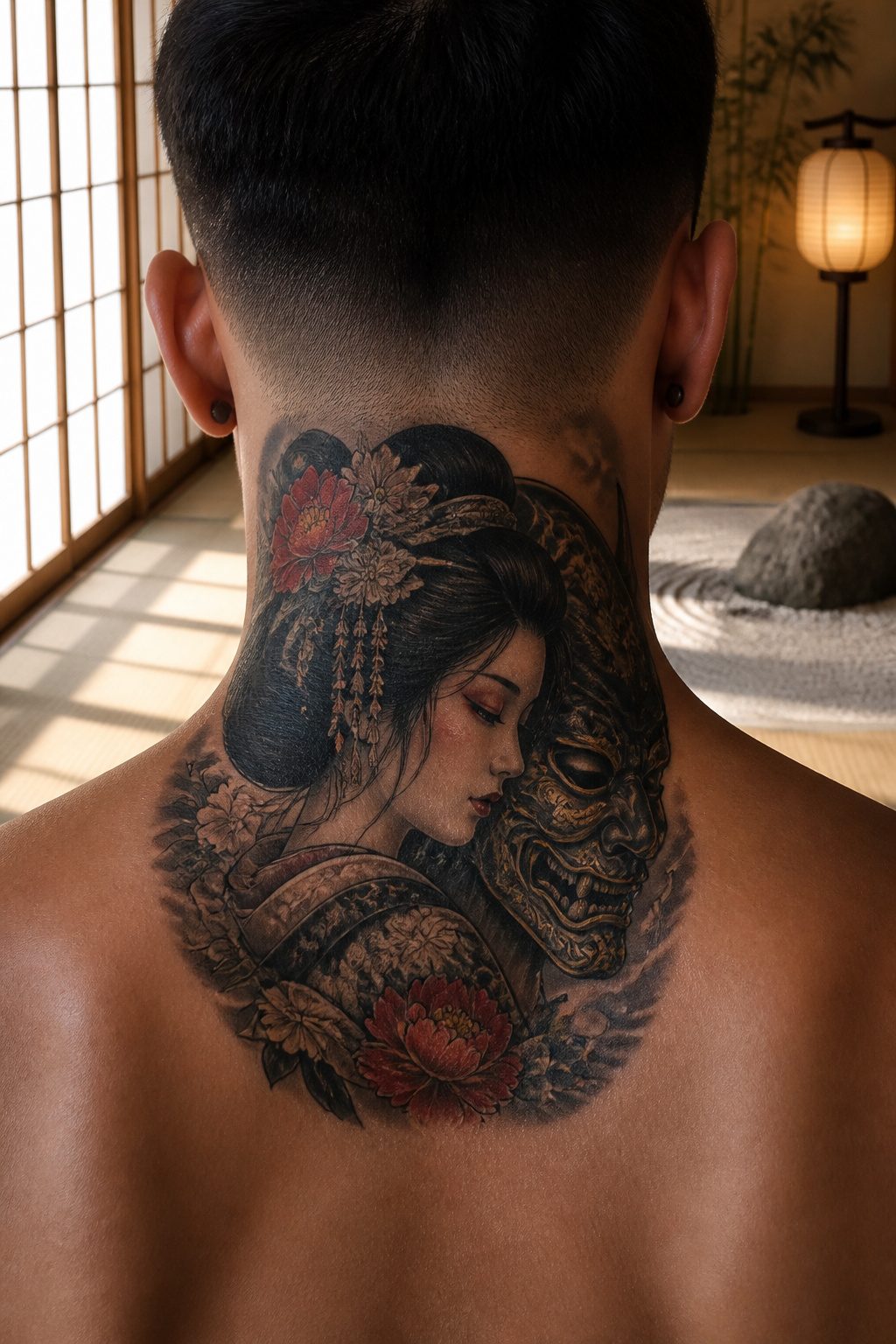
A geisha with mask design draws from Japanese portraiture that pairs refined feminine beauty with the menace of an oni or noh mask. The geisha half carries soft, detailed shading around the eyes and jaw, while the mask side bares teeth and adds a pop of color through red gemstones. What makes this work on a neck is the single light source backing the whole piece: the shading is built as if one lamp hits the face from a fixed angle, so the curvature of the throat becomes part of the drama rather than a complication. The aggressive mask element reads as masculine without needing to replace the geisha entirely, which keeps the tension between grace and threat alive. On the back of the neck, this dual imagery gains room for the meticulous linework that separates the two halves, and the sharp contrast against skin or a close fade lets the dark shading hold its depth. The manly vibe comes from the mask’s expression, not from stripping out the elegance, and that balance is what keeps the design from flattening into pure aggression.
14. Evil Wolf
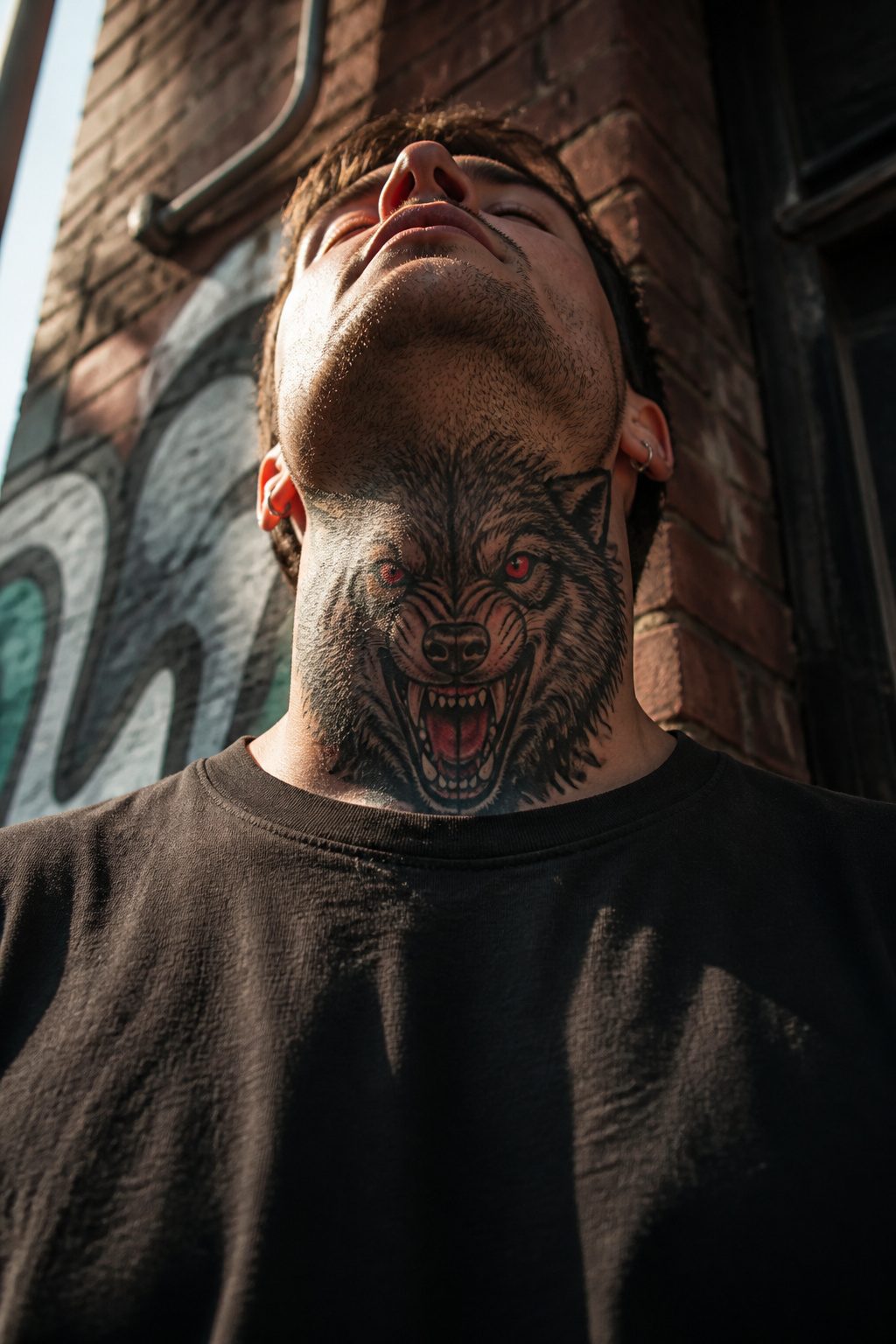
A snarling wolf placed at the throat carries immediate visual aggression that softer designs cannot match. Black shading mixed with red accents builds the ominous tone, while sunken, predatory eyes and bared teeth turn the head into a warning for anyone walking behind. The meaning splits two ways: pack loyalty twisted dark, or a predator that needs no pack at all. Both readings gain force from the neck’s visibility, since the throat is already a vulnerable point and marking it with something fierce claims that space rather than hides it. The back of the neck works best for the full snarl, where the curve of the spine gives the wolf’s jaw natural room to open. Front placement, under the chin or along the side, reads more like a threat the wearer directs outward, which shifts the symbolism from inner identity to outward posture. For men choosing this design, the question is which balance they want: the lone wolf that hunts alone, or the betrayed pack member whose loyalty turned feral.
15. Mandala
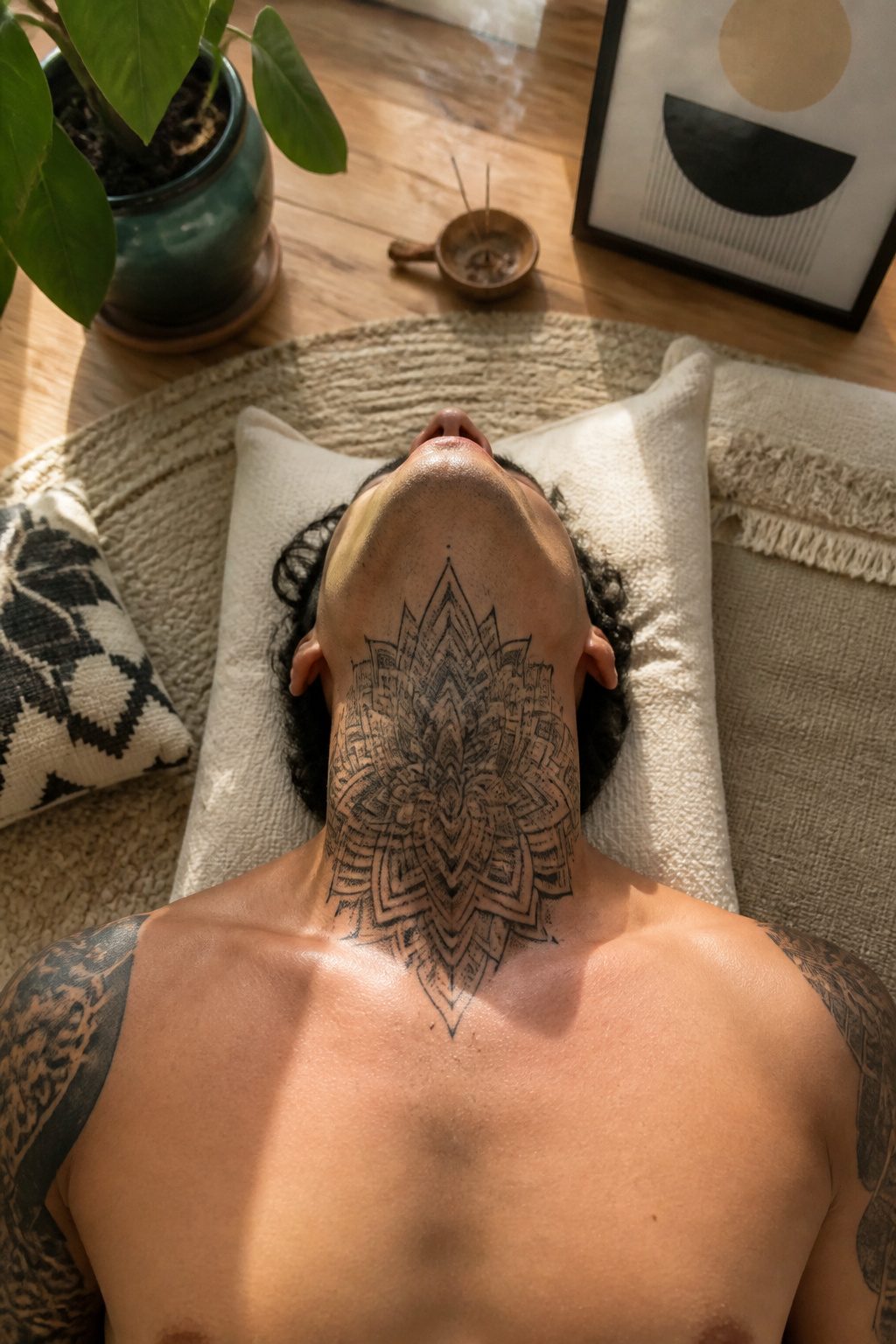
A full circular mandala centered on the throat or the back of the neck carries spiritual weight that predates its use in tattooing. The design grew out of Hindu and Buddhist practice, where the mandala served as a map of the cosmos and a tool for meditation; carrying one on the throat, specifically, places that symbolism at the voice and breath, which is either powerful or overdone depending on who you ask. What convinced me, looking through portfolio after portfolio, is that the piece lives or dies on symmetry, and the neck is one of the worst places on the body to ask for it. Skin shifts with every swallow and turn of the head, so the artist has to account for movement in the stencil phase, not just hope the lines hold steady during the session. The throat’s curve also distorts a perfect circle the moment the client looks down, which is why the strongest throat mandalas I have seen use negative space and dotwork to break the ring into smaller geometric units that read as balanced even when the canvas moves. Dots and varied shading, rather than solid black fill, give the eye places to rest and help the design contour to the skull and jawline without fighting them. A back-of-neck mandala avoids some of this trouble, since the skin there moves less, but it sacrifices the immediate visibility that draws most people to neck work in the first place.
16. Simple Designs
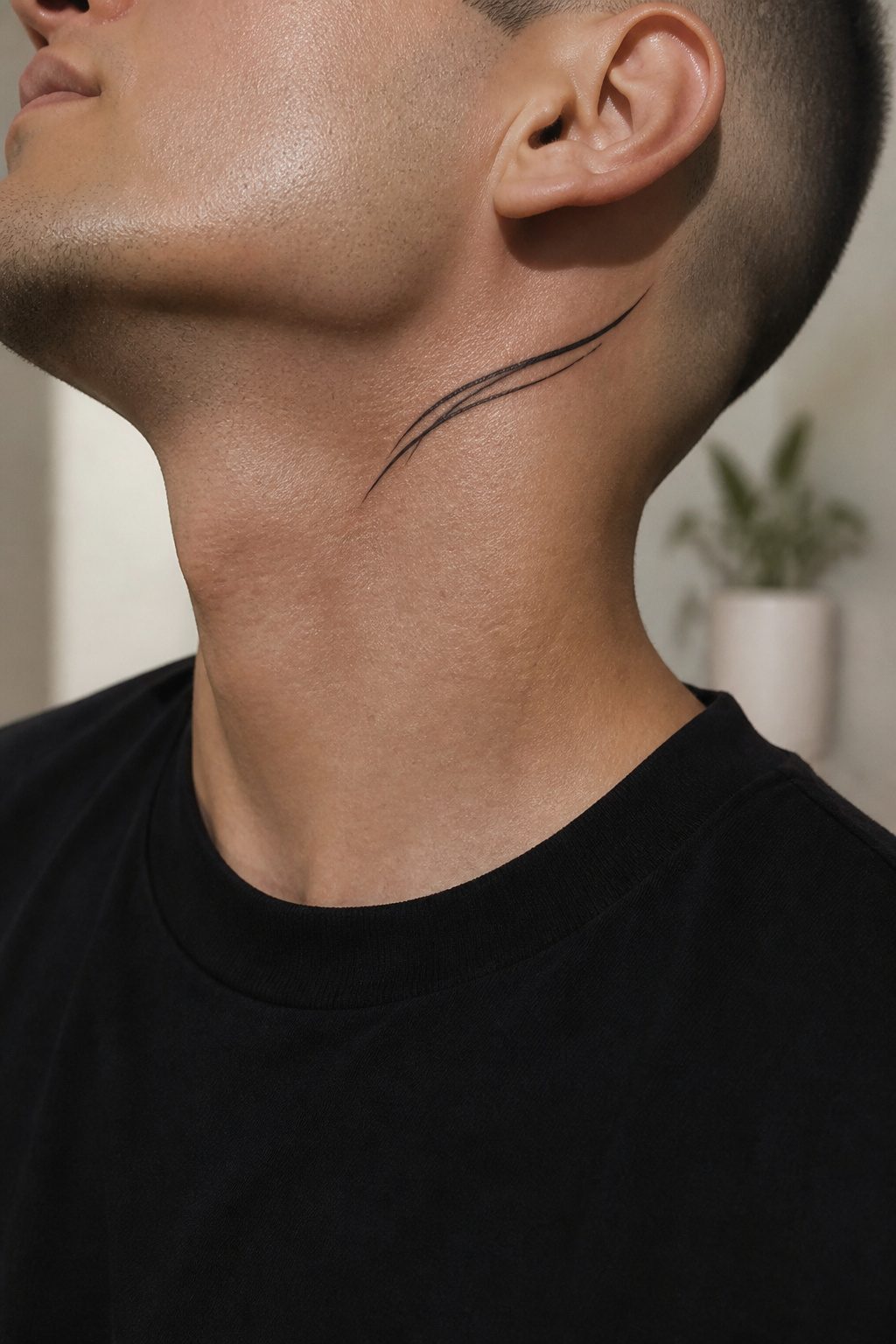
A single needle running along the jawline or a slim rose with just enough shading to catch light reads as certainty rather than hesitation. The neck is already a loud placement; stripping the design back to clean lines or a small geometric shape lets the choice itself speak. I have watched friends heal out heavy black saturation on the throat and the peeling dragged on for weeks. Lighter work sits closer to the surface, and the skin turns over faster when there is less ink to push through. The aftercare stays the same regardless: wash with a fragrance-free foaming soap, pat dry with a clean paper towel, and keep a natural balm on it. Aloe, shea butter, and vitamin E do the actual work. Stay out of the sun for two to four weeks or the lines blur before they settle. Once the skin closes, sunscreen becomes the only thing standing between that crisp edge and a fade that arrives two years early.
17. Karma Symbols
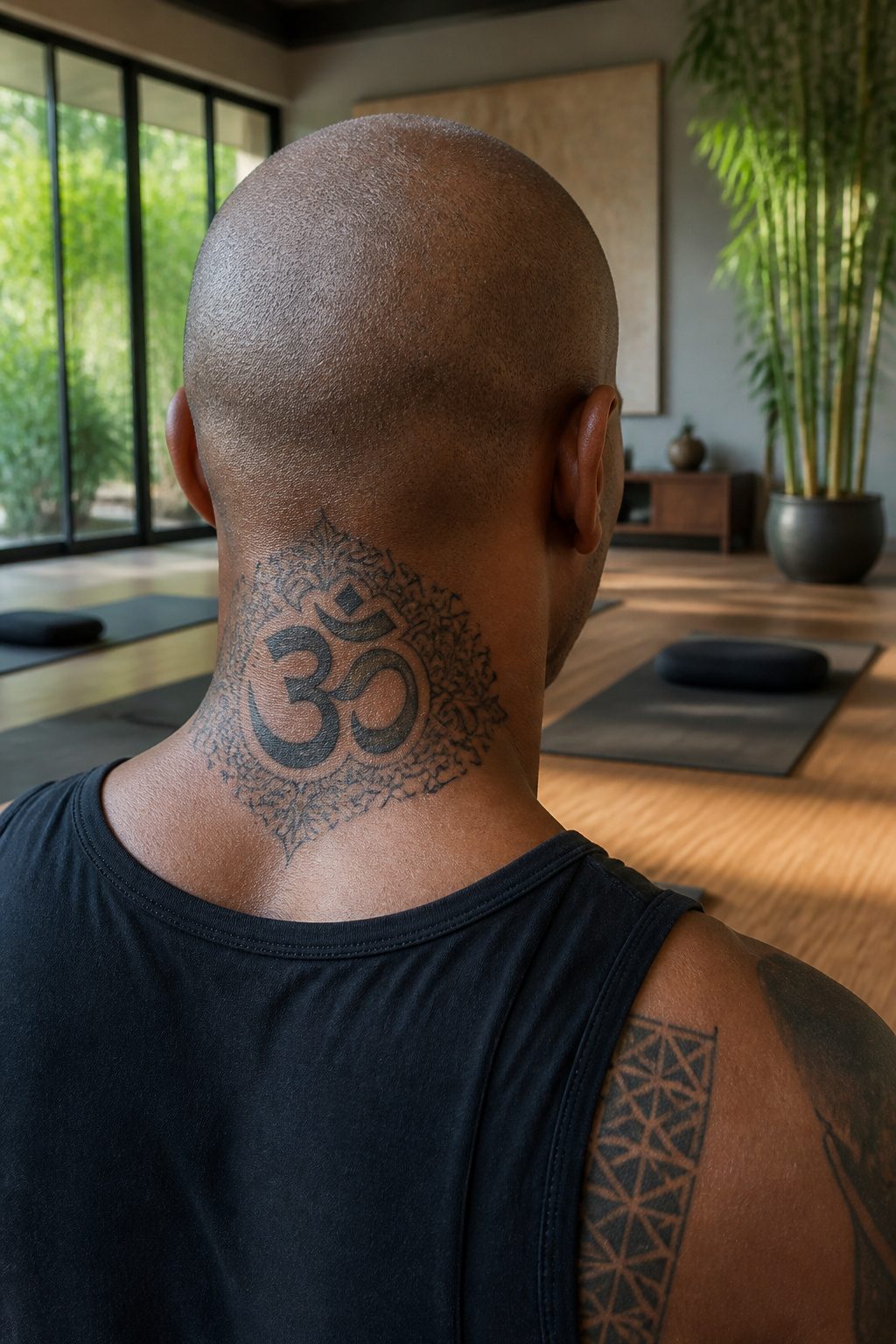
Sanskrit characters and endless knots carry a weight on the neck that simpler motifs do not. The placement itself becomes the statement: a spiritual belief worn where concealment is nearly impossible, and that visibility demands a level of conviction that quieter placements let you sidestep. Om symbols read cleanly from a distance, their curves holding up at the scale neck skin allows, while the endless knot’s interlacing lines reward closer inspection without collapsing into blur at conversational range.
The circularity built into these designs, what goes around comes around made literal in looping form, ties directly to the neck’s own shape. That mirroring of body and symbol is part of what draws the choice, though it also limits flexibility; the motif sits where it sits, and moving it elsewhere breaks the logic that made it compelling. For men considering this, the commitment is doubled: the spiritual claim and the social one, neither retractable with a collar button. The neck’s sensitivity as a tattoo site adds its own layer, pain endured for a principle rather than pure ornament, which the culture around these symbols would likely recognize as fitting.
18. Clock
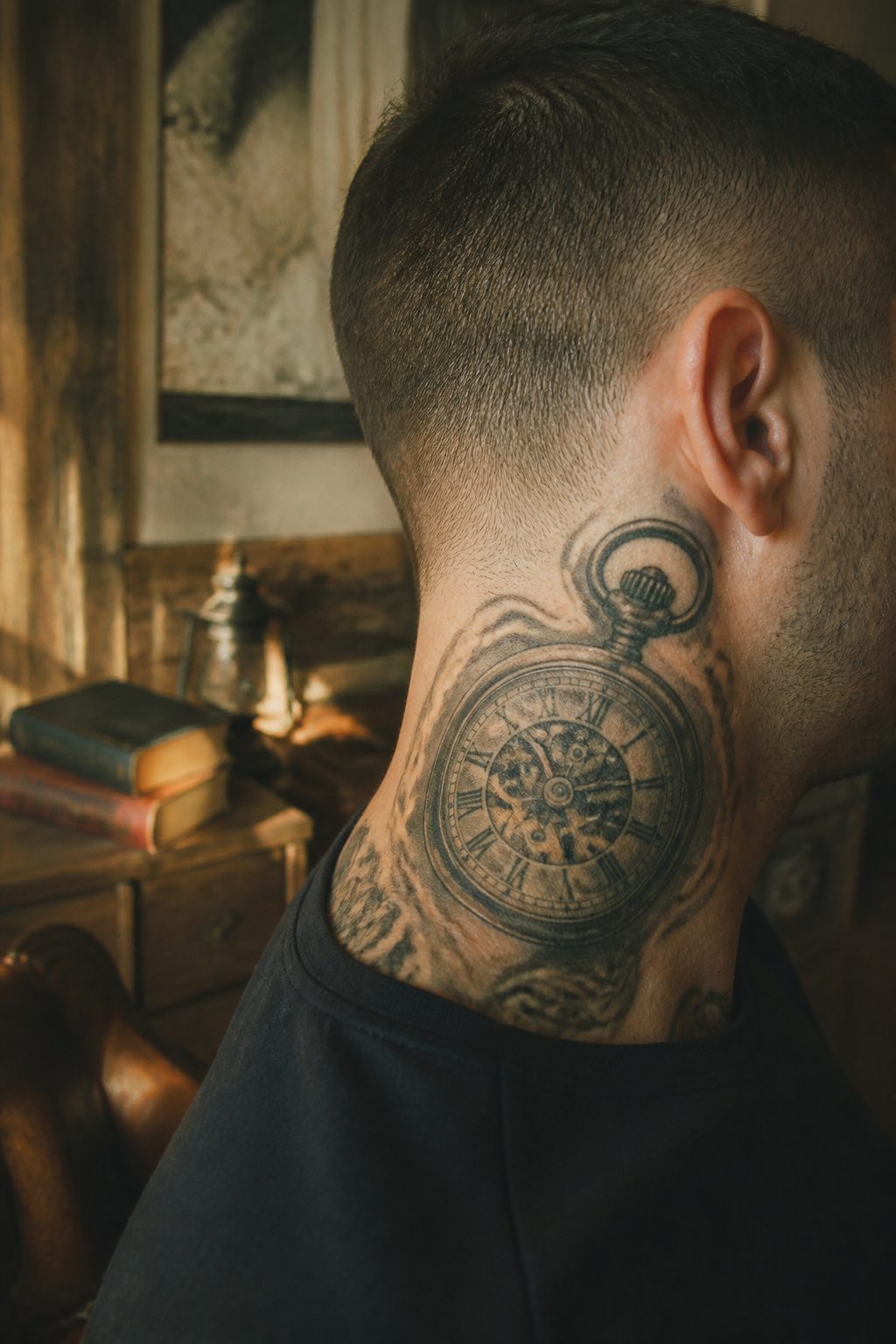
A pocket watch face sits well on the side of the neck, where the round shape follows the jaw’s curve without fighting it. The glass cover and exposed gears give an artist room to play with light and shadow, but the detail needs to hold up at a distance. Melting clocks, the kind borrowed from Dali’s persistence of memory, work better as a small accent behind the ear than stretched across the throat where the distortion can look accidental rather than intentional. Roman numerals read cleaner for their straight lines, though spacing them evenly on skin that moves with every swallow takes more planning than most first-timers expect. Mortality is the usual reading, memento mori in permanent ink, though plenty of guys now choose a clock stopped at a child’s birth hour or a parent’s death, trading the grim reminder for something lived in instead of feared. Carpe diem lands harder when the clock hands are set forward, not frozen, a small tilt of the hands that changes the whole tone from warning to push. The neck leaves little room for a full dial with numerals all the way around; partial faces or hands alone often carry the idea with less clutter, and heal cleaner in a spot that bends and creases all day.
19. Tree Silhouettes

Bare branches running up the side of the neck carry a stark, winter-boned look that ages better than most figurative work. The line of the throat becomes the trunk; the collarbone, where roots can spread. A full canopy above the jawline risks crowding a beard or stubble line, so keeping the canopy light or open at the edges usually reads cleaner on men who don’t stay clean-shaven.
Family tree readings, names worked into roots or hung like fruit, follow the same vertical pull. The neck’s length suits a generation-by-generation climb, oldest at the base, newest rising toward the ear. Roots at the throat have a different weight: they read as grounded, sometimes as strangled, depending on how thick the lines run and whether they wrap toward the Adam’s apple.
I have seen vertical growth pieces where the artist let the natural wrinkles at the neck become part of the bark texture. That only works if planned from the stencil stage; adding it later looks like an excuse for a line that drifted. The skin here moves constantly with swallowing and turning, so fine detail in leaves or individual names tends to soften within a few years. Bold silhouettes hold their shape longer than delicate branchwork in this spot.
20. Vertical Words
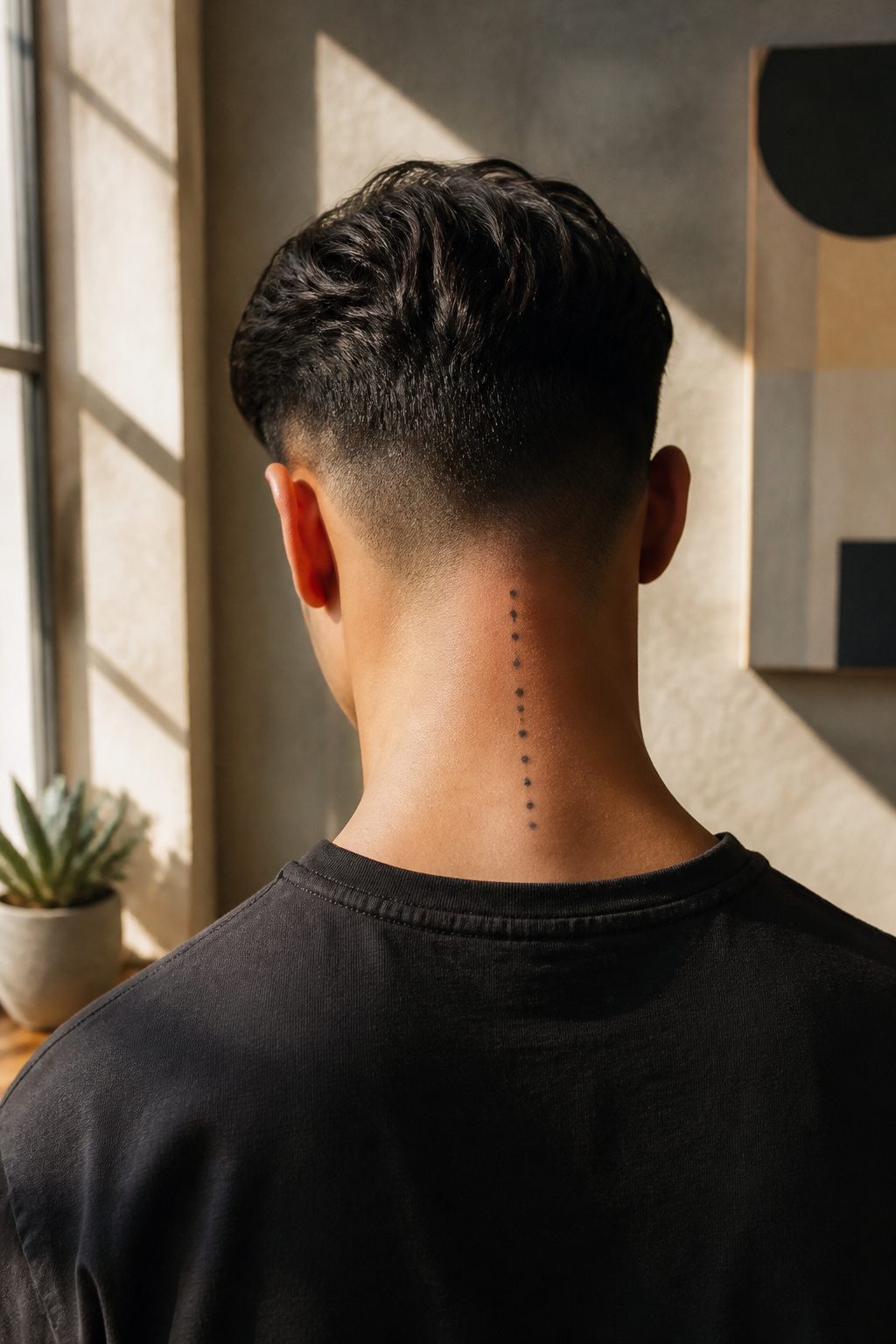
Script running straight down the spine of the neck reads cleanly from a distance but the real test comes five years out. Fine serif fonts blur into soft tissue; sans-serif or custom block lettering holds edges longer at the scale most men actually request. I have watched healed pieces where the descender on a "g" or "y" pooled ink and left a gray shadow that the artist never intended, which is why vertical placement demands extra spacing between lines even when the sketch looks tight on paper.
Text commits harder than image. A skull ages into a stylized skull; a misspelled word or a phrase that sounded profound at twenty stays misspelled and becomes embarrassing. The permanence works both ways: names of children or coordinates of home ground the design in something that outlasts trend cycles, but lyrics from a band that breaks up next year do not. Most men I have seen choose vertical words for the narrow real estate, not the statement itself, and that is the wrong order to shop in.
21. Half Mandala
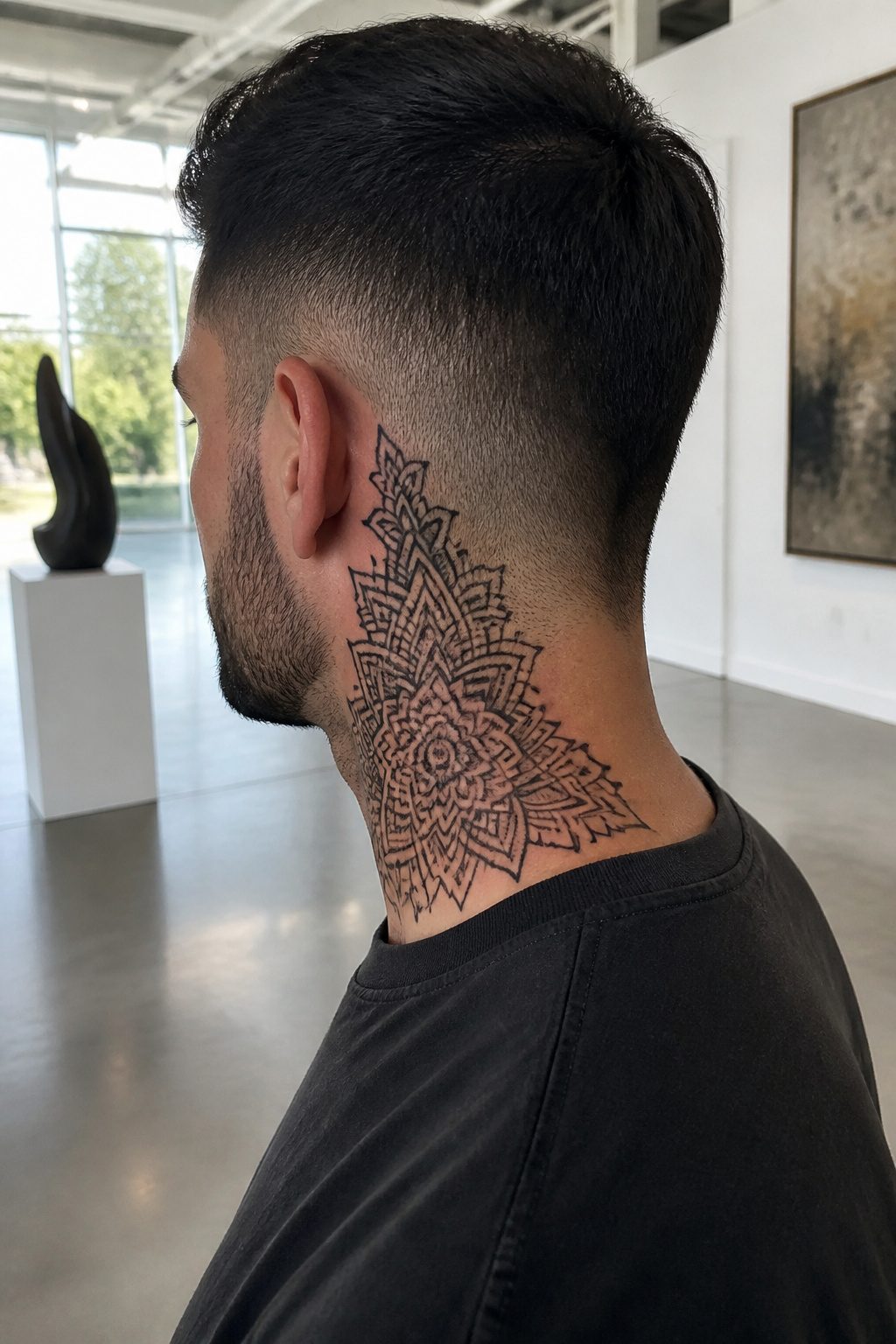
A mandala sliced in half and tucked beneath the ear follows the jaw’s curve in a way full circles rarely manage. The straight edge sits against the hairline or the lobe, and the geometry fans outward toward the shoulder or the corner of the mouth. What surprised me, looking through portfolios, was how often artists crop to a quarter-circle instead of a semicircle when the placement sits higher, almost at the sideburn. The smaller slice keeps the detail readable at that tighter angle.
The partial format also lets the design stop where the neck meets the collar, which matters for anyone who needs to hide the work. A full mandala demands center placement and a visible collar line; the half version disappears under a buttoned shirt while still carrying the same symbolic weight. Line weight needs to run heavier than on a full back piece. Skin on the neck shifts with every turn of the head, and fine points blur faster there than on steadier ground.
22. Cyber Sigilism
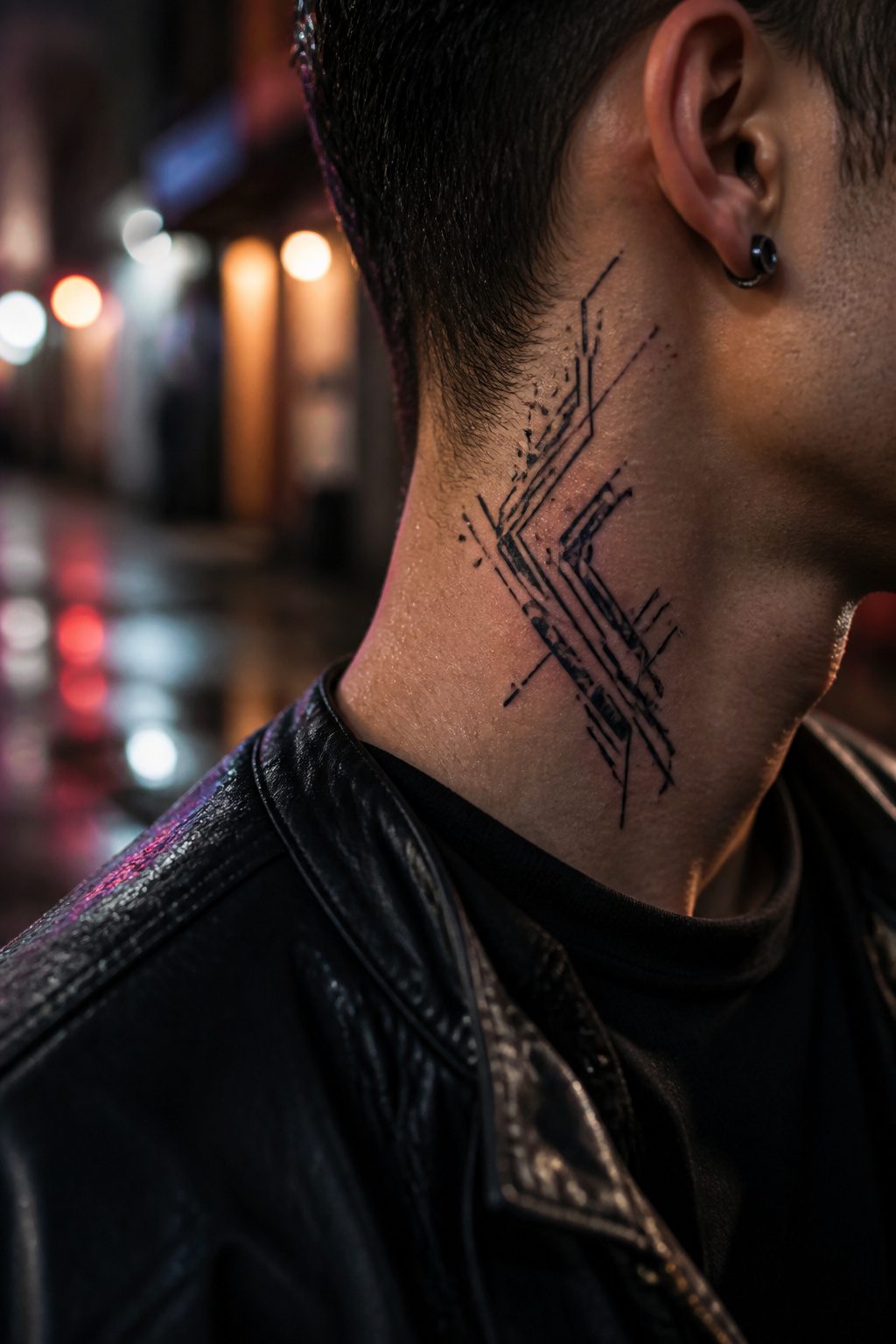
Cyber sigilism lands somewhere between spellcraft and system architecture, and that tension is exactly why it works on a neck. The style borrows from ceremonial sigils, those compressed symbols magicians designed to bypass conscious thought, but renders them in circuit-board geometry and deliberate glitch breaks. Lines that should connect stop short or fragment into static-like scatter, giving the whole piece the feel of a file that almost failed to load.
What surprised me, looking through the portfolios where this shows up, is how young the clientele skews. The artists carrying real volume in this style are booking mostly Gen Z clients, men in their early twenties who found the aesthetic through digital art accounts rather than tattoo tradition. That generational concentration matters for a neck placement because it signals where the style sits in 2026: not yet crossed over to mainstream shop flash, still carrying the single-source credibility that comes from knowing which three or four artists are actually pushing it forward.
The neck suits the style because the geometry needs flat planes to read correctly. Jawline to collarbone gives the canvas, and the glitch elements let the artist break the silhouette so the piece does not sit like a collar. For men considering it, the commitment level runs high; this is not imagery that softens with age or hides under a standard collar.
23. Important Dates
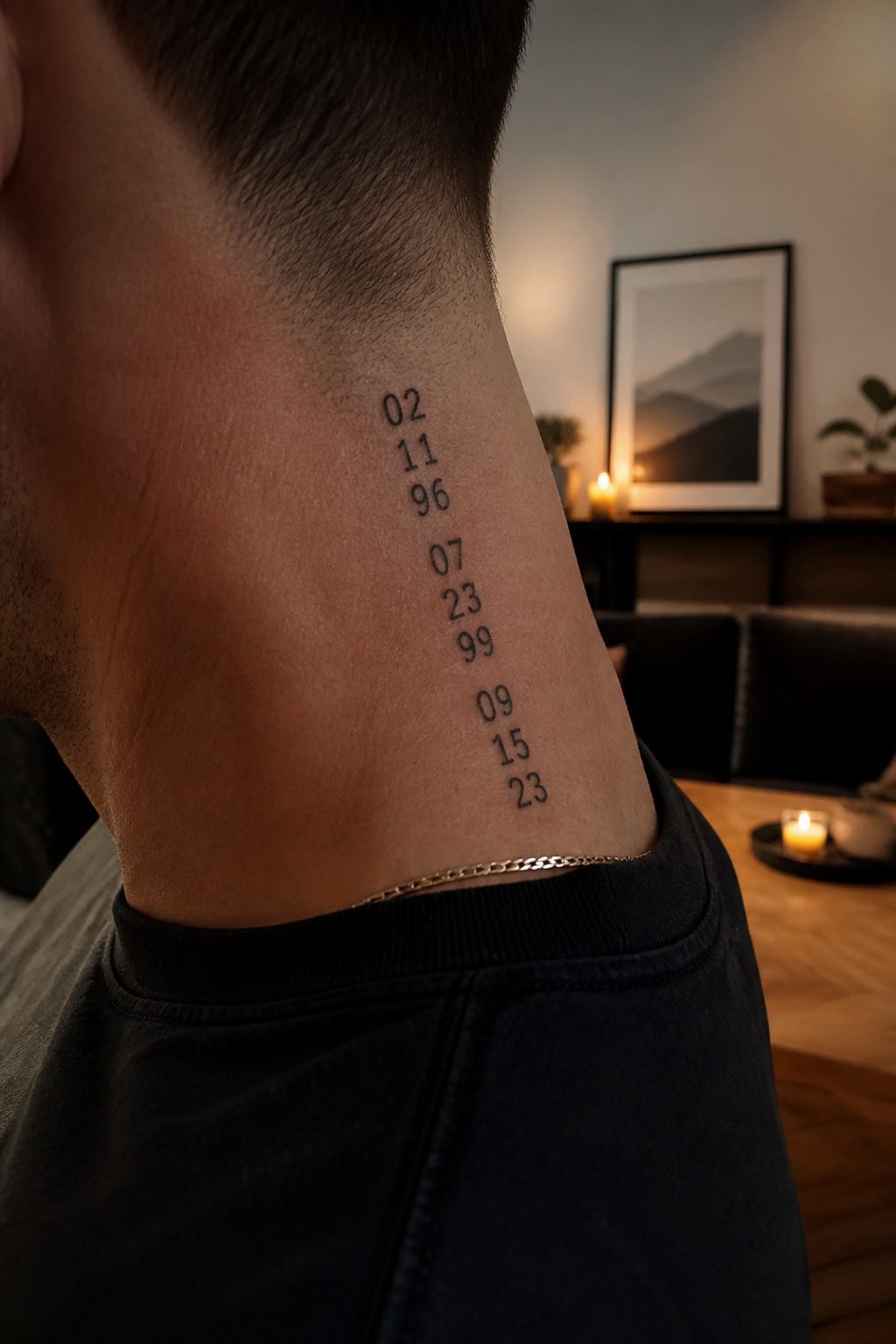
Dates on the neck carry a weight that flowers or geometric shapes rarely match. A birthday, a death date, or an anniversary number sits at the threshold between private memory and public declaration, and the neck makes that line impossible to ignore. Roman numerals remain the default choice for men who want the information readable without looking like a driver’s license, though block digits in a narrow vertical column can read as more modern and less sentimental. The real decision is placement. A date tucked behind the ear keeps some control over when it shows; wrapping onto the throat puts it in every handshake and job interview. What convinced me, looking through portfolios, is that the most successful date tattoos include some secondary element that breaks the sequence: a small rose for a birth month, a feather for a passing, a simple line that turns the numbers into part of a larger shape. Without that, the neck can start to look like a calendar page. The format matters as much as the date itself: stacked vertically follows the neck’s natural line, while horizontal reads as a collar and tends to age poorly as skin shifts. Most artists will push for sizing that keeps the numbers legible from conversational distance, not arm’s length, which usually means taller characters than clients first imagine.
24. Dreamcatchers
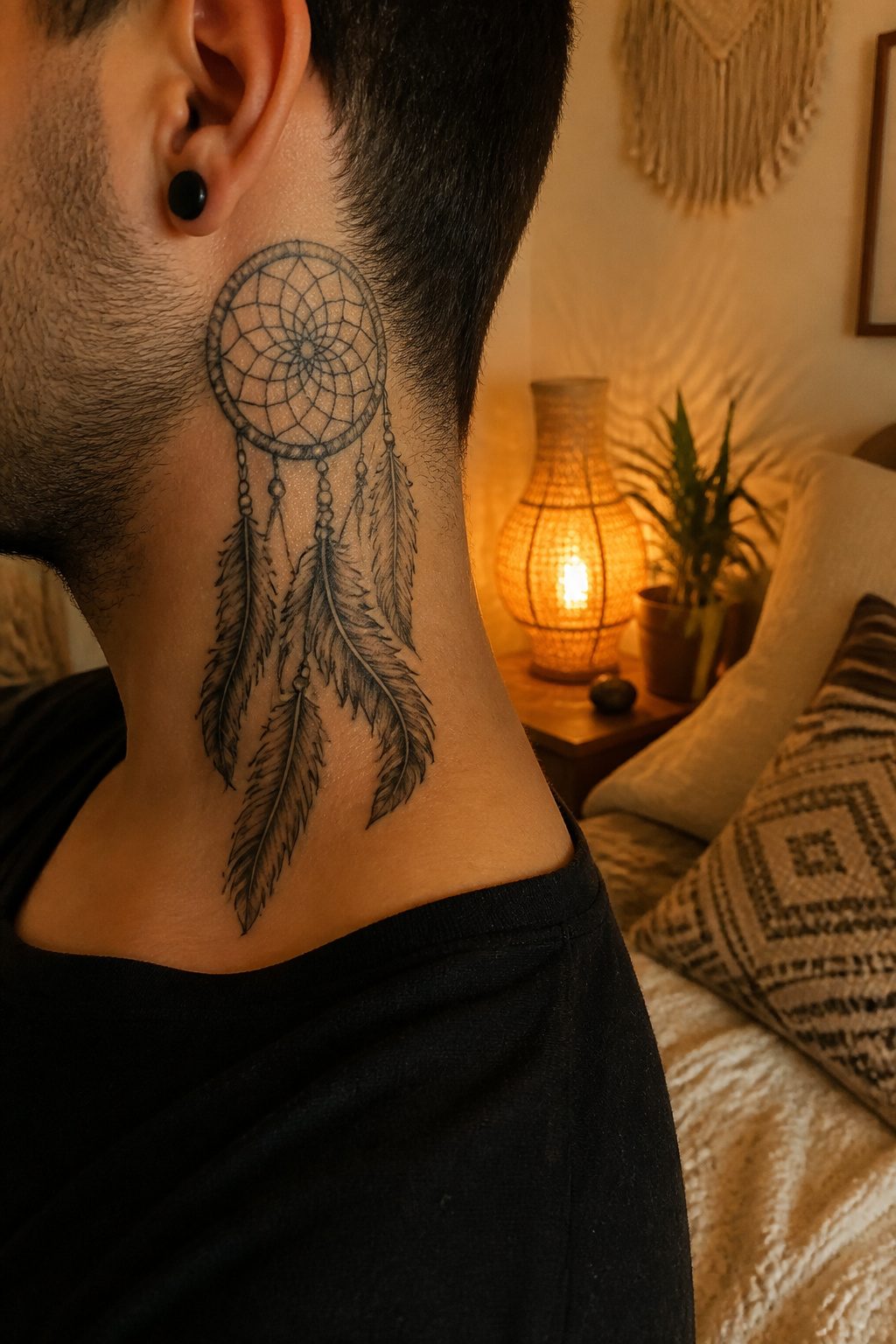
The dreamcatcher’s hoop sits naturally at the side of the neck, where the curve of the webbed circle follows the jawline and the feathered strands trail down toward the collarbone. That placement gives the design movement when the head turns, though the drape of those fine lines demands a steady hand from the artist; skin on the neck shifts with every swallow and conversation.
The form itself carries weight that many wearers underestimate. Dreamcatchers belong to Ojibwe tradition, and their migration into mainstream tattoo culture sits uneasily with that origin. The web was meant to filter dreams for sleeping children, not to serve as aesthetic ornament for bodies outside that heritage. What reads as spiritual or protective to some scans as extraction to others, especially when rendered without relationship to the community that developed the symbol.
A man choosing this for his neck faces that tension openly, since the location refuses to hide. The visibility is the point of neck tattoos for men, yet here it amplifies a question the wearer should answer honestly: whether the design honors a genuine connection or borrows a meaning he has not earned. The feathers, the beadwork, the specific weave pattern, each carries original significance that flattening into generic tattoo vocabulary strips away.
Artists who specialize in this work sometimes refuse the request outright, and that refusal itself is worth hearing.
What Neck Tattoos Symbolize
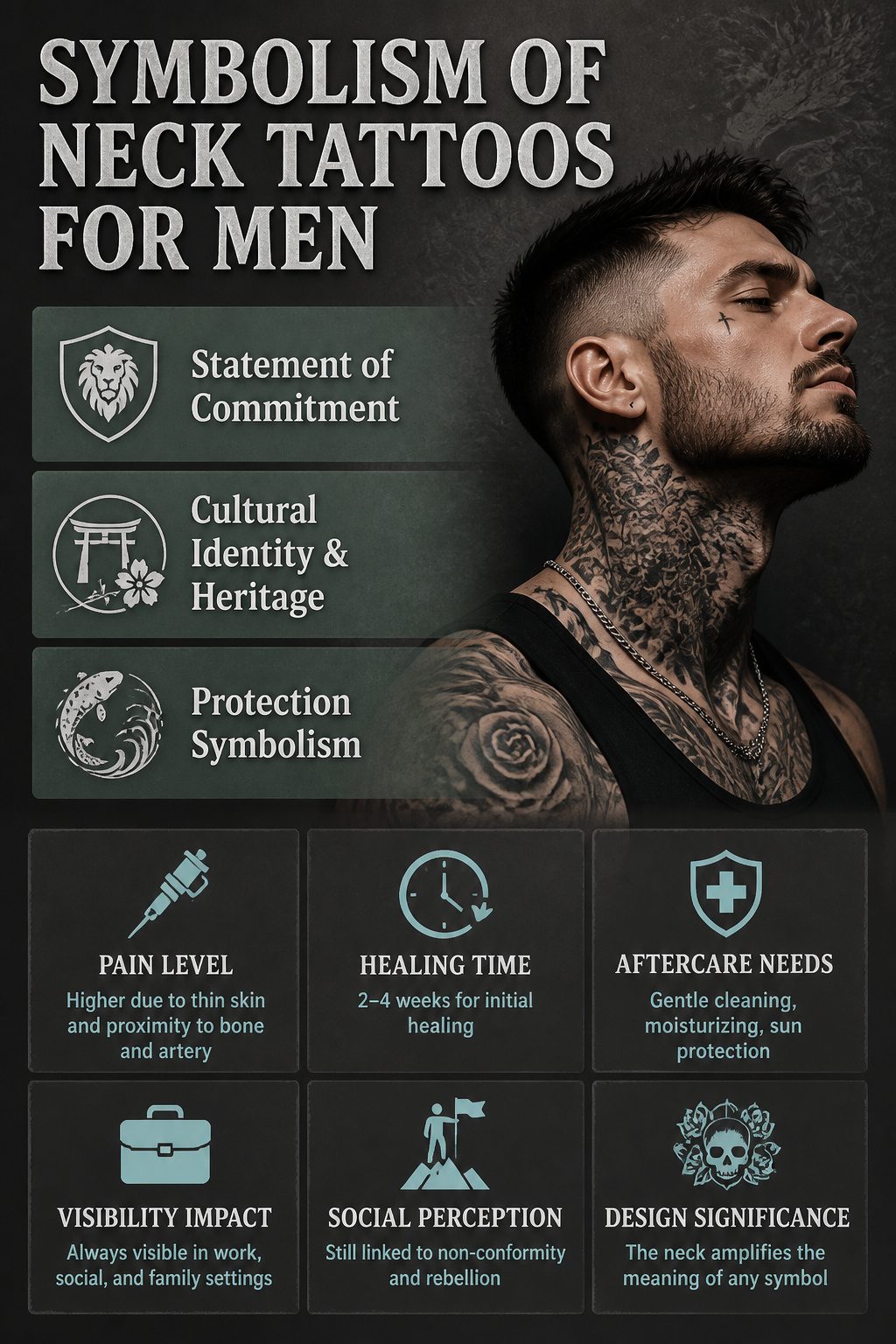
Neck tattoos for men carry weight because the placement itself is a decision. The skin sits close to bone and artery, the pain is sharper than on a shoulder or thigh, and the result is visible in every mirror, every job interview, every family dinner. That visibility turns the ink into a statement before the design even speaks.
Strength and resilience sit at the core of that statement. A man choosing this spot signals he endured the needle where others might hesitate, and he did it knowing the work cannot be hidden. The neck was once taboo, tied to counterculture and rebellion; even now, with celebrities and influencers normalizing the look, the trace of non-conformity remains. It is a commitment to standing apart.
Protection runs through older traditions. Japanese neck pieces often frame the back with smoke, cherry blossoms, or rising suns meant to guard against negativity, to act as talismans against harm. Some men carry that same intention into modern designs, choosing symbols that ward off or draw in according to belief. Cultural identity layers on here too: the imagery can root a wearer in heritage, in story, in a lineage he wants visible.
What convinced me, reading through the range of work out there, is that the symbolism lives in the choice of placement as much as the image itself. A skull on the bicep is decoration. A skull on the throat is a declaration. The neck leaves nowhere to retreat, and that openness, for many men, is the entire point.
Pain by Placement
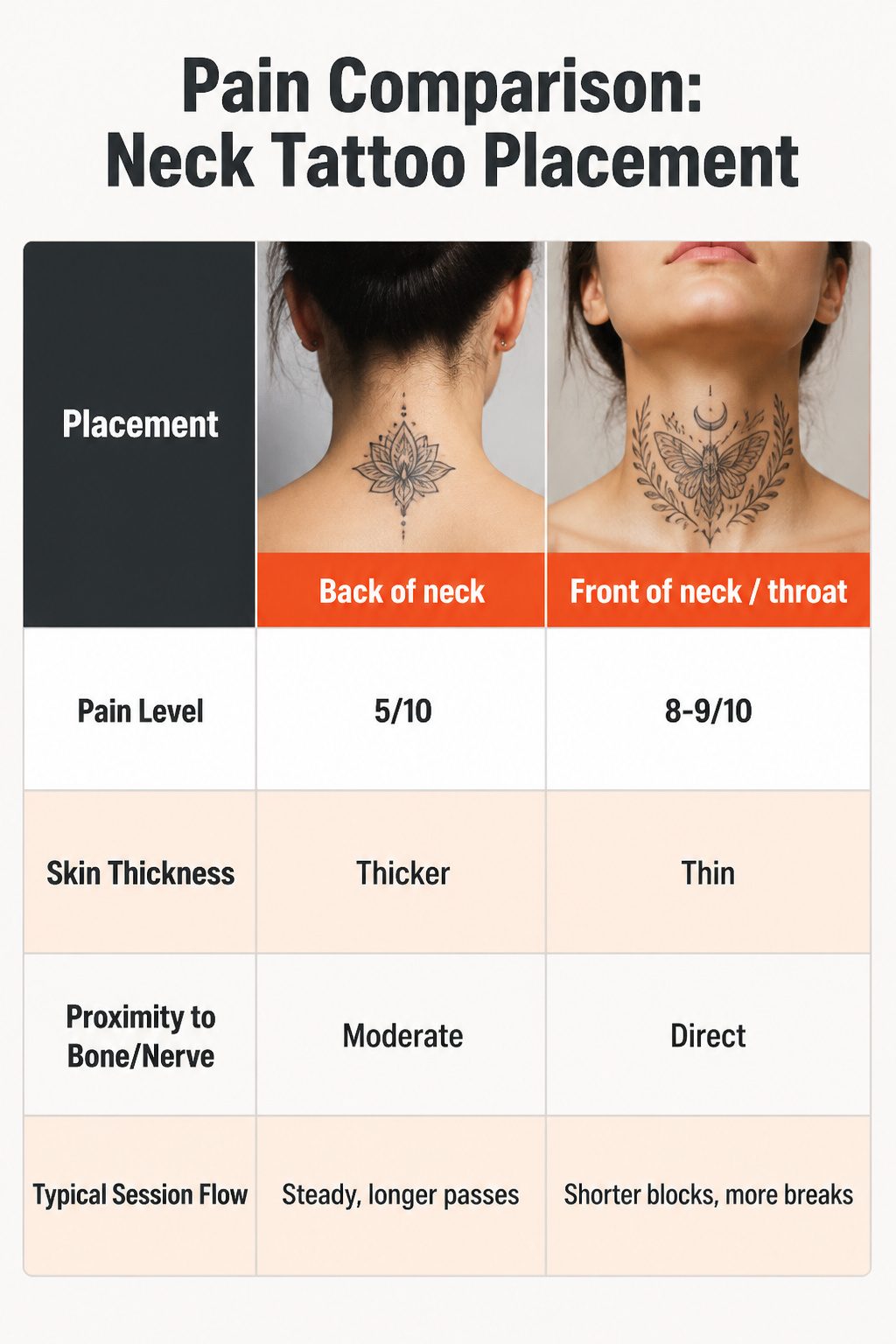
The back of the neck sits at 5/10 on the pain scale, low enough that most people sit through the session without a break. Skin there is thicker and there is some cushioning over the bone, so the vibration feels dull rather than sharp. The front of the neck and throat land at 8–9/10, a jump that surprises a lot of first-timers. That skin is thin, the bone sits right underneath, and clusters of nerve endings run close to the surface. The needle registers as a deep, persistent sting that can make your eyes water.
Placement also changes how long the session feels. The back of the neck lets you settle into the chair, breathe normally, and zone out. Face-up work on the throat tends to tighten the whole body, which amplifies the sensation. Artists often schedule throat pieces in shorter blocks for that reason, even if the total area is small.
| Placement | Pain Level | Skin Thickness | Proximity to Bone/Nerve | Typical Session Flow |
|---|---|---|---|---|
| Back of neck | 5/10 | Thicker | Moderate | Steady, longer passes |
| Front of neck / throat | 8–9/10 | Thin | Direct | Shorter blocks, more breaks |
Aftercare for Neck Work
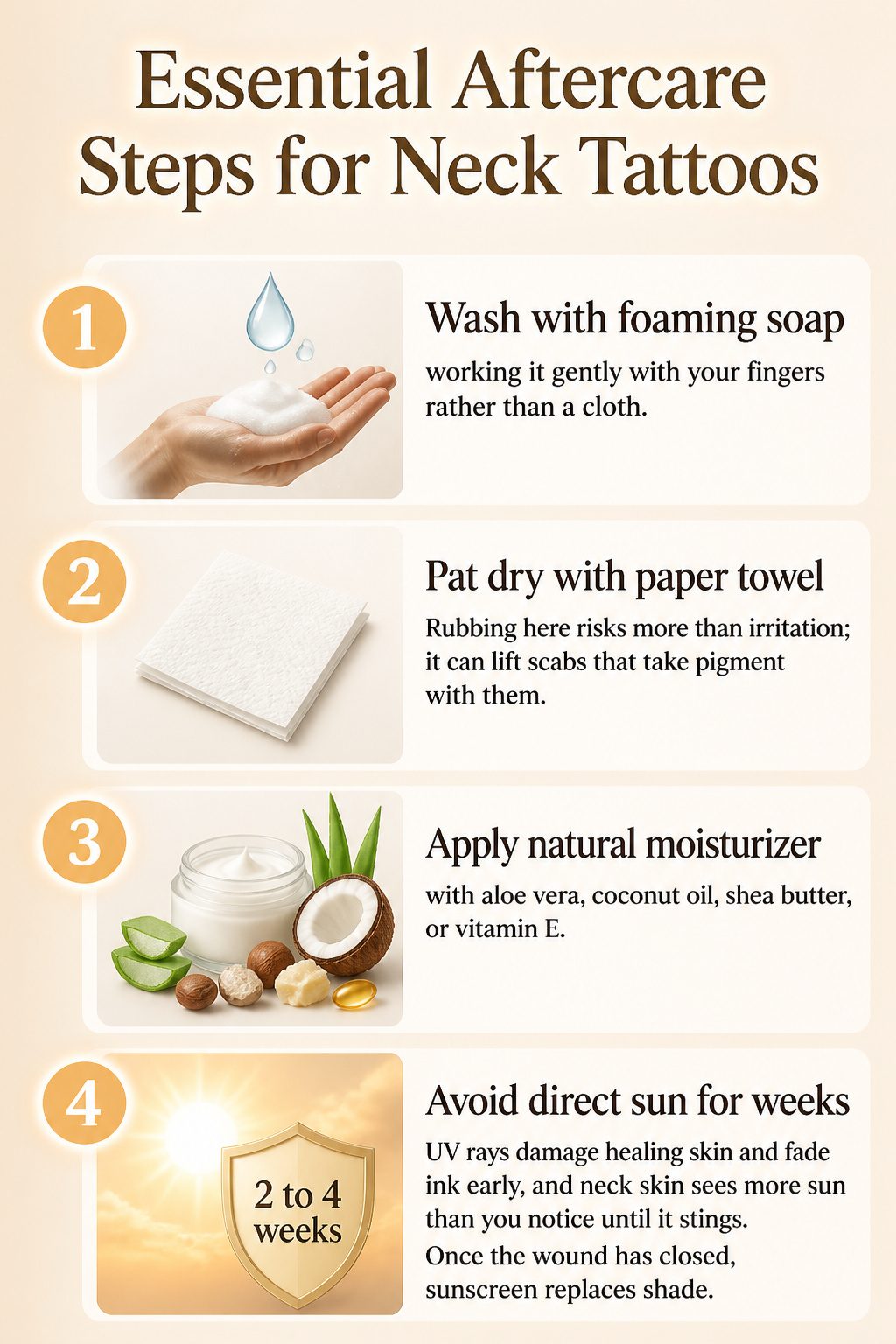
Neck skin heals thinner and tighter than skin on your arm or thigh, which means the aftercare routine matters more there than it might for a piece on your shoulder. The steps run in order, and each one builds on the last.
- Wash with lukewarm water and a fragrance-free foaming soap, working it gently with your fingers rather than a cloth. Foaming soap spreads without dragging, and the neck’s constant movement already pulls at fresh ink enough.
- Pat dry with a clean paper towel. Rubbing here risks more than irritation; it can lift scabs that take pigment with them.
- Apply a natural moisturizer with aloe vera, coconut oil, shea butter, or vitamin E. The neck’s exposure to collar friction and sun means it dries faster, so the soothing ingredients in a balm or lotion support healing where standard body lotion might not.
- Keep the tattoo out of direct sun for 2 to 4 weeks. UV rays damage healing skin and fade ink early, and neck skin sees more sun than you notice until it stings. Once the wound has closed, sunscreen replaces shade.
Design Considerations with Your Artist
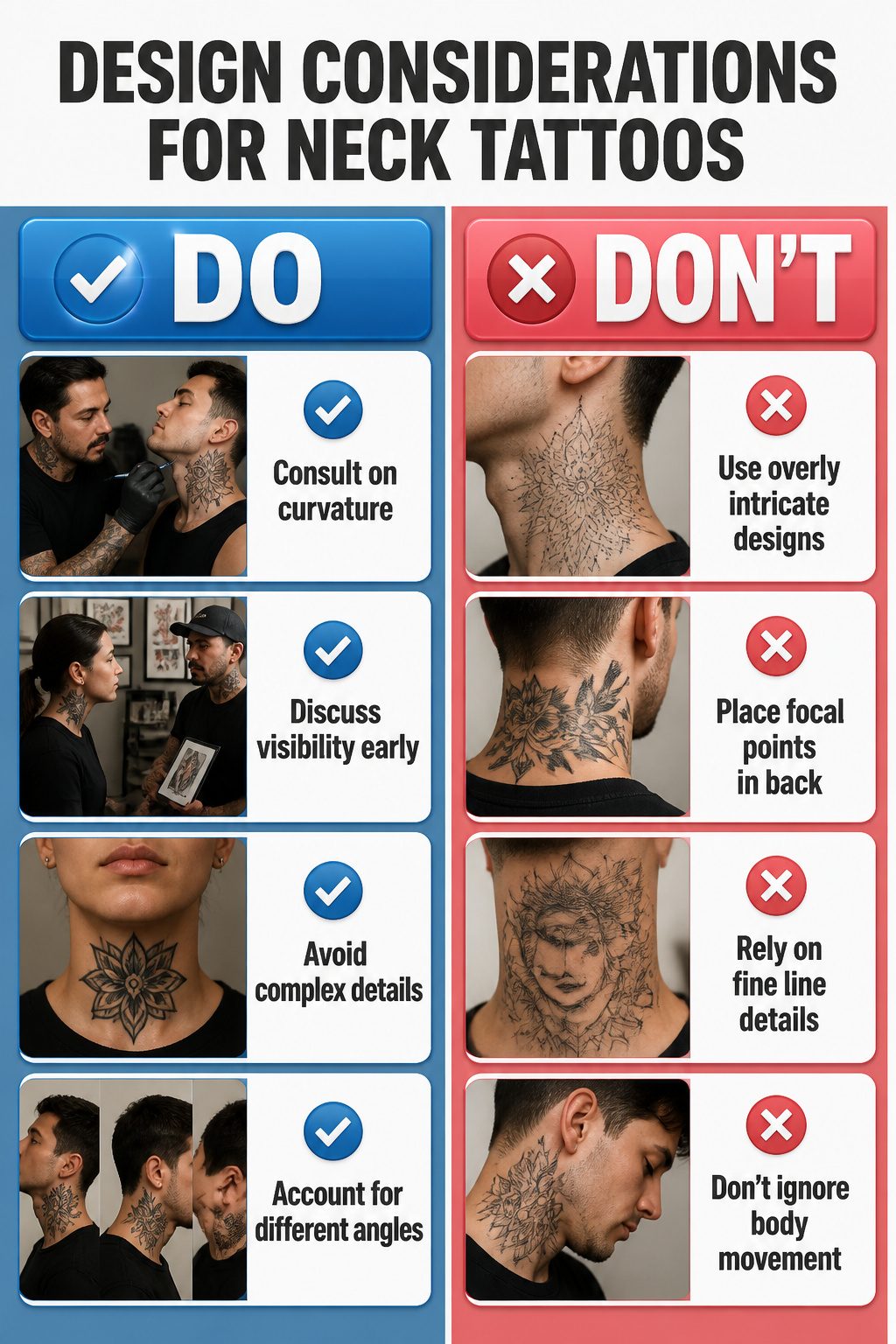
Neck skin moves constantly with speech, swallowing, and turning the head, so the design has to account for curvature that shifts rather than staying fixed. An artist who works neck pieces regularly will map how the skin stretches across the trapezius versus the throat, and they’ll adjust line weight so the tattoo holds together when the client talks or tilts. I sat through a consultation once where the artist kept having me look up, down, and to the side while he sketched, and the final piece sat better for it.
Visibility is the other conversation worth having early. A design that reads cleanly from across a room needs different spacing than something meant for close inspection, and the neck’s cylindrical shape means part of the image is always disappearing around the edge. Most experienced artists will recommend simplifying the concept, keeping the focal point toward the front or side where the eye naturally rests, and avoiding fine detail that collapses when the angle changes. The ones who rush past this discussion are the ones whose work blurs inside two years.
Cultural History and Rebellion
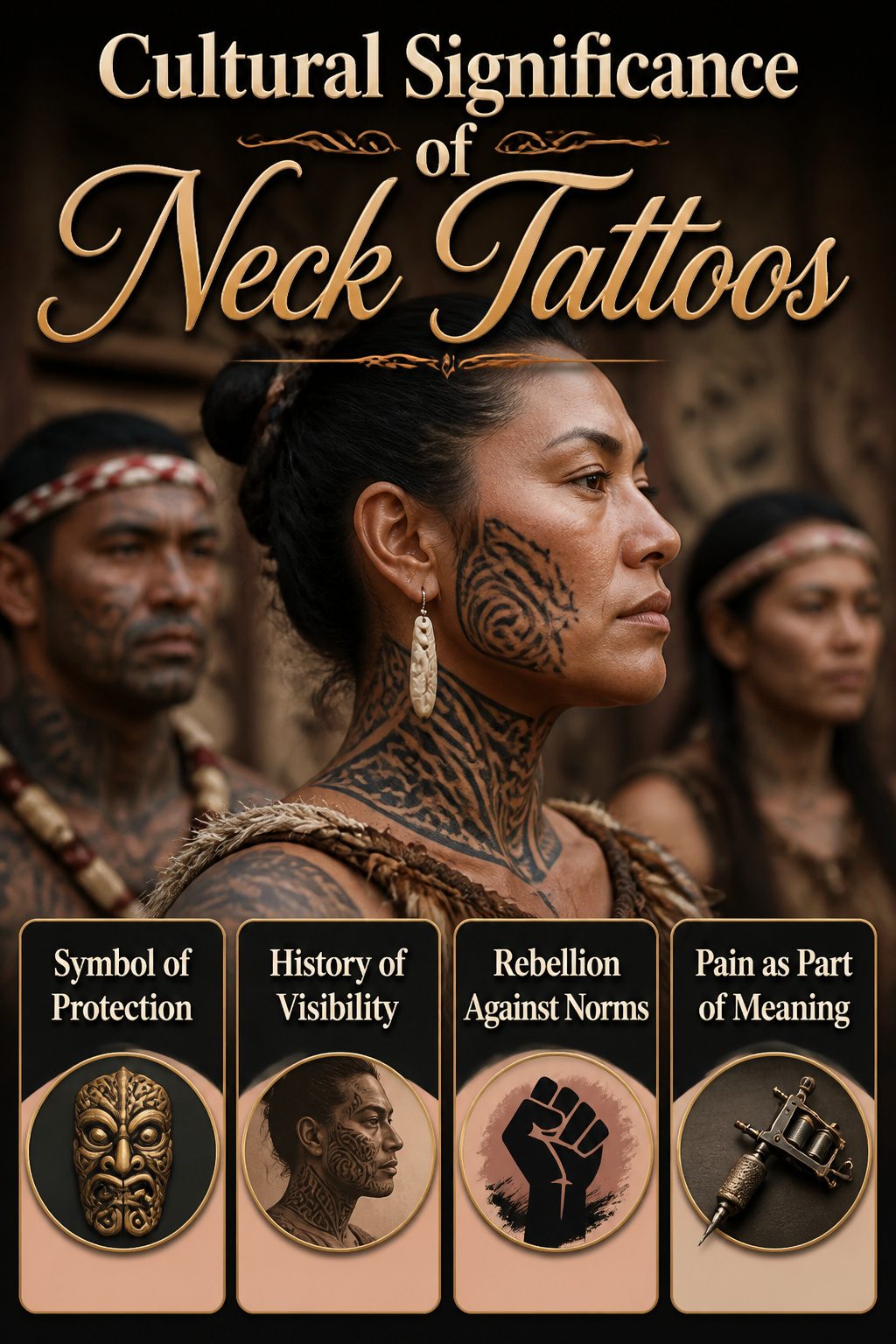
Neck tattoos carry the weight of cultures that treated the placement as armor rather than ornament. In several traditions, ink at the throat served as a talisman against harm, positioned where the body itself felt most exposed. The visibility was the point: a mark that could not be hidden signaled that protection was active and that the wearer stood unguarded by choice.
Counterculture movements in the twentieth century seized on that same visibility for opposite reasons. Where earlier wearers sought spiritual defense, later ones used neck work to reject mainstream acceptance deliberately. The placement guaranteed conflict with employers, family, institutions. That friction was the purpose. A chest piece could be covered; a neck piece refused to cooperate.
Pain played its part in both stories. The skin sits thin over bone and nerve, and the endurance required became part of the meaning. Whether the goal was warding off evil spirits or declaring nonconformity, the willingness to sit through the work mattered as much as the image left behind.
Modern celebrity adoption has softened the edges without erasing the history. The same tattoo that now reads as fashion on a performer still scans as defiance in a job interview. The context shifts; the placement does not.
Visibility and Professional Life
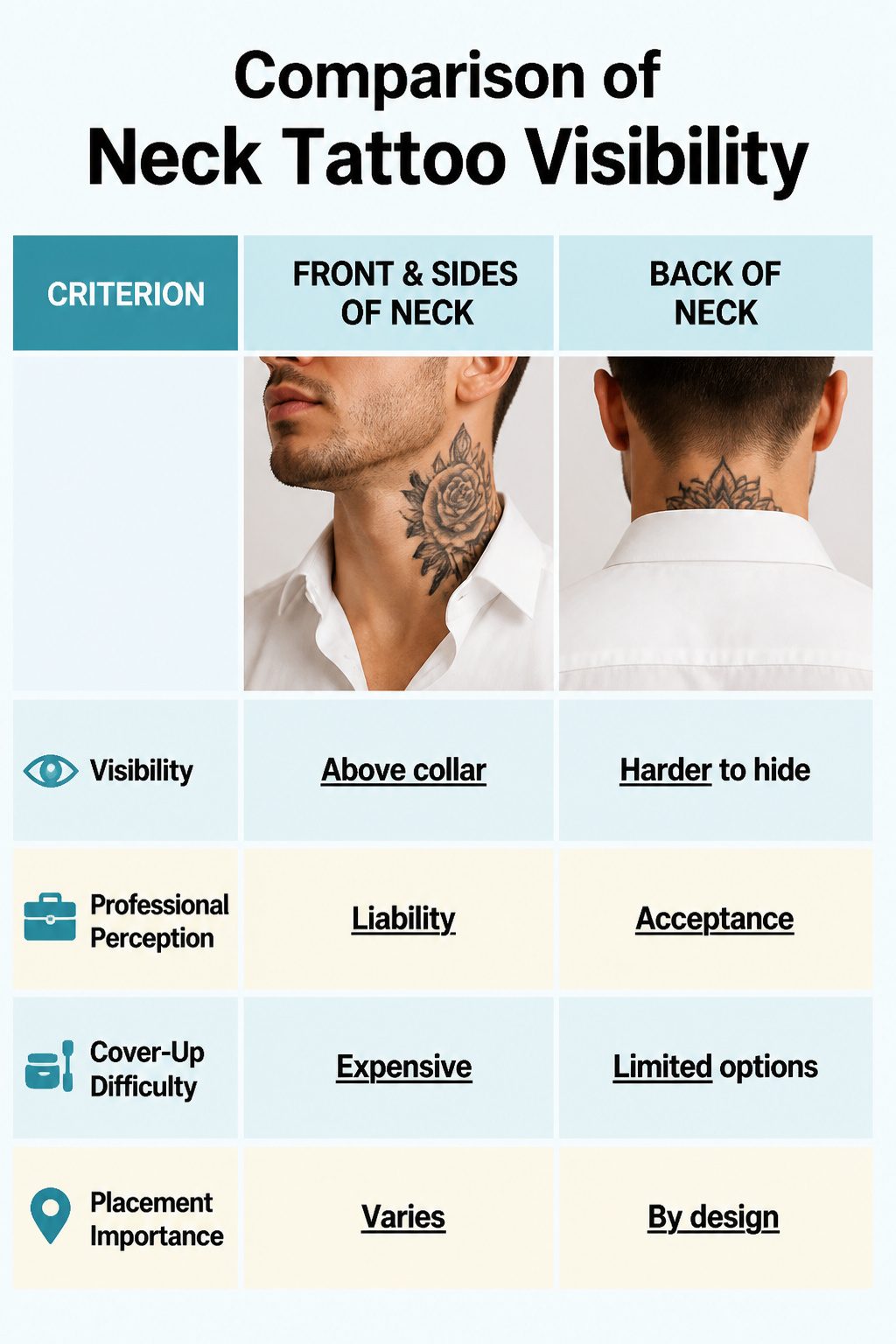
Neck tattoos sit above the collar, which makes them harder to hide than work on the arm or chest. A buttoned dress shirt covers most placements, but the moment the top button loosens or you reach for something overhead, the ink shows. Industries with strict client-facing dress codes, finance and law especially, still treat visible neck work as a liability. Creative fields and trades have shifted faster; what read as unprofessional in 2010 barely registers now in kitchens, studios, or job sites. Cover-up options are limited and expensive — makeup meant for daily wear cakes in neck creases and rubs off on collars, and laser removal on that skin runs more sessions than flatter areas because the neck heals slower. If you are between careers or climbing a ladder where you cannot predict the dress code, the back of the neck hides under a standard collar while the throat and sides do not. That placement difference matters more than the design itself.
Frequently Asked Questions
Do neck tattoos hurt?
Yes, neck tattoos hurt more than most placements. The back of the neck rates around a 5 out of 10, but the front of the neck and throat hit 8 or 9 out of 10 because the skin is thin and sits close to bone and lymph nodes. The pain is part of the point for many men choosing this spot, signaling a willingness to endure visibility rather than hide it.
What are some popular neck tattoo designs for men?
Skulls paired with hearts and wings remain a steady choice for their balance of mortality, love, and freedom. Roses, geometric patterns, religious crosses and praying hands, Japanese koi and dragons, and mandalas all show up regularly in portfolios. The neck’s curve suits wings along the hairline, skulls at the throat, and compasses on the side where the circle follows the jaw naturally.
How should I care for my neck tattoo?
Wash gently with lukewarm water and fragrance-free foaming soap, then pat dry with a clean paper towel rather than rubbing. Apply a natural balm with aloe, shea butter, or vitamin E to keep the skin nourished. Stay out of the sun for two to four weeks so the lines do not blur before they settle, and use sunscreen daily once the skin has closed to prevent early fading.