Polynesian tattoos are a system of body art built from repeating geometric motifs, each one carrying specific meaning that shifts depending on placement and what surrounds it. What separates this tradition from ornamental ink is that the symbols are not decorative; a single enata figure might honor one ancestor or map an entire lineage, and the same shark-tooth band reads differently on a shoulder than on an ankle. The hand-tapped method, bone and shark-tooth tools struck with a mallet, has largely given way to machines, though some artists still open sessions with chants that preserve the ritual’s weight.
Niho Mano
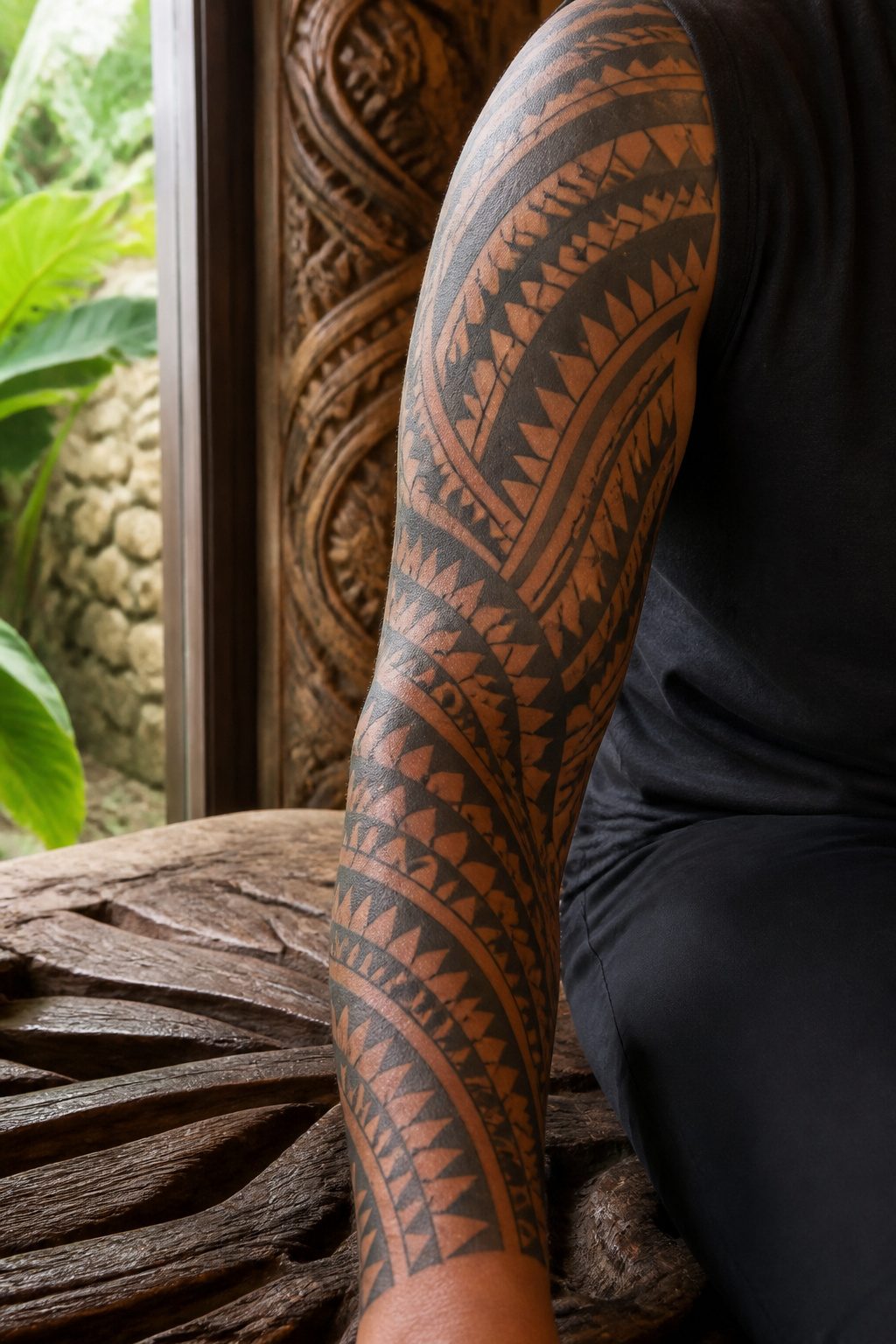
Niho mano, the shark teeth motif, ranks among the most common elements you’ll see repeated across Polynesian tattoo traditions. The pattern typically appears as a band of interlocking triangles, each row suggesting the serrated edge of a shark’s jaw. Protection and strength sit at the core of its meaning, though the sources add ferocity and adaptability to what the design communicates about the wearer. In practice, artists work niho mano into sleeves, chest pieces, and bands as a foundational texture rather than a single focal point. The motif layers with others, its repetition building visual weight while the meaning shifts slightly depending on placement and what surrounds it. Someone wearing heavy niho mano near the shoulder reads differently than the same pattern circling an ankle, though both carry that base association with resilience. What struck me, comparing how different shops handle this element, is the consistency of the meaning paired with near-infinite variation in execution. Some artists sharpen the triangles to aggressive points; others round them, letting the pattern read almost as a geometric border until you look closer.
Enata
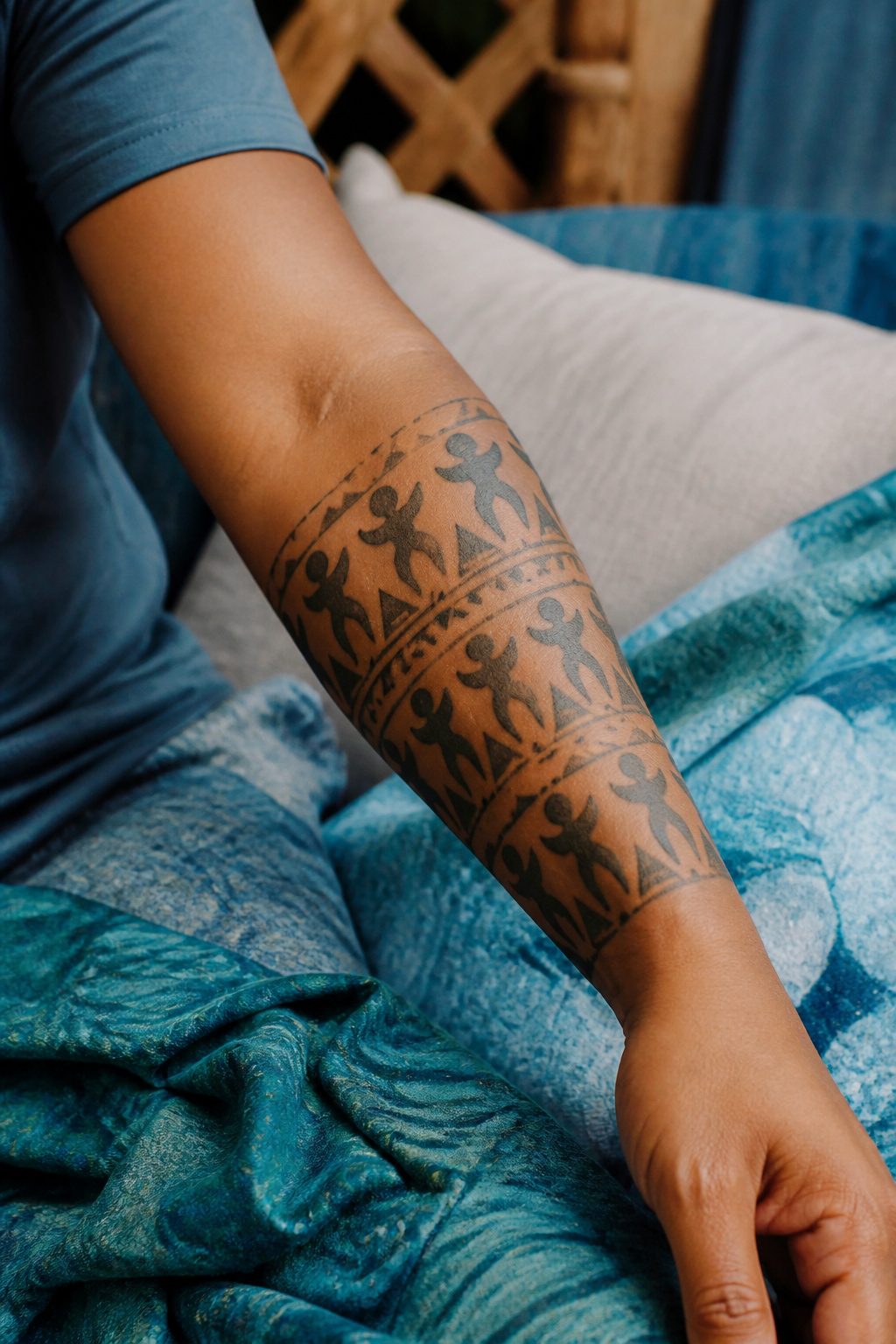
The enata motif appears as a simple human figure, arms and legs rendered in clean curves, sometimes repeated in rows or stacked to form larger patterns. In Marquesan work, the peka ‘enana cross shows this clearly: four curved limbs contained inside a block shape, a design that reads as personhood distilled to its essence.
Samuela, whose family comes from both Tahiti and the Marquesas, explained to National Geographic that tatau traditionally functioned as identity and social record, tracking family genealogy and marking milestones across the body itself. That function lives on in how enata are arranged today: a row wrapping the forearm speaks to ancestry and lineage, while placement across the chest shifts the reading toward personal identity.
The meaning is not fixed by the shape alone. A single enata might honor a specific ancestor; a sequence can map generations. The figure’s power comes from its context, from what sits beside it and where the wearer places it. This is the core tension in reading any Polynesian tattoo: the same motif carries different weight depending on the body that wears it and the story being told.
"Traditionally, tatau served as a form of ID or social rank, keeping track of the genealogy of the family, and representing important milestones."
For anyone considering enata in their own design, the practical question is what lineage you are marking and where on the body that record belongs.
Ocean Waves
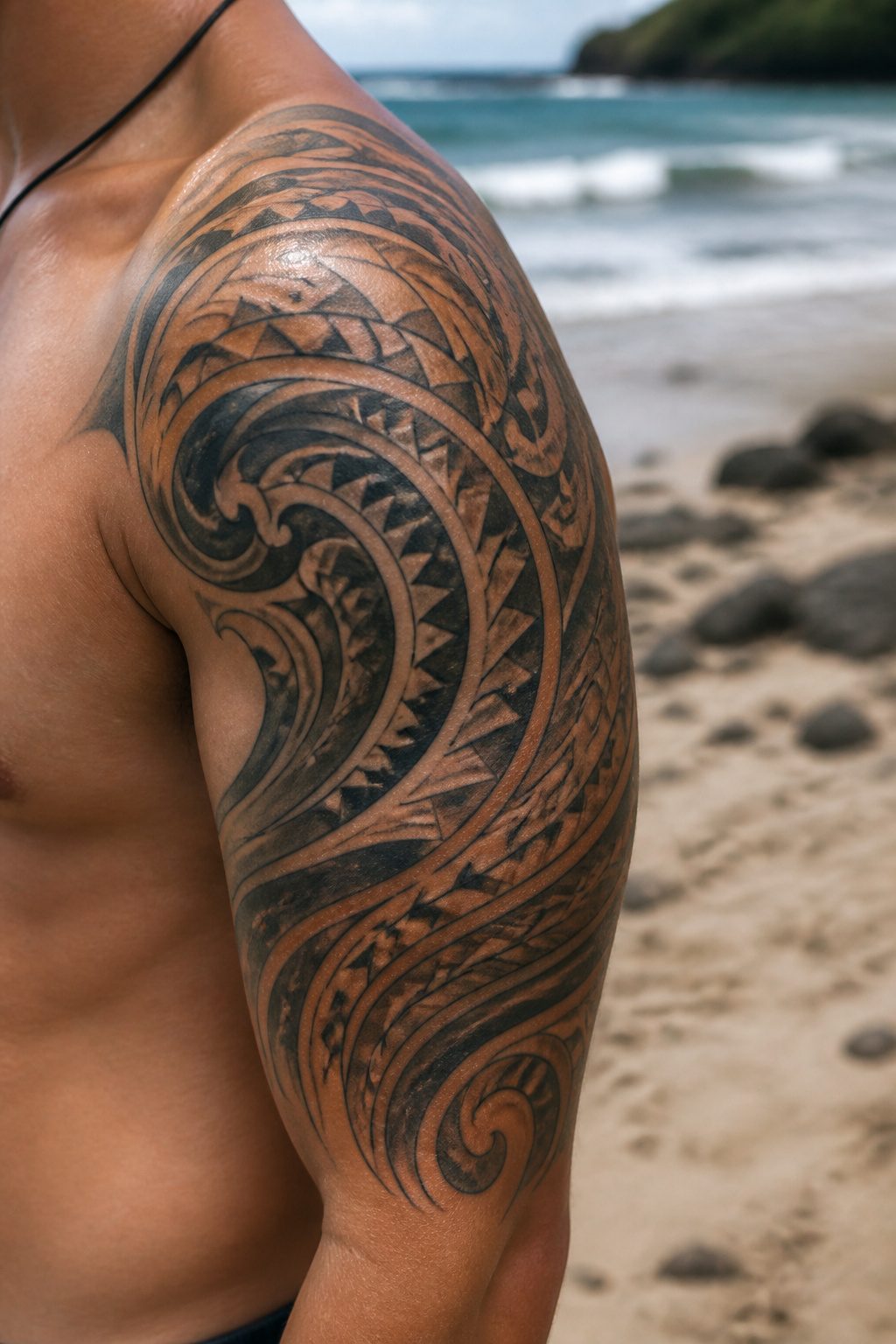
Ocean waves carry life, change, and journey through nearly every Polynesian tattoo composition, threading between bolder motifs like shark teeth or enata figures to soften the hard lines and keep the eye moving. In island cultures where the horizon is water and the next island is days away by canoe, that constant motion matters more than a single dramatic symbol ever could.
A skilled artist builds waves to flow, never to sit flat. Curved lines repeat and interlock, suggesting both the pull of tides and the passage of time itself. The pattern gains weight when it wraps another motif: a koru spiral cradled by waves reads as growth through change, while enata figures standing beside surf lines speak to family carried forward by life’s current. The waves do not dominate; they connect.
Continuity is the quieter meaning here. Water outlasts the volcano that births the island, outlasts the generations who tattoo and are tattooed. That is why the motif appears so often in larger pieces, filling gaps the eye might otherwise snag on, keeping the story in motion from shoulder to wrist or hip to knee.
Turtle
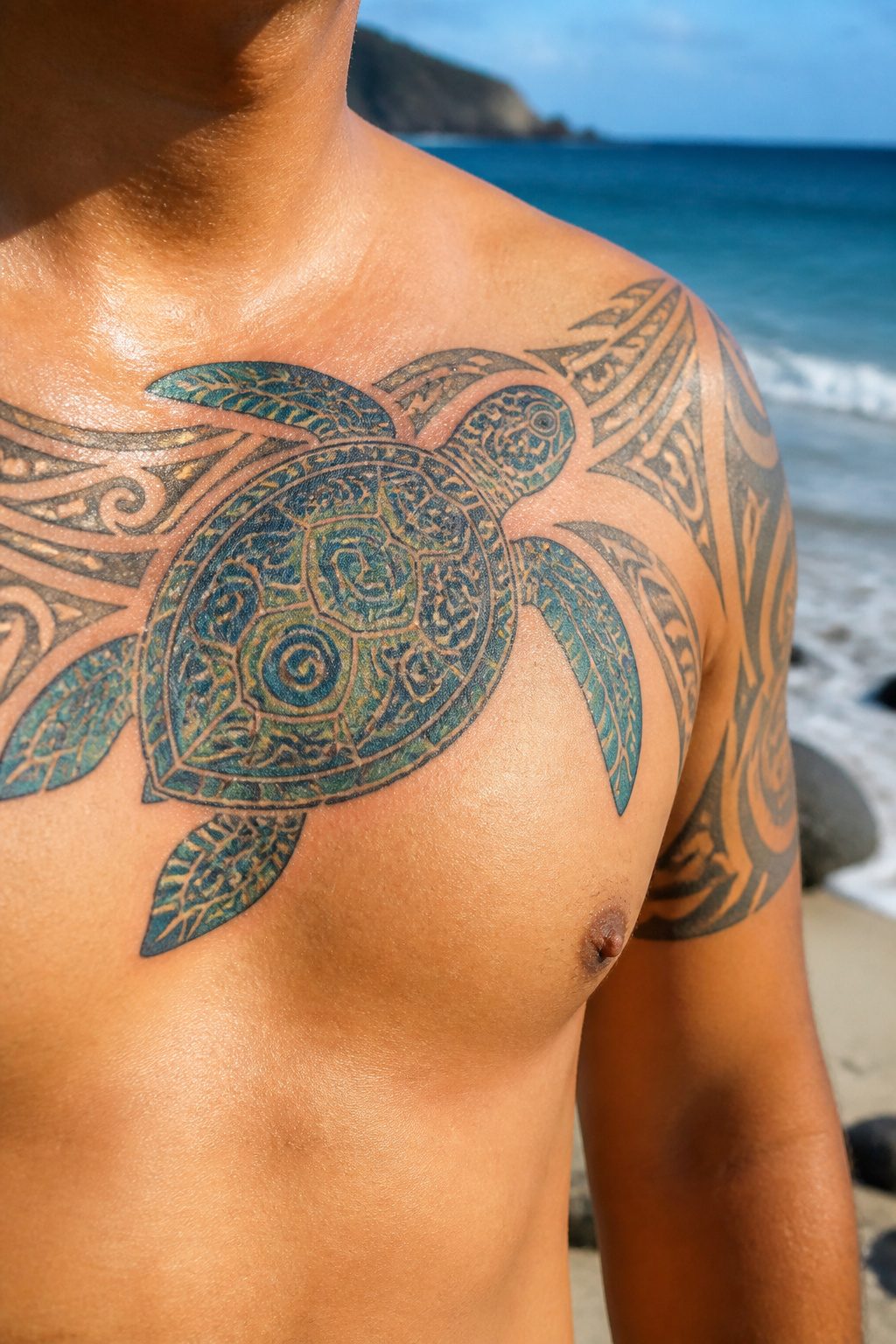
The turtle, or honu, carries some of the most layered meaning in Polynesian tattoo work. Polynesian navigators spent enough hours on open water to notice that sea turtles live remarkably long lives, return to the same nesting grounds across generations, and cross vast distances with an unhurried calm that reads as purposeful rather than lost. Those observations translated into ink: the honu stands for longevity, family, navigation, and peace, often all at once rather than one at a time.
In practice, the motif tends to appear with deliberate complexity. Shell patterns might reference genealogy, since turtles carry their home and their history on their backs. Flipper designs can suggest the actual paddling motion navigators watched for hours, reading current and direction from how a turtle moved through the water. The connection to family runs through the turtle’s own nesting behavior, returning to shore in cycles that match how Polynesian cultures passed tattoo traditions from one generation to the next.
Peace enters the symbol through the animal’s temperament in the water. Navigators noted that turtles did not fight the current or panic in rough weather; they adjusted, waited, kept moving. That quality made the honu a fit emblem for someone who had endured something, a visible mark of having learned to move through difficulty without losing direction. The meaning shifts slightly depending on which island tradition the artist draws from, but the core stays: this is a creature that knows where it belongs and takes its time getting there.
Manta Ray
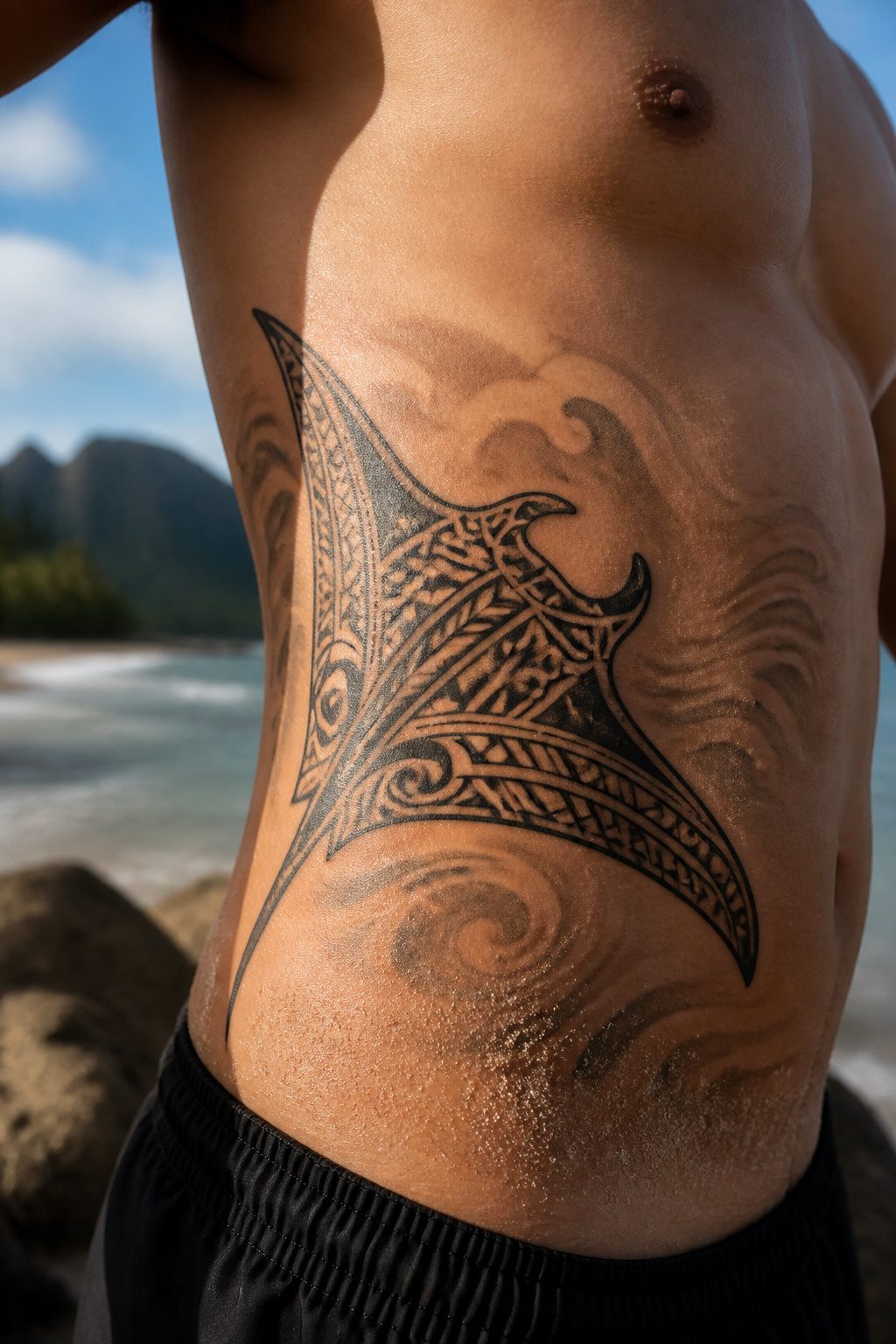
The manta ray glides through Polynesian tattoo work as a symbol of grace, freedom, wisdom, and guidance, carrying a meaning that shifts with placement and context. Artists render it with broad, sweeping wing shapes that suggest motion even in still ink, often positioning the ray across the shoulder blade or down the ribs so the body seems to move with it.
Someone who chooses this motif usually wants to signal a particular relationship with the ocean, not just admiration from a distance. The ray lives in open water, navigates by currents most swimmers never feel, and the tattoo marks that same willingness to be carried rather than to fight direction. Wisdom sits in that distinction, the older reading says: knowing when to swim and when to let the tide take over.
In practice, the manta pairs well with wave bands or shark-tooth patterns, but the ray itself stays the focal point. Wearers who grew up near the Pacific often place it where they can see it, a reminder of home waters; those who did not still choose it for the guidance meaning, a kind of navigational compass set into the skin. The design works large enough to show the wing span, or small enough to tuck inside a larger sleeve, and either way the meaning holds.
Spearhead
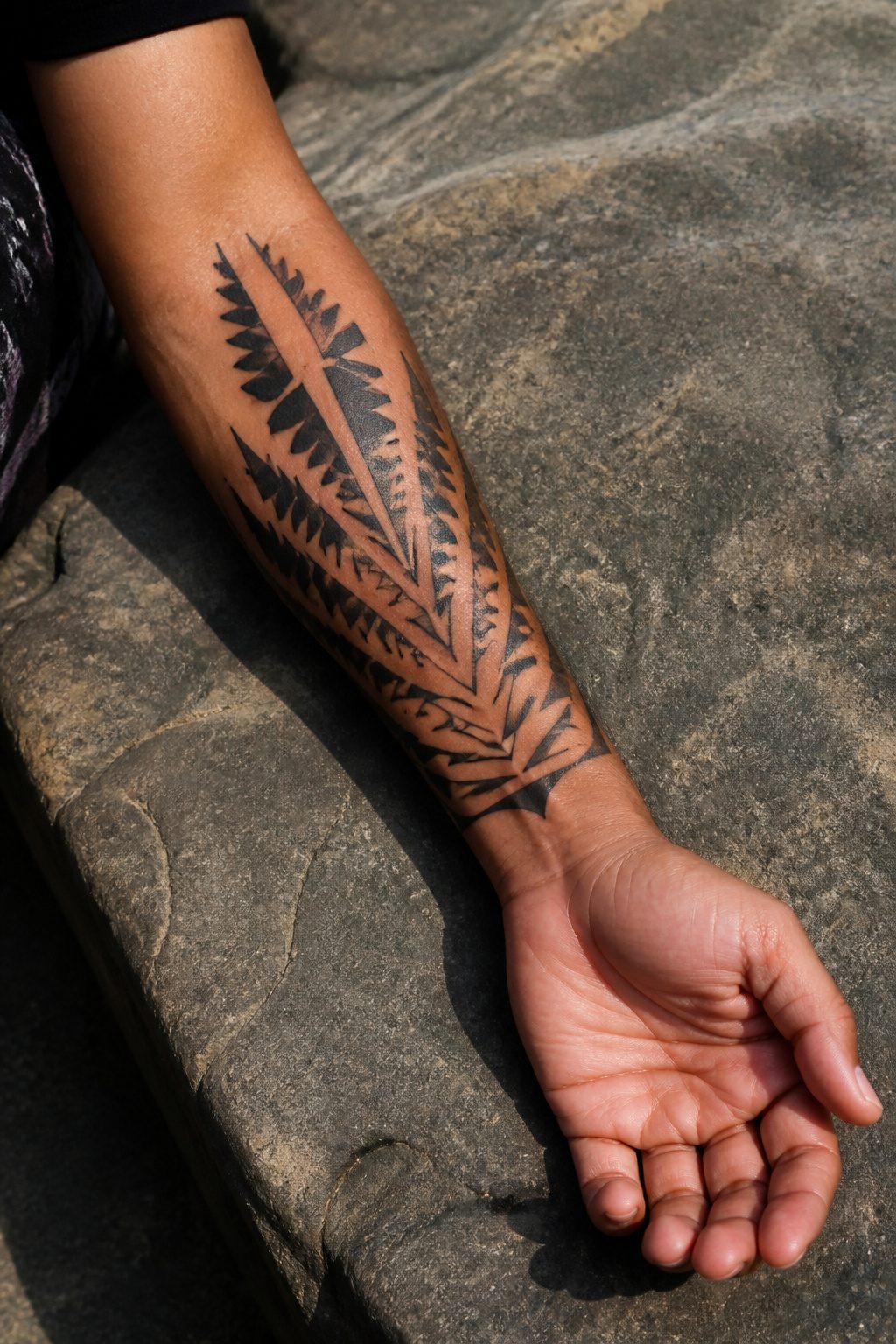
The spearhead motif in Polynesian tattooing carries a weight that lands immediately on the skin: courage, warrior spirit, and defense. Visually, it reads as a sharp, angular triangle or barbed point, often repeated in rows or radiating lines that suggest motion and intent. Artists sometimes nest it inside larger bands or let it stand alone along the shoulder, forearm, or calf, where the body’s own lines give it forward thrust.
In Polynesian martial traditions, the spear was not only a weapon but a marker of social role. The men who carried and mastered it occupied specific stations, and wearing the motif signaled that lineage of readiness. A design built from spearheads can therefore read as personal armor, a declaration that the bearer claims that same readiness as part of their story. The repetition matters here: a single point might read as a moment of bravery, while a full band of spearheads suggests sustained vigilance, a life structured around protection of family or community.
Tiki
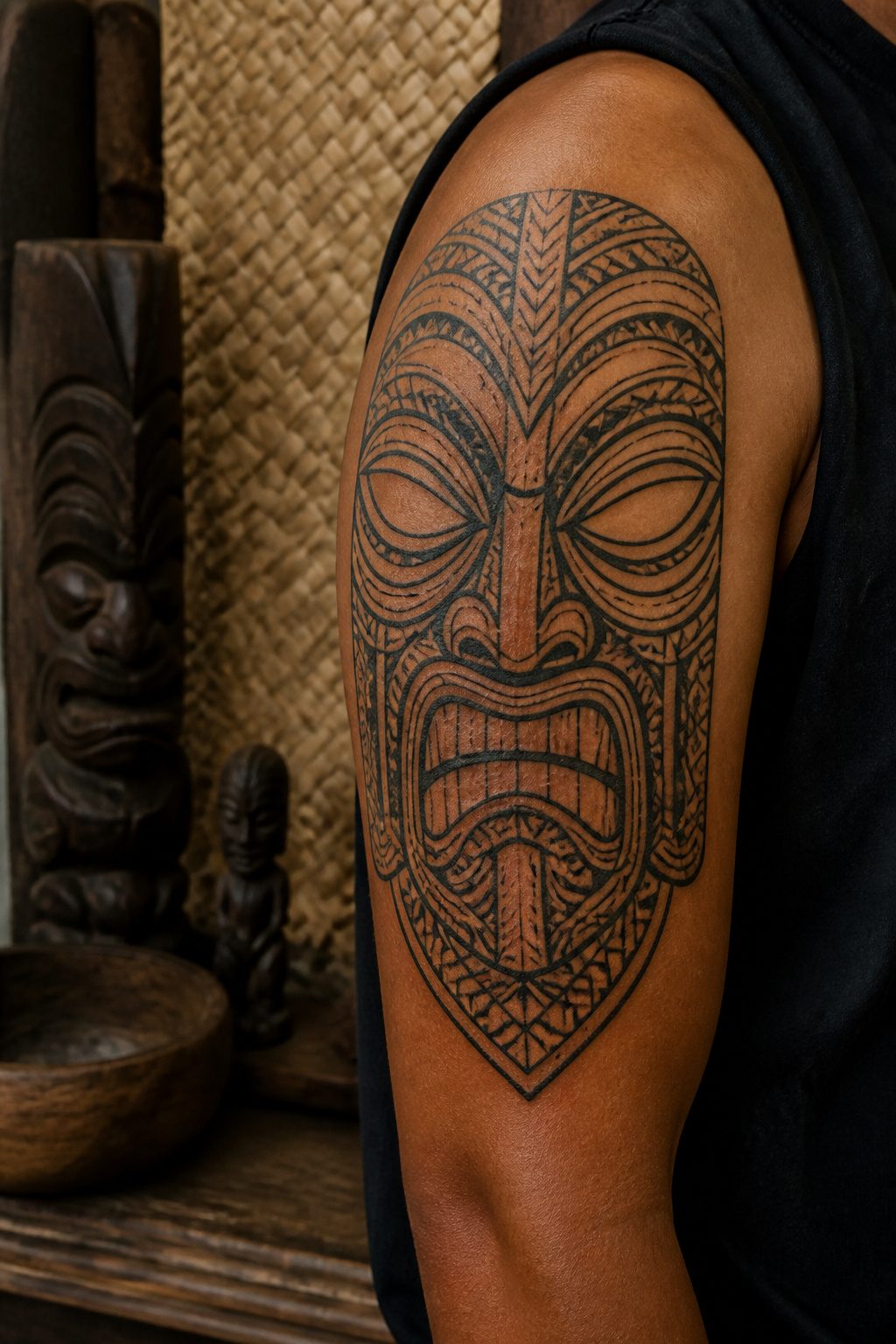
Tiki figures carry some of the heaviest spiritual weight in Polynesian tattoo work, and artists treat them with corresponding care. These motifs represent deified ancestors and spiritual guardians, not decorative characters. In traditional compositions, a tiki might anchor a sleeve or back piece, eyes and mouth stylized into geometric patterns that read as protective presence rather than portraiture.
The function matters more than the form. A tiki placed at joints or transitions, shoulder to chest or hip to thigh, acts as a guardian at the body’s thresholds. Some wearers request tiki pairs flanking a central story, ancestors watching inward toward the narrative of enata figures or ocean waves that trace their own lineage.
Protection runs through every layer of meaning here. Sources note tiki are "used with care," which in practice means the artist and wearer discuss intent thoroughly. The figure isn’t generic spiritual wallpaper; it connects to specific ancestral respect and the wearer’s own sense of spiritual vulnerability. Get this relationship wrong, and the tattoo becomes costume rather than shield.
Traditional tools, bone and shark tooth, once carved these lines with deliberate pain. The discomfort itself was part of the mana. Modern electric work keeps the symbol but loses that ceremonial weight, a tradeoff most contemporary wearers accept without knowing what passed.
Lizard
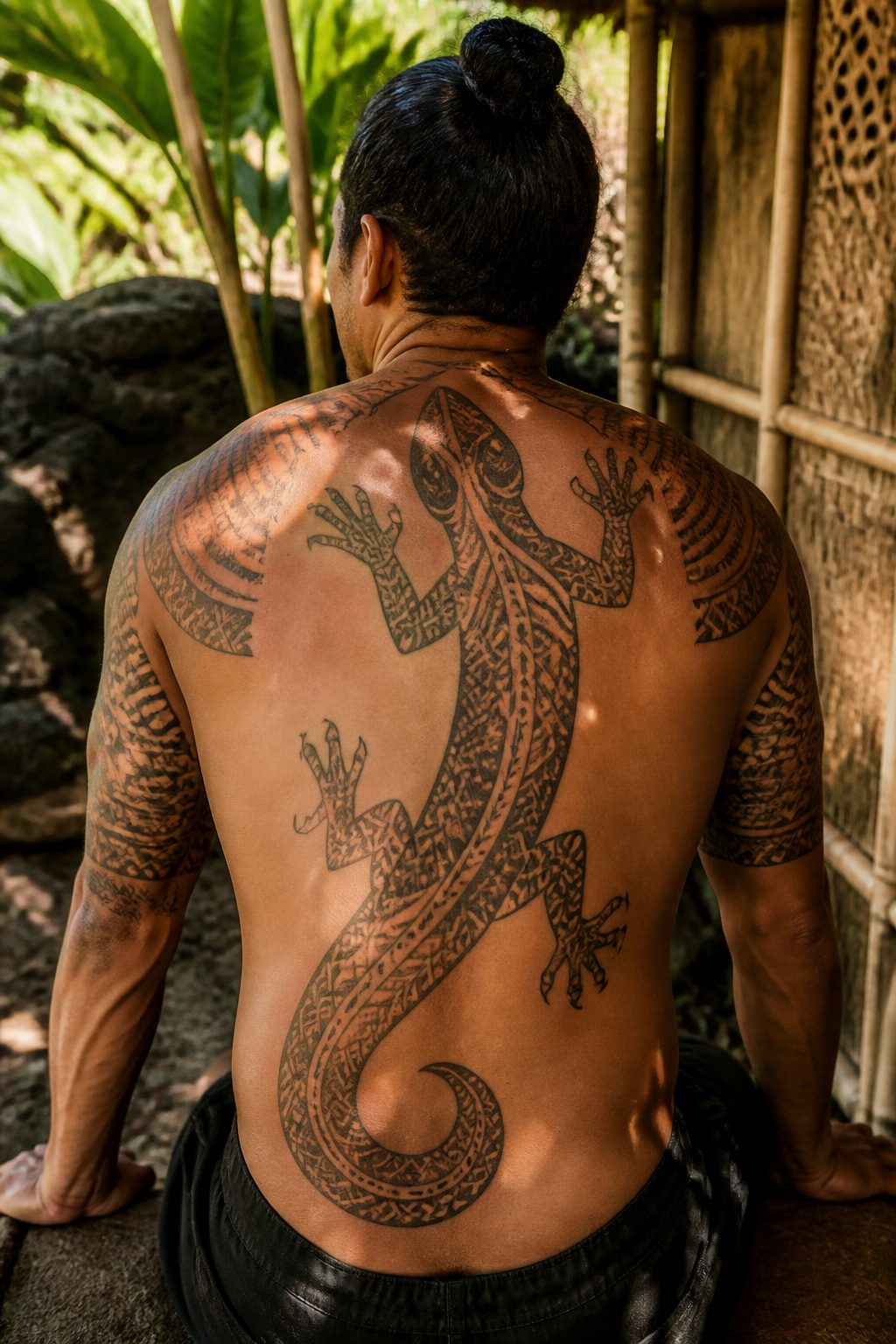
The mo’o, or lizard motif, carries one of the heavier spiritual loads in Polynesian tattoo work. In Hawaiian belief, these creatures move between worlds, acting as messengers that carry human speech to the gods and bring back awareness of what sits beyond ordinary sight. That dual nature matters: the same source that channels divine contact can deliver death or ill fortune to anyone who treats it with disrespect.
Translating that power into skin art takes care. The lizard shape tends to appear in pieces where protection and spiritual reach are the point, not as decoration but as a working symbol. Tattoo artists who build Polynesian-style work still treat the mo’o with the same caution the old stories demand, placing it where its role as intermediary makes sense in the larger design.
The meaning holds steady across the regional variations, though the exact rendering shifts from island to island. What stays fixed is the core idea: wearing the mo’o signals a willingness to occupy that in-between space, to accept both the blessing and the risk that comes with opening a channel to something unseen.
Marquesan Cross
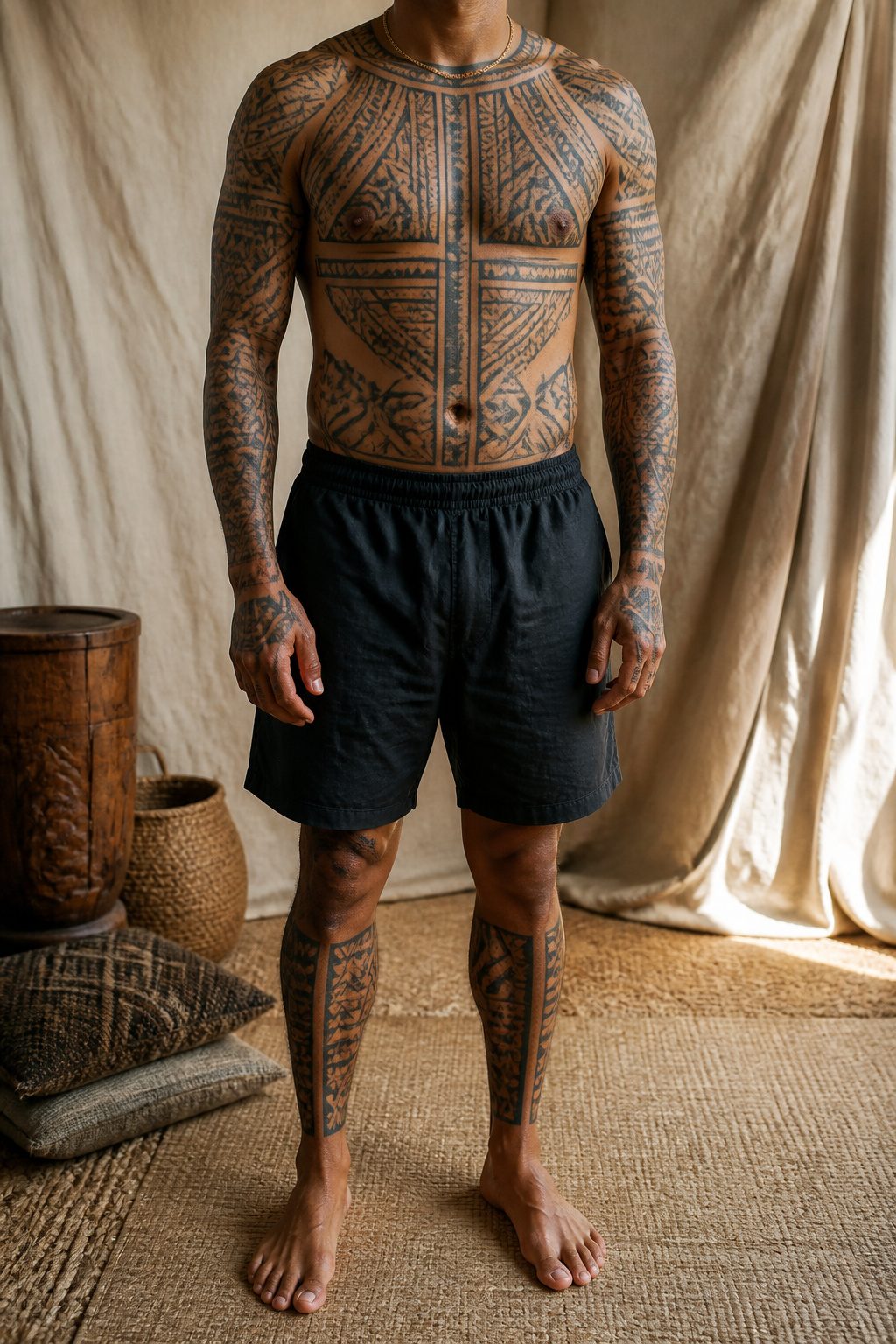
The Marquesan cross carries a geometry that sets it apart from the Latin or Greek crosses most people picture. Its arms widen toward the ends and often terminate in rounded or pointed caps, creating a form that reads more as interlocking shapes than as two simple lines crossing. In Marquesan tattooing, this motif anchors dense compositions that leave almost no untouched skin, historically covering the full body in panel-rich designs.
The meaning attached to it centers on balance: the four elements held in equilibrium, harmony between forces rather than dominance of one over another. That interpretation fits the broader Marquesan visual system, which runs to the darkest and most geometric of all Polynesian styles. Large blocks of solid black, asymmetrical layouts for men and symmetrical ones for women, give these tattoos their weight.
What struck me, comparing regional styles, is how the Marquesan cross functions almost as architecture within the design. Other Polynesian traditions use cross-like forms, but none build them with this same blocky, structural presence. If you are drawn to a sleeve that feels built rather than drawn, the Marquesan tradition is the visual foundation modern artists reach for first.
Koru
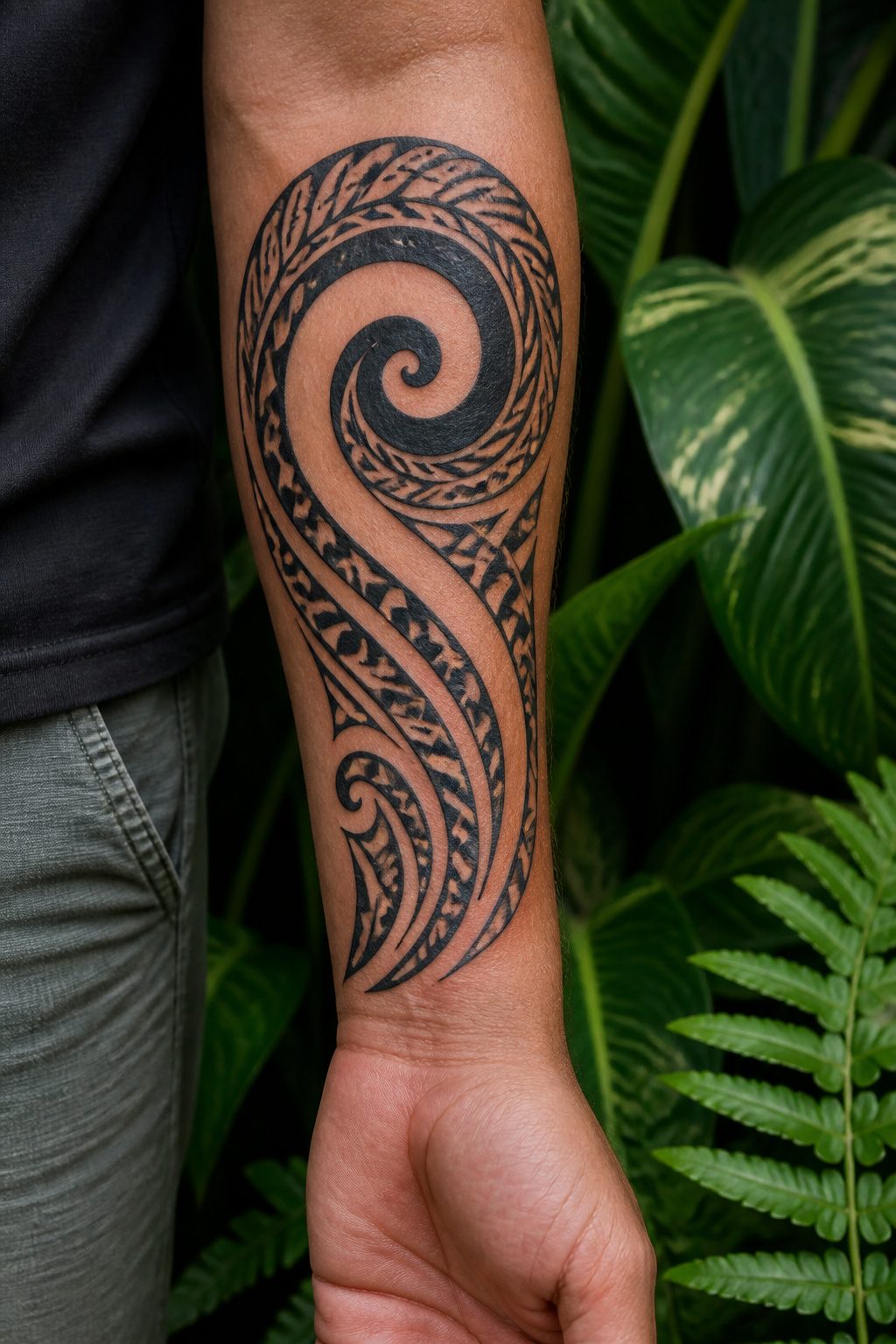
The koru spiral sits at the center of Māori tattoo work, where it stands for new life, growth, and harmony. Its shape copies the tight coil of an unfurling fern frond, that moment before the leaf opens fully to the light. In ink, the koru usually appears as a single sweeping curve with a rounded bulb at one end, sometimes nested inside larger spirals or repeated in bands that run along a shoulder or thigh.
What draws me to the motif is how it anchors a whole piece to something living and cyclical. A fern frond does not open once and finish; the plant keeps producing them, season after season. The koru carries that same sense of return and continuation, which is why artists often place it at the start of a design, letting other elements branch outward from its curve. In Polynesian work broadly, the spiral reads as balance and forward movement rather than the sharper, more aggressive lines you see in shark teeth or spearhead patterns.
What Polynesian Tattoos Mean
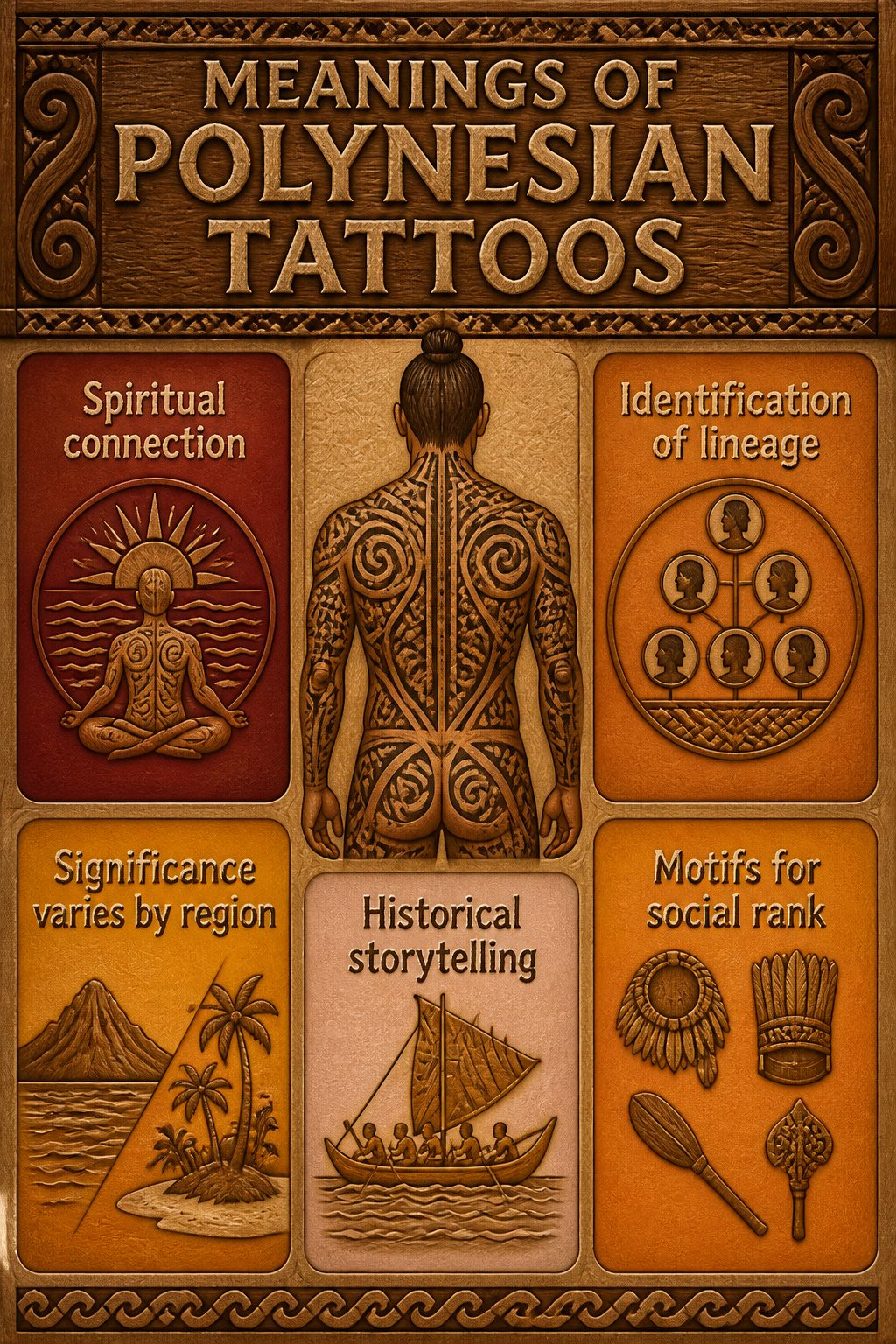
Polynesian tattoos carry meaning at every level, from the placement on the body to the specific motifs chosen. The upper body connected the wearer to the spiritual world, while the lower body anchored them to the earth. Tattoos on the back looked toward the past; those on the front faced the future. Each design functioned as a form of identification, tracking genealogy, social rank, and life milestones without needing written records.
The question "Do Polynesian tattoos have meaning?" has a clear answer: yes, and the meaning is layered. In ancient Tahitian society, certain designs were reserved for the gods, others for priests, and specific patterns like the hui ari’i marked chiefs exclusively. The hui to’a, hui ra’atira, ‘īato’ai, and manahune identified war chiefs, warriors, dancers, and canoeists respectively. Even the same motif shifted significance depending on which archipelago it came from; islanders living among mountains used different earth symbols than those on atolls with only coconut trees.
Today, many wearers still approach these tattoos with intention and respect, though the hand-tapping method using bone, wood, and shark-tooth tools has largely given way to modern machines. What persists is the principle that the tattoo tells a story specific to the person wearing it.
How They Were Made
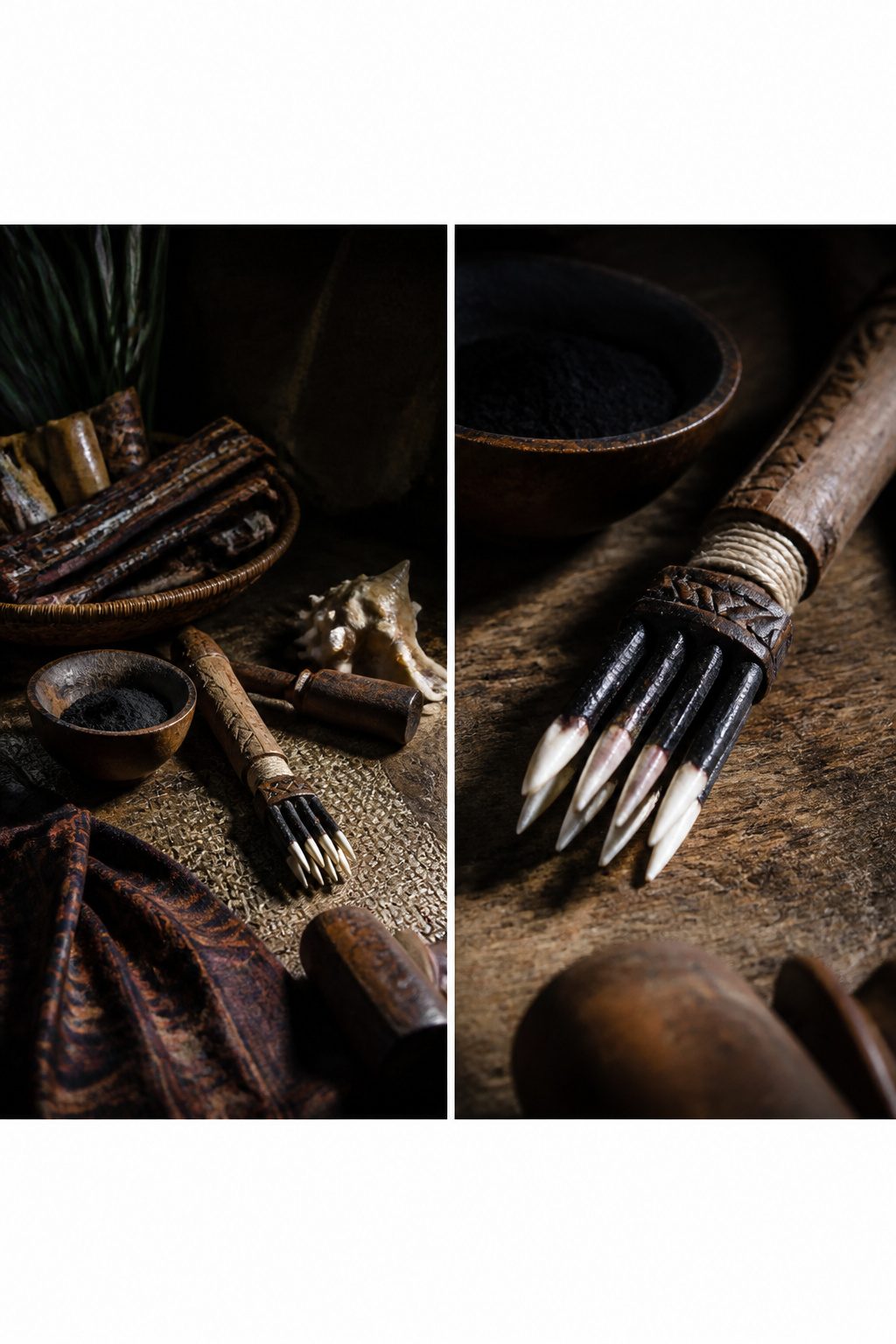
Traditional Polynesian tattooing relied on tools carved from bone, wood, and shark teeth, lashed together to form a comb that artists struck repeatedly with a small mallet. The teeth punctured skin hundreds of times per minute, driving ink made from soot or burnt candlenut into the dermis without any modern anesthetic. A single session could stretch for hours; larger pieces demanding full sleeves or torso work often required days or months of returning to the mat before the design was complete.
The pain served a purpose beyond decoration. Men who abandoned the process unfinished faced real social consequences in Marquesan society, where endurance marked readiness for responsibility. Seawater bathing helped ward off infection during recovery, though an intricate tattoo generally needed about a year to fully settle and heal.
Contemporary Polynesian artists sometimes use coil or rotary machines now, especially for clients unaccustomed to traditional hand-tapping. The shift in method has not erased the ritual’s weight. Chants still open sessions in some studios, and the same genealogical symbols are earned rather than chosen casually. What changed was the tool, not the threshold.
Where on the Body
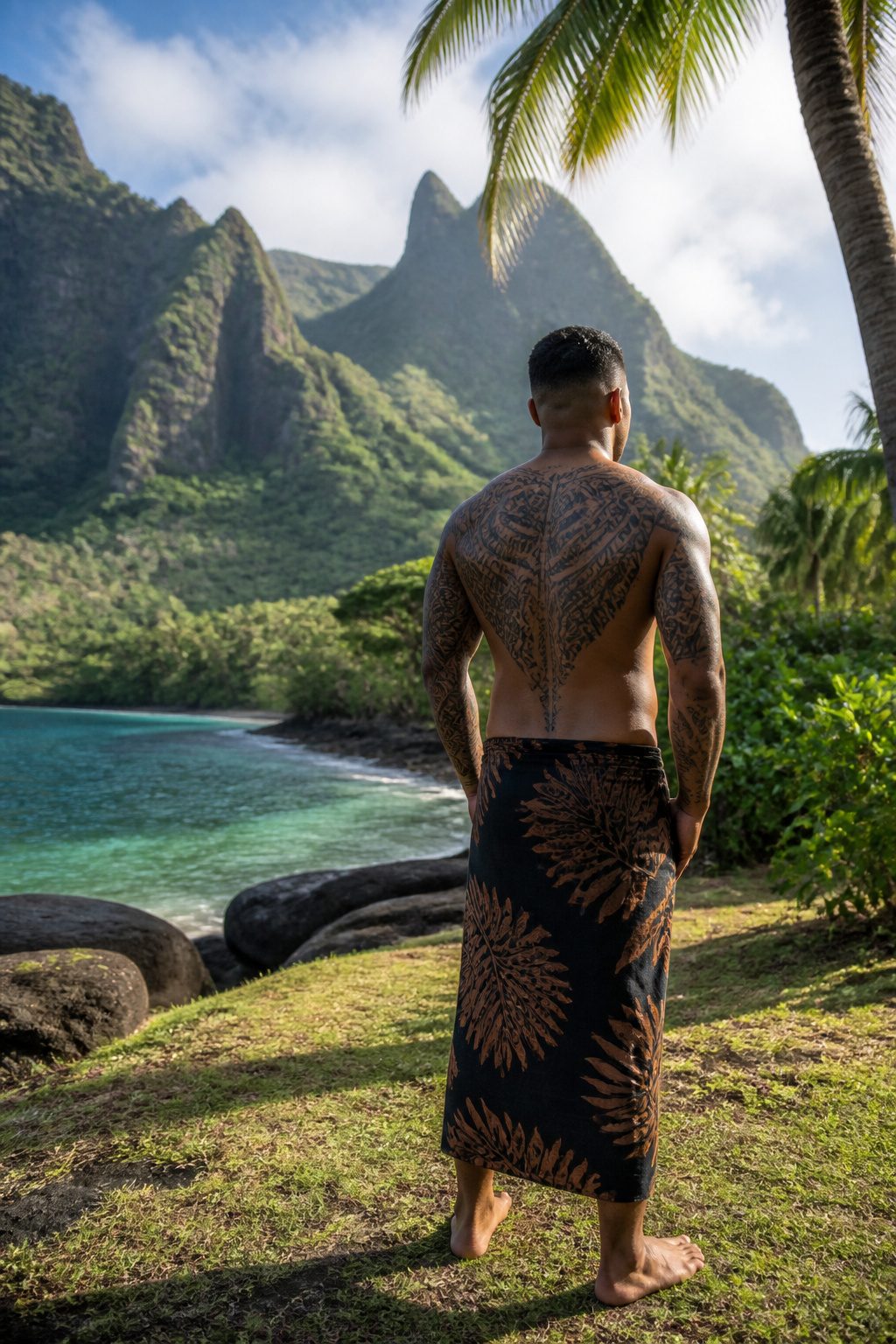
The body in Polynesian tattooing functions as a kind of map, with placement carrying meaning as deliberate as the symbols themselves. Upper body tattoos, from the head down to the navel, connect to spirituality and the sky, while anything below that line grounds itself in earth, physical strength, and the matters of daily life. The head sits closest to Rangi, the heavens, so ink there speaks to knowledge and intuition. Drop to the chest and you are in the space between worlds, where balance matters. The lower trunk, thighs, and legs handle courage, sexuality, marriage, independence, the body’s own power.
The left side carries feminine energy, intuition, harmony; the right, masculine energy, logic, strength. Back and front split along time, with the back tied to the past and the front open toward the future. These are not decorative choices. A chief’s markings sat differently from a warrior’s, a canoeist’s from a priest’s, and the wearer’s social standing could be read at a glance by anyone who understood the code.
What strikes me, reading through the old accounts, is how intentional the whole system remains. Someone choosing a Polynesian design today is not just picking a pattern. They are deciding whether their tattoo speaks to who they were, who they are becoming, or what they hope to protect. The placement is the first half of that sentence.
Regional Styles
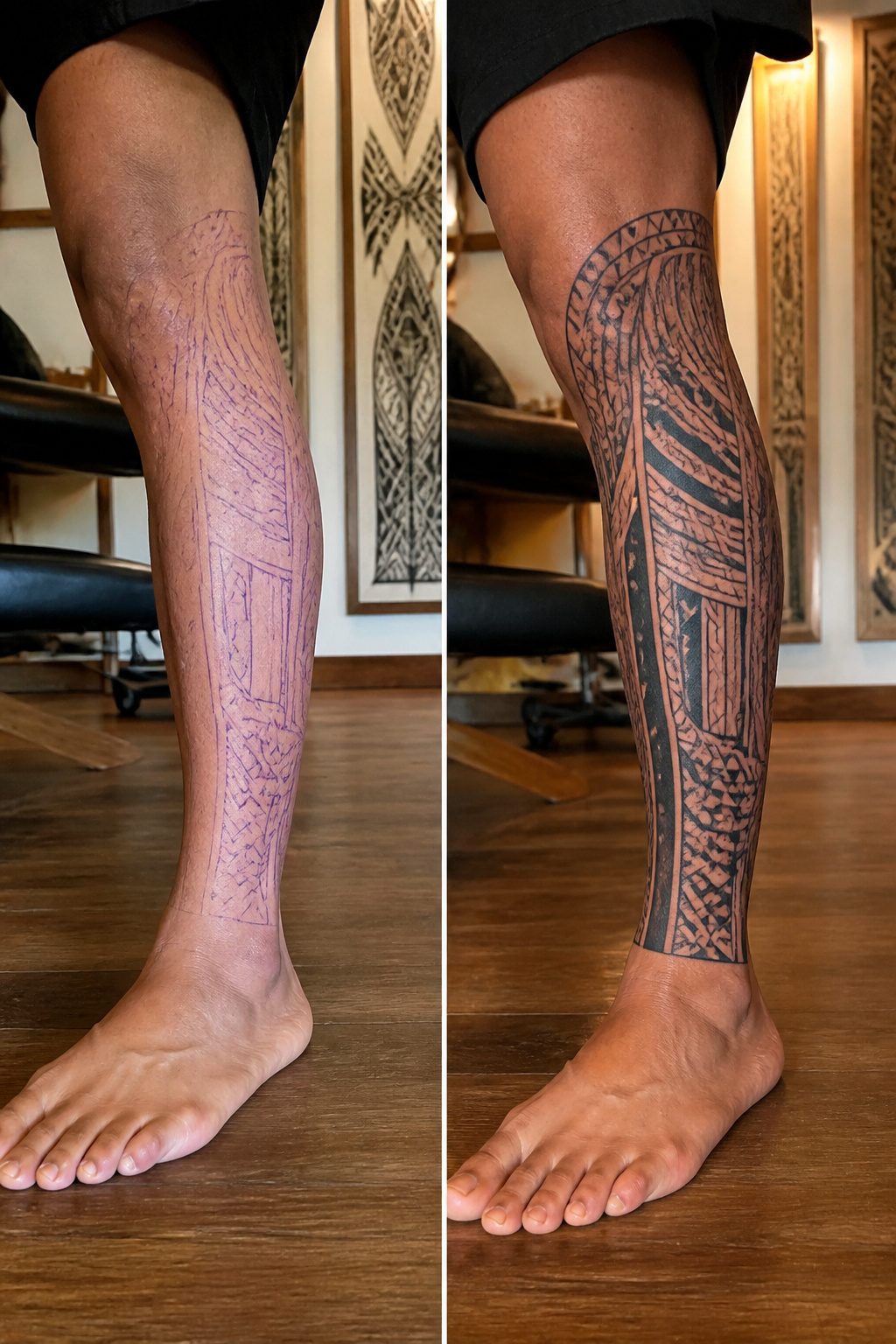
Polynesian tattooing is not one tradition but a family of them, each with its own visual grammar and ritual practice. The distinctions matter, because flattening them into a single style erases what made each island culture’s work recognizable to its own people.
Samoan tatau runs dense and geometric, built from repeating shapes that cover large areas of the body. The pe’a for men and the malu for women rank among the most ritualized forms, earned rather than merely worn, with patterns that signal community standing through their completeness and placement. Māori tā moko moves differently, all flowing spirals and curvilinear genealogy marks, the koru unfurling across skin to record lineage and status in a way no Samoan panel attempts. Marquesan work, historically the center of Polynesian tattooing’s spread, pushes density further with panel-rich, highly geometric compositions that can read almost architectural against the body’s curves. Tahitian styles contributed the word "tattoo" itself, favoring bold silhouettes and strong negative space, while Hawaiian kakau keeps to black geometric work tied to lineage and protection.
What convinced me, reading through the sources, is how the pain and time investment varied by region too. Marquesan sessions could stretch across months, seawater bathing the accepted aftercare, with incomplete work marking a man as someone who could not endure. That social consequence belonged specifically to Marquesan practice, not a universal Polynesian rule. The regional differences are not decorative variations on one theme. They are separate languages, and learning to see them separately is the first step toward respecting what each one actually says.
What It Costs Now
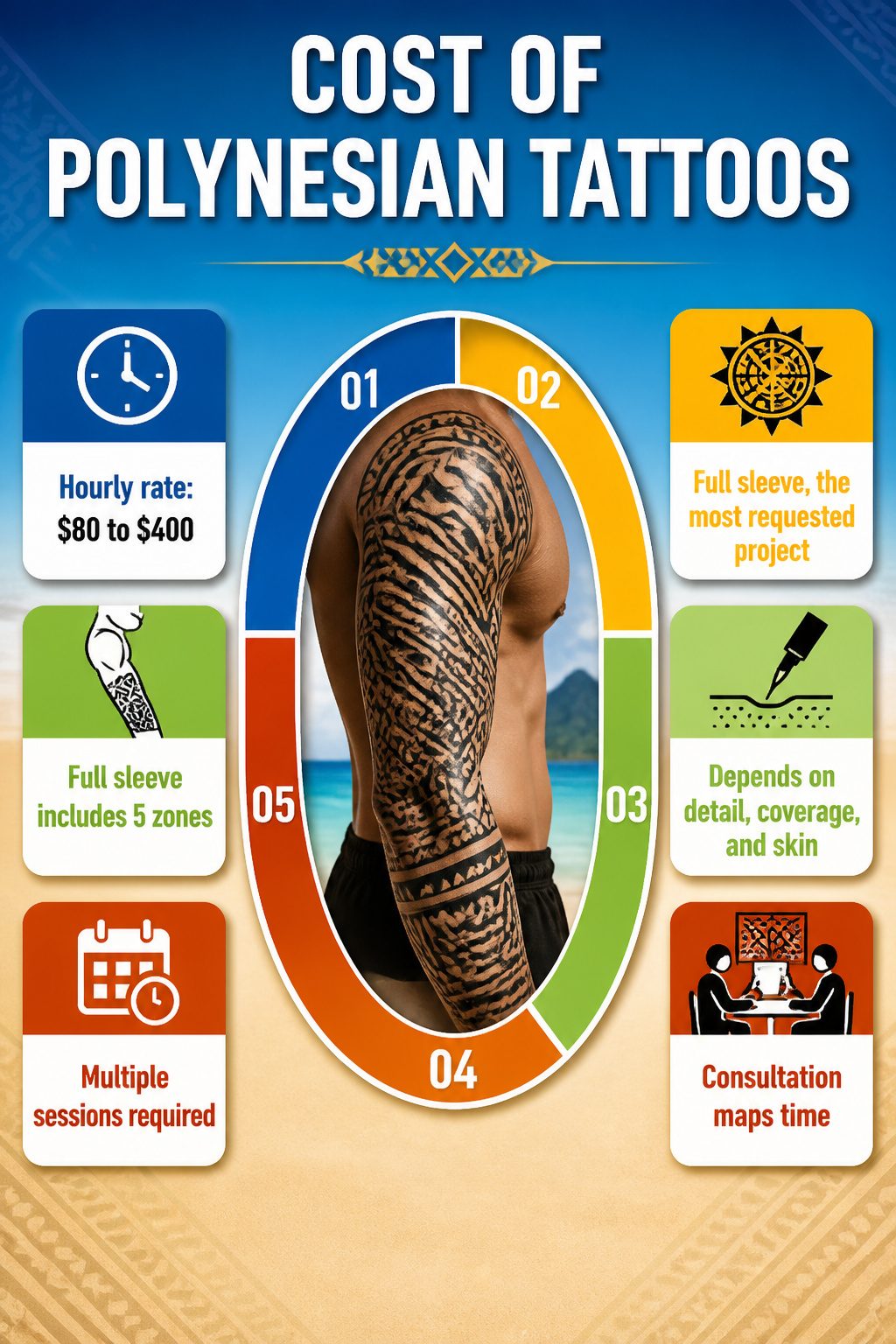
Hourly rates for Polynesian tattoos run $80 to $400, with the artist’s years of work setting the bracket. A full sleeve, the most requested project in this style, wraps shoulder to wrist as one flowing composition built from interlocking motifs. The arm gets divided into five zones, each carrying its own motif role inside the overall flow, which is why the piece reads as coherent rather than a stack of separate tattoos.
The total hours depend on design detail, coverage, and how your skin takes the needle. Most sleeves need multiple sessions scheduled across weeks or months to let healing happen between passes. During consultation, the artist maps estimated tattoo time, any separate design work, and how the sessions break down.
Respect and Appropriation
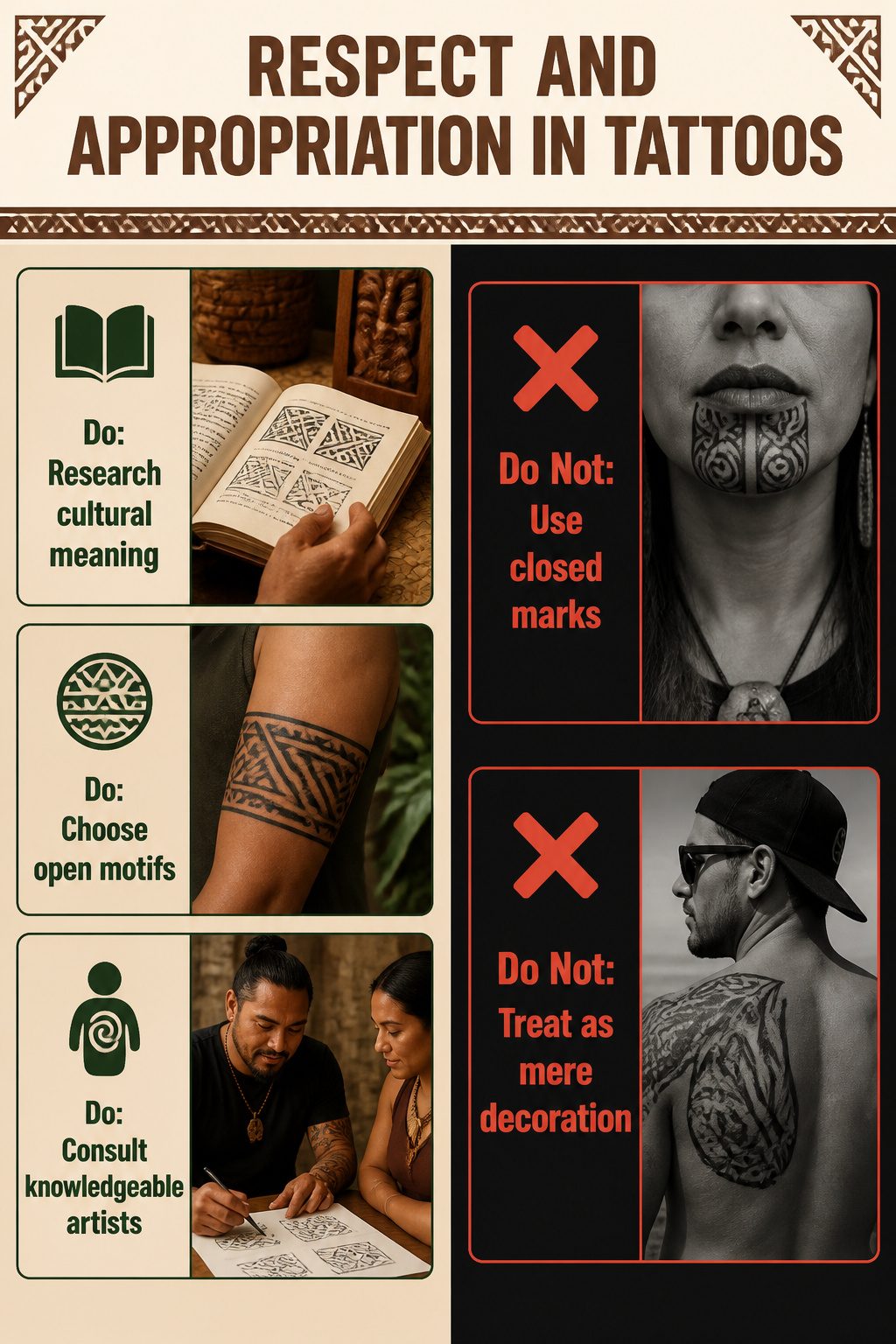
Polynesian tattoos carry weight that flash art simply does not. The full Samoan pe’a, the female malu, the Māori facial moko, and specific Hawaiian lineage marks remain closed to anyone outside their proper cultural context. Other motifs stay intentionally open, the geometric grammar of the Marquesas and Tahiti available for custom work that maps your own story onto Polynesian visual language rather than wearing someone else’s identity as costume.
Research before you sit in the chair. Understanding what a symbol represents separates meaningful composition from appropriation. The same hand-tapped techniques seeing revival within Polynesian communities for ancestral pride are also drawing non-Polynesians who value authenticity over convenience. This resurgence makes the artist’s background more consequential than their hourly rate. A practitioner who can name each motif’s region of origin and documented meaning, who will redirect requests for closed marks toward open alternatives that carry equivalent significance, proves worth more than the discount shop skipping those questions entirely.
Frequently Asked Questions
What is a Polynesian tattoo?
A Polynesian tattoo is a structured composition of geometric motifs from the Polynesian Triangle, including Samoa, Hawaiʻi, Tonga, the Marquesas, Tahiti, and Aotearoa (Māori). These designs are built from symbols like shark teeth, enata figures, ocean waves, and tiki guardians, each carrying specific meaning tied to genealogy, protection, and personal story. Language, protocol, and meaning vary by island culture, lineage, and practitioner.
Do Polynesian tattoos have meaning?
Yes, and the meaning operates at multiple levels. The motifs themselves carry specific significance, like shark teeth for protection and strength, or enata figures for lineage and identity. Placement on the body adds another layer: upper body tattoos connect to spirituality, lower body to earth and physical strength, the back faces the past, and the front faces the future. Historically, these tattoos functioned as identification, tracking social rank and life milestones without written records.
How much does a Polynesian tattoo cost?
Hourly rates run from $80 to $400, set by the artist’s experience and years of work. A full sleeve, the most common request, needs multiple sessions across weeks or months to allow healing between passes. The total cost depends on design detail, coverage area, and how your skin takes the needle. Your artist maps the estimated time and session breakdown during consultation.
How long does a Polynesian sleeve take?
A Polynesian sleeve requires multiple sessions scheduled across weeks or months, with healing time between each pass. The arm gets divided into five zones, each assigned its own motif role, so the piece reads as one flowing composition rather than stacked separate tattoos. Total hours depend on design detail, coverage, and how your skin holds the ink. Your artist estimates this during consultation and breaks the work into scheduled sessions.